Tag: Wings of Change

  • The Unraveling of the New Deal, FDR’s Vision, Part 4

    The Unraveling of the New Deal, FDR’s Vision, Part 4

    If Roosevelt had lived what was his vision for the country and for the world?

    The Unraveling of the New Deal, FDR’s Vision, Part 4

    By Sue Ann Martinson / Wings of Change / June 30, 2025

    FDR: The Four Freedoms

    FDR, besides the New Deal, left this legacy of a New Bill of Rights as well. He had been elected for a fourth term and these were his promises. What America would be like now if he had been able to carry them out we can only speculate. But certainly as a nation we would not have been in the autocratic state we in now and people would have been more secure economically and with the comfort of being who the are without outside definitions created by others that are derogatory.

    Having corporate overmasters is unconstitutional and yet another way to deconstruct a democracy that is “of the people, for the people and by the people.” Idealistic? Yes. But FDR more than any other president attempted to make a people’s government.

    THE FOUR FREEDOMS (FDR)Engraving of the Four Freedoms at the Franklin Delano Roosevelt Memorial in Washington, D.C.

    National and International Intentions After the War

    On January 6, 1941 ─ after the invasion of Poland in 1939 when England declared war on Germany ─ FDR was focusing on the state of the world. He gave a State of the Union address in which he named the Four Freedoms for the world. In this speech he addressed the need to achieve world peace and peace for America.

    This speech is 80 years to the day when on January 6, 2021, the United States Capitol in Washington, D.C., was attacked by a mob of supporters of President Donald Trump in an attempted self-coup, two months after his defeat in the 2020 presidential election.

    The Four Freedoms:

    Equality of opportunity for youth and for others:

    • Jobs for those who can work.
    • Security for those who need it
    •  The ending of special privilege for the few
    • The preservation of civil liberties for all.

    Many subjects connected with our social economy call for immediate improvement. As examples:

    We should bring more citizens under the coverage of old-age pensions and unemployment insurance.

    We should widen the opportunities for adequate medical care.

    We should plan a better system by which persons deserving or needing gainful employment may obtain it.

    FDR also outlined U.S. foreign policy at that time:

    Just as our national policy in internal affairs has been based upon a decent respect for the rights and the dignity of all our fellow men within our gates, so our national policy in foreign affairs has been based on a decent respect for the rights and dignity of all nations, large and small. And the justice of morality must and will win in the end.

    Our national policy is this:

    First, by an impressive expression of the public will and without regard to partisanship, we are committed to all-inclusive national defense.

    Second, by an impressive expression of the public will and without regard to partisanship, we are committed to full support of all those resolute peoples, everywhere, who are resisting aggression and are thereby keeping war away from our Hemisphere. By this support, we express our determination that the democratic cause shall prevail; and we strengthen the defense and the security of our own nation.

    Third, by an impressive expression of the public will and without regard to partisanship, we are committed to the proposition that principles of morality and considerations for our own security will never permit us to acquiesce in a peace dictated by aggressors and sponsored by appeasers. We know that enduring peace cannot be bought at the cost of other people’s freedom.

    In the recent national election there was no substantial difference between the two great parties in respect to that national policy. No issue was fought out on this line before the American electorate. Today it is abundantly evident that American citizens everywhere are demanding and supporting speedy and complete action in recognition of obvious danger.

    No realistic American can expect from a dictator’s peace international generosity, or return of true independence, or world disarmament, or freedom of expression, or freedom of religion ─ or even good business.

    Such a peace would bring no security for us or for our neighbors. “Those, who would give up essential liberty to purchase a little temporary safety, deserve neither liberty nor safety.”

    As a nation, we may take pride in the fact that we are softhearted; but we cannot afford to be soft-headed.

    In a later State of the Union speech on January 11, 1944, FDR explained his vision of a New Bill of Rights:

    FDR’s New Deal and his “Four Freedoms” speech outlined a broader “New Bill of Rights” that included economic security, a concept distinct from the traditional Bill of Rights which focused on individual liberties. The “New Bill of Rights” encompassed the right to a job, adequate living standards, healthcare, education, and protection from economic hardship, as outlined in FDR’s “Second Bill of Rights.”

    The Four Freedoms are the foundation for the Universal Declaration of Human Rights that was adopted by the United Nations on December 10, 1948. After the death of FDR Eleanor carried the torch forward as chair of the UN Commission on Human Rights that created the document.

    Although the war was not yet over, in his State of the Union address on January 11, 1944 FDR, planning ahead for the war-end, reiterated a commitment to a New Bill of Rights for the American people.

    FDR Fireside Chat, State of the Nation, June 11, 2044

    On June 11, 1944 FDR repeated the full text of the speech in one of his Fireside Chats for the nation to hear.

    Henry David Thoreau
    On the Duty of Civil Disobedience

    Perhaps FDR had been reading Thoreau’s essay on civil disobedience that calls for an even more perfect Union in the United States than existed in the Constitution. Thoreau said:

    The authority of government, even such as I am willing to submit to— for I will cheerfully obey those who know and can do better than I, and in many things even those who neither know nor can do so well— is still an impure one: to be strictly just, it must have the sanction and consent of the governed. It can have no pure right over my person and property but what I concede to it.

    The progress from an absolute to a limited monarchy, from a limited monarchy to a democracy, is a progress toward a true respect for the individual…. Is a democracy, such as we know it, the last improvement possible in government?

    Thoreau goes on to say:

    Is it not possible to take a step further towards recognizing and organizing the rights of man? There will never be a really free and enlightened State, until the State comes to recognize the individual as a higher and independent power, from which all its own power and authority are derived, and treats him accordingly.

    I please myself with imagining a State at last which can afford to be just to all men, and to treat the individual with respect as a neighbor; which even would not think it inconsistent with its own repose, if a few were to live aloof from it, not meddling with it, nor embraced by it, who fulfilled all the duties of neighbors and fellow-men.

    First Thoreau is taking about himself as a good neighbor. We tend to think of neighborhoods as small units. But what if it were another country? What if all countries considered themselves a good neighbor to the countries next to them? He goes from the microcosm to the macrocosm. That interpretation seems to fit with FDR’s idea of the Four Freedoms as he expresses it in relation to Russia and Great Britain, remembering that settler colonialism was still prevalent and Western European countries held empires, including the British Empire, which  was dominant.

    Here is how Thoreau concludes:

    A State which bore this kind of fruit, and suffered it to drop off as fast as it ripened, would prepare the way for a still more perfect and glorious State, which also I have imagined, but not yet anywhere seen.

    State of the Union, January 11, 1944

    “Necessitous men are not free men.” People who are hungry and out of a job are the stuff of which dictatorships are made.

    FDR, in the January 11, 1944, State of the Union Speech addressed his vision for a second Bill of Rights and explains that these rights are true security and that “The best interests of each Nation, large and small, demand that all freedom-loving Nations shall join together in a just and durable system of peace.”

    It is our duty now to begin to lay the plans and determine the strategy for the winning of a lasting peace and the establishment of an American standard of living higher than ever before known. We cannot be content, no matter how high that general standard of living may be, if some fraction of our people—whether it be one-third or one-fifth or one-tenth- is ill-fed, ill-clothed, ill housed, and insecure..

    This Republic had its beginning, and grew to its present strength, under the protection of certain inalienable political rights—among them the right of free speech, free press, free worship, trial by jury, freedom from unreasonable searches and seizures. They were our rights to life and liberty.

    As our Nation has grown in size and stature, however—as our industrial economy expanded—these political rights proved inadequate to assure us equality in the pursuit of happiness.

    We have come to a clear realization of the fact that true individual freedom cannot exist without economic security and independence. “Necessitous men are not free men.” People who are hungry and out of a job are the stuff of which dictatorships are made.

    In our day these economic truths have become accepted as self-evident. We have accepted, so to speak, a second Bill of Rights under which a new basis of security and prosperity can be established for all regardless of station, race, or creed.

    Among these are:

    The right to a useful and remunerative job in the industries or shops or farms or mines of the Nation;

    The right to earn enough to provide adequate food and clothing and recreation;

    The right of every farmer to raise and sell his products at a return which will give him and his family a decent living;

    The right of every businessman, large and small, to trade in an atmosphere of freedom from unfair competition and domination by monopolies at home or abroad;

    The right of every family to a decent home;

    The right to adequate medical care and the opportunity to achieve and enjoy good health;

    The right to adequate protection from the economic fears of old age, sickness, accident, and unemployment;

    The right to a good education.

    All of these rights spell security. And after this war is won we must be prepared to move forward, in the implementation of these rights, to new goals of human happiness and well-being.

    America’s own rightful place in the world depends in large part upon how fully these and similar rights have been carried into practice for our citizens. For unless there is security here at home there cannot be lasting peace in the world.

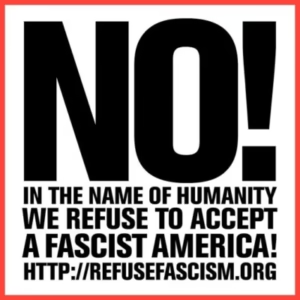
    NO FASCISM

    One of the great American industrialists of our day, a man who has rendered yeoman service to his country in this crisis-recently emphasized the grave dangers of “rightist reaction” in this Nation. All clear-thinking businessmen share his concern. Indeed, if such reaction should develop—if history were to repeat itself and we were to return to the so-called “normalcy” of the 1920’s—then it is certain that even though we shall have conquered our enemies on the battlefields abroad, we shall have yielded to the spirit of Fascism here at home.

    I ask the Congress to explore the means for implementing this economic bill of rights for it is definitely the responsibility of the Congress so to do. 

    Flash Forward
    Los Angeles (LA) June 2025

    From the Brennan Foundation: A panel discussion re the sending in the military to LA. Is it legal? What are the ramifications for the future?

    The deployment of Marines and federalized National Guard members to police protests in Los Angeles poses a serious threat to American democracy. The president’s memorandum appears to preemptively allow the deployment of federal forces anywhere there are protests against immigration raids nationwide, regardless of whether or not they are peaceful. This broad authorization suggests that the troop deployments go beyond protecting federal property or law enforcement — they are about suppressing disagreement against the government.
    — Elizabeth Goitein in a Just Security expert panel discussion.

    Note FDR words above:

    …the grave dangers of “rightist reaction” in this Nation.

    …we shall have yielded to the spirit of Fascism here at home.

    AND NOW…PROJECT 2025

    Yet now Congress has fallen under thrall to that “rightist reaction” under the influence of those forces of fascism daily are that being forced upon us that is the opposite of “a new basis of security and prosperity can be established for all regardless of station, race, or creed.” Instead social welfare programs that support that vision are being slashed with support for money for corporate needs growing and for the military while the rest of the citizenry is ignored, funds for social programs decimated. Thousands have lost their jobs, their retirement savings, even their homes while the New Bill of Rights is decimated. Education, a core of democracy, is being defunded.

    Yet FDR is very clear: these are the rights worldwide that bring true security, not the building up of the military:

    In the plain down-to-earth talks that I had with the Generalissimo Chiang Kai Chek and Marshal Stalin and Prime Minister Churchill, it was abundantly clear that they are all most deeply interested in the resumption of peaceful progress by their own peoples—progress toward a better life. All our allies want freedom to develop their lands and resources, to build up industry, to increase education and individual opportunity, and to raise standards of living.

    All our allies have learned by bitter experience that real development will not be possible if they are to be diverted from their purpose by repeated wars—or even threats of war.

    Those leaders of primary world powers are now dead and the lessons learned from WWI and WWII have faded from consciousness. Endless War prevails. The monies taken from the social programs is instead to be used to increase the military might of America with Trump’s proposed Golden Dome, similar to the Iron Dome in Israel only four times larger to somehow protect the whole of the United States. But did the Iron Dome protect Israel from attack by Hamas?

    Instead we now have a government that has embraced the “rightest reaction” and taken much of the nation with it through propaganda and lies. Our so-called president (not my president) becomes more autocratic every day. He blatantly declares his racism by word and deed. He is as he has always been basically a misogynist. The women he has appointed to positions are women who just do what they are told, yes-women. He openly flaunts the Constitution and tries to silence anyone who attempts to defy him. He calls himself a king. He allows his “flock” of fundamentalists to worship him as if he were divine. The “divine right of kings.” That went out in the Middle Ages.

    “The law stands high above the king.” Magna Carta, 1215

    The lords of England issued a writ that they would no longer be subservient to the king. The “divine right of kings” absolute authority was challenged. It included the right to a speedy trial, now known as habeas corpus.

    A wise person once observed that it takes the support of the middle class for a revolution to succeed. Although it was the nobility of England who rebelled, they were in the middle, as the king with his divine right was above them and the peasants below them..

    The Magna Carta still forms an important symbol of liberty today, often cited by politicians and campaigners, and is held in great respect by the British and American legal communities, Lord Denning describing it in 1956 as “the greatest constitutional document of all times—the foundation of the freedom of the individual against the arbitrary authority of the despot.”

    Back to the Law

    U.S. judges, have often, if not consistently, challenged Trump’s edicts, that is, executive orders, as being unconstitutional or breaking established laws. Trump has attempted to go after them of course, but different judges keep cropping up to challenge his often anti-Constitutional and law-breaking declarations. So far the idea of law above the king is functioning, resembling some semblance of law and order, not with guns, but with THE LAW as judges nationwide intervene against many of Trump’s edicts as unconstitutional or otherwise illegal. Most recent as I write this is a judge ruling the release of Mahmoud Khalil, the student from Columbia arrested for his pro-Palestinian activities although he has a green card and is married to a U.S. citizen.

    Flash Forward, June 27, 2025

    To stop the lower courts from challenging his unconstitutional executive orders Trump and his pro-fascist cohorts has had their allies in the U.S. Supreme Court state that the lower courts can no longer challenge Trump’s executive orders that undermine the Constitution although it will not go into effect immediately. As reported in Reuters, “The ruling also did not address the legality of the policy, part of Trump’s hardline approach toward immigration.”

    Relevant Diversion

    The U.S. system of law, while it was heavily influenced by French philosophers of the Enlightenment, is still based on English common law. The most predominant French influencers were Locke, Montesquieu, and Rousseau. But in turn Locke and Montesquieu were heavily influenced by English law in their contributions to the structure of the Constitution and the shaping of the U.S. government as it still stands today.

    Rousseau’s primary contribution was the idea of laws created directly by the vote of the people. He also introduced the idea of “neighborhoods,” an idea that Thoreau elaborated on in his essay on civil disobedience. The idea of neighborhoods still exists in many cities, including Minneapolis which is divided into neighborhoods that have governing bodies that create and manage programs that deal with neighborhood-specific issues.

    Locke believed in what he called a social contract and influenced Thomas Jefferson’s writing of the Declaration of Independence. Locke favored a representative government. Montesquieu advocated for the separation of powers.

    One more influence on the creating of the Constitution was Native American, including The Great Law of Peace

    Flash Forward, June 30, 2025

    The ‘Big Beautiful’ Budget Bill

    The Senate is debating the “Big Beautiful Bill” that further destroys the Pillars of Democracy and Violates FDR’s Four Freedoms.

    If I remember my civics class correctly (that was ninth grade ─ do they teach it anymore?) the executive, legislative, and judicial sections of government were meant to balance each other. The legislative branch today is often impotent on many issues, controlled by Trump’s and the GOP’s yes-men and women. As noted, by one vote on May 22, 2025, the House passed the “Big Ugly Budget” that steals money from the people of the United States.

    These cuts, if they are allowed, will cause significantly more struggling to survive for millions of Americans. In some cases they will cause preventable deaths because of the cuts to Medicare and Medicaid. In the case of Social Security, cuts that are a lifeline for many Americans could be seriously cut down.

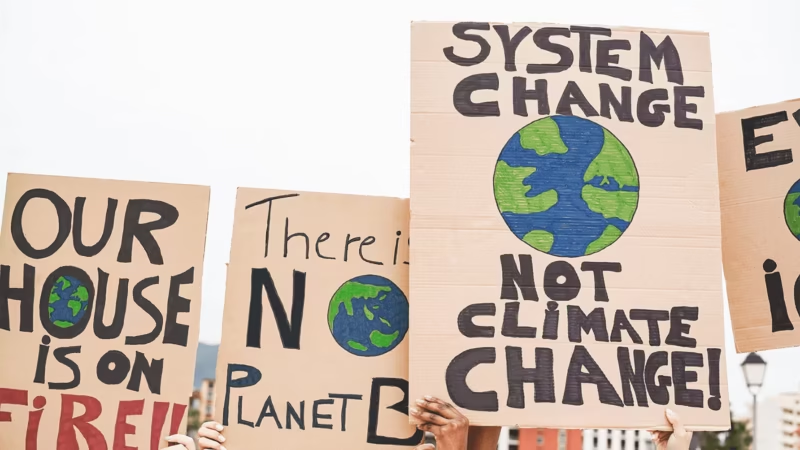
    But not for corporate America: They are being pampered with money for investments and new laws are allowing them to develop fossil fuel that will further pollute the planet and hasten the global crisis. (There is no Planet B!)

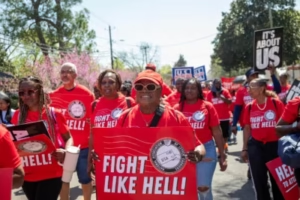
    Will the Senate show any backbone in accepting this Big Ugly Budget or not? That is not hopeful as they are controlled by the GOP. Sad, but true. That is the real fraud against the American people. We cannot go back (MAGA), even if we wanted to, and millions of us do not want to, as evidenced by the Hands Off and No Kings demonstrations. Many of us joined in the demonstrations not because we are Democrats (or Republicans either), but because we are antiwar and anti-genocide in Gaza because of its obvious inhumanity. We are also opposed to the illegal DOGE actions by Elon Musk and approved by Trump after creating DOGE as a government department by a presidential executive order not approved by Congress.

    Elon Musk has left of DOGE and has actually criticized Trump’s platform and fascistic plans. In part this may be because the sales of his Tesla have greatly decreased, although it is only one way he makes money. He has been pilloried for the cuts he is responsible for, including USAid which affects millions worldwide.

    Most members of Congress are supporters of Israel. Because so many of us  support Palestine and are adamantly opposed the the genocide being perpetrated by Israel on Palestine, we are accused of being supporters of Hamas. We are what we say we are: antiwar and pro-Palestine. Having been involved in support of Palestine in educational programs and demonstrations, I can honestly say that we do not support Hamas per se. It has not come up in 20 years of pro-Palestine activities, not even since October 7, 2023. No chants I know of glorify or support Hamas.

    Those who have worked on Middle East issues for 20 years or more such as  Boycott, Divestment and Sanctions (BDS) and the WAMM Middle East Committee see Hamas as part of the very complicated geopolitics in the Middle East. What is not complicated is that genocide is a crime against humanity and no amount of Israel’s denial, even with the support of the U.S., can change the moral outrage at the wholesale death of a people. That was also true of the Holocaust, of course, but what Israel has become in its zealous Zionism backed by the U.S. is NOW, not then.

    What About Now?

    Shame hangs over the U.S. like a shroud.

    As I write this the Senate is still deliberating about the Big ‘Beautiful’ Budget Bill and has not yet voted. Once they do settle on a version it has to go back to the House where members may wish to make changes. A final version of the bill may still take some time to be decided.

    PILLARS OF DEMOCRACY
    Trump, Congress, and the Supreme Court and 2025 supporters attack the Pillars of Democracy

    Trump’s ravaging of the Constitution and American values in the Constitution and as they have developed in Constitutional additions over the years is a denial and attempt to crush democracy. These additions have become laws, such as the right of people of color to vote, of women to vote, laws against child labor, and union rights like collective bargaining. Many became law over the years of our existence since 1787 when the U.S. Constitution went into effect after being approved by the individual states. Some of these laws were created under the influence of socialism, such as the eight-hour work day, social security, the minimum wage, better working conditions, rights and healthcare for veterans, even Obama’s more recent healthcare law, and more. It’s how a democracy works.

    These amendments to the Constitution and these laws have also improved our democracy over the years.

    FIGHT HATE

    These additions and changes did not happen automatically but were fought for with much sacrifice by many Americans of all races, colors, and religions. Not the least are the laws against discrimination based on race, color, national origin, religion, age, gender, disabilities, etc., in the Civil Rights Act of 1964 and related legislation.

    MAGA is an unachievable myth, at least the way Trump and project 2025 define it. The U.S. Empire is losing hold, as all empires in the history of the world do. We can dance out gracefully and still be who our best selves are.

    We can choose to be what and who we would like to be in our most positive forms, created by the original Constitution and by the laws and Constitutional amendments added over the years of our country’s existence that were chosen by the people, not by corporate rule or some ruling elite that consider themselves superior; but they are not. Many Americans who came from poor circumstances have distinguished themselves in their areas of expertise while many of the “elite” have been lackluster or incompetent, as evidenced by many current public officials. On the other side are those who still have moral fiber and refuse to go along with the destruction of democracy that the Trump administration is engaged in. They include but are not limited to the current Supreme Court judges who wrote the dissenting opinions regarding Trump’s most recent efforts as he and his cohorts continue to attack democracy.

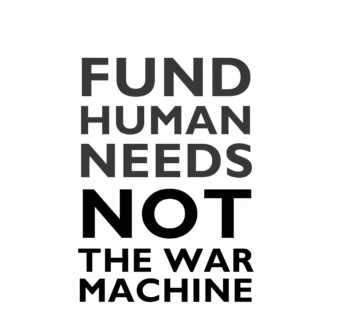
    We can become an utter failure as a people and as a nation, or we can protest and actively fight for our rights against legislation like the Big Beautiful Budget that is really a Big Ugly Budget that does the opposite of what we strive for in equality, that is, it robs from the poor and gives to the rich. We can protest the obscene build-up of the military and the constant endless wars that support the oil industry and the war industry machine. We can continue to protest and fight the corporate entities that defile our planet with pollution and cause death in other parts of the world and in ours unusually severe weather patterns of storms, tornados, hurricanes. Our planet as a living organism strives to survive our mistreatment and desperately continues to need our help, which we can continue to offer in as many ways possible.

    In spite of the shameful actions of our collective governments, that is, both Republicans and Democrats, we can especially protest in regard to what is clearly a genocide in Gaza/Palestine and a weaponization of anti-Semitism that is an insult to the ancient religion of Judaism and to those who died and those who survived the Holocaust. We can protest and actively defy the recent executive orders and autocracy of our current president and those he represents in cruel and anti-democratic actions that lean into fascism. Instead we can support those values that reflect our better selves in the Constitution. the amendments to the Constitution, and the laws created around equal rights and civil liberties that support those American democratic values.

    Which is it going to be?


    Related:

    US supreme court limits federal judges’ power to block Trump orders  Ruling to limit nationwide injunctions could see president’s order to ban birthright citizenship partially implemented.  in Washington and  / The Guardian / June 27, 2025

    Liberal supreme court justices’ dissents reveal concerns that the US faces a crisis — As the supreme court upends precedent again and again, the liberal justices reveal the divisions within the legal body. / The Guardian / June 27, 2025

    The mainstream media has enabled Trump’s war on universities — For the past decade, the US press has fueled a moral panic over leftists on campus while failing to report on the right’s assault.  / The Guardian / Fri 13 Jun 2025 10.00 EDT

    Supreme Court Explained with Second Amendment Example
    Jack Jones


    In these most perilous times support independent media. Wings of Change gets no funding except from our readers.

    Wings of Change FeatherOh, sacred world
    now wounded,
    we pledge to make you free,
    of hate, of war,
    and selfish cruelty,
    and here in our small corner
    we plant a tiny seed,
    and it will grow to beauty
    to shame the face of
    greed

    Pete Seeger 


  • War on Iran Is Part of US Plan for Global Domination: Economist Michael Hudson Explains

    War on Iran Is Part of US Plan for Global Domination: Economist Michael Hudson Explains

    What does Washington want to get out of its never-ending political and economic war on Iran?

    War on Iran Is Part of US Plan for Global Domination: Economist Michael Hudson Explains

    War on Iran is part of the US empire’s larger attempt to re-impose its unipolar dominance on the global political and financial system, argues economist Michael Hudson.

    Washington wants to preserve dollar hegemony and the petrodollar, while disrupting BRICS and Eurasian integration with China and Russia.

    Hudson explained this in the following interview with Geopolitical Economy Report editor Ben Norton.

    You can read Michael Hudson’s article here: War on Iran is fight for US unipolar control of world.

    Transcript

    Introduction

    BEN NORTON: Why is the United States so concerned about Iran?

    US President Donald Trump admitted that what Washington wants is regime change in Tehran, to overthrow the Iranian government.

    Trump backed a war on Iran in June, in which both the US and Israel directly bombed Iranian territory.

    Trump claimed that he brokered a ceasefire after what he calls the 12-Day War that the US and Israel waged against Iran. But it’s very difficult to believe that this ceasefire will hold.

    Especially considering that Trump said the same in January. He claimed to broker a ceasefire in Gaza, but then in March, two months later, Israel started the war again, after Trump had given Israel the green light to violate the ceasefire that he helped to broker.

    So it’s very difficult for Iranian officials to believe that the ceasefire will truly hold. And even if it does hold in the short term, the reality is that the US government has been waging a kind of political war and an economic war against Iran for many decades, going back to 1953, when the US carried out a coup that overthrew Iran’s democratically elected Prime Minister Mohammad Mosaddegh and installed a pro-US dictator, Shah Mohammad Reza Pahlavi.

    So why is this? What does Washington want to get out of its never-ending political and economic war on Iran?

    To try to answer this question, I interviewed the renowned economist Michael Hudson, who has written many books and is an expert on global political economy.

    Michael Hudson published an article in which he outlines the economic and political reasons for this war on Iran, and he posits that this is part of the attempt by the US empire to impose a unipolar order on the world, like we saw in the 1990s, when the US was the only superpower and it could impose its political and economic will on almost all countries on Earth.

    Iran was one of the very few countries that was actually resisting US unipolar hegemony. And today we see, as the world is more and more multipolar, Iran plays an important role as a BRICS member, and as a supporter of resistance groups.

    Iran is pushing for a more multipolar world, in opposition to the US empire’s unipolarity, as the economist Michael Hudson describes in this essay.

    Hudson wrote:

    What is at stake is the US attempt to control the Middle East and its oil as a buttress of US economic power, and to prevent other countries from moving to create their own autonomy from the US-centered neoliberal order administered by the IMF, World Bank, and other institutions to reinforce US unipolar power.

    In our discussion today, Michael connects all of the different factors involved in this conflict, including the oil and gas and other resources in West Asia (in the so-called Middle East); including the role of the US dollar and the petrodollar system; and how Iran, as a member of BRICS, and many other Global South countries, are de-dollarizing and seeking alternatives to the dollar.

    We also talk about the geopolitics of the region, the trade routes and interconnectivity among China, Iran, and Russia, as part of a project of Eurasian integration; we talk about the geopolitical goals of the US and Israel; and much, much more.

    Here is an excerpt of our conversation, and then we’ll go straight to the interview:

    MICHAEL HUDSON: What we have seen in the last month — or I should say the last two years actually — is the culmination of the long strategy that America has had ever since World War II, to take complete control of the Near Eastern oil lands and make them proxies of the United States, under client rulers, such as Saudi Arabia and the king of Jordan.

    Iran represents a military threat to Russia’s southern border, because if the United States could put a client regime in Iran, or break up Iran into ethnic groups who would be able to interfere with Russia’s corridor of trade southwards, into access to the Indian Ocean, well, then you have boxed in Russia, you have boxed in China, and you have managed to isolate them.

    That is the current American foreign policy. If you can isolate countries that do not want to be part of the American international financial and trade system, then the belief is that they cannot exist by themselves; they are too small.

    America is still living back in the epoch of the 1955 Bandung Conference of Non-Aligned nations in Indonesia. When other countries wanted to go alone, they were too economically small.

    But today, for the first time in modern history, you have the option of Eurasia, of Russia, China, Iran, and all of the neighboring countries in between. For the first time, they are large enough that they do not need trade and investment with the United States.

    In fact, while the United States and its NATO allies in Europe are shrinking — they are de-industrialized, neoliberal, post-industrial economies — most of the growth in world production, manufacturing, and trade has occurred in China, along with the control of the raw materials refining, such as rare earths, but also cobalt, even aluminum, and many other materials in China.

    So America’s strategic attempt to isolate Russia, China, and any of their allies in BRICS or the Shanghai Cooperation Organization ends up isolating itself. It is forcing other countries to make a choice.

    That is the only thing that America has to offer other countries in today’s world. It can’t offer them exports. It can’t offer them monetary stability.

    The only thing that America has to offer the world is to refrain from destroying their economy and causing economic chaos, such as Trump has threatened to do with his tariffs, and what he has threatened to do to any country trying to create an alternative to the dollar.

    Hence this free lunch, where other countries can earn dollars, but they have to re-lend them to the United States. And the United States, as their banker, has to hold it all, and the banker may just decide whom to pay and whom not to pay.

    It’s a gangster. It has been called a gangster state, for just such reasons. And other countries are afraid of what the United States can do, not only under Donald Trump, but what it has been doing for the last 50 years. It is simply confiscating, and destabilizing, and overthrowing.

    America has basically declared war against any attempt to create an international trade and investment system that the United States does not control, in its own self-interest, wanting all of the earnings from it, all of the revenue from it, not just part of it. It’s a greedy empire.


    Interview

    BEN NORTON: Michael, thanks for joining me. It’s always a real pleasure having you.

    Let’s talk about this article you wrote, in which you argue that the war on Iran is part of an attempt by the United States to impose its unipolar hegemony on the world.

    We see that we’re living in more and more of a multipolar world, and Iran has played an important part of the multipolar project as a member of BRICS, as a member of the Shanghai Cooperation Organization, as a partner of China and Russia. Iran has also been pushing for de-dollarization of the global financial system.

    Talk about how you see the war on Iran — which didn’t start under Donald Trump, this goes back many years — and how you see it in particular as an economist.

    MICHAEL HUDSON: Well, the war on Iran started in 1953, when the United States and MI6 overthrew the elected Prime Minister [Mohammad Mosaddegh], and the reason he was overthrown was because he wanted to nationalize the oil reserves of Iran. The United States has always viewed Iran as part of the Near Eastern oil Gulf.

    American foreign policy, in terms of weaponizing its foreign trade, has always been based on two commodities: food grains — the ability to stop exporting food to countries that oppose US policy, as the United States stopped exporting grain to China under Mao — and oil.

    For a century, the United States has focused on control of the oil as the basis of its international trade balance — it’s the largest contributor to the trade balance — and of its ability to sanction the rest of the world, by turning off the oil supply, and thereby turning off the electricity, turning off the gas, turning off the home heating, of countries that break away from US policy.

    When I worked for the Hudson Institute in the early 1970s, Herman Kahn brought me to a meeting with some generals, and they were discussing what to do with Iran in case, under the shah, Iran should ever once again try to assert its autonomy and go its own way.

    Iran has always been the strongest power in the entire Near East, and the capstone to controlling the Near East. You cannot fully control the Near Eastern oil — Syria, Iraq, the rest of the countries there — without controlling Iran too, because of the size of its population and the strength of its economy.

    It was a very interesting meeting. Herman Kahn, the model for Dr. Strangelove, discussed how to break up Iran into its various ethnicities, five or six ethnicities, in the case that it should, take a policy independent from the United States.

    The United States’ concern already in the 1970s, 50 years ago, was, “What do we do if other countries do not follow the kind of international world order that we are, organizing?”

    Herman said that he thought the crisis point that was going to break up in international news was going to be Balochistan, at Iran’s border with Pakistan. The Balochis are a distinct population, just as the Azerbaijanis, Azeris, the Kurds.

    Iran is a composite of many ethnic groups, including a very large Jewish group there. It is a multi-ethnic society, and the United States’ strategy, in case there was a war against Iran, was to play on these ethnicities — just as similar plans were drawn up for Russia, how to break it into separate ethnic parts; and China, how to break China into ethnic parts, at such point as America wants to take them on.

    And the reason this ethnic division was developed was, as a democracy, especially in the 1970s, it became very apparent that the United States never again could field an army for invasion, as it was doing in Vietnam.

    At the time I sat in on this meeting, late 1974 I think, or early ’75, there were demonstrations. It was obvious that there could never be a military draft again.

    How was the United States to exert its international power without military power? It had military bases all over the world; it spent more on military than any other country.

    The entire US balance of payments deficit was military spending abroad, and yet it couldn’t go to war. It had to use proxies.

    This was the time when, in addition to the discussions that I sat in on how to use ethnicities in countries that we declared war on, as opponents; America decided to create the largest military base in the Near East, and that was Israel.

    Henry Jackson, the pro-war, Military-Industrial Complex’s senator, met with Herman Kahn — I actually was in Herman’s office, listening to the phone call, when it came through — and the agreement was that the Military-Industrial Complex and Jackson would back Israel, if Israel agreed to act as America’s landed aircraft carrier in the Near East, as it was put at the time.

    Herman very gladly made that arrangement, because the Hudson Institute at that time was a Zionist organization, and it was a training ground for Mossad.

    One of my colleagues was Uzi Arad. We made a number of trips together to Asia. And Uzi became Netanyahu’s advisor and head of Mossad in subsequent years.

    So I sort of sat in at the time when the American strategy was being outlined.

    Israel was going to be America’s face, and indeed has been coordinating America’s backing of Al-Qaeda and the Wahhabi butchers who have taken over Syria, and are now busy killing the Christians, killing the Shiites, killing the Alawites.

    And you will never see any criticism of Israel by Al-Qaeda, or the group [Hayat Tahrir al-Sham (HTS)] in Syria, whatever you want to call it there now. And vice versa, there has always been a working relationship.

    So this gives some background as to how long the United States has anticipated the day when it would try to finally capstone its invasion of Iraq, its attack on Syria, its destruction of Libya, its backing of the destruction of Lebanon, and other countries, in North Africa, etc.

    What we have seen in the last month — or I should say the last two years actually — is the culmination of the long strategy that America has had ever since World War II, to take complete control of the Near Eastern oil lands and make them proxies of the United States, under client rulers, such as Saudi Arabia and the king of Jordan.

    Geopolitics and global trade

    BEN NORTON: You raised so many interesting points, Michael. I want focus on two main issues here: one is the geopolitics of Iran’s integration with Eurasia, and the other is oil and the petrodollar system.

    I will start with the geopolitics. Of course, when we talk about the petrodollar, we should keep in mind that Iran has been selling its oil and gas in other currencies, and pushing for de-dollarization.

    But before we get to that, I want to talk about the role that Iran has played not only in supporting resistance groups in West Asia, but also in deepening its political and economic partnership with China and Russia, as part of a larger Eurasian partnership.

    There are numerous physical projects integrating these regions.

    Iran is at the heart of China’s New Silk Road. This was originally launched by Chinese President Xi Jinping in 2013, and then it expanded into the Belt and Road Initiative (BRI).

    Iran is an important part in that, connecting East Asia, through Central Asia, through Iran, into West Asia. And the US has really tried to disrupt that.

    Iran also plays an important role in a Russian-led economic corridor that connects from St. Petersburg, through Moscow, down through the Caspian Sea, through Iran, and to India.

    This is known as the International North-South Transport Corridor, the INSTC.

    So we have seen that Iran has played a very important role challenging the US dollar, challenging US hegemony, and also seeking economic and political integration with other countries in Eurasia.

    Can you speak more about this and why these imperial planners in Washington see this as so much of a threat?

    MICHAEL HUDSON: Well, you just summarized the two maps that I included in my article.

    About a month ago, Iran just completed its Belt and Road railroad, that goes all the way to Tehran. For the first time, there is a land corridor from Iran to China.

    Now, the Belt and Road corridor means they’re avoiding going by sea.

    American and British military policy has been based for a hundred years on control of the seas, and control of the oil trade was part of that strategy.

    Because if Iran, Saudi Arabia, Kuwait, and the other oil-producing countries can’t load up tankers with oil, how are they going to be able to export? And how can importers such as China, or India, obtain oil from the Near East?

    Well, with China’s Belt and Road Initiative, its intention was to go all the way through, via Iran, and then proceed on all the way to the Atlantic Ocean, to Europe.

    This Belt and Road was to span the entire Eurasian continent, the entire eastern hemisphere.

    And if the United States could conquer Iran and take it over, that would interfere with China’s long-distance railroad development, and it would block it — just as the United States is hoping to goad India and Pakistan into some kind of fight that would interrupt China’s Belt and Road Initiative that goes through through Pakistan [the China-Pakistan Economic Corridor (CPEC)].

    So, on the one hand, Iran is the key to China’s overland trantransportation to Europe.

    And as you just pointed out, with Russia: Iran represents a military threat to Russia’s southern border, because if the United States could put a client regime in Iran, or break up Iran into ethnic groups who would be able to interfere with Russia’s corridor of trade southwards, into access to the Indian Ocean, well, then you have boxed in Russia, you have boxed in China, and you have managed to isolate them.

    That is the current American foreign policy. If you can isolate countries that do not want to be part of the American international financial and trade system, then the belief is that they cannot exist by themselves; they are too small.

    America is still living back in the epoch of the 1955 Bandung Conference, of Non-Aligned nations, in Indonesia. When other countries wanted to go alone, they were too economically small.

    But today, for the first time in modern history, you have the option of Eurasia, of Russia, China, Iran, and all of the neighboring countries in between. For the first time, they are large enough that they do not need trade and investment with the United States.

    In fact, while the United States and its NATO allies in Europe are shrinking — they are de-industrialized, neoliberal, post-industrial economies — most of the growth in world production, manufacturing, and trade has occurred in China, along with the control of the raw materials refining, such as rare earths, but also cobalt, even aluminum, and many other materials in China.

    So America’s strategic attempt to isolate Russia, China, and any of their allies in BRICS or the Shanghai Cooperation Organization ends up isolating itself. It is forcing other countries to make a choice.

    This was made very clear immediately upon Trump taking the presidency and announcing his tariff policy, saying, “In three months, I’m going to impose such devastatingly high tariffs that you, the Global South countries, the Global Majority countries, your economies will be in chaos without having access to the American market”.

    But, [Trump said], “We have three months to negotiate, and, if you give us a give-back, I will roll back these tariffs to 10%, so that it won’t devastate your economies. And one of the agreements that you have to make is you’ll agree to America’s sanctions not to trade with China, not to invest in China, not to use alternatives to the US dollar”.

    China is trying to avoid using dollars, just as Russia no longer is able to use dollars, because the United States has simply confiscated $300 billion of Russia’s foreign exchange holdings in the West, that it held in Brussels, in order to manage its foreign exchange, to stabilize its exchange rate, which is what central banks do throughout the world.

    Well, it’s very interesting. The Financial Times had a front page article [reporting] that now European countries, especially Germany and Italy, which have the second- and third-largest gold holdings, have asked, “Could you please [give us our gold back]? We have, since World War II, we have left all of our gold supplies at the Federal Reserve in New York”.

    America’s gold is in Fort Knox, but other countries keep their gold reserves in the basement of the Federal Reserve Bank, right across from Chase Manhattan bank in the downtown area.

    And other countries now realize that, under Trump, if he says, “Well, Europe has been really taking advantage of us; they have been exporting more to us than we’ve sold to them” — you know, Italy and Germany are worried that somehow America will say, “Well, we’re just gonna grab all of this gold that you’ve built up by taking advantage of us”.

    So you’re having the rest of the world pull back from the dollar. This reflects the effect of everything that the United States is trying to do to isolate the other parts of the world from contact with the United States, if they try to have an alternative economic system to neoliberal finance capitalism, if they try to have industrial socialism — which is really industrial capitalism on the way to being industrial socialism, with active government investment in basic infrastructure, instead of privatizing the infrastructure Margaret Thatcher style.

    The effect will be to leave the United States isolated, and all the rest of the world going its own way, unable to trade with the United States because of the high tariffs that Trump has imposed, and afraid to trade in dollars because of the predatory weaponization of the dollar standard, which had been America’s free lunch under the whole epoch of US Treasury bill standard, since America went off gold in 1971.

    Oil and the petrodollar

    BEN NORTON: Again, Michael, you raised so many good points there.

    I want to stick with this issue of oil and the US dollar, and the petrodollar system.

    Now, you have mentioned a few times that the US really relies on exports of oil and control of the oil trade, partially to try to reduce its enormous current account deficit — which, I mean, it still is not very successful. The US runs massive current account deficits — that is, trade deficits with the rest of the world.

    But what is something that is different in the 2020s is that the US is now the world’s largest exporter of oil. It’s the largest producer of oil on Earth, and the largest producer of gas.

    So that’s a significant difference. That’s largely a development in the past decade due to the explosion in fracking in the US, and also the shale oil revolution.

    So, it’s not necessarily that the US needs to physically get access to all of the oil in the region.

    Although, of course, US fossil fuel corporations would love to privatize all of the oil in West Asia, that is state-owned.

    So for instance, we talked about Mohammad Mosaddegh, the prime minister of Iran who was overthrown in the 1953 CIA-backed coup, after he nationalized the oil in Iran and kicked out US and British oil companies.

    Well, the current Iranian government, following the Iranian Revolution in 1979, also nationalized the oil, and the Iranian state does actually have a lot of influence in the economy, including through state-owned enterprises.

    So, of course the US would love to privatize that. But this is not really necessarily about getting access to all that oil.

    This is about maintaining the current financial order, which is really backed by oil, especially after Richard Nixon in 1971 took the dollar off of gold.

    Then, in 1974, Nixon sent his treasury secretary, William Simon — Bill Simon, from Salomon Brothers — who was a bond expert. He ran the Treasuries desk, trading US government debt at Salomon Brothers, this major Wall Street investment bank.

    He was sent to Jeddah in 1974, where they brokered a deal saying that the US would protect the Saudi monarchy, and, in return, Saudi Arabia would sell all of its oil in dollars, maintaining global demand for the US dollar.

    This came one year after the OPEC oil embargo, in which the countries in the Global South showed that they could use their control of oil as a geopolitical tool to punish the US and the West for their support of Israel.

    So I mean, all this history is still so relevant today.

    Now, Iran is directly challenging that petrodollar system. Iran is selling its oil to China in Chinese yuan, the renminbi.

    Iran is also trading with India, selling its oil, and it is using its currency, the rial. India is also using its currency, the rupee, and India is essentially trading its agricultural goods for Iranian oil.

    So can you talk about this petrodollar system, and why Iran is seen as such a major challenge to this system? And really what that means is a direct challenge to the global dominance of the US dollar itself.

    MICHAEL HUDSON: Well, I mentioned that the original drive of the United States was to control Near Eastern oil.

    I was the balance of payments economist for Chase Manhattan Bank, and I did a whole study on behalf of the US oil industry to calculate the balance of payments returns, and the average dollar spent by the Seven Sisters, the big oil companies.

    The average dollar invested in Saudi Arabia, Kuwait, other Arab countries, was recovered in only 18 months.

    Oil was the most profitable investment in the entire US economy, and it was tax free.

    Now, the original plan, as I mentioned, of the US in the Near East, it viewed as having oil. Then came the oil war — and it was more than an oil war — in 1974, after Israel waged the 1973 war, and after the United States quadrupled its grain prices.

    Well, you mentioned [Nixon’s Treasury Secretary] Bill Simon. Herman Kahn and I went to meet with Bill Simon in 1974, to discuss what should America’s strategy be with the oil companies.

    Simon said, “We’ve explained to them that, they can charge whatever they want for oil. They can quadruple the prices”.

    In fact, that made Standard Oil of New Jersey, Socony [later Mobil], and the other American oil companies very happy, because, as you point out, America was itself a huge oil producer.

    When the OPEC countries quadrupled the price of oil, that made the American oil companies immensely profitable on their and Canada’s oil production.

    So, Bill Simon told me that he had explained to them that they could charge whatever they wanted for the oil; quadrupling was okay.

    But the agreement was they had to keep all of their savings from what they made off this oil — I won’t call it profit, because it’s really natural resource rent — they had to keep their rents in the United States economy.

    The deal was that Saudi Arabia and other countries would export their oil for dollars; they would not remove these dollars from the United States.

    They would leave the dollars that they were paid by European countries, by other countries buying their oil; they would invest it primarily in US Treasury securities, and they could also buy US stocks and bonds.

    But they could not do what America did with its foreign exchange of European currency, for instance. The OPEC countries could not buy control of any major American company.

    They could buy stocks and bonds, but they had to spread the investment in the stock market over the market as a whole. So I think the king of Saudi Arabia bought a billion dollars of every stock in the Dow Jones Industrial Average, to spread it all out.

    But most of their money was kept safely in US Treasury securities.

    So, essentially, the OPEC revenue — I won’t say earnings because, again, it wasn’t really earned; it’s unearned income — OPEC revenue from the oil sales all ended up in the United States, most of it lent to the United States government.

    Well, that inflow of dollars is what enabled the United States to do two things.

    One, as a balance of payments inflow, it enabled the United States to continue spending its military overseas spending abroad, in order to have the military fist behind its economic empire.

    But it also funded the domestic budget deficit. Foreign central banks were largely funding America’s own domestic budget deficit, by their holding of American Treasury bills.

    So the OPEC countries essentially became captive parts of the American financial system that I had described in my book Super Imperialism.

    So I met with the Treasury Treasury people, basically explaining what I had written about in Super Imperialism, about how ending other countries’ practice of holding their international monetary reserves in gold, but holding them in loans to the US Treasury in the form of buying Treasury bonds as the vehicle for their savings, essentially made the savings of the entire world, the monetary savings, all centralized in Washington and New York.

    That control of what began as control of the oil trade, to weaponize the trade in oil, became control of the international financial system with the dollar’s surpluses being thrown off by the oil trade.

    So you had that symbiosis between the trade system and the financial system as the basis for American military policy, and what I called super imperialism.

    Super imperialism

    BEN NORTON: Yeah, and what you described over 50 years ago, so brilliantly, as the system of super imperialism, what we’re seeing today is that Iran and other BRICS countries are challenging that system.

    They are challenging the exorbitant privilege of the US dollar and trying to seek alternatives.

    So maybe you can speak more about this global de-dollarization movement and how Iran plays a central role in this.

    And that is one of the reasons, of course, why it’s a target of the US.

    MICHAEL HUDSON: Well, Iran really wasn’t central to it, because the United States has been able to isolate Iran.

    As soon as the shah was overthrown, the United States played a dirty trick on Iran — Chase Manhattan Bank did.

    Iran had a foreign debt — like every country has, by issuing foreign bonds — and it sent the dollars to the Chase Manhattan Bank, to pay the bond holders their dividends.

    The Treasury went to David Rockefeller and told him, “Don’t send this Iranian money along. Just hold it there”. And so Iran was considered to be in default, and the entire foreign debt came due, and America seized, confiscated, Iranian economic and financial resources in the United States.

    They later negotiated to give it back, because all of this was illegal under international law, but that has never stopped the United States, as we’re seeing right now.

    After the shah was overthrown, the United States said, “We’ve got to destabilize the the new Iranian government, and if we grab its foreign reserves, that will cripple it and cause chaos, and that’s how we run the world, by causing chaos”.

    That is the only thing that America has to offer other countries in today’s world. It can’t offer them exports. It can’t offer them monetary stability.

    The only thing that America has to offer the world is to refrain from destroying their economy and causing economic chaos, such as Trump has threatened to do with his tariffs, and what he has threatened to do to any country trying to create an alternative to the dollar.

    Hence this free lunch, where other countries can earn dollars, but they have to re-lend them to the United States. And the United States, as their banker, has to hold it all, and the banker may just decide whom to pay and whom not to pay.

    It’s a gangster. It has been called a gangster state, for just such reasons. And other countries are afraid of what the United States can do, not only under Donald Trump, but what it has been doing for the last 50 years. It is simply confiscating, and destabilizing, and overthrowing.

    America has basically declared war against any attempt to create an international trade and investment system that the United States does not control, in its own self-interest, wanting all of the earnings from it, all of the revenue from it, not just part of it. It’s a greedy empire.

    Sanctions and economic warfare

    BEN NORTON: Yeah, and what you’re getting at, Michael, is such an important point, because essentially what this shows is that these tactics that the US has abused more and more frequently in the past few decades are not entirely new.

    Today, one-third of all countries on Earth are under US sanctions, which are unilateral; they are illegal under international law.

    But of course, Iran was one of the first countries to be sanctioned, after its revolution in 1979.

    And we know that in 2022, the US and the EU seized $300 billion dollars and euros worth of Russian assets, and that was a huge wake-up call to the world.

    But, actually, Iran was the kind of first test case. It was the US that seized Iran’s assets first, and then they later seized Venezuela’s assets, and then Afghanistan’s assets, and now Russia.

    So Iran was always the first country to be targeted by these aggressive tactics, and now they have become so commonplace that we have seen a kind of global rebellion against this system, even by longtime US allies.

    Like for instance Saudi Arabia and the UAE, which historically have been US client states, but they see what has happened to Russia, Iran, and Venezuela, and they’re worried that they could be next.

    MICHAEL HUDSON: Well, this is exactly what is shaping Saudi Arabian and Arab policy in the region.

    Obviously, the Arabs don’t like what Israel is doing in Gaza.They don’t like the ethnic cleansing, and the ethnic cleansing of the West Bank, and the whole attack on the Palestinians and other Arab populations.

    But they’re afraid of acting on behalf of Iran.They may be very sympathetic with it. The populations of these countries are very much against the violence that Israel is waging against the Arab states, but the leaders of these countries have a problem: All of the savings that Saudi Arabia has accumulated for the last 50 years are held as hostage in the US Treasury and in the US banks.

    And the US banks, essentially, are arms of the Treasury. Most of all, Chase Manhattan was a designated bank that would act on behalf of the Treasury. Citibank was more independent, of that.

    So you have not heard a peep out of Saudi Arabia and its neighboring oil-producing countries, because they’re afraid. They realize that they’re in a very delicate position.

    All of this money that their sovereign wealth fund that they have built up to finance their own future development — if you can call what they’re doing, it’s a twisted development — but their plans for the future are held hostage, and they’ve been politically neutralized, because of this exposure to the US dollar.

    Well, you can imagine that other countries realize what is happening, and Asian countries, the Global South countries, and even European countries like Germany and Italy, say, “We don’t want to be stuck in the same trap that the Arab countries are stuck in, where not only our savings, and Treasury securities, and US stocks and bonds, and our investments in the United States are held hostage; our gold supply is being held there!”

    And the whole world is now moving toward gold.They’re afraid to hold dollars. Dollar holdings by foreign central banks have been at just stable, while the gold holdings have been going up.

    And many foreign official gold holdings are held off the books. The government will hold stock in a company that holds gold. You can conceal what they’re doing, so they won’t very conspicuously being shown to be dumping the dollar.

    There’s a kind of Kabuki dance going on in financial statistics, as well as in dropping bombs on countries.

    The Military-Industrial Complex

    BEN NORTON: Michael, I want to talk about the military-industrial complex, because another point that you made in this article which is very important and is often left out is how US military contractors profit from these wars — like we saw in what they’re now calling the 12-Day War, between the US/Israel and Iran.

    You pointed out that Iran was mostly using its older missiles. It was emptying its stockpile of old missiles to hit Israel, and trying to overwhelm Israel’s air defense system.

    Now, we know that US military contractors have boasted about the advanced military equipment the US has given to Israel, like the Iron Dome, the David’s Sling system, and the Arrow system.

    US corporations have benefited from helping to design these systems, and from providing the missiles and interceptors.

    So Israel has spent many millions of dollars trying to shoot down these old Iranian missiles that Iran wanted to get rid of anyway.

    If the war had continued, it would obviously have bled more and more resources of Israel and the US.

    But as you point out, this is actually something that the military-industrial complex in the US benefits from, because what the US calls the “aid” that it gives to many countries is actually not really aid; it’s actually contracts given to US private contractors, and then they give that military equipment to Israel, or to Egypt, or to Japan, South Korea, and other countries.

    So can you talk more about the role of the military-industrial complex, and how it has profited from all of this?

    MICHAEL HUDSON: Well, this is the key to the debate in Congress that is now occurring over the Republican tax law. The enormous amount of money that is spent on the military-industrial complex that basically, the weapons it makes do not work.

    We’ve seen in Ukraine the inability of the NATO countries to defend against the Russian missiles.

    We’ve seen in Israel that the Iron Dome is very easily penetrated by Iran.

    And Iran, already several months ago, demonstrated this when it sent two sets of rockets. It warned Israel, “We don’t want to go to war. We don’t want to hurt anybody, but we just want to show you that we can bomb you whenever you want, and so we’re gonna drop a bomb on this particular location; get everybody out of there; we’re just gonna show you that it works. Try to shoot us down”. And they dropped it.

    They did the same with the United States, in Iraq, saying:

    “You know, we don’t want to really have to go to war with you in Iraq. We lost a million Iranians fighting the Iraqis, when you were setting Saddam Hussein against us before [in the Iran-Iraq War in the 1980s], but you should know that we can wipe out your American bases whenever we want. Let’s give you a demonstration. Here’s a base that’s not very populated. We’re going to bomb it, so get everybody out; we don’t want anyone to get hurt. We’re gonna bomb you on such and such a date. Do everything you can to shoot us down”.

    Whoosh! They bombed it. America could not shoot them down.

    Well, the Iron Dome obviously doesn’t work, nor does the American military defense work.

    Well, President Trump has just come out and said, “We’re going to vastly increase the US budget deficit by creating an Iron Dome in the United States for $1 trillion”.

    Well, imagine spending a trillion dollars replicating the system that Iran and Russia show that they can penetrate right away.

    BEN NORTON: Michael, this is called the Golden Dome. And Elon Musk’s companies like SpaceX are poised to get massive US government contracts. It is estimated that hundreds of billions of dollars in total will be spent to make this Golden Dome that won’t even work.

    MICHAEL HUDSON: Of course, for Trump, everything is gold, not iron — I should have noticed that — just like the doorknobs in his Trump Towers, of course.

    So we’re seeing this fantasy.

    What the military-industrial complex makes aren’t arms to actually be used in war. They’re arms to be traded or sold.

    And, as as you pointed out, in addition to the enormous amount of direct Congressional spending on buying arms for the US Army, Navy, and Marines, on the military, the United States gives foreign aid to South Korea, Japan, and other countries, and this foreign aid is spent by their own purchases of US military arms.

    This is not included in the American military budget, but in effect, it’s financing the military-industrial complex through the back door, by giving money to America’s allies to buy America’s arms, that also don’t work.

    Well, you must wonder what these allies are thinking now, especially in Europe, it’s almost embarrassing to see NATO refusing to acknowledge the fact that the American arms that it wants to buy, and the European arms that it has made, simply are not able to defend themselves against Russian and Iranian arms.

    American technology is backwards, because the military-industrial complex companies have taken all this enormous money that they’ve paid, their profits that they’ve made, by paying out dividends and buying their own stocks.

    They haven’t spent it on research and development. 92% of every dollar they’ve got is recycled into supporting their stock prices, not in actually making arms.

    So, by financializing its military system, along with the industrial economy as a whole, the United States has essentially de-industrialized itself, and you could almost say disarmed itself, against the rest of the world, that actually spends their military money on arms that work, arms that are intended to work, not simply to make profits, to increase the stock prices of military-industrial companies.

    BEN NORTON: Yeah, I think that’s actually a great note to end on. We could go on for another hour, but we should save that for another time.

    Michael, is there anything you would like to recommend for people who want to find more of your work?

    MICHAEL HUDSON: Well, I have my website, Michael-Hudson.com, and all of my articles are on the website, including the one that Ben has just mentioned. So you can see my ongoing commentary on all of this.

    And my book Super Imperialism explained the whole unfolding dynamic of all of this.

    BEN NORTON: As always, Michael, it’s a real pleasure. Thanks for joining us today, and we’ll talk again soon.

    MICHAEL HUDSON: Well, it was a timely discussion.Thanks for having me..

    Michael Hudson is president of the Institute for the Study of Long-Term Economic Trends (ISLET), a Wall Street financial analyst, and distinguished research professor of economics at the University of Missouri, Kansas City. He is the author of many books, including “Super Imperialism,” “…And Forgive Them Their Debts,” and “Killing the Host.” You can follow his work at Michael-Hudson.com.

    Author Site

    You can also make a donation to our PayPal or subscribe to our Patreon.


  • For Dr. Refaat Alareer, by Fatena Abu Mostafa

    Young woman in hijab.
    Your poems journey across the world,
    echo in my mind,
    gather like a family’s embrace.
    GATHER

    A man with beard and glasses with a kite flying in the background.

    Artist: El-Metmari, Creative Commons 3.0

    For Dr. Refaat Alareer 

    If you must die
    then I must live
    to begin where you left off, although
    you have never truly ceased.

    Your poems journey across the world,
    echo in my mind,
    gather like a family’s embrace.
    Your lessons visit me each night,
    an alarm that stirs the soul,
    reminding me to live,
    always, and without fail.

    I must live
    to trace your steps,
    stand where your footprints lie.
    I must read in cafés and cars,
    on bustling streets,
    amidst the market stalls.
    I must read at home and in the university —
    just as you so often did.
    I must meet you in the pages of your books —
    Gaza Writes Back. Gaza Unsilenced.

    No hesitation, I must live
    to cling to the tail of a paper kite
    soaring across the world,
    boundless and free, no walls to hinder,
    no soldier to halt my flight.
    I fly with a pen in my hand as my weapon,
    just as you did.
    On my back I carry a bag
    filled with your poems,
    inked on paper, so true.

    I must soar
    to scatter the fragrance of your verses from the sky.
    Your words descend, colorful blossoms upon the earth.
    One drifts to a child with a paper kite in hand.
    The child glimpses the brilliance you release
    and is struck, as I was,
    with a fever of love for poetry and art —
    caught by it, just as I was.

    I will live
    to answer that little one’s questions,
    to plant the seeds of your verses,
    scatter the nectar of your steps,
    and one day stand before you in the sky.
    I will carry your trust on the wings of a plane,
    deliver your message to all those children
    who will be struck with love for poetry,
    the children who tomorrow will rise,
    successors to Refaat in poetry and letters.

    I must live
    to prosecute those who sentenced your art to death,
    halted its rightful course
    and sought to crush the scent of safety
    your verses breathed into the hearts of your readers.
    I must stand before your words,
    draw hope there —
    a hope I fear losing
    as I lost you.

    I must do my work
    so you may rest in peace —
    you’ve left your legacy in the right hands.
    Your inheritance, divided justly, multiplies
    and even strangers tremble at the weight of its value.

    I will live
    to mourn the tale of the great father,
    to close the notebooks of barren grief,
    to ignite a revolution of true poetry
    and sound the warning of a searing fire,
    to bring to the world the essence of your verses
    and tear down the veil of Zionism,
    as you once desired.

    I can still imagine you there — in the university.
    I must tell you how everyone yearned for your counsel,
    how they hesitated to mourn you.
    The students flocked to the Faculty of Arts
    at the mere mention of your name in the news,
    the weight of your death
    pressed upon them,
    even as they tried not to hear it.

    I must craft endless poems
    from the deepest part of my sea,
    tuck them away in my travel bag
    along with countless messages
    from all who love you.
    I will keep them safe for you
    until we can meet.

    I must live
    to write a new story.

    Read tributes to Dr. Refaat.

    Smiling woman with curly hair and large earrings.
  • Welcome to Wings of Change

    Welcome to Wings of Change

    These are perilous times, and we have much work to do. It is wonderful to see how much work is being done by activists locally, around the country, and around the world. But there is more to do.

    Let Freedom Ring! The Liberty Bell may be cracked but “that’s how the light gets in” says Leonard Cohen. Meanwhile “ring the bells that still can ring” with continued action everywhere in every possible nonviolent way as we continue to plant the seeds of justice and peace. You’ve heard the saying “every time a bell rings an angel gets its wings.” Now every time you take an action for justice and peace from a phone call or email to civil resistance you use your Wings of Change.

    On this my new website and blog I will still be posting some articles just as I did on Rise Up Times, with the addition of a blog. I am so glad to have a website again.

    Subscribe today! Access is always free. Wings of Change is  entirely reader supported. Your support is important and essential in these perilous times. Please donate here to WingsofChange.me.

    The original Rise Up Times website has been archived but these are still rise up times, and it is even more important that we continue to rise up! Rise Up Times is still on social media: Twitter (X), Facebook, Pinterest, Tumbler, Linked In, and under my name, Sue Ann Martinson, on my personal Facebook page. And also now on Instagram and Tik Tok.

    With peace and justice for all,

    Sue Ann

    WINGS OF CHANGE

    Wings of Change

    Seeds of Resistance art by artist/activist Ricardo Levins Morales: rlmartstudio.com. Posters, cards, and more.

    Need a T-shirt or a roll of stickers or a bumper sticker? Or maybe a button for your cause.Don’t forget Northern Sun (northernsun.com) for custom orders and peace and justice items.