Tag: Wings of Change

  • Chris Hedges: Earth’s Greatest Enemy, with Abby Martin

    Chris Hedges: Earth’s Greatest Enemy, with Abby Martin

    In their most recent documentary, “Earth’s Greatest Enemy”,  Abby Martin and Mike Prysner examine the US military as not only the world’s biggest consumer of fossil fuels, but also the world’s biggest perpetrator of ecological devastation and a driver of both increasing carbon emissions and militarization in other countries.

    Earth’s Greatest Enemy, the second feature film project by Abby Martin, documents how the Pentagon, the world’s single largest institutional polluter, spews carbon, contaminates water and spreads toxins across vast landscapes while being exempt from climate agreements. A full transcript is included below.

    Chris Hedges speaks about the new film and why it is an important tool in the global struggle against imperialism with Abby Martin in this episode of The Chris Hedges Report.

    On top of the US military’s direct carbon emissions from powering warships, bombers, tanks, the vast web of foreign bases and more, in the feature length film, Martin exposes the amount of indirect carbon emissions generated by the military industrial supply chain, from the extraction of raw materials in Global South countries to the factories that manufacture weapons and equipment. Martin also discusses the toxic footprint of the US military both at home and abroad, which poisons the land and water leaving a legacy of disease and death, and the Pentagon’s efforts to deny responsibility and prevent compensation for the suffering it causes. She states, “Every base is a story of toxic dumping with the soldiers as the lab rats.”

    Hedges and Martin speak about the US military as the enforcement arm for global capital, especially for fossil fuel corporations and Big Agriculture, which “imposes the dictates of global capitalism around the world at the barrel of a nuclear armed gun.” They describe the ‘collective suicide’ of an unsustainable system that uses fossil fuels to protect the interests of and expand the fossil fuel industry. And they explain the imperial boomerang effect of “a global military empire that acts as a for-profit corporation,” which supplies surplus weapons “to entities like ISIS or the Taliban or to local police forces here in the US, which in turn brutalizes and subjugates its respective population.”

    The interview concludes with a discussion of what can be done to change course. Hedges and Martin agree that a major obstacle is the lack of an opposition party in power. Even the most progressive Democrats are unwilling to take on the Military Industrial Complex. But Martin finds hope in the rising support for socialism and growing realization that “Gaza is actually the connective tissue to our liberation all over the world.” She adds, “I do have revolutionary optimism in the fact that people are putting their careers on the line…. We need to be militant. We need to be proud and confident about our anti-imperialism.”

    RELATED

    Militarism, Climate Chaos, and the New Fascism: A Conversation with Abby Martin and Robert Scheer

    Transcript
    Margaret Flowers

    Chris Hedges: Earth’s Greatest Enemy, the second feature film project by Abby Martin, documents how the Pentagon, the world’s single largest institutional polluter, spews carbon, contaminates water and spreads toxins across vast landscapes while being exempt from climate agreements. The film focuses on an often unexamined aspect of the war industry, which not only eliminates human lives through violence, but also through ecological devastation. The US military is the single largest consumer of fossil fuels on the planet at 270,000 barrels of oil a day. This amounts to 55 million metric tons of CO2 annually, more than 150 countries. The United States is the only country which has some 1,000 installations and bases dotted throughout the globe. Russia has nine, China has one.

    These military outposts are equipped with thousands of vehicles and aircraft. The US Air Force alone is larger than the next five biggest air powers combined. It would take the average American driver over 40 years to burn as much fuel as a single flight of a Boeing Pegasus. The US flies more than 600 of these tankers, triple the rest of the world combined. The direct emissions from warships, vehicles, warplanes, tanks, and military bases do not include the indirect emissions emitted by weapons manufacturers, suppliers for the military, and the machinery that extracts raw materials in countries such as the Congo that are vital to the military machine. If these indirect emissions are factored into the carbon footprint, the pentagon’s CO2 output is at least three times higher, over 165 million metric tons a year.

    Joining me to discuss her film, “Earth’s Greatest Enemy”, is Abby Martin. It’s a great film and we’ve got to make sure we tell viewers how to link to it, but what is it that propelled you to look at the military from this angle?

    Abby Martin: I think for a lot of us who have been witnessing the ecocidal nature of U.S. imperialism and the destruction that it brings around the world, it’s been so obvious for so long that when you destroy landscapes, when you mass murder people, those toxins, the carcinogens that are unleashed from the constant bombing, the pulverization of concrete, this carbon-dense material that we’ve seen in Gaza, it’s so obvious, Chris. You know, I’ve always been an environmentalist and so as an anti-imperialist journalist, it’s always just been such an obvious link. And I was always so curious why no one had synthesized this material and not just the emissions, but the totality of this gargantuan subject, because it’s not just emissions. It’s really everything. Every base is a story of not only legacy contamination, but ongoing contamination with the waves of militarization that we see today. So, I was really upset that this wasn’t a mainstream issue, that this wasn’t incorporated in the narratives with mainstream environmentalism. And instead, you saw people like Elizabeth Warren talking about greening a global military empire, which we know is completely unsustainable and uninhabitable with the viability of a planet that sustains human life.

    Chris Hedges: Well, and they don’t just poison those abroad. I remember the bombing in Bosnia when I covered the war and, in those craters, nothing ever grew because there was uranium. Those were uranium depleted munitions. I drove on my way to Basra, where I was eventually captured by the Iraqi Republican Guard, up the highway of death. It was coated in white dust from Iranian depleted munitions that of course sickened and killed many of the service members who had to go clean it up. But you also talk about Camp Lejeune, that these poisons are, in that sense, the military’s non-discriminatory. They’re quite happy to poison their own as well. We didn’t even talk about the trash dumps in places like Iraq.

    Abby Martin: Exactly, I mean you look at something as cynically exploited as the 9-11 first responders. I mean these were lauded as the heroes of 9-11, slapped over all the propaganda to activate that reptile brain after 9-11 and what was done to them? Basically, left to die, denied health care at every step of the way. These are the 9-11 first responders that were digging through the asbestos-laden toxic dust. So of course, the service members are completely expendable in the eyes of the ruling class and the military brass.

    I mean, every base is a story of toxic dumping with the soldiers as the lab rats. We saw this during the waves of radiation with nuclear, the extractivism with the Cold War, literal US soldiers as lab rats with the nuclear testing and, today, the burn pits and, of course, you mentioned Camp Lejeune. This was the worst water contamination event in American history and for years the military command was dumping intentionally toxic chemicals and lying about it. And then, of course, this is their modus operandi. They deny claims. They deny the existence of the toxic dumping until it’s undeniable and then they’ll just basically dole out these claims with such an extreme delay that a judge today said it will take 100 years to basically look at every claim because they’re trying to deny the class action lump sum lawsuit.

    So, it’s insane. I mean this is a 50 plus year old story and there’s still people that are sick and dying because of this cover-up. And they’ve never been held accountable and they’ve never properly remediated any of these areas. Chris, most of the superfund sites in the US have either housed military installations or been used for military use and they completely do not clean these sites up. They are left to rot and kill the people who live there, and this includes American citizens and servicemen members.

    Chris Hedges: Well, Camp Lejeune, the Marine Corps camp, it of course not only sickened and poisoned the Marines, but their families. As you said, it was incredibly prolonged because the military denied it. You do explore it in the film, but give us the kind of details of just how callous that abuse was.

    Abby Martin: Yeah, this is a thing that people can look at and say, “They didn’t know any better”, right? “It was a long time ago. They certainly didn’t know the toxicity. They didn’t have any safe alternatives.” Of course they did. Similarly to PFAS today, they have safe alternatives. They don’t need to use PFAS. They choose to, Chris, they choose to. There’s always safe alternatives. There’s always other things that they could be doing other than open burning, open detonation on all of these indigenous lands and desecrating these places. But when it comes to Camp Lejeune, this was a story that was happening for decades. I mean, they were dumping so much toxic waste because you look at just the maintenance of the military arsenal alone, the amount of toxic chemicals that are dumped into the ground and the open atmosphere just to clean these engine parts to make these engines mission ready to fly around in pointless patrols.

    So, the amount of toxic waste that that’s accumulating every day, it’s really unquantifiable. So, the military was doing this, dumping the toxic waste into water wells at this Marine Corps base for years and years and years. So, when the tests were done and they knew the wells were poisonous, instead of stopping the dumping, Chris, they continued. They continued for years and covered it up while Marines were drinking the water, bathing in the water. I mean, it was just like Red Hill where they were literally bathing, cooking, cleaning in toxic water. And who died as a result of that? Of course, countless people. I mean, we’re talking about a million people that were impacted by this. But the people who really were affected by this were the babies. The babies who didn’t have the ability to deflect the carcinogens in their body. They didn’t have the ability to do that. So, we saw over a thousand babies that were killed. Stillborn, newborn infants, Chris.

    One of the women who goes back to these graves sees three born and died gravestones of children. Every two years, this woman would have a stillborn baby and probably thought it’s her. She didn’t know to blame the military brass. They didn’t know. There was no accountability. There was no information given. Still to this day, you have people, activists, are going out with cards saying, “Did you know about Camp Lejeune? Hey, you might be affected by this.” I mean, it’s absolutely insane to think of the lives lost, the destruction wrought on the families there, and actually no knowledge of what happened. Think about how many lives were ruined thinking that’s you, and there was no answers for these people.

    Chris Hedges: Let’s talk about the nexus between our addiction to fossil fuels and imperialism, which I think is also a theme of the film.

    Abby Martin: Yeah, I mean, you look back at the existence of the US military as an institution. It’s always been to extract, I mean, basically as the enforcement arm of extractivism. You look at the first extraterritorial bases, and they were always to protect coal, the infrastructure of coal. And then it became oil, right? When oil was discovered that became cemented as the national security priority. It’s always been there. It’s just that we adopted the pretense of national security being human rights, democracy, freedom. It’s always been explicitly about oil. But the military has always been the enforcement arm for global capital.

    So, today, the military basically is pointed as this arch nemesis in the film. But really, it is just the consequence of an imperialist system that imposes the dictates of global capitalism around the world at the barrel of a nuclear armed gun. And the consequences are dire if you don’t bow to the dictates of the system, Chris. So, I always look at the perpetrators that have been rightly pointed at in terms of the global pollution that we are experiencing today, Big Oil, Big Ag. But who enforces these mechanisms? Who props up this system? Who does it? It’s the U.S. military. The oil companies have a military and that’s the U.S. military.

    Now you mentioned the fact that if you look at just the institutional level of pollution in terms of the consumption of oil, that amounts to 150 countries, right? But it doesn’t even scratch the surface of the emissions because we’re talking about U.S.-led military emissions, which includes NATO. It includes the Great Power Competition. When the U.S. continues to build up its armaments and withdraws from all these treaties, well, of course, Russia and China will respond with their own military buildup. It all goes back to the impetus, to the imperial core and the belligerence and arrogance by the US.

    And then you see this reaction, this wave around the world reacting to the US belligerence. But you talk about the necessity of maintaining this arsenal and kind of the self-fulfilling prophecy, and that’s, I think, really the key here is the actual infrastructure of the fossil fuel domination and that cyclical need to get the natural resources to pillage and plunder, to extract the last vestiges of natural gas and oil, to justify feeding the arsenal. To feed the oil dragon, you need to continue to grow and expand just to feed it.

    So, it really is a self-fulfilling prophecy in the worst way possible. It’s collective suicide because the military itself is the main driver of this system. It is driving this unsustainable world that’s dominated by fossil fuel. And then it uses the expanse to justify its own growth and expansion. And then you have people like Nancy Pelosi and these liberal politicians saying the military is the solution for the problem that it caused. So, we’re in the worst way possible where there’s no imagination or ingenuity outside of the system itself that has caused the very problem that we’re facing. And they want it to be the solution for it.

    Chris Hedges: Well, as the climate breaks down, as you have increasing numbers of climate refugees fleeing from the Global South, as you have naval bases, and the military is planning for this, essentially buried underwater because of sea level rises, the very problem they create becomes the excuse not only for their existence, but their expansion where Trump is now talking about a military budget of a trillion and a half dollars. I mean it is this kind of very bizarre feedback loop.

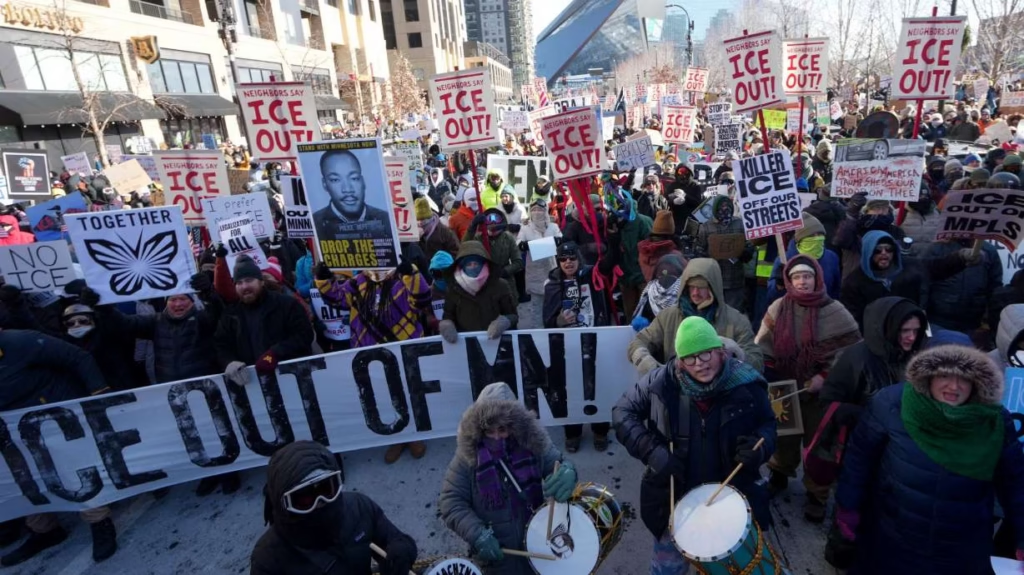
    Abby Martin: Yeah, it is. People talk about the notion of the imperial boomerang. Of course, for marginalized brown and black people, they’ve always felt the brunt of our colonial, the consequences of colonialism and imperialism. But I think for people who look like me in this country, they’re seeing that this is inseparable. This boomerang effect of the consequences of having a global military empire that acts as a for-profit corporation. That when you have surplus weaponry that you need to continue to justify the next generation of these pointless vehicles, it either is handed off to entities like ISIS or the Taliban or to local police forces here in the US, which in turn brutalizes and subjugates its respective populations like in Minneapolis. So, it’s a feedback loop in the worst way in every possible way that you need to continue to grow on a finite planet. You need to continue to justify the growth and the expanse. And so, one fascinating thing about Trump that I’ve heard you articulate many times is the fact that he’s completely dropped the mask. I mean, all of this is just very explicit. It’s about the oil. Iran’s the third largest oil producer in the world and Venezuela’s the first. I mean, this is insane. It’s an overlap of just the law of the jungle, complete lawlessness, harkening back to the days of Christopher Columbus, where it’s just openly colonial, like Operation Total Extermination of Latin America.

    Any country that doesn’t bow to this global system will be punished, will be destroyed unapologetically from the ruling class. So, when we did this film, what’s amazing about it, it was kind of the incubation period to get us somewhere like Trump. I mean, this was the neoliberal doctrine. This is the neoliberal order. This is what was deemed normal, right? This was the status quo. And this is a death spiral, Chris.

    So, the film’s really instructive because it shows us how we got here. It gives us answers to how things have gotten so bad, how it is possible that someone like Trump can get in and ratchet things up to this extent, because he’s not a king. He’s not an anomaly. He’s exactly the perfect encapsulation of the system that we have today.

    Chris Hedges: Let’s talk about the opposition. Those who are attempting to confront the now naked imperialism that backs genocide in Gaza, that carries out unprovoked attacks against countries like Iran. Where is it coming from? And what are the strategies that are effective to combat this monster that we’ve created?

    Abby Martin: I mean, as uncertain and dystopian as the time that we’re living through is, Chris, I find it simultaneously very exciting because of the uncertainty, because of where it could go. We both know that 10 years ago, talking about socialism was considered completely controversial in this country. We are living in a country that its unofficial religion is anti-communism. And so, to live in a time where all of this is exposed, the bankrupt, hollowed out nature of this feckless opposition that has done nothing but lay down as the doormats for empire, for genocide, I mean, it’s a very important time because there’s no toeing the line. There’s no middle ground. It’s really socialism or barbarism.

    We have to abandon this notion that this is the end of history. This is the finality of our economic system. This is unacceptable. This is barbarism in its purest sense. This is where it’s gone. It’s gone on the ruins of all these institutions that have basically just been fronts for U.S. power this whole time. It’s all been exposed as sacrificial, like we are all sacrificial lambs, all of the human beings on this planet and also the environment, all of us are expendable basically in the eyes of the ruling class. It’s all about short-term profit. It’s not even about tactics or strategy.

    I mean, you look at the Strait of Hormuz, you look at even the Iraq War. When has the US even won a war, right? I mean, we stole the glory from the Soviet Union with World War II, but when has the US, in terms of asserting its imperial dominance and US hegemony, when has it actually resulted in a victory, like a military victory? It’s all about profit and that’s what’s so dystopian about it. They are willing to create apocalyptic moonscapes all over the planet. Dead zones still existing from small armaments during World War I. I mean, this is the result. This is the legacy of these wars, but they’re not stopping. In fact, you saw it getting worse with Iran – the intentional targeting of oil infrastructure, oil depots, natural gas pipelines. The casual warning of committing war crimes – today is ‘Bridge Day’, tomorrow is ‘Power Plant Day’ with the world’s media just being like, “Is he gonna do it? Like, let’s find out. We have a 48-hour timeline.”

    So, I think this is how we got here is the wanton impunity for war criminals, not holding people accountable for the Iraq war crimes. I mean, this is how we get Gaza This is how we get the new lawlessness and the law of the jungle. And so, the resistance that we’re seeing to it is incredible, the sustained actions around the world, people’s understanding that Gaza is actually the connective tissue to our liberation all over the world. How Gaza fits into everything because five years ago no one understood that and it was always considered too controversial. It was a third rail and now it’s understood as everything. It is intrinsically tied to humanity’s liberation, and so to understand that and to see that foundation of understanding ripple throughout the world is something that is incredibly motivating and inspiring to me. And I do have revolutionary optimism in the fact that people are putting their careers on the line, their bodies on the line, their lives on the line just for the chance to move the needle, Chris, because that’s what we’re up against. We’re up against a completely insane global system. But it’s comprised of a bunch of dumb people. And that’s also what gives me hope. It’s not just the banality of evil, it’s the stupidity of evil. These people are so compartmentalized in their self-preservation that they can’t even see what’s right in front of them. They can’t even see that they’re destroying the planet for their kin. So, this is the opening that we have. We have a chance to change the world, to insert the truth, to reclaim our narratives and uplift those. And this movie is one tool in the arsenal to push that forward.

    Chris Hedges: And yet when capitalists feel threatened, they reach for fascism. And we are rapidly consolidating a fascistic system within the United States. Fascists are not particularly smart. They’re often very buffoonish, but they’re very deadly.

    Abby Martin: Indeed. And to see the US waning its power in terms of the consciousness of the public. I mean this is the least popular war ever. Trump has the lowest approval rating but still, the fact that they don’t even need to try I think says a lot, right? The fact they didn’t even need to placate the public. They didn’t need to put out a propaganda campaign like in the wake of 9-11, What does that say? They don’t even care to try.

    And that really exposes the state that we’re in, the detachment from the ruling class to the public, the fact that they don’t care. That should show us everything, that there is no connection whatsoever. There’s no representation. There has to be something that we do that’s outside of this electoral arena because it has completely failed us. There’s no material gains whatsoever from the Democratic Party. They are going to continue to basically push this system as we all fly off a cliff.

    Chris Hedges: Abby, it’s always, the Pentagon is really not only unaccountable, but unassailable. It often submits budgets and then Congress will give them more than they even ask for. In many ways, it’s a state within a state. I remember the historian Arnold Toynbee highlighted unchecked, unregulated militarism as the death blow of the empire. You’re right that, of course, this is at once suicidal in terms of the imperialist policies and yet the power of the war industry, I mean even Bernie Sanders isn’t going to go after it. The power of the war industry is such within the American political system that it’s virtually sacrosanct.

    Abby Martin: Indeed, this is the problem, isn’t it? Even with the case like Bernie Sanders or AOC as president, they’re still imperialists. I mean, at the end of the day, they are going to sustain the bipartisan consensus of US empire. They have never questioned the notion, the existence of a global military dictatorship, holding the world under its boot, subjugating billions of people.

    This is unacceptable. You cannot call yourself an environmentalist if you are not anti-imperialist. Similarly to how Zionism is incompatible with progressivism. These concepts are contradictory. So, the real problem is that one of the only politicians that I ever heard even talking about closing down the bases around the world was Ron Paul, right? This is why he was so popular, but people tried to basically castigate him and lump all of his supporters in as racists. And that’s a really, really problematic premise because you have to have an opposition that is calling into question this imperial machinery of death.

    And when you have Bernie Sanders, the most progressive wing of the Democratic Party, not even questioning that, not even talking about roping in these bases, decommissioning any aspect of the military empire. And instead, it’s just the liberal wing of it, right? I mean, defending the use of sanctions as diplomacy. Sanctions killed 1,800 babies in Cuba since 2019. This is mass murder by policy, right? You have AOC, I mean, basically just defending Liberal interventionism. This is a huge, huge problem.

    We need to be militant. We need to be proud and confident about our anti-imperialism. We need to not throw the Global South under the bus when times get tough and castigate Cuba and Venezuela. We need to full-throatedly defend the Global South and their sovereignty and independence. And we need to call into question the entire premise that we have the ordained right to arbitrate anything around the world. That’s the problem, Chris. This is chauvinism. This is insane. So, we need to start basically pressing our politicians at the bare minimum that they need to be anti-imperialist. And it’s unacceptable that you have people posing as progressives that are not anti-imperialist at all.

    Chris Hedges: Well, all the great socialists, Rosa Luxemburg and others, reminded us that you can’t be a socialist unless you’re also an anti-imperialist. You can’t.

    Abby Martin: No, and sadly you’re not seeing any of that. Where is anyone in power talking about this stuff? There’s cursory kind of attempts to just admonish Trump like on these mealy mouth statements from people like Hakeem Jeffries, “Oh, the process. Well, Maduro had to go, but the process had to be better. We should have had the process involved better when it came to a war of aggression and eco-side unleashed against Iran.” I mean, it is disgusting. It is disgusting to have Chuck Schumer out there talking about his undying support for Israel as he tries to hawk books about anti-Semitism while there’s a goddamn genocide going on. This is the opposition party? This is the opposition party that you want to browbeat Leftists and is saying, “Vote blue”? If you’re not going to stand up against genocide, how the hell are you going to fight for democracy? Jesus Christ.

    Chris Hedges: Tell us how people can see the film and, also, follow your work.

    Abby Martin: You can see the film. It’s up now on Vimeo. It’s for streaming for international audiences and domestic audiences. Check it out, Vimeo. You can check out EarthsGreatestEnemy.com and it’s embedded right on the home screen. You can also get me to do Q and A’s, show the film all around the world if you want to. It’s also available for patrons on our Patreon and YouTube members only. Soon in a couple of weeks, we’re releasing with Watermelon Pictures out on Amazon and Apple, so it’ll be widely available on streaming then.

    I encourage everyone to reach everyone you know who’s still reachable with the film. It’s an incredible tool in the arsenal to try to activate and motivate people and agitate them into becoming anti-imperialist and give us a fighting chance against the parasites robbing us blind, Chris.

    Chris Hedges: You did a wonderful job, Abby. Thanks. And I want to thank Max and Diego, who produced the show. You can find me at ChrisHedges.subtack.com.

    You can also make a donation to our PayPal or subscribe to our Patreon.

    Please share this story and help us grow our network!

  • Chris Hedges: How America’s Corporate Class Became Legally Unaccountable (w/ Marie Gottschalk) | TCHR

    Chris Hedges: How America’s Corporate Class Became Legally Unaccountable (w/ Marie Gottschalk) | TCHR

    Crime and No Punishment

    How concentrated economic and political power in America protects elites and fosters violence of all kinds.⁠

    Chris Hedges Report  July 23, 2026

    In the opening chapter of Maria Gashot’s book, Crime and No Punishment: Wealth, Power, and Violence in America, a chapter titled Social Murder, she writes, “The United States is an exceptionally militarized, lethal, and violent country. The growing concentration of economic, political, and military power is draining America of vital resources to sustain healthy and peaceful communities.”

    Crime and No Punishment, book published by Princeton University Press.

  • Settler Colonialism, Right and Left

    Settler Colonialism, Right and Left

    The right and left may disagree about content, but the structure is identical.

     By Relentless Indigenous Woman / 2026

    Sometimes I go on a little field trip to the right-wing side of social media. A type of field research, if you will. Here’s what I notice:

    • They speak the same way about the left as the left does the right.
    • Both sides posture as liberators, but both remain bound to the same colonial script: divide the world into binaries, declare who owns “truth,” and treat the other as incorrigible.

    Both sides cast the other as:

    • Emotionally broken
    • Intellectually dishonest
    • Beyond hope

    Political psychology calls this mirror-image perception. This mirror is intentional, shaped by colonial logic. The right and left may disagree about content, but the structure is identical:

    • One side possesses truth, the other denies it.
    • One is enlightened, the other ignorant.

    This is the colonial binary at work. The same binary that once justified empire—civilized/savage, rational/irrational, good/evil—now replays itself in partisan politics. Both sides are still standing on colonial ground.

    When we accept the mirror, we inherit the colonial script. We start to believe that the struggle is about who is right instead of how colonial violence continues unchallenged. The right is not interested in equal ground—it seeks domination. The left, meanwhile, often mistakes inclusion within colonial systems as liberation. Both positions leave the system intact. Both drain our energy into a hall of mirrors.

    True liberation requires a refusal to keep playing by colonial rules of debate and recognition. Here are 4 ways to refuse the colonial game:

    1. Refuse the binary: Stop performing inside colonial categories of light/dark, civilized/savage, rational/irrational. Our truths are not possessions to wield against others; they are relations we live into.
    2. Reclaim relational ground: Center worldviews where knowledge is carried through story, relationality, kinship, and accountability, not through conquest of an opponent.
    3. Stop feeding extraction: Debating people who deny our humanity is not liberation. It’s depletion. Your precious energy belongs in building.
    4. Build forward: Our compassion is not owed to those who weaponize denial. It belongs to our own people and to those willing to walk in real solidarity. Compassion here means refusing to let colonial rage shape our direction.

    The right and left may hurl the same insults, but neither offers a way out. One clings to domination; the other polishes recognition.

    Both are still colonial politics. Our energy is being used as currency right now. Every reaction and defense pulls us into their mirror; our energy is extracted and redirected to sustain the very system we resist.

    Decolonization means refusing that extraction and being conscious of where you’re placing your energy. Because as we continue on the path of resistance, your energy matters: Don’t let colonial politics distract you. Don’t let them drain you. Step away from the mirror. Refuse the binary. Place your energy where it multiplies: into relation, resistance, and futures built on our own terms.

    Truth is not something they can own.
    It is something we live.

    Dr. Candace Manitopyes is an educator, scholar, and unapologetic advocate forIndigenous children and communities. A member of the Moose Cree First Nation and a certified trauma-informed somatic practitioner, she blends academic rigor with lived grassroots experience. Her podcast is one of Canada’s top education platforms, and her social media work has sparked international conversations around decolonization, education, and Indigenous sovereignty.


  • The United States of Betrayal, by Nick Turse

    BETRAYAL

    Turning on our allies has always been the American way.

    The United States of Betrayal

    Trump Adds to America’s Lethal Legacy of Treachery

    Who can even remember it now? That giddy moment less than five months ago when President Donald Trump called on the Iranian people to rise up and take on the ruling regime. “When we are finished, take over your government. It will be yours to take. America is backing you with overwhelming strength,” Trump promised on February 28. “This is the moment for action. Do not let it pass.”

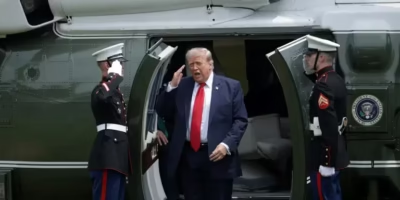
    THE TRUMP SALUTE
    Photo: Getty

    Like a million Trump pledges before it, it was part bluster, part bullshit. Last week, Trump admitted as much, stating he knew the Iranian opposition had no chance against the ruling regime. “Nobody is gonna take over. They have no guns, and the other side has machine guns,” he said at the NATO summit in Ankara, Turkey. “They can’t take over because they’re dead.” This was not, however, just a routine Trumpian lie; it was also part of a grand American tradition.

    They say baseball is America’s national pastime, but you could make a solid case that it’s actually betrayal. Washington loves nothing more than to sell out its friends, betray its partners, leave its allies in a lurch, and call people into the streets and then abandon them to slaughter.

    Related

    Ahmadinejad Is Still Bad for Iranians — and Still Great for Israel

    In an interview with the Washington Post on the Iran war’s first day, Trump said that “freedom for the people” of Iran was the goal of the conflict. It never was. But what would be lost in luring Iranian activists into the streets — aside from Iranian lives?

    This type of lethal double-cross has been America’s stock-in-trade since its infancy — and has continued across the globe no matter the conflict, era, or president.

    During the American Revolution, most Native peoples viewed America’s colonial rebels with skepticism and attempted to remain neutral or sided with the British. But some placed a bet on the revolutionaries, assuming that they would be rewarded with fair, if not preferential, treatment in the event of a win by the colonies. They were, in the end, wrong to assume their allies would act honorably.

    The Oneida, for example, split from most of the Haudenosaunee Confederacy — the Mohawk, the Onondaga, and others — who allied with the British. “There would have probably been a lot more death for the Continental Army,” according to Heather Bruegl, a public historian and citizen of the Oneida Nation of Wisconsin who noted that the Oneida altered the tide of the war by breaking the famine at Valley Forge.

    Even the Pentagon lauds the Oneida Nation, noting its “support for American independence saw the Continental Army through its lowest point in the Revolutionary War” but admitted that while Congress offered thanks, “that gratitude did not always translate into equitable treatment.” This is nothing but a mealy-mouthed reference to the fact that at the end of the Revolutionary War, the Oneida Homelands were estimated at between five to six million acres of land but were reduced to just 32 acres by the early 1900s.

    Related

    Rebecca Nagle on the Boomerang of Empire

    The Lenape people also threw in with the American rebels, signing a treaty that pledged their backing to the nascent United States in exchange for protection and the creation of a 14th state, governed by Native Americans. The agreement fell apart within weeks. As the official State Department history puts it:

    First, the Lenape leader White Eyes died. While American officials insisted White Eyes died from smallpox as the cause, evidence indicated members of the [colonial] militia murdered him, and the circumstances remain unclear to this day. This act showed the Lenape that the Americans did not value nor honor the importance of kinship alliances.

    Despite a failure by the Americans to protect Lenape lands, some Lenape warriors nonetheless assisted the Continental Army and a delegation went to the Continental Congress to attempt to repair the pact. But the Americans made no effort to salvage the agreement and said the Lenape had broken the treaty. Worse still, in 1782, Pennsylvania militia massacred a neutral, pacifist Christian Lenape community in Gnadenhutten, bludgeoning 96 unarmed people to death. Thirty-nine of those killed, many with a hammer to the back of the head as they prayed for mercy, were children.

    Deception and Disloyalty

    Still, it wasn’t until the 20th century that America hit its stride, selling out allies at an unbelievable clip. Approximately 250,000 Filipinos joined the U.S. military, for example, and fought for America during World War II. Washington promised them the same health and pension benefits as their American counterparts, a pledge that was even reaffirmed at the close of the war. But then Congress passed and President Harry Truman signed the Rescission Act of 1946 that said that the service of Filipinos “shall not be deemed to be or to have been service in the military or national forces of the United States or any component thereof or any law of the United States conferring rights, privileges or benefits.”

    Also during World War II, the U.S. Office of Strategic Services, a forerunner of the CIA, armed, trained, and supported a guerrilla force in French colonial Vietnam fighting the Japanese and their French quislings. In 1945, with the Japanese defeated, the top local OSS agent — the charismatic Ho Chi Minh — proclaimed Vietnam’s independence, using the words of the U.S. Declaration of Independence as his template. “All men are created equal,” he told a crowd of half a million Vietnamese in Hanoi. “The Creator has given us certain inviolable rights: the right to life, the right to be free, and the right to achieve happiness.”

    Related

    The Vietnam War Is Still Killing People, 50 Years Later

    Ho thought his allies would back him. He was wrong. They instead turned on Ho and his comrades, funded the French reconquest of Vietnam, and spent the better part of the next three decades propping up an ever more corrupt and repressive rump state in South Vietnam while advising, arming, training, and funding an allied South Vietnamese military, and fought a long, destructive war against revolutionaries in the South and Ho’s North Vietnam that left millions dead, wounded, or displaced.

    Eager to turn the conflict over to the Potemkin state they fostered and extricate the U.S., President Richard Nixon pledged to re-enter the war with the “full force” of American power, to induce the despotic South Vietnamese government to sign a 1973 peace agreement with the North. Two years later, the U.S. ignored this guarantee and abandoned South Vietnam and millions of allies, collaborators, and hangers-on.

    No single moment sums up this betrayal better than an incident recounted by Stuart Herrington, a counterintelligence officer who spent 30 years in the Army. Herrington made a vow to hundreds of Vietnamese who crowded onto U.S. Embassy grounds in Saigon on the final day of the U.S. evacuation in 1975. “Nobody is going to be left behind,” he assured them. One of the 420 Vietnamese who was there remembered his words: “I promise me and my soldiers will be the last ones to leave the embassy.” Herrington promised them that a large helicopter was coming to rescue them and then excused himself to go “take a leak.” Scurrying off into the shadows, Harrington slipped into the embassy building and onto a helicopter, abandoning those to whom he’d just given his word.

    BRUSSELS, BELGIUM - APRIL 22: Special Rapporteur on the situation of human rights in the Palestinian Territory, Francesca Albanese delivers a speech during the Global Sumud Parliamentary Congress in Brussels, Belgium on April 22, 2026. Bringing together lawmakers, representatives of political parties and public institutions, UN rapporteurs and prominent figures from around the world, the congress has begun as the Global Sumud Flotilla that set off for Gaza on April 12 continues its journey. (Photo by Dursun Aydemir/Anadolu via Getty Images)

    Related

    Trump’s Sanctions Against the ICC Are Unconstitutional, Rights Groups Say

    Noah Hurowitz

    A U.S.-backed military regime in neighboring Cambodia also crumbled in 1975 and was abandoned to face the genocide of the Khmer Rouge. A proxy army in neighboring Laos was similarly discarded in the 1970s. Decades later, surviving troops and their families were still in hiding and on the run. “We want America to give us a place to live,” Va Chang, a then-60-year-old veteran found in the jungle in the mid-2000s told a reporter. “If the Americans don’t want to do that, they should drop a big bomb on us and end our misery.”

    Prior to a 1956 uprising, the CIA air-dropped leaflets into Hungary with messages like “The regime is weaker than you think.” János Rainer, director of Hungary’s 1956 Institute Foundation, said, “Hungarians clearly got the impression that, in the event of a rebellion, the U.S. would support them effectively.” But the U.S. stood aside as the Soviet Union crushed the uprising, killing and wounding almost 20,000, imprisoning 13,000, and executing 229 others following trials, according to one count. The writer Tamás Aczél, who fled to the U.S. in 1956, wrote that Hungarians had been naive to put their faith in U.S. calls for “liberation” in Eastern Europe, writing: “[W]e learned what we didn’t know — that the West had written off these countries and only their propaganda machines pretended otherwise.”

    In an even more egregious exercise, the CIA trained and armed Cuban exiles, landing them at the Bay of Pigs in 1961. The counterrevolutionaries were promised ample air cover — “the sky will be yours” — and led to believe they would be supported by 15,000 American troops. But the invasion of Cuba went south quickly, President John F. Kennedy canceled a second round of airstrikes, and the exiles ran out of ammunition, were pushed back into the sea, and were abandoned. Grayston Lynch, a CIA operative who participated in the landing, recounted that he called two American destroyers on the scene for help but was told by the captain of one: “My orders are not to become involved.”

    While the U.S. has betrayed people the world over, one group stands preeminent in the sheer amount of American treachery. “Nothing in this world is certain except death, taxes, and America betraying the Kurds,” wrote Jon Schwarz for The Intercept in October 2019, recounting eight instances from the 1920s to that very moment when the U.S. used independence-seeking Kurdish peoples to further American aims and then cut them loose.

    One of the most craven of these instances was a Nixon-era plot with then U.S.-allied Iran to use the Kurds to bleed the then-Soviet-aligned Iraqis.

    Once the Kurds outlived their usefulness, however, U.S. aid was then cut and the Iraqi military killed thousands as the Kurds begged for help. As a congressional report later admitted, “Even in the context of covert action ours was a cynical enterprise.” But Secretary of State Henry Kissinger shrugged at the slaughter, explaining “covert action should not be confused with missionary work.”

    As the U.S. bombed Iraq during the Gulf War in 1991, President George H.W. Bush called on “the Iraqi military and Iraqi people to take matters into their own hands, to force Saddam Hussein, the dictator, to step aside.” Both Shias in southern Iraq and Kurds in northern Iraq answered the call, expecting U.S. military support. It never came, Hussein stayed in power, and some 20,000 Kurds and up to 60,000 Shias who rose up were slaughtered by the Iraqi military.

    More than a decade later, another failed U.S. war in the Middle East fostered the rise of the Islamic State group and the creation of a brutal caliphate across a wide swath of Iraq and Syria. Between 2014 and 2017, Kurdish-led forces dismantled this quasi-state for the U.S. But after 93 percent of Iraqi Kurds voted for independence in 2017, America was nowhere to be found. Within weeks, Iraqi federal troops and Iranian-backed Hashd al-Shaabi militias launched a coordinated offensive. The Kurds lost the city of Kirkuk, the Nineveh Plains, and roughly 40 percent of the territory their fighters had held. Washington offered no military response and no assistance — not even a diplomatic protest to the government in Baghdad. Then in 2019, President Donald Trump withdrew U.S. troops from northeastern Syria, opening the door for a Turkish invasion of the very land the Kurdish-led Syrian Democratic Forces had taken from ISIS at the cost of more than 20,000 lives.

    Hundreds of thousands of locals also served alongside U.S. troopsdiplomatsintelligence officers, and contractors during the failed Afghan War. Despite 20 years of Americans mouthing the phrase “shohna ba shohna” (“shoulder to shoulder” in Dari), it meant very little. In the chaotic 2021 U.S. withdrawal from Afghanistan, most Afghans who fought on the side of the U.S. and its coalition partners were left behind as the Taliban retook the country.

    But even those who made it out have been abandoned. In April, the Trump administration floated plans to send Afghan allies stranded at Camp As Sayliyah in Qatar to the Democratic Republic of Congo. While that plan was reportedly shelved, rumblings of casting them to the winds elsewhere remain. And in May, the Department of Homeland Security formally ended Temporary Protected Status for roughly 10,000 Afghans who fled after the Taliban’s return to power.

    “We made a promise to those who helped America in our time of need, and it’s wrong to turn our backs on them,” Rep. Jason Crow, D-Colo., a member of the House Armed Services Committee and a combat veteran who fought in Afghanistan, said last month, noting that they will likely face torture, persecution, and even death if they are returned to Afghanistan.

    — Nick Turse, editor of TomDispatch.

    If you haven’t yet, sign up to receive TomDispatch in your inbox here.


  • Trump’s Formula for Forever Wars, The Intercept Briefing

    Trump’s Formula for Forever Wars, The Intercept Briefing

    “This is the sort of thing that an empire in decline does. Rather than figuring out new strategies to growth, it redistributes wealth from its own people, to its driving oligarchic sectors.”

    The irony to what you’re saying, of course, is that on the campaign trail, Donald Trump effectively sold himself as a non-interventionist, promising no new forever wars, declaring himself a peace president. Many pundits, podcasters, journalists, others backed up that claim, despite the fact that during his first term, he assassinated an Iranian general, escalated conflicts in Iraq and Syria, and loosened the military’s rules of engagement.

    President Donald Trump blew up the temporary ceasefire after the U.S. launched a series of airstrikes against Iran over the weekend. The two nations have continued to exchange strikes throughout the week, with Iran targeting U.S. allies in the Middle East, as Congress debates further entangling the United States military with Israel — a proposal that would give Israel enormous leverage over U.S. defense policy.

    Buy the End Forever Wars  t-shirt here.

    The Intercept Briefing / July 17, 2026

    “This is a formula for a forever war,” national security reporter Spencer Ackerman tells The Intercept Briefing. A major champion of such forever wars was Sen. Lindsey Graham, who passed away over the weekend. “Lindsey Graham never met a war he didn’t like, never met a war he didn’t want to send other people’s children to wage,” says Ackerman, who writes the Substack Forever Wars. “The white whale for Lindsey Graham and many others in the bridge between neoconservatism and MAGA was Iran — assaulting Iran not only at home, but rolling back its regional challenge to U.S. and Israeli power in the Middle East.”

    “Whatever else MAGA says about wars,” says Ackerman, “what it wants is domination. It wants domination not only at home, but abroad. That’s where Graham recognized — that instead of being someone like John McCain, who sought to occasionally butt against, fight against Donald Trump — that Graham could help maneuver Trump into being a vehicle for their shared project. And he did that with really tremendous success.”

    “You are seeing a more rent-seeking U.S. empire than ever before as a defining characteristic … of the Trump-era empire,” says Ackerman, on the administration’s thirst to turn countries in its orbit, like Venezuela, into “vassal that pay tribute.” “This is the sort of thing that an empire in decline does. Rather than figuring out new strategies to growth, it redistributes wealth from its own people to its driving oligarchic sectors.”

    Politics reporter Akela Lacy also drops in to discuss how the turmoil at home and abroad is impacting the midterms. After Democratic Senate candidate Graham Platner dropped out of the race, Lacy says, “Maine Democrats are in a situation where they’re all trying to become the nominee that the party picks to replace Platner on the ballot to go against Collins in November. Many of those candidates have now come out and called to abolish ICE outright after the shooting in Maine.”

    For more, listen to the full conversation of The Intercept Briefing on Apple PodcastsSpotifyYouTube, or wherever you listen.

    Transcript

    Akela Lacy: Welcome to The Intercept Briefing, I’m Akela Lacy, senior politics reporter at The Intercept.

    Jessica Washington: And I’m Jessica Washington, politics reporter at The Intercept.

    AL: Jessie, we were anticipating having a slow July, but the news has not slowed down. Trump reignited the U.S. war with Iran, resuming airstrikes on the country, and said we’re taking over the Strait of Hormuz.

    Meanwhile, Congress is trying to pass the National Defense Authorization Act after several weeks of gridlock, asking for a record $1.15 trillion in funding. On Tuesday, Senate Democrats blocked the bill in protest of the Iran war and over a provision that would more closely integrate the U.S. and Israeli military. On Wednesday, more than half of House Democrats voted to strip $3.3 billion in aid to Israel from the measure, though the effort failed in the broader House.

    And within the last week, there have been four ICE-related deaths. Federal immigration agents shot and killed two fathers: Lorenzo Salgado Araujo in Texas and Johan Sebastián [Durán] Guerrero in Maine. That brings the total number of people fatally shot by immigration agents in Trump’s second term to 11. On Tuesday, a third man was struck by a truck fleeing agents in Florida. And a Venezuelan man died in custody in Georgia after being denied medicine, reported by our former colleague Jose Olivares at The Guardian.

    At least 52 people have died in ICE custody during Trump’s second term. It’s the highest level in a decade according to a new report from Physicians for Human Rights [and Human Rights Watch].

    Jessie, this week you covered how lawmakers are responding, or not, to Trump’s deadly immigration agenda. What did you find out?

    JW: When I was looking into it, I was wondering where is this momentum that we saw in January and February around immigration, around at least saying, ICE is wrong, the actions that ICE is taking are immoral, are against the code of our nation. Those were the kinds of things you were hearing in January and February.

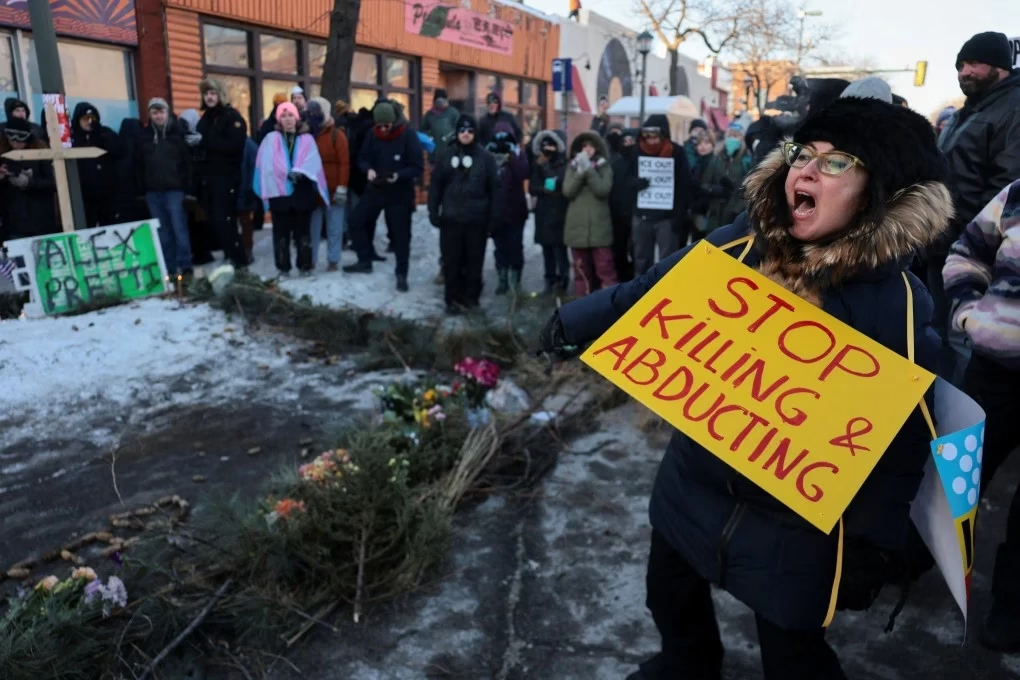
    That was in response, obviously, to the killings of Renee Good and Alex Pretti in Minnesota that elicited a huge response — not just from Congress, but also you saw a massive response in the streets, people coming out in droves to support their community to say this isn’t right, to say that you can’t just rob us of vital members of our community.

    We’re really not seeing that same intensity either in policies that were put out, even policies that were going to go nowhere. Obviously, Democrats caved on DHS spending in April. We just really haven’t seen the same moment that we did in January and February.

    I had a long conversation with Congresswoman Delia Ramirez, who introduced the “Melt ICE” Act in January. That bill would end the Department of Homeland Security’s funding to detain and monitor immigrants. She’s characterized it as a first step, but really when she’s had conversations with her colleagues in the wake of these two really horrific shootings, she’s found that there just isn’t that same intensity, there isn’t that same momentum for action.

    There’s two things happening from her perspective, from what she told me. One of them is racism and the fact that the people who were killed most recently were not U.S. citizens. Alex Pretti and Renee Good were, and they were also white, and that obviously changes the tenor, at least for the media and the public.

    Then there’s the fact that without the large national outpouring, without voters really pushing politicians, they aren’t motivated because their donor class is not motivated. They benefit from a broken immigration system where people are forced to take these low-wage jobs. So in an absence of kind of a massive public outcry of people pushing their politicians, you just aren’t going to see that action, and that’s really coming from my conversation with her.

    But I think you can see that in the way that Democratic politicians have not risen in this moment — and I would argue they didn’t rise in January and February — but certainly we saw more energy.

    The other big news of the week was as the world closely watched for updates on Sen. Mitch McConnell’s health, Sen. Lindsey Graham died from a heart condition. This of course happened in the backdrop of the looming midterms where Republicans currently hold a slim majority in the senate.

    Maine Sen. Susan Collins who is running in a chaotic Senate race, is facing protests for voting to give DHS $70 billion for immigration enforcement after ICE agents fatally shot Guerrero in Maine. Akela, there is so much to unpack here. Can you talk about the political implications unfolding here and what you’re watching for in the midterms?

    AL: This is really shaping what was already a tumultuous situation in the Maine Senate race, where obviously, Graham Platner dropped out last week over an allegation of rape. Now Maine Democrats are in a situation where they’re all trying to become the nominee that the party picks to replace Platner on the ballot to go against Collins in November.

    Many of those candidates have now come out and called to abolish ICE outright after the shooting in Maine. That was something that Platner had campaigned on, obviously, prior to the shooting. Our colleague Noah Hurowitz is actually working on a story about this that you can read at The Intercept.

    Related

    Would-Be Platner Replacements in Maine Rally Around “Abolish ICE” (or Something Close)

    We see candidates adopting this sense of urgency around ICE that is shaping the campaigns of insurgent candidates and frustration among voters right now. Jessie, you’re talking about feeling like the momentum on the ground against ICE is not being matched in Congress, something that’s animating the midterms and emphasizing this sort of split-screen where people don’t feel like Democratic leadership or longtime incumbents are meeting the moment. We’re seeing that shape now not just this race in Maine, but we’ve seen that be a rallying call for many of the candidates who have won their races already this primary cycle.

    One thing that I thought was interesting about how this is unfolding in Maine is that one of the candidates, Dr. Nirav Shah, who I spoke to actually before Platner dropped out of the race — he had stopped short of calling to abolish ICE outright. He said it can’t exist in its current form, whether we reform it or dismantle it or transfer its duties to another body, it has to go.

    But earlier this week, he came out and said “Abolish ICE” outright, after the shooting. So we are seeing this have a real effect on how candidates are running their races. Even people who might have thought saying “Abolish ICE” a week ago — wasn’t the right strategy.

    JW: That’s one thing in my conversation with Congresswoman Ramirez that came up, is that people are not feeling as if Congress is meeting this moment or meeting them where they’re at.

    They’re saying, we’re in the streets. We’re risking our lives, our freedom, in some cases. Obviously, we’ve seen the prosecutions that came out of Prairieland, those protests. So people are saying, “We’re risking our lives, we’re risking our freedom, and you’re going to lunches and meetings on the Hill like everything is normal.”

    I do think that’s going to be a motivating force in these midterms, and we’ll see if candidates meet that moment. Or if they end up on the side of most of Congress, which seems to be doing not much of anything on this really horrific issue.

    AL: You mentioned that there’s been protests against Collins in Maine after the ICE shooting, pointing to the fact that she voted for ICE funding without any conditions. I’m interested to see if the most recent killings and deaths related to ICE have any effect on what appeared — even in the week where the last Platner scandal broke — she was still leading him in polling. I’m curious to see if this will affect that in the coming months.

    JW: That’s definitely something to look out for. The way that it’s worked has been very regionally specific. I think we’ve seen Minnesota really come together and come out on this issue. Now we’re seeing it in Maine, and perhaps in Texas as well.

    There’s obviously so much to get into. The Iran war, the proposed U.S.–Israel partnership, Lindsey Graham’s death and his foreign policy legacy. We’re going to talk about all of this with national security reporter Spencer Ackerman, who’s reported on the war on terror since 2002.

    His most recent piece reflects on Graham’s legacy of warmongering and preserving Guantánamo Bay, or as Ackerman describes it, “an extrajudicial cage that is still swallowing people.”

    Ackerman is the author of “Reign of Terror: How the 9/11 Era Destabilized America and Produced Trump,” which traces the political, legal, and cultural evolution of the last 25 years and how the boomerang has come back home.

    Ackerman has reported from Iraq, Afghanistan, Guantánamo Bay, and many U.S. bases. He’s won a Pulitzer Prize and National Magazine Award, and currently writes for Zeteo and Forever Wars, where you can sign up for his newsletter.

    [Break]

    JW: Spencer Ackerman, welcome back to The Intercept Briefing.

    Spencer Ackerman: Thank you for having me back, Jessica.

    JW: There’s a lot that we have to discuss with you, but first, we’re going to start with the broken temporary ceasefire deal between the United States and Iran. The United States launched a wave of airstrikes over the weekend against Iran; the two countries have exchanged strikes throughout the week.

    On Monday, President Donald Trump announced the U.S. military would reinstate its blockade of the Strait of Hormuz and implement a 20 percent cargo charge. The latter, he has since scrapped.

    Spencer, what is known at this point about why we’re at war again with Iran, and why the U.S.–Iran memorandum of understanding to bring a permanent end to the war failed?

    SA: The simple answer is the fifth paragraph in the memorandum of understanding, which despite what I think fairly counts as a clear concession by the United States that Iran henceforth will be able to control and hence impose some manner of cost on shipping transiting the Strait of Hormuz, the United States rejects that interpretation and rejects that outcome.

    Most importantly, that paragraph in the memorandum of understanding indicates just how deeply Iran has triumphed in this conflict that the United States and Israel brought to it. Before February 28, there were no costs, no fees on transits across one of the world’s most economically important waterways. That was the result of Iranian decision-making up to this point, a lot of which we don’t have a great deal of fidelity on, but basically represented a step that Iranians, even under the decades-long enmity with the United States and Israel, never felt that it had reason to impose.

    Related

    Putting Fuel on a Ceasefire: Israel Tries to Kill U.S.–Iran Talks

    It is a really historical shift. It is a pivot away from what has been an absolutely central aspect of not just U.S., but Western economic hegemony going back centuries. Which is to say what we in the West like to call free trade, freedom of navigation — that is a major thing for the United States to lose, and the Trump administration knows that. The shipping industry knows that.

    The Trump administration, when it reached the memorandum of understanding, appears to have operated in such a way that it would agree, as negotiated by Trump’s envoys — his son-in-law, Jared Kushner, and his buddy Steve Witkoff — to do whatever necessary once the markets reacted with such shock to this war to get Iran to stop firing and to make it appear for those markets like there was going to be a resolution of the conflict.

    The memorandum of understanding represents the pathway to that resolution, and so the Trump administration had been hailing it as a way back to normalcy and a way out of dire economic straits. So the U.S. needed that memorandum of understanding for the shooting to stop, but it would not accept the state that it had agreed to under the memorandum of understanding, which basically saw Iran agree to waive fees during the 60-day period authorized under the memorandum of understanding to achieve a lasting peace deal, some form of resolution over the nuclear file, and also explicitly authorized Iran and its neighbor Oman — which also has significant territorial waters in that strait — to come up with essentially a lasting mechanism to provide for continued access in transit, a new way of doing business for global shipping.

    Once the United States started seeing Iran basically keep control over those shipping routes, it started attacking Iran. Iran replied not just by harassing shipping, but also by resuming its missiles and drone strikes at U.S. facilities in Gulf countries that host them — and that basically broke down the ceasefire.

    I think the question going forward now is what new or expanded capacity the United States has not only to open the strait but keep it open. I think that we saw during the month of shooting that preceded the ceasefire that led to the memorandum of understanding, that the United States lacks that.

    This is not either a military or an economic calculation that favors U.S. power, that the Iranians have leveraged this rather intelligently in order to hold something very, very desired by the United States and indeed the global economy at risk. That’s where this stands.

    “Once the United States started seeing Iran basically keep control over those shipping routes, it started attacking Iran.”

    JW: It’s hard to imagine under these circumstances an end to the war in a real sense. And even Trump, when asked by CNN reporter Kaitlan Collins if bombing Iran was the new normal, said, “We were in Vietnam for 19 years.”

    Kaitlan Collins: Mr. President, you noted the United States is bombing Iran again. You’ve been bombing Iran for months now. Is this just the new normal for the American people?

    Donald Trump: No. We were in Vietnam for 19 years. We’re here for four months. I think we’ve done a lot. We’ve knocked out their navy in a period of one month.

    JW: At this point, where do you see this heading? Trump hasn’t ruled out sending ground troops to Iran, but he also hasn’t done it yet. Do you think there’s a possibility or are there signals that there could be an off-ramp? Or is this a forever war that’s about to happen?

    SA: It’s absolutely a forever war. I think that the future looks a lot like the present here, where you have essentially an unresolved situation where the United States does not accept Iranian control over the strait, regardless of the fact that it conceded as much in the memorandum of understanding.

    The Iranians will not relinquish this concession over the strait now that it achieved it in this memorandum of understanding, however much a dead letter it might formally be. That deadlock is going to persist. There’s also the dire math of the U.S. missile interceptor magazine, which is to say that a whole lot of very expensive missile interceptors that the United States possesses will have to, over now an extended period, be placed in the Middle East, in the Gulf countries that host the U.S. presence up against far, far, far cheaper Iranian missiles and drones.

    Related

    A Point-by-Point Breakdown of Trump’s Failed Iran War Objectives

    You heard the president say that the Iranian navy has been knocked out. Well, if the Iranian navy can swarm around, as we’ve seen them able to do even during the so-called ceasefire, shipping in the Gulf, then that kind of raises a question of how, even with whatever higher-end capacities the U.S. military has knocked out, whether that represents an actual defeat of the Iranian navy or whether Iranian naval capabilities remain sufficient to keep this kind of harassment going.

    When we hear the president compare this war to Vietnam, that’s a five-alarm fire. Yes, the Vietnam War lasted a very, very long time. That’s what now we’re looking at even in month four of this war, I guess more like month five at this point. This was a war that both Marco Rubio and Pete Hegseth said was over.

    Marco Rubio: Operation Epic Fury is concluded. We achieved the objectives of that operation.

    Pete Hegseth: Operation Epic Fury was a historic and overwhelming victory on the battlefield.

    SA: And clearly it’s not over. We are in just a shape change of this. There will be periods, I would imagine, of continued diplomacy. But until the United States is able to either, A, deliver some sort of finishing blow against the Iranians that they find intolerable, which I don’t really see much indication of them doing, or the Iranians decide through whatever coercive measures that they will give up control of the strait — this situation will persist.

    All of the drivers of this conflict, and we haven’t even gotten to Israel here, which would prefer to both destroy the regime and collapse the Iranian state. This is a formula for a forever war. This is a formula for — if not necessarily every single day seeing exchanges of U.S., Iranian, and even potentially Israeli fire — a situation where, like the questioner said, this is a new normal. This is what the Middle East risks looking like. The coercive ability of the United States to break this logjam, the diplomatic will necessary, has simply not been in evidence.

    JW: So Congress obviously has a role here. We’re speaking on Wednesday, July 15, and things may have changed by the time people are hearing this.

    But as of Wednesday, the National Defense Authorization Act, which authorizes Pentagon spending, is stalling in the Senate. Democrats are refusing to take up the NDAA, arguing that it’s a “permission slip” for the Trump administration as they wage war on Iran.” Others balked at the fact that the proposal would increase authorized defense spending by $80 billion. And the NDAA includes the United States–Israel Defense Technology Cooperation Initiative, which would facilitate between the two countries technology sharing from weapons development to artificial intelligence.

    Here is Israeli Prime Minister Benjamin Netanyahu on Fox trying to sell it.

    Benjamin Netanyahu: I’m calling it from aid to partnership. So we take away the money that is given to Israel, which is one part. But the other part is we invest, co-invest in equal measures in the new technologies that are needed to give our military and your military the advantage. So we want — there are some unbelievable projects.

    JW: Spencer, what’s at stake in this National Defense Authorization Act fight?

    SA: The U.S. has co-production deals for military hardware and technological development with a number of countries that’s part of the AUKUS partnership with the U.K. and Australia that the Biden administration spearheaded. It also has co-production deals with Israel for things like the Iron Dome missile defense system.

    “There’s just nothing like this that exists outside of this proposal.”

    It is nevertheless completely unlike any other bi- or multilateral defense technological production agreement, ever. This will enmesh the U.S. and Israeli defense technological, both research and manufacturing capabilities like never before, like nothing that the United States has.

    It puts Israeli firms that are nominally competing, in some cases with American firms across various aspects of the defense technological enterprises, into licensing agreements that give them intellectual property stakes over their American competitors and their nominal competitors. Perhaps most importantly, it puts Israeli firms, academic institutions, and so forth, into the supply chains of the U.S. military’s technological enterprise and production capabilities.

    Related

    Congress Is Trying to Permanently Integrate U.S. and Israeli Defense Tech

    That gives Israel enormous leverage over U.S. defense policy, U.S. defense decision-making. And as well, unlike any other co-production deal that the U.S. military has with any of its partners, it creates an executive agent within the Pentagon who is empowered to override existing bureaucratic processes, procurement issues, and decision-making to basically be, essentially, an Israeli commissar in the Pentagon advocating for greater and greater production and technological integration.

    There’s just nothing like this that exists outside of this proposal. There isn’t, as best I can tell, much of a precedent for it. And think of the implications of that. By the time this is out, I’ll have a piece on my newsletter, Forever Wars, about this. You’re already seeing real questions during the Iran war and Iran’s ability to hit U.S. infrastructure hosted in the Gulf about the viability of keeping the network of about 18 or so U.S. bases that span the Gulf from Kuwait to Bahrain.

    You could see that bivouacking for reasons of both defensibility and certainly ease of integration into Israel. You’re already seeing a U.S. general placed in charge of the force that’s supposed to be essentially occupying Gaza under Trump’s imperial Board of Peace proposal.

    The amount of missile strikes from Iran and drone strikes that Israel had to absorb during this war of aggression that it and the United States launched — if those Israeli firms, academic institutions, and so on are part of the U.S. military supply chain, and they’re vulnerable to Iranian missiles, then the United States has a direct interest in protecting those firms, installations, and so forth.

    “This is an epochal, I would argue, tectonic shift in the U.S.–Israeli military relationship.”

    So now U.S. defense of Israel will be a matter of U.S. defense necessity. So this is an epochal, I would argue, tectonic shift in the U.S.–Israeli military relationship. It needs to be said that right now Israel is committing a genocide in Gaza, it’s committing an ethnic cleansing in the West Bank, and it’s undergoing a process of territorial conquest in Lebanon and Syria.

    This is what the United States would be far deeper yoked to than ever before, and all of this is occurring precisely as you heard the Israeli Prime Minister Benjamin Netanyahu say, to make U.S.–Israeli economic integration, particularly over defense, seamless, invisible, and far less susceptible to the rising political challenge that’s happening in the United States as the result of Israel’s genocide.

    JW: The irony to what you’re saying, of course, is that on the campaign trail, Donald Trump effectively sold himself as a non-interventionist, promising no new forever wars, declaring himself a peace president. Many pundits, podcasters, journalists, others backed up that claim, despite the fact that during his first term, he assassinated an Iranian general, escalated conflicts in Iraq and Syria, and loosened the military’s rules of engagement.

    One of his biggest cheerleaders on this foreign policy front was the now late Sen. Lindsey Graham, who passed away suddenly on Saturday as a result of a tear in his heart, while the world was actually awaiting news of his longtime friend Sen. Mitch McConnell’s health. Recently, you wrote, “It’s darkly poetic that Senator Lindsey Graham left this world the same weekend that the Iran ceasefire collapsed. Graham had wanted this war for a very long time. While it would be nice to think that its rapid emergence as a fiasco would have redounded to Graham’s political detriment, absolutely nothing in his political biography as one of Capitol Hill’s premier warmongers suggests that would have happened.” Talk about Graham’s foreign policy legacy.

    SA: Lindsey Graham never met a war he didn’t like, never met a war he didn’t want to send other people’s children to wage. He treated war as a game, and a game that the United States and Israel, and also Ukraine — he was a very big proponent of Ukraine’s defense against the Russian invasion — that really animated Graham as much as criminalizing abortion and limiting the bodily autonomy of pregnant people animated his domestic vision.

    The litany is great. An advocate of all aspects of the war on terror, from the Afghanistan War, to especially the Iraq War, to the global drone campaigns, to keeping Guantanamo Bay open, establishing, he didn’t succeed in this, but attempting to establish a globally applicable system of U.S. wartime detention that was non-judicial, that would basically be a major, major entrenchment and expansion of what we see at Guantanamo Bay.

    The Libya war, attacking Bashar al-Assad in Syria, on and on it goes. But especially the white whale for Lindsey Graham and many others in the bridge between neoconservatism and MAGA was Iran — assaulting Iran not only at home, but rolling back its regional challenge to U.S. and Israeli power in the Middle East.

    As you saw from the true media saturation ahead of the February 28 kickoff for the war, there was Lindsey Graham constantly advocating for it, talking with Trump, liaising behind the scenes between the White House and Benjamin Netanyahu, serving as one of the greatest advocates for launching this new forever war, and also attempting to conceal what an epochal both commitment of military power and, naturally following this would be.

    “There was never any political consequence that he experienced.”

    I wrote that to indicate that the main reason why Graham was able to operate this way is that there was never any political consequence that he experienced despite various changes in national mood, especially like elite political mood toward the war on terror, Graham never felt that personally. He never felt that as a real genuine challenge to his political career.

    Then when there’s no consequences, there’s no accountability for that, there’s no reason for Graham to have changed, and he never did. In fairness, by all indications, he did this not just because of the campaign contributions, not just because of rise in popularity for such bellicose policies, but for the love of the game. This man was by all measures a committed militarist, someone who believed deeply in the American imperial project and was always a committed advocate of it, even when he saw that it inhibited the political careers even of his allies, John McCain, Joe Lieberman being important examples of that.

    JW: Graham seems to have viewed Trump as a vehicle for his warmongering ambitions. What do you think Graham understood about Trump that the people who thought he would be a peacetime president missed?

    SA: First, I think anyone who wrote that Trump would be a peacetime president or an anti-war president committed a great disservice to the public discourse.

    You can read my book, “Reign of Terror,” about why this would never, ever be actually the case. It is not an accident that Trump escalated the wars that he inherited and launched new and epochal ones, especially, Venezuela we didn’t even mention, which the U.S. now has imperial control over.

    “Graham understood that Donald Trump is a malleable, impressionable figure, that he is protean.”

    Graham understood that Donald Trump is a malleable, impressionable figure, that he is protean, that there are certain things that Trump responds to as someone who formed his political self-understanding primarily in the Reagan era and before, and that’s a healthy receptivity, to put it mildly, to U.S. militarism, that whatever else MAGA says about wars, what it wants is domination. It wants domination not only at home, but abroad.

    That’s where Graham recognized that instead of being someone like John McCain, who sought to occasionally butt against, fight against Donald Trump, that Graham could help maneuver Trump into being a vehicle for their shared project. And he did that with really tremendous success.

    Related

    Lindsey Graham Is the Most Shameless Man in American Politics

    It occasionally cost Graham dignity, but Graham, throughout his career, has never been someone who placed a great deal of shall we say, emphasis on having political dignity as long as it meant having political success. So he saw that as an easy trade-off if it meant maneuvering Trump into a kind of position that Graham, had he been president, had he been secretary of state, had he been secretary of defense, would’ve wanted to pursue.

    JW: One thing that I’ve been thinking about is, does someone else come in to fill his place as a champion for endless war in the Senate? Or, at this point, does there not even need to be a congressional champion for war to continue at this point?

    SA: It’s a good question. Lindsey Graham’s probably a singular figure in Republican politics at the moment. But that’s not to say that someone similar, though not identical, could fill the same void — as material conditions, it’s fair to say, probably produced Graham, and so they’ll produce, as long as they persist, another figure like Graham to take political advantage.

    I think probably the figure in Republican politics, certainly in the Senate, that best fits a Graham-type profile is Tom Cotton, the Republican senator from Arkansas. Like Graham, also a lawyer. Like Graham, an Iraq veteran, although Graham was in the reserves in the Air Force, Cotton was in the Army.

    Similarly bellicose, and bellicose in many of the same ways on the same footings. Both were fierce advocates of U.S. support for Ukraine after the Russian invasion. Similarly, never met aspects of the war on terror they disliked, and seek the aggression against Iranfervent support for Israel. Characterologically similar in the sense that you could often see aggrieved-lawyer come out in them. So I would say probably Tom Cotton.

    JW: On a holistic sense, we are now well into Trump’s second term. The U.S. is at war with Iran. The administration has conducted an undeclared war in the Caribbean Sea and Pacific Ocean, killing scores of civilians by deploying drone strikes on boats they allege are carrying drugs. Marco Rubio is effectively running Venezuela from afar after the U.S. kidnapped the country’s president and his wife.

    How would you characterize the Trump administration’s foreign policy at this point?

    SA: Purely imperial. The dream of the Teddy Roosevelt administration is alive within the Trump one. I’ll never be able to forget the interview that Stephen Miller gave to Jake Tapper right after the Maduro kidnapping.

    This is worth watching. Reading the transcript doesn’t really do it justice because you’ve really gotta see the way Miller performs in this interview. But it’s this expression of what the French used to call hyperpuissance: invincibility applied to an imperial level. A sense that the United States was capable militarily of imposing its will — militarily, economically — over the entire world in a way that the war on terror represented a drain of resources and capabilities from this was despite those material realities persisting, represented a declaration that Trump was going to make the American empire both more ambitious and recrafted in his image.

    It is very explicitly rent-seeking. It seeks to make the countries in its orbit, whether traditional allies or new conquests like Venezuela, truly into vassals. Vassals that pay tribute. Tribute that provides the United States, which looks to be in pretty substantial economic decline, with new sources of revenue that stave off what will probably be politically unacceptable shocks economically to the system.

    “It seeks to make the countries in its orbit, whether traditional allies or new conquests like Venezuela, truly into vassals. Vassals that pay tribute.”

    Every empire throughout history has sought to bring in resources from the periphery into the metropole. That’s absolutely what’s happening here. That Miller interview with Jake Tapper from January was the same one where Miller sounds like he’s cutting a wrestling promo threatening Denmark over Greenland — which now during the NATO summit, Trump brings back up. You are seeing a more rent-seeking U.S. empire than ever before as a characteristic, a defining characteristic, I would say, of the Trump-era empire.

    I will leave it to listeners, viewers, historians to figure out where we are historically on the long trajectory of American decline. But this is the sort of thing that an empire in decline does. Rather than figuring out new strategies to growth, it redistributes wealth from its own people to its driving oligarchic sectors.

    Related

    AI’s Imperial Agenda

    This is [the] civilizing mission that you see in Silicon Valley now from companies like Palantir that talks about the need for, essentially, they don’t say it exactly like this, but the need for U.S. public subsidies to keep the AI booming, going in order to make sure that the West doesn’t, in some sense, fall behind, whatever that means, or doesn’t become vulnerable to Chinese power.

    We haven’t even talked about Somalia, which is now essentially been subject to 200 drone strikes in the course of just 18 months, which makes a completely invisible war that the United States has conducted for 20 years in an East African nation.

    So this is a very erratic moment in American imperial history, but it absolutely has to be understood as a moment of American imperial assertion.

    “This is the sort of thing that an empire in decline does. Rather than figuring out new strategies to growth, it redistributes wealth from its own people, to its driving oligarchic sectors.”

    JW: Yeah. No, I’m getting thoughts of the Romans when they stopped making their own food and just expanded their empire out too fast. It’s giving a lot of those history flashbacks.

    SA: Those Egyptian grain imports, right?

    JW: Yeah. [Laughs] And we have so much that we could get into, but we’re going to have to leave it there for time. Spencer, thank you so much for joining us again on The Intercept Briefing.

    SA: Once again, I mentioned Eastern Roman history and killed a podcast. Thank you very much, Jessica. [Laughter]

    JW: For more from Spencer Ackerman, visit Forever Wars, where you can subscribe to his newsletter. We’ll add a link in the show notes.

    We want to hear from you. Tell us what you’re following or want to see more coverage of. Email us at podcasts@theintercept.com or leave us a voicemail at 530-PODCAST. That’s 530-763-2278.

    That does it for this episode.

    This episode was produced by Laura Flynn. Ben Muessig is our editor-in-chief. Maia Hibbett is our managing editor.

    Fei Liu is our product and design manager. Nara Shin is our copy editor. William Stanton mixed our show. Legal review by David Bralow.

    Slip Stream provided our theme music.

    This show and our reporting at The Intercept does not exist without you. Your donation, no matter the amount, makes a real difference. Keep our investigations free and fearless at theintercept.com/join.

    And if you haven’t already, please subscribe to The Intercept Briefing wherever you listen to podcasts. Do leave us a rating or a review, it helps other listeners to find us.

    Let us know what you think of this episode, or If you want to send us a general message, email us at podcasts@theintercept.com.

    Until next time, I’m Jessica Washington.

    IT’S EVEN WORSE THAN WE THOUGHT.

    What we’re seeing right now from Donald Trump is a full-on authoritarian takeover of the U.S. government.

    This is not hyperbole.

    Court orders are being ignored. MAGA loyalists have been put in charge of the military and federal law enforcement agencies. The Department of Government Efficiency has stripped Congress of its power of the purse. News outlets that challenge Trump have been banished or put under investigation.

    Yet far too many are still covering Trump’s assault on democracy like politics as usual, with flattering headlines describing Trump as “unconventional,” “testing the boundaries,” and “aggressively flexing power.”

    The Intercept has long covered authoritarian governments, billionaire oligarchs, and backsliding democracies around the world. We understand the challenge we face in Trump and the vital importance of press freedom in defending democracy.

    We’re independent of corporate interests — and powered by members. Join us.   Become a member


  • Water, Dog-Lovers, Dakota Indians and the Law, by Susu Jeffrey

    Water, Dog-Lovers, Dakota Indians and the Law, by Susu Jeffrey

    Water, Dog-Lovers, Dakota Indians and the Law

    By Susu Jeffrey / Original to Wings of Change / July 5, 2026

    On June 17, the Minneapolis Park and Recreation Board voted to revoke the very popular Minnehaha Off-Leash Dog Park, effective at the end of 2026. It was inevitable. The Park Board meeting was standing room only and as  emotional as grand opera.

    More than 30, mostly dog-lovers, signed up to speak and were allotted one minute each. A lot of passion was packed into those single minutes,  punctuated with applause, sign waving, cheers, tears, curses and audience do-se-do-ing. We heard that dogs are not illegal, dogs are a part of the family, my dog is my best friend and I met my husband at the dog park. The dog park is a way of life.

    Overexploitation of Resources

    Minnehaha Off-Leash Dog Park access begins at the top of the Mississippi River gorge and descends a quarter mile to the muddy riverbank. It is dog heaven—no leash, water, playmates. For people it is the end of the day, social time, exercise, therapy.

    As soon as the National Park Service opened Coldwater Park in 2012 human resistance to dog traffic began. Dog walkers switched from paid parking at the south end of Minnehaha Park to free parking at Coldwater, just a half mile down the access road parallel to Highway 55. Dogs leapt from cars into the grass, pooped, and raced down to the Mississippi.

    The word went out to the dog-walk community. Phooey to the law that states  “all dogs must be on a leash no longer than six feet.” How can you leash a dog that’s already halfway to the river much less pick up after it? The National Park folks tried furnishing trash cans and then plastic baggies to no avail. It was disgusting. It was a dog waste field just a seven-minute walk to the outflow of 10,000-year-old sacred Coldwater Springs.

    Back when what is now Mni Owe Sni (water-spring-cold) Park was still a Cold War federal research campus the No Trespass government land was  protected by a 6-foot chain link fence topped with little steel barbed twist ties. After 1955 there was one (1) emergency that allowed the public inside the locked gates. “In 1976 after months of draught,” wrote Carolyn Lyschik (10/21/2006) then of Minneapolis, “the city water developed an alga that was putrid and undrinkable by my husband who was very ill at the time. I made trips every other day to Coldwater Spring and stood in line to get the best tasting fresh water. We were so thankful for this vital resource. If it is still not polluted it should be a National Treasure!”

    The Cold War ended with the 1991 collapse of the Soviet Empire and the Twin Cities U.S. Bureau of Mines research center (a Senator Hubert Humphrey project) shuttered. Coldwater’s privacy fencing was removed. In 1992 the Minnehaha Off-Leash Dog Park opened. Gradually the public explored the open land between Minnehaha Regional Park and federal Coldwater and Fort Snelling land. In 2010 Coldwater Park (a project of Congressman Martin Sabo) opened under the same name it had been known as from the 1880s to 1950.

    From the Mississippi to the top of the river gorge public parkland stretched from Minnehaha Falls past Coldwater Springs to Fort Snelling. Since the first Minneapolis dog park in 2001 their popularity mushroomed. However the dog park at Rev. Dr. Martin Luther King Jr. Park in Minneapolis was closed for cultural insensitivity. Dogs were sicced on Indian people too. In recent news Israeli prisoners have reported dogs trained to rape prisoners. Dog reputations range from life-threatening to warm and fuzzy.

    Opening Coldwater Park relieved pressure on Minnehaha dog park access overuse but city park and national park people wanted to educate people about the geologic and human history of the place. Imagine National Park Service dog poop strategy meetings.

    At first it was reduced free parking from a dozen spots to four cars with legal handicapped signs hanging from a rearview mirror. Then pay-parking meters lined the access road from Minnehaha Regional Park to the Coldwater entrance where park police patrolled for enforcement via fines. Signage was posted at the Coldwater Spring House outflow warning that the spring water’s safety was questionable. Some dogs jumped into the reservoir but it is about five feet deep and offers little leverage for climbing out. No, the dog park on the Mississippi bank was the draw for dogs and their people.

    Coldwater: literally the Birthplace of the State of Minnesota where the soldiers who built Fort Snelling camped 1820-23 and then a civilian community grew to service the fort; source for the army post’s potable water supply for nearly a century; Mississippi bluff-top land saved from becoming an airport off-site parking lot by a 17-month (1998-99) youth-led encampment that even 802 police could not dislodge. Coldwater then devolved into a squat-stop on the way to the Mississippi River dog park.

    Meanwhile Standing Rock resistance to the Dakota Access Pipeline (2016-17) erupted on the border of North and South Dakota with the next generation of American Indian leadership. They did not win but they were speaking up and being heard.

    In 2023 Minnesota’s four legally recognized Dakota tribal governments filed paperwork with the National Park Service to recognize Coldwater as “Traditional Cultural Property.” In other words, sacred to the Dakota oyate (nation). 

    The “Pike” Treaty of 1805

    The Minneapolis Park Board “had no authority to decide who could use” the land currently called the Minnehaha Off-Leash Dog Park is because that land never legally belonged to the United States of America.

    The 1805 Treaty With the Sioux (aka “the Pike Treaty”) was never proclaimed by the U.S. President, a necessary step in making treaties official. Therefore that treaty is not valid now and never was. This issue is not like common law marriage; this is federal treaty law.

    Sometimes Indigenous people call treaties “TP” as in toilet paper. Psychologists might call American Indian treaties wishful thinking from the perspective of white men writing laws on paper. Clearly Natives were encouraged to believe guarantees as real and enforceable. The dominant culture gave Indian treaties the longevity of writing in sand. Native practice made understandings concrete through ceremony. Legally this land is still Dakota territory where Dakota customs make verbal agreements binding.

    The 1805 Treaty With the Sioux was never proclaimed by the U.S. President, a necessary step in making treaties official. That treaty is not valid now and never was.

    The Language of the “Treaty With the Sioux’

    “The Sioux Nation grants unto the United States for the purpose of the establishment of military posts…from below the confluence of the Mississippi and St. Peters [Minnesota], up the Mississippi, to include the falls of St. Anthony, extending nine miles on each side of the river…the full sovereignty and power…forever… which when ratified and approved of by the proper authority, shall be binding.”

    But it was never approved by the proper authority. Furthermore 21-year-old Lt. Zebulon Pike did not have the authority to treat with the Sioux nation.

    In Article 3 of the treaty “The United States promise on their part to permit the Sioux to pass, repass, hunt or make other uses of the said districts, as they have formerly done….”

    Indian treaties have been disregarded and overwritten by each wave of manifest destiny. In Minnesota after the six-week Dakota Uprising in 1862, the mass hanging of 38 Dakota men in Mankato the day after Christmas, the expulsion of all Dakota and Ho Chunk people from the state, and the state’s offer of $200 cash for each Indian scalp delivered into the 1900s—well, the Indian problem quieted.

    The American Indian Movement was founded in 1968 in Minneapolis. Civil rights attorney, the late Larry Leventhal, activated the new generation of warriors by simply giving them a copy of the 1805 Treaty With the Sioux.

    The Minneapolis Park Board did the right thing by closing the off-leash dog park. They made the closing “legal.” The courts will increasingly be challenged to wrestle with original American treaty law as clean water becomes more scarce. We’ll see how long the “Pike” Treaty survives in an evolving courts system. Mni Owe Sni, listed in the National Register of Historic Places, encompasses the spring itself and the surrounding landscape down to the riverbank.

    In October 2005 two Dakota Natives and one non-native were ticketed at Coldwater Spring by federal authorities for “failure to obey a legal order.” “It was not a legal order,” said attorney Larry Leventhal because the Pike Treaty of 1805 was never reified.

    Defendants in the 1805 Treaty trial (l. to r.) Chris Mato Nunpa (Two Bears), an elder from  Upper Sioux Reservation along the Minnesota River in Granite Falls, a Dakota first language speaker; Susu Jeffrey, FriendsofColdwater.org, and Jim Redsky Anderson, historian for the Mendota Mdewakanton Dakota Community.

    Had the case gone to trial the federals could lose nine miles of land on either side of the Mississippi from the confluence of the Minnesota and Mississippi (the b’dota) upstream to the falls called St. Anthony. That would mean losing Minneapolis, a chance the U.S. government did not want to take.

    This legality is the seed of the Dakota Land Back argument. Leventhal said the October 2005 “failure to obey a legal order” case was the third time the question of the legality of the 1805 “Pike” treaty reached federal court, only to have charges dismissed rather than to possibly lose Minneapolis, economic engine of Minnesota, to the Dakota oyate (nation).

    The Worldwide Water Crisis Comes Home

    In 1880 the Coldwater reservoir could furnish 921,600 gallons of water pumped out daily. (Historical Study, Former U.S. Bureau of Mines, Twin Cities Research Center, final report by Barbara J. Henning, 10/2002, p. 22.) The next flow rate measure was reported in the early 1990s with the Highway 55 reroute dispute as 130,00 gallons per day (gpd). In the intervening century-plus ten years “development” occurred with the loss of 791,000 gpd. More recently the 2024 Minnesota National River and Recreation Area flow rate for Coldwater Spring for the year 2024 was 69,552 gpd.

    Unfortunately, the Great Medicine Spring in Minneapolis’ Theodore Wirth Park was dewatered for Interstate-394 in the 1980s. Native people were known to come from “hundreds of miles” to collect the healing properties of that medicine, now forever gone. The only other major water source in Hennepin County is Frederick Miller Spring in Eden Prairie, which was recently saved from another upscale housing development.

    But for the people of Minneapolis only the much-reduced Mni Owe Sni, Coldwater, still flows. The ultimate irony of closing the dogs’ favorite dog park is that saving Coldwater Spring was the initiative of dog walkers throughout the 1990s. Hundreds and hundreds of signatures were collected by Park and River Alliance but no government office would accept the pile of citizen paperwork. The Alliance filed a lawsuit against the Highway 55 “reroute” through Minnehaha Park land and trees. The suit was dismissed on a technicality.

    “…Dogs are likely more sensitive than humans” to E.coli and blue green algae.  Apparently, the Minneapolis Chain of Lakes is not clean enough for dogs.

    While Park Board Commissioners voted out the Minnehaha Off-Leash Dog Park members repeatedly assured dog lovers that a new park featuring water would be on their to-do list. The problem is that the frequent toxicity of Minneapolis Lakes closes beaches with E.coli concentrations and blue-green algae blooms that sicken children and can quickly kill dogs.

    In a park commissioners’ move to mollify dog lovers, a new water park for dogs, probably at one of the lakes, would be located and opened. However Michael Sorenson, Water Resources Lead for the Minneapolis Park Board, says “it’s safest to keep dogs out of lakes. Dogs are likely more sensitive than humans” to E.coli and blue green algae. Apparently, the Minneapolis Chain of Lakes is not clean enough for dogs. He suggests giving dogs tap water to drink right before allowing them in a lake.

    In a park commissioners’ move to mollify dog lovers a new water park for dogs, probably at one of the lakes, would be located and opened. However Michael Sorenson, Water Resources Lead for the Minneapolis Park Board, says “it’s safest to keep dogs out of lakes. Dogs are likely more sensitive than humans” to E.coli and blue green algae. Apparently, the Minneapolis Chain of Lakes is not clean enough for dogs. He suggests giving dogs tap water to drink right before allowing them in a lake.

    COLDWATER GROUP PHOTO 1999

    Coldwater Nation at the pond and Spring House, 12/17/1999
    Photo: Dick Bancroft

    Coldwater is a survivor of the Highway 55 “reroute” dispute that resulted in the 17-month “Minnehaha Free State” encampment. Stop the Reroute/Save the Park featured the largest police action in Minnesota at the time with 802 officers arresting 38 land defenders at a cost of $15,000 per arrest during a blizzard on Christmas week 1998.

    The combination of earth protectors with federally recognized Indian leaders proved expensive for the city of Minneapolis, Hennepin County, the state of Minnesota, especially the Department of Transportation, but Coldwater
    became a popularity bonanza against government overreach. Two books and a movie documented the struggle and energized the Environment-Indian entente.

    The late Eddie Benton-Benai, a fullblood Anishinaabe from northern Wisconsin and Grand Chief of the Mdewiwin Lodge (Medicine Society), said the following in court-ordered testimony on 3/19/99. (Transcribed by Susu Jeffrey from an audio-visual tape of the testimony filmed by Michael Scott, documentarian, Mendota Mdewakanton Dakota Community.}

    We know that the falls which came to be known as Minnehaha Falls, was a sacred place, was a neutral place, a place for many nations to come. Between the falls and that point [where the rivers meet] there were sacred grounds that were mutually held to be a sacred place. And that all nations used to draw the sacred water for the ceremony.”

    Benai continued, “My grandfather who lived to be 108, died in 1942 [born 1834]. Many times he retold how we traveled, how he and his family, he as a small boy traveled by foot, by horse, by canoe to this great place to where there would be these great religious, spiritual events. And that they always camped between the falls and the sacred water place.”

    Benai identified the Anishinabe (Ojibwe) along with the Dakota Nation, the Sauk and Fox (Mesquakie), and the Pottawattamie as mutually using the land and agreeing “that it is forever a neutral place and forever a sacred place.”

    Susu Jeffrey is a poet and writer living in Minneapolis.


    Wings of Change is entirely reader supported.
    Wings invites you to subscribe.
    To subscribe: Join us on Wings of Change

    In this critical time hearing voices of truth is all the more important although censorship and attacks on truth-tellers are common. Support WingsofChange.me as we bring you important articles and journalism beyond the mainstream corporate media on the Wings of Change website and Rise Up Times on social media. Donate now to sustain Wings of Change.

    Access is always free, but if you would like to help:
    A donation of $25 or whatever you can donate will bring you articles and opinions from independent websites, writers, and journalists as well as a blog with the opinions and creative contributions by myself and others.

    Join us on Wings of Change

    We still have much work to continue to do as many activists and organizations address current threats to our democracy and unjust actions against people of color and are making plans for the upcoming years. Wings of Change is a part of that work through education, information, and inspiration.

    Sue Ann Martinson, Editor Wings of Change

    “We don’t have to engage in grand, heroic actions
    to participate in the process of change.
    Small acts, when multiplied by millions of people,
    can transform the world.”

    — Howard Zinn

  • Trump Sells Dominance. Americans Get Invoices, by Mary Geddry

    Trump Sells Dominance. Americans Get Invoices, by Mary Geddry

    Trump Sells Dominance.  Americans Get Invoices.

    The Iran war bill comes due, the World Cup gets a phone call, and voters start asking what the strongman act actually costs.

    Editor’s Note: Excerpts from a longer article. View Mary Geddry’s full post  here as a .pdf.

    PICK UP THE TAB

    Fresh off hijacking the nation’s 250th birthday celebration for his own personal aggrandizement, Trump has now managed to taint the World Cup before Team USA even takes the field against Belgium. The flags go up, the bunting comes out, the cameras roll, and then somewhere behind the curtain the phone calls begin.

    This is Trump’s America, sadly, where every shared space eventually becomes a private transaction. A national birthday becomes a campaign stage, a soccer match becomes a favor call, and a rulebook becomes a suggestion. A beloved global tournament becomes one more venue for the old familiar sequence: grievance, access, pressure, reversal, victory lap.

    Having dragged the World Cup into the White House favors office, Trump is off to meet with NATO leaders. What could possibly go wrong, other than the alliance, the postwar order, Ukraine policy, European defense planning, and the remaining shreds of America’s reputation?

    Originally posted on Substack:


    Wings of Change is entirely reader supported.
    Wings invites you to subscribe.
    To subscribe: Join us on Wings of Change

    In this critical time hearing voices of truth is all the more important although censorship and attacks on truth-tellers are common. Support WingsofChange.me as we bring you important articles and journalism beyond the mainstream corporate media on the Wings of Change website and Rise Up Times on social media. Donate now to sustain Wings of Change.

    Access is always free, but if you would like to help:
    A donation of $25 or whatever you can donate will bring you articles and opinions from independent websites, writers, and journalists as well as a blog with the opinions and creative contributions by myself and others.

    Join us on Wings of Change

    We still have much work to continue to do as many activists and organizations address current threats to our democracy and unjust actions against people of color and are making plans for the upcoming years. Wings of Change is a part of that work through education, information, and inspiration.

    Sue Ann Martinson, Editor Wings of Change

    “We don’t have to engage in grand, heroic actions
    to participate in the process of change.
    Small acts, when multiplied by millions of people,
    can transform the world.”

    — Howard Zinn


  • Chris Hedges: How the War on Terror Created the Age of Trump, with Matt Kennard

    Chris Hedges: How the War on Terror Created the Age of Trump, with Matt Kennard

    How the War on Terror Created the Age of Trump, with Matt Kennard
    The Chris Hedges Report

    WOC Editor’s note: In some ways this post is difficult to follow because it is so thorough and reveals the many connections to neo-fascism among different aspects of U.S. government, including both Republicans and Democrats. It focuses of course on the Trump Regime while at the same time brings in the culpability of Democrats as well. If we are able to vote in the Democrats in the midterm elections to take control of both the House of Representatives and Senate we will still have our work cut out for us at the national and international levels with the Democrats. Biden did create that some good legislation regarding energy and healthcare, etc., that was passed by Congress before he was deposed, so to speak. The Trump Regime has destroyed most if not all of that good legislation, and it needs to be restored.

    Under Biden the worst crime of the Democrats is the funding and weapons support of Netanyahu’s Zionism and of genocide in Gaza/Palestine. This support persists under the Trump Regime and the Republicans of course, but must continue to be challenged along with ending the war on Iran fiasco that has created global issues and problems. Many corporations, including the war industry and the fossil fuel industry particularly, as well as AI groups supporting the Iran war. are benefiting monetarily. The AI corporation Palantir is making millions with Maven, an AI software being used for direct targeting of both military and nonmilitary targets in Iran. Israel is also using AI for targets in Lebanon, Syria, etc., in what is the larger war in the whole of the Middle East that is being waged by US/Israel together.

    Another area Kennard covers is the psychological effects of war. He mentions PTSD (Post Traumatic Stress Disorder) as going back as far as Vietnam in its effects on veterans and bringing it forward to veterans of recent wars. Remembering  that Kennard is British, not American, he does not mention directly the concept of “Moral Injury” as used by U.S. Veterans but he does discuss the psychological effects as directly linked to the fascist resurgence and also the coverup of those connections that some veterans have recognized and attempted to expose. At the same time U.S. veterans of especially the Iraq and Afghanistan wars are struggling with ‘moral injury’ and have protested in Washington D.C. and other places, refusing to remain silent.

    IRREGULAR ARMY
    How the US Military Recruited Neo-Nazis, Gang Members, and Criminals

    Irregular Army

    How the US Military Recruited Neo-Nazis, Gang Members, and Criminals

    EXPANDED AND REVISED EDITION WITH A NEW PREFACE BY THE AUTHOR
    Foreword by
    ABBY MARTIN

    Afterword by CIA whistleblower JOHN KIRIAKOU

    An explosive investigation into how America’s longest wars created a threat from within by flooding the US military with extremists now fueling MAGA, domestic terror, and the global far right.

    “One of our finest investigative journalists illuminates the terrifying machinery of our ascendant authoritarian state. Essential.”

    —Chris Hedges

    “A necessary corrective to patriotic bromides about the troops, and a bracing exposé of the declining quality of personnel serving in America’s all-volunteer army in an era of endless war.”

    —Seth Harp

    “A powerful wake-up call. Time is running out.”

    —Lawrence B. Wilkerson, former chief of staff to US Secretary of State Colin Powell

    “Exposes the growth of extremist elements within the world’s most lethal killing machine . . . a warning cry.”

    —Jeremy Scahill

    “Couldn’t be more urgent.”

    Huffington Post

    “Chilling . . . Kennard’s nonpartisan portrait of martial waywardness is foreboding.”

    Publishers Weekly

    “Kennard demonstrates a serious weakness in America’s ability to recruit a long- or even medium-term occupying force.”

    The American Conservative

    “A devastating critique of the recruitment policies of our major ally.”

    The Independent

    “Exposes both the roots of defective military recruitment and its deadly aftershocks . . . An urgent warning.”

    —Daryl Johnson, former senior domestic terrorism analyst, US Department of Homeland Security

    “Chilling in its prescience.”

    —Spencer Ackerman

    “Required reading . . . a compelling explanation for the clear and present danger facing America.”

    —Thomas Drake, whistleblower and former executive, US National Security Agency

  • Palantir Publishes Weird Manifesto for World Domination

    Palantir Publishes Weird Manifesto for World Domination

    What they produced is “extraordinarily efficient mass murder.”

    People hold signs as they march and protest outside
    Palantir’s offices in New York City, US, on August 23, 2025. [Eduardo Munoz/Reuters]

    RELATED

    The Palantir Manifesto, Point by Point

    Technofacism? Why Palantir’s pro-West ‘manifesto’ has critics alarmed

    Wings of Change is entirely reader supported.
    Wings invites you to subscribe.
    To subscribe: Join us on Wings of Change

    In this critical time hearing voices of truth is all the more important although censorship and attacks on truth-tellers are common. Support WingsofChange.me as we bring you important articles and journalism beyond the mainstream corporate media on the Wings of Change website and Rise Up Times on social media. Donate now to sustain Wings of Change.

    Access is always free, but if you would like to help:
    A donation of $25 or whatever you can donate will bring you articles and opinions from independent websites, writers, and journalists as well as a blog with the opinions and creative contributions by myself and others.

    Join us on Wings of Change

    We still have much work to continue to do as many activists and organizations address current threats to our democracy and unjust actions against people of color and are making plans for the upcoming years. Wings of Change is a part of that work through education, information, and inspiration. Here in Minnesota we are particularly targeted by the Trump regime with ICE immigrant law enforcement illegally arresting and deporting our neighbors who are mostly people of color. In spite of promises to withdraw ICE, the arrests continue. Other cities have been targeted as well, and they will try to target more to fill the detention centers they are building all over the country.

    Sue Ann Martinson, Editor Wings of Change

    “We don’t have to engage in grand, heroic actions
    to participate in the process of change.
    Small acts, when multiplied by millions of people,
    can transform the world.”

    — Howard Zinn


  • The Battle for Our Minds, by Heather Cox Richardson

    The Battle for Our Minds, by Heather Cox Richardson

    Trump’s lies about Springfield’s immigrants eating dogs and cats…

    Today in Politics / Explainer
    The Upcoming Election Campaign, the Epstein Files, and more…

    Heather Cox Richardson is an American historian who works as a professor of history at Boston College, where she teaches courses on the American Civil War, the Reconstruction Era, the American West, and the Plains Indians. She previously taught history at MIT and the University of Massachusetts Amherst. Richardson has authored seven books on history and politics. In 2019, she started publishing Letters from an American, a nightly newsletter that chronicles current events in the larger context of American history. Richardson focuses on the health of American democracy. As of July 2025, the newsletter had over 2.6 million subscribers, making it one of the most popular Substack publications.

    As a historian, Richardson advocates studying history to learn how to distill complex situations into something easier to understand. She does this through her newsletters, books, and podcasts. (Wikipedia)


    Wings of Change is entirely reader supported.
    Wings invites you to subscribe.
    To subscribe: Join us on Wings of Change

    In this critical time hearing voices of truth is all the more important although censorship and attacks on truth-tellers are common. Support WingsofChange.me as we bring you important articles and journalism beyond the mainstream corporate media on the Wings of Change website and Rise Up Times on social media. Donate now to sustain Wings of Change.

    Access is always free, but if you would like to help:
    A donation of $25 or whatever you can donate will bring you articles and opinions from independent websites, writers, and journalists as well as a blog with the opinions and creative contributions by myself and others.

    Join us on Wings of Change

    We still have much work to continue to do as many activists and organizations address current threats to our democracy and unjust actions against people of color and are making plans for the upcoming years. Wings of Change is a part of that work through education, information, and inspiration. Here in Minnesota we are particularly targeted by the Trump regime with ICE immigrant law enforcement illegally arresting and deporting our neighbors who are mostly people of color. In spite of promises to withdraw ICE, the arrests continue. Other cities have been targeted as well, and they will try to target more to fill the detention centers they are building all over the country.

    Sue Ann Martinson, Editor Wings of Change

    “We don’t have to engage in grand, heroic actions
    to participate in the process of change.
    Small acts, when multiplied by millions of people,
    can transform the world.”

    — Howard Zinn