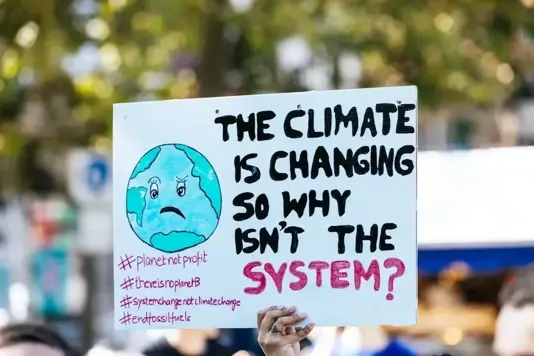
Who cares? Everyone should.
By Kenneth J. Davis, Penn State / The Conversation /
Editor’s Note, Making the Connections
This analysis by Professor Davis is full of good information. However, it does not tell the full story and is therefore misleading regarding U.S. responsibility for CO2 emissions. The U.S. military has approximately 1000 bases worldwide. These bases are large emitters of CO2 emissions from vehicles, tanks, etc., but the worst emitters are the jet planes. This information is documented by a study done by Neta C. Crawford in research at Brown University* and in her book The Pentagon, Climate Change, and War: Charting the Rise and Fall of U.S Military Emissions, MIT Press, 2022, pp.147-148 and 154-156.
February 28, 2026
According to PBS news Israel and the U.S. have attacked Iran, using U.S. 200 fighter jets that made 500 hits.
Democracy Now! reports that Israeli-U.S. airstrikes across Iran have killed to date (3/2/2026) 550 people including bombing a girl’s school. Iranian Supreme Leader Ayatollah and family members and other officials have been killed as well.
The strike was not approved by the U.S. Congress or the U.N. Security Council. Widening to a regional war, bombing throughout the Middle East has also taken place. Trump has threatened that the bombings may go on for weeks.
Trump’s “strong man” authoritarian approach to global politics includes his build-up of the military as a solution to all problems if he cannot “make a deal.” In his mental processes he does not understand any need for accountability. As Col. Smedley Butler once said, War is Hell.
Detached from reality and tucked away in his golden dream, Trump has no concept of morality. He does not care that people, citizens of Iran and other Middle Eastern countries were killed and injured in the strike any more than he cares about the many thousands of death in Palestine/Gaza or the callousness of ICE or the Border Patrol in the U.S. Nor does he care in the U.S about the many people due to lose Medicare, Medicaid and other benefits or the people who have lost their jobs or have to work two jobs make ends meet with the incremental increase in the cost of everything, including food and rent, due to inflation and his tariffs; ultimately it is the taxpayer who has to pay.
*Neta Crawford’s research, primarily conducted for the Costs of War Project at Brown University’s Watson Institute for International and Public Affairs, has established that the U.S. Department of Defense is the world’s largest institutional user of petroleum and, consequently, one of the largest producers of greenhouse gases. (AI Overview, Google)
Why is understanding the role of the U.S. military in the climate crisis important?
Davis’s final chart shows more emissions from the U.S. than any other country. If he includes jet fuel under any of the categories of emissions for the U.S. he does not mention it specifically in his global analysis.
The gas and oil industry as well as those who see China as a U.S. arch enemy promote a narrative that does not tell the full story. Since Crawford’s book was published China has made strides in using solar power and other methods to cut CO2 emissions. Smaller countries are also creating innovative ways to create sustainable energy and put the U.S. to shame in their creativity. Under the Trump regime fracking and the use of oil-based energy has increased to feed the oil pipeline and the greed of the gas and oil industry and also the weapons industry and million/billion-aires in the U.S. and by multinationals; several are U.S. based.
The Trump regime’s latest disaster (one of many) in the Reign of Terror is to repeal EPA standards that were set up by President Biden around energy. The repeal now allows the gas and oil industry, which is coupled with the U.S. military, free rein. What is usually not discussed is CO2 and the climate crisis and the dependence of the U.S. military on gas and oil.
Making the connections between the U.S. military and the global domination and hegemony Trump craves is an essential key in driving down carbon emissions and saving the planet. The future of the planet depends on making those connections and reining in the hyper-military “strong man” authoritarian approach of Donald Trump and seeking non-violent solutions to global peace.
Article by Professor Davis
Vehicles, energy production and industry are the largest emissions
sources in the U.S.© David McNew/Getty Images
Earth’s atmosphere contains carbon dioxide, which is good for life on Earth – in moderation. Plants use CO2 as the source of the carbon they build into leaves and wood via photosynthesis. In combination with water vapor, CO2 insulates the Earth, keeping it from turning into a frozen world. Life as we know it on Earth would not exist without CO2 in the atmosphere.
Since the industrial revolution began, however, humans have been adding more and more carbon dioxide to the Earth’s atmosphere, and it has become a problem.
The atmospheric concentration of CO2 has risen by more than 50% since industries began burning coal and other fossil fuels in the late 1700s, reaching concentrations that haven’t been found in the Earth’s atmosphere in at least a million years. And the concentration continues to rise.
Excess CO2 drives global warming
Who cares? Everyone should.
More CO2 in the air means temperatures at the Earth’s surface rise. As temperature rises, the water cycle accelerates, leading to more floods and droughts. Glaciers melt, and warmer ocean water expands, raising sea levels.
We are living with an increasing frequency or intensity of wildfires, heat waves, flooding and hurricanes, all influenced by increasing CO2 concentrations in the atmosphere.
The ocean also absorbs some of that CO2, making the water increasingly acidic, which can harm species crucial to the marine food chain.
Where is this additional CO2 coming from?
The biggest source of additional CO2 is the combustion of fossil fuels – oil, natural gas and coal – to power vehicles, electricity generation and industries. Each of these fuels consists of hydrocarbons built by plants that grew on the Earth over the past few hundred million years.
These plants took CO2 out of the planet’s atmosphere, died, and their biomass was buried in water and sediments.
Today, humans are reversing hundreds of millions of years of carbon accumulation by digging these fuels out of the Earth and burning them to provide energy.
Let’s dig a little deeper.
Where do CO2 emissions come from in the US?
The Environmental Protection Agency has tracked U.S. greenhouse gas emissions for years.
The U.S. emitted 5,053 million metric tons of CO2 into the atmosphere in 2022, the last year for which a complete emissions inventory is available. We also emit other greenhouse gases, including methane, from natural gas production and animal agriculture, and nitrous oxide, created when microbes digest nitrogen fertilizer. But carbon dioxide is about 80% of all U.S. greenhouse gas emissions.
Of those 5,053 million metric tons of CO2 emitted by the U.S. in 2022, 93% came from the combustion of fossil fuels.
Where America’s CO emissions come from – what you need to know, in charts
More specifically: about 35% of the CO2 emissions were from transportation, 30% from the generation of electric power, and 16%, 7% and 5% from on-site consumption of fossil fuels by industrial, residential and commercial buildings, respectively. Electric power generation served industrial, residential and commercial buildings roughly equally.
What fossil fuels are being burned?
Transportation is dominated by petroleum products, or oil – think gasoline and diesel fuel.
Nationwide, power plants consume roughly equal fractions of coal and natural gas. Natural gas use has been increasing and coal decreasing in this sector, with this trend driven by the rapid expansion of the shale gas industry in the U.S.
How poisonous mercury can get from coal-fired power plants into the fish you eat – Trump’s EPA plans to weaken emissions rules meant to lower the risk
U.S. forests are removing CO2 from the atmosphere, but not rapidly enough to offset human emissions. U.S. forests removed and stored about 920 million metric tons of CO2 in 2022.
How US CO2 emissions have changed
Emissions from the U.S. peaked around 2005 at 6,217 million metric tons of CO2. Since then, emissions have been decreasing slowly, largely driven by the replacement of coal by natural gas in electricity production.
Some additional notable trends will impact the future:
First, the U.S. economy has become more energy efficient over time, increasing productivity while decreasing emissions.
Where America’s CO emissions come from – what you need to know, in charts.
Second, solar and wind energy generation, while still a modest fraction of total energy production, has grown steadily in recent years and emits essentially no CO2 into the atmosphere. If the nation increasingly relies on renewable energy sources and reduces burning of fossil fuels, it will dramatically reduce its CO2 emissions.
Solar and wind energy became cheaper as a new energy source than natural gas and coal, but the Trump administration is cutting federal support for renewable energy and is doubling down on subsidies for fossil fuels. The growth of data centers is also expected to increase demand for electricity. How the U.S. meets that demand will impact national CO2 emissions in future years.
How US emissions compare globally
The U.S. ranked second in CO2 emissions worldwide in 2022, behind China, which emitted about 12,000 million metric tons of CO2. China’s annual CO2 emissions surpassed U.S. emissions in 2005 or 2006. NOTE:
China’s influence grows at COP29 climate talks as US leadership fades
Added up over time, however, the U.S. has emitted more CO2 into the atmosphere than any other nation, and we still emit more CO2 per person than most other industrialized nations. Chinese and European emissions are both roughly half of U.S. emissions on a per capita basis.
Where America’s CO emissions come from – what you need to know, in charts
Greenhouse gases in the atmosphere mix evenly around the globe, so emissions from industrialized nations affect the climate in developing countries that have benefited very little from the energy created by burning fossil fuels.
The takeaway
There have been some promising downward trends in U.S. CO2 emissions and upward trends in renewable energy sources, but political winds and increasing energy demands threaten progress in reducing emissions.
Reducing emissions in all sectors is needed to slow and eventually stop the rise of atmospheric CO2 concentrations. The world has the technological means to make large reductions in emissions. CO2 emitted into the atmosphere today lingers in the atmosphere for hundreds to thousands of years. The decisions we make today will influence the Earth’s climate for a very long time.
This article is republished from The Conversation, a nonprofit, independent news organization bringing you facts and trustworthy analysis to help you make sense of our complex world. It was written by: Kenneth J. Davis, Penn State
Read more:
Kenneth J. Davis does not work for, consult, own shares in or receive funding from any company or organization that would benefit from this article, and has disclosed no relevant affiliations beyond their academic appointment.
Wings of Change is entirely reader supported.
Wings invites you to subscribe.
To subscribe: Join us on Wings of Change
In this critical time hearing voices of truth is all the more important although censorship and attacks on truth-tellers are common. Support WingsofChange.me as we bring you important articles and journalism beyond the mainstream corporate media on the Wings of Change website and Rise Up Times on social media. Donate now to sustain Wings of Change.
Access is always free, but if you would like to help:
A donation of $25 or whatever you can donate will bring you articles and opinions from independent websites, writers, and journalists as well as a blog with the opinions and creative contributions by myself and others.
Join us on Wings of Change
We still have much work to continue to do as many activists and organizations address current threats to our democracy and unjust actions against people of color and are making plans for the upcoming years. Wings of Change is a part of that work through education, information, and inspiration. Here in Minnesota we are particularly targeted by the Trump regime with ICE immigrant law enforcement illegally arresting and deporting our neighbors who are mostly people of color. In spite of promises to withdraw ICE, the arrests continue. Other cities have been targeted as well, and they will try to target more to fill the detention centers they are building all over the country.
Sue Ann Martinson, Editor 
“We don’t have to engage in grand, heroic actions
to participate in the process of change.
Small acts, when multiplied by millions of people,
can transform the world.”
— Howard Zinn