
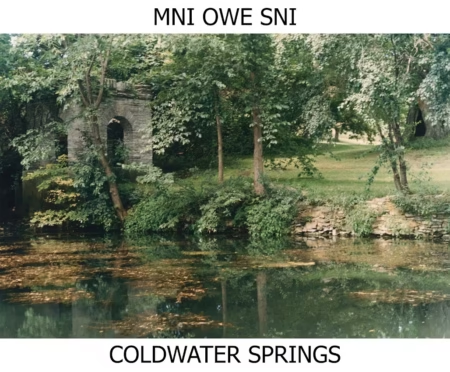
Water, Dog-Lovers, Dakota Indians and the Law
By Susu Jeffrey / Original to Wings of Change / July 5, 2026
On June 17, the Minneapolis Park and Recreation Board voted to revoke the very popular Minnehaha Off-Leash Dog Park, effective at the end of 2026. It was inevitable. The Park Board meeting was standing room only and as emotional as grand opera.
More than 30, mostly dog-lovers, signed up to speak and were allotted one minute each. A lot of passion was packed into those single minutes, punctuated with applause, sign waving, cheers, tears, curses and audience do-se-do-ing. We heard that dogs are not illegal, dogs are a part of the family, my dog is my best friend and I met my husband at the dog park. The dog park is a way of life.
Overexploitation of Resources
Minnehaha Off-Leash Dog Park access begins at the top of the Mississippi River gorge and descends a quarter mile to the muddy riverbank. It is dog heaven—no leash, water, playmates. For people it is the end of the day, social time, exercise, therapy.
As soon as the National Park Service opened Coldwater Park in 2012 human resistance to dog traffic began. Dog walkers switched from paid parking at the south end of Minnehaha Park to free parking at Coldwater, just a half mile down the access road parallel to Highway 55. Dogs leapt from cars into the grass, pooped, and raced down to the Mississippi.
The word went out to the dog-walk community. Phooey to the law that states “all dogs must be on a leash no longer than six feet.” How can you leash a dog that’s already halfway to the river much less pick up after it? The National Park folks tried furnishing trash cans and then plastic baggies to no avail. It was disgusting. It was a dog waste field just a seven-minute walk to the outflow of 10,000-year-old sacred Coldwater Springs.
Back when what is now Mni Owe Sni (water-spring-cold) Park was still a Cold War federal research campus the No Trespass government land was protected by a 6-foot chain link fence topped with little steel barbed twist ties. After 1955 there was one (1) emergency that allowed the public inside the locked gates. “In 1976 after months of draught,” wrote Carolyn Lyschik (10/21/2006) then of Minneapolis, “the city water developed an alga that was putrid and undrinkable by my husband who was very ill at the time. I made trips every other day to Coldwater Spring and stood in line to get the best tasting fresh water. We were so thankful for this vital resource. If it is still not polluted it should be a National Treasure!”
The Cold War ended with the 1991 collapse of the Soviet Empire and the Twin Cities U.S. Bureau of Mines research center (a Senator Hubert Humphrey project) shuttered. Coldwater’s privacy fencing was removed. In 1992 the Minnehaha Off-Leash Dog Park opened. Gradually the public explored the open land between Minnehaha Regional Park and federal Coldwater and Fort Snelling land. In 2010 Coldwater Park (a project of Congressman Martin Sabo) opened under the same name it had been known as from the 1880s to 1950.
From the Mississippi to the top of the river gorge public parkland stretched from Minnehaha Falls past Coldwater Springs to Fort Snelling. Since the first Minneapolis dog park in 2001 their popularity mushroomed. However the dog park at Rev. Dr. Martin Luther King Jr. Park in Minneapolis was closed for cultural insensitivity. Dogs were sicced on Indian people too. In recent news Israeli prisoners have reported dogs trained to rape prisoners. Dog reputations range from life-threatening to warm and fuzzy.
Opening Coldwater Park relieved pressure on Minnehaha dog park access overuse but city park and national park people wanted to educate people about the geologic and human history of the place. Imagine National Park Service dog poop strategy meetings.
At first it was reduced free parking from a dozen spots to four cars with legal handicapped signs hanging from a rearview mirror. Then pay-parking meters lined the access road from Minnehaha Regional Park to the Coldwater entrance where park police patrolled for enforcement via fines. Signage was posted at the Coldwater Spring House outflow warning that the spring water’s safety was questionable. Some dogs jumped into the reservoir but it is about five feet deep and offers little leverage for climbing out. No, the dog park on the Mississippi bank was the draw for dogs and their people.
Coldwater: literally the Birthplace of the State of Minnesota where the soldiers who built Fort Snelling camped 1820-23 and then a civilian community grew to service the fort; source for the army post’s potable water supply for nearly a century; Mississippi bluff-top land saved from becoming an airport off-site parking lot by a 17-month (1998-99) youth-led encampment that even 802 police could not dislodge. Coldwater then devolved into a squat-stop on the way to the Mississippi River dog park.
Meanwhile Standing Rock resistance to the Dakota Access Pipeline (2016-17) erupted on the border of North and South Dakota with the next generation of American Indian leadership. They did not win but they were speaking up and being heard.
In 2023 Minnesota’s four legally recognized Dakota tribal governments filed paperwork with the National Park Service to recognize Coldwater as “Traditional Cultural Property.” In other words, sacred to the Dakota oyate (nation).
The “Pike” Treaty of 1805
The Minneapolis Park Board “had no authority to decide who could use” the land currently called the Minnehaha Off-Leash Dog Park is because that land never legally belonged to the United States of America.
The 1805 Treaty With the Sioux (aka “the Pike Treaty”) was never proclaimed by the U.S. President, a necessary step in making treaties official. Therefore that treaty is not valid now and never was. This issue is not like common law marriage; this is federal treaty law.
Sometimes Indigenous people call treaties “TP” as in toilet paper. Psychologists might call American Indian treaties wishful thinking from the perspective of white men writing laws on paper. Clearly Natives were encouraged to believe guarantees as real and enforceable. The dominant culture gave Indian treaties the longevity of writing in sand. Native practice made understandings concrete through ceremony. Legally this land is still Dakota territory where Dakota customs make verbal agreements binding.
The 1805 Treaty With the Sioux was never proclaimed by the U.S. President, a necessary step in making treaties official. That treaty is not valid now and never was.
The Language of the “Treaty With the Sioux’
“The Sioux Nation grants unto the United States for the purpose of the establishment of military posts…from below the confluence of the Mississippi and St. Peters [Minnesota], up the Mississippi, to include the falls of St. Anthony, extending nine miles on each side of the river…the full sovereignty and power…forever… which when ratified and approved of by the proper authority, shall be binding.”
But it was never approved by the proper authority. Furthermore 21-year-old Lt. Zebulon Pike did not have the authority to treat with the Sioux nation.
In Article 3 of the treaty “The United States promise on their part to permit the Sioux to pass, repass, hunt or make other uses of the said districts, as they have formerly done….”
Indian treaties have been disregarded and overwritten by each wave of manifest destiny. In Minnesota after the six-week Dakota Uprising in 1862, the mass hanging of 38 Dakota men in Mankato the day after Christmas, the expulsion of all Dakota and Ho Chunk people from the state, and the state’s offer of $200 cash for each Indian scalp delivered into the 1900s—well, the Indian problem quieted.
The American Indian Movement was founded in 1968 in Minneapolis. Civil rights attorney, the late Larry Leventhal, activated the new generation of warriors by simply giving them a copy of the 1805 Treaty With the Sioux.
The Minneapolis Park Board did the right thing by closing the off-leash dog park. They made the closing “legal.” The courts will increasingly be challenged to wrestle with original American treaty law as clean water becomes more scarce. We’ll see how long the “Pike” Treaty survives in an evolving courts system. Mni Owe Sni, listed in the National Register of Historic Places, encompasses the spring itself and the surrounding landscape down to the riverbank.
In October 2005 two Dakota Natives and one non-native were ticketed at Coldwater Spring by federal authorities for “failure to obey a legal order.” “It was not a legal order,” said attorney Larry Leventhal because the Pike Treaty of 1805 was never reified.
Defe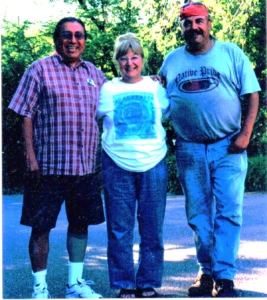 ndants in the 1805 Treaty trial (l. to r.) Chris Mato Nunpa (Two Bears), an elder from Upper Sioux Reservation along the Minnesota River in Granite Falls, a Dakota first language speaker; Susu Jeffrey, FriendsofColdwater.org, and Jim Redsky Anderson, historian for the Mendota Mdewakanton Dakota Community.
Had the case gone to trial the federals could lose nine miles of land on either side of the Mississippi from the confluence of the Minnesota and Mississippi (the b’dota) upstream to the falls called St. Anthony. That would mean losing Minneapolis, a chance the U.S. government did not want to take.
This legality is the seed of the Dakota Land Back argument. Leventhal said the October 2005 “failure to obey a legal order” case was the third time the question of the legality of the 1805 “Pike” treaty reached federal court, only to have charges dismissed rather than to possibly lose Minneapolis, economic engine of Minnesota, to the Dakota oyate (nation).
The Worldwide Water Crisis Comes Home
In 1880 the Coldwater reservoir could furnish 921,600 gallons of water pumped out daily. (Historical Study, Former U.S. Bureau of Mines, Twin Cities Research Center, final report by Barbara J. Henning, 10/2002, p. 22.) The next flow rate measure was reported in the early 1990s with the Highway 55 reroute dispute as 130,00 gallons per day (gpd). In the intervening century-plus ten years “development” occurred with the loss of 791,000 gpd. More recently the 2024 Minnesota National River and Recreation Area flow rate for Coldwater Spring for the year 2024 was 69,552 gpd.
Unfortunately, the Great Medicine Spring in Minneapolis’ Theodore Wirth Park was dewatered for Interstate-394 in the 1980s. Native people were known to come from “hundreds of miles” to collect the healing properties of that medicine, now forever gone. The only other major water source in Hennepin County is Frederick Miller Spring in Eden Prairie, which was recently saved from another upscale housing development.
But for the people of Minneapolis only the much-reduced Mni Owe Sni, Coldwater, still flows. The ultimate irony of closing the dogs’ favorite dog park is that saving Coldwater Spring was the initiative of dog walkers throughout the 1990s. Hundreds and hundreds of signatures were collected by Park and River Alliance but no government office would accept the pile of citizen paperwork. The Alliance filed a lawsuit against the Highway 55 “reroute” through Minnehaha Park land and trees. The suit was dismissed on a technicality.
“…Dogs are likely more sensitive than humans” to E.coli and blue green algae. Apparently, the Minneapolis Chain of Lakes is not clean enough for dogs.
While Park Board Commissioners voted out the Minnehaha Off-Leash Dog Park members repeatedly assured dog lovers that a new park featuring water would be on their to-do list. The problem is that the frequent toxicity of Minneapolis Lakes closes beaches with E.coli concentrations and blue-green algae blooms that sicken children and can quickly kill dogs.
In a park commissioners’ move to mollify dog lovers, a new water park for dogs, probably at one of the lakes, would be located and opened. However Michael Sorenson, Water Resources Lead for the Minneapolis Park Board, says “it’s safest to keep dogs out of lakes. Dogs are likely more sensitive than humans” to E.coli and blue green algae. Apparently, the Minneapolis Chain of Lakes is not clean enough for dogs. He suggests giving dogs tap water to drink right before allowing them in a lake.
In a park commissioners’ move to mollify dog lovers a new water park for dogs, probably at one of the lakes, would be located and opened. However Michael Sorenson, Water Resources Lead for the Minneapolis Park Board, says “it’s safest to keep dogs out of lakes. Dogs are likely more sensitive than humans” to E.coli and blue green algae. Apparently, the Minneapolis Chain of Lakes is not clean enough for dogs. He suggests giving dogs tap water to drink right before allowing them in a lake.
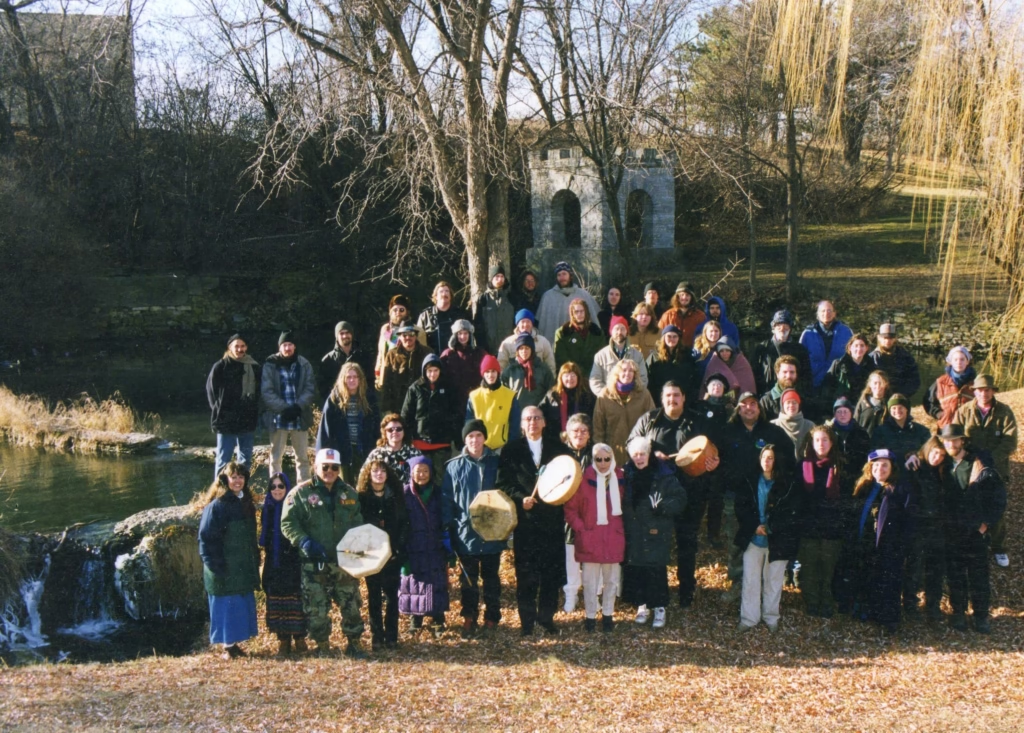
Coldwater Nation at the pond and Spring House, 12/17/1999
Photo: Dick Bancroft
Coldwater is a survivor of the Highway 55 “reroute” dispute that resulted in the 17-month “Minnehaha Free State” encampment. Stop the Reroute/Save the Park featured the largest police action in Minnesota at the time with 802 officers arresting 38 land defenders at a cost of $15,000 per arrest during a blizzard on Christmas week 1998.
The combination of earth protectors with federally recognized Indian leaders proved expensive for the city of Minneapolis, Hennepin County, the state of Minnesota, especially the Department of Transportation, but Coldwater
became a popularity bonanza against government overreach. Two books and a movie documented the struggle and energized the Environment-Indian entente.
The late Eddie Benton-Benai, a fullblood Anishinaabe from northern Wisconsin and Grand Chief of the Mdewiwin Lodge (Medicine Society), said the following in court-ordered testimony on 3/19/99. (Transcribed by Susu Jeffrey from an audio-visual tape of the testimony filmed by Michael Scott, documentarian, Mendota Mdewakanton Dakota Community.}
“We know that the falls which came to be known as Minnehaha Falls, was a sacred place, was a neutral place, a place for many nations to come. Between the falls and that point [where the rivers meet] there were sacred grounds that were mutually held to be a sacred place. And that all nations used to draw the sacred water for the ceremony.”
Benai continued, “My grandfather who lived to be 108, died in 1942 [born 1834]. Many times he retold how we traveled, how he and his family, he as a small boy traveled by foot, by horse, by canoe to this great place to where there would be these great religious, spiritual events. And that they always camped between the falls and the sacred water place.”
Benai identified the Anishinabe (Ojibwe) along with the Dakota Nation, the Sauk and Fox (Mesquakie), and the Pottawattamie as mutually using the land and agreeing “that it is forever a neutral place and forever a sacred place.”
Susu Jeffrey is a poet and writer living in Minneapolis.
Wings of Change is entirely reader supported.
Wings invites you to subscribe.
To subscribe: Join us on Wings of Change
In this critical time hearing voices of truth is all the more important although censorship and attacks on truth-tellers are common. Support WingsofChange.me as we bring you important articles and journalism beyond the mainstream corporate media on the Wings of Change website and Rise Up Times on social media. Donate now to sustain Wings of Change.
Access is always free, but if you would like to help:
A donation of $25 or whatever you can donate will bring you articles and opinions from independent websites, writers, and journalists as well as a blog with the opinions and creative contributions by myself and others.
Join us on Wings of Change
We still have much work to continue to do as many activists and organizations address current threats to our democracy and unjust actions against people of color and are making plans for the upcoming years. Wings of Change is a part of that work through education, information, and inspiration.
Sue Ann Martinson, Editor 
“We don’t have to engage in grand, heroic actions
to participate in the process of change.
Small acts, when multiplied by millions of people,
can transform the world.”
— Howard Zinn