Trump’s lies about Springfield’s immigrants eating dogs and cats…
Today in Politics / Explainer The Upcoming Election Campaign, the Epstein Files, and more…
Heather Cox Richardson is an American historian who works as a professor of history at Boston College, where she teaches courses on the American Civil War, the Reconstruction Era, the American West, and the Plains Indians. She previously taught history at MIT and the University of Massachusetts Amherst. Richardson has authored seven books on history and politics. In 2019, she started publishing Letters from an American, a nightly newsletter that chronicles current events in the larger context of American history. Richardson focuses on the health of American democracy. As of July 2025, the newsletter had over 2.6 million subscribers, making it one of the most popular Substack publications.
As a historian, Richardson advocates studying history to learn how to distill complex situations into something easier to understand. She does this through her newsletters, books, and podcasts. (Wikipedia)
Wings of Change is entirely reader supported.
Wings invites you to subscribe. To subscribe: Join us on Wings of Change
In this critical time hearing voices of truth is all the more important although censorship and attacks on truth-tellers are common. Support WingsofChange.me as we bring you important articles and journalism beyond the mainstream corporate media on the Wings of Change website and Rise Up Times on social media. Donate now to sustain Wings of Change.
Access is always free, but if you would like to help:
A donation of $25 or whatever you can donate will bring you articles and opinions from independent websites, writers, and journalists as well as a blog with the opinions and creative contributions by myself and others.
We still have much work to continue to do as many activists and organizations address current threats to our democracy and unjust actions against people of color and are making plans for the upcoming years. Wings of Change is a part of that work through education, information, and inspiration. Here in Minnesota we are particularly targeted by the Trump regime with ICE immigrant law enforcement illegally arresting and deporting our neighbors who are mostly people of color. In spite of promises to withdraw ICE, the arrests continue. Other cities have been targeted as well, and they will try to target more to fill the detention centers they are building all over the country.
Sue Ann Martinson, Editor
“We don’t have to engage in grand, heroic actions
to participate in the process of change. Small acts, when multiplied by millions of people,
can transform the world.” — Howard Zinn
The unprecedented ICE surge has the hallmarks of an occupation in some neighborhoods, as masked and heavily armed agents drive around in large SUVs, tussle with protesters and observers, and break into people’s cars and houses to make arrests. —Axios
By Susu Jeffrey / Original to Wings of Change / March 2, 2026
What an honor when The Nation nominated Minneapolis for the 2026 Nobel Peace Prize! The initial butterfly-in-the-stomach thrill dissipated with the thought of what President Trump would do (next) if we got his award. The revenge-dealing, super bully apparently stays awake imagining schemes on his social media site while we make new signs for the next NO KINGS demonstration and grocery lists for shut-in neighbors.
NO HATE, NO FEAR! IMMIGRANTS ARE WELCOME HERE! In Minneapolis hard times make good neighbors.If we want to eat tomatoes or reroof our buildings we need to pay local people willing to do the work. The law of economics requires low wage, compliant workers in Minneapolis like every other American city. We need childcare, eldercare, healthcare, farm workers, meat packers, independent restaurants and all the oil that lubricates western society where the dream of a richer future is the hook.
The Americana rainbow of Minneapolis is like “Eat Street,” (Nicollet Avenue and 26th Street) where Alex Pretti was shot to death by federal agents. My favorite restaurant is across the street from the people’s Alex Pretti memorial. They serve Vietnamese pho soup and cream cheese wontons or you could go donuts-coffee and local bands, Mexican, Vietnamese-French-bread sandwiches, Greek, Middle East, Malaysian, pizza or burgers and fries. Minneapolis has the population of a stew, a toothsome mix of ingredients harmonizing in one pot.
Why Minneapolis?
Why did President Trump decide to sic ICE (Immigration and Customs Enforcement) and Border Control (Customs and Border Control) on the Twin Cities of Minneapolis-St. Paul? Minnesota is the state that ranks 28th among the 50 United States hosting “illegal aliens”? Trump has a perfect zero political success rating here; he does not study history (for example George Floyd) and he has difficulty separating his ego from reality.
Since the 1934 truckers strike where two people were shot dead by zealous enforcers (sound familiar) the Minneapolis model of citizen support for everyday people’s rights has echoed across the nation. The appalling executions of Renee Good and Alex Pretti caused Gov. Tim Walz to label the president’s agents “untrained, aggressive” and noted that Trump “picked the wrong state to make an example of.” (CBS nightly news). This comment from the vice-presidential candidate who charmed his way through the 2024 campaign like a fatherly and practical human being who doesn’t lie.
Part of the Minneapolis social scene is political activism. Minneapolis-based peace groups were associated with the 1997 Nobel Peace Prize nomination for the Campaign to Ban Landmines and the 2017 prize to ICAN, the International Campaign to Abolish Nuclear Weapons.
Furthermore Minnesota has the highest voter turnout in the nation. The midterm elections are coming up in November this year. Statistically the president’s party loses congressional seats in the midterms.
Since December 1, 2025, the 3,000 Gestapo agents of Operation Metro Surge made 4,000 arrests (they had a 2,000 per day quota) which the existing incarceration and judicial systems could not process. Among the innocent victims were two Native American children (to which rez would they be extradited), 5-year-old Liam Ramos in his blue bunny hat, and an Asian man wearing handcuffs, boxer shorts and plastic slip-on shoes in minus 9-degree weather who lived in a house formerly occupied by a man already in prison.
ICE Agent Who Shot Renee Good Self-Deports
Jonathan Ross and his second wife
Image: Daily Mail
Masked agents move household items from the Ross home. Image: Daily Mail
Agent Ross, 43, of Chaska, Minnesota, an upscale southwest Minneapolis suburb, fled his half-million-dollar home with his family after shooting Renee Good to death on January 7. He was quickly identified. Two nights after Ross killed Renee Good a Special Response Team in masks was seen removing boxes including electronics and family photos from Ross’s home. Ross told neighbors he was a biologist. Neighbors described him as a hardcore MAGA supporter. His father labelled him a “conservative Christian.”
The last words Renee Good spoke was to tell Ross “I’m not mad at you” while he circled her car making a video. Then there were shots and Ross is heard saying “f—ing bitch.”
Renee as captured by Ross’s camera just before he executed her. Image Wikipedia
“They had guns. We had whistles,” said Renee Good’s widow.
On the night of February 17 the Renee Good sidewalk flower bedecked memorial between 33rd and 34th Streets on Portland Avenue South was sprinkled with gasoline and set afire. A volunteer night guard discouraged the arson vandals, preventing damage from spreading.
National Public Radio’s 1A program (1-1-2026) noted the frequency of the president’s people “ignoring judicial orders. The Trump administration doesn’t follow laws they don’t like.”
So pooh-pooh to the laws of God and the State. Still, most of us await the arrests of Jonathan Ross and Texas-based Border Patrol agents Jesus Ochoa, 43, and Raymundo Gutierez, 35, for the first-degree murders (intentional killing) of Renee Good and Alex Pretti.
What is To Be Done?
Vote.
ICE’s budget has metastasized from $10 billion to $85 billion. “They have the kind of budget you would give to a standing army to fight an actual war,” David Miller wrote on Facebook. Miller advocates “neighborism.”
Congress controls the budget, “the power of the purse.” Congress can also impeach. Trump was impeached twice during his first term.
First Trump was impeached by the House of Representatives for “incitement of insurrection” of the January 7th rebellion in and around the Capitol building which was thoroughly filmed. However our 100 U.S. senators failed to reach the required 66 votes getting just 57 votes for inciting an insurrection.
Then the state of Georgia impeached Trump for his post-election interference: “I just want to find 11,780 votes….” But that effort was dismissed by the Department of Justice policy of avoiding to prosecute a sitting president.
On January 28, 2026, the FBI seized those 2020 ballots from the Biden/Trump Fulton County Georgia elections warehouse even though they had been counted and recounted three times, by hand and by machine. Trump’s inability to accept his failed reelection bid bodes ill for the upcoming 2026 midterm elections. It is a nutter world when black and white paper proof translates into Alice in Wonderland technicolor.
In reality it’s another practice run by Trump at not believing our lying eyes. Here are the videos, here are the ballots. Minnesota is a voting state. Voting is a form of neighborism.
It feels good to vote, especially in overwhelming numbers, and you get one of those little red I VOTED stickers.
Voting feels like I-AM-DOING-SOMETHING:
I AM — SOMEBODY (A chant made famous by Jesse Jackson)
It is the next step after 100,000 people marched against Operation Metro “Siege.” The crowd was so dense an American flag-carrying friend said it almost felt claustrophobic.
The comb-overs, Trump, Putin and Netanyahu, plan to divide up the world with their bombs and guys in masks with guns. Look again at those old men hiding their shiny pates, white-knuckled trying to hold onto their fictions. America has been multicultural since the Vikings and the Conquistadores invaded. What would baseball be without immigrants?
George Floyd, Renee Good, Alex Pretti
George Floyd’s murder by Minneapolis policeman Derek Chauvin put him in prison for 22.5 years and that was for “unintentional” murder, murder two. The murder one, intentional killings using three bullets for Renee Good and nine or ten bullets to execute Alex Pretti are proof of intention.
“Democracy is stronger than fear,” says Minnesota state Sen. John Hoffman, who survived an eight-bullet assassination attempt. Hoffman has just returned to his seat in the state capitol.
Wings of Change is entirely reader supported.
Wings invites you to subscribe. To subscribe: Join us on Wings of Change
In this critical time hearing voices of truth is all the more important although censorship and attacks on truth-tellers are common. Support WingsofChange.me as we bring you important articles and journalism beyond the mainstream corporate media on the Wings of Change website and Rise Up Times on social media. Donate now to sustain Wings of Change.
Access is always free, but if you would like to help:
A donation of $25 or whatever you can donate will bring you articles and opinions from independent websites, writers, and journalists as well as a blog with the opinions and creative contributions by myself and others.
We still have much work to continue to do as many activists and organizations address current threats to our democracy and unjust actions against people of color and are making plans for the upcoming years. Wings of Change is a part of that work through education, information, and inspiration. Here in Minnesota we are particularly targeted by the Trump regime with ICE immigrant law enforcement illegally arresting and deporting our neighbors who are mostly people of color. In spite of promises to withdraw ICE, the arrests continue. Other cities have been targeted as well, and they will try to target more to fill the detention centers they are building all over the country.
Sue Ann Martinson, Editor
“We don’t have to engage in grand, heroic actions
to participate in the process of change. Small acts, when multiplied by millions of people,
can transform the world.” — Howard Zinn
This analysis by Professor Davis is full of good information. However, it does not tell the full story and is therefore misleading regarding U.S. responsibility for CO2 emissions. The U.S. military has approximately 1000 bases worldwide. These bases are large emitters of CO2 emissions from vehicles, tanks, etc., but the worst emitters are the jet planes. This information is documented by a study done by Neta C. Crawford in research at Brown University* and in her book The Pentagon, Climate Change, and War: Charting the Rise and Fall of U.S Military Emissions, MIT Press, 2022, pp.147-148 and 154-156.
February 28, 2026
According to PBS news Israel and the U.S. have attacked Iran, using U.S. 200 fighter jets that made 500 hits.
Democracy Now! reports that Israeli-U.S. airstrikes across Iran have killed to date (3/2/2026) 550 people including bombing a girl’s school. Iranian Supreme Leader Ayatollah and family members and other officials have been killed as well.
The strike was not approved by the U.S. Congress or the U.N. Security Council. Widening to a regional war, bombing throughout the Middle East has also taken place. Trump has threatened that the bombings may go on for weeks.
Trump’s “strong man” authoritarian approach to global politics includes his build-up of the military as a solution to all problems if he cannot “make a deal.” In his mental processes he does not understand any need for accountability. As Col. Smedley Butler once said, War is Hell.
Detached from reality and tucked away in his golden dream, Trump has no concept of morality. He does not care that people, citizens of Iran and other Middle Eastern countries were killed and injured in the strike any more than he cares about the many thousands of death in Palestine/Gaza or the callousness of ICE or the Border Patrol in the U.S. Nor does he care in the U.S about the many people due to lose Medicare, Medicaid and other benefits or the people who have lost their jobs or have to work two jobs make ends meet with the incremental increase in the cost of everything, including food and rent, due to inflation and his tariffs; ultimately it is the taxpayer who has to pay.
*Neta Crawford’s research, primarily conducted for the Costs of War Project at Brown University’s Watson Institute for International and Public Affairs, has established that the U.S. Department of Defense is the world’s largest institutional user of petroleum and, consequently, one of the largest producers of greenhouse gases. (AI Overview, Google)
Why is understanding the role of the U.S. military in the climate crisis important?
Davis’s final chart shows more emissions from the U.S. than any other country. If he includes jet fuel under any of the categories of emissions for the U.S. he does not mention it specifically in his global analysis.
The gas and oil industry as well as those who see China as a U.S. arch enemy promote a narrative that does not tell the full story. Since Crawford’s book was published China has made strides in using solar power and other methods to cut CO2 emissions. Smaller countries are also creating innovative ways to create sustainable energy and put the U.S. to shame in their creativity. Under the Trump regime fracking and the use of oil-based energy has increased to feed the oil pipeline and the greed of the gas and oil industry and also the weapons industry and million/billion-aires in the U.S. and by multinationals; several are U.S. based.
The Trump regime’s latest disaster (one of many) in the Reign of Terror is to repeal EPA standards that were set up by President Biden around energy. The repeal now allows the gas and oil industry, which is coupled with the U.S. military, free rein. What is usually not discussed is CO2 and the climate crisis and the dependence of the U.S. military on gas and oil.
Making the connections between the U.S. military and the global domination and hegemony Trump craves is an essential key in driving down carbon emissions and saving the planet. The future of the planet depends on making those connections and reining in the hyper-military “strong man” authoritarian approach of Donald Trump and seeking non-violent solutions to global peace.
Earth’s atmosphere contains carbon dioxide, which is good for life on Earth – in moderation. Plants use CO2 as the source of the carbon they build into leaves and wood via photosynthesis. In combination with water vapor, CO2 insulates the Earth, keeping it from turning into a frozen world. Life as we know it on Earth would not exist without CO2 in the atmosphere.
Since the industrial revolution began, however, humans have been adding more and more carbon dioxide to the Earth’s atmosphere, and it has become a problem.
The atmospheric concentration of CO2 has risen by more than 50% since industries began burning coal and other fossil fuels in the late 1700s, reaching concentrations that haven’t been found in the Earth’s atmosphere in at least a million years. And the concentration continues to rise.
Excess CO2 drives global warming
Who cares? Everyone should.
More CO2 in the air means temperatures at the Earth’s surface rise. As temperature rises, the water cycle accelerates, leading to more floods and droughts. Glaciers melt, and warmer ocean water expands, raising sea levels.
We are living with an increasing frequency or intensity of wildfires, heat waves, flooding and hurricanes, all influenced by increasing CO2 concentrations in the atmosphere.
The ocean also absorbs some of that CO2, making the water increasingly acidic, which can harm species crucial to the marine food chain.
Where America’s CO emissions come from – what you need to know, in charts
Where is this additional CO2 coming from?
The biggest source of additional CO2 is the combustion of fossil fuels – oil, natural gas and coal – to power vehicles, electricity generation and industries. Each of these fuels consists of hydrocarbons built by plants that grew on the Earth over the past few hundred million years.
These plants took CO2 out of the planet’s atmosphere, died, and their biomass was buried in water and sediments.
Today, humans are reversing hundreds of millions of years of carbon accumulation by digging these fuels out of the Earth and burning them to provide energy.
The U.S. emitted 5,053 million metric tons of CO2 into the atmosphere in 2022, the last year for which a complete emissions inventory is available. We also emit other greenhouse gases, including methane, from natural gas production and animal agriculture, and nitrous oxide, created when microbes digest nitrogen fertilizer. But carbon dioxide is about 80% of all U.S. greenhouse gas emissions.
Of those 5,053 million metric tons of CO2 emitted by the U.S. in 2022, 93% came from the combustion of fossil fuels.
Where America’s CO emissions come from – what you need to know, in charts
More specifically: about 35% of the CO2 emissions were from transportation, 30% from the generation of electric power, and 16%, 7% and 5% from on-site consumption of fossil fuels by industrial, residential and commercial buildings, respectively. Electric power generation served industrial, residential and commercial buildings roughly equally.
What fossil fuels are being burned?
Transportation is dominated by petroleum products, or oil – think gasoline and diesel fuel.
Nationwide, power plants consume roughly equal fractions of coal and natural gas. Natural gas use has been increasing and coal decreasing in this sector, with this trend driven by the rapid expansion of the shale gas industry in the U.S.
How poisonous mercury can get from coal-fired power plants into the fish you eat – Trump’s EPA plans to weaken emissions rules meant to lower the risk
U.S. forests are removing CO2 from the atmosphere, but not rapidly enough to offset human emissions. U.S. forests removed and stored about 920 million metric tons of CO2 in 2022.
How US CO2 emissions have changed
Emissions from the U.S. peaked around 2005 at 6,217 million metric tons of CO2. Since then, emissions have been decreasing slowly, largely driven by the replacement of coal by natural gas in electricity production.
Some additional notable trends will impact the future:
First, the U.S. economy has become more energy efficient over time, increasing productivity while decreasing emissions.
Where America’s CO emissions come from – what you need to know, in charts.
Second, solar and wind energy generation, while still a modest fraction of total energy production, has grown steadily in recent years and emits essentially no CO2 into the atmosphere. If the nation increasingly relies on renewable energy sources and reduces burning of fossil fuels, it will dramatically reduce its CO2 emissions.
Solar and wind energy became cheaper as a new energy source than natural gas and coal, but the Trump administration is cutting federal support for renewable energy and is doubling down on subsidies for fossil fuels. The growth of data centers is also expected to increase demand for electricity. How the U.S. meets that demand will impact national CO2 emissions in future years.
How US emissions compare globally
The U.S. ranked second in CO2 emissions worldwide in 2022, behind China, which emitted about 12,000 million metric tons of CO2. China’s annual CO2 emissions surpassed U.S. emissions in 2005 or 2006. NOTE:
China’s influence grows at COP29 climate talks as US leadership fades
Added up over time, however, the U.S. has emitted more CO2 into the atmosphere than any other nation, and we still emit more CO2 per person than most other industrialized nations. Chinese and European emissions are both roughly half of U.S. emissions on a per capita basis.
Where America’s CO emissions come from – what you need to know, in charts
Greenhouse gases in the atmosphere mix evenly around the globe, so emissions from industrialized nations affect the climate in developing countries that have benefited very little from the energy created by burning fossil fuels.
The takeaway
There have been some promising downward trends in U.S. CO2 emissions and upward trends in renewable energy sources, but political winds and increasing energy demands threaten progress in reducing emissions.
Reducing emissions in all sectors is needed to slow and eventually stop the rise of atmospheric CO2 concentrations. The world has the technological means to make large reductions in emissions. CO2 emitted into the atmosphere today lingers in the atmosphere for hundreds to thousands of years. The decisions we make today will influence the Earth’s climate for a very long time.
This article is republished from The Conversation, a nonprofit, independent news organization bringing you facts and trustworthy analysis to help you make sense of our complex world. It was written by: Kenneth J. Davis, Penn State
Kenneth J. Davis does not work for, consult, own shares in or receive funding from any company or organization that would benefit from this article, and has disclosed no relevant affiliations beyond their academic appointment.
Wings of Change is entirely reader supported.
Wings invites you to subscribe. To subscribe: Join us on Wings of Change
In this critical time hearing voices of truth is all the more important although censorship and attacks on truth-tellers are common. Support WingsofChange.me as we bring you important articles and journalism beyond the mainstream corporate media on the Wings of Change website and Rise Up Times on social media. Donate now to sustain Wings of Change.
Access is always free, but if you would like to help:
A donation of $25 or whatever you can donate will bring you articles and opinions from independent websites, writers, and journalists as well as a blog with the opinions and creative contributions by myself and others.
We still have much work to continue to do as many activists and organizations address current threats to our democracy and unjust actions against people of color and are making plans for the upcoming years. Wings of Change is a part of that work through education, information, and inspiration. Here in Minnesota we are particularly targeted by the Trump regime with ICE immigrant law enforcement illegally arresting and deporting our neighbors who are mostly people of color. In spite of promises to withdraw ICE, the arrests continue. Other cities have been targeted as well, and they will try to target more to fill the detention centers they are building all over the country.
Sue Ann Martinson, Editor
“We don’t have to engage in grand, heroic actions
to participate in the process of change. Small acts, when multiplied by millions of people,
can transform the world.” — Howard Zinn
Nobel Prize-Winning Economist Debunks President Trump’s Tariffs
Nobel Prize-winning economist Joseph Stiglitz responds to Donald Trump’s State of the Union address on Tuesday, when the president repeatedly touted his tariffs as saving the country money and boosting the economy. Stiglitz says Trump’s “lies” about tariffs can’t erase the truth about how they have raised costs for most U.S. residents. “It is estimated the average family is paying somewhere between $1,000 and $1,700 in extra money because of the tariffs,” says Stiglitz. “His policies have failed.”
Transcript
This is a rush transcript. Copy may not be in its final form.
This is Democracy Now!, Democracynow.org, the War and Peace Report. I’m Amy Goodman. During his State of the Union, President Trump repeatedly hailed his economic record over the past year. He also openly criticized the Supreme Court again for striking down his global tariffs in a decision that’s having major implications on the global economy. Less than half, four of the nine Supreme Court justices, attended the speech. This is part of what Trump said.
PRESIDENTDONALDTRUMP: Everything was working well. Countries that were ripping us off for decades are now paying us hundreds of billions of dollars. They were ripping us so badly, you all know that. Everybody knows it. Even the Democrats know it, they just don’t want to say it. And yet these countries are now happy and so are we. We made deals. The deals are all done and they’re happy. They’re not making money like they used to but we’re making a lot of money. There was no inflation, tremendous growth. And the big story was how Donald Trump called the economy correctly and 22 Nobel Prize winners in economics didn’t. They got it totally wrong. They got it really wrong. And then just four days ago, an unfortunate ruling from the United States Supreme Court, it just came down. It came down.
PEOPLE: [applause]
PRESIDENTDONALDTRUMP: Very unfortunate ruling.
PEOPLE: [cheers and applause]
PRESIDENTDONALDTRUMP: But the good news is that almost all countries and corporations want to keep the deal that they already made. Right, Scott? Knowing that the legal power that I as president have to make a new deal could be far worse for them. And therefore, they will continue to work along the same successful path that we had negotiated before the Supreme Court’s unfortunate involvement.
So despite the disappointing ruling, these powerful country-saving — it’s saving our country, the kind of money we’re taking in — peace-protecting — many of the wars I settled was because of the threat of tariffs, I wouldn’t have been able to settle them without — will remain in place under fully approved and tested alternative legal statutes, and they have been tested for a long time — they’re a little more complex but they’re actually probably better — leading to a solution that will be even stronger than before.
Congressional action will not be necessary. It’s already time-tested and approved. And as time goes by, I believe the tariffs, paid for by foreign countries, will like in the past substantially replace the modern-day system of income tax, taking a great financial burden off the people that I love.
PEOPLE: [applause]
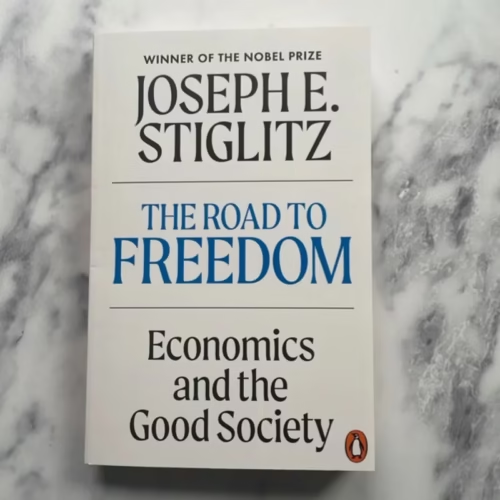
AMYGOODMAN: We are joined now by Joseph Stiglitz, Nobel Prize-winning economist, Columbia University professor, former chair of the Council of Economic Advisers. Professor Stiglitz is also currently the chief economist of the Roosevelt Institute. His latest book just out in paperback this week, The Road to Freedom: Economics and the Good Society.
Professor Stiglitz, welcome back to Democracy Now! Your response? You were among the signatories, the economists who have signed a letter against the tariffs. Talk about the president’s State of the Union and his argument for tariffs and against the Supreme Court. Two of his own appointees ruled against him.
JOSEPHSTIGLITZ:Well, the speech was characteristic of Trump — lies, misleading statements.
I was with a group of a large number of Nobel Prize winners who predicted that he would be bad for the economy and we were right. The tariffs are paid by Americans. They’re not paid for by the foreigners. He says they didn’t have any effect on inflation. We saw inflation was going down, and if we compare where inflation would have been with where we are today, it is estimated the average family is paying somewhere between $1,000 and $1,700 in extra money because of the tariffs.
The irony is he said it was going to bring back manufacturing jobs. Manufacturing jobs are down in the United States in 2025 when they were up under President Biden. He doesn’t talk about that. In fact, last year was one of the slowest growth in jobs ever in recent memory, about a quarter of what it was under President Biden. And interestingly, most or more than 100% of the jobs that were created were in the healthcare sector, nothing to do with his tariffs at all.
AMYGOODMAN: Trump said in the past, “We have the most people working in history.” What is the state of unemployment, of livable employment, the overall economy?
JOSEPHSTIGLITZ: Well, when the economy — more people in the country? Yes, there are going to be more people working. That’s true. The fact is that labor force participation has not gone up. The unemployment rate has gone up a little bit, not a lot. But what is striking is how weak the job market is. As I said before, we have not created very many jobs, less than a quarter of what we had created under President Biden. And anybody with friends trying to get jobs knows what a difficult labor market today’s labor market is.
AMYGOODMAN: I want to go back to President Trump speaking last night.
PRESIDENTDONALDTRUMP: Now the same people in this chamber who voted for those disasters suddenly use the word “affordability,” a word — they just used it, somebody gave it to them — knowing full well that they caused and created the increased prices that all of our citizens had to endure. You caused that problem. You caused that problem.
AMYGOODMAN: “Affordability,” Professor Stiglitz. We are speaking to you here in New York. Of course the new mayor Zohran Mamdani sent the message to people all over the country, especially those who are considering elected office or to diehard politicians, senators, congressmembers, that affordability was the word, was the issue people are most concerned about. What about President Trump mocking it?
JOSEPHSTIGLITZ: I think he is mocking the American people when he mocks the issue of affordability. The reason people worry about affordability is things are not affordable. And the other way of putting it is that their real incomes adjusted for inflation are down. Now, one of the striking things about what President Trump has done, he talked about this tax cut, the biggest tax cut in history. He was wrong about that. As a percentage of GDP, it doesn’t even rank near the top.
But where it does rank at the top is that it was the most regressive tax cut. That is to say the benefits went to the millionaires, the billionaires, the corporations, and those at the bottom paid the price. They paid the price with almost a $1 trillion cut in Medicaid. That was why the Democrats had insisted on the government shutdown. They said, “You can’t do that! That’s not right!” That you would be giving a tax cut for billionaires and asking the poorest Americans not to have adequate healthcare in a country where healthcare has been so bad, so bad that life expectancy even before the pandemic was on the down.
AMYGOODMAN: Your final comments, Professor Stiglitz, coming off of what’s considered one of the longest State of the Unions, an assessment of this country, in modern history?
JOSEPHSTIGLITZ: Well, long speeches like that reminds me of Castro and other demagogues who just love — they get the platform and they just talk and talk and talk. But I think the striking thing is that in spite of the tariffs that were supposed to bring back manufacturing jobs, manufacturing jobs are actually down. And in spite of the tariffs that were supposed to eliminate the huge trade deficit in goods, the trade deficit in goods is actually up. So his policies have failed even in the areas where he — in the objectives that he set forth. So, yes, his speech was filled with misleading statements, with lies. We’ve come to expect that. But in the core aspect of his agenda, the numbers show that he has dramatically failed to do what he promised.
AMYGOODMAN: Joseph Stiglitz, Nobel Prize-winning economist, Columbia University professor, and former chair of the Council of Economic Advisers. Professor Stiglitz is also currently the chief economist of the Roosevelt Institute. His new book just out in paperback this week, The Road to Freedom: Economics and the Good Society.
The original content of this program is licensed under a Creative Commons Attribution-Noncommercial-No Derivative Works 3.0 United States License. Please attribute legal copies of this work to democracynow.org. Some of the work(s) that this program incorporates, however, may be separately licensed. For further information or additional permissions, contact us.
Wings of Change is entirely reader supported.
Wings invites you to subscribe. To subscribe: Join us on Wings of Change
In this critical time hearing voices of truth is all the more important although censorship and attacks on truth-tellers are common. Support WingsofChange.me as we bring you important articles and journalism beyond the mainstream corporate media on the Wings of Change website and Rise Up Times on social media. Donate now to sustain Wings of Change.
Access is always free, but if you would like to help:
A donation of $25 or whatever you can donate will bring you articles and opinions from independent websites, writers, and journalists as well as a blog with the opinions and creative contributions by myself and others.
We still have much work to continue to do as many activists and organizations address current threats to our democracy and unjust actions against people of color and activists and make plans for the upcoming years. Wings of Change is a part of that work through education, information, and inspiration. Here in Minnesota we are particularly targeted by the Trump regime with ICE immigrant law enforcement illegally arresting and deporting our neighbors who are mostly people of color. In spite of promises to withdraw ICE, the arrests continue. Other cities have been targeted as well, and they will try to target more.
Sue Ann Martinson, Editor
“We don’t have to engage in grand, heroic actions to participate in the process of change. Small acts, when multiplied by millions of people,
can transform the world.” — Howard Zinn
Wings of Change is entirely reader supported.
Wings invites you to subscribe. To subscribe: Join us on Wings of Change
In this critical time hearing voices of truth is all the more important although censorship and attacks on truth-tellers are common. Support WingsofChange.me as we bring you important articles and journalism beyond the mainstream corporate media on the Wings of Change website and Rise Up Times on social media. Donate now to sustain Wings of Change.
Access is always free, but if you would like to help: A donation of $25 or whatever you can donate will bring you articles and opinions from independent websites, writers, and journalists as well as a blog with the opinions and creative contributions by myself and others.
We still have much work to continue to do as many activists and organizations address current threats to our democracy and unjust actions against people of color and activists and make plans for the upcoming years. Wings of Change is a part of that work through education, information, and inspiration. Here in Minnesota we are particularly targeted by the Trump regime with ICE immigrant law enforcement illegally arresting and deporting our neighbors who are mostly people of color. In spite of promises to withdraw ICE, the arrests continue. Other cities have been targeted as well, and they will try to target more.
Sue Ann Martinson, Editor
“We don’t have to engage in grand, heroic actions
to participate in the process of change. Small acts, when multiplied by millions of people,
can transform the world.” — Howard Zinn
So, the U.S. has plans to build a huge military base there for their international occupation force. The Israelis are in control of nearly 60% of Gaza in the east of the strip. They don’t seem to have any intent of leaving.
Journalist Jeremy Scahill says the Trump administration’s vision for the Gaza Strip is of a continued “colonial apartheid regime” with Israel and U.S. interests controlling the lives of millions of Palestinians in perpetuity. “Palestinians are being told that they must completely surrender,” says Scahill. President Trump chaired the first meeting of his so-called Board of Peace this week, a body established for Gaza but whose remit has already expanded.
Transcript
This is a rush transcript. Copy may not be in its final form.
AMY GOODMAN: I want to go back for a moment before we end to the so-called Board of Peace. President Trump speaking at it in Washington, D.C., on Thursday.
PRESIDENT DONALD TRUMP: The war in Gaza is over. It’s over. There are little flames. Little flames. Hamas has been—I think they’re going to give up their weapons, which is what they promised. If they don’t, they will be harshly met. Very harshly met. They don’t want that.
AMY GOODMAN: This was the inaugural meeting of the so-called Board of Peace, Trump’s new initiative to create an alternative to the United Nations. By the way, the Pope has refused to join it, talking about it as a threat to the United Nations. Trump vowed to provide $10 billion in U.S. funds to the board, even though Congress has not approved any such spending, and has named himself the group’s chair for life. Among Trump’s board key proposals is to turn Gaza into an upscale seaside resort with gleaming skyscrapers and entirely new cities. Your final comment on this?
JEREMY SCAHILL: Let’s skip forward from all of the ridiculous pageantry of the scene at the Board of Peace and talk about what’s really happening here. Palestinians are being told that they must completely surrender not just Kalashnikovs and other weapons that they would use to defend themselves against Israeli occupation, but the very cause of Palestinian liberation or self-determination. What Palestinians in Gaza are being faced with is you either fully bend the knee and accept a colonial apartheid regime as your overseer, that you accept a new reality as dystopian plantation workers on Jared Kushner’s real estate project, or we’re going to kill you. That is what is being said here.
So, the U.S. has plans to build a huge military base there for their international occupation force. The Israelis are in control of nearly 60% of Gaza in the east of the strip. They don’t seem to have any intent of leaving. You have a reeducation program that Israel’s foreign minister spoke of at this so-called Board of Peace meeting yesterday and said that it begins with disarmament and demilitarization and then deradicalization. So if you are a Palestinian family, what they’re saying to you is your children need to be raised to accept that Zionism is going to dominate their lives now, that colonial apartheid regime is going to dominate your lives now, and if you dare think otherwise we erase you from the earth.
They still very well may try to mass-remove Palestinians but it does seem that the plan right now is to turn them into the plantation workers for Jared Kushner’s real estate plans moving forward, while you have Mahmoud Abbas and the Palestinian Authority rewriting the Palestinian constitution alongside France and other Western powers to try to ban any Palestinians that don’t accept the Oslo Accords, don’t accept Israeli colonialism, from ever running for office.
So what they want to do is put in this Palestinian technocratic committee in Gaza and force them to essentially be like Mahmoud Abbas where you are the mayors of a large prison camp run by the United States and Israel, and the residents of this prison camp are just keeping the land until Israeli settlers can come in and take it over. That’s what this Board of Peace is entirely about.
Democracy Now! produces a daily, global, independent news hour hosted by award-winning journalists Amy Goodman and Juan González. Our reporting includes breaking daily news headlines and in-depth interviews with people on the front lines of the world’s most pressing issues. On Democracy Now!, you’ll hear a diversity of voices speaking for themselves, providing a unique and sometimes provocative perspective on global events.
In one of the scariest moments in modern history, we’re doing our best at ScheerPost to pierce the fog of lies that conceal it but we need some help to pay our writers and staff. Please consider a tax-deductible donation.
Wings of Change is entirely reader supported.
Wings invites you to subscribe. To subscribe: Join us on Wings of Change
In this critical time hearing voices of truth is all the more important although censorship and attacks on truth-tellers are common. Support WingsofChange.me as we bring you important articles and journalism beyond the mainstream corporate media on the Wings of Change website and Rise Up Times on social media. Donate now to sustain Wings of Change.
We still have much work to continue to do as many activists and organizations address current threats to our democracy and unjust actions against people of color and activists and make plans for the upcoming years. Wings of Change is a part of that work through education, information, and inspiration. Here in Minnesota we are particularly targeted by the Trump regime with ICE immigrant law enforcement illegally arresting and deporting our neighbors who are mostly people of color. In spite of promises to withdraw ICE, the arrests continue. Other cities have been targeted as well, and they will try to target more.
Sue Ann Martinson, Editor
“We don’t have to engage in grand, heroic actions
to participate in the process of change. Small acts, when multiplied by millions of people,
can transform the world.” — Howard Zinn
Pulitzer Prize winning journalist, author, and theologian Chris Hedges returns to Bad Faith to engage in a spirited debate about how to act now that liberal incrementalism has led to incremental fascism.
Why does it feel like so much left discourse is explaining why we aren’t ready to act?: Insufficient union density, insufficient political consciousness, insufficient organization? Also, Hedges discusses his viral commentary on Epstein’s relationship with Noam Chomsky, why he’s not a Marxist, and more.
Chris Hedges / Posted By Joshua Scheer / ScheerPost / February 18, 2026
Joshua Scheer:
In this wide‑ranging and deeply sobering conversation, journalist and author Chris Hedges speaks with Bad Faith’s Briahna Joy Gray and they lay out the accelerating collapse of democratic institutions in the United States and the rapid expansion of state repression — from Cop City to ICE raids to the bipartisan assault on protest itself. Drawing on decades spent reporting from war zones and revolutionary movements, Hedges warns that the U.S. is “on the cusp of becoming a police state,” and that the window for organized resistance is narrowing by the day.
Joshua Scheer Commentary, continued:
The discussion confronts the central dilemma facing anyone committed to justice in this moment: If waiting is counter-revolutionary and the state is escalating its violence, what does meaningful resistance look like now? Hedges argues that resistance is not a question of guaranteed victory but of moral obligation — standing with the vulnerable, the targeted, and the disappeared even when the cost is high. He details how the state’s harshest crackdowns — from terrorism charges against Cop City activists to the criminalization of filming ICE — reveal precisely what forms of dissent the ruling class fears most.
At the same time, the conversation pushes back against fatalism. Millions have taken to the streets in recent years — for Palestine, against police violence, against authoritarianism — and that political energy, Hedges insists, must be organized, sharpened, and sustained. The question is not whether people have power, but whether they recognize it before the authoritarian machinery fully locks into place.
This is a bracing, historically informed, and morally urgent analysis of where we stand — and what the moment demands.
Highlights
1. The State Shows You What It Fears
“You can always tell what works by how the state responds.” Hedges explains why activists opposing Cop City were hit with terrorism and RICO charges — because their tactics were effective.
2. Criminalizing Solidarity
Hedges recounts how activists were charged with terrorism for raising bail money — a sign of how aggressively the state is moving to shut down dissent.
3. The U.S. Is “On the Cusp of a Police State”
Hedges warns that the infrastructure for authoritarian rule is already in place, and the shift could happen “very quickly.”
4. ICE as the Tip of the Spear
From Minneapolis to Princeton, Hedges describes ICE raids as a testing ground for broader domestic repression — and details local resistance efforts.
5. The Myth of Powerlessness
Briana pushes the conversation toward the political potential of mass mobilization:
Black Lives Matter mobilized 20 million people — more than twice the 3% often cited as the threshold for revolutionary change.
6. Resistance as Moral Imperative
Hedges:
“It doesn’t matter whether you win or lose. You must stand with the Palestinians. You must stand with your neighbors being ripped off the streets.”
7. The Powell Memo to Palantir
A historical through‑line from the corporate counterrevolution of the 1970s to today’s surveillance‑state architecture.
8. Liberal Paralysis vs. Popular Power
Hedges argues that Democratic Party leadership refuses to call for mass mobilization because they fear their own base more than authoritarianism.
9. The Danger of Illusions
Hedges cautions against “Pollyannaish” expectations that resistance will be easy — not to discourage action, but to prepare people for the long struggle ahead.
10. “Make Their Lives Difficult”
Hedges describes practical, local forms of resistance — from monitoring ICE to disrupting their operations — as essential groundwork for broader movements.
In one of the scariest moments in modern history, we’re doing our best at ScheerPost to pierce the fog of lies that conceal it but we need some help to pay our writers and staff. Please consider a tax-deductible donation.
Wings of Change is entirely reader supported. Wings invites you to subscribe. To subscribe: Join us on Wings of Change
In this critical time hearing voices of truth is all the more important although censorship and attacks on truth-tellers are common. Support WingsofChange.me as we bring you important articles and journalism beyond the mainstream corporate media on the Wings of Change website and Rise Up Times on social media. Donate now to sustain Wings of Change.
Join us on Wings of Change. We still have much work to continue to do as many activists and organizations address current threats to our democracy and unjust actions against people of color and activists and make plans for the upcoming years. Wings of Change is a part of that work through education, information, and inspiration. Here in Minnesota we are particularly targeted by the Trump regime with ICE immigrant law enforcement illegally arresting and deporting our neighbors who are mostly people of color. In spite of promises to withdraw ICE, the arrests continue. Other cities have been targeted as well, and they will try to target more.
Sue Ann Martinson, Editor
“We don’t have to engage in grand, heroic actions to participate in the process of change. Small acts, when multiplied by millions of people, can transform the world.” — Howard Zinn
My partner, an immigrant from Brazil, shows love through acts of service. At first, I was confused. I had been raised to see romantic love, partner love, as centered on acts of adoration, big and intense actions designed to make me, the beloved, feel exceptional. My partner, who is romantic but not in that way, finds this focus on exceptional love confusing. She bonds with other immigrants on the strangeness of the adoration economy, sharing stories of childhoods where love was pragmatic, not gilded. My feminist self took an embarrassingly long time to feel the depth of love embedded in my partner doing my laundry or putting together a new shelf for my office. I grew up with the acts-of-service kind of love but my family didn’t describe it as love. It was about duty. And survival.I think about all of this, sitting in my Minneapolis home, reading essay after essay about the mutual aid and collective care that is everywhere on these streets. Some of the reporting is laced with the tinsel of adoration: Minneapolis is exceptional! Better than anyone! No one else is like this!!! I want to reach out and grab the authors by the pen and say, Hey, that isn’t what this is. Please don’t exceptionalize us. This is a steadiness of love as caring for your neighbor, love as meeting the material needs of someone nearby. There is nothing new or fancy or romantic about it. It’s just love. Junauda Petrus, poet laureate of Minneapolis, said it beautifully — and off-handedly — to me during a recent phone call:
“What people are vibing off of right now is getting to know each other, spending time together. For a lot of folks, this isn’t how they were raised. Or they were raised like this and they forgot. They have forgotten how to meet each other, to just spend time with each other — not as people who agree on everything but as people who are just part of the same thing. In the [Twin] Cities, we’re building a technology of togetherness.”
In writing this piece, I thought about what would help people in my communities to feel seen and what might help those living elsewhere to have clear examples of what we are doing here. I called a range of beloveds, all of them doing so much, and some of them unable to leave their homes and benefiting from the care being spread around, and asked them this: Would me interviewing you for an essay be nourishing or would it feel like another thing you have to cross off your list? And some people said, “Ouch, not this week,” or “No, we are being targeted too much and it feels scary,” or “I love you, Susan, but god, I am tired.” And they said things like, “If you need it, I will make it happen,” and I got to say back to them, “No, beloved, it’s ok. I got you. You got me. That’s how it works.”
Acts of Service and Mutual Aid Sustain Minneapolis as It Remains Under Assault
Not everything happening in Minneapolis is new. All of this care builds on the relationships already in place. My friend Hannah (who is using a pseudonym to protect her mutual aid network) said that even before “Operation Metro Surge,” some parents were already taking turns bringing children to school and having conversations with teachers and school staff about school safety.
“In October, when things started to get scary, we — the parents at our kid’s school — set up a Google Voice number and email and got the school admin to informally connect us with parents who needed help with rides for their children and groceries,” Hannah said. “It started small and then it grew. Now there are 88 families, or 106 students — a fifth of the school population — that we are supporting. About 40 of those kids, the ones still attending school in person, get rides to and from school from 30 different drivers made up of parents and neighbors and grandparents…. We have patrols who watch drop-in time, end of day pick-up, recess, and special events, and they call an alert when ICE is spotted nearby, which happens too often.”
And the community isn’t just coming together around school and student safety.
“We have set up grocery and food shelf deliveries. We have someone helping with Delegation of Parental Authority forms for just in case a parent is kidnapped and their child is left behind. We also have a lawyer who can file habeas petitions. There are seniors at a nearby assisted living facility who do the laundry for those sheltering in their homes,” Hannah said. “There are rent funds and funds for bills that sometimes include paying for bonds and legal fees. We have a doctor who can do medical house calls and we are connected with a group of vets who can help people with their pets.”
Violet (who is using a pseudonym to protect herself) is a nurse who mostly works with prenatal and postnatal patients through a community clinic. She said that the old lines that defined professionalism have shifted dramatically: “I had never called people from my personal cell phone before. I had never been to their houses. I’m not supposed to work outside of the clinic.” She is part of the vast network of health care workers finding ways to shift their systems so that institutional care is more accessible, and showing up outside of that institutional care to make sure patients have what they need.
“My adult daughter has been helping, packaging up food and driving with me for deliveries. This means she sees patient names and addresses — all of the things we aren’t supposed to do,” Violet said.
“I know there’s professional risk here, but every person I know cares more about making sure that we are doing this in a way that keeps our neighbors safe. That is why we are here. Every other risk just seems so inconsequential.”
I talked with another dear one about the relationship between patrols and neighborhood care, how they are overlapping circles that each inform the other. Jamie Schwesnedl from Moon Palace Books talks about how these acts of service are woven together in a lot of families. In his case, he explained that he takes on rapid response and patrol duties while his partner delivers groceries and other supplies that have been delivered to Moon Palace, a neighborhood site for supply drop-off.
And still, he reflects, the lines between rapid response and mutual aid are blurrier than you would think:
“My partner is able to receive deliveries like groceries and diapers at the bookstore and then be available for people who come to do pick-up, checking their names against the spreadsheets and ensuring that everyone is who they say they are. Our front counter has become a free zone for whistles, signs, and flyers, and people coming to get groceries to deliver also pick up whistles. When I am on patrol, I drop things off between places, change light bulbs, or carry boxes, or plunge toilets, or pick up things people have dropped off to bring to a patrol meeting or some other form of neighborhood organizing. I don’t deliver anything for those sheltering in place during this time, but there are deliveries needed to support the people on patrol who are facing down ICE. Any time I leave home, I have an eyewash water bottle for pepper spray, bullhorns, and snacks and hand warmers.”
“Different families,” he said, “split up acts of service in different ways and everyone is careful to protect those targeted by ICE.”
This Love Isn’t Exceptional — It’s Just Love
It is a dangerous idea that any one person has to carry everything on their shoulders. We take turns. A teacher of mine once said to me: Never underestimate who might be willing to show up when things are tough. Who we are in moments of crisis and struggle is not always the same as who we are in easier times.
And people around us are not always who we think they are. Ojibwe writer Marcie Rendon told me the story of one of her neighbors, a person who flies the American flag and has red, white, and blue bunting on their house all year round. Somewhat reclusive, everyone assumed that this older white man was a right-leaning person, but really, she said, he’s just someone from rural Minnesota who loves his country, loves the flag, and hates what is happening. He came to one of the block meetings and people were surprised. Now he is just one of the many showing up in the neighborhood.
Everyone I interviewed for this piece, and the six people who said “no,” and the 15 people whose names I wrote down but then didn’t reach out to because I ran out of time, is beloved to me. Intimate and known. And there are so many more — people I will never meet and who are more than two degrees removed from the hundreds I do know and they are protecting their communities as well.
When I look away from my to-do lists and Signal threads and worries about those I know and those I don’t, when I take a moment to exhale, I keep seeing this beautiful web being woven in Minnesota: not with new materials but with wisdom that was already here. When I stop, I can feel this net with my hands, this connection when I am on patrol and we pass that group of three on the corner of Cedar and Lake, this connection as I see someone who I know pull boxes of baby formula out of their trunk, look left and right, and then head over to a drop-off point.
This is not romantic love, not some kind of exceptionalism that wants to put everything in bright lights and roses. No, we are all the same people as we were last year. Some folks need to be the main character of every story, white saviorism is real, Black beloveds have to watch as those who did not show up in these kinds of numbers when George Floyd was murdered show up now, and each of these little pods of neighbors organizing legal aid and groceries do not always have access to their best selves. We are real people in real time, and these are acts of service and they are a form of love, but it is not exceptional love. It is just love.
I remember this very old fishing net someone showed me years ago, guiding my fingers to feel where the net had been repaired over and over again, like scars in the fibers that strengthen rather than break. ICE is sharp like knives, nicking and sometimes shoving and tearing through this connected set of scars and fresh material. There are wounds, this is violence, and some of you are being stopped on the road because of how you are perceived and I am not being stopped and none of this is ever okay… and still, I feel the pull and tug of a net that is larger than anything I have experienced before. Is there anyone in these cities not showing up in some way? I can’t remember the last time I heard anyone with words other than: How can I help?
There is a net and it has always been here, it is always here. This is not exceptional. There is nothing new here. All that is happening in Minnesota is that some of the confusion is fading and what is visible is the link and weave and stumble and steady between us. May we keep repairing it as it frays, from those outside and from the rising tension we hold within, and may this net grow with wisdom and may bodies tired of holding themselves up alone someday feel like they can relax into the steady certainty of something much bigger than the size of their skin.
This love is not exceptional. It is the acts-of-service kind of love. The kind of love that says to your neighbor: Let us take care of each other. I am going to remember you. It’s the kind of love that says: This, this is how we survive. Together.
Susan Raffo is a writer and bodyworker living in Mni sóta Makoce, Minneapolis. You can find out about her work at www.susanraffo.com.
Wings of Change is entirely reader supported.
Wings invites you to subscribe. To subscribe: Join us on Wings of Change
In this critical time hearing voices of truth is all the more important although censorship and attacks on truth-tellers are common. Support WingsofChange.me as we bring you important articles and journalism beyond the mainstream corporate media on the Wings of Change website and Rise Up Times on social media. Donate now to sustain Wings of Change.
Join us on Wings of Change. We still have much work to continue to do as many activists and organizations address current threats to our democracy and unjust actions against people of color and activists and make plans for the upcoming years. Wings of Change is a part of that work through education, information, and inspiration. Here in Minnesota we are particularly targeted by the Trump regime with ICE immigrant law enforcement illegally arresting and deporting our neighbors who are mostly people of color. In spite of promises to withdraw ICE, the arrests continue. Other cities have been targeted as well, and they will try to target more.
Sue Ann Martinson, Editor
“We don’t have to engage in grand, heroic actions
to participate in the process of change. Small acts, when multiplied by millions of people,
can transform the world.” — Howard Zinn
In a victory for the fossil fuel industry, a set of Obama-era rules that required the federal government to regulate the emissions of six greenhouse gases is being reversed by the Trump administration. The changes would undo the legal basis of the fight against global warming, as well as remove industrial reporting obligations and roll back emissions standards for cars and trucks. Environmental engineer Gretchen Goldman helped author those emission standards while working for the Department of Transportation under the Biden administration. Now as the president of the Union of Concerned Scientists, she says their repeal will not only increase what drivers pay at the pump but also set U.S. innovation back on the world stage. “We’re really seeing the abdication of U.S. leadership on climate, and that has huge implications, both for our immediate ability to reduce heat-trapping emissions globally. . .but also in terms of our standing and contribution in the world.”
Transcript
This is a rush transcript. Copy may not be in its final form.
AMYGOODMAN: This is Democracy Now!, democracynow.org. I’m Amy Goodman.
We turn now to the Trump administration’s sweeping rollback of climate change policy. On Thursday, the Environmental Protection Agency plans to overturn its own conclusion that greenhouse gases endanger public health and cause global warming. Known as the endangerment finding, the Obama-era rules from 2009 required the federal government to regulate the emissions of six gases, including carbon monoxide and methane, which are released from the burning of oil, gas and coal. The Trump administration’s reversal of this decision would undo the legal basis of the fight against global warming and remove emissions standards for cars and trucks and reporting on obligations for power plants and industries. The EPA’s draft version the new rule says the endangerment finding overstated the risk of heat waves and underplayed the benefits of increased carbon pollution.
In a post on X on Tuesday, the EPA Secretary Lee Zeldin wrote, quote, “This week, we make history. Getting ready to join President Trump to announce the single largest act of deregulation in the history of the USA,” unquote.
For more, we go to Washington, D.C., where we’re joined by Gretchen Goldman, president and CEO of the Union of Concerned Scientists, also an environmental engineer, formerly worked on environmental policy in the Biden White House and at the Department of Transportation.
Gretchen, thanks so much for being with us. Talk about the significance of what’s happening now.
GRETCHENGOLDMAN: It’s quite significant, and it was quite devastating to see, even though we expected that this was coming. The impacts of this action will be vast, both in terms of our immediate ability to protect people from the harms of climate change, economic harms, health harms, and also in terms of our ability to meet U.S. climate goals, to meet global climate goals.
And this is all happening with time that we don’t have. We know we need to swiftly and dramatically reduce heat-trapping gas emissions now, as year after year we see devastating harm from climate-driven extreme weather events. And this is now something we really need to take action on, and so it’s quite devastating to see this week.
AMYGOODMAN: The Trump administration initially attempted to undermine the science behind the endangerment finding. And again, for people to understand, explain exactly what that is and what that report was, based at the Department of Energy.
GRETCHENGOLDMAN: As part of their broader attacks on climate science and climate action, the Trump administration secretly convened a group of climate contrarians under the Department of Energy to produce a report that reiterated many of the long-debunked climate denial talking points and tried to pass it off as a science-based report. We won in court, the Union of Concerned Scientists and the Environmental Defense Fund together. We won, and the administration disbanded that group of climate contrarians and have had to turn over more than 100,000 pages of documents related to that. We’re seeing that they are being slowed down by these efforts and our ability to push back.
AMYGOODMAN: Can you talk about President Trump’s personal connections to fossil fuel executives and how exactly that is affecting what is expected to be announced on Thursday, again, what many are calling the single — including Zeldin, the single biggest attack in U.S. history on federal authority to tackle the climate crisis? He calls it the single largest deregulation act in U.S. history.
GRETCHENGOLDMAN: This is their holy grail. They’ve been focused on this for a long time, because the reality of climate change and its impacts are very inconvenient if you’re someone who wants to give handouts to the fossil fuel industry and wants to ensure that these industries can continue polluting communities across the country. And so, we’re seeing them really take steps to give handouts to connections to the fossil fuel industry and others. And that’s harming communities, especially Black and Brown communities, where we know already face disproportionate impacts and harms from toxic air pollution.
AMYGOODMAN: This comes a month after President Trump pulled the U.S. out of the UNFCCC — right? — the United Nations Framework Convention on Climate Change. Talk about the significance of these two acts together.
GRETCHENGOLDMAN: We’re really seeing the abdication of U.S. leadership on climate, and that has huge implications, both for our immediate ability to reduce heat-trapping emissions globally, as we know is desperately needed, but also in terms of our standing and contribution in the world. The U.S. has long exhibited climate leadership in terms of innovation, in terms of reduction in emissions and in terms of providing that urgency around what we need to do to take action on climate change. And this, unfortunately, is going to set us back a long time in terms of that diplomacy, those international relationships and the U.S.’s ability to help lead the world in taking action on climate change.
AMYGOODMAN: Karoline Leavitt, the White House press spokesperson, emphasized auto standards being an area where regulation will be rolled back. You used to work, Gretchen Goldman, at the Department of Transportation. Can you talk about emissions standards and what’s been achieved by these standards, and the incredible effect of a rollback?
GRETCHENGOLDMAN: I was at the Department of Transportation working on climate and transportation issues, and so this is very devastating to me personally, as well. Under the previous administration, we issued the strongest standards to reduce dependence of cars and trucks on fossil fuel, and this was saving people money at the pump. It was helping us with climate emissions reductions, and it was reducing toxic air pollution in communities. It was one of the strongest climate actions that this nation has taken. But now, tomorrow, it’s expected to be announced that they’re repealing those standards, and that’s going to set us back. It’s going to cost consumers more money, and it’s really going to stifle innovation and our ability to meet the moment and reduce climate emissions everywhere.
AMYGOODMAN: Well, I want to thank you very much for being with us, Gretchen Goldman, president and CEO of the Union of Concerned Scientists, speaking to us from Washington, D.C.
On Monday, February 23rd, once again, Democracy Now! will be celebrating our 30th anniversary at the historic Riverside Church here in New York City. Guests will include Angela Davis and Naomi Klein; Maria Ressa, the journalist who won the Nobel Peace Prize; Michael Stipe, the singer, the songwriter, the activist; the jazz legend Wynton Marsalis; the Pulitzer Prize-winning poet Mosab Abu Toha; V., the renowned playwright; Hurray for the Riff Raff; and so many more. Go to democracynow.org for details and to get tickets. The seats are filling up fast.
The original content of this program is licensed under a Creative Commons Attribution-Noncommercial-No Derivative Works 3.0 United States License. Please attribute legal copies of this work to democracynow.org. Some of the work(s) that this program incorporates, however, may be separately licensed. For further information or additional permissions, contact us.
From Al Jazeera: Trump Climate Rollback
Wings of Change is entirely reader supported.
Wings invites you to subscribe. Join us on Wings of Change
In this critical time hearing voices of truth is all the more important although censorship and attacks on truth-tellers are common. Support WingsofChange.me as we bring you important articles and journalism beyond the mainstream corporate media on the Wings of Change website and Rise Up Times on social media.
Join us on Wings of Change. We still have much work to continue to do as many activists and organizations address current threats to our democracy and unjust actions against people of color and activists and make plans for the upcoming years. Wings of Change is pleased and excited to be a part of that work through education, information, and inspiration. Here in Minnesota we are particularly targeted by the Trump regime with ICE immigrant law enforcement illegally arresting and deporting our neighbors who are mostly people of color.
“We don’t have to engage in grand, heroic actions
to participate in the process of change. Small acts, when multiplied by millions of people,
can transform the world.” — Howard Zinn
An authoritarian president consolidates executive power by weakening democratic checks and balances, often suppressing opposition, attacking independent media, and using state institutions for personal or political agendas. Such leaders prioritize centralized control, frequently challenging constitutional norms and, in competitive systems, eroding democratic processes from within. (Google AI)
Editor’s Note: These videos are from last year, but explain how the Trump administration has set about creating a database with centralized detailed information on all Americans so they can control it. The history of the idea of total control by some proponents, including some Congressional members, goes back to Trump’s first presidency, and even further, as Greenwald discusses.
Databases regarding immigration already exist and are being used. They don’t even hide their attempts to centralize data anymore by hiding behind slippery words. In Minnesota they have said they will remove all the ICE Gestapo in Minnesota if Gov. Walz and state officials turn over the whole state’s voter rolls, Trump might be calling it “making a deal” but I call it extortion.* Gov. Walz refused of course. So although as a panacea they have removed 700 ICE enforcers from Minnesota, we still have a minimum of 2000 in the state.
It’s similar to extortion of the colleges and universities by threatening to withdraw federal funds unless their administrations ordered attacks on and punished students who were protesting the genocide in Palestine.
Using threats, intimidation, or coercion (including violence, property damage, or business harm) to force someone to give money, property, or perform an act. (Google AI)
Wings of Change is entirely reader supported.
Wings invites you to subscribe. Join us on Wings of Change
In this critical time hearing voices of truth is all the more important although censorship and attacks on truth-tellers are common. Support WingsofChange.me as we bring you important articles and journalism beyond the mainstream corporate media on the Wings of Change website and Rise Up Times on social media.
Join us on Wings of Change. We still have much work to continue to do as many activists and organizations address current threats to our democracy and unjust actions against people of color and activists and make plans for the upcoming years. Wings of Change is pleased and excited to be a part of that work through education, information, and inspiration. Here in Minnesota we are particularly targeted by the Trump regime with ICE immigrant law enforcement illegally arresting and deporting our neighbors who are people of color.
“We don’t have to engage in grand, heroic actions
to participate in the process of change. Small acts, when multiplied by millions of people,
can transform the world.” — Howard Zinn











 Editor’s Note: These videos are from last year, but explain how the Trump administration has set about creating a database with centralized detailed information on all Americans so they can control it. The history of the idea of total control by some proponents, including some Congressional members, goes back to Trump’s first presidency, and even further, as Greenwald discusses.