
Tag: United Nations (UN)

  • How the UN could act today to stop the genocide in Palestine

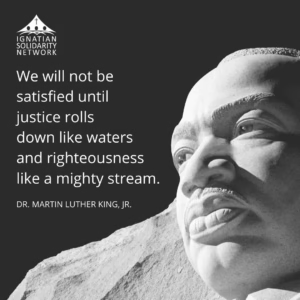
    We will not be satisfied until Justice rolls down like waters...As a key deadline approaches in the United Nations General Assembly, a little-used UN mechanism, immune from the US veto, could bring military protection to the Palestinian people — if we demand it.

    How the UN could act today to stop the genocide in Palestine
    After twenty-two months of unprecedented carnage, three things are clear: (1) the Israeli regime will not end the genocide in Palestine of its own will,  (2) the U.S. government, Israel’s principal collaborator, as well as the majority of Israelis, and the regime’s proxies and lobbies in the West, are fully committed to this genocide, and to the destruction and erasure of every remnant of Palestine from the river to the sea, and (3) other Western governments like the UK and Germany as well as far too many complicit Arab states in the region are fully dedicated to the cause of Israeli impunity.

    That means that genocide (and apartheid) will only end through resistance against the Israeli regime, the steadfastness of the Palestinian people, the solidarity of the rest of the world, and the isolation, weakening, defeat, and dismantling of the Israeli regime.

    As was the case in apartheid South Africa, this is a long-term struggle. But even in the face of Western government obstruction, there are things that can be done right now. Things like boycott, divestment, sanctions, demonstrations, disruption, civil disobedience, education, prosecutions under universal jurisdiction, and civil cases against Israeli perpetrators and complicit actors in our own societies. And yes, we can also demand intervention and protection for the Palestinian people.

    Advertisement
    Shop the Free Palestine t-shirt in the Mondoweiss store!

    Established by a Cold War-era resolution adopted in 1950, the Uniting for Peace mechanism authorizes the UN General Assembly (UNGA) to act when the Security Council is blocked by the veto of one of its permanent members. Under this mechanism, the UNGA could mandate a UN protection force to deploy to Palestine, protect civilians, ensure humanitarian aid, preserve evidence of Israeli crimes, and assist in recovery and reconstruction.

    And the upcoming deadline set by the UNGA last year for Israeli compliance with the orders and findings of the International Court of Justice, with a promise of “further measures” in the wake of non-compliance, provides a critical moment for action. Indeed, the time for intervention is long past due.

    Models of intervention

    As I have written previously, any country can legally intervene (individually or in concert with others) to stop the genocide, crimes against humanity, and war crimes of the Israeli regime. Indeed, under the Geneva Conventions, the Genocide Convention, and other sources of law, states are legally obliged to do so in the face of such atrocities. International law requires intervention, the State of Palestine has invited intervention, and Palestinian civil society has appealed for intervention. But few states have met this solemn obligation, while Yemen, under Ansar Allah, has been mercilessly attacked by U.S. forces for doing so, and the genocide has been allowed to rage on for almost two years now. Thus, a multilateral mandate could provide the legal, political, and diplomatic cover that most states would need to participate in an intervention.

    Here, caution is warranted. There are many proposals for intervention. But some of these are not about protection for the Palestinian people, let alone their liberation.

    Some have called for civilian monitors for Gaza, essentially a few dozen observers in blue vests armed only with clipboards and radios. But there have been human rights monitors in the West Bank and Gaza for decades, before and throughout the current genocide. While these perform valuable work, they have no deterrent effect, and the Israeli regime views them as no impediment at all to its nefarious designs.

    Others, including the French and the Saudis, have called for a so-called “stabilization force.” But the details of their proposal suggest that such an intervention would not be designed principally to protect the Palestinians from the Israeli regime, but rather to keep an eye on the Palestinian resistance, and to restore the cruel status quo ante before October 2023, with the caging of the Palestinian people, and their slow, systematic annihilation.

    At the same time, many such proposals appear to be designed in large measure to resume the process of normalization of the Israeli regime, and to resuscitate the ruse of Oslo. Needless to say, a return to a kind of Oslo 2.0, as yet another smokescreen for Israeli impunity, wherein Palestinians are told they must negotiate for their rights with their oppressor, as their rights and land are continuously eroded and the regime’s status increasingly solidified and normalized, is not the answer.

    Then there is Donald Trump’s proposal for direct U.S. occupation, ethnic purging, and colonial domination of Gaza, revealing once again the dangerous and deeply racist delusions of the U.S. empire. Finally, the Israeli regime itself has suggested the deployment of a proxy occupation force manned by forces from Arab states that collaborate with the regime. As is self-evident, these proposals are not about ending genocide and apartheid. They are about entrenching them.

    The UN options

    That brings us to the United Nations.

    Mid-September will see the expiration of the deadline set last year by the General Assembly for Israel to comply with the demands of the International Court of Justice and of the UNGA or face “further measures.” Western delegations are scurrying to forestall this ratcheting up of Israeli accountability by shifting the focus to recognizing Palestine or by trying to resuscitate the long-dead corpse of Oslo and the so-called “two state solution,” i.e., another political process that normalizes Israel, marginalizes Palestinians, provides a smokescreen for continuing Israeli abuses, and offers an amorphous promise of a Palestinian Bantustan somewhere down the road. But the UN need not fall for this ruse.

    Of course, the UN itself has much to answer for in this genocide. To be sure, some in the UN have been absolutely heroic: like the UNRWA workers, who have been murdered in their hundreds by the Israeli genocide, many along with their families; other UN humanitarians who have continued to work to relieve the suffering of the people of Gaza, in the face of enormous risk; the UN’s International Court of Justice, which has issued historic decisions affirming the rights of the Palestinian people in the face of enormous pressure not to do so; and the UN special rapporteurs, like Francesca Albanese, who have endured two years of smears, slander, harassment, death threats, and U.S. sanctions, just for telling the truth and applying the law.

    But the political side of the UN has failed miserably. Some, like the UNSG, his senior advisors (on genocide, children in conflict, sexual violence in conflict, political affairs, etc.), the High Commissioner for Human Rights, and other senior political leadership, have failed miserably, not because they could not do more, but because they chose not to. And, of course, the enduring symbol of UN failure is the Security Council, rendered entirely useless under the constraints imposed on it by the U.S. and its Western allies. Uniting for Peace offers a chance to right the UN ship, and to rescue the legacy of the organization from the potentially fatal blow of yet another genocide on its watch.

    Security Council scenarios

    Of course, under Chapter 7 of the UN Charter, the Security Council has the power to deploy an armed force and to impose that force even against a country’s will.

    But given that the U.S., UK, and France (all genocide complicit states) have veto power in the Council, there are only two possible outcomes from the Security Council in addressing a proposal for intervention: (1) A mandate that pleases the U.S., as Israel’s proxy, and which therefore would be framed in a way disastrous for the Palestinians, and could be imposed against the will of the Palestinians, under Chapter 7, or (2) A U.S. veto of any force that would actually be helpful.

    Clearly, the Security Council, by design, is no friend to the occupied, the colonized, or the oppressed. As such, the road to protection and justice travels not through the Security Council, but around it.

    Uniting for Peace in the UNGA

    Thus, meaningful UN Security Council action is effectively impossible in a body dominated by the U.S. veto.

    But here is the point: the world need not surrender in the face of that veto.

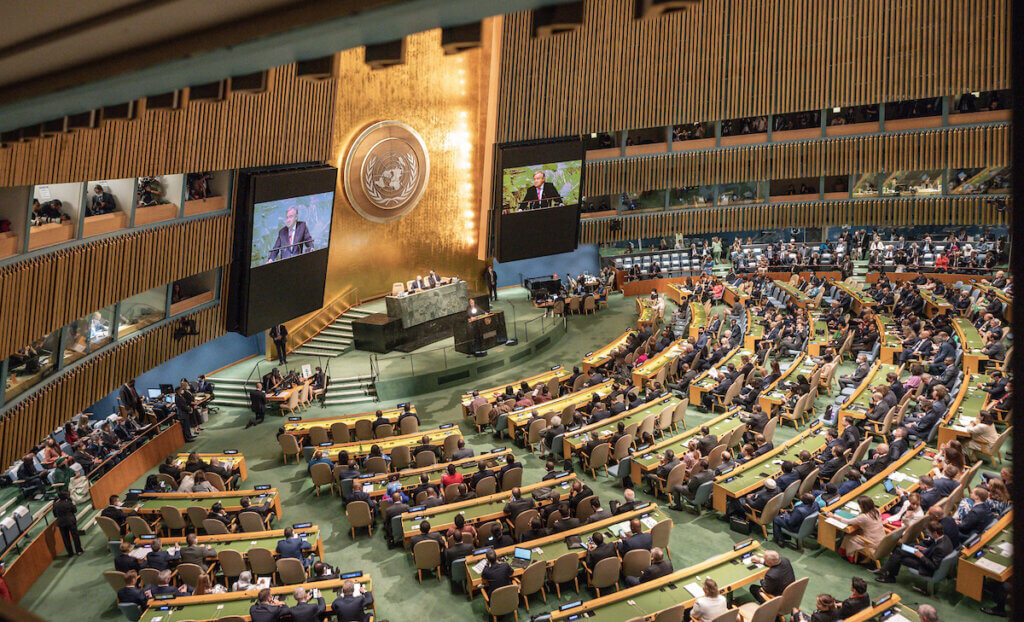
    The UN General Assembly (UNGA), that will meet in September, is empowered under the Uniting for Peace resolution, to act when the Security Council is unable to act owing to the veto. There are historical precedents. And taking such extraordinary action has never been more urgent.

    A UNGA resolution adopted under Uniting for Peace could

    1.     Call on all states to adopt comprehensive sanctions and a military embargo against the Israeli regime. While it lacks the power to enforce sanctions, it can call them, monitor them, and supplement them as required.

    2.     Decide to reject the UNGA credentials of Israel, as the UNGA did in the case of apartheid South Africa.

    3.     Mandate an accountability mechanism (like a criminal tribunal) to address Israeli war crimes, crimes against humanity, apartheid, and genocide.

    4.     Reactivate the UN’s long-dormant anti-apartheid mechanisms to address Israeli apartheid, and

    5. Mandate an armed, multinational, UN protection force to deploy to Gaza (and, ultimately, to the West Bank), acting at the request of the State of Palestine, to protect civilians, open entry points via land and sea, facilitate humanitarian aid, preserve evidence of Israeli crimes, and assist in recovery and reconstruction.

    All of these actions could be adopted by the UNGA with a two-thirds majority, thereby circumventing the U.S. veto in the Security Council. As Palestine has requested intervention, no Chapter 7 action by the Security Council is needed to deploy a protection force. Palestine would retain full authority over when and for how long the mission was to be deployed, obviating fears of yet another occupation force.

    Very importantly, as affirmed by recent World Court findings, Israel would have no legal right to refuse, obstruct, or influence the mission. The Court has affirmed that Israel has no authority, no sovereignty, and no rights in Gaza or in the West Bank.

    The process is simple: (1) First, a proposal is vetoed in the Security Council (this is inevitable, given the role of the U.S. as a proxy for Israel in the Security Council); (2) States call for an emergency special session (ESS) of the UNGA under the Uniting for Peace mechanism (this too is easy, as the 10th Emergency Special Session remains active, and can be easily resumed at the request of a member state);  (3) A resolution is proposed by one or more sponsors, in close consultation with the state of Palestine; (4) The resolution is adopted with a two-thirds majority (a threshold required by the rules for “important matters” such as this. Previous voting patterns on Palestine indicate that this margin is achievable); (5) The UN Secretary-General is instructed to solicit troop contributions from countries, in consultation with the State of Palestine as the requesting entity, and: (6) The mission is assembled and deployed (while likely to be politically challenging due to predictably active U.S. interference, this is technically easy).

    Legally, there are no hurdles. The rules allow it, the UNGA’s Uniting for Peace power has been repeatedly affirmed, and there are precedents, most notably the UNGA’s mandating of the 1956 UN Emergency Force to the Sinai (UNEF) over the objections of the UK, France, and Israel.

    Of course, the U.S. and the Israeli regime will use every available carrot and stick to try to prevent the securing of the necessary two-thirds majority, seeking to water down the text, and bribing and threatening states to vote no, to abstain, or to be absent for the vote. The current lawless government in Washington may even threaten sanctions on behalf of the Israeli regime, as it has already done vis-à-vis the International Criminal Court and the UN’s Special Rapporteur. And they are likely to try to obstruct the protection force itself, once mandated.

    As such, the global majority of states will need to stay the course in the face of U.S. and Israeli threats. And global civil society will need to be steadfast in its demands for protection and justice, ensuring the glare of public exposure under which states will be forced to vote for or against a force to protect the Palestinians from genocide. None will be allowed to hide behind the U.S. veto, throwing up their hands with the familiar refrain of “we tried but the U.S. vetoed it.”

    Once mandated, let the protection force be deployed by air, land, and sea, accompanied by international media and supported by all diplomatic avenues to ensure its successful deployment and to press the regime and its Western backers to stand down. The world has a chance, belatedly, to stop a genocide and other crimes against humanity. All it needs is the will to do so.

    Conclusion

    In the face of historic atrocities such as these, that threaten the very survival of a people, and that could bury the nascent project of human rights and international law in their wake, every tool available must be deployed. The world has not done so. It must try, and quickly.

    Of course, we are not naïve. Success is not assured. But failure is guaranteed if we do not try.

    And time is of the essence. Genocide continues to rage in Gaza and is spreading as well in the West Bank. Famine has been declared in Gaza. Israel is expanding its military presence in Gaza and is rampaging across the West Bank. And September 18 will mark the end of a one-year deadline set by the UNGA for Israel to comply with their demands and that of the World Court or face “further measures.” The time to act is now.r

    Craig Mokhiber is an international human rights lawyer and former senior United Nations Official. He left the UN in October of 2023, penning a widely read letter that warned of genocide in Gaza, criticized the international response and called for a new approach to Palestine and Israel based on equality, human rights and international law. 


    Free speech is under attack—especially when it comes to Palestine.

    From the censorship of student voices to the assassinations of journalists in Gaza, the cost of telling the truth about Palestine has never been higher. At Mondoweiss, we publish fearless reporting and critical analysis that others won’t touch—because we believe the public needs to know the truth about Palestine.

    Mondoweiss is funded by readers who believe in justice, transparency, and freedom of the press. If you believe journalism should challenge power—not serve it—please make a donation today.


    In this critical time in our country hearing the voices of truth and engaging in honest discussion for critical issues is all the more important while censorship (and outright lies) along with attacks on truth-tellers are common. Support the WingsofChange.me website and Rise Up Times on social media as we to bring you important articles and journalism beyond the mainstream corporate media. Access is alway free, but if you would like to help:
    Wings of Change FeatherWhatever you are able donate will bring you articles and opinions from independent websites, writers, and journalists as well as a blog with the opinions and creative contributions.
    One place to begin is with reason and truth, and how fundamental they are to creating critically engaged citizens and communities. 

    —Henry A. Giroux

  • “Time to Cut Ties with Israel”: U.N. Expert Francesca Albanese on Gaza Hospital Bombing

    “Time to Cut Ties with Israel”: U.N. Expert Francesca Albanese on Gaza Hospital Bombing

    “There has been a tolerance of Israel’s impunity for decades,” says Albanese. “However, the United States is the single most important factor of crisis in the United Nations.”

    Israel’s war on Gaza is the deadliest conflict for journalists in recorded history. In an attack on Nasser Hospital in Gaza Monday, Israel killed five more journalists in addition to over a dozen others. Israeli Prime Minister Benjamin Netanyahu claimed the hospital attack was a “tragic mishap,” but just hours later, Israeli forces killed a sixth journalist. “There is a pattern of targeting and killing journalists that lets us think that there is an intention,” says Francesca Albanese, U.N. special rapporteur on the occupied Palestinian territory.

    As countries prepare for the U.N. General Assembly, Albanese notes the complicity of Western states in the genocide in Gaza, particularly the United States. “There has been a tolerance of Israel’s impunity for decades,” says Albanese. “However, the United States is the single most important factor of crisis in the United Nations.”

    Note: Video also included below: “Chicago Leaders Prepare to Face the Dictator Head On” Below the Chicago video is the full transcript of Franceca Albanese’s intertiew video with Amy Goodman of Democracy Now!

    “We Must Defeat Fascism”: Chicago Alderman on Trump’s Threat to Deploy Troops to City

    Transcript for Francesca Albanese

    This is a rush transcript. Copy may not be in its final form.

    AMY GOODMAN: Human rights and press freedom groups are denouncing Israel’s attack on Nasser Hospital in Gaza Monday that killed at least 21 journalists — that killed at least 21 people, including five journalists. According to eyewitnesses, Israel carried out a double-tap strike on the hospital. In the initial strike, a drone hit Hussam al-Masri, a cameraman who worked for Reuters. Then another strike, minutes later, hit journalists and rescue workers who were responding to the initial strike.

    Israeli Prime Minister Benjamin Netanyahu claimed the hospital attack was a, quote, “tragic mishap.” But just hours later, Israeli forces killed a sixth journalist, Hassan Douhan, a well-known editor at Al-Hayat Al-Jadida. He was killed when an Israeli tank shelled a tent sheltering displaced people in Khan Younis.

    Over the past 23 months, Israel has barred all foreign journalists from reporting inside Gaza, while systematically killing Palestinian journalists. According to one count, Israel has killed least 245 journalists. On Monday, Thibaut Bruttin, the director general of Reporters Without Borders, denounced Israel’s attack on journalists.

    THIBAUT BRUTTIN: When and where is it going to end? Are we going to let the Israel Defense Forces continue the repeated killing of journalists? There is international law. There are guarantees that should be granted to journalists covering conflicts. And none of that seems to be applying. So, we need to be very clear about the fact that none of the journalists that are allegedly terrorists are terrorists. They are professional journalists working for legacy professional media, like, for example, Reuters or, for example, AP.

    AMY GOODMAN: In other news from Gaza, three more Palestinians have starved to death, bringing the total to at least 303.

    We’re joined right now by Francesca Albanese, the U.N. special rapporteur on the occupied Palestinian territory. She’s joining us from Tunis, Tunisia.

    Welcome back to Democracy Now!, Francesca Albanese. Can you start off by responding to the killing of the, at this point, in the last day, six journalists, five of them in a double-tap strike on Nasser Hospital?

    FRANCESCA ALBANESE: Thank you, Amy. Yeah, of course.

    Look, in a situation of conflicts, targeting or killing journalists is unlawful. Journalists, like doctors and medical personnel and rescues, all those who have been killed in this attack, are civilians, so killing them is unlawful. They are protected under international humanitarian law.

    However, here, it’s not an isolated incident. Journalists have been killed in such high numbers. Some say 200 have been documented. Al Jazeera speaks of 270 journalists killed. So there is a pattern of targeting and killing journalists, that let us think that there is an intention behind it. There is a widespread and systematic attack against them, like there is a systematic and widespread attack against civilians. And this might qualify as also as a crime against humanity in and of itself.

    However, however, I want to remind everyone that we are on the 688th day of the assault against Gaza, which an increasing consensus denounces as genocidal. And there is famine, and there is this complete destruction of landscapes in Gaza. So, the question is: What are member states waiting exactly to intervene and stop this carnage?

    JUAN GONZÁLEZ: And, Francesca Albanese, you have said that there have to be response. You’ve called for sanctions against Israel. Could you talk about how those might work, especially, as you mentioned, the fact that state governments are not taking any action?

    FRANCESCA ALBANESE: Oh, absolutely. Look, I would like people to understand this in the broader context of international law. No later than last year, the International Court of Justice has confirmed that Israel’s presence in the West Bank, the Gaza Strip and East Jerusalem is unlawful, must be dismantled totally and unconditionally. And the General Assembly has also given Israel a very generous deadline of one year to do so, which will expire in a month from now. In the face of this, member states have an obligation not to aid and assist in any possible ways a state like Israel in maintaining the situation created by Israel’s unlawful presence. So, while it is abhorrent that they are not stopping Israel, this delay increases their level of responsibility, their violation of international law, and possibly their complicity with the crimes that Israel is committing.

    This is why my recommendations are for member states who do not want to incur in this legal — in their legal responsibilities, and also out of humanity, to break the siege. Member states who have a port in the Mediterranean Sea must absolutely send their navies, under their national flag, with humanitarian aid and doctors, with food and baby formula, because 500,000 people, according to the United Nations, are close to — are really close to starvation. But also, as we see the Sumud Flotilla, so ordinary citizens jumping on boats and trying to do what member states are not doing, I feel that it’s totally immoral and irresponsible to let individuals like this take this risk, when it’s a state obligation to break the siege.

    But also, it’s time to cut ties with Israel, to cut trade, because this is also what the ICJ has reminded member states they need to take all steps to prevent trade and investment relations that are assisting in the maintenance of Israel’s unlawful presence. And we must recall that while Israel is committing genocide in Gaza, it’s also advancing, as it was said in the beginning, annexation at an incredible, incredible speed. So there is no way out of this other than a firm, robust action from member states.

    JUAN GONZÁLEZ: And I wanted to ask you — the Trump administration, instead of heeding your calls as the special rapporteur, have instead imposed sanctions on you, supposedly claiming that your naming of dozens of companies that are profiting from the Israeli occupation and genocide in Gaza. And Secretary of State Marco Rubio said, quote, “Albanese’s campaign of political and economic warfare against the United States and Israel will no longer be tolerated.” Your response to these kinds of words from leaders of the United States?

    FRANCESCA ALBANESE: Well, first of all, as a non-American, but as someone who has lived in the United States, I wonder how American people understand this, because, of course, it’s a violation of the First Amendment, right? I mean, I’ve just done my job, which is a pro bono job. I’ve been requested by the United Nations to investigate and report on the most prominent violations of international law that occur in the occupied Palestinian territory. And I’ve simply stated facts, according due process to businesses, saying there is an economy of the occupation, and this is the reason why Israel has profited and has allowed private entities, arms manufacturers, even banks, pension funds, universities, really, to help and profit — to help it and profit from Israel’s maintenance of the unlawful occupation. Now, this occupation has also turned into genocidal over the past 688 days, and I’ve denounced it. I’ve said, “How come that Israelis were becoming — many Israelis were becoming poorer and poorer, and Israeli stocks exchange kept on going up?”

    Because of that, I’ve been sanctioned, which is something unprecedented, that no states in 80 years of life of the United Nations have ever attempted, had ever dared, because it’s absolute — it’s a violation of international law, of the U.N. Charter, of the Convention on Privileges and Immunities. And still, the United Nations — the United States maintains a sanction, which are now entering the second month. It’s abominable. And this is the situation. But you understand, against a person who has just written a report, I have been called a threat to global economy. It’s clear that I’ve hit a nerve, but this is not the way to react to this.

    AMY GOODMAN: I want to turn to the last story that the Reuters cameraman Hussam al-Masri filmed before he was killed by Israel on Monday at Nasser Hospital. On Saturday, just two days before, al-Masri shot this interview with Hikmat Fojo, a Palestinian woman whose relatives were killed in another Israeli strike.

    HIKMAT FOJO: [translated] While they were sleeping, they were hit by missiles. While they were sleeping, an entire family was lost. And he was praying. He was praying. He was praying. His children were gone. Two were martyred. They were born after 10 years of waiting. One was sleeping. And the woman’s hands and legs, but, God willing, it’s all right. God willing, it doesn’t matter. If my nephew’s hand remains amputated, it doesn’t matter, but may he stay alive, O Lord.

    AMY GOODMAN: So, that was the — one of the last pieces of video that the Palestinian journalist, the Reuters journalist Hussam al-Masri filmed before he was killed Monday in that double-tap strike. He had — apparently was setting up a live stream at the fourth-floor balcony, which journalists used, when he was hit. So, now I want to go to Reuters reporter Steve Holland, who questioned President Trump about this in the Oval Office.

    STEVE HOLLAND: If we could get your reaction, sir? The Israelis bombed a hospital in Gaza, that killed 20 people, including five journalists. Are you —

    PRESIDENT DONALD TRUMP: When did this happen?

    STEVE HOLLAND: This happened overnight today.

    PRESIDENT DONALD TRUMP: I didn’t know that.

    STEVE HOLLAND: Any reaction to this? Are you going to talk to Prime Minister —

    PRESIDENT DONALD TRUMP: Well, I’m not happy about it. I don’t want to see it. At the same time, we have to end that whole nightmare. I’m the one that got the hostages out. I got them out, all of them.

    AMY GOODMAN: That was President Trump. Francesca Albanese, can you talk about the responsibility of the United States? And tell us more about the mechanisms at the U.N., since it’s very clear they block any kind of action at the U.N. Security Council.

    FRANCESCA ALBANESE: Yeah, as I said, there are clear indication, clear instructions from International Court of Justice on how to deal with the situation. The only lawful thing that Israel can do in the occupied Palestinian territory is to withdraw, withdraw the troops, dismantle the settlements, stop exploiting Palestinian resources.

    In the face of this, any aid, any support, any exchange of commerce, military intelligence and others from the United States or others is a breach of the obligation not to render aid and assistance in maintaining the situation. However, on top of this, there are proceedings for genocide pending before the International Court of Justice, which trigger an obligation to prevent, which, as a minimum, as the ICJ has said in the case of Nicaragua v. Germany, entails the ban on transfer of weapons to a country, to a state which is committing violations of international humanitarian law, meaning even war crimes. You know, we don’t even need to go and bother the Genocide Convention. So, yet again, another layer of responsibility of the United States.

    And then there are proceedings against Benjamin Netanyahu and Yoav Gallant for war crimes and crimes against humanity, including starvation. Because of this, even if the United States is not a party to the ICC, it should be respectful of international law, international criminal law. And instead of giving — of receiving the ICC-wanted Netanyahu as if he was really a war hero, as is being defined, the United States should facilitate justice and accountability. Instead, they are waging a war against the ICC itself, not just me. All the judges of the ICC have been sanctioned, and so the prosecutor of the court. So, this is the situation.

    Of course, there are complicities on the side of this administration, and, in my opinion, even in the — on the previous one. But this is something that belongs to the American people. It’s the American people that need to, or the American — the American political landscape that needs to, take action on this.

    JUAN GONZÁLEZ: And, Francesca Albanese, I wanted to ask you — in a few weeks, the U.N. — the annual meeting of the U.N. General Assembly will take place. Leaders from all over the world will come and give speeches to the U.N. General Assembly. Do you think this is a defining moment for the United Nations as an institution in its inability of the member states or the unwillingness of the member states to stop a genocide that the entire world has been witnessing now for —

    FRANCESCA ALBANESE: Yeah.

    JUAN GONZÁLEZ: — two years?

    FRANCESCA ALBANESE: Yeah, I will take the opportunity to also answer the other part of Amy’s question, which I dropped, but it’s — yeah, I think that it’s a — it’s an historical moment, the one we live in, and it’s a defining one. We will not get out of this genocide with the same pretense of innocence that we had when we entered. The crimes of Israel against the Palestinians were already 56-plus years old when the assault against Gaza on the terrible — after the terrible day that October 7 was — and there is no question about that. So, there have been a tolerance of Israel’s impunity for decades.

    However, the United States is the single most important factor of crisis in the United Nations system at the moment, because the United Nations are clearly paralyzed in the face of a crisis which is political, legal and humanitarian, and the United States have contributed to that paralysis by also — for example, what are the mechanisms to impose sanctions or to dispose of coercive or noncoercive measures against Israel within the U.N. would be through the Security Council, and the United States have firmly and steadily sheltered Israel from most important instances of accountability. A rare exception is the 2016 Security Council resolution that recognized the illegality of the settlements under international law.

    So, it’s a catch-22 situation. But at the same time, I want to remind everyone that the international community is constituted by 193 member states, and the other 191, that does not — are not part of the Gaza genocide as much as Israel in the United States, should do the utmost not only to stop the genocide, but also to salvage what remains of the multilateral system, because so far it has protected — I wouldn’t say all of us, but most of us, especially in the West. And it seems that we are really giving it for granted. But we will miss human rights very much when we don’t have them anymore.

    AMY GOODMAN: Francesca Albanese, the International Criminal Court has said it deplores new U.S. sanctions on its judges and prosecutors. Last week, the U.S. State Department announced new sanctions on two judges and two prosecutors in the ICC for engaging in efforts to prosecute U.S. and Israeli citizens. The ICC statement said, “These sanctions are a flagrant attack against the independence of an impartial judicial institution which operates under the mandate from 125 States Parties from all regions. They constitute also an affront against the Court’s States Parties, the rules-based international order and, above all, millions of innocent victims across the world.” I’m wondering if you can comment on this latest development, the sanctions against the ICC prosecutors and judges, and also your own situation. You are the U.N. special rapporteur on the occupied Palestinian territory, and the U.S. has sanctioned you. And if you can talk exactly about what that means?

    FRANCESCA ALBANESE: Look, the sanctions are very heavy and, frankly, an awful, awful instrument, when targeting, when directed at people whose job and whose efforts are in the — in the pursuit of justice and accountability. So, look at the absurdity of using an instrument, which is meant to protect U.S., U.S. interests and U.S. citizens, being used to punish people who are trying to stop and make account — make people responsible for crimes accountable. Where is the harm to the U.S. citizens? What is harmed — and this is why I often say these sanctions are a sign of fragility of those who use it — who use them. I mean, they are — what’s the harm that is done to the American interest, other than to the illegality that is denounced?

    Yes, the special rapporteur has put on notice 48 businesses. And what? Why didn’t they defend themselves? Why didn’t they interact with me, most of them, surely the American companies? Why did they went to complain to the American administration, who put me on notice not to continue this investigation already made? Again, look, I come from a place which has been plagued by Mafia-style logics, techniques, and I’m fully familiar with this way of behaving. And this kind of threats win only if they meet fear. But the people, united, must resist this. And this is why I’m not going to step back, and I’m not going to stop my work.

    AMY GOODMAN: And I wanted to ask a final question about the West Bank. As we went air, I think something like 24 people have been injured in Ramallah in an Israeli military raid. This is not Gaza. This is Ramallah. At the same time, you have the far-right ministers talking about starting to annex the West Bank this week. What does this mean?

    FRANCESCA ALBANESE: Yeah.

    AMY GOODMAN: And what role does the U.N. have in this?

    FRANCESCA ALBANESE: Yes, two things. First, when we say this is not Gaza, last week, the Israeli newspaper +972/Local Call issued a report based on a leaked document by the Israeli army, which admitted that only one of six of the people killed in Gaza were Hamas combatants. And I want to — I want to underscore that Israel’s definition of “combatant” is much broader than what is, in fact, afforded by international law. So, it confirms and actually aggravates the accusations of the U.N., independent experts and others that the death toll has steadily been 70 — at least 70% women and children, and therefore civilians. So, they are saying that, in fact, 80%-plus of the death toll in Gaza is made of civilians.

    The situation is not different from the West Bank, where Israel is advancing its ethnic cleansing agenda through annexation. This is not new. In February 2023, the coalition government passed an agreement that basically transferred to Bezalel Smotrich, so the minister of finance, control over large swathes of the West Bank. This was yet another act of annexation, but formalizing what Israel has been doing for 57 years, creating settlements, which are war crime, in occupied territories for Israeli Jews only that were on — were on stolen land and were resulting in forcibly — dispossession and forcible displacement of Palestinians. Of course, today, this has reached abysmal proportion, because there is — there is even that veneer of respect of international humanitarian law has gone. There are settlers and soldiers ravaging the West Bank, and the Jordan Valley is unprotected, other than from by a few Israeli activists who go there night and day and try to protect shepherds and pastoralist communities.

    But, look, the situation is abominable, abominable. And now the state of Palestine has requested an intervention from the international community. Some presidents, like some authorities, like the Irish president, has called for a military intervention. And I understand that everything must pass up, in accordance with international law, through the Security Council. And at the same time, because Israel has no sovereignty whatsoever over Gaza, the West Bank and East Jerusalem, it’s about time that a protection — the deployment of a protection presence is considered, because there is no other way to stop what Israel is doing.

    AMY GOODMAN: Francesca Albanese, we want to thank you for being with us, U.N. special rapporteur on the occupied Palestinian territory. We were hoping to reach a doctor at Nasser Hospital, but could not reach him today.

    Coming up, we go to Chicago as local and state officials push back against President Trump’s threat to send in the National Guard. We’ll also look at Trump’s new executive orders ending so-called cashless bail. Stay with us.

    [break]

    AMY GOODMAN: The late folk singer-songwriter Michael Hurley performing “What’s Buggin’ You Baby?” at our Democracy Now! studio.

    The original content of this program is licensed under a Creative Commons Attribution-Noncommercial-No Derivative Works 3.0 United States License. Please attribute legal copies of this work to democracynow.org. Some of the work(s) that this program incorporates, however, may be separately licensed. For further information or additional permissions, contact us.


    In this critical time in our country hearing the voices of truth and engaging in honest discussion for critical issues is all the more important while censorship (and outright lies) along with attacks on truth-tellers are common. Support the WingsofChange.me website and Rise Up Times on social media as we to bring you important articles and journalism beyond the mainstream corporate media. Access is alway free, but if you would like to help:
    Wings of Change FeatherWhatever you are able donate will bring you articles and opinions from independent websites, writers, and journalists as well as a blog with the opinions and creative contributions.

    One place to begin is with reason and truth, and how fundamental they are to creating critically engaged citizens and communities. 

    —Henry A. Giroux