Tag: The Guardian

  • Eight wars settled and Chinese windfarms: factchecking Trump’s Davos claims, by Joseph Gedeon

    Eight wars settled and Chinese windfarms: factchecking Trump’s Davos claims, by Joseph Gedeon

    Donald Trump’s address at the World Economic Forum in Davos featured a parade of dubious claims about everything from peace deals to windfarms. Several assertions ranged from exaggerated to provably false.
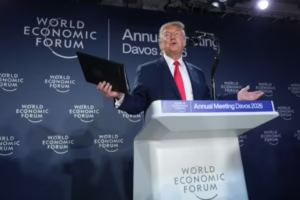
     

    Donald Trump at the World Economic Forum in Davos on Wednesday. Photograph: Evan Vucci/AP

    The president’s address in Switzerland featured a range of dubious assertions, from exaggerated to false.

    By Joseph Gedeon / The Guardian / January 21, 2026

    Wings Editorial Note: Because what is happening in Minnesota since this article was originally published it is a week old. The comments on Greenland and NATO, for example, are out of date because of recent developments. Nonetheless, this article illustrates how Trump lies and manipulates the truth and is well worth reading.  

    Here’s what Trump got wrong.


    ‘I’ve now been working on this war for one year, during which time I settled eight other wars.’

    Trump did not go into detail on which wars he was talking about, but he has repeated the claim enough times in his first year back in office that we can assess those we believe he was describing. His administration played a role in brokering ceasefires between Israel and Iran, India and Pakistan, and Armenia and Azerbaijan, though these were incremental agreements, and some leaders dispute the extent of his involvement. He did secure the Israel-Hamas ceasefire and hostage deal, but it involves multiple stages and remains incomplete – with hundreds in Gaza reported killed since the first phase took effect in October.

    The temporary peace deal between Rwanda and the Democratic Republic of the Congo fell apart, with fighting killing hundreds of civilians since it was signed in June. Cambodia and Thailand are still trading accusations over broken ceasefires and border clashes. The Egypt-Ethiopia dispute is about a dam on the Nile – a diplomatic problem, but not a shooting war. As for Kosovo and Serbia, it’s unclear what brewing conflict Trump believes he prevented.


    ‘We’re leading the world in AI by a lot. We’re leading China by a lot.’

    Key figures in the AI industry have assessed the race differently. Nvidia’s chief executive, Jensen Huang, said in September that China was “nanoseconds” behind the US. The White House AI czar, David Sacks, estimated in June that Chinese models lag by “three to six months”.

    Chinese companies such as DeepSeek have released cheaper models that rival America’s best, despite restrictions on advanced chips. Trump himself called DeepSeek a “wake-up call” for US tech companies.


    ‘China makes almost all of the windmills, and yet I haven’t been able to find any windfarms in China. Did you ever think of that? It’s a good way of looking. You know, they’re smart. China is very smart. They make them. They sell them for a fortune. They sell them to the stupid people that buy them, but they don’t use them themselves.’

    This claim is incorrect. China has more wind capacity than any other country and twice as much capacity under construction as the rest of the world combined.

    China’s wind generation in 2024 equaled 40% of global wind generation, according to the thinktank Ember Energy. The country is building 180 gigawatts of solar projects and 159 gigawatts of wind projects, which together amount to nearly two-thirds of the renewable capacity coming online worldwide, according to Global Energy Monitor. Rather than avoiding wind power domestically, China is the world’s largest generator of wind energy.


    ‘We’re there for Nato 100%. I’m not sure if they’d be there for us.’

    Nato allies have already demonstrated their willingness to support the US, suffering significant casualties in Afghanistan and Iraq over the past two decades.

    In Afghanistan, according to the independent nonprofit tracker icasualties.org, Nato allies sustained 1,144 deaths out of 3,609 total coalition fatalities between 2001 and 2021. The UK lost 455 service members, Canada lost 158, France lost 86, Germany lost 54 and Denmark lost 43. In Iraq, coalition partners sustained 324 deaths out of 4,910 total fatalities, with the UK suffering 182 casualties. These were substantial commitments to American-led military operations.


    ‘They called me Daddy.’

    Nato secretary general Mark Rutte did indeed call Trump “Daddy” at a summit last June. It happened after Trump compared Israel and Iran to “two kids in a schoolyard” fighting, with Rutte quipping that “Daddy has to sometimes use strong language”.

    Trump’s use of the plural “they called me” suggests a pattern of Nato leaders breathlessly addressing him this way, which is for now unsupported. Unless, of course, world leaders are calling him Daddy in soon-to-be-leaked private text messages.


    ‘After the war, we gave Greenland back to Denmark. How stupid were we to do that? But we did it. But we gave it back. But how ungrateful are they now?’

    The US never owned Greenland. In 1916, the secretary of state, Robert Lansing, declared the US “will not object to the Danish government extending their political and economic interests to the whole of Greenland” as part of a deal in which Denmark sold the US Virgin Islands. That’s not ownership.

    When Norway tried to claim part of Greenland in 1931, the international court ruled for Denmark in 1933, citing an 1814 treaty showing Denmark retained Greenland when it ceded Norway to Sweden. US-Denmark agreements in 1941 and 1951 allowing American military bases explicitly stated these were “without prejudice to the sovereignty of the Kingdom of Denmark”. At no point did the United States possess sovereignty over Greenland that it could then return to Denmark.


    ‘If we were able to cut out 50% of the fraud … we would have a balanced budget without having to talk about even growth.’

    The math doesn’t work. The highest estimate of US fraud losses is $521bn, according to the Government Accountability Office. Even eliminating all of it – which would be unprecedented – would cover less than a third of the 2025 deficit of about $1.7tn.

    Cutting fraud in half, as Trump proposed, would yield roughly $260bn if the highest estimate is the target. That’s less than one-sixth of the deficit, leaving the government more than $1.5tn short of balanced.


    Dharna Noor contributed reporting


    Wings of Change is entirely reader supported.
    Wings invites you to subscribe.
    Join us on Wings of Change

    In this critical time hearing voices of truth is all the more important although censorship and attacks on truth-tellers are common. Support WingsofChange.me as we bring you important articles and journalism beyond the mainstream corporate media on the Wings of Change website and Rise Up Times on social media

    Please join me on Wings of Change. It’s only the beginning as we still have so much work to continue to do as many activists and organizations address current threats to our democracy and unjust actions against people of color and activists and make plans for the upcoming years. Wings of Change is pleased and excited to be a part of that work through education, information, and inspiration.

    Access is always free, but if you would like to help:
    A donation of $25 or whatever you can donate will bring you articles and opinions from independent websites, writers, and journalists as well as a blog with the opinions and creative contributions by myself and others

    Sue Ann Martinson, Editor Wings of Change

    “We don’t have to engage in grand, heroic actions to participate in the process of change. Small acts, when multiplied by millions of people, can transform the world.”
    — Howard Zinn
  • Donald Trump talks peace but he is a man of war, by Simon Tisdall

    Donald Trump talks peace but he is a man of war, by Simon Tisdall

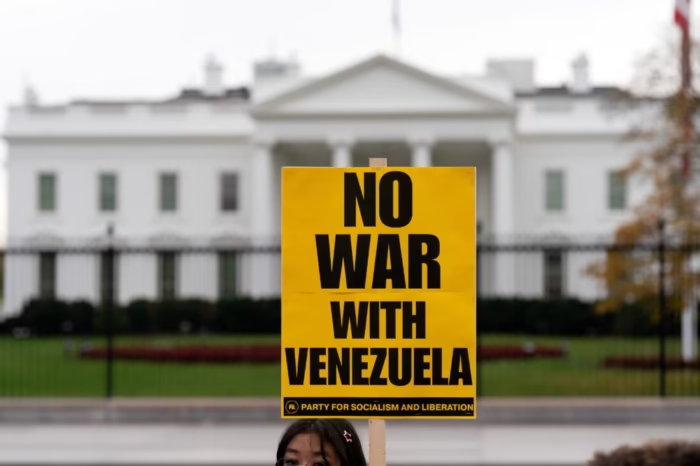
    Today an illegal coup in Venezuela, but where next? Donald Trump talks peace but he is a man of war.

    / The Guardian / January 3, 2026

    ‘This is the world we now live in – the world according to Donald Trump.’  Photograph: Brendan Smialowski/AFP/Getty Images

    The world will be anxious, and rightly so. For a man so bent on a peace prize, Trump appears to revel in conflict.

    The overthrow and reported capture by invading US forces of Nicolas Maduro, Venezuela’s hardline socialist president, will send a shiver of fear and consternation around the world. The coup is illegal, unprovoked and regionally and globally destabilising. It upends international norms, ignores sovereign territorial rights, and potentially creates an anarchic situation inside Venezuela itself.

    It is chaos made policy. But this is the world we now live in – the world according to Donald Trump.

    The direct attack on Venezuela marks an extraordinary, dangerous assertion of unfettered US power and comes in the same week that Trump threatened military strikes against another unpopular anti-western regime: that of Iran. It follows months of escalating US military, economic and political pressure on Maduro, including lethal maritime attacks on the boats of alleged drug traffickers.

    Trump claims to be acting to prevent illegal narcotics flowing into the US via Venezuela and to halt an alleged influx of “criminal” migrants. In an echo of the US invasion of Iraq in 2003, he is also accused of coveting Venezuela’s huge oil and gas resources – suspicions reinforced by repeated, illegal US seizures of Venezuelan oil tankers.

    But Trump’s primary motives appear to be personal animosity directed at Maduro, and a desire to revive the 19th-century Monroe doctrine by creating a US sphere of influence and dominance throughout the west.

    Regional leaders, including Colombia’s president, Gustavo Petro, who has clashed with Trump in recent months, greeted the coup with outrage and alarm; not least, perhaps, because they fear they too could become victims of Washington’s aggressive new hegemony. Cuba’s leftwing government has particular cause for concern. It relies heavily on Venezuela’s regime for cheap energy and political and economic support.

    Marco Rubio, the US secretary of state, has made no secret of his wish to see regime change in Havana. In Panama, too, anxiety levels will be running high. Trump has previously threatened military action there, over control of the Panama canal. Indeed, the reported capture of Maduro recalls the 1989 US invasion of Panama and the toppling and arrest of its then dictator, Manuel Noriega.

    Authoritarian, anti-democratic regimes around the world will be carefully watching Trump’s next steps, as will Washington’s democratic allies. Iran condemned the coup. It has good reason to be fearful. But Vladimir Putin, Russia’s president, may not be totally displeased by the defenestration of his Venezuelan ally.

    Trump’s unprovoked resort to violence is not so very different from Putin’s actions in invading Ukraine. Both have illegally attacked a neighbouring country and sought to remove its leadership. For China’s Xi Jinping, whose forces were last week practising military action against the “separatists” of Taiwan, Trump has just set a precedent he may one day gladly follow.

    Trump’s coup is of great concern to Britain, the EU and western democracies. They should, and must, unequivocally condemn it. It directly challenges the rules and principles of the international order they hold dear. The US has once again ignored the UN and traditional methods of addressing inter-state grievances. And it is acting with apparently scant regard or thought for what happens next in Venezuela.

    The Caracas government has been decapitated, but other senior members of the regime appear still to be in place. They are urging resistance and, potentially, retaliation against the US. There are unconfirmed reports of civilian casualties. If a power vacuum develops, public order could collapse, sparking civil war or a possible military coup. And it is unclear whether the latest US military action has ended, or may escalate further.

    The idea that exiled opposition leaders, such as the 2025 Nobel peace prizewinner María Corina Machado, will swiftly return and that full democracy will now be restored is naive. The coming days will be critical. And it’s all down to Trump.

    Trump’s reckless action should finally lay to rest his always misleading characterisation of himself as a “global peacemaker”. It’s high time Keir Starmer and other European leaders publicly recognise him for what he is – a global warmaker, a universal menace.

    Each time he blunders noisily into conflict zones, such as Russia-Ukraine or Israel-Palestine, setting deadlines, issuing ultimatums, picking favourites and monetising misery, the quest for just and lasting peace is set back.

    Little wonder peace is elusive. And bizarrely, even while posing as a disinterested peacemaker and non-interventionist, Trump simultaneously wages war on the world. The US conducted record numbers of air strikes in the Middle East and Africa last year, surveys show.

    Since returning to office a year ago, peace-loving Trump has bombed Yemen, carelessly killing numerous civilians after loosening rules of engagement; bombed Nigeria, to counter-productive effect; bombed Somalia, Iraq and Syria; and bombed Iran, where he mendaciously exaggerated the success of US strikes on nuclear facilities. He even refuses to rule out bombing Greenland, a sovereign territory of Nato ally Denmark.

    What’s going on inside Trump’s head? A benign interpretation is that in matters of war and peace, he has no idea what he is doing – no strategy, no clue – and makes up policy as he goes, depending on how he feels.

    The sinister interpretation says he knows exactly what he’s at, that more and worse is to come. Like previous second-term presidents who ran out of road domestically, Trump finds the world stage offers greater possibilities for the exercise of power and ego. He is building a legacy in blood.

    Trump’s irresponsible, dangerously erratic behaviour is getting measurably worse. His Venezuela “success” may encourage him to attempt more and bigger, unhinged outrages. Like Mark Antony minus the toga and brains, he struts and preens, cries havoc! and lets slip the dogs of war.

    Simon Tisdall is a Guardian foreign affairs commentator.


    Wings of Change is entirely reader supported.
    Wings invites you to subscribe.
    Join us on Wings of Change

    In this critical time hearing voices of truth is all the more important although censorship and attacks on truth-tellers are common. Support WingsofChange.me as we bring you important articles and journalism beyond the mainstream corporate media on the Wings of Change website and Rise Up Times on social media  Access is always free, but if you would like to help:
    A donation of $25 or whatever you can donate will bring you articles and opinions from independent websites, writers, and journalists as well as a blog with the opinions and creative contributions by myself and others

    Sue Ann Martinson, Editor Wings of Change