

Minneapolis, MINNEAPOLIS!
The unprecedented ICE surge has the hallmarks of an occupation in some neighborhoods, as masked and heavily armed agents drive around in large SUVs, tussle with protesters and observers, and break into people’s cars and houses to make arrests. —Axios
By Susu Jeffrey / Original to Wings of Change / March 2, 2026
What an honor when The Nation nominated Minneapolis for the 2026 Nobel Peace Prize! The initial butterfly-in-the-stomach thrill dissipated with the thought of what President Trump would do (next) if we got his award. The revenge-dealing, super bully apparently stays awake imagining schemes on his social media site while we make new signs for the next NO KINGS demonstration and grocery lists for shut-in neighbors.
NO HATE, NO FEAR! IMMIGRANTS ARE WELCOME HERE!
In Minneapolis hard times make good neighbors. If we want to eat tomatoes or reroof our buildings we need to pay local people willing to do the work. The law of economics requires low wage, compliant workers in Minneapolis like every other American city. We need childcare, eldercare, healthcare, farm workers, meat packers, independent restaurants and all the oil that lubricates western society where the dream of a richer future is the hook.
The Americana rainbow of Minneapolis is like “Eat Street,” (Nicollet Avenue and 26th Street) where Alex Pretti was shot to death by federal agents. My favorite restaurant is across the street from the people’s Alex Pretti memorial. They serve Vietnamese pho soup and cream cheese wontons or you could go donuts-coffee and local bands, Mexican, Vietnamese-French-bread sandwiches, Greek, Middle East, Malaysian, pizza or burgers and fries. Minneapolis has the population of a stew, a toothsome mix of ingredients harmonizing in one pot.
Why Minneapolis?
Why did President Trump decide to sic ICE (Immigration and Customs Enforcement) and Border Control (Customs and Border Control) on the Twin Cities of Minneapolis-St. Paul? Minnesota is the state that ranks 28th among the 50 United States hosting “illegal aliens”? Trump has a perfect zero political success rating here; he does not study history (for example George Floyd) and he has difficulty separating his ego from reality.
Since the 1934 truckers strike where two people were shot dead by zealous enforcers (sound familiar) the Minneapolis model of citizen support for everyday people’s rights has echoed across the nation. The appalling executions of Renee Good and Alex Pretti caused Gov. Tim Walz to label the president’s agents “untrained, aggressive” and noted that Trump “picked the wrong state to make an example of.” (CBS nightly news). This comment from the vice-presidential candidate who charmed his way through the 2024 campaign like a fatherly and practical human being who doesn’t lie.
Part of the Minneapolis social scene is political activism. Minneapolis-based peace groups were associated with the 1997 Nobel Peace Prize nomination for the Campaign to Ban Landmines and the 2017 prize to ICAN, the International Campaign to Abolish Nuclear Weapons.
Furthermore Minnesota has the highest voter turnout in the nation. The midterm elections are coming up in November this year. Statistically the president’s party loses congressional seats in the midterms.
Since December 1, 2025, the 3,000 Gestapo agents of Operation Metro Surge made 4,000 arrests (they had a 2,000 per day quota) which the existing incarceration and judicial systems could not process. Among the innocent victims were two Native American children (to which rez would they be extradited), 5-year-old Liam Ramos in his blue bunny hat, and an Asian man wearing handcuffs, boxer shorts and plastic slip-on shoes in minus 9-degree weather who lived in a house formerly occupied by a man already in prison.

ICE Agent Who Shot Renee Good Self-Deports
Jonathan Ross and his second wife
Image: Daily Mail
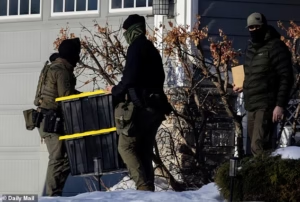
Agent Ross, 43, of Chaska, Minnesota, an upscale southwest Minneapolis suburb, fled his half-million-dollar home with his family after shooting Renee Good to death on January 7. He was quickly identified. Two nights after Ross killed Renee Good a Special Response Team in masks was seen removing boxes including electronics and family photos from Ross’s home. Ross told neighbors he was a biologist. Neighbors described him as a hardcore MAGA supporter. His father labelled him a “conservative Christian.”
The last words Renee Good spoke was to tell Ross “I’m not mad at you” while he circled her car making a video. Then there were shots and Ross is heard saying “f—ing bitch.”

Renee as captured by Ross’s camera just before he executed her. Image Wikipedia
“They had guns. We had whistles,” said Renee Good’s widow.
On the night of February 17 the Renee Good sidewalk flower bedecked memorial between 33rd and 34th Streets on Portland Avenue South was sprinkled with gasoline and set afire. A volunteer night guard discouraged the arson vandals, preventing damage from spreading.
Church, State, Media and the Public React
Catholic Cardinal Joseph W. Tobin of Newark, New Jersey called ICE a “lawless organization” and remarked on the importance of human dignity in a televised Christiane Amanpour interview. Pope Leo XIV urged people to “fast from violent language,” especially during Lent and Ramadan.
National Public Radio’s 1A program (1-1-2026) noted the frequency of the president’s people “ignoring judicial orders. The Trump administration doesn’t follow laws they don’t like.”
So pooh-pooh to the laws of God and the State. Still, most of us await the arrests of Jonathan Ross and Texas-based Border Patrol agents Jesus Ochoa, 43, and Raymundo Gutierez, 35, for the first-degree murders (intentional killing) of Renee Good and Alex Pretti.
What is To Be Done?
Vote.
ICE’s budget has metastasized from $10 billion to $85 billion. “They have the kind of budget you would give to a standing army to fight an actual war,” David Miller wrote on Facebook. Miller advocates “neighborism.”
Congress controls the budget, “the power of the purse.” Congress can also impeach. Trump was impeached twice during his first term.
First Trump was impeached by the House of Representatives for “incitement of insurrection” of the January 7th rebellion in and around the Capitol building which was thoroughly filmed. However our 100 U.S. senators failed to reach the required 66 votes getting just 57 votes for inciting an insurrection.
Then the state of Georgia impeached Trump for his post-election interference: “I just want to find 11,780 votes….” But that effort was dismissed by the Department of Justice policy of avoiding to prosecute a sitting president.
On January 28, 2026, the FBI seized those 2020 ballots from the Biden/Trump Fulton County Georgia elections warehouse even though they had been counted and recounted three times, by hand and by machine. Trump’s inability to accept his failed reelection bid bodes ill for the upcoming 2026 midterm elections. It is a nutter world when black and white paper proof translates into Alice in Wonderland technicolor.
In reality it’s another practice run by Trump at not believing our lying eyes. Here are the videos, here are the ballots. Minnesota is a voting state. Voting is a form of neighborism.
It feels good to vote, especially in overwhelming numbers, and you get one of those little red I VOTED stickers.
Voting feels like I-AM-DOING-SOMETHING:
I AM — SOMEBODY (A chant made famous by Jesse Jackson)
It is the next step after 100,000 people marched against Operation Metro “Siege.” The crowd was so dense an American flag-carrying friend said it almost felt claustrophobic.
The comb-overs, Trump, Putin and Netanyahu, plan to divide up the world with their bombs and guys in masks with guns. Look again at those old men hiding their shiny pates, white-knuckled trying to hold onto their fictions. America has been multicultural since the Vikings and the Conquistadores invaded. What would baseball be without immigrants?
George Floyd, Renee Good, Alex Pretti
George Floyd’s murder by Minneapolis policeman Derek Chauvin put him in prison for 22.5 years and that was for “unintentional” murder, murder two. The murder one, intentional killings using three bullets for Renee Good and nine or ten bullets to execute Alex Pretti are proof of intention.
“Democracy is stronger than fear,” says Minnesota state Sen. John Hoffman, who survived an eight-bullet assassination attempt. Hoffman has just returned to his seat in the state capitol.
Wings of Change is entirely reader supported.
Wings invites you to subscribe.
To subscribe: Join us on Wings of Change
In this critical time hearing voices of truth is all the more important although censorship and attacks on truth-tellers are common. Support WingsofChange.me as we bring you important articles and journalism beyond the mainstream corporate media on the Wings of Change website and Rise Up Times on social media. Donate now to sustain Wings of Change.
Access is always free, but if you would like to help:
A donation of $25 or whatever you can donate will bring you articles and opinions from independent websites, writers, and journalists as well as a blog with the opinions and creative contributions by myself and others.
Join us on Wings of Change
We still have much work to continue to do as many activists and organizations address current threats to our democracy and unjust actions against people of color and are making plans for the upcoming years. Wings of Change is a part of that work through education, information, and inspiration. Here in Minnesota we are particularly targeted by the Trump regime with ICE immigrant law enforcement illegally arresting and deporting our neighbors who are mostly people of color. In spite of promises to withdraw ICE, the arrests continue. Other cities have been targeted as well, and they will try to target more to fill the detention centers they are building all over the country.
Sue Ann Martinson, Editor 
“We don’t have to engage in grand, heroic actions
to participate in the process of change.
Small acts, when multiplied by millions of people,
can transform the world.”
— Howard Zinn



 Whatever you are able donate will bring you articles and opinions from independent websites, writers, and journalists as well as a blog with the opinions and creative contributions.