Tag: Rise Up Times

  • Waging Nonviolence: The playbook of every successful nonviolent struggle, by Jamila Raqib

    Waging Nonviolence: The playbook of every successful nonviolent struggle, by Jamila Raqib

    The playbook of every successful nonviolent struggle

    by Jamila Raqib / Waging Nonviolence / November 26, 2025

    Democracy is being tested in our communities. Cities from Charlotte to Memphis face escalating threats from the deployment of military troops and immigration raids. States like Maryland and Vermont are being denied federal funding for disaster recovery and response. However, there are also many signs that resistance is building.

    Federal courts have become an important tool to protect against federal overreach, and Americans are increasingly getting activated — and yes, radicalized, in the best sense of the word. They’re recognizing that business as usual is no longer an option and that they have a role to play in protecting our communities and political systems.

    This is a time of great urgency, and the strategies being used against us are meant to overwhelm us, instill fear and confusion, and make us feel helpless. Authoritarians like to present the oppressive reality as a fait accompli, one that cannot be undone, thus undermining the will to resist.

    In America, however, resistance is widespread and growing, and there’s an urge to act quickly. Recent research out of Harvard shows that protests this year have reached “a wider swath of the United States than at any other point on record.” This is an important development, but how we act also matters. Now, the goal should be to use tactics and strategies that will increase our effectiveness in the short term, while ensuring our achievements are durable.

    What’s happening in America closely follows an authoritarian playbook common throughout history and around the globe today. But we have a playbook too — one that offers frameworks and lessons from people who have successfully resisted invasions, occupations and authoritarianism.

    These four steps enable us to think holistically about nonviolent resistance — a powerful tool in the fight for democracy and human rights — and ensure that all pieces of the puzzle are put in place.

    1. Assess the situation to understand the conflict landscape

    Movements often jump into action without a clear picture of the terrain they’re navigating. We must resist the impulse to respond to every outrage with immediate mobilization. Instead, we should pause to assess the situation, our objectives and the capabilities of the groups we are mobilizing against, as well as those of our movements.

    This kind of strategic assessment is a necessary prerequisite to action. We need to know what harm is being done or planned and who is doing it. And we need to know what systems and institutions enable this harm through their cooperation and obedience, and which are vulnerable to persuasion or pressure. It’s at that point that we can assess our movement’s numbers, capabilities, resources and people’s level of training and discipline.

    Previous Coverage

     Overcoming despair and apathy to win democracy

    This kind of analysis, carried out before mobilizing people, has been crucial in past movements. It’s revealed untapped power and enabled groups to target their actions in a way that makes success more likely. For example, the Otpor movement in Serbia which was successful in removing the Slobodan Milosevic dictatorship from power in October 2000 relied on strategic assessments to prepare actions. One of its key objectives was to convince police to shift their allegiance to the resistance, which seemed impossible. However, the movement realized that appealing to and recruiting police officers’ family members could prove effective given their proximity and influence. At the final showdown, when hundreds of thousands of protesters took to the streets of Belgrade, most police officers simply refused orders to open fire on the crowd.

    It’s this kind of clear-eyed, strategic assessment that comes first. Then we build, and not just power in numbers, but also in skills, strategy and infrastructure.

    2. Build the power to carry out effective action

    Once we understand the strengths and weaknesses of the groups we’re mobilizing against, as well as those of our movement, we need to build power.

    This means developing a strategy to recruit and train people beyond the usual suspects. And ensuring that they have nonviolent discipline so that our response to repression is strategic, not reactive, and we’re not provoked into violence and other counterproductive behavior. It also means building parallel institutions to meet our needs as existing systems weaken, collapse or are used for repression.

    Sudan’s neighborhood committees, which emerged in the 2019 resistance and helped bring down Omar al-Bashir’s regime, were decentralized, grassroots structures that coordinated protests, disseminated information and organized mutual aid — creating parallel centers of power grounded in local legitimacy and trust. In Lithuania, during the final years of Soviet rule, citizens built alternative communication networks, coordinated economic resistance and prepared for civilian-based nonviolent defense. And during the anti-apartheid movement in South Africa, street committees and people’s courts played a crucial role in both resisting apartheid policies and building new forms of democratic participation, effectively undermining the regime’s authority and replacing it with localized self-governance.

    In the U.S., faith groups, garden clubs and tenants’ unions could be similarly utilized as pockets of power and organizing hubs. Supported by a decentralized training infrastructure, any group in America, anywhere, could design and carry out action, even if centralized leadership doesn’t emerge or is disrupted.

    When these alternative capacities are built and integrated into resistance struggles and movement work, they become potent tools in our nonviolent arsenal and can better facilitate the next step: carrying out powerful actions.

    3. Act to shift power

    Our default, too often, are marches and rallies. Yes, these can be symbolically powerful, but unless they’re part of a broader strategy to shift power — by withdrawing cooperation, applying economic pressure and disrupting key functions — they rarely force change on their own. Actions must not only express outrage, but help bring about specific shifts in power.

    There’s a reason why the list of 198 methods of nonviolent action created by Gene Sharp is organized in three strategic buckets: protest, noncooperation and intervention. The most effective movements sequence these methods deliberately. That’s why timing, sequencing and clarity of objective are key.

    In Chile, civil resistance against Augusto Pinochet’s regime involved student boycotts, labor strikes and underground media, all of which were working in concert. In Israel, antiwar protesters recently moved from street protests, involving military reservists, to a general strike that carried the potential to create substantial economic and political pressure.

    Effective action builds momentum by involving a growing cross-section of society and increasing costs for the regime or institution. In the U.S., similar actions could include a coordinated tax resistance, sustained student walkouts, rent strikes or labor disruptions — all tied to specific demands, sequenced and scaled over time.

    Any of these actions will need defending, which is the final step.

    4. Defend our wins to ensure long-term resilience.

    Every movement that wins a policy change, campaign or struggle must ask how it’ll be defended. Without the capacity for defense, every gain can be reversed.

    This is where civilian-based defense is essential. It involves preparing society for decentralized nonviolent resistance in the face of attacks against our communities, institutions and political systems. It means building the muscle not just to mobilize once, but to sustain mobilization.

    In Latvia and Lithuania, for example, while declaring independence from the USSR, leaders prepared their entire societies, including neighborhood committees, for civilian-based defense. They trained people how to resist occupation without taking up arms. And it worked. During Bangladesh’s recent nonviolent student uprising that removed their authoritarian leader, when police vacated the streets, students took over many of their functions, such as directing traffic and providing security.

    In the U.S., this means embedding resistance training in civil society groups, civic education, labor unions and professional associations. It means preparing city councils, schools and unions to reject unconstitutional directives, and establishing watchdog groups to monitor and respond to democratic backsliding. And it means preparing for what comes after victory, so we’re not left scrambling during the transition.

    This is how decentralized, disciplined and strategic resistance can topple oppressive regimes, prevent coups and transform societies. Civil society in the U.S. is waking up: the No Kings protests on Oct. 18 brought 7 million Americans into the streets, making it one of the largest mobilizations in U.S. history. Now we need to act with both urgency and strategy. A decentralized and empowered civil society is one of the most resilient forms of democratic defense. This moment calls for us to assess wisely, build steadily, act strategically and defend relentlessly. The time is now.


  • COP30: Handwringing at the UN Climate Talks, by Inside Climate News

    COP30: Handwringing at the UN Climate Talks, by Inside Climate News

    DONATE TO WINGS OF CHANGE TODAY

    Editor’s Note: Many analyses summarizing the COP30 Climate conference have appeared by mainstream corporate media and by others. This analysis is not mainstream corporate media. I found the analysis of the internal workings of the conference and paticularly the role of the U.S. even though there was no formal delegation this year, as Trump refused to attend and to send a delegation.

    Go behind the scenes with executive editor Vernon Loeb and climate science reporter Bob Berwyn as they break down the key outcomes of COP30. COP30 has wound down in Belém, Brazil – the U.N. climate change conference marked this year by Indigenous rights demonstrations, an actual fire, and not a lot of movement on global climate action. Before leaving Belém, Bob explains what happened at COP30, both within the formal proceedings and adjacent to them; how American influence was woven into the process; and what to look for leading up to next year’s COP31 in Turkey.


    The INC video above does not include mention of the announcement of this Initiative:

    Colombia and The Netherlands Announce First Fossil Fuel Non-Proliferation Initiative …

    The Fossil Fuel Non-Proliferation Treaty Initiative

    Belém, Brazil – As COP30 negotiations draw to an end, and the most recent text released this morning makes no mention of fossil fuels, the Governments of Colombia and the Netherlands show leadership by announcing they will co-host the First International Conference on the Just Transition Away from Fossil Fuels. The announcement was made by the Minister of Environment of Colombia, Irene Vélez Torres, and the Deputy Prime Minister and Minister for Climate Policy of the Netherlands, Sophie Hermans, during a high-level press conference in Belém.

    The conference will advance international cooperation on transitioning away from fossil fuel extraction.

    Two of many news reports on the results of COP30.

    BBC COP30: Five key takeaways from a deeply divisive climate …

    Many countries were livid when COP30 in Belém, Brazil ended on Saturday with no mention of the fossil fuels that have heated up the atmosphere.


    Subscribe! Sign Up for Updates

    FREE SPEECH

    Join Wings of Change! It’s only the beginning as we still have so much work to do as many activists and organizations make plans for the upcoming years. Wings of Change is pleased and passionate about being a part of that work through education, information, and inspiration.

    Updates Sign-up

    Never miss news articles on current issues  and Sue Ann’s blog! Sign up here for an email notice of new posts from Wings of Change.

  • DN! COP30 Report: The Amazon Tipping Point, Fossil Fuel Phaseout, Climate-induced Migration

    DN! COP30 Report: The Amazon Tipping Point, Fossil Fuel Phaseout, Climate-induced Migration

    The Race to Save the Amazon: Top Brazilian Scientist Says Rainforest Is at “Tipping Point”

    Amy Goodman interviews scientist Carlos Nobre / Democracy Now! / November 20, 2025

    AMY GOODMAN : As we broadcast from the COP30 climate summit in Belém, Brazil, we are joined by one of Brazil’s most prominent scientists, [Nobel Prize winner] Carlos Nobre, who says the Amazon now produces more carbon emissions than it removes from the atmosphere, moving closer to a “tipping point” after which it will be impossible to save the world’s largest rainforest. “We need urgently to get to zero deforestation in all Brazilian biomes, especially the Amazon,” he argues. (See full transcript below.)


    StoryNov 20, 2025 Democracy Now!

    Brazilian Indigenous Minister Sônia Guajajara on Fossil Fuel Phaseout, Bolsonaro’s Conviction & More

    SÔNIA GUAJAJARA[translated] It’s always a challenge. It’s really — it’s not simple. It’s hard, because there is a dispute, a big one, with the economic sectors, so that these changes do not happen. So we need to make sure that agreements done at COP and commitments done at COP can tackle this, because the world knows the impact that oil exploitation, fossil fuels does, the risk of us achieving the point of no return, but these sectors, the economic sectors, need to understand this is an emergency. So we need to have, like, a clear decision here in this conference to stop depending on fossil fuel.

    _____________________

    StoryNov 20, 2025  Democracy Now!

    Climate Crisis Displaces 250 Million Over a Decade While U.S. & Other Polluting Nations Close Borders

    “This is not abstract,” Nikki Reisch, director of climate and energy at the Center for International Environmental Law, says of climate-induced migration. “This is about real lives. It’s about survival. It’s about human rights and dignity, and, ultimately, about justice.”

    Trump’s Response to COP30

    Trump sends no formal U.S. delegation at COP30: Here is Trump’s response as he is determined to destroy the planet and continues his own version of genocide against the Least Developed Countires (LTC) that are most affected by global warming caused by fossil fuels. Meanwhile 80 nations at COP30 have signed on to plan to phase-out fossil fuels.

    Trump Saudi Arabia© Evan Vucci

    The Trump administration announced on Thursday new oil drilling off the California and Florida coasts for the first time in decades, advancing a project that critics say could harm coastal communities and ecosystems, as President Donald Trump seeks to expand U.S. oil production.

    More than 80 countries at Cop30 join call for roadmap to fossil fuel phaseout

    Countries from Africa, Asia, Latin America, Pacific and Europe plead for transition to be central outcome of talks.

    Transcript
    This is a rush transcript. Copy may not be in its final form.

    AMY GOODMAN: This is Democracy Now!, democracynow.org. We’re broadcasting at the U.N. climate summit, COP30, here in the Brazilian city of Belém, the gateway to the Amazon rainforest. I’m Amy Goodman, with Nermeen Shaikh. As we broadcast, there’s a protest right behind us by the Loss and Damage Youth Coalition, where they are holding a banner that reads, “From opinion to obligation, respond to loss and damage.”

    NERMEEN SHAIKH: We end today’s show with one of Brazil’s most prominent scientists, Dr. Carlos Nobre. He’s a senior researcher at the Institute of Advanced Studies at the University of São Paulo and co-chair of the Scientific Panel for the Amazon. He’s a lead author of the U.N.’s Intergovernmental Panel on Climate Change, or IPCC, that won a Nobel Peace Prize in 2007 for its reports on global warming.

    AMY GOODMAN: For decades, Carlos Nobre has been warning the Amazon rainforest is being pushed beyond the tipping point. The Amazon rainforest is almost as large as the contiguous United States.

    Carlos Nobre, welcome to Democracy Now! It’s an honor to be in your presence. You have been warning for quite some time, and now it’s getting more serious than ever. What is the tipping point? And for a lay audience around the world, explain to us why the biome of the Amazon rainforest is so important for the world.

    CARLOS NOBRE: Good morning. Thank you very much.

    Yes, I’ve been working for 43 years with the Amazon. I was the first scientist, 1990, 1991, publishing a science article saying if we continue with very high deforestation, the Amazon would cross the tipping point. But that was 1990, ’91, 36 years ago. Now the Amazon is very close to the tipping point.

    Why do we say that? Because from the Atlantic to Bolivia, Peru and Colombia, this is 2.5 million square kilometers. The whole forest, close to 7 million square kilometers, but this southern portion, very close to tipping point. The dry season is four to five weeks’ length here — in 45 years, one week per decade. It was three, four months, but with rain during the dry season. Now it’s four to five months, 20, 30% drier, two, three degrees warmer. And also, tree mortality has increased a lot in these areas. In the southeastern Amazon, south of where we are, the forest has become a carbon source. It’s losing more carbon than removing.

    So, if we continue — deforestation is about 18%, degradation 30% — if we reach 20, 25% deforestation, global warming close to two degrees, we cross permanently the tipping point. We are going to lose up to 70% of the Amazon within 30 to 50 years. If we continue with global warming, deforestation, we reach the tipping point by 2040. So, by 27 — 2100, we’re going to lose 70% of the Amazon. We’ll release more than 250 billion tons of carbon dioxide to the atmosphere, making it impossible to maintain the global warming at 1.5 degrees. We are going to lose the highest biodiversity in the planet. So, terrible.

    And also, the Amazon recycles water so well that about 45% of the water vapor that comes from the Atlantic Ocean, transported by the trade winds, goes to the south of the Amazon and feeds more than 50% of rainfall on the tropical savanna south of the Amazon, so — and also the Atlantic rainforest. So, it’s really essential. If we lose the Amazon, not only the Amazon forest will disappear, but the tropical savanna, as well.

    NERMEEN SHAIKH: If you could also talk, Dr. Nobre — in addition to increasing heat and the dryness that you talked about, you’ve also said that livestock grazing is a form of ecological pollution. Now, Brazil is the world’s second-largest producer of beef. If you could talk about what the impact of cattle ranching has been on this deforestation of the Amazon?

    CARLOS NOBRE: Yes, of course. I mean, 90% of the deforestation in the lowlands in the Amazon in Brazil is related to cattle ranches. And when we compute, Brazil is the only country in the world where 70% of fossil fuel emissions, greenhouse gas emissions, come from land use change, about 70% of emissions, 40% deforestation. And about 20, 25% of this comes from agriculture, but mostly for cattle ranches. Particularly, the cattle emits a lot of methane, so — all ruminants. So, we say 55% of emissions in Brazil related to livestock, you know, the deforestation for cattle ranches and also the cattle emitting methane.

    So, really, we need urgently to get to zero deforestation in all Brazilian biomes, especially the Amazon, and also merging to the so-called regenerative livestock. Regenerative livestock. We have about 15% in Brazil of regenerative livestock, and very little. The regenerative livestock makes — reduces a lot emissions by livestock.

    NERMEEN SHAIKH: And, you know, in Brazil, as you well know, Brazil is one of the world’s largest agricultural exporters, which means the alternative that you mentioned may compensate, but presumably it would be a massive economic loss to Brazil if their agricultural production were to go down. But as you were mentioning earlier, though, there has been a commitment by countries here to work on a roadmap to get to zero deforestation by 2030. So there is an agreement there, whereas there is not a majority of countries signing up to the roadmap to phasing out fossil fuels. So, if you could just talk about, I mean, the countries that are, in part, dependent on agricultural exports, what would it mean to diminish cattle ranching? And, I mean, you’ve become, in fact, vegetarian as a result of this.

    CARLOS NOBRE: Oh, listen, mostly livestock average productivity is very low. Brazil has about 1.5 heads of cattle per hectare. This is very little. Brazil has about 3.2 million square kilometers, mostly livestock and also agricultural. So, regenerative livestock will have three to five heads of cattle per hectare, reduce emission, and also the regenerative agriculture and livestock is much more resilient to the climate extremes. For instance, last year, Brazil had a record-breaking drought in the Amazon tropical savanna, Cerrado, and a record-breaking number — decline of agricultural productivity. So, therefore, Brazil can continue being a tremendous high producer of meat, agriculture, soy grains, using not 3.2 million square kilometers, but maximum 2 million square kilometers.

    AMY GOODMAN: I want to ask you a question about climate science. You have said that it’s a mystery to you, the country which invested the most in climate science, a country with the largest number of climate scientists and very few who deny climate change, which contributed the most to the IPCC report — how is it possible this country elected a climate denier? And we’re talking about the United States. But talk about the significance of the billions of dollars being removed from science research in the United States, and the effect that has all over the world?

    CARLOS NOBRE: Well, that’s a very good question, because, in fact, I mean, I create a name, because all tipping points that we know in the climate, more than 20, they are all associated with ecological, biological, hydrological, ocean-related tipping points. But I’m thinking how the world, in democracies, we are creating a, quote, quote-unquote, “a social/political tipping point,” which is — it’s not only in the U.S. In many countries in the world, democracies, we are electing more and more populist politicians — U.S. President Trump, Argentina President Milei. Brazil elected a former president, Bolsonaro, totally climate denier. Deforestation increased a lot in those four years. That’s happening all over the planet. So, this is a — I even gave a name in the West. I said this social/political tipping point is the “trumping point.” Why we are, in democracies — as you mentioned, the country with the top science on climate change, U.S., always, for decades — why U.S. democracy electors are electing a climate-denier president? This is very serious.

    NERMEEN SHAIKH: And you’ve said, Dr. Nobre — I mean, it’s remarkable, as you said, with these right-wing governments, being led in part by Donald Trump, the fact that this roadmap to deforestation was agreed. You’ve said that COP30 is a critical meeting of — a critical climate summit. Explain why, and what you hope is going to come out of this. It’s formally concluding tomorrow, but it regularly goes beyond that date.

    CARLOS NOBRE: Yes, that’s a very good point, because all of us scientists, we say this COP30 has to be very important, I mean, as important as Paris Agreement, as important as COP26, when all countries agree in reducing emissions. But now we have to accelerate reducing emissions.

    Yesterday, we, the Planetary Science Pavilion people, we hand-delivered our declaration to all negotiators, and I hand-delivered to President Lula, as well. We say, in addition to zero deforestation in all biomes, tropical forests by 2030, we have to accelerate reducing of emission by fossil fuels. We say, ideally, zero fossil fuel emissions by 2040, no longer than 2045 — no questions, because the temperature is reaching 1.5 degrees within five to 10 years permanently. If we only get to net-zero emissions by 2050, we may reach two degrees and even more. It will be a tragedy, an ecocide for the planet.

    And when I presented this document to President Lula, he said also — four times, he said — I was in a meeting with him. He said, “This has to be the most important COP of all COPs.” Let’s hope, in two days now, countries will agree not only zero deforestation in all tropical forests by 2030, but zero fossil fuel emissions —

    AMY GOODMAN: Ten seconds.

    CARLOS NOBRE: — by 2040.

    AMY GOODMAN: We want to thank you so much, Carlos Nobre, leading Brazilian scientist, world-renowned climatologist, senior researcher at the Institute of Advanced Studies at the University of São Paulo, co-chair of the Scientific Panel for the Amazon, where we are right now. We’re in Belém, the gateway of the Amazon. I’m Amy Goodman, with Nermeen Shaikh.

    The original content of this program is licensed under a Creative Commons Attribution-Noncommercial-No Derivative Works 3.0 United States License. Please attribute legal copies of this work to democracynow.org. Some of the work(s) that this program incorporates, however, may be separately licensed. For further information or additional permissions, contact us.


    Rise Up Times is entirely reader supported.

    In this critical time in hearing the voices of truth is all the more important although censorship and attacks on truth-tellers are common. Support WingsofChange.me as we bring you important articles and journalism beyond the mainstream corporate media on the Wings of Change website and Rise Up Times on social media  Access is alway free, but if you would like to help:
    A donation of $25 or whatever you can donate will bring you articles and opinions from independent websites, writers, and journalists as well as a blog with the opinions and creative contributions by myself and others

     Subscribe: Join us on Wings of Change

    Note: to reach the Wings of Change website quickly type the full .url in the search engine of your choice: wingsofchange.me

    Sue Ann Martinson, Writer, Editor Wings of Change

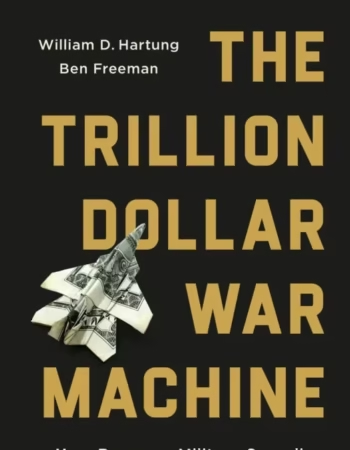
  • “The Trillion Dollar War Machine”: William Hartung on How U.S. Military Spending Fuels Wars

    “The Trillion Dollar War Machine”: William Hartung on How U.S. Military Spending Fuels Wars

    “The Trillion Dollar War Machine”: William Hartung on How U.S. Military Spending Fuels Wars

    By William Hartung / Democracy Now! / November 14, 2025

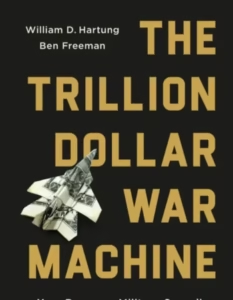
    Democracy Now! speaks to William Hartung about his new book The Trillion Dollar War Machine and who profits from the United States’ runaway military spending that fuels foreign wars. Hartung says that U.S. policy is “based on profit” and calls for a rethinking of our foreign entanglements. “We haven’t won a war in this century. We’ve caused immense harm. We’ve spent $8 trillion,” he says.

    Transcript
    This is a rush transcript. Copy may not be in its final form.

    AMY GOODMAN: This is Democracy Now!, democracynow.org. I’m Amy Goodman with Juan González.

    As the U.S. expands its military presence in Latin America, Defense Secretary Pete Hegseth declared earlier this week the Pentagon’s now on a war footing. In a major speech, Hegseth called for weapons companies executives to speed up production of weapons for the military.

    SECRETARY PETE HEGSETH: Every dollar squandered on redundancy, bureaucracy and waste is a dollar that could be used to outfit and supply the warfighter. We must wage an all-out campaign to streamline the Pentagon’s process to unshackle our people from unproductive work and to shift our resources from the bureaucracy to the battlefield.

    Our objective is simple: transform the entire acquisition system to operate on a wartime footing, to rapidly accelerate the fielding of capabilities and focus on results. Our objective is to build, rebuild the arsenal of freedom.

    AMY GOODMAN: We’re joined now by William Hartung, coauthor of the new book, The Trillion Dollar War Machine: How Runaway Military Spending Drives America into Foreign Wars and Bankrupts Us at Home. Bill Hartung is Senior Research Fellow at the Quincy Institute for Responsible Statecraft. Bill, welcome back to Democracy Now!.

    How unprecedented is the Pentagon budget at this point and what the military’s doing? For example, even President Trump, in his executive order, renaming the Department of Defense the Department of War, although only actually Congress can officially do that.

    WILLIAM HARTUNG: Well, the Pentagon budget has never hit a trillion dollars before. Even its most ardent supporters kind of didn’t believe we would ever hit this mark. But now that they’re there, all bets are off.

    And speeches like that by Pete Hegseth are basically saying, “Not only are we going to spend a trillion, there’s not going to be rules. We’re not going to have independent testing of these weapons, we’re not going to vet them for human rights when we export them.” It was basically a gift to the arms industry. And they talk about speeding it up. When it comes to weapons, speed kills.

    AMY GOODMAN: So – yeah, go ahead, Juan.

    JUAN GONZÁLEZ: Yeah, Bill, I wanted to ask you about the increasing shift in the military machine of the United States from actually troops to machines, this shift of this new defense industry that has arisen from Silicon Valley that, I guess, dreams of being able to fight wars without losing any human beings and just depending on remote-control killing abilities, robots, AI. Could you talk about to what degree this has moved forward?

    WILLIAM HARTUNG: Well, it’s definitely moving. In Washington, the two ways to make money, if you mention China, if you mention AI, or if you mention both, even better. It’s part of a long myth that technology can win wars, which didn’t happen in Vietnam, it didn’t happen in Iraq, didn’t happen with Reagan’s alleged leak-proof missile defense.

    So, they’re selling kind of a bill of goods that’s kind of stale. It’s old ideology with new software. And they’re much more aggressive than the head of, like, Lockheed Martin, who might say to his shareholders, “Oh, this turbulence is going to create business for us.”

    Palmer Luckey’s saying, “We’re going to have war with China in two years. We’re going to bury them. We’re going to have more ammunition.” They’re sort of acting like they’re in charge of our foreign policy, and they view themselves as almost the new technological messiahs. So, I think their ideology and their political influence is almost as dangerous as the weapons they want us to use.

    JUAN GONZÁLEZ: And in your book, you have an extensive discussion of the War on Gaza and how the Gaza War became big business for U.S. companies. Could you talk about that?

    WILLIAM HARTUNG: Yeah, well, there’s this mythology in the Pentagon that sending arms is better than sending troops because our troops aren’t at risk, and the countries will, quote, “Defend themselves.” But of course, Israel committed genocide in Gaza. It was not defense under any terms. And when you’re sending weapons, all the money goes to the companies. You’re not doing troops, you’re not doing logistics. It’s almost pure revenue.

    And when you say it’s military aid to Israel, it’s really military aid to Lockheed Martin and Palantir because the money rests in Israel, comes right back to them. Palantir even had its board meeting during the Gaza War and tried to get other companies profiting from the War to be more vocal in their support of Israel. Of course, they also gave them the software to accelerate the bombing.

    So, it’s one of the more shameful episodes in the history of an industry that, of course, is not based on morality, it’s based on profit. And I think unfortunately, a lot of people who are kind of into tech are like, “Oh, these are amazing people. They put rockets in space. It’ll be cheaper,” and so forth. But we’ll pay a big price if we put our trust in these companies.

    And of course, they’re very much into the Trump administration, including J. D. Vance, who was groomed in Silicon Valley, and is a creature of Silicon Valley and owes Peter Thiel, essentially, his career. When he was appointed VP, the champagne corks went off in Silicon Valley, and huge amounts of money came in behind Trump.

    So, they’re trying to basically displace these huge companies like Lockheed Martin, and what the government’s going to do is pay off both of them. Golden Dome is going to have hardware by Lockheed Martin, software by Anduril and other companies. So, that just means that trillion dollars is going to be in the rearview mirror in a few years if we don’t fight back and fight back hard, which means not accepting the myth of technological superiority.

    AMY GOODMAN: You have two fascinating chapters in this book, “The Militarization of American Science: Buying the Ivory Tower,” and, “Capturing the Media: How Propaganda Powers the War Machine.” Talk about both.

    WILLIAM HARTUNG: Well, this move towards AI and advanced tech means they need the university folks more because Lockheed Martin doesn’t have those kind of people. They’re prized now. And so, they’re doing much more recruiting, sending much more money. Johns Hopkins gets a billion dollars a year to work on things like ballistic missiles, but the average student there wouldn’t know it. The lab is 40 miles away. They’re occupied with other things.

    Berkeley helps run a nuclear weapons lab. If you walked into a student on the quad, likewise, they would not know that. So, they’re accelerating that. And also, the pipeline from engineering students into the weapons industry. And the media, well, between vetting Hollywood scripts, spokespersons from think tanks funded by the weapons industry, just the framing.

    Very few outlets now really do deep critiques of the military. And then, on top of that, they’re not covering it. Some papers don’t even have a Pentagon reporter anymore, so they just print up the Pentagon press release. And then, paragraph 32, somebody like Bill Hartung makes a little quote so they can say they’re being balanced. But the whole framing is pro-military.

    And there’s this notion that if something happens in the world, if we don’t respond with the military, we’re, quote-unquote, “Not doing anything.” Of course, whenever we do it, it’s disastrous. You have members saying, “Oh, peace through strength.” Well, we haven’t won a war in this century.

    We’ve caused immense harm, we’ve spent eight trillion dollars, we’ve got troops with PTSD in the hundreds of thousands, who we’re not taking care of. And yet, that myth persists. So, I think there’s kind of a cultural educational task that has to happen as well as pulling back the amount of money we’re throwing at these companies.

    JUAN GONZÁLEZ: And, Bill, you begin your book by citing Trump’s 2024 campaign speech in Wisconsin, where he pledged to end endless wars. But ultimately, as you point out, Trump wasn’t very different from Biden on many of these metrics. They both turned out to be staunch supporters of the U.S. war machine. Could you elaborate?

    WILLIAM HARTUNG: Yeah, well, Trump uses that tool when needed. Like, when he beat Jeb Bush and Hilary Clinton over the head about Iraq, which, of course, he did not oppose when it was happening. And I think this stuff about war profiteering is a message to those parts of his base who are sick of corporate welfare, sick of war, some even voted for him because they believed this idea that he was going to be less interventionist.

    But here we are, blowing innocent people out of the water off of Venezuela, continuing to arm genocide in Gaza, giving away the store to these companies. “We’ll give you money, we won’t regulate you, you’ll get to do pretty much what you want.” In his first term, he did a similar thing, until he cozied up to Saudi Arabia to sell them record amounts of arms and then claimed they were job creators in the United States.

    So, he really views the arms industry as a political ally, and he’s not going to go after them in any big way. But every once in a while, he’ll lapse into that, or he says we have too many nuclear weapons. But there’s no evidence in his policy. In fact, they’re increasing spending on nuclear weapons. So, he’s erratic, but there is a political purpose, which is just to keep that part of his base that’s skeptical of war feeling like he maybe will do something about it.

    AMY GOODMAN: Before we end, I wanted to ask you about Axios yesterday reporting Israel seeking a new 20-year security agreement with the United States, while the past agreement promised Israel around $4 billion per year in military aid, and Israel’s likely to seek at least that much going forward.

    WILLIAM HARTUNG: Well, yeah, they want to be kind of a permanent client of the United States and for us to pay for their aggression. And the current one that runs out had a few little things they didn’t like. Like, they used to be able to spend U.S. military aid to build up their own arms industry.

    That was supposed to come to an end. It certainly will be waived if it’s negotiated under the Trump administration. So, basically, they’re going to – if they do that, they’re permanently tying themselves to whatever Israel does in the region. For example, when Israel bombed Iran while the U.S. was supposed to be negotiating with them, Trump followed right behind with bombings and false claims about how they’d obliterated Iran’s nuclear program. He even chided some of his own people for acknowledging that that was not the case.

    STOP THE U.S. WAR MACHINE

    So, it’s one of the worst moves that could be made. It’s tying us to an archaic, damaging, destabilizing policy and egging on the worst forces in Israel. So, I’m hoping there’ll be some pushback. The problem is, these deals are often done behind closed doors.

    JUAN GONZÁLEZ: And, Bill, one more question about this. In this trade war between the United States and China, the issue of rare earths has continued to come up as a major weakness of the U.S. military establishment, and also, obviously, in other industry as well. How big an issue do you think this is and a weakness for the United States?

    WILLIAM HARTUNG: Well, it goes against their notion that they can create this self-sufficient garrison state because it’s a global economy, and they can’t do everything here. They don’t have every resource, don’t have every technical kind of expertise. So, this idea that they’re going to have this perfect system all controlled by the United States is a pipe dream.

    Even at the most dominant moments of the United States in history, we were never completely self-sufficient. So, Trump is actually selling a bill of goods that is not possible to actually fulfill, which, of course, is happening in other spheres as well, but is more dangerous when you’re talking about peace and security.


    William D. Hartung (Bio from Quincy Institute  where he is Senior Researcher)

    William D. Hartung focuses on the arms industry and US military budget. He was previously the director of the Arms and Security Program at the Center for International Policy and the co-director of the Center’s Sustainable Defense Task Force. Bill is the co-author, with Ben Freeman, of the recently released The Trillion Dollar War Machine: How Runaway Military Spending Drives America into Foreign Wars and Bankrupts Us at HomeHe is also the author of Prophets of War: Lockheed Martin and the Making of the Military-Industrial Complex (Nation Books, 2011) and the co-editor, with Miriam Pemberton, of Lessons from Iraq: Avoiding the Next War (Paradigm Press, 2008). And Weapons for All (HarperCollins, 1995) is a critique of US arms sales policies from the Nixon through Clinton administrations.

    Bill previously directed programs at the New America Foundation and the World Policy Institute. He also worked as a speechwriter and policy analyst for New York State Attorney General Robert Abrams. Hartung’s articles on security issues have appeared in the New York Times, the Washington Post, the Los Angeles Times, The Nation, and the World Policy Journal.

    He has been a featured expert on national security issues on CBS 60 Minutes, NBC Nightly News, the PBS Newshour, CNN, Fox News, and scores of local, regional, and international TV and radio outlets.

    The original content of this program is licensed under a Creative Commons Attribution-Noncommercial-No Derivative Works 3.0 United States License. Please attribute legal copies of this work to democracynow.org. Some of the work(s) that this program incorporates, however, may be separately licensed. For further information or additional permissions, contact us.


    Donate to Wings of Change   Your Donation Counts

    “We don’t have to engage in grand, heroic actions to participate in the process of change. Small acts, when multiplied by millions of people, can transform the world.”
    — Howard Zinn

    Join us on Wings of Change  Subscribe Now


  • Robert Reich: This Is What They’re Afraid Of: Notes on the Status of the Media

    Robert Reich: This Is What They’re Afraid Of: Notes on the Status of the Media

    DONATE TODAY

    THIS IS WHAT THEY’RE AFRAID OF

    By Robert Reich
    US columnist, the Guardian
      November 14, 2025

    The richest man on earth owns X.

    The family of the second-richest man owns Paramount, which owns CBS, and could soon own Warner Bros, which owns CNN.

    The third-richest man owns Facebook, Instagram and WhatsApp.

    The fourth-richest man owns the Washington Post and Amazon MGM Studios.

    Another billionaire owns Fox News, the Wall Street Journal and the New York Post.

    Why are the ultra-rich buying up so much of the media? Vanity may play a part, but there’s a more pragmatic – some might say sinister – reason.

    If you’re a multibillionaire, you might view democracy as a potential threat to your net worth. Control over a significant share of the dwindling number of media outlets would enable you to effectively hedge against democracy by suppressing criticism of you and other plutocrats, and discouraging any attempt to – for example – tax away your wealth.

    You also have Donald Trump to contend with. In his second term of office, Trump has brazenly and illegally used the power of the presidency to punish his enemies and reward those who lavish him with praise and profits.

    So perhaps it shouldn’t have been surprising that the editorial board of the Jeff Bezos-owned Washington Post defended the razing of the East Wing of the White House to build Trump his giant ballroom – without disclosing that Jeff Bezos-owned Amazon is a major corporate contributor to the ballroom’s funding.

    The Post’s editorial board also applauded Trump’s defense department’s decision to obtain a new generation of smaller nuclear reactors, but failed to mention Amazon’s stake in X-energy, a company that’s developing small nuclear reactors. And it criticized Washington DC’s refusal to accept self-driving cars without disclosing that Amazon’s self-driving car company was trying to get into the Washington DC market.

    These breaches are inexcusable.

    It’s much the same with the family of Larry Ellison, founder of the software firm Oracle and the second-richest person in the world. Ellison is a longtime Trump donor who also, according to court records, participated in a phone call to discuss how his 2020 election defeat could be contested.

    In June 2025, Ellison and Oracle were co-sponsors of Trump’s military parade in Washington. At the time, Larry and his son David, founder of Skydance Media, were waiting for the Federal Communications Commission (FCC) to approve their $8bn merger with Paramount Global, owner of CBS News.

    In the run-up to the sale, some top brass at CBS News and its flagship 60 Minutes resigned, citing concerns over the network’s ability to maintain its editorial independence, and revealing pressure by Paramount to tamp down stories critical of Trump. No matter. Too much money was at stake.

    In July, Paramount paid $16m to settle Trump’s frivolous lawsuit against CBS and canceled The Late Show With Stephen Colbert, much to Trump’s delight. Three weeks after the settlement was announced, Trump loyalist Brendan Carr, chair of the FCC, approved the Ellisons’ deal, making David chief executive of the new media giant Paramount Skydance and giving him control of CBS News.

    In October, David made the anti-“woke” opinion journalist Bari Weiss the CBS News editor-in-chief, despite her lack of experience in either broadcasting or news. Earlier this month, it was revealed that CBS News heavily edited Trump’s latest 60 Minutes interview, cutting his boast that the network “paid me a lotta money”.

    I’m old enough to remember when CBS News would never have surrendered to a demagogic president. But that was when CBS News – the home of Edward R Murrow and Walter Cronkite – was independent of the rest of CBS, and when the top management of CBS had independent responsibilities to the American public.

    It is impossible to know the full extent to which criticism of Trump and his administration has been chilled by the media-owning billionaires, or what fawning coverage has been elicited.

    But what we do know is that billionaire media owners like Musk, Bezos, Ellison and Murdoch are businessmen first and foremost. Their highest goal is not to inform the public but to make money. They know Trump can wreak havoc on their businesses by imposing unfriendly FCC rulings, enforcing labor laws against them or denying them lucrative government contracts.

    And in an era when wealth is concentrated in the hands of a few individuals who have bought up key media, with a thin-skinned president who is willing and able to violate laws and norms to punish or reward, there is a growing danger that the public will not be getting the truth it needs to function in this democracy.

    What to do about this?

    At the least, media outlets should inform their readers about any and all potential conflicts of interest, and media watchdogs and professional associations should ensure they do.

    A second suggestion (if and when the US has a saner government) is that anti-monopoly authorities not approve the purchase of a major media outlet by someone with extensive businesses that could pose conflicts of interest.

    Acquisition of a media company should be treated differently than the acquisition of, say, a company developing self-driving cars or one developing small nuclear reactors, because of the media’s central role in our democracy.

    A third suggestion is to read and support media such as the Guardian, which is not beholden to a wealthy owner or powerful advertiser and does not compromise its integrity to curry favor with the powerful.

    To the contrary, the Guardian aims to do what every great source of news and views should be doing, especially in these dark times: illuminate, enlighten and elucidate. This is why I avidly read each day’s edition and why I write a column for it.

    As the Washington Post’s slogan still says, democracy dies in darkness. Today, darkness is closing in because a demagogue sits in the Oval Office and so much of the US’s wealth and media ownership is concentrated in the hands of a few people easily manipulated by that demagogue.

    Editor’s Note: This article includes a personal plea by Robert Reich to donate to The Guardian, but also to support independent media in general. Reich also summarizes the current status of the buying of media for control by the billionaire class which is why, of course, I have posted it. You are under no obligation to subscibe to The Guardian, of course, unless you wish to.


    WINGS OF CHANGE

    Subscribe! Sign Up for Updates

    Please join Wings of Change. It’s only the beginning as we still have so much work to do as many activists and organizations make plans for the upcoming years. Wings of Change is pleased and passionate about being a part of that work through education, information, and inspiration.

    Updates Sign-up

    Never miss news articles on current issues  and Sue Ann’s blog! Sign up here for an email notice of new posts from Wings of Change.

  • Roger Waters This is Not a Drill Live From Prague – The Movie

    Roger Waters This is Not a Drill Live From Prague – The Movie

    Roger Waters This is Not a Drill Live From Prague – The Movie
    Saturday, November 15, 2025, 1:00 pm- 3:45 pm
    4:00 pm: Roger Waters LIVE with Q and A: He will join us live via Zoom after the screening for a Q and A session.

    Holy Trinity Church: 2730 E. 31st Street Minneapolis MN 55406. Enter on East side of the building. The parking lot entrance off Lake Street is between 28th and 29th Avenues  – next to the “Trinity on Lake” building.


    Cosponsored by Veterans for Peace
    Chapter 27 Minneapolis

    This is Not a Drill: Live From Prague is a 2023 concert film by Pink Floyd cofounder Roger Waters, featuring a live performance by Roger and the band. The film combines songs from his 60-year career with Pink Floyd and his solo work, and is described as a stunning “cinematic extravaganza” with political commentary that includes elaborate staging and visual effects.

    We refuse to accept a fascist America.The show is an indictment of the militarism, perpetual war, imperialism, settler colonialism, and the “corporate dystopia” we all struggle to survive and a call to action to love, protect and share our precious and precarious planet home.

    This is Not A Drill, with a message of love, hope and unity, is “dedicated to brothers and sisters all over the world who are engaged in the existential battle for the soul of humanity.”

    Roger is known worldwide for not only his music, but his work for justice and peace. In 2025 he won the Artistic War Abolisher of 2025 Award from World Beyond War for his “incredibly powerful combination of songwriting, singing, speaking and performing against the horrors of war,” in the words of David Swanson, World Beyond War executive director.

    Directors: Roger Waters, Sean Evans / Distributed by Trafalgar, Released 2025 / 2 h 24 m

    Film cosponsors are Women Against Military Madness and Veterans For Peace Chapter 27, with thanks to Holy Trinity Church for their support.

    _______________________________________

  • The Politics of Change: Why Global Democracy Needs Dissent, by Roland Bleiker

    The Politics of Change: Why Global Democracy Needs Dissent, by Roland Bleiker

    The Politics of Change: Why Global Democracy Needs Dissent

    By Roland Bleiker. Originally published in “Dynamics of Dissent” Georgetown Journal of International Affairs. Summer/Fall 2008 pp. 33-39. Used with permission of the author.

    Editors Note: This article was written before the genocide by Israel in Palestine but casts perspective on the global dissent around the genocide. It also invites considering the global significance of the No King’s Day demonstrations and other national acts of dissent in relation to the current U.S. administration. In addition, it addresses the issues of inclusion and dissent around climate change as paramount while the annual global COP conference in regard to the ongoing climate crisis is currenly taking place in Brazil.

    Dissidents are celebrated as heroes when they struggle against oppressive political regimes.1

    In democracies, however, dissent is all too often seen as a dangerous force that undermines stability, order, and the rule of law.

    Vilified as they are, dissidents nevertheless play an important role in democratic practice. This paper explores what may well be one of the key challenges of our day: extending democratic ideals to the global realm. Doing so is essential because processes of globalization increasingly undermine the traditional realm of democratic participation: the national state. Citizens’ daily lives are influenced by political, financial, and cultural forces that transgress state boundaries. For example, the effects of greenhouse gas emissions are global, even though most of them are caused by a relatively small number of developed countries. Any solution to the ensuing problems of climate change, from droughts to rising sea levels, can only be found through a concerted and coordinated global effort. People in all parts of the world should thus have a say in how the related issues are addressed, but many global institutions, international organizations, and multinational companies are neither transparent nor accountable to a democratic public.

    Extending democracy to the global level is, of course, a difficult task. Some very limited efforts are already in place. The UN, for instance, offers a forum in which states can debate issues of global concern. Some urge the UN to add an elected and globally repre-sentative assembly to its existing struc-ture, but such suggestions are a long way from being realized in practice.2 Even if they are adopted, a far more difficult underlying problem remains: Global democratic institutions must be embesdded in a global regulatory framework with the power to implement decisions if they are to play the same role as their state-based counterparts. Such a scenario is highly unlikely in the foreseeable future. If democracy is to have meaning and significance at the global level, then a more fundamental rethinking of the very notion of democracy is required. This essay recommends how one might productively approach some aspects of the challenges at stake.

    I first suggest, somewhat counter-intuitively, that dissident movements can make a positive contribution to the search for global democracy. This is pre-cisely because dissent disturbs existing political orders and the privileges they mask. I sustain this position through a brief engagement with the anti-globalization movement, focusing solely on the protest element of the movement. Anarchical, disruptive, and at times violent, the protest element is certainly the most contentious aspect of the movement. It also illustrates, however, how dissent can challenge institutionalized relations of power and, by doing so, generate public debate and perhaps even enforce a certain level of accountability otherwise impossible in a global realm that lacks viable democratic institutions. Arguing so is not to deny the importance of democratic institutions but to stress that without periodic political challenges, existing forms of governance tend to establish, uphold, and mask practices of domination and exclusion.

    The second point I wish to make is a conceptual reinforcement of the first: democracy must be viewed not only as a set of institutions, but also as an evolving attitude. Many theorists suggest that our conceptualization of democracy should go beyond institutional models and into a procedural realm.3 William Connolly, for instance, fosters a democratic ethos based not on fundamental principles but on the need to disturb these principles. Connolly is afraid that any institutional order that remains unchallenged poses a serious obstacle to a truly transnational democratic disposition. He thus advocates a “democratic politics of disturbance” and, far-fetched as it may seem, promotes respect for “multiple constituencies honoring different moral sources.” 4

    Globalization and the Changing Nature of Dissent

    Dissent is, at first sight, an unlikely ally in the search for global democracy. More specifically, the anti-globalization movement seems to highlight the problems of globalization rather than the search for democratic solutions.

    For one, the movement is disorganized, chaotic, and seemingly unable to come up with any coherent and positive strategy. Among the diverse and often polarized groups of the movement we find feminists, environmentalists, steel-workers, anarchists, farmers, and students. Their goals are far too diverse to produce a common agenda, and violent elements of the movement, even if they are in the minority, often derail a protest event that was meant to be peaceful. Skepticism is thus warranted about the extent to which such a chaotic dissident movement can make a positive contribution to global democracy. But is this skepticism really justified? A closer look reveals a surprisingly different picture.

    A crisis of legitimacy stems from the weak democratic accountability of the state and multilateral institutions.

    The movement’s first major event that attracted global media coverage was the so-called “Battle for Seattle,” which resulted in four days of massive street demonstrations against a December 1999 World Trade Organization (WTO) meeting in Seattle, Washington. Many commentators consider this event, which brought together some 40,000 demonstrators of different backgrounds and political persuasions, a watershed event in the public awakening to a global consciousness. They speak of an event that symbolized the world’s discontent with the spread of globalization and with policies that seemingly promoted free trade and corporate greed over the inter-ests of average people and the environment.5 Numerous other protest events followed in the years to come, including demonstrations against meetings of the World Economic Forum, the Interna-tional Monetary Fund (IMF), and the World Bank.

    The substantive claims of the anti-globalization movement are highly con-troversial. Its main targets are key liberal economic institutions of the world economy: the World Bank, the IMF, and the WTO. Protesters strongly lament the lack of democratic accountability within these organizations. The influential voice of journalist Vandana Shiva, who argues that the WTO is enforcing an “anti-people, anti-nature decision to enable corporations to steal the world’s harvests through secretive, undemocratic structures and processes,” is representative of many anti-globalization protesters.6 Many scholars and commentators dismiss such a pessimistic understanding of globalization. Instead, we often hear of the benign story of Western democracy and free market principles bringing progress and economic growth to previously undeveloped parts of the world.7

    The reality lies somewhere in between these extremes, but the message that the anti-globalization movement seeks to convey is perhaps less important than the manner in which it has managed to capture public attention. Since many people around the globe see street protests as the only opportunity to express their opinions, a crisis of legitimacy stems from the weak democratic accountability of the state and multilateral institutions. The anti-globalization movement demonstrates what Joan Bondurant identified as liberal thought’s primary flaw: “the failure to provide techniques of action for those critical occasions when the machinery of democratic government no longer functions to resolve large-scale, overt conflict.”8

    But the situation is not nearly as gloomy as anti-globalization movements claim it to be. The very fact that we are aware of this movement and of its various grievances demonstrates that globalization has provided populations with a new method of participating in political debates. There are at least two reasons for this transformation of dissent.

    First, recent technological innovations have provided dissidents with tools to organize and coordinate their actions. Many of the protesters that went to Seattle, for example, were united through e-mail correspondences and a variety of websites that organized resistance strategies, thus making the movement far less disorganized and aimless than it initially seemed. Mobile phones helped coordinate on-the-ground actions, which resulted in alliances between highly unlikely protest segments. In Seattle, again, the labor and environmental movements joined with anarchists and church groups to present a common front.9

    Second, global media networks have fundamentally transformed the nature and methodology of dissent. Media can deliver images of protest that reach a global audience. The Battle for Seattle will be remembered as a global media spectacle—a rallying call for anti-globalization political movements worldwide. As such, dissidents utilized another way to attack the global economic order.

    Global Democracy as a Politics of Disturbance

    So far I have suggest-ed that globalization empowers average citizens as much as it disempowers them. Effective protest actions may be able to induce political change at the global level. Dissenting protests may even become a new method of accruing power. Are dissenting protests a new kind of democratic participation, then, and do they make a meaningful contribution to the theory and practice of global democracy?

    When viewed from a traditional, institutional democratic perspective, protest actions do not seem to add a meaningful dimension to democratic deliberations. The situation looks more complex, however, if we push our understanding of democracy beyond an institutionalized framework of procedures, such as holding elections. Anti-globalization protests may then be understood as part of broader, transnational democratic processes.

    In an oppressive political environment, longed-for change will often come not from internal and institutionalized reforms, but from an externally induced politics of disturbance. William Connolly suggests that sometimes “it takes a militant, experimental, and persistent political movement to open up a line of flight from culturally induced suffering.”10 Certainly, democratic participation cannot be fully institutionalized. This is particularly the case in a global context that lacks democratic accountability and intuitions that might anchor and regulate popular participation in decision-making procedures. Regardless of the degree to which any political system has developed democratic procedures, it will necessarily include a structure of exclusion. Public scrutiny ensures the legitimacy of even the most democratically advanced society. This constant revisionist tendency promotes adequate and fair political foundations.

    The anti-globalization movement affirms this revisionist tendency because it makes globalization a constant topic of discussion. Protest actions formed around issues like environmental protection and indigenous rights ensure that these issues remain under scrutiny. Anti-globalization protests challenge what Manfred Steger calls globalism: “a political ideology that endows the concept of globalization with market-oriented norms, values, and meanings.”11 Steger argues that the neoliberal approach to globalization rose to such prominence in the 1990s that its fundamental values were beyond contention. Free trade and market expansion were considered politically benign; they were corollaries to globalization’s economic growth. So imperative were neoliberal norms that alternative development models were considered illegitimate, irrational, or even illusory and thus dismissed as protectionist, socialist, or utopian.12

    The preponderance of anti-globalization dissenting movements and world media coverage of their activities questions the belief that free market economics produce seamless global development. As society debates neo-liberalist ideology and considers other perspectives on globalization, belief in an alternative model is becoming more and more popular. Consider the charter of the World Social Forum, the loose institutional element of the global justice movement, which describes a set of values and goals that promote to a pacifist path of development.13 Although many people dis-agree with this agenda, the salient observation is that the anti-globalization movement has forced advocates of neo-liberalism to actively justify the ideology’s political foundations.

    Towards Global Democratic Accountability

    Important as it is, politics of dissent and disturbance are not enough to establish a new, global form of democracy. Yet, how would we justly define norms and prioritize policies when a society lacks a consensus of political opinion as well as a forum for mediating potential conflicts of interest?

    Although it may be too early to realistically imagine how democracy could work beyond the realm of the state, a contemplation of this scenario demands consideration of dissent as a positive force of globalization.

    What, then, are the practical implications of the conceptual arguments I have presented here? Democratic constituencies must make decision. They need to formulate particular positions and clearly distinguish right from wrong. Often, it is not possible to do so by consensus. Excluding certain views is desirable, even necessary—this is why dissent is inevitable in a democracy. But to keep the decision-making process as fair and transparent as possible, these dissident voices must be heard and taken into account in the deliberation process. Established state-based democracies have well worked out procedures to do so, but such procedures do not yet exist at the global level where power relations are far more prevalent than democratic principles. Multinational companies and international organizations are not run according to traditional principles of democratic accountability. The UN is the only truly global institution where most states have a say, but its decision-making procedures revolve around the veto powers of the Security Council, which is dominated by few powerful nations.

    Given the absence of a global institution that could facilitate and implement democratic ideals, dissent becomes an even more crucial tool in the global society. Dissent is often the only way for disenfranchised people to contribute to global affairs, and thus key actors in international politics must be more attuned to integrating outside dissident voices into their deliberations. Take the issue of climate change: The most powerful international actors, such as the United States, the EU, and China, will inevitably shape the types of policies that are being established and implemented in response to the challenges ahead. But the ensuing framework can only be democratically legitimate if the voices of disenfranchised  people—often  those most affected by climate change—are heard in global deliberations. When this is not the case, dissatisfaction grows until it is so widespread that popular resentment erupts in the form of mass protest, revolutionary upheaval, or a terrorist attack. A functioning democratic system, one that listens to and debates grievances and heeds dissident voices, is far more likely to generate political outcomes capable of avoiding such disruptive and often violent scenarios.

    Order is a necessary precondition for democracy, the rule of law, the provision of human rights, and human civilization itself.

    Appreciating the nexus between dissent and democracy requires rethinking the underlying relationship between order and change.14 Most politicians, diplomats, and philosophers have emphasized the importance of order over the forces that promote change. Existing orders tend to be accepted as good and desirable because they reflect the values and institutions that have emerged slowly over time. Alain Joxe, a fierce critic of current international regimes, asserts, “The most formidable enemy one must face in politics is disorder.” For Joxe, order “is always necessary because it pro-vides protection.”15 Most commentators would agree that order is desirable, if not essential because order is a necessary pre-condition for democracy, the rule of law, the provision of human rights, and human civilization itself.

    But the politics of order and the politics of disturbance are more intricate than they might seem. Many injustices, from domestic abuse to torture and genocide, occur not from a lack of order but under an unjust order. The concentration camps of Nazi Germany did not result from the absence of order, but from the meticulous infatuation with an order—which envisioned a racially “pure” state and was determined to pursue its racial agenda with all requisite action.

    Dissent can occasionally be required to challenge oppressive orders and to promote a more just global society. Doing so is an ongoing process and of particular importance in the current age of globalization, which witnesses sudden and unforeseen events that challenge and transform norms, identities, and values. Addressing the ensuing challenges demands a politics of order and a dissident democratic element capable of critically evaluating the value of competing orders. Institutionalizing this scrutinizing process is unrealistic. This is why a healthy dose of dissent is a beneficial—even essential—component in the search for global democracy.

    ***

    Roland Bleiker is professor of International Politics at the University of Queensland. His pubilcations include Popular Dissent, Human Agency, and Global Politics; Divided Korea: Toward a Culture of Reconciliation; and, as co-editor, Security and the War on Terror. The book Aesthetics and World Politics examines the emotional dimensions of security threats through a range of aesthetic sources, including literature and visual art.

    NOTES

    1. Thanks to Mark Chou and Emma Hutchison for comments on a This essay is an attempt to con-dense, but also further explore work I have previously presented on this topic, most recently in “Visualising Post-National Democracy,” in The New Pluralism: William Connolly and the Contemporary Global Condition, eds. Mort Schoolman and David Campbell, 121-142. Durham, NC: Duke University Press, 2008.
    2. Richard Falk and Andrew Strauss, “Toward glob-al parliament,” Foreign Affairs 80 (2001): 212-220; David Held, Democracy and Global Order (Oxford: Polity, 1995), 273; Robert E. Goodin, “Global Democracy: In the Beginning” (The University of Queensland, Brisbane, Australia, March 23, 2008).
    3. John Dryzek, Deliberative Democracy and Beyond: Liberals, Critics, Contestations (Oxford: Oxford University Press, 2000); Jürgen Habermas, Theorie des kommunika-tiven Handelns (Frankfurt: Suhrkamp, 1988).
    4. William Connolly, The Ethos of Pluralization (Minneapolis: University of Minnesota Press, 1995), 149, 154; Why I am not a Secularist (Minneapolis: University of Minnesota Press, 1999), 51, 155; Neuropolitics: Thinking, Culture, Speed (Minneapolis: University of Min-nesota Press, 2002), 195-196.
    5. Margaret Levi and David Olson, “The Battles for Seattle,” Politics and Society 3 (September 2000): 325.
    6. 6 Vandana Shiva, “This Round to the Citizens,” The Guardian, August 12,1999.
    7. Most prominently expressed by Thomas Friedman in The Lexus and the Olive Tree (New York: Farrar, Straus and Giroux, 2000) and The World is Flat: A Brief History of the Twenty-First Century (New York: Farrar, Straus and Giroux, 2006).
    8. Joan Bondurant, Conquest of Violence: The Gandhi-an Philosophy of Conflict (Berkeley: University of Califor-nia Press, 1967), x.
    9. See, for instance, Robert O’Brien, Anne Marie Goetz, Jan Aart Scholte, and Marc Williams, Contesting Global Governance: Multilateral Economic Institutions and Global Social Movements (Cambridge University Press, 2000), 7; Mark Rupert, “In the Belly of the Beast: Resisting Globalisation and War in a Neo-Imperial Moment,” in Critical Theories, World Politics and the Anti-Globalisation Movement, Catherine Eschle and Bice Maiguashca, 46-47 (London: Routledge, 2005; Ronald J. Deib-ert, “International Plug ‘n Play? Citizen Activism, the Internet and Global Public Policy,” International Studies Perspectives 1.3 (2000): 255-272; Michael Hardt, “Today’s Bandung?“ New Left Review, 14 (March/April 2002):117.
    10. Connolly, Why I am not a Secularist,
    11. Manfred Steger, Globalism: Market Ideology Meets Terrorism (Lanhan: Rowman & Littlefield, 2005), ix.
    12. Steger, Globalism, 8-9.
    13. World Social Forum, “World Social Forum Charter of Principles,” http://www.forumsocial-org.br/main.php?id_menu=4&cd_lan-guage=2 (date accessed March 2008).
    14. See William Connolly, Pluralism (Durham: Duke University Press, 2005), 121-126.
    15. Alain Joxe, Empire of Disorder, Ames Hodges (New York: Semiotext(e), 2002).
  • Who has betrayed the American people?

    Who has betrayed the American people?

    The Occupation of the United States by our Rogue Government

    The Great Betrayal and Trump’s imitation of Nazi Fascist Tactics.

    Editor’s Note: At the end of this article you will find a video of a System Update by Glenn Greenwald featuring his rebuttal of Stephen Miller, who drives much of Trump’s racist program. In addition, The Guardian has published information they have received of another Trump cohort, tech entrepreneur Peter Thiel, who cofounded PayPal and whose latest travesty is Palantir, a software that now works with the Department of War and with ICE in analyzing data, among other corporations and government agencies.

    THEIL LECTURES

    Over the past month, Peter Thiel has hosted a series of lectures philosophizing about who the antichrist could be and warning that Armageddon is coming. Illustration: Guardian Design/Getty Images

     in San Francisco and  / The Guardian / October 10, 2025

    Here is text from talks given by Thiel who had barred reporters and anyone from recording or replicating his talks in any form of public information; the series of four talks attracted large audiences consisting of primarily young white males. The Guardian obtained the excerpts from an anonymous source. Here are Thiel’s influences:

    The Silicon Valley heavyweight drew on a wide swath of religious thinkers, including the French-American theorist René Girard, whom Thiel knew at Stanford University, and the Nazi jurist Carl Schmitt, whose work he said helped create the core of his own beliefs. He credited the English Catholic theologian John Henry Newman as the inspiration for his four-part series, saying: “Newman did four, so I’m doing four. I’m happy about it.”

    In the midst of his antichrist hype and meandering, he says:

    Then of course, the global financial architecture we discussed is not really run by shadowy international organizations, it’s basically American. And perhaps always a very important feature is the reserve currency status of the dollar, where it’s sort of the backstop for all the money. The petrodollar regime, there’s sort of crazy ways you have trade deficits, current account deficits, but then in all these ways, the money gets recycled into the US.

    This comment folds in with an offhand comment I heard the other day online about money laundering, Thiel is all over the place in theology; he basicallly sounds somewhat confused if not mad. But money (and how to make it) he understands. However, if the money does get recycled to the U.S. it goes to the corporations, gas and oil and war industries, to the billionaires, not to the common people or for the common good. And many Americans are beginning to understand this fact.

    IMITATION OF FASCIST TACTICS

    NEW ICE ARMY

    ICE

    • The most obvious tactic and strategy right now is ICE with unlimited power. ICE was created during Trump’s first term.
      • ICE stands for U.S. Immigration and Customs Enforcement, a federal law enforcement agency within the U.S. Department of Homeland Security (DHS) responsible for enforcing federal laws governing immigration, trade, and border security to promote national security and public safety. Created in 2003, ICE was formed by merging the U.S. Customs Service and the Immigration and Naturalization Service, giving it a broad range of civil and criminal authorities to address threats related to immigration and trade. (Definition: Google AI)
      • It sounds in bureaucratise like a good thing, whereas it is a deadly consolidation of law enforcement with intelligence and other government agencies. The power of their enforcement arm was enhanced by funding from the passing of the Big Beautiful (Ugly) budget biill this year and ICE police now roam the streets of our cities with impunity and cruelty, arresting and jailing immigrants and other “suspicious” people for deportation.
    • Needless to say, almost all of these arrests are of people of color. The ICE police are simply an imitation of Hitler’s SS/Gestapo:
      • The Gestapo was the official secret police of Nazi Germany, infamous for its brutality and use of terror to suppress political opposition and persecute minority groups. During the Holocaust, the Gestapo arrested and persecuted countless individuals, using extreme violence and torture to enforce Nazi policies. (Definition: Google AI)
    • The consolidation of these agencies and their intertwining is documented by Unicorn Riot in a rather dense article rife with ancronyms of agencies. (‘ICE Army’ From National Guard, State, Local & College Police)
      • Soon after the article was published an incident proving their coordination and use occurred in south Minneapolis, an Hispanic center of the city, under the rubric of being a drug raid. No doubt there is a drug trade in the Twin Cities, but this “raid’ had the hallmarks of an excuse for ICE, whose officers were present, along with FBI and some anonymous law enforcement who refused to be identified, and local police, The community responded by turning out in large numbers to protest their presence.

    ICE-Led ‘Homeland Security Task Force’ Raid Draws Large Mobilization in Minneapolis: Feds Leverage Assistance from Minneapolis Police & Hennepin County Sheriff’s Office; Debut Action of New Task Force Shocks Lake Street Community; Anonymous Federal Police Identify as “The Others” on Nameplate.

    Interestjngly, the drug trade is also named by the Trump administration as the reason for the raids on speedboats off the coast of Venezuela in international waters, which is illegal by international law. In one such attack 11 people were killed. Speculation is that they were immigrants, not drug-trade criminals. If it was a boat smuggling drugs why were many people in it? If connected to drug smuggling there would only have most likely been two or three.

    Education

    • In regard to student protest Hitler’s action was swift and cruel. A group of students who were leafletting against Hitler called the White Rose were simply arrested and beheaded along with their faculty advisor.
    • Jewish professors under Hitler suddenly found themselves without a job with no good reason for their firing.
    • The destruction of academic freedom around Palestine/Gaza and the suppression and punishment of student protesters and their allies:
      Trump has singled out and attacked professors who support the students and who support academic freedom and are against the genocidal bombing of Gaza. He has attacked faculty and students on many campuses around the country, starting with Columbia and most recently the University of California in Berkeley.
    • Only Harvard has had the resources to challenge the Trump administration that has threated colleges and universities nationwide with withdrawal of federal funds unless they comply with the demanded actions. Currently their lawsuit is awaiting a ruling by a judge regarding an agreement reached. However, the government shutdown may hold back the decision.
    • In the case of Berkely Trump and his cohorts have gone even further, targeting 160 faculty and closing down the office that dealt with these issues of academic freedom.
    • Note: As of Oct. 4 2025 Gov.Gavin Newsom defended his intent to withhold state funds from any California university or college that signs on to Trump’s demands to essentially silence student and academics who support Palestine or question Trump’s education agenda that curtails free speech. This defense continues.
    • Education programs based on DEI are under attack:
      A concerted and multi-pronged attack on Diversity, Equity, and Inclusion (DEI) efforts in education is underway in 2025, driven by political pressure, new federal policies, and state laws. This has led to the dismantling of DEI programs in hundreds of schools and a climate of intense scrutiny for institutions that maintain them. (Google AI)

    The Camps

    • The Trump administration’s camps that hold immigrants illegally, without due process of law, usually before deportation, are not quite as severe perhaps as gassing people to death in “showers” as Hitler did. But the conditions have proved to be terrible, with the Florida “Alligator Alcatraz” being an example of the worst with inadequate toilet facilities, no medical care, maggots in inadequate food, etc.
    • Many people have already been deported; some are holders of green cards and even U.S. citizens. Often they are shuffled into inadequate spaces to hold them under inadequate facilities. Some are deported back to countries they left as political refugees and fear for their lives, others are sent not to their countries of origin but to places where they have no history with the culture and may not even speak the language. Daily, hourly, people are grabbed from rhe street by the ICE police, sometimes with the aiding and abetting of local law enforcement.

    Racism

    • As you can see the practice of racism is woven throughout the polices of the Trump administration and the Heritage Foundation’s project 2025 with blatant evidence of rampant racism. White supremacy reigns with all its fascist implications. The false idea of a superior race flashes in white neon in front of you every step of its fascist way. The dominance of the corporation typical of fascist governments is also obvious with attempts to privatize what should be government functions.
      • Shutting down DEI in corporations has been controversial. Target immedately stopped the DEI programs started under the Biden administation, resulting in a national boycott. COSCO on the other hand has vowed to keep its DEI program. Those are just two examples of many corporations. A list of those who ended their programs is here.   Many have been boycotted and have lost money; Target is a prime example.
      • Here is a list of companies who have defied the Trump administration around DEI.

    Some parallels that may not seem to be so obviously connected.

    Military Build-up

    • Hitler’s obvious build-up of the military led by the SS, also included conscription of the “common man” into the military and focus on building it as a fighting force. Along with building an army, sophisticated weapons were built and used while the rest of the world was behind Germany in their development at the beginning of Hitler’s invasions.
    • Trump and Co. have continued with their military build-up started in the his first term. It just gets worse and worse. Secretary of War (formerly Department of Defense before Trump renamed it) Hegseth called a gathering of U.S. military to a meeting that Trump spoke at, threatening more occupations of U.S. cities besides LA and DC that have strong antiwar movements with the excuse that they have high crime rates. Examples are Chicago and also DC whose crime rates have actually gone down recently. Such manipulation of the truth is a Trump trademark. He has now included Portland and threatened other cites of a blue stripe, that is, he is targeting cities that voted Democratic in the last election and not for Trump. Out and out revenge. Portland is the latest city to have troops sent in. All cities targeted are “blue,” dominated by the Democratic Party.

    Religion

    • The support of Trump and his agenda by the fundamentalist Christian church has been blatant. Hitler also had the support of a majority of Christian clergy and theologians in the Christian Lutheran Church in Germany. The pope, headquartered in Rome at the Vatican in Mussolini’s Italy, did not speak out against the Holocaust genocide.
    • One exception in Germany was Lutheran minister Dietrich Bonhoeffer, who spoke out and was even involved in an unsuccessful plot to kill Hitler that he was imprisoned for, and then executed as the liberating troops approached the camp where he was incarcerated. He wrote Letters and Papers from Prison and succeeded in smuggling the manuscript out of his prison. The book is now a classic and still read widely. This book, read in college in a history of religion class, was influential in my becoming an activist.

    Propaganda/Lies

    • In visiting the Holocaust Museum in Washington D.C. a number of years ago I was able to visit a special exhibit regarding the heavy use of propaganda against the Jewish people. There are, for example, copies of newspapers that accused Jewish people in grotesque caricature of starting wars they had nothing to do with and other crimes. Also there is a poster about disabled people rhat questions whether money should be spent in taking care of them.
    • Recent lying manipulations include after the shooting of Charlie Kirk when Trump immediately declared that the ‘left’ was responsible although statistics prove that actually more shootings are by right-wingers..
    • Another incidence was the signing of an executive order declaring Antifa a terrorist organization when Antifa is not even an organization. This move is considered a pre-warning that Trump and Co. will try to attack legitimate non-profit organizations that have said something they do not like; their attempt to sllence them is a violation of free speech.
    • The range and amount of propaganda and outright lies by Trump and the Trump administration increases every day. They are often covered or rather uncovered on alternative media such as System Update by Glenn Greenwald and many others. But they are not usually uncovered by the mainstream corporate media.

    The Media

    • Attacks on journalists have escalated, especially in and around Gaza. Many have died in their courage to reveal the truth of the genocide. Most are not western journalists but some are. Many are from Al Jazeera. Many are Palestinian. Some are independent. Numbers differ, but well over 200 have been killed according to the United Nations and others. An actual number is difficult to pin down because of different methodologies in counting.
    • The Western Mainstream Corporate Media, led by The New York Times and Washington Post, have basically been pro-Israel over the Palestine/Israel issue and conflict, especially since Oct. 7, 2023 when the initial attack by Hamas took place. Yet just recently—and at least in part  from UN Gaza rapporteur Francesca Albanese’s statement that Israel’s bombings constitute genocide — here have been some articles that are not as pro-Israel. She opened door for the governments of Western nations to formally condemn the bombings and recognize what Israel is doing as genocide although that has not stopped governments from arresting pro-Palestine protesters.
    • In a recent vote in the UN Security Council all voted against the genocide and for the Palestinians except the U.S.  When Netanyahu spoke to UN representives on his recent visit to the United States, they staged a walk-out; he spoke to a virtually empty chamber.
    • As you undoubtedly know a ceasefire and hostage exchange program is now taking place. But Israel still claims Gaza as theirs.
    • Ukraine
      • Trump continues to make deals, the only way he knows how to operate, but seems to get no place. Many see the conflict as just between Russia and Ukraine, others see it as a proxy war between the U.S and Russia and consider it part of the hegemony struggle for world domination. The U.S. losing its world domination, its imperialistic empire, which it is desperate to maintain; the struggle is playing out in part in Ukraine. Unfortunately, the current rogue rulers have escalated it into an even ‘hotter’ war with missiles going back and forth between Ukraine and Russia.
    • The U.S. mainstream corporate media remains for the most part a tool of the government and government policy.

    Art and Culture

    Hitler banned artists of all types from producing any work that criticized the Third Reich. That ban included paintings, poetry, fiction, dance…all the arts.

    A filmmaker named Leni Riefenstahl made two seminal films for Hitler:

    • In the 1930s, she directed the Nazi propaganda films Triumph of the Will (1935) and Olympia (1938), resulting in worldwide attention and acclaim. The films are widely considered two of the most effective and technically innovative propaganda films ever made.
    • Trump has followed in Hitler’s footsteps by taking over the Kennedy Center for the Performing Arts in Washington DC and pushing to name it after himself. Trump and Co. have gone through the Center removing any art that is “woke” in their estimation.

    • In general Trump’s regime has frowned upon and is complicit in banning many artists and musicians such as Roger Waters of Pink Floyd fame — and winner of the World Beyond War 2025 Artistic War Abolisher Award — and also singer/songwriter David Rovics: They both have had cancellations on planned tours including in Europe; Rovics has had much of his music removed from the internet.

    Corporatism and Fascism  (Google AI)

    Corporatism is an economic and political system in which major interest groups, like labor unions and employer associations, are integrated into the government’s structure. Fascism, a radical, authoritarian political ideology, uses a specific type of corporatism as a central economic tool to exert control over the state and eliminate dissent. While corporatism can exist in other contexts, fascist corporatism is distinct in its use for totalitarian ends.

    Corporatism as a Concept

    • Ideological roots: Corporatism developed in the 19th century as a “third way” between laissez-faire capitalism and communism, advocating for class collaboration over class conflict.
    • Organizational structure: The theory organizes society into “corporations” or guilds based on economic sectors, like agriculture, industry, and professional services. These bodies are meant to represent the interests of their members and work with the government for the national good.
    • Wider application: Outside of fascism, corporatist models have been incorporated into other political systems, such as the social democracies of Nordic countries, where unions and employers negotiate with government mediation. 

    Corporatism within Fascism

    • State control: In practice, fascist corporatism became a tool for state domination rather than genuine negotiation between interest groups. The “corporate state” in Benito Mussolini’s Italy, for example, was designed to reflect the dictator’s will, not the adjusted interests of economic groups.
    • Suppression of labor: In the fascist model, the state destroyed independent labor movements and outlawed strikes, ensuring that organized workers could not challenge the regime. The government created its own controlled “unions” with appointed, not elected, leaders, which served to benefit major business owners.
    • National interest over individual: The core principle was that the national interest superseded the interests of individuals and social classes. Workers and employers were compelled to collaborate under state supervision to maximize economic output for the nation.
    • State-business partnerships: While private property was allowed, the state exerted significant control over the economy through a managed partnership with business. This included subsidizing preferred companies and directing investment toward national priorities like militarization and self-sufficiency (autarky). As historian Gaetano Salvemini noted, profits were privatized while losses were socialized, with the state bailing out failing companies. 

    Key differences between generic and fascist corporatism:

    Feature  Generic Corporatism Fascist Corporatism
    Class relations Aims for collaboration between labor and capital through genuine negotiation, sometimes with government mediation. Eliminates class conflict by force, imposing cooperation under state control, and suppressing independent labor movements.
    State’s role Mediates between organized interest groups to facilitate policy and promote stability. Serves as the ultimate authority, dictating terms and controlling the corporate bodies to enforce the will of the ruling party or leader.
    Decision-making Involves formal mechanisms for negotiation between unions, employers, and state officials. Reflects the will of the dictator, with negotiation being a facade for state-imposed policies.
    Goals Promotes social harmony, stability, and manages economic outcomes within a broader political framework. Subordinates all economic activity to the overarching political goals of the state, such as nationalism, militarism, and autarky.

    Hitler abolished unions in 1933. He was able to simply abolish them.

    • Early on Trump attacked unions and was met with strong resistance from established unions as discussed in The Unraveling of the New Deal  Part 2 on Wings of Change. More recently unions have actively  joined in opposing the rise of fascism under the Trump administration:  (Google AI)
      • As of late 2025, labor unions are actively engaged in resisting the rise of far-right authoritarianism and the policies of corporate elites and their political allies. While the labor movement is a key force in this fight, there is an ongoing debate about whether its efforts are aggressive enough, especially concerning direct challenges to potential fascist threats in the United States.

    POSTAL WORKERS Letter carriers across the country rally to stop the Trump administration from stripping the U.S. Postal Service of its independence and possibly privatizing it. Photo by: Jim West/UCG/Universal Images Group via Getty Images

    Union actions and challenges in 2025:  (Google AI)

    • Targeting specific policies: Unions are taking legal and public action against specific policies and political figures they see as anti-democratic and anti-worker. For example, the AFL-CIO is challenging actions by the Trump administration that have stripped collective bargaining rights from federal workers and threatened to illegally fire them during government shutdowns. The AFL-CIO has also publicly opposed Project 2025, a conservative policy roadmap, on the grounds that it would harm workers.
    • Promoting democracy: Unions are advocating for a “Third Reconstruction,” a political realignment that would empower a multiracial democratic movement from below. This effort aims to counter authoritarianism with a proactive vision for a more just economy and robust democracy.
    • Internal divisions and debates: Not all parts of the labor movement are unified on how to confront the threat. Some union leaders have been hesitant to explicitly name the threat of fascism, prompting concern from more militant voices within the movement. Publications like the World Socialist Web Site have criticized some union leadership for inaction, calling for a grassroots rebellion against the established union apparatus.
    • Increasing organizing efforts: Despite low union density in the United States, labor organizing is on the rise, particularly in states with stronger protections for collective bargaining. Unions are organizing in new areas and mobilizing workers to fight for better wages and conditions. This increased activity is often seen as a direct way to build worker power and resist anti-democratic forces.
    • Strong public support: Public approval for labor unions remains high, a factor that strengthens their position in fighting back against corporate and political opposition. This public backing provides a strong foundation for unions’ political and organizing efforts.
    • International perspective: Global organizations, such as the International Trade Union Confederation (ITUC), also explicitly condemn the rise of authoritarianism and far-right movements, seeing them as direct threats to workers’ rights and democracy. The ITUC’s 2025 Global Rights Index documented a worsening global crisis for workers’ rights fueled by these trends. 

    Acknowledging historical context:

    • The labor movement has a history of opposing fascist and authoritarian regimes. The AFL-CIO passed resolutions in 2017 to condemn and oppose fascism and white supremacist groups, stating there is no moral equivalence between those who fight fascism and those who promote hate. These efforts continue to guide the movement’s stance, but the current political climate poses renewed challenges. 

    Some Previous Tactics by the Trump Administration

    One of several of Donald Trump’s weapons of distraction because the people, including some of his followers, want the Epstein papers released to reveal Epstein’s sick cult exploiting young women as sex objects — blatant sexual abuse — is calling Obama a traitor. Without going into detail about Obama’s presidency, which had high and low points, I hope most people have realized the absurdity of this charge. He then arranged a meeting with Putin in Alaska which came to nothing among other attempts to distract from the possible release of the Epstein papers,

    Because of course the real traitor of the American people is Donald Trump and his administration, and they have taken much of Congress along with them and the Supreme Court.

    The Big Beautiful [Ugly] budget bill that has passed is proof positive that they do not care a bit about the American people, and in Trump’s case only about his millionaire and billionaire buddies. The others in his administration are in it for Money. Power, and Greed. He is the real traitor to American values and to the people of America, slashing aid of all kinds right and left, raising the cost of everything, especially food and housing, essentials for living. And then Medicaid and Medicare. Even Social Security is threatened.

    Many of the proposed changes will not take place until after the mid-term elections so those people who are not informed, many of his followers, will not know what hit them. Even if the Democrats are able to take back the House there’s still the Senate to deal with.

    A lot of what got Trump elected was the fact that so many Americans disagree with further funding of Israel’s genocide in Gaza, but Congress, especially the Senate, is immovable and has “sold the country down the river” regarding funding and arms for Israel. Anti-genocide activists did not vote for Trump but also not for Kamala Harris representing the Democratic Party. The Democrats don’t seem to understand that it lost them the election or if they do still insist on keeping their pro-Zionist stance.

    In many ways the same goes for Ukraine. It’s a proxy war with Russia with the Ukranian people who are suffering the most. Many have died, and yet the war continues. The U.S. wants resources that are in Ukraine, or what’s left of it. It is not just the wheat that fed much of the world, it is evidently mineral resources as well. Congress under Biden approved money and weapons consistently for Ukraine. So he is not off the hook either. And that is a problem for all peace people.

    Francesca Albanese, the UN rapporteur for Gaza, has courageously spoken out about how the war economy is controlling the government. She has come under attack of course by Trump and Co. I would include the gas and oil industry; these two corporate giants, the war/arms industry and gas and oil, are symbiotic: The gas and oil industry with their fossil fuel — and the corporations that practice fracking — and also the financial institutions that support them, who provide the fuel to the war economy that supplies the polluting jet planes that are used at the 877 U.S. bases around the world. That is just a portion of the pollution the U.S. military causes worldwide. It is a well-established tenet of fascism, and is updated and discussed in detail in Henry Giroux’s book American Nightmare. 

    Definition of fascism and government-directed economy: Fascist governments create a “corporate state” in which the economy is managed collectively by state officials, employers, and workers. In practice, however, the state holds the dominant role, dictating policies and subordinating private enterprise to its agenda. (Google AI)

    So who is the real traitor? It is a trick we have seen before but not at this level. During demonstrations the police would attack demonstrators and then say that the demonstrators had attacked them when they resisted arrest..

    I don’t like saying that the American people are the victims. Yet in spite of demonstrations and protests of all kinds we have been unable to stop Trump and the fascist authoritarianism based on military might instead of the use of diplomacy, for a start.

    What characterizes Trump? A huge ego that is insatiable for starters. His rudeness. His attacks on anyone who even just disagrees with him. Lies, lies, lies. Denial. And no accountability. His racism is blatant and ugly. His fostering of hate, a legacy from his first term, continues in spades. He’s a misogenist, whether or not he participated in the Epstein cult. There really is not much to admire. I just don’t see the attraction but I know many are swayed by this con man. He can sound so sincere when he is lying through his teeth.

    As far as religion is concerned, I certainly cannot see him as a Christian, although many seem to think he is. I do not know what Kool-aid they are drinking, above even his lack of moral fiber he lacks compassion: He clearly does not even know the meaning of the word.

    So maybe, finally, in the Epstein scandal he has met his Waterloo. He may also be under pressure from other officials who are included in those papers about Epstein’s cult. And there are also many photos of Trump with Epstein circulating online.

    In the meantime many more countries. some that are U.S. allies, are joining in recognizing the Palestinian state or have stated that they will.

    Trump, with the brains of Stephen Miller in charge of racist policied, also continues his fight in the colleges against pro-Palestinian protesters and the academics who support them, many of whom like Columbia, are capitulating to his threats so they receive federal funds.

    This is a clip from our show SYSTEM UPDATE, now airing every weeknight at 7pm ET on Rumble. You can watch the full episode for FREE here: https://rumble.com/v6wwl7s-system-upd…


    How will we stop Trump and his fascist regime? How wll we convince well-meaning people who believe his lies that Trump is not saving America but is destroying U.S.?

    Millions have turned out for the NO KING protests called by Indivisible. Daily we have demonstrations, bannerings, protests, workshops and conferences, organized and attended by many people in the U.S., and they represent many different segments of our society and culture. All that is good.

    But the wheels of justice move slowly. Progress is there but slower than we might like, even with the whole world engaged with not just thousands but millions turning out in countries around the world to protest the genocide in Gaza/Palestine often in defiance of their governments, using their people power. “The game is afoot.” And it is not just about the crime that is the genocide being committed by Israel with U.S. support. It is about Decolonization, Demilitarism and instead Human Rights and governments that represent the people..

    Paul Theil links the efforts to save the planet with CO2 and methane (fossil fuel and fracking) to the “antichrist” he talks about when of course the opposite is true. He attacks Greta Thunberg because of her activism to save the planet.

    Such thinking does not contain any truth. “That way madness lies,” to quote Shakespeare’s King Lear. Words and the things they represent get turned around and twisted in this world as it is now, with a need to see through to truths and reality instead of an upside down, inside out world. Language and how it is spoken and written plays a large role in our perceptions and thoughts.

    As activists we continue to gather and act in our communities, to collaborate with each other. To act, no matter which activist path we choose, keeps us sane. So far we have stayed along the path of nonviolence although challenged constantly by police and other authorities, many who do not honor nonviolence.

    We will continue and I think strive to break the barriers that divide us from those who are often our relatives, neighbors, friends and sometimes share a church or religion with us but are still taken in by those who would destroy the good things in our heritage. Yes, there are plenty of actione that are not good, especially around the history of racism in the U.S.A. and of exploitation of workers and oppression of women. But those who argue that shoving the bad things and banning the books and stories that tell of them under a blanket of white supremacy will make America great again are of course wrong. Knowing the truth is not always easy. Learning from our mistakes is I think the cliche but true. If we do not know our mistakes how can we learn from them.

    A first step is acceptance of the new demographics of a large population of people of color who are not different from you and me in their hopes and dreams and how they lead their lives as good people, imperfect as we all are.

    In one job I had the research I was doing led to me an understanding that  Hispanic peoples, at least in south and central America, had a much stronger sense of community and the importance of community lnstead of the individualism our western culture idolizes. Perhaps we can learn, are learning, from them the value of community. Something I think the Black culture in America also has.

    We go forward with nonviolence and critique, truth-telling and collaboration and continued activism in the cradles of communities of love and hope.

    Since this article was published Trump has orchestrated a ceasefire in Gaza/Palestine and a release of prisoners by both Hamas and Israel, one of his “deals.” But as welcome as this ceasefire and also influx finally of food into the starving in Gaza, the future of Palestine is not clear. While many support a two-state solution there is no guarantee that that will happen. Others support a one-state solution. In the ceasefire there is no provision for Palestine’s future. Some of Netanyahu’s govenment officials have stated that the bombing may resume. Even though the ceasefire is working thus far no concrete provisions or conditions have been proposed as to what Palestine will becomd assuming the ceasefire holds.

    At practically the same time of the ceasefire Israel attacked the food for Gaza flotilla of about 50 ships in international waters, which is illegal, and took hundreds of hostages, who were then subject to beatings and other abuse before being released. Such treatment of prisoners is unconsionable. While Trump is taking credit for the ceasefire, the recent pressure on Israel that includes the walk-out refusal to listen to Netanyahu’s speech in the UN. a number of countries, especially in Europe, supporting Palestine in agreeing that what Israel has done is genocide, the massive pro-Palestine demonstrations worldwide, along with the ICC court accusation of Israel of committing genocide.


    In this critical time hearing the voices of truth is all the more important although censorship and attacks on truth-tellers are common. Support Wings of Change as we bring you important articles and journalism beyond the mainstream corporate media on the Wings of Change website and Rise Up Times on social media  Access is alway free, but if you would like to help:
    A donation of $25 or whatever you can donate will bring you articles and opinions from independent websites, writers, and journalists as well as a blog with the opinions and creative contributions by myself and others

     “In the end,” Henry Giroux says, “there is no democracy without informed citizens, no justice without a language critical of injustice, and no change without a broad-based movement of collective resistance.”

    Rise Up Times is entirely reader supported.

    Thank you!

    Sue Ann Martinson


  • Robert Reich on the Government Shutdown and Ralph Nader on the Democratic Party with Chris Hedges

    Robert Reich on the Government Shutdown and Ralph Nader on the Democratic Party with Chris Hedges

    Reich explains the stakes and how we got there. . . Nader decries the impotence of the Democrats and why. . .

    Why This Is Not a Normal Government Shutdown


    Why the Democrats WON’T Save Us…


    In this critical time in hearing the voices of truth is all the more important although censorship and attacks on truth-tellers are common. Support WingsofChange.me as we bring you important articles and journalism beyond the mainstream corporate media on the Wings of Change website and Rise Up Times on social media  Access is alway free, but if you would like to help:
    A donation of $25 or whatever you can donate will bring you articles and opinions from independent websites, writers, and journalists as well as a blog with the opinions and creative contributions by myself and others

    Rise Up Times is entirely reader supported.

    Sue Ann Martinson, Writer, Editor Wings of Change

  • Glenn Greenwald Reacts to Netanyahu’s UN Speech

    Glenn Greenwald Reacts to Netanyahu’s UN Speech

    Netanyahu speaks to an empty UN chamber… 

    By Glenn Greenwald /  ScheerPost / September 28, 2025

    Glenn Greenwald is a journalist, constitutional lawyer, and author of four New York Times best-selling books on politics and law. He broke the Snowden leaks in 2013. Greenwald currently hosts a political commentary show for Rumble called “System Update.”  Author Site

    RELATED 

    Netanyahu addresses empty UN chamber


    Subscribe! You are all an inspiration. Please join me on Wings of Change. It’s only the beginning as we still have so much work to do as many activists and organizations make plans for the upcoming years. Wings of Change is pleased and excited to be a part of that work through education, information, and inspiration.