
JUAN GONZÁLEZ: And but yet, here we are in the United States, going in the complete opposite direction from what China and the rest of the world are striving for. How do we deal with that situation here in this country?
As the Trump administration grows increasingly hostile to renewable energy, we speak with acclaimed environmentalist Bill McKibben about his new book, Here Comes the Sun, in which he lays out a hopeful vision for the future that includes avoiding climate catastrophe, reshaping the economy and saving democracy. He says the key to unlock that future is fully embracing renewable energy over the fierce opposition of the fossil fuel industry and its political enablers. He notes that solar and wind are already the cheapest and fastest-growing power sources in history, with more green energy coming online every year.
“It’s not that we’re going to stop global warming. It’s too late for that. It’s that we really have a chance to reboot the way the world and its economy and its geopolitics works right now,” says McKibben.
Transcript
AMY GOODMAN: This is Democracy Now!, democracynow.org, The War and Peace Report. I’m Amy Goodman, with Juan González.
We turn now to the climate crisis. A new report by the clean energy tech research group Ember finds China is, quote, “creating the conditions for a decline in fossil fuel use,” unquote, as it leads the production of solar panels and wind turbines.
Meanwhile, another new report confirms the Trump administration is openly hostile to renewable energy and has overseen, quote, “the most abrupt shift in energy and climate policy in recent memory,” unquote, which has led to a jump in greenhouse gas emissions in the first seven months of the Trump presidency. Trump’s so-called One Big Beautiful Bill not only ended subsidies for renewable power sources, but applies a new tax on solar and wind projects.
On Friday, the Department of Energy wrote on social media, quote, “Wind and solar energy infrastructure is essentially worthless when it is dark outside, and the wind is not blowing,” they said.
Trump criticized renewable energy efforts during a recent Cabinet meeting.
PRESIDENT DONALD TRUMP: We don’t allow windmills. We’re not allowing any windmills to go up, I mean, unless there’s a legal situation where somebody committed to it a long time ago. We don’t allow windmills, and we don’t want the solar panels that I was speaking with the secretary about, because they take up, you know, thousands of acres of our farmland. You see these big, ugly patches of black plastic that comes from China.
AMY GOODMAN: Despite all this, the Los Angeles Times reports today renewable energy reached nearly 25% of U.S. power generation in June, up from 18% last year.
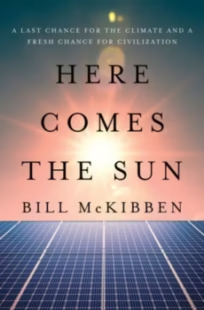
We spend the rest of the hour with Bill McKibben, co-founder of 350.org, founder of the group Third Act. His new book is titled Here Comes the Sun: A Last Chance for the Climate and a Fresh Chance for Civilization.
You, actually, Bill McKibben, despite Trump going back on renewable energy, people fear going back decades, hold out great hope. You see this as a opportunity we’ve never had before.
BILL McKIBBEN: Amy, Juan, you guys have been at this for a long time. This is as dark a moment as there’s ever been in our democracy, and our planet is overheating fast. In the midst of that, there is this one big good thing simultaneously happening, and it’s so big and so good that it might help with both the climate and the authoritarianism crisis. And that’s this rise in the last 36 months, a pretty untold story, of just extraordinary amounts of clean energy surging into the world’s energy system. It is centered in China, and the numbers are staggering. May is the last month we have data for. In May, the Chinese were putting up three gigawatts of solar panels a day, a gigawatt being the rough equivalent of a coal-fired power plant. They were putting up one of those, made out of solar panels, every eight hours.
California, which has done more than any place in this country, reached some kind of tipping point in the last 18 months. Most days now, California supplies more than 100% of its electricity from renewable energy for long stretches. At night, the biggest source of supply on its grid is batteries that have been soaking up excess sunshine all afternoon. Bottom line, California, fourth-largest economy in the world, is using 40% less natural gas to produce electricity than they were two years ago. That’s the kind of number — that may be the most optimistic thing that I’ve — number that I’ve heard in the 40 years I’ve been working on the climate crisis. It’s the kind of number that begins to shave tenths of a degree off how hot the world eventually gets. And remember, every tenth of a degree means 100 million people moving from a safe climate zone to a dangerous one.
So, it’s not that we’re going to stop global warming. It’s too late for that. It’s that we have really a chance to reboot the way the world and its economy and its geopolitics works right now.
JUAN GONZÁLEZ: And, Bill, I wanted to ask you about this staggering investment that China has been putting into renewable energies. It accounts now for almost a third of all the clean energy investment in the world. It’s producing 80% of all the solar panels, 60% of the wind turbines. And so, all of this investment has actually driven the price of green energy down, so that now it’s in some — according to the Ember report, 90% of wind and solar projects commissioned worldwide produce power more cheaply than fossil fuel alternatives. So, isn’t this — doesn’t this mean that the Global South now will gobble up, the poorer nations of the world will gobble up clean energy alternatives to fossil fuel?
BILL McKIBBEN: Absolutely, Juan. It’s really important to understand that as of about four years ago, we live on a planet where the cheapest way to produce energy is to point a sheet of glass at the sun. And China has been leading that effort. We know about petrostates. China is the world’s first electrostate. And now, as you say, that’s leaking out from across its borders.
Pakistan, right next door, last year, Pakistanis, just basically using TikTok videos as their guide, installed enough solar panels to equal half the country’s national electric grid. Pakistani farmers, who were early adopters of this, because diesel to run their tube wells for irrigation is their biggest cost input, they bought millions of these solar panels. They lack the money to build the metal stanchions to point them at the sun, so, instead, they’re just laying them on the ground. Nonetheless, Pakistan was using 35% less diesel last year than the year before.
Now this is leaking into Africa, not just the solar panels, but the things that make use of the clean energy that they provide. We’re used to thinking of Detroit as the center of the world’s auto industry. That is not true. It’s now two or three cities in China whose names I find difficult to pronounce. They’re producing the best and cheapest cars on the planet, and they are flooding the markets of the developing world. Forget about Ford. It’s BYD that’s going to be the car company of the future.
JUAN GONZÁLEZ: And but yet, here we are in the United States, going in the complete opposite direction from what China and the rest of the world are striving for. How do we deal with that situation here in this country?
BILL McKIBBEN: So, it’s what’s so fascinating. And it’s pretty easy, I think, to explain the success of renewable energy, which is good news for almost everyone on the planet, except the people who own oil wells and coal mines. And for them, it’s an existential threat.
So, what did they do? You’ll recall candidate Trump last year telling the oil industry that for a billion dollars — I mean, it was kind of Austin Powers moment – for a billion dollars, they could have anything they wanted. They ended up raising about half a billion, between donations, advertising, lobbying, in the last election cycle. And clearly that was enough, because they’ve — the Trump administration has done everything that Big Oil could have hoped — and more, really.
I mean, I don’t think anyone anticipated that they would actually shut down work on 80% complete wind farms off the coast of New England like they did last week. That’s just insane. I mean, if they keep with it, a thousand years from now, archeologists will be trying to explain how this aqueous Stonehenge emerged off the coast of Rhode Island. We’re — if we keep at this, our role in the world a decade from now will be as the kind of Colonial Williamsburg of internal combustion, a place where the rest of the planet, if they can get tourist visas, come to gawk at how people did things in the olden days.
And that’s especially aggravating, or should be, for Americans, because this technology was invented here. I mean, the solar cell was invented 20 miles away, in Edison, New Jersey. The first industrial wind turbine was 30 miles south of my house in Vermont in the 1940s. And yet we’re just handing it all to China in order to appease the oil industry.
AMY GOODMAN: You talk about California. You’re headed, what, to D.C. to speak at Politics and Prose, then the Petro Metro. That’s Houston. You’re headed to Texas.
BILL McKIBBEN: Yeah.
AMY GOODMAN: Texas might surprise people, when it comes to solar and wind energy.
BILL McKIBBEN: Texas is now putting up clean energy faster than California, faster than any place in this country. Big Oil doesn’t like that. And they tried, in the state legislative session this year, to pass a number of laws, the most prominent of which people called ”DEI for natural gas.” It was going to force anybody who wanted to put up five megawatts of solar to also put up five megawatts of natural gas. People emerged from the hinterlands across rural Texas to say, “Don’t do this. This is how we pay property taxes in our county. This is what keeps the schools open.” And so the Legislature backed off, returned to their project of redistricting Texas to help Mr. Trump instead.
It’s not clear that even in this country they can beat down the economics of renewable energy, though, obviously, they’re going to do much damage, which is precisely why we’re rallying across the country on September 21st for this thing we’re calling Sun Day.
AMY GOODMAN: You’re wearing a T-shirt that says “Sun Day.”
BILL McKIBBEN: Indeed, I am, because there are hundreds and hundreds and hundreds of events planned for that day. We obviously can’t change policy in Washington in the short term, but we can change policy in states and localities across the country to make it much, much easier to do solar power.
Amy, it costs three times as much to put up solar panels in the U.S. as it does on your house in Australia or the EU. A tiny bit of that’s from tariffs on solar panels. Mostly it’s because we have 15,000 municipalities, each with their own building code and team of inspectors. It can take months to get done what takes days everyplace else. This can be changed with easy — with ease by local officials. California, Maryland and New Jersey have already adopted this thing called the SolarAPP, that allows a contractor to get instant permitting just by putting a few details into a computer program. We need that across the country, especially in light of federal intransigence.
AMY GOODMAN: Sun Day is September 21st, the fall equinox?
BILL McKIBBEN: The fall equinox, exactly right.
JUAN GONZÁLEZ: And, Bill, I wanted to ask you — last month, the Environmental Protection Agency formally proposed revoking the Obama-era scientific determination that greenhouse gases are a danger to public health and welfare because they cause global warming. Your response to that, and what people can do?
BILL McKIBBEN: I mean, it’s nonsense, of course. The EPA and the Trump administration can’t repeal the laws of physics, which are the problem here. That’s what’s driving climate change.
But I think there’s something deeper going on, as we move into this possibility of a world that runs on clean energy. And I was really thinking about it as we were listening to Jeremy report from Middle East. I mean, think about — you guys have run The War and Peace Report for a long time. Think about what this show and this world would have been like for the last few decades if oil was of trivial value on this planet, how many wars and coups and assassination attempts would have been averted. Humans are, you know, altogether too good at starting wars, but figuring out how to start one over sunshine will be a trick.
I think that this is not just a possibility for dealing with climate change. I think the fact that we have access now to energy that’s available to everyone everywhere, instead of being something concentrated in a few spots, controlled by a few autocrats and plutocrats, that’s a huge, huge potential gift.
AMY GOODMAN: It’s a real challenge to capitalism, because, I mean, this is decentralized as you can get, unless the Big Oil companies, when they see their days are numbered, just switch over to try to control the access to the sun.
BILL McKIBBEN: Even if they switch over, which I don’t think they will, I’m afraid, all they can do — and it’s very important, and you can make a lot of money doing it — is build the solar panels. But once you’ve built the solar panels, the sun delivers the energy for free every morning when it rises above the horizon. There’s no way to hoard it or hold it in reserve. The same charismatic object in our galaxy that brings us light and warmth and, via photosynthesis, our food is now willing to provide us with all the power we could ever want. That’s the kind of moment that changes civilization, as thoroughly as learning to harness the combustion of fossil fuel changed civilization. That’s what we call the Industrial Revolution.
AMY GOODMAN: You’re here in New York. Zohran Mamdani has just shocked the Democratic establishment. Still, the Democratic leader in Congress from New York, Hakeem Jeffries, astonishingly, has not endorsed the Democratic primary candidate. But how do you see Zohran Mandani’s race for mayor of New York as a model for the rest of the country?
BILL McKIBBEN: Well, I mean, the fact that he’s creative and full of good humor is a shocking thing in our political life, but it’s a real reminder of how much there is that we could do. Across Europe, in cities full of apartment dwellers like New York, millions of people have put up what we call balcony solar over the last three years. They just go to the Best Buy, come home with a solar panel designed to hang over the railing of their apartment balcony, plug it into the wall with a standard plug and producing 20% of the power they use. That’s illegal everywhere in the country, except in the state of Utah, where the state Legislature, that progressive bastion, enabled it by a unanimous vote earlier this year. I’m betting that within weeks of Mr. Mamdani becoming Mayor Mamdani, we’re going to see balcony solar installations sprouting across the five boroughs. And what a nice sign that will be.
AMY GOODMAN: And you gave this — you started Sunday with another renegade mayor, and that is Michelle Wu of Boston, who Trump is trying to take on.
BILL McKIBBEN: Michelle Wu, Zohran —
AMY GOODMAN: We have 20 seconds.
BILL McKIBBEN: — Zohran Mamdani, people like this, offer a real potential future. And they have an enormous ally in this new technology that really gives us a fresh kind of hope.
AMY GOODMAN: Bill McKibben, co-founder of 350.org, founder of the organization Third Act. His new book is just out, Here Comes the Sun: A Last Chance for the Climate and a Fresh Chance for Civilization. He is on book tour. Tonight he’ll be in D.C. at Politics and Prose, tomorrow in Houston. And he’s organizing a national mobilization for September 21st, the fall equinox, called Sun Day 2025, celebrating solar and wind power. I’m Amy Goodman, with Juan González.
Join me on Wings of Change. We still have so much work to do as activists and organizations make plans for the upcoming months and years. Wings of Change is pleased and excited to be a part of that work through education, information, and inspiration.
Subscribe to Wings of Change here!
Donate
Whatever you are able donate will bring you articles and opinions from independent websites, writers, and journalists as well as a blog with opinions and creative contributions.
Sue Ann Martinson
One place to begin is with reason and truth, and how fundamental they are to creating critically engaged citizens and communities.
—Henry A. Giroux
 Whatever you are able donate will bring you articles and opinions from independent websites, writers, and journalists as well as a blog with opinions and creative contributions.