
Tag: Peter Thiel

  • DN! “End Times Fascism”: Naomi Klein & Astra Taylor on Billionaires, Bunkers, AI, Gaza & the Far Right

    DN! “End Times Fascism”: Naomi Klein & Astra Taylor on Billionaires, Bunkers, AI, Gaza & the Far Right

     And I think we see that commitment to what we call “hereness” in the book in the movement against data centers that is sweeping the nation, in the resistance to ICE where people are saying, “No, I’m going to defend my community, defend my neighbors” and people standing up and fighting for labor rights, which fascists are always attacking. Fighting for the environment, fighting against detention centers.

    Transcript This is a rush transcript. Copy may not be in its final form.

    AMY GOODMAN: This is Democracy Now!Democracynow.org, the War and Peace Report. I’m Amy Goodman in New York joined by Democracy Now! cohost Juan González in Chicago. Hi, Juan.

    JUAN GONZÁLEZ: Hi, Amy, and welcome to all of our listeners and viewers across the country and around the world.

    AMY GOODMAN: “The people building AI earnestly believe that it could kill us by the end of the decade.” That was the warning last week from former Anthropic researcher Jacob Coxon that set off an escalating debate over how to regulate increasingly powerful AI systems. Coxon spoke to the BBC.

    COXON: So it’s not at all an exaggeration to say that the people who were involved with both founding these companies and building the tech believe there is a possibility of human extinction. And many of the people who are sort of deep in the weeds on actually coding the thing believe that there is like a greater than 10% chance or even greater—some smaller, but they all have different numbers—for a probability that humans might die. And they all keep this in their head on a daily basis while working on the technology.

    AMY GOODMAN: Anthropic’s CEO Dario Amodei also called for the pace of development of artificial intelligence models to slow down. In an essay, he wrote that within six to 12 months a swarm of AI agents could be capable of taking over the entire internet and cause hundreds of billions of dollars in damage. He wrote, “The scale of damage would continue to increase from there if AI becomes more powerful without the necessary guardrails.” But President Trump has rejected growing calls for placing regulatory guardrails on the AI industry and has called concerns over AI a “hoax.” On Monday, Trump called Jensen Huang, the CEO of the computer chip maker Nvidia, while Huang was speaking at an AI summit in Los Angeles. Huang put the president on speakerphone.

    PRESTRUMP: The data centers are great and they make people wealthy and they make states wealthy and it’s the oil of the next 20, 25 years. It’s bigger than the Internet. And the AI, you know, much more so. And they are just playing right into the hands of a lot of people that don’t want to see it happen. And that could be political people; it could also be China. And we’re not going to let that happen. It’s a hoax. And [crosstalk]—

    JENSEN HUANG [laughs] You’re right. We’re not going to let that happen, sir.

    AUDIENCE: [applause]

    PRESTRUMP: No, we’re not going to let it happen. The robots are not going to be taking over the world.

    AMY GOODMAN: As the debate over AI intensifies, the award-winning journalists and writers Naomi Klein and Astra Taylor have a new book out today that is connected to all of this. It is titled End Times Fascism: And the Fight for the Living World. It examines how wealthy elites, including tech CEOs, are preparing for the end of the world even as they contribute to growing inequality, political instability, wars and the climate crisis. They will join us in a minute but first, here is a short excerpt from a video that was released with the book.

    ASTRA TAYLOR: End-times fascism is not a monolith. It’s a dangerous and fractious alliance of three main groups.

    NARRATOR: Religious end-timers.

    ROBERT JEFFRESS: From the very beginning it has been clear that god has a special plan and purpose for the nation of Israel.

    NARRATOR: Tech end-timers.

    SAM ALTMAN: You know, I think AI will probably like most likely sort of lead to the end of the world. But in the meantime there will be great companies created.

    NARRATOR: Ethnonationalist end-timers.

    BENJAMIN NETANYAHU: America is fighting with Israel for a common goal—to protect our future, to protect civilization against these barbarians.

    PERSON: That was a good take right there.

    PERSON: Seig fucking Heil, let’s fucking go!

    PERSON: You would prefer the human race to endure, right?

    PERSON: Uh—

    PERSON: You’re hesitant.

    PERSON: Yeah, well, I—

    PERSON: End-times fascists haven’t just given up on liberal democracy. They’ve given up on the possibility of a shared future for all of us.

    PERSON: The most powerful people in the world—

    PERSON: —are preparing for the end of the world—

    PERSON: —an end they themselves are both accelerating—

    PERSON: —and profiting from.

    ELON MUSK: [laughs]

    PERSON: We have imagined Armageddon so many times it can almost feel inevitable. Except it’s not. So, which side are you on?

    PERSON: The side of bunkering down, abandoning Earth and profiting from apocalypse? Or staying loyal to this planet and its people—

    PERSON: Who are you aligned with? Who are you protecting?

    PERSON: —and making life here better?

    AMY GOODMAN: A short video released in conjunction with the new book End Times Fascism: And the Fight for the Living World written by our guests in studio for the hour. Naomi Klein, award-winning journalist, documentary filmmaker, best-selling author of a number of books including Doppelganger and No Logo and The Shock Doctrine. Naomi Klein is also an associate professor and co-director of the Centre for Climate Justice at the University of British Columbia in Canada. Astra Taylor is an award-winning writer, activist and documentary filmmaker, the co-founder of the Debt Collective and author of several books including The Age of Insecurity: Coming Together as Things Fall Apart and The People’s Platform: Taking Back Power and Culture in the Digital Age. Thanks so much for spending the hour with us. Naomi, start off with a title, start off with End Times Fascism, why you chose this.

    NAOMI KLEIN: First of all, thank you for having us here, Amy. It’s great to be launching the book on Democracy Now! It just came out this morning, as you said. And I think we have a long tradition of launching books together. We decided to call it End Times Fascism because we are trying to understand what is the same and what is different about our moment of far-right extremism. We know that far-right parties with lineages to the fascists of the 20th century are rising to power around the world. We just saw a fateful election in a German state, the first time the far right has won an election since the Second World War. We’re seeing very disturbing polls in France, for instance. And we’re seeing more and more open fascist expressions in the United States from very powerful people in government and in tech.

    But we don’t believe that this is simply a rerun. We don’t believe that history repeats on a loop. We believe that we’re in something more like a sequel where the logics of fascism, which are the logics of dehumanization, of othering, of racial supremacy and hierarchy, are now being applied in a time of global existential crisis. This is not news to Democracy Now! listeners and viewers that we live in a time of a climate breakdown and collapse. We have tools like nuclear weapons, that were not known to Hitler and Mussolini, that have the ability to inflict apocalyptic levels of violence that were beyond their reach.

    And fascism always emerges during times of systemic crises, and it actually emerges as a way to protect capitalism from systemic change. So if we think about 20th century fascism in Europe after the First World War, there was a rising socialist response to the wreckage of the First World War and then to the Great Depression. And fascism rises up—we call it “capitalism threat response” or “capitalism with bared teeth”—to make sure all of that popular public anger is pivoted toward the scapegoat. In our time, as we see these global crises—that could lead to systemic change or there can be this what we are calling “end times fascist” response that says, “let it burn,” and now it’s a fight for who’s going to survive the future.

    Now it’s about building—as you saw in that film that we were fortunate to work with a great team of filmmakers on—it’s about building the bunkers and the rocket ships and the escape hatches. For religious end-timers, it’s literally about the bunker in the sky; it’s about the idea of the rapture. But that is almost like a template for these more secular stories that are also a kind of a rapture, but we call it in the book a “wealth rapture.” If you’ve got resources, you can rapture yourself away from the impacts of those threats that we are all in. So that’s why we call it End Times Fascism. It hasn’t won yet. And the reason we wrote the book is because people are fighting back. And we think if we are able to look at this very frightening reality with clear eyes, the more it is exposed to the light, the less popular it is because in fact those people cherish our one and only home and want to stay and want to make it better.

    JUAN GONZÁLEZ: Naomi, how is this different, for example, if in the 1950s and 1960s when at the height of the Cold War there were Americans, especially upper-class Americans, building bomb shelters, convinced that there was going to be a nuclear war, and the rest of the population eventually began to organize in an anti-nuclear movement that peaked in the 1980s and that led really to capitalism being forced to restrain itself to some degree in terms of arms control treaties? Why is this different than back then?

    NAOMI KLEIN: Well, Juan, I guess it’s different because the people we’re calling end-times fascists are systematically dismantling that precise international infrastructure. One of the things that all those three factions all agree on—whether it’s the religious fundamentalists, the tech extremists that we heard from in that video, or the ethnonationalists—they don’t agree on everything but they all agree they want to get rid of the United Nations. They all believe that that is the sort of antichrist of their story. Sometimes they literally call it the antichrist. And that chapter that you are describing, which we write about in the book, Juan—and I would actually love to bring Astra into the conversation because she went pretty deep into this research on the history of bunkering in the United States and how people shifted the tide, because we actually think that’s a really inspiring story that we need to know better.
    Can I bring in Astra, my incredible co-author?

    JUAN GONZÁLEZ: Sure.

    ASTRA TAYLOR: Thank you so much. Again, thanks for having us. Yeah, it is—very quickly, in the 1950s, the government policy was to encourage people to build their own bomb shelters in their backyard, and that was the response to the nuclear threat. Only around 1%, 2% of households did that, in part because people revolted at the idea of protecting themselves and letting their neighbors perish. And there was a massive debate in magazines like TIME magazine, LIFE magazine that was around the idea of “gunning thy neighbor.” People said, “We don’t want to do that. We don’t want to be hiding in a hole in the ground with guns pointing outwards and turning the people we care about away.” That is part of the genesis of the movement for nuclear disarmament. It was ordinary people who put the right solution on the table, which is let’s get rid of nuclear bombs; let’s not turn on each other and bunker down. There’s a lesson in that for today.

    NAOMI KLEIN: It’s so interesting because what they understood at the time is like either you bunker—either you just protect you and yours—or you get at the root cause of the crisis and you say, “Actually, we can’t live with these weapons.” Right? It’s just—”It’s too dangerous.” And as you both know, the nuclear disarmament movement had tremendous successes. In many ways, we argue in the book that it was a victim of its own success because many people in the disarmament movement believed that they had won so many victories that now the people in charge were just going to finish the job, because so many thousands of nuclear warheads were successfully disarmed that it seemed like there was a new era. The majority of the stockpiles were disarmed but not enough, and now there is a rearming and AI is being embedded in the nuclear arsenal. Which is why at the end of the book we call for a triple disarmament movement.

    In fact, Juan, we have something that you might be interested in—a new coinage in the book—which is “the Stephen Miller test.” Basically the argument that we’re making is that eventually, the most powerful tools, the most powerful weapons, will meet the worst people in the world, and if you don’t want those tools to find themselves in the hands of Stephen Miller, then the tools should not exist. That applies to nuclear weapons. It applies to AI. It applies to the wealth concentration itself, which we believe should be now understood as a WMD. That this level of wealth that has accumulated at the top of our economy has itself become a weapon of mass destruction. And so we need to be disarming the wealth bombs, the tech bombs, and of course, the bomb-bombs. Because we are now seeing that these very dangerous, completely immoral people who seem to have such a casual attitude—and we see this from Donald Trump’s most recent post, just a kind of shrug in the face of apocalypse—they will find—they exert a magnetic pull towards one another.

    JUAN GONZÁLEZ: I wanted to follow-up and ask either one of you if you want to answer this, because I did read the book in the last couple of days and really found it to be tremendously well written. At the same time, though, there were some concerns I had. For instance, there is very little mention of the rise of a multipolar world, of how the rise of East Asia, especially, the shift of the world’s industrial working class to China, Vietnam, India, Indonesia, Bangladesh, along with Brazil and Mexico—in the view of many, that is the single biggest impediment to U.S. economic dominance, of the capitalist markets’ expansion. And that’s also the biggest threat that many of these end-timers, as you label them, are concerned about. They are concerned about China, yet China and its impact on U.S. hegemony and capitalism is not mentioned at all in the book.

    NAOMI KLEIN: Well, I think that the threat of China is really, really central to the unimpeded AI rollout. It’s really the only argument they have. We do write about that in the book, but you’re right, it’s not the central focus of the book. We are more focused on the United States and the way in particular this is being pushed through Latin America, because we think there—and Europe. But the threat of the multipolar world I do think is central, because the only argument that Donald Trump really has in the face of the threats that are now being articulated from inside the house, from inside the companies, is “But China, but China; if we don’t build it, they will.” It’s completely untrue that deregulated AI has to be built the way it’s being built or else China will build it. China is much more open to regulating these technologies, to rules within the multilateral system. It’s the U.S. that has been blowing up these agreements.

    And when the Doomsday Clock was reset this year, it was a really—I mean, it’s always pretty harrowing, but this year it was particularly so; they moved it forward four seconds—and described not just the threats, whether it was biological weapons, nuclear weapons, AI, but the way the U.S. government under Donald Trump was going after all of the international agreements that governments like China had been a party to, and just saying, “We don’t need them.” So I think it’s the tools and the dismantling of any attempt to constrain those tools.

    ASTRA TAYLOR: It’s also about the narrative that the people in power are telling themselves. We’re tracking how there’s a certain embrace of apocalyptic narrative, of Armageddon, of the end times, that doesn’t—every government in the world doesn’t have that narrative, right? It’s something that’s very powerful in certain branches of the United States political class, in Israel, in parts of Latin America. We’re not saying that it applies to every country around the entire world, and so that’s one reason that that isn’t—there are some very powerful international players that aren’t central to the thesis.

    AMY GOODMAN: Astra and Naomi, you write about Peter Thiel, saying, “Today a staggering number of his former colleagues and acolytes occupy powerful positions in every part of the Trump Administration. The most consequential of them is JD Vance.” If you can explain, who is Peter Thiel? What does it mean to have his inner circle populating the inner circle of the United States? And talk about all of these figures that are so much in the news now, that were standing behind President Trump during his inauguration, people who were opposed to him before, who took him off their platforms. We are talking about people like Jeff Bezos, people like Mark Zuckerberg and others.

    ASTRA TAYLOR: Yes. Peter Thiel is a powerful billionaire and venture capitalist who has been in Silicon Valley for a long time. He is part of the PayPal mafia so he founded PayPal with David Sacks, who was Trump’s former AI and crypto czar. And also Elon Musk, of course, who is now the president of SpaceX; everybody will know him. Peter Thiel is quite interesting because he has been on the far right very proudly for a long time since he was an undergraduate at Stanford when he and David Sacks actually wrote a book against political correctness. And he has been on the vanguard of being very much against democracy, very—quasi-libertarian but now just explicitly authoritarian—and has written things like “Democracy and freedom are incompatible.”
    He was one of the first figures in Silicon Valley to come out for Trump in 2015.

    And as we write in the book and as you said, many of his protégés are now in positions of power and the most influential one is JD Vance. JD Vance has written about how his life changed when he saw Peter Thiel give a lecture. This lecture inspired to Vance to go to Silicon Valley to become a venture capitalist—not a very illustrious one—and that’s where he met critical figures who would fund his political rise, including Thiel who gave what was a record-breaking donation of $15 million and kind of launched and made possible Vance’s bid to become a senator of Ohio. And it was Peter Thiel who also brokered the meeting at Mar-a-Lago where Vance was able to apologize for calling Donald Trump “Hitler.” So Vance is of course one of those figures who used to be opposed—

    AMY GOODMAN: Explain that? That Vance said—

    ASTRA TAYLOR: Yeah, Vance was once—he was once for green energy. He was against Donald Trump who he said misleads people and offers empty promises like building a wall which won’t actually improve people’s lives. But he’s also quite an opportunist, and Peter Thiel brokered peace among those two, and now we know Vance as the VC VP.

    J.D. Vance is also critical in our book because he is who helped bring together the AI industry and Donald Trump. We remember from Donald Trump’s first term that he was against Big Tech. He was railing against Big Tech all the time. Thanks to JD Vance who hosted a dinner at David Sacks’ house, Trump got on the AI train. It was a fundraiser but it was also a pitch session. Vance’s Silicon Valley brethren told Donald Trump that AI would be good for the economy but it would be very good for the fossil fuel sector. And now we see that the Trump administration is all in on AI and not much else. So when we look at the famous image of the second Trump inauguration and we see all those tech execs given their front seats and they’re lined up, our position is that it was the promise of generative AI eating the economy that actually turned them fascist and caused this incredible alliance with the Trump regime that we’re seeing.

    NAOMI KLEIN: Yeah, that that alliance has served them incredibly well. It has produced the first trillionaire. It has produced companies that are claiming valuations roughly equivalent to the entire U.S. economy. And what they wanted from Donald Trump was exactly what they got: a frontier. You hear this phrase used all the time now—”frontier AI”—but if you think about what a frontier is, a frontier is a wild West. It has no rules. And what they were upset about under the last administration was that there were some, you know, not radical, very simple rules like you have to label deepfakes, guardrails against precisely the scenarios that they are now talking about in terms of integration with weapons systems, and the prospect of a rogue AI. So all of this was on the table years ago. There were discussions at the United Nations.

    It’s interesting that they’re always using China as the bogeyman of why they have to roll out AI without rules. China has many more rules regulating AI than the United States has,
    including rules around not allowing children to have these like personal relationships with AI where there’s confusion about whether or not you are talking to a friend or a robot or a therapist or whatever it is. First of all, that’s a lie, and that’s just the fact that people are not educated about what China is doing that is allowing people to fall for this line of, like, “Oh, no, if we don’t do it, China will.” They just simply don’t know how China is regulating this.

    But one of the things I’ve been thinking about is—and we have to be aware of how active this push was for the frontier, because now of course these CEOs are all coming forward and saying “Please regulate us, we’ll regulate ourselves, we know we need to be regulated,” as if they weren’t the ones who not only demanded this wild West frontier but bankrolled it and created the strategic alliance with Donald Trump so that he would deliver it to them. And now they’re realizing, “OK, maybe we’ve gone too far and have to look more credible.” And Donald Trump is going, “No way.”

    Why is he saying, “No way”? Because he has tanked the entire U.S. economy and the only thing he has going for him is the AI stock bubble, and he’s terrified of this bubble bursting all over him before the midterm elections or before the next presidential. He also is very invested in it personally. He’s richer than he has ever been because of the rampant corruption of this administration, the money he has made from crypto but also many different ways that he and his family are invested in AI. So that’s why he’s doing these frantic things like calling Jensen Huang on stage to say, “Don’t worry, we’re not going to do anything.”

    But if you’ll allow me, I was really struck because there’s this myth that—these sort of parables of the technology slipping out of the hands of the men who built it, right? The Sorcerer’s Apprentice, Frankenstein. Creating a monster right? That’s the myth that they’re all telling. “Oh no, we’ve created this powerful monster. It’s out of our hands and now it’s going to destroy us.” I would argue that that myth really is coming true but the monster is not AI, Amy; it’s Donald Trump. They created Donald Trump, he is their monster, he’s out of control and he just won’t stop. And they’re like, “Wait a minute, maybe it is’s going too fast.”

    AMY GOODMAN: We’re going to break and then come back to this discussion. Naomi Klein and Astra Taylor are co-authors of the new book out today, End Times Fascism: And the Fight for the Living World.

    [MUSIC BREAK]

    AMY GOODMAN: This is Democracy Now!Democracynow.org, the War and Peace Report. I’m Amy Goodman with Juan González. We are spending the hour with Naomi Klein and Astra Taylor, co-authors of the new book End Times Fascism: And the Fight for the Living World. I want to go back to the video that was released in conjunction with the book.

    NAOMI KLEIN: On a mountaintop in the dead of winter, a group of faithful men gathered an audience to share their vision. They had seen a gleaming city bathed in golden light. The city would be filled with buildings so beautiful they would seem to float above the earth as if descended from heaven. Their vision already had a name.

    PERSON: New Gaza.

    JARED KUSHNER: So, we’ll see if these things work. They never usually work.

    NAOMI KLEIN: The mountaintop in question was the resort town of Davos. The faithful men presenting their vision were U.S. real estate moguls Jared Kushner and Steve Witkoff.

    PRESDONALD TRUMP: Well, this is a very exciting day. See, I’m a real estate person at heart and it’s all about location. Look at this beautiful piece of property.

    PERSON: Let’s just plan for catastrophic success.

    NAOMI KLEIN: Out of the horrors of a live-streamed genocide, an exclusive paradise was about to emerge fully formed.

    PERSON: We’ve already started removing the rubble and doing some of the demolition.

    AMY GOODMAN: Part of the video that was released with the book End Times Fascism: And the Fight for the Living World. It is by Naomi Klein and Astra Taylor. I want to talk about Gaza right now. We are coming off of—in Venice right now you have two Israeli filmmakers, Rachel Szor and Yuval Abraham, who just came out with a film called NAZA and now members of the Israeli government are threatening to take away their citizenship, and it was based on the commentary of high-level Israeli officials, unnamed, talking about the killing in Gaza deliberately. Naomi Klein?

    NAOMI KLEIN: Yeah, and the use of AI to do so. I actually haven’t seen the film. I’m definitely looking to see it. But it underlines what we already know thanks to Palestinian journalists at huge personal cost in the documenting of a livestream genocide.

    AMY GOODMAN: Over 250 of them killed in this last two years.

    NAOMI KLEIN: And as we say in the film, this is the story that the Trump administration is telling, is that out of apocalypse there will be this paradise. There will be what they are calling “New Gaza.” We begin the book with it because it is such an extreme distillation of the story. And I believe it’s the most dangerous story ever told. It’s a biblical story. It’s deeply encoded in our culture whether we’re religious or not. And the story is first comes the flood, first comes the apocalypse, first comes the mass death—and out of the mass death, the great cleansing, the fury of god, comes the golden city, the paradise, for the chosen few.

    That story, which—it’s the story of the flood and the ark; it’s told in its most violent form in the book of _Revelation_—for people who believe in it literally, it has confused the difference between bad and good. It has kind of flipped the switch, where when we see the things in our world that should be warning us, telling us we need to act, we are in a time of crisis, it is an emergency—whether it’s climate disasters, whether it’s COVID, that things are breaking down—that what is seen instead are signs. “Oh, no, what it means is that we’re entering the end times.” And while that may be bad for many people, it’s actually very good for the chosen few. That’s why we started with this myth of New G…there is no paradise that is coming out of the apocalypse in Gaza but that is the story that the Trump administration is telling. It’s a privatized paradise that they’re proposing to build. They are using this kind of biblical narrative but of course it’s all for profit because it’s the Trump administration. They want to build luxury condominiums over a mass grave. And you saw there that it’s a literal story.

    We do think that the Board of Peace is significant in the sort of evolution of the privatization of the state, the fact that the Trump Administration is not just attacking the United Nations and defunding the United Nations but trying to replace the United Nations with something called the Board of Peace, which Trump would be head of for life, that they would control the—they would give themselves immunity. This is part of what we mean by bunkering, by escaping. It’s like they see the state as a mine site. They see the United States as a place that they can extract from. Not just extract wealth and resources—and we’re watching them do that—but also extract other things that matter to them, like legal immunity. Right? I mean, the Board of Peace gives them that.

    So that’s why we start with that. And it brings together these different parts of the coalition. Because there are religious extremists, both Christian Zionists and messianic Jews, who really do believe that Gaza, Iran mean that the Messiah is coming. Like the more violent, the better. And you’ve covered on the show officers in the U.S. military lodging complaints that their officers are telling them that they should welcome apocalyptic levels of violence in Iran because it means that Jesus is returning. But it’s not just the religious extremists. It’s also the secular versions of the story. We don’t think Trump believes in the biblical version of this story, but we do believe he believes in a kind of a wealth rapture. And when you see those AI-generated images of new Gaza and Trump sharing them, you can see how these stories have distorted his brain.

    JUAN GONZÁLEZ: In the little time we have left, I’m wondering if you could talk a little bit about the resistance movements, the people’s movements against this growing fascism, and also perhaps deal with some of the critiques of let’s say of Marxists like John Bellamy Foster, who basically insists that the fascist movement in the United States, the mass base of it is really the middle class, those people driven out by the Walmarts and the Targets from small businesses, and franchisees and others who have been driven down by the growth of these top-end monopoly capitalists and who have now turned to a fascist movement for their salvation.

    ASTRA TAYLOR: To answer the second part first, fascism is always a movement of the injured powerful. It is a movement that creates vertical solidarity between political and corporate elites and people who are not the worst off but feel that they’ve lost status and directs their sense of insecurity downwards further towards vulnerable scapegoats—towards immigrants, towards trans kids, towards feminists—instead of upwards at the oligarchs and the politicians. So that’s how we understand Elon Musk buying X or what was Twitter, right, is that it was a way for him to control a media ecosystem and help direct that rage downwards at the left and at the vulnerable instead of letting it be harnessed towards people like him. So I think that that’s right, if fascism creates what we call a vertical solidarity to protect capitalism, to protect the status quo. That’s certainly true of fascism in the past and it’s certainly true today.

    What we have to do to build the resistance is create that horizontal solidarity, to not scapegoat the vulnerable, to build our own coalition and find our own unusual bedfellows. I think you see that in the resistance to fascism that’s growing in the United States and around the world. One thing—Naomi said this—the people we’re tracking—end-times fascism is not a coherent ideology necessarily. It’s not a monolith. It’s a fractious alliance of these three groups: the religious end timers, the tech accelerationists, the ethnonationalists. But what they have in common is this sense that things are going to be increasingly unstable. We say that they’re both building their arks and they’re causing the floods. They’re accelerating collapse. They’ve decided to just bring it on and abandon this shared world in their various fantasies about bunker nation or ascending to heaven or the digital class.

    So the resistance fundamentally needs to be grounded in a desire to stay here on Earth, to commit to this place. We describe them at one point in the book as traitors to creation. And we don’t use that word “traitors” lightly. We are saying they’re not traitors to the flag or the nation but actually to life on Earth, to our shared humanity, our shared planet. And I think we see that commitment to what we call “hereness” in the book in the movement against data centers that is sweeping the nation, in the resistance to ICE where people are saying, “No, I’m going to defend my community, defend my neighbors” and people standing up and fighting for labor rights, which fascists are always attacking. Fighting for the environment, fighting against detention centers.

    And so we see the resistance growing all over the world, but I think that the data center revolt is the main one for us because it really draws new lines and shows people—is bringing people together who a year ago or a couple of years ago might have been fighting over culture war issues. Now they’re saying, “Well, actually, we have a lot in common because there’s a class of people who actually want to replace us with robots. Maybe we should be on the side of humanity against the machines.”

    NAOMI KLEIN: Including those small business people, Juan, who you were referring to. This is why it really is an opportunity to form those new alliances. Because Donald Trump has betrayed many of the people who did vote for him the first time. The trouble, of course, is that many powerful Democrats are also taking money from the large tech companies and so are not willing to harvest what has been called by a comedian in I believe it was Madison—”the most bipartisan issue since beer” is the opposition to these tech companies. But in order to gain political advantage from that huge bipartisan issue, you have to be willing to go against your donors or not take their money in the first place.

    JUAN GONZÁLEZ: Naomi, the business model of these AI fascists, if they were to be able to prevail, throw millions of people out of work, how will they make their money? Because obviously Henry Ford, back in the days of the early monopoly capitalism, believed you had to give workers a living wage so they could consume the products that you produced.

    NAOMI KLEIN: Well, I’m not sure it’s all that thought through. I think that they think they’re mainly going to be selling products to other businesses in the short term. But this is why, Juan, it is a bubble, and it is a process of extraction, and the bubble is rigged to explode all over working people and their pensions right now.

    ASTRA TAYLOR: Yeah, I think they also think that they’ll make a lot of money hooking up with the government and the military. There is a quote from Alex Karp—who is a colleague of Peter Thiel, CEO of Palantir—and he said—we quote him in the book saying, “If these tech companies think they’re going to take everybody’s jobs and then not work with the military, they are”—I’m going to change what he said and say—”they are foolish.” What he’s saying is essentially if you’re planning to build a technology that causes a job apocalypse, you are also going to have to align with the state and help build the mechanisms to police and control and contain the masses of dispossessed human beings.

    AMY GOODMAN: I wanted to end with the end of your book: “We didn’t choose to be born into a fight quite so fateful but we have reached a choice point. We can either follow end-times fascists into oblivion or we can commit to building the unruly, boundary-crossing movement they so deeply fear, one that wrests away their weapons, holds them accountable for their crimes, and defends the paradise of here.”

    Those are the words of Naomi Klein and Astra Taylor, co-authors of the new book out today End Times Fascism: And the Fight for the Living World. Happy birthday to Sam Alcoff! Naomi and Astra will be in Brooklyn tonight at St. Ann’s Church. Then they go from Brooklyn to Brookline, Massachusetts, tomorrow. Then they’re headed to Washington—Politics and Prose—and beyond. They’ll also be in London and in Europe as well.

    On Thursday, September 17th, I’m going home to Bay Shore, New York, in Long Island, for a screening of Steal This Story, Please! at the Boulton Center with the director Tia Lessin and the producer Caren Spruch. This has been a remarkable conversation. Thanks so much for being with us. I’m Amy Goodman with Juan González for another edition of Democracy Now!.

    The original content of this program is licensed under a Creative Commons Attribution-Noncommercial-No Derivative Works 3.0 United States License. Please attribute legal copies of this work to democracynow.org. Some of the work(s) that this program incorporates, however, may be separately licensed. For further information or additional permissions, contact us.


  • “They’re Fascists”: Silicon Valley Journalist Gil Durán on “The Nerd Reich” Takeover of U.S. Politics

    “They’re Fascists”: Silicon Valley Journalist Gil Durán on “The Nerd Reich” Takeover of U.S. Politics

    Protesters demonstrate outside the Palantir offices in New York City [Eduardo Munoz/Reuters]

    When Silicon Valley says it is ‘‘moving fast and breaking things,’’ the world interprets the chaos as a necessary cost of innovation. Gil Durán reveals something far more sinister: a decades-long campaign to replace elected governments with corporate rule.
    —Simon and Schuster [Publisher]

    Full Transcript / This is a rush transcript. Copy may not be in its final form.

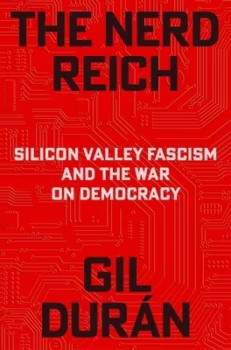
    AMY GOODMAN: This is Democracy Now!, democracynow.org, The War and Peace Report. I’m Amy Goodman, with Anjali Kamat, as we bring you Part 2 of our conversation with Gil Durán, author of The Nerd Reich: Silicon Valley Fascism and the War on Democracy.


    Gil Durán, in this Part 2 of the discussion, just start off by talking about: What is tech fascism?

    GIL DURÁN: Tech fascism is like classic fascism in most respects. It’s a cult of grievance and self-victimization that seeks to return to a mythical greatness by purging its demonized enemies, using propaganda focused on law and order, gender and sexuality, in order to impose a permanent hierarchical structure on the world. This hierarchy is what they consider the moral order of the world. And in their idea, it’s basically that rich white men should rule the world and the universe, and that’s the things — the way things should be.

    AMY GOODMAN: It’s very interesting. At the end of his presidential term, President Biden warned about the tech billionaires. Talk about what he said.

    GIL DURÁN: In his final speech as president, Biden said that the democracy was in danger from what he called a tech-industrial complex that had become radicalized and powerful and that was rising in our midst. And it’s not clear why he waited ’til his final speech to warn everybody, because this thing was growing in plain sight for a few years.

    But I start my book with that, because I want people to understand this is not just one journalist with a newsletter saying this. This is something that the president of the United States declared in his final speech, clearly intending to warn people about what was coming.

    And a few days later, Elon Musk stood behind the presidential seal at an inaugural event for Trump and threw a Hitler salute. And we’ve seen the rest of this regime, since then, follow these terrifying, scary contours of history, with masked, armed goons roaming around targeting immigrants, people being prosecuted for protesting, etc. So, I think that the president’s warning was important, but it came far too late.

    ANJALI KAMAT: Yet many of these same tech billionaires had supported President Obama before. What changed their mind and sort of cemented this fascist turn?

    GIL DURÁN: It was in their interest at the time, because Democrats had power.

    And, look, no one should be happier than the tech billionaires. They have won our system. They have all the money. They have tremendous influence and power. A lot of these guys, like Elon Musk and Peter Thiel and David Sacks, they’re immigrants. They weren’t even born here. They came to our country, and they became massively successful and wealthy.

    And now they’re full of anger, and they feel like it’s not enough, and they want more. And with Trump, they see now, in their own self-interest, or so they think, the opportunity to completely change how our country works, to disrupt democracy. This is largely what venture capitalists do: They bet on disruptive technologies that can provide a massive return of some kind in terms of profit. And they’ve bet on Trump and on fascism as a way to destroy democracy and make sure billionaires don’t have to worry about other people and the threat of the vote in the future. That’s very much the project they’re working on.

    AMY GOODMAN: Talk about the men who stood behind President Trump, and how unusual it was, in his second inauguration.

    GIL DURÁN: Definitely. You had Mark Zuckerberg, who had previously banned Trump from Facebook, at his inauguration. You had the head of Google, Sundar Pichai, there. You had Elon Musk, which is really no surprise; Jeff Bezos, who for many years seemed like a heroic guy to some people, the guy who was going to save The Washington Post, and now it’s become the opposite of that. The Washington Post editorial page, which in normal times would be a watchdog against corruption and excess, is now a lapdog for Donald Trump’s regime.

    AMY GOODMAN: Of course —

    GIL  DURÁN:  And — yeah.

    AMY GOODMAN: — it was Bezos who intervened when they were going to endorse Kamala Harris, and said there would be no endorsement.

    GIL DURÁN: Yeah, that’s where it started. And we’ve seen the results since then. It’s hard to even recognize the Post. I mean, there are good reporters there on the news side still, but the editorial page has become a complete lapdog for Donald Trump. And this is how that works, that it’s money chasing power, and power chasing money.

    AMY GOODMAN: So, for example, how did Zuckerberg change?

    GIL DURÁN: Zuckerberg is just doing what he thinks is in his own self-interest. I see Zuckerberg largely as a follower. The thing to keep in mind about Zuckerberg, though, is that the first major investor in Facebook was Peter Thiel. Wherever you look in the story of how Silicon Valley billionaires have become radicalized against democracy, you find the influence of Peter Thiel lurking not far away.

    If Kamala Harris had won the election, we would see an entirely different behavior out of these people. You know, they would be promoting diversity and putting people of color in important positions and espousing progressive values. But now the mask is fully off, and we see what these people truly are. You can’t go this hard in favor of an authoritarian regime and expect to ever recover your reputation. So they’re kind of locked in now, which makes them desperate and, I think, makes them more dangerous.

    ANJALI KAMAT: And who do they turn to for inspiration? Who are the world leaders in other countries that inspire them? And they’ve also set their sights beyond the United States, as well, their projects in Honduras, in Greenland.

    GIL DURÁN: Yeah, I mean, they love authoritarianism, because it’s more — especially authoritarianism that is open to capital investment, where you can buy what you want. I mean, it was Mark Zuckerberg who asked the dictator of China to name his child, and he refused. I mean, this is bizarre behavior from a tech CEO.

    In Honduras, though, they’ve created this project called Próspera, which is supposed to be this new territory, a wannabe nation where they make their own rules, laws and regulations. And you’re starting to see this idea pop up in different parts of the world. There’s one now being built in Kazakhstan, where the government plans a crypto megacity.

    And this comes from this same group of ideas, which some call the “network state cult,” this idea that we should invest in creating new territories that will become independent countries in the 21st century and give all of these billionaires escape routes when their prophesied apocalyptic collapse of democratic nations takes place.

    And Trump himself has promised to build 10 new “Freedom Cities” in the United States. These would be new private cities built by corporations on federal land. It was part of his 2024 platform. And what was interesting to me in my reporting was that, though people like Politico and others reported superficially that Trump had promised to build these cities, no one has ever explained: What’s a Freedom City? Why do we need Freedom Cities? And where does the idea come from? It comes from these crazy, radical Silicon Valley network state ideas.

    AMY GOODMAN: Can you talk about Peter Thiel both as founder of PayPal, but then Palantir, and the role Palantir has played, how it’s been used by militaries, domestic and foreign, for example, to spy on people?

    GIL DURÁN: What’s interesting about Peter Thiel is that for many years people described him as a libertarian. But for most of the time that Peter Thiel’s been in the public eye, he’s actually been a government surveillance and military intelligence contractor through Palantir, a company named after this all-seeing stone wielded by an evil wizard in The Lord of the Rings. And Palantir has quickly become one of the most well known and, I’d say, most hated tech companies in the country, because it’s being embedded in the military, in intelligence, in ICE operations, and as part of this massive surveillance apparatus coming out of Silicon Valley that is now partnering with an authoritarian regime.

    And something interesting about Peter Thiel, back in 2010, he gave a speech in which he said government was fundamentally evil. And this guy, he’s talking to a group of libertarians. He’s a government surveillance contractor, which is about as far away from the libertarian idea as you can get.

    And so, what you see is a group of men who opposed government until they saw the chance to claim government power for themselves. And Palantir is raking in billions of dollars in government contracts under Donald Trump as Silicon Valley pumps billions of dollars into the Trump family. It’s a tower — technology has proved to be a weapon of mass corruption in Washington. If you look at how much the crypto cartels are spending in our elections, they’re now the biggest spender in politics. Ten years ago, they weren’t even in existence in the political game.

    AMY GOODMAN: And explain what they are.

    GIL DURÁN: Yeah. Crypto? Crypto is a fake, digital, wannabe currency that’s mostly useful for scams, human trafficking, drug trafficking and crime, and gambling. And a very small percentage of Americans use crypto, less than 20%. Pew reported a few years ago it was 14%. But they are now the biggest moneyed force in American politics, basically holding our political system hostage by promising to spend tens of millions of dollars against any politician who dares to challenge crypto and doesn’t support crypto in any way. This would be like if a drug cartel suddenly entered American politics and threatened anybody who refused to legalize cocaine or heroin. This is what we’re watching here. Yet it’s become completely normalized.

    AMY GOODMAN: And how does President Trump and his family fit into that picture?

    GIL DURÁN: President Trump spent years describing crypto as a scam against the dollar. And on the day he returned to the White House, he became a crypto billionaire. And he is now the country’s crypto-bro-in-chief. His entire family is cashing in with bitcoin mining, with coin scams. Even Melania had a coin, that sucked money out of dummies and then enriched the Trump family. So, it’s amazing. At one point, The Wall Street Journal reported that the Trump family’s fortune had increased by $5 billion thanks to crypto. But because crypto’s so scammy and volatile, it’s now down to about 1.2, I think, in today’s news reporting.

    ANJALI KAMAT: I want to go back to Palantir. You were banned from X for criticizing Palantir? Can you talk about what happened?

    GIL DURÁN: In April, I was banned from X for criticizing Palantir’s manifesto, that they published, as fascism. I just said ”TLDR: Fascism,” Too long, didn’t read: Fascism.” But that follows a weird trend. The year before, Facebook banned links from my newsletter from being posted. And when I asked why, a representative said it’s because I write about the network state and I criticize tech figures, which was an amazing thing for a rep from Facebook to say. And after that got media attention, they reversed it. I was also banned by X when Elon Musk first bought it.

    And right now YouTube is threatening to take down my little podcast, because I’m being targeted by a campaign of false copyright claims, which is a tactic that’s emerging now. You can pay people, often emanating out of India, to just file constant copyright strikes. And YouTube’s answer to this problem is to just remove your channel permanently. And by Saturday, we’re supposed to be offline. So, I think my book is upsetting some people.

    AMY GOODMAN: You know, ABC reported last week that a Trump-appointed national bank regulator granted a wing of the Trump family’s crypto business conditional approval to establish a bank charter, opening the door to larger clients and potentially heightened profits. The decision marks the first time in U.S. history that a company owned by the sitting president’s family has been granted bank status.

    GIL DURÁN: A weapon of mass corruption, that’s what crypto is. We are basically living right now in a crypto banana republic. And it’s not clear why any Democrat or any Republican, for that matter, who loves this country is supporting crypto, taking crypto, legitimizing crypto. If you look at the history of crypto, it is openly designed as a way to undermine government authority and power. It was seen by cypherpunks as a way to escape from democracy, from rules and from law. So, why now do we have the president and his family starting a crypto bank, going into cryptocurrencies? You know, people are losing millions and billions of dollars to these scams. And, you know, it used to be that crypto was only useful for drug dealing, human trafficking, gambling and crime. Now it’s being used to buy power in order to break the country. And I think there has to be a real reckoning with the role of this pernicious technology, that is so — I mean, the corruption is so staggering, it’s almost hard to explain in words.

    AMY GOODMAN: So, the question is: Where does government fit into this picture? You quoted President Biden’s last speech, warning about the tech-bro-industry complex, the technology-industry complex, or TIC. But what are Democrats doing right now in Congress? And what are Republicans doing?

    GIL DURÁN: Largely not going after the Silicon Valley oligarchs who are behind Trump. You know, a lot of people are attacking Trump and criticizing his family, criticizing Vance. But we don’t see a lot of direct criticism of these billionaires who are enabling the entire thing. The way I look at it, Donald Trump is being paid billions of dollars to do these things, right? When’s the last time we had a president make billions of dollars while in office? This is direct transfer, including from foreign governments that are buying into and investing in his companies to curry favor.

    I think we need to see Democrats speaking directly against billionaire power, against tech billionaire power, against the crypto takeover of our country. You see all these Democrats trying to say, “Oh, AI innovation, Silicon Valley innovation.” Those are outdated talking points. Silicon Valley is no longer about innovation. Silicon Valley is about fascism and a race to control the future. And that future will not be good for most people. And it’s the job of our elected officials, especially on the Democratic side of things, to stand up for the people.

    There are a few people doing it. You see Bernie Sanders, James Talarico, Jasmine Crockett and others who have spoken directly to this, Chris Murphy, Ron Wyden. But people like Gavin Newsom and others are suspiciously avoiding any critique of Silicon Valley. And I don’t think we can have that going forward. People are waking up to this threat. We see it all across the country. And we need politicians who match the energy of the people, or we need those people to be the new politicians.

    ANJALI KAMAT: We’re seeing this massive movement against data centers, right? Across the country, people are opposing data centers. What’s happening in Silicon Valley? Is there some resistance to this massive takeover and this kind of ideology?

    GIL DURÁN: A little bit. Nothing too noteworthy. Most of the resistance is coming from communities that are being targeted by data centers, that are being targeted by Palantir surveillance and fascism aided by ICE. You see people resisting and rising up. There are also movements like Purge Palantir, which is boycotting any company that has Palantir products, raising awareness of the role of this company in our government, and putting a lot of pressure on the company. Same thing is happening to Flock surveillance, where people are starting to militate against putting these Big Brother facial recognition, license plate recognition cameras in every aspect of our lives.

    So, you see people waking up to that. And it’s not just Democrats, by the way. It’s also Republicans and independents. And it’s also people who are not activists. It’s people who are just becoming activated by the threat of this alien invasion of our country by these surveillance-mad, power-hungry billionaires. And it’s pretty inspiring to watch. It’s the grassroots, and I think the politics are going to have to catch up with that.

    AMY GOODMAN: As we begin to wrap up, what is missing from the whole debate around artificial intelligence?

    GIL DURÁN: The question is why we are pursuing this idea that we have this dangerous technology that is going to kill all of our jobs and potentially wipe out all of humanity. This is the marketing of the AI industry itself. And why is that being made to seem inevitable? I don’t think it’s inevitable at all. I think we have the right to reject this dystopian future that’s being imposed on us. How does it make sense to destroy our economy to enrich a handful of oligarchs who are already wealthy and whose wealth has driven them insane and hasn’t made them very happy?

    You know, we have this problem where it’s becoming a competition between democracy and capitalism, and which one is more important. You know, even before the tech bros came along, we were destroying the planet for a handful of fossil fuel companies. How does that make any sense? There has to be a different way to do this.

    And the same thing with AI. AI is being marketed as this destructive, terrifying force, and we all have to invest in it and adopt it or else. And I don’t think it has to be that way, and I think people need to push back harder on a policy level and stop trying to ingratiate themselves to the AI moguls, which is largely what’s happening now. Even the best politicians among us are playing along with this idea that this is an intelligence, which it’s not, and that this is inevitable, which it’s not.

    And so, I think we need to backtrack a bit and get off of this idea, and question the narrative that we have no choice except to bow down to this AI god these guys claim to be building, that it’s a religion. It’s a myth. It’s not real. I don’t think LLMs are completely useless. I think there’ll be some good applications for AI.

    ANJALI KAMAT: Explain what LLMs are.

    GIL DURÁN: Large language models, like Claude, etc. I don’t think these things have to be useless. I just don’t understand why they have to eat everything. They don’t. This is — this is the marketing for the investors. This is convincing people that you have to spend trillions of dollars on this, so we can create this massive thing that will then suck all of the value out of the economy and render every worker useless. This is absurd, it’s ridiculous, and it’s an apocalyptic cult.

    ANJALI KAMAT: You know, you’ve been spending time reading the statements and writings of all of these figures. What scares you the most?

    GIL DURÁN: What scares me is that you can be as anti-American and anti-democratic as Peter Thiel and still be a government contractor with investment from the CIA. I mean, Palantir was created with investment from the CIA. And I worked in government for many years for Democrats. I worked for Senator Feinstein when she was chair of the Intelligence Committee. And it boggles my mind that you can say that kind of stuff and believe these radical things and still be that deep in our intelligence infrastructure. I have a lot of questions about what went wrong there. I mean, to get into government, you have to pretend like you never smoked marijuana, and here you are smoking the most anti-American, anti-democratic dope in the world and becoming a billionaire off of government contracts. That’s what scares me.

    How did no one catch this? You know, trying to talk about what’s happening to our country without talking about these tech fascists is like trying to explain 9/11 without talking about al-Qaeda. This cult of dangerous billionaires has a very pronounced idea of what our future is, and it’s not going to have democracy in it. And I don’t understand how they got this far, this fast. Nobody — and even today, most people in the media and the political establishment aren’t really addressing it. And I hope my book can help change that.

    AMY GOODMAN: The name of the book is The Nerd Reich: Silicon Valley Fascism and the War on Democracy. The author, Gil Durán. To see Part 1 of our conversation, go to democracynow.org. I’m Amy Goodman, with Anjali Kamat. Thanks for joining us.

    The original content of this program is licensed under a Creative Commons Attribution-Noncommercial-No Derivative Works 3.0 United States License. Please attribute legal copies of this work to democracynow.org. Some of the work(s) that this program incorporates, however, may be separately licensed. For further information or additional permissions, contact us.

  • “The Nerd Reich”: Author Gil Durán on Big Tech Fascism, Peter Thiel, JD Vance and the War on Democracy

    “The Nerd Reich”: Author Gil Durán on Big Tech Fascism, Peter Thiel, JD Vance and the War on Democracy

    “The Nerd Reich: Silicon Valley Fascism and the War on Democracy” follows the rise of Vice President JD Vance, the former venture capitalist whose “outsider” campaign for Senate was bankrolled by the billionaire co-founder of PayPal and Palantir, Peter Thiel….“These guys were never libertarians,” says Durán. “Now that they are the government, we see their true face: They’re fascists, and they’re authoritarians.”

    “The Nerd Reich: Silicon Valley Fascism and the War on Democracy” follows the rise of Vice President JD Vance, the former venture capitalist whose “outsider” campaign for Senate was bankrolled by the billionaire co-founder of PayPal and Palantir, Peter Thiel. Durán traces the ideological lineage of the current Trump administration back from Vance to Thiel and the far-right-wing monarchist Curtis Yarvin, whose “right-libertarian” political theory has long made the rounds among Silicon Valley elite. “These guys were never libertarians,” says Durán. “Now that they are the government, we see their true face: They’re fascists, and they’re authoritarians.”

    Book published by Simon & Schuster.

    Subscribe to our Daily Email Digest: https://democracynow.org/subscribe

    THE NERD REICH

    Full Transcript/This is a rush transcript. Copy may not be in its final form.

    AMY GOODMAN: This is Democracy Now!, democracynow.org, The War and Peace Report. I’m Amy Goodman, with Anjali Kamat.

    ANJALI KAMAT: The Nerd Reich: Silicon Valley Fascism and the War on Democracy. That’s the name of a new book by our next guest, the journalist Gil Durán. The book looks at how tech billionaires, including Peter Thiel and Elon Musk, are pushing what Durán calls “tech fascism.”

    Gil Durán also documents how Thiel had played a pivotal role in JD Vance’s rise to power. Durán writes, quote, “Vance is almost entirely a creation of Thiel who bankrolled his brief stint as a Silicon Valley venture capitalist and United States senator. With Vance at Trump’s side — Silicon Valley had one of their own in the White House — a tech venture capitalist one heartbeat away from the presidency.”

    AMY GOODMAN: Gil Durán joins us here in New York. He’s the former opinion editor of The Sacramento Bee and editorial page editor at the San Francisco Examiner. He now publishes two newsletters: The Nerd Reich and FrameLab.

    Welcome to Democracy Now! So, let’s start with the title, The Nerd Reich: Silicon Valley Fascism and the War on Democracy. Why’d you choose it?

    GIL DURÁN: Well, in 2024, I wrote a series for The New Republic about the extremist ideological beliefs coming out of Silicon Valley. And after I’d written a story that went really viral and got me under attack by one of these guys, someone reached out to me from the crypto world and said, “You know, we’ve been calling these guys ‘the Nerd Reich’ for years.” And that blew my mind. And I saw that no one was really using that title, and so I rebranded my newsletter, which had some boring other name, as The Nerd Reich, and that became the main message of it. But I thought it was amazing that from within their own community, this was a label that was applied to them. People understood it was fascist and was echoing Nazism in nature.

    AMY GOODMAN: But I want to just say the billionaire tech bros, as they are known, another name for them, haven’t always been the way they are now, in fact, when Trump was first coming into office. Talk about how they have changed.

    GIL DURÁN: During the first Trump administration, we saw something called Tech Against Trump, where there were all these tech companies standing up to Trump, filing lawsuits, opposing his crackdowns on immigration. This time around, it’s completely different.

    AMY GOODMAN: He was removed from X.

    GIL DURÁN: Yeah, removed from X. Facebook banned him. Now we see the opposite happening.

    I think what happened is that Trump was able to tap into some undercurrents in Silicon Valley with his return to power. Billionaires had become radicalized by things like the #MeToo movement, by Occupy, by the Black Lives Matter movement, and then by the pandemic. And so, when Trump is able to return to power, they are now in a very different mentality. They’ve made billions and billions of more dollars. They’re even more against taxes and government, even though government is generally the basis for many of their fortunes.

    And so, now we see a complete alignment behind Trump. In fact, Trump is being funded and supported by Silicon Valley. He wouldn’t be able to do the things he’s doing without the billions of dollars he’s raking in in open crypto corruption.

    ANJALI KAMAT: You know, in the epigraph to your book, you quote Peter Thiel from 2010. So, in a way, they’ve changed, but this also goes back and has a longer history. And the end of that quote is “technology is this incredible alternative to politics.” Can you talk about what he meant by that and what that means in terms of the kind of influence Peter Thiel has?

    AMY GOODMAN: And who he is?

    GIL DURÁN: Yeah. Some billionaires appear to have changed, but Peter Thiel hasn’t really changed. He’s been right-wing for a very long time. Peter Thiel was born in Germany, came to the United States as a child, went to Stanford, became a lawyer, studied philosophy, and then got very lucky to be in Silicon Valley in the late 1990s as things were about to take off.

    In 1997, he read a book called The Sovereign Individual, which predicted that in the 21st century technology would overthrow democracy, specifically something called cybercurrency, or what we would today call crypto, which would undermine government authority, and advanced automation, which we would call AI, which would collapse the economy by destroying most jobs and concentrating wealth in the hands of a savvy few that were called the “sovereign individual.” And Peter Thiel has credited this crazy book with being the inspiration for PayPal, which he saw — which he says was an effort to get ahead of this digital currency.

    It didn’t quite work out that way, but it made him a billionaire, eventually, because it provided the basis for his fortune, and he’s been able to use his money to grow this influential cult of right-wing ideas in Silicon Valley, which, by the way, they were always there, this libertarian, it was called, vibe coming out of Silicon Valley in the ’80s and the ’90s. There were a handful of writers who wrote about it then. But what we’ve learned is these guys were never libertarians. They just wanted to be in charge of the government. They weren’t against the government, unless they don’t get to be the government. So, now that they are the government, we see their true face: They’re fascists, and they’re authoritarians.

    Peter Thiel [left]/Silicon Roundabout/Photo: The Guardian

    ANJALI KAMAT: You know, you tell this story in the book, a remarkable story, of a group of these billionaire tech bros. It’s not just Peter Thiel; it’s several other men. Can you talk about some of these other characters that you talk about? And what is their crusade against democracy?

    GIL DURÁN: They have this idea, largely stemming from this Sovereign Individual book, that technology means democracy is an obsolete software system, that the United States is an obsolete country, that it won’t survive the 21st century. And I want to say, I know this sounds crazy to people, but much of my book is told in the words of these men, from — in podcasts, in interviews, in long essays, they write about it. And their problem with democracy is that they don’t get to have all the power.

    ANJALI KAMAT: So, you didn’t have to get secret documents. I mean, you have some remarkable statements in this book. You have Balaji Srinivasan and also Curtis Yarvin, and Curtis Yarvin, I believe, talking about, in an early blog post perhaps, talking about San Francisco and what to do with the poor?

    GIL DURÁN: Yeah. So, this idea is that they’ve got — some call it the network state. Curtis Yarvin called it “patchworks.” Part of their apocalyptic vision for the future is that the country will be broken up. It will no longer be one country. It’ll be broken up into these sort of corporate zones or fiefdoms called patchworks or network states. And the new governing structure will be these autocratic, dictator-like corporations that will have total power over their citizens. Yarvin wrote that they could even turn unproductive people into biodiesel to fuel city buses. But he said he was just kidding about that, but that what we really need for the poor is a humane alternative to genocide.

    So, these are the kinds of ideas you see. And what’s disturbing is that Balaji Srinivasan, another Peter Thiel protégé, because Curtis Yarvin is funded by Peter Thiel — that’s the only reason anyone’s ever heard of him — goes on to create this idea called the network state, which is a more startup-friendly version of this, that corporations and billionaires should fund their own cities and countries. And we’re seeing that grow.

    AMY GOODMAN: Let’s go to Curtis Yarvin in his own words at the Institute of Art and Ideas, where he explained why he supports monarchical system of government.

    CURTIS YARVIN: Let’s debunk this concept of liberal democracy. There’s actually no such thing. Democracy in today’s world just means a good or legitimate government. It means a claim to a legitimate government. Just because you call yourself a democracy doesn’t mean anything. North Korea calls itself the DPRK, Democratic People’s Republic of Korea. That is three euphemisms for democracy, one place name, and it’s a monarchy. …

    Anything that works is a monarchy. So, for example, if you take your your iPhone and you look at the box that your iPhone comes in, it says, “Designed by Apple in California, manufactured in China.” So, that is two monarchies — Apple has a CEO, and China has a dictator — and one oligarchy, which is the government of California, which is, by the way, basically a single-party state. There are no longer competitive elections in California. So, when you try to imagine the state of California, in which I live, trying to build an iPhone or design an iPhone, the concept is ridiculous.

    AMY GOODMAN: Let’s go back to 2021, when JD Vance, then a candidate in Ohio for U.S. Senate, appeared on the conservative Jack Murphy Live podcast. Murphy asked Vance how to root out so-called wokeism from American institutions.

    JD VANCE: There’s this guy Curtis Yarvin, who’s written about some of these things. And so, one is to basically accept that this entire thing is going to fall in on itself, right? … I tend to think that we should seize the institutions of the left and turn them against the left, right? We need — we need like a de-Baathification program, but like a de-wokeification program in the United States, right?

    AMY GOODMAN: So, that was JD Vance back in 2021. The latest news, this out of The Washington Post, that President Donald Trump recently told donors in private that he wants to see his vice president, JD Vance, win the 2028 presidential election, a sign that he’s open to publicly backing JD Vance. There’s been this kind of war between JD Vance and Marco Rubio, the secretary of state. But talk about the significance of this and, as you said, JD Vance being a creation of Peter Thiel.

    GIL DURÁN: JD Vance is a dangerous extremist who embraces a set of ideas that should put a chill down the spine of every American. He went on in that interview to say that Donald Trump would likely win the 2024 election, and that when he did, he should purge the federal government, just like Yarvin had recommended, and, in fact, he should defy the courts and the law and challenge the Supreme Court justices to force him to follow their dictates. It’s pretty amazing that you have a man on the political stage in the White House a heartbeat away from the presidency, who has espoused such radically anti-American ideas.

    And I think people need to understand the degree to which he is so closely related to Peter Thiel. We wouldn’t have a JD Vance without a Peter Thiel. Peter Thiel is even the reason that JD Vance converted to Catholicism. He’s the reason JD Vance became a venture capitalist and a millionaire. He’s —

    AMY GOODMAN: How did they hook up?

    GIL DURÁN: Peter Thiel likes to go around speaking to schools and graduate schools. And in 2011, he went to Yale Law School and gave a speech. And JD Vance said it was one of the most significant moments of his life and that Peter Thiel was one of the most intelligent people he’d ever heard. And basically, that speech convinced him to not be a lawyer, and instead to become a venture capitalist. And at every step of JD Vance’s life since then, it has been Peter Thiel who has made him who he is, who has essentially created him whole cloth.

    ANJALI KAMAT: And it’s not just JD Vance, right? I mean, it’s — Bloomberg, I think, reported that 16 people connected to Thiel are in the Trump administration. Can you talk about, you know, what kind of effect this has had in terms of policies? Like, you know, when we hear these ideas, they sound a little outlandish, to say the least. It’s hard to see them being translated into policy. But then, what we’ve been living over the past two years, you’re seeing a lot of this coming to fruition. So, can you talk about, you know, DOGE, for example, or the, you know, mass layoffs at federal jobs, what happened to USAID, and where those ideas came from?

    GIL DURÁN: The main argument of Curtis Yarvin for a long time has been that a president should act as a dictator. And one of the ways to cement this dictator’s power is to purge the federal government of anyone who is unwilling to follow the orders of the dictator, basically to destroy the civil service. In addition — this is 15, almost 20 years ago — he recommended that the United States pretty much destroy its diplomatic standing in the world and eliminate international aid programs.

    We saw all of that happen during DOGE. In fact, Yarvin had updated his idea to say that it should be a CEO who the president should install as a dictator to run rampant over the federal government. And DOGE was an almost perfect expression of that. So, these ideas that used to be —

    ANJALI KAMAT: And what did Curtis call it? RAGE?

    GIL DURÁN: He called it RAGE — “Retire All Government Employees.” So, even the four-letter, all-caps acronym is an echo of Yarvin. And these are ideas that were on an anonymous, weird blog, marginal in Silicon Valley 15 years ago, and have now become policy under the Trump administration, because when you’re a billionaire, you have the power to impose these crazy ideas on everyone else.

    And that’s what’s happening. Peter Thiel’s entire inner circle has infiltrated government at the same time that the Trump family is now becoming tech venture capitalists and crypto cartel moguls. There’s this joining of forces. The corporate is becoming the state, and both of it’s combined with apocalyptic religious movements. And that is the heart of fascism.

    AMY GOODMAN: Where does Elon Musk fit into this picture?

    GIL DURÁN: Elon Musk and Peter Thiel go way back to PayPal. They started it together. They’ve had some tensions.

    AMY GOODMAN: The so-called PayPal Mafia?

    GIL DURÁN: The so-called PayPal Mafia. But you’ll note that Peter Thiel is considered the godfather of the PayPal Mafia, even though Elon Musk is the wealthiest man in the world. Musk is certainly aware of these ideas, and when he was thinking of starting his own political party after he left DOGE, he consulted with Curtis Yarvin about how to do that and what the party should say. So, here’s Yarvin, who knows nothing about anything, but he’s considered a genius by these billionaires, largely because he tells them what they want to hear.

    So, Elon Musk is clearly radicalized, is clearly open to these ideas. I’m not sure that he reads a lot about these things as much as he just believes the basic idea behind this, which is that wealthy, white technologists should be the ruler of the world, and then the galaxy and the universe. This is the cosmology coming out of Silicon Valley these days.

    AMY GOODMAN: Where do women and people of color fit into this picture?

    GIL DURÁN: At the bottom of the hierarchy, if they exist at all. Look at what’s happening with the USAID cuts: a targeted hit delivered against the poorest people in the world by the richest man in the world, with millions of people projected to die. These billionaires who promise abundance because of AI, well, we already have abundance, and we’re not sharing it. Look at what they’re doing to the poorest people today. And if you listen to the apocalyptic visions that AI will kill all jobs and transform everything, they say that, “Well, don’t worry. Everyone will get a share of the extreme universal wealth that’s created.” But that’s not what we’re seeing today, and we can’t really believe that when they say that. Fascism is about imposing a hierarchy, a moral order. And white, wealthy, Western men are at the top of that moral order in fascism.

    AMY GOODMAN: Gil Durán is author of The Nerd Reich: Silicon Valley Fascism and the War on Democracy. If you have time, we’re going to do Part 2 of this discussion, and then we’re going to post it online at democracynow.org. Again, the book, The Nerd Reich.

    I’ll be speaking after the screening of Steal This Story, Please! in Middlebury, Vermont, on August 28th. Check our website at democracynow.org. I’m Amy Goodman, with Anjali Kamat.

    The original content of this program is licensed under a Creative Commons Attribution-Noncommercial-No Derivative Works 3.0 United States License. Please attribute legal copies of this work to democracynow.org. Some of the work(s) that this program incorporates, however, may be separately licensed. For further information or additional permissions, contact us.
  • AI Targeted Killings in War: Palantir and the US Military

    AI Targeted Killings in War: Palantir and the US Military

    Palantir’s AI: Targeted Killing

    By Sue Ann Martinson, Editor /  Wings of Change /  August 7,  2026 

    Palantir Technologies is a U.S.-based software company specializing in centralizing large amounts of data using artificial intelligence (AI). Founded in 2003 by Peter Thiel (Board Chair), Alex Karp (CEO), Joe Lonsdale, Stephen Cohen, and Nathan Gettings, the company headquarters are in Miami Florida. 

    Editor’s Note: Palantir has its tentacles into many areas, including ICE targeting, data centers, and private data including of voting rolls, healthcare information, and more. The main focus of this article is on Palantir’s involvement in working with the military in the Iran war and to some extent in general.

    For a link to local action in MN see the RELATED section later in this post. Information for an August 28 panel by DIVESTMN will examine “How MN Money is Funding Palantir’s Deadly Surveillance Network.”

    Palantir Software Structure

    I am hardly a tech expert and even less do I know much about how AI works. I think of these platforms as layers of software with new layers built out from and integrated with the initial software developed by Palantir. For example, the Maven software platform is dependent on the Palantir program Foundry, which handles large-scale data integration and transformation. Also another Palantir software, Gotham, is used by government, defense, and intelligence agencies for intelligence analysis and operations. These are only a few of Palantir’s software platforms.

    Maven Smart System: Automated Recognition

    Palantir’s role is concerned with direct combat and use of intelligence systems such as Project Maven. Founded in 2017, Maven uses AI to analyze drone and satellite imagery for automated target recognition. It is able to pinpoint individual targets with accuracy and speed. Initially, it held contracts with the U.S. government along with Google. After Google employees objected to its use on the grounds that it was dangerous Google withdrew, while Palantir retained its contract. What makes it so frightening is that it can be used without human approval once set in motion: The automated capability makes Maven especially dangerous.

    As noted, it is the integration of the software as it analyzes the data that allows for quick analysis of possible targets. What used to take up to six months to analyze now is immediate. Palantir can thus quickly find and attack defined targets. Palantir’s Maven is being used by not only the US but also by Israel for targets in Lebanon and Gaza,

    Basically Maven’s use is a significant structural change in that it gathers enormous amounts data from many sources such as satellites, drones, and radars, centralizes and speedily analyzes them. It’s use also signals a cultural change because it incorporates artificial intelligence into decision-making. “What previously required hours and even months of analysis is now resolved ln seconds.”

    In the first targeted direct strike on Iran on February 26, 2026 that signaled US entry into the war Iran’s supreme leader Ayatollah Ali Khamenei was murdered, along with other Iranian officials, in a joint targeted U.S/Israeli airstrike on his compound in Tehran. As the war has continued, more targeted areas within Iran have been bombed. Most tragic and controversial is the bombing of the Shajareh Tayyebeh Elementary School girls’ school on February 28, 2026, when 175 staff and mostly children, more than 100 ages 7 to 12, were murdered. Technology from Palantir’s Maven platform was used along with technology from Claude, a project of the corporation Anthropic

    The US administration had restricted the use of certain AI platforms such as Palantir’s Maven due to security concerns, requiring human approval of strikes. Despite known concerns, approval was given for the school bombing.

    According to Amnesty International, the girls’ school was struck as part of an attack on 12 other structures in the adjacent Islamic Revolutionary Guard Corps (IRGC) compound, raising serious concerns that the compound may have been targeted based on outdated intelligence, as the compound was no longer being used. CNN reported that AI technology was utilized.

    Continued use of artificial intelligence magnifies the risk of such failures. In this situation, faulty AI information was blamed. However, that begs the question of human approval. Because Maven includes the ability as noted above of automated target recognition information it is to be examined by a US military officer or officers to grant final human permission to order a strike. But as Amnesty International notes, whether the error was Palantir’s or Anthropic’s (the other AI corporation involved) there were clear questions about accuracy of information: That raises the issue of human error for future use of AI to identify targets no matter what corporate technology is used.

    The Pentagon’s current policy on lethal autonomy does not address AI decision-support systems (AI-DSS), which are now operational and shape lethal decision-making in ways that can introduce errors, bias, and escalation risks in U.S. military operations.

    Existing legal and policy frameworks have not kept pace with these operational realities, leaving a critical gap in ensuring that AI-DSS are secure, reliable, and subject to meaningful oversight. AI-DSS rely in part on commercial frontier AI models — including Anthropic’s model Claude, which is reportedly integrated into Palantir’s Maven Smart System — that may not have been tested and evaluated sufficiently for security and reliability.

    Adversarial compromise, corrupt or outdated data, and misalignment in these systems can propagate directly into use-of-force decisions, resulting in target misidentification, increased collateral damage, or unintended escalation, even where a human remains formally in control.

    Initially targets were categorized as military. That guideline has now been seriously violated as the US aims at nonmilitary Iranian targets. According to Al Jazeera there have also been more than 20 strikes on nonmilitary Iranian healthcare targets since the first of March. As the bombing continues Al Jazeera also reports the targeting and bombing of universities and other nonmilitary targets.

    On February 26, 2026 an article appeared on OpinioJuris (two days before the bombing of the girls’ school) that framed the issue between Anthropic and the Department of Defense (DOD). indicating that the issue was already being discussed and predicting that what was at state was not a “spat” but a consequential “legal and ethical test” for the future that clearly has not been resolved:

    What may appear, at first glance, to be a contractual spat between a technology provider and its government client is, in fact, emerging as a far more consequential legal and ethical stress test for the future and limits of AI-enabled warfare.

    …the battle over AI in war is not theoretical, academic or confined to the halls of diplomatic negotiation…it’s playing out in real time with huge implications.  …some states will likely attempt to keep the status quo, others will attempt to propose guardrails and draw lines. Whether those lines are created and held, and whether they are respected and for how long and by whom, will have profound effects on the future of warfare, the protection of civilians, and more broadly on civil liberties and global governance.

    Increased demand by activists for AI guidelines has proved that legal and ethical stress tests are increasingly being called for in all areas regarding the use of AI. On July 29, 2026 President Trump made a statement regarding AI guidelines jn relation to the military: “Trump weighs tighter AI controls but warns against falling behind China. The president warned the U.S. must balance AI safety with maintaining its technological lead over China.” In other words, with the usual waffling non-answer. US hegemony and empire are most important; other areas may require AI guidelines but the military is exempt. As is always true, being Number One is most important to Trump, nor does he recognize that the US empire is already in decline. The Trump regime warped view thinks that military power alone can save the empire, as personified in Trump’s” strong man” image he so enjoys wallowing in.

    Culpability

    The U.S./Israel and Donald Trump should not have started this war with Iran in the first place. The war has expanded with estimated millions of dollars  spent to date. Iran’s blockage of the Strait of Hormuz, which includes moving 20 percent of the world’s oil but also other significant products such as fertilizers that effect the world’s food growth, has proved disastrous and has global effects.

    It has raised havoc not only in the Middle East but globally because of the blockage of oil and other commodities through the Strait of Hormuz. Israel continues to attack Lebanon and Gaza, and the U.S. has attacked Somalia with its strategic location in the Horn of Africa. People are dying and losing their homes as millions of refugees have resulted from these wars. The men in the Trump Regime—who are running the show along with the corporations (especially the gas and oil corporations and the war industry)—are obsessed with power and with the military. Palantir CEO Alex Karp, in an interview on December 3, 2025, reveals his obsession with and glorification of the military and war. Use of Palantir military software platforms, especially Maven, is making hundreds of millions of dollars for Palantir, millions of the estimated money spent to date on what has turned into a Middle East war.

    • Human Oversight vs. Automation company’s role, stating that ultimate decisions and legal responsibilities regarding targeting remain with the military organization utilizing the software rather than the tech provider.
    • Global Backlash:

    [Palantir’s] deep involvement with military campaigns in the Middle East has drawn intense criticism and protests from human rights organizations, civil society groups, and international watchdogs.

    Civil Society Inquiries: Groups like the Electronic Frontier Foundation (EFF) and
    Amnesty International have publicly critiqued Palantir’s transparency regarding government operations, sometimes noting friction or gaps in how the company replies to specific human rights due-diligence questions.

    The Continuing Middle East War

    Palantir has come under criticism from the IISS and has sued them. While Palantir has a human rights policy it has been criticized for human rights violations. Palantir Has a Human Rights Policy. Its ICE Work Tells a Different Story

    Excerpt: International Institute for Strategic Studies (IISS)

    The United States is also deploying these technologies across the region. Notably, the US Department of War has used AI decision-support systems AI DSS to identify targets across Iran, Iraq, Syria and Yemen. Most recently, Operation Epic Fury hit 1,000 targets in Iran within 24 hours. A key factor in the scale and rapid selection of targets has been the US military’s use of Palantir’s Maven Smart System, which also integrates Anthropic’s Claude AI, to analyze surveillance data, create targeting lists and enable target-prioritization.

    Many of the targets hit in Iran have been civilian, including a  school and healthcare and residential facilities, illustrating the risks of rapid target generation.

    Iran in turn has targeted AWS data centres in the United Arab Emirates (UAE) and Bahrain to ‘identify the role of these centers in supporting the enemy’s military and intelligence activities’, possibly a reference to the hosting of Palantir’s artificial-intelligence platform, which integrates Anthropic’s Claude AI, on Amazon Web Services (AWS) servers.

    Commercial enablers

    Underlying these technologies is a vast and complex network of commercial providers. Some are companies with an explicit national-security purpose, such as the United States’ Palantir and Israel’s Corsight AI. Israel and Palantir signed a strategic partnership in 2024 to ‘harness Palantir’s advanced technology in support of war-related missions’.
    Even if not involved in direct strike targeting they all appear to want to be somehow involved, undoubtedly because of the money to be made:
    Many other commercial providers, however, have not trained their AI functionality for a specific security or military function. Big-tech companies such as Amazon, Anthropic, Google, Microsoft, and OpenAI have provided AI products to a variety of defence ministries, including the US and Israel. A 2024 draft contract between Google and the Israeli defence ministry highlighted the latter’s pre-existing exclusive ‘landing zone’ to access cloud infrastructure, and new plans to create specific landing zones for military units..

    Under the terms of Project Nimbus, Israel’s state-owned Israel Aerospace Industries and Rafael Defence Industries are required to use the cloud services provided by Amazon and Google for their cloud-computing needs. As Israel stands accused of war crimes, crimes against humanity and genocide at both the International Criminal Court and the International Court of Justice, its deepening cooperation with commercial providers could potentially expose them to liability under both domestic and international law frameworks.

    The Present Situation

    Note that the cost of Palantir stock had dropped significantly. information about what Palantir is doing  militarily in Iran in an unpopular war with the American public and Palantir’s link with Israel re Genocide in Gaza and mass bombing of Lebanon is very unpopular. and has had an impact. The sheer amount of money Palantir is garnering while Americans rue the results of the Trump regime as they lose Medicare and Medicaid benefits and money for food from the SNAP program affects many, especially children and elders. The cost of food has increased because of increased tariffs and transportation costs are more because of the well known gas and fuel increases during these Middle Eastern Oil Wars. None of these things are mentioned as a reason for the drop in price of Palantir’s stocks, of course. The circulation of their strange Manifesto has also had a negative effect. However, they still are making significant money as the war expands.

    After Palantir’s Alex Pate met with Trump the latest report in August is that Palantir stock is again climbing but not to match earlier heights.

    UN AI Conferences

    These conferences, designed specifically for people involved in AI technology, may pose problems and perhaps solutions as the ongoing controversies over AI and AI guidelines continue. Unfortunately, at the same time the Trump regime continues to ignore the UN processes (like the ICC declaration of Genocide in Gaza) as the rogue administration under Trump and his cohorts like Stephen Miller and others continue to act with the lack of accountability of the US military as represented by them: Robert Reich sums it up in three words: “the war, the economy, the corruption.” Sadly it is deeply embedded among the fascist “ruling elite” who cannot see beyond the ends of their lying noses. Like Pinocchio, the more lies they tell the longer their noses get and the irises of their eyes have turned into dollar signs.

    The UN holds a yearly conference on AI security and ethics. In 2025 they discussed how current humanitarian laws intersect with AI. Click here for the full 2025 conference.

    A second conference on AI Security took place on June 18-19 2026 in Geneva.

    The challenge before us is no longer whether AI will influence international peace and security, but how we shape that influence. The pace of technological change is outstripping many existing governance frameworks. Bringing together diverse perspectives is essential to better understand emerging risks, identify opportunities, and strengthen international cooperation.

    Dr. Robin Geiss, UNIDIR Director

    To access the full conference click here.

    Palantir will continue to glorify the US military and participate in war. The Trump regime will continue to deny the rule of law, the US Constitution, and any “laws they don’t like.” Trump will continue to attack journalists and the media (especially women journalists). including The New York Times. that writes or says anything negative about him or his policies until they are stopped. The sooner the better.

    RELATED

    Note that Palantir is often in the news in some form or another. Also note that this post is mostly concerned with the military uses of Palantir software which is not covered as often as some of its other projects. The following panel by DIVESTMN will examine “How MN Money is Funding Palantir’s Deadly Surveillance Network”

    Amid Growing Fears of Rogue AI, Expert Urges Governments to “Bring This to a Grinding Halt”  August 6, 2026

    Palantir Profits From European Public Services; Avoids Taxes That Fund Them  via Popular Resistance, August 7, 2026

    By Ana Vracar, BreakThrough News. Tech company Palantir has become widely known for the dystopian values espoused by its founders and their stated support for Israel throughout the genocide in Gaza. A new report now indicates the company may also be engaged in extensive tax dodging, allowing it to avoid contributing to the public services it profits from. Launched on August 5 by the European Federation of Public Service Unions and the Center for International Corporate Tax Accountability and Research, the report identifies “an estimated €12 million ‘tax gap’ between what Palantir pays in Europe and what they would have paid…” -more-

    Palantir CEO Alex Karp Surges 67 Places In Forbes Billionaire Ranks As Stock Skyrockets 30%  Forbes,  August 5, 2026

    Palantir’s primary billionaire leaders and co-founders are CEO Alex Karp, whose net worth sits at roughly $15.3 billion, and billionaire investor Peter Thiel, valued around $29.8 billion, alongside co-founder Stephen Cohen.  Forbes, August 5, 2026

    Previous

    “Palantir Exposed: The New Deep State and The TRUTH About Palantir CEO Alex Karp”, as Glenn Greenwald explains the political philosophy of both Thiel and Karp, Palantir founders.

    Palantir Publishes Weird Manifesto for AI World  Apr 21, 2026

    Palantir Manifesto  Full Text

    Why Palantir is America’s Most Dangerous Corporation 12/2/25 Robert Reich on Inequality Media

    ___________________________________________