AMY GOODMAN: This is Democracy Now!, democracynow.org. I’m Amy Goodman with Juan González.
As the U.S. expands its military presence in Latin America, Defense Secretary Pete Hegseth declared earlier this week the Pentagon’s now on a war footing. In a major speech, Hegseth called for weapons companies executives to speed up production of weapons for the military.
SECRETARY PETE HEGSETH: Every dollar squandered on redundancy, bureaucracy and waste is a dollar that could be used to outfit and supply the warfighter. We must wage an all-out campaign to streamline the Pentagon’s process to unshackle our people from unproductive work and to shift our resources from the bureaucracy to the battlefield.
Our objective is simple: transform the entire acquisition system to operate on a wartime footing, to rapidly accelerate the fielding of capabilities and focus on results. Our objective is to build, rebuild the arsenal of freedom.
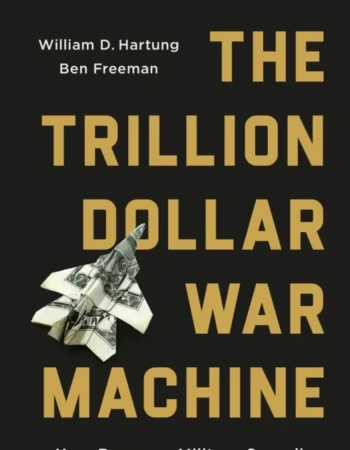
AMY GOODMAN: We’re joined now by William Hartung, coauthor of the new book, The Trillion Dollar War Machine: How Runaway Military Spending Drives America into Foreign Wars and Bankrupts Us at Home. Bill Hartung is Senior Research Fellow at the Quincy Institute for Responsible Statecraft. Bill, welcome back to Democracy Now!.
How unprecedented is the Pentagon budget at this point and what the military’s doing? For example, even President Trump, in his executive order, renaming the Department of Defense the Department of War, although only actually Congress can officially do that.
WILLIAM HARTUNG: Well, the Pentagon budget has never hit a trillion dollars before. Even its most ardent supporters kind of didn’t believe we would ever hit this mark. But now that they’re there, all bets are off.
And speeches like that by Pete Hegseth are basically saying, “Not only are we going to spend a trillion, there’s not going to be rules. We’re not going to have independent testing of these weapons, we’re not going to vet them for human rights when we export them.” It was basically a gift to the arms industry. And they talk about speeding it up. When it comes to weapons, speed kills.
AMY GOODMAN: So – yeah, go ahead, Juan.
JUAN GONZÁLEZ: Yeah, Bill, I wanted to ask you about the increasing shift in the military machine of the United States from actually troops to machines, this shift of this new defense industry that has arisen from Silicon Valley that, I guess, dreams of being able to fight wars without losing any human beings and just depending on remote-control killing abilities, robots, AI. Could you talk about to what degree this has moved forward?
WILLIAM HARTUNG: Well, it’s definitely moving. In Washington, the two ways to make money, if you mention China, if you mention AI, or if you mention both, even better. It’s part of a long myth that technology can win wars, which didn’t happen in Vietnam, it didn’t happen in Iraq, didn’t happen with Reagan’s alleged leak-proof missile defense.
So, they’re selling kind of a bill of goods that’s kind of stale. It’s old ideology with new software. And they’re much more aggressive than the head of, like, Lockheed Martin, who might say to his shareholders, “Oh, this turbulence is going to create business for us.”
Palmer Luckey’s saying, “We’re going to have war with China in two years. We’re going to bury them. We’re going to have more ammunition.” They’re sort of acting like they’re in charge of our foreign policy, and they view themselves as almost the new technological messiahs. So, I think their ideology and their political influence is almost as dangerous as the weapons they want us to use.
JUAN GONZÁLEZ: And in your book, you have an extensive discussion of the War on Gaza and how the Gaza War became big business for U.S. companies. Could you talk about that?
WILLIAM HARTUNG: Yeah, well, there’s this mythology in the Pentagon that sending arms is better than sending troops because our troops aren’t at risk, and the countries will, quote, “Defend themselves.” But of course, Israel committed genocide in Gaza. It was not defense under any terms. And when you’re sending weapons, all the money goes to the companies. You’re not doing troops, you’re not doing logistics. It’s almost pure revenue.
And when you say it’s military aid to Israel, it’s really military aid to Lockheed Martin and Palantir because the money rests in Israel, comes right back to them. Palantir even had its board meeting during the Gaza War and tried to get other companies profiting from the War to be more vocal in their support of Israel. Of course, they also gave them the software to accelerate the bombing.
So, it’s one of the more shameful episodes in the history of an industry that, of course, is not based on morality, it’s based on profit. And I think unfortunately, a lot of people who are kind of into tech are like, “Oh, these are amazing people. They put rockets in space. It’ll be cheaper,” and so forth. But we’ll pay a big price if we put our trust in these companies.
And of course, they’re very much into the Trump administration, including J. D. Vance, who was groomed in Silicon Valley, and is a creature of Silicon Valley and owes Peter Thiel, essentially, his career. When he was appointed VP, the champagne corks went off in Silicon Valley, and huge amounts of money came in behind Trump.
So, they’re trying to basically displace these huge companies like Lockheed Martin, and what the government’s going to do is pay off both of them. Golden Dome is going to have hardware by Lockheed Martin, software by Anduril and other companies. So, that just means that trillion dollars is going to be in the rearview mirror in a few years if we don’t fight back and fight back hard, which means not accepting the myth of technological superiority.
AMY GOODMAN: You have two fascinating chapters in this book, “The Militarization of American Science: Buying the Ivory Tower,” and, “Capturing the Media: How Propaganda Powers the War Machine.” Talk about both.
WILLIAM HARTUNG: Well, this move towards AI and advanced tech means they need the university folks more because Lockheed Martin doesn’t have those kind of people. They’re prized now. And so, they’re doing much more recruiting, sending much more money. Johns Hopkins gets a billion dollars a year to work on things like ballistic missiles, but the average student there wouldn’t know it. The lab is 40 miles away. They’re occupied with other things.
Berkeley helps run a nuclear weapons lab. If you walked into a student on the quad, likewise, they would not know that. So, they’re accelerating that. And also, the pipeline from engineering students into the weapons industry. And the media, well, between vetting Hollywood scripts, spokespersons from think tanks funded by the weapons industry, just the framing.
Very few outlets now really do deep critiques of the military. And then, on top of that, they’re not covering it. Some papers don’t even have a Pentagon reporter anymore, so they just print up the Pentagon press release. And then, paragraph 32, somebody like Bill Hartung makes a little quote so they can say they’re being balanced. But the whole framing is pro-military.
And there’s this notion that if something happens in the world, if we don’t respond with the military, we’re, quote-unquote, “Not doing anything.” Of course, whenever we do it, it’s disastrous. You have members saying, “Oh, peace through strength.” Well, we haven’t won a war in this century.
We’ve caused immense harm, we’ve spent eight trillion dollars, we’ve got troops with PTSD in the hundreds of thousands, who we’re not taking care of. And yet, that myth persists. So, I think there’s kind of a cultural educational task that has to happen as well as pulling back the amount of money we’re throwing at these companies.
JUAN GONZÁLEZ: And, Bill, you begin your book by citing Trump’s 2024 campaign speech in Wisconsin, where he pledged to end endless wars. But ultimately, as you point out, Trump wasn’t very different from Biden on many of these metrics. They both turned out to be staunch supporters of the U.S. war machine. Could you elaborate?
WILLIAM HARTUNG: Yeah, well, Trump uses that tool when needed. Like, when he beat Jeb Bush and Hilary Clinton over the head about Iraq, which, of course, he did not oppose when it was happening. And I think this stuff about war profiteering is a message to those parts of his base who are sick of corporate welfare, sick of war, some even voted for him because they believed this idea that he was going to be less interventionist.
But here we are, blowing innocent people out of the water off of Venezuela, continuing to arm genocide in Gaza, giving away the store to these companies. “We’ll give you money, we won’t regulate you, you’ll get to do pretty much what you want.” In his first term, he did a similar thing, until he cozied up to Saudi Arabia to sell them record amounts of arms and then claimed they were job creators in the United States.
So, he really views the arms industry as a political ally, and he’s not going to go after them in any big way. But every once in a while, he’ll lapse into that, or he says we have too many nuclear weapons. But there’s no evidence in his policy. In fact, they’re increasing spending on nuclear weapons. So, he’s erratic, but there is a political purpose, which is just to keep that part of his base that’s skeptical of war feeling like he maybe will do something about it.
AMY GOODMAN: Before we end, I wanted to ask you about Axios yesterday reporting Israel seeking a new 20-year security agreement with the United States, while the past agreement promised Israel around $4 billion per year in military aid, and Israel’s likely to seek at least that much going forward.
WILLIAM HARTUNG: Well, yeah, they want to be kind of a permanent client of the United States and for us to pay for their aggression. And the current one that runs out had a few little things they didn’t like. Like, they used to be able to spend U.S. military aid to build up their own arms industry.
That was supposed to come to an end. It certainly will be waived if it’s negotiated under the Trump administration. So, basically, they’re going to – if they do that, they’re permanently tying themselves to whatever Israel does in the region. For example, when Israel bombed Iran while the U.S. was supposed to be negotiating with them, Trump followed right behind with bombings and false claims about how they’d obliterated Iran’s nuclear program. He even chided some of his own people for acknowledging that that was not the case.

So, it’s one of the worst moves that could be made. It’s tying us to an archaic, damaging, destabilizing policy and egging on the worst forces in Israel. So, I’m hoping there’ll be some pushback. The problem is, these deals are often done behind closed doors.
JUAN GONZÁLEZ: And, Bill, one more question about this. In this trade war between the United States and China, the issue of rare earths has continued to come up as a major weakness of the U.S. military establishment, and also, obviously, in other industry as well. How big an issue do you think this is and a weakness for the United States?
WILLIAM HARTUNG: Well, it goes against their notion that they can create this self-sufficient garrison state because it’s a global economy, and they can’t do everything here. They don’t have every resource, don’t have every technical kind of expertise. So, this idea that they’re going to have this perfect system all controlled by the United States is a pipe dream.
Even at the most dominant moments of the United States in history, we were never completely self-sufficient. So, Trump is actually selling a bill of goods that is not possible to actually fulfill, which, of course, is happening in other spheres as well, but is more dangerous when you’re talking about peace and security.
William D. Hartung (Bio from Quincy Institute where he is Senior Researcher)
William D. Hartung focuses on the arms industry and US military budget. He was previously the director of the Arms and Security Program at the Center for International Policy and the co-director of the Center’s Sustainable Defense Task Force. Bill is the co-author, with Ben Freeman, of the recently released The Trillion Dollar War Machine: How Runaway Military Spending Drives America into Foreign Wars and Bankrupts Us at Home. He is also the author of Prophets of War: Lockheed Martin and the Making of the Military-Industrial Complex (Nation Books, 2011) and the co-editor, with Miriam Pemberton, of Lessons from Iraq: Avoiding the Next War (Paradigm Press, 2008). And Weapons for All (HarperCollins, 1995) is a critique of US arms sales policies from the Nixon through Clinton administrations.
Bill previously directed programs at the New America Foundation and the World Policy Institute. He also worked as a speechwriter and policy analyst for New York State Attorney General Robert Abrams. Hartung’s articles on security issues have appeared in the New York Times, the Washington Post, the Los Angeles Times, The Nation, and the World Policy Journal.
He has been a featured expert on national security issues on CBS 60 Minutes, NBC Nightly News, the PBS Newshour, CNN, Fox News, and scores of local, regional, and international TV and radio outlets.

 Watch Full Show