
Tag: Omer Bartov

  • Chris Hedges: Abolishing the First Amendment

    Chris Hedges: Abolishing the First Amendment

    Our sin was that we dared to mention the unmentionable – the genocide in Gaza.

    Abolishing the First Amendment

    Those who testified at the state capital against New Jersey’s adoption of the IHRA, arguing that it would criminalize free speech, had our microphones muted and were shouted down, proving our point.

    The Final, Final Solution – by Mr. Fish

    By Chris Hedges / The Chris Hedges Report / ScheerPost / July 29, 2025

    I testified at the New Jersey state capital in Trenton last week against Bill A3558, which would adopt the International Holocaust Remembrance Alliance (IHRA) definition of antisemitism, which conflates anti-Zionism with antisemitism.

    Chis Hedges testimony is included in the video below. Links are also included in the text.

    “This is a dangerous assault on free speech by seeking to criminalize legitimate criticism of Israeli policies,” I said. “The Trump administration’s campaign to ostensibly root out antisemitism on college campuses is clearly a trope to shut down free speech and deport non-citizens, even if they are here legally. This bill falsely conflates ethnicity with a political state. And let’s be clear, the brunt of repression on college campuses is directed against students and faculty who oppose the genocide in Gaza, 3,000 of whom were arrested and hundreds of whom were censored, suspended or expelled. Many of these students are Jewish. What about their rights? What about their constitutional protections?”

    “I have had numerous relationships with Israeli journalists and political leaders,” I went on. “I knew, for example, former Israeli prime minister Yitzhak Rabin who negotiated the Oslo peace agreement. Rabin was assassinated in 1995 by an Israeli ultranationalist who opposed the peace accord. Rabin stated bluntly on numerous occasions that the occupation was harmful to Israel. Israeli colleagues frequently criticize Israeli policies in the Israeli press in language that would be defined as antisemitic by this bill.”

    “For example,” I continued, “the Israeli journalist Gideon Levy, who served in the Israeli army and writes for the newspaper Haaretz, has called for sanctions to be imposed on Israel to stop the slaughter in Gaza, saying ‘Do to Israel what you did to South Africa.’”

    “Omer Bartov, who served as an Israeli company commander in the 1973 war, is Professor of Holocaust and Genocide Studies at Brown University,” I said. “He stated in an article on July 15 in The New York Times that his ‘inescapable conclusion has become that Israel is committing genocide against the Palestinian people.’”

    “These kinds of statements, and many more I can quote from Israeli colleagues and friends, would see them under this bill criminalized as antisemites,” I added.

    Committee chairman Robert Karabinchak, a Democrat, muted my microphone, banged his hammer for me to stop and allowed gaggles of Zionists, who openly harassed and insulted Muslims in the room, to jeer and shout me down.

    There I was arguing that this bill would curtail my free speech, at the same time I was being denied free speech.

    You can see my full testimony here.

    This cognitive dissonance defines the United States and Israel.

    The committee chairman also muted Raz Segal, the Israeli historian and genocide scholar and, in an especially callous move, chastised Mehdi Rabee, whose 14-year-old brother Amer was killed by Israeli soldiers in April 2025.

    “My 14-year-old brother who was from Saddlebrook, New Jersey, was murdered by the IDF,” Mehdi, his voice shaking with emotion, told the committee. “All he was doing was picking olives from an olive tree with his friends, which we have been doing as Palestinians for thousands of years. My brother, whom I will never see again, my brother who my parents will never watch graduate from high school or college. Assemblywoman Swain, my father and the Palestinian-American Community Center tried reaching out to you over and over. And all that we were met with was nothing but silence. Given your silence, you should not have the right to even consider voting for this bill until you meet with my family, who are under your district.”

    “I am going to ask you to stick to the bill,” Karabinchak interrupted.

    “This bill puts at risk my First Amendment right to criticize Israel for what they have done to my brother,” he went on. “I have a right to call Israel whatever I want to call it. When their policies mirror that of the Nazis, I have a right to call it as it is. I call on you to vote no in remembrance of my brother.”
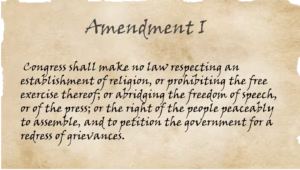
    FIRST AMENDMENT TO U.S. CONSTITUTION

    You can see Mehdi’s statement here.

    Karabinchak, angered that supporters gave Rabee a standing ovation, reduced all testimonies critical of the bill from three minutes to one minute.

    “Time is down to one minute,” he told the crowd of about 400 in the committee and four overflow rooms. “I’m going to ask everybody now to speak, who wants to speak, is going to say ‘I oppose the bill’ or ‘I support the bill.’”

    He paused.

    “Let’s have some more claps,” he said, his voice dripping with sarcasm. “Let’s be happy now, right? I didn’t throw you out like I said I was going to. So now you just stifled the other people who have a right to speak. That’s what you just did! Understand what you did! Okay? One minute. One minute. That’s it. And I’m not going to be nice and say let’s rap it up. I’m going to shut the mic off. ”

    Our sin was that we dared to mention the unmentionable – the genocide in Gaza.

    The Zionists in the room were verbally and physically abusive to the Muslims who had come to oppose the bill. One Zionist repeatedly shoved himself into the bodies of those outside the state capital holding a rally against the bill.

    You can see his harassment here.

    Amy Gallatin, who is on the commission of the West Orange Human Relations Commission, “established by municipal ordinance in 1992 in order to create and foster values of diversity, equity and inclusion among groups in the community,” pulled up pictures on her iPad in one of the overflow rooms and said to those seated around her “Look, its Mohammed!”

    You can see her Islamophobic hate speech here.

    When Rabbi Yitzchok Deutsch made an emotional plea to save the people of Gaza Lisa Swain of District 38 and Assemblyman Avi Schnall of District 30, both Democrats, snickered and laughed as he spoke.

    You can see their reactions to Rabbi Deutsch here.

    Zionists, who painted lurid pictures of Jews living under harassment and in fear for their lives, and of Nazism supposedly running amok on the streets of New Jersey, were not muted, although their statements were hyperbolic to the extreme and often a product of over-active imaginations. They openly salivated at the adoption of the bill, which they said would give law enforcement the tools to criminalize those who engage in hate speech, which, if you read the “contemporary examples of antisemitism,” that accompany the IHRA, include speech that criticizes Israeli policies.

    The IHRA has been adopted by 35 states, the District of Columbia and universities such as Harvard and Columbia.

    “The IHRA working definition of antisemitism includes protected criticism of Israel and its policies,” writes the American Civil Liberties Union (ACLU). “For example, the definition declares that ‘denying the Jewish people their right to self-determination, e.g., by claiming that the existence of a State of Israel is a racist endeavor,’ ‘drawing comparisons of contemporary Israeli policy to that of the Nazis,’ and ‘applying double standards by requiring of [Israel] a behavior not expected or demanded of any other democratic nation’ are all examples of antisemitism.”

    “If the Department of Education were to adopt this definition, and investigate universities for Title VI complaints based on it, college and university administrators would likely silence a range of protected speech including criticism of the Israeli government’s treatment of Palestinians, analogies likening Israeli policies to those of Nazi Germany, or sharing differing beliefs about the right to a Jewish state,” the ACLU continues. “People may disagree about whether such speech is antisemitic, but that debate is irrelevant to the First Amendment, which prohibits the government from censoring or penalizing core political speech.”

    U.S. attorney Kenneth S. Stern — a self-professed Zionist and the lead drafter of what became the IHRA definition of antisemitism — laments that the IHRA has been “grossly abused” to “restrict academic freedom and punish political speech,” including “pro-Palestinian speech.”

    The five committee members, who had clearly made up their minds before they entered the packed hearing room, unanimously passed the measure, which will go to the floor of the State Assembly for a vote. They will, like all politicians who bow before the dictates of the Israel lobby, no doubt, be compensated for their perfidy.

    America, like Israel, exists in a parallel reality. It denies the stark and incontrovertible reality of the live-streamed genocide. It slanders anyone, including Israeli holocaust scholars such as Professor Segal, as antisemites.

    I know, sadly, where this goes. I witnessed it in the many dictatorships I covered as a foreign correspondent for two decades in Latin America, the Middle East, Africa and the Balkans. Those of us who fight for an open society are silenced, attacked as traitors and criminals. We are blacklisted, censored and at times, locked up. If we can escape in time, we are forced into exile. As we are silenced, the sycophants, grifters, Christian fascists, billionaires, Zionists and thugs, elevated to the highest positions in the federal government by the Trump White House, are rewarded with absolute power, luxury and debauchery.

    Our corporate-indentured ruling class has no genuine political ideology. Political parties are a farce, a species of entertainment to beguile the population in our pretend democracy. Liberalism, and the values it claims to represent, is a spent and bankrupt force.

    The burlesque in the committee room in Trenton was another depressing reminder that there is little now that will halt our path towards an authoritarian state, not the press, not the universities, not the courts, which cannot enforce the few rulings made by courageous judges, not the political classincluding the Democratic Party, and not the electoral process.

    We must resist, if only to assert our integrity and dignity, if only to stand in solidarity with the oppressed, if only to slow the consolidation of tyranny, if only to revel in the small pyrrhic victories that resistance alone makes possible.

    But we should not be fooled.

    Subscribe here for more


    In this critical time in our country hearing the voices of truth and engaging in honest discussion for critical issues is all the more important while censorship (and outright lies) along with attacks on truth-tellers are common. Support the WingsofChange.me website and Rise Up Times on social media as we to bring you important articles and journalism beyond the mainstream corporate media. Access is alway free, but if you would like to help:
    Wings of Change FeatherWhatever you are able donate will bring you articles and opinions from independent websites, writers, and journalists as well as a blog with the opinions and creative contributions.
  • DN!: “I’m a Genocide Scholar. I Know It When I See It””: Prof. Omer Bartov on the Growing Consensus on Gaza

    DN!: “I’m a Genocide Scholar. I Know It When I See It””: Prof. Omer Bartov on the Growing Consensus on Gaza

    “Israel is trying to concentrate the population of Gaza in the southernmost parts of the strip, to enclose them and to enforce, eventually, either that they would just die out there or that they would be removed from the Gaza Strip altogether.”

    We speak with leading Israeli American historian Omer Bartov about his latest essay for The New York Times, headlined “I’m a Genocide Scholar. I Know It When I See It.” Bartov cites the United Nations definition of “genocide,” which includes an intent to destroy a group of people that makes it impossible for the group to reconstitute itself. “This is precisely what Israel is trying to do,” he says. “Israel is trying to concentrate the population of Gaza in the southernmost parts of the strip, to enclose them and to enforce, eventually, either that they would just die out there or that they would be removed from the Gaza Strip altogether.”

    Related
    Writer Adam Shatz on How Oct. 7 & Israel’s Brutality in Gaza Reshaped the World
    STARVING CHILDREN OF GAZA
    Palestinians gather to receive food cooked by a charity kitchen, amid a hunger crisis, as the Israel-Gaza conflict continues, in Khan Younis in the southern Gaza Strip, December 4, 2024. REUTERS/Mohammed

    NERMEEN SHAIKH: Israel’s military is continuing to attack civilians across the Gaza Strip, with at least 93 Palestinians killed over the past 24 hours, bringing the total number of deaths in Gaza to 58,000, most of them women and children. This number is believed to be a vast undercount. At least 10,000 are believed to be buried under the rubble. The U.N. estimates approximately 92% of all residential buildings in Gaza, around 436,000 homes, have been damaged or destroyed.

    As the situation continues to deteriorate, an emergency meeting of the Hague Group convened in Bogotá, Colombia, to discuss the conflict. It concluded with the announcement of a series of measures aimed at halting Israel’s attacks on Palestine and ending the, quote, “era of impunity.” The Hague Group came together in January as a bloc of Global South countries committed to coordinating legal and diplomatic measures in defense of international law and solidarity with the Palestinian people. There are now 30 member states. The action steps announced at the conclusion of the summit include banning arms sales to Israel and reviewing ties with companies who profit from the occupation of Palestine. So far, only 12 states have agreed to implement the steps. The summit was co-chaired by South Africa and Colombia. This is Colombia’s President Gustavo Petro.

    PRESIDENT GUSTAVO PETRO: [translated] We need to leave NATO. We need to form an army of light with all the peoples of the world who want to. And we need to tell Europe that if it wants to be with Latin America or Africa, it must stop helping the Nazis. And we need to tell the American people of all colors, because they are now of all colors, to stop helping the Nazis.

    NERMEEN SHAIKH: The Hague Group’s joint statement affirms the commitment to, quote, “Comply with our obligations to ensure accountability for the most serious crimes under international law through robust, impartial and independent investigations and prosecutions at national or international levels, in compliance with our obligation to ensure justice for all victims and the prevention of future crimes,” end-quote.

    AMY GOODMAN: Well, there’s perhaps no greater crime than genocide. Our next guest, Omer Bartov, is professor of Holocaust and genocide studies at Brown University. He is an Israeli American scholar who’s been described [by] the U.S. Holocaust Memorial Museum as one of the world’s leading specialists on the subject of genocide. And he’s just written an op-ed for The New York Times headlined “I’m a Genocide Scholar. I Know It When I See It.” Professor Bartov joins us from Cambridge, Massachusetts.

    Well, why don’t you, Professor Bartov — and thanks for joining us again — lay out your case?

    OMER BARTOV: Well, thanks for having me again.

    The case that I made in the article and that I’ve been making for a while is that at the beginning, immediately after October 7th, the Hamas attack on October 7th, Israeli political and military leaders made a series of pronouncements which could be interpreted as calling for genocide. But there was still no — at that point, there was no evidence that this was being implemented.

    Over time, and I would say by May of 2024, it became apparent that these statements were not only made in the heat of the moment following the massacre by Hamas, but were actually being implemented in a manner that would make it impossible for people to live in Gaza, make the entire Gaza Strip uninhabitable and make life there impossible, as well as destroy all the institutions that would be there for that group to reconstitute itself as a social, cultural, political group once the violence was over. Of course, it’s not over yet. I started thinking that in May. In August that year, I wrote an article that explained that.

    But the violence has only continued, and the attempt, as you just reported, to destroy Gaza entirely has continued since. And it is now clear that Israel is trying to concentrate the population of Gaza in the southernmost parts of the strip, to enclose them and to enforce, eventually, either that they would just die out there or that they would be removed from the Gaza Strip altogether.

    NERMEEN SHAIKH: And, I mean, obviously, the points that you’ve made, Professor Omer Bartov, makes it completely indisputable, the argument that you make in the piece, indeed, that there is a genocide ongoing and that that is the long-term plan of Israel. You point out in the piece, though, that genocide scholars are often hesitant about applying the term “genocide” to contemporary events, in part because, as you write, quote, “it often serves more to express outrage than to identify a particular crime.” Of course, there are people who believe that that’s the case even today with respect to Gaza. If you could respond to that?

    OMER BARTOV: Correct. So, this is one reason that I did not come out right after October 7th and say, “Well, Israel is about to commit genocide,” because, despite those statements, one had to observe and see what was actually happening on the ground. And yes, it is true that the term “genocide” has been used more as an expression of outrage when seeing massacres, mass killings, but that does not necessarily mean that what you’re watching is genocide. “Genocide” is well defined in a U.N. convention from 1948. And under international law, only events that can — that conform to the definition can be seen as genocide. And that means that you have to show both that there is an intent to destroy a particular group, in whole or in part, as such, and that that intent is being implemented. And that, obviously and unfortunately, takes time to adjudicate.

    I think that the term, while problematic, is very important, because it does identify a very particular crime. It talks about the attempt to destroy not simply people in large numbers, but to destroy them as members of a group. The intent is to destroy the group itself. And it doesn’t mean that you have to kill everyone. It means that the group will be destroyed and that it will not be able to reconstitute itself as a group. And to my mind, this is precisely what Israel is trying to do. And many of its spokespersons, to this day, keep reiterating that, to the extent that it’s somewhat bizarre that so much of the rest of the world is not taking them seriously.

    NERMEEN SHAIKH: Professor Bartov, could you also talk about — I mean, you are an Israeli American scholar and are in touch with people in Israel. How do you see perceptions of Israel’s ongoing assault on Gaza changing within Israel? And where are people getting their information there? There’s been talk of basically self-censorship of the mainstream media, but, of course, so many of these images and information are circulating not in the mainstream press, but on social media.

    OMER BARTOV: So, look, I should say first I am — I was born and raised in Israel. I spent the first half of my life in Israel. I served in the Israeli military. And for me, to see what is happening is personally, not only just as a mere human being, but also as an Israeli, heartbreaking.

    What I see in the Israeli public is an extraordinary indifference by large parts of the public to what Israel is doing and what it’s done in the name of Israeli citizens in Gaza. In part, it has to do with the fact that the Israeli media has decided not to report on the horrors that the IDF is perpetrating in Gaza. You simply will not see it on Israeli television. If some pictures happen to come in, they are presented only as material that might be used by foreign propaganda against Israel. Now, Israeli citizens can, of course, use other media resources. We can all do that. But most of them prefer not to. And I would say that while about 30% of the population in Israel is completely in favor of what is happening, and, in fact, is egging the government and the army on, I think the vast majority of the population simply does not want to know about it. And that goes back both to the inability to see anything on their own TVs and, in response to October 7th, a sense that after that — and that’s a widespread sense in Israel — after that, there is no way of finding any solution with the Palestinians, and the only way to deal with that issue is to eradicate it.

    AMY GOODMAN: Professor Bartov, can you talk about the genocide scholars across the world who have come to the same conclusion?

    OMER BARTOV: Yes. So, as I wrote in the op-ed, over time, many genocide scholars who are — and legal experts, experts in international law, who, like me, have been very cautious about applying this term, have gradually come to the conclusion that what we’re watching is genocide. And that’s important, in the sense that there is now, I think, a growing consensus over that view.

    As I wrote in the piece, unfortunately, scholars and institutions dedicated to researching and commemorating the Holocaust have generally, with few very courageous exceptions, have generally refused to say anything, to express themselves in any way, about what is happening in Gaza. And to my mind, by doing that, they, first of all, betrayed the very idea of “never again,” because “never again” was never about “never again the Holocaust,” it was “never again genocide and such other crimes against humanity.” So, there’s now a rift between genocide scholars, who have generally come to agree on Gaza being an Israeli genocidal operation, and Holocaust scholars and institutions that have remained mum.

    AMY GOODMAN: Can you talk about how the term “genocide” came into use? Can you talk about the Polish lawyer Raphael Lemkin?

    OMER BARTOV: Yeah, so, Raphael Lemkin was a Polish Jewish lawyer who, already in the 1930s, was trying to find some kind of terminology that would describe and legally define that particular crime of trying to destroy a group. And the example that he had at the time was the genocide of the Armenians during World War I by the Ottoman Empire. During World War II, he had to escape Poland as a Jew. Most of his family was murdered. He ended up in the United States. And in 1944, he published a book in which he defined what he understood as the crime of genocide, a term that he coined, which is a combination of Greek and Latin, meaning killing a group or an ethnic group. And he struggled for a few more years to have the U.N., the United Nations, just established in 1945, to recognize that crime, and he succeeded in doing so in 1948.

    NERMEEN SHAIKH: Professor Bartov, I want to ask you about a question, indeed, that you ask in your piece, which is, quote, “How will Israel’s future be affected by the inevitable demolition of its incontestable morality, derived from its birth in the ashes of the Holocaust?” What’s the answer to that question?

    OMER BARTOV: Look, I mean, this is beside the horrific killing of human beings in Gaza. And I should just say, because you mentioned the distribution points of food, that between late May, when this so-called humanitarian group started distributing food, and today, more Palestinian civilians have been killed at these distribution groups than Israeli civilians were killed in the Hamas attack.

    Now, what is the — what does all this mean for Israel? As I suggested in the piece, first of all, I think Israel will no longer be able to draw on the credit, if you like, of having been the state that was created after the Holocaust as an answer to the Holocaust. It will no longer be able to say, “We can do whatever we like, because we were a nation subjected to genocide.” You cannot continue to use this argument following the mass killing of another group.

    I hope — and I write that, too — I hope that future generations of Israelis, who will not be clean of that stain — that stain will remain — but will at least be liberated from this shadow of the Holocaust and will start to look at reality as it is, and start to think of how can they reconstitute their own nation, not as a response to the genocide against the Jews, as a response to the Holocaust, but rather as a nation that knows how to share this land, where 7 million Jews and 7 million Palestinians live side by side between the Jordan and the sea, to share it with them with equality and dignity, and not with the use of bombs and violence.

    AMY GOODMAN: Can you talk about this plan to make, build a so-called humanitarian city — the defense minister, Israel Katz, has proposed this idea — on the rubble of Rafah, and the opposition of two former prime ministers? You have Ehud Olmert, you have Yair Lapid. They’re saying if there is no exit, this is a concentration camp. The significance of these men saying this?

    OMER BARTOV: Well, I think it’s very important that Lapid, who’s been sort of on all parts of this debate, said something and that Olmert spoke out, although Olmert no longer has any political power in Israel.

    The plan itself, again, using the typical euphemisms that are used by organizations and states that carry out such crimes, calling that a humanitarian city, which would be a vast concentration camp, a sort of combination of ghetto and concentration camp, that would be built, as you said, on the ruins of Rafah — Rafah has been completely destroyed, there’s nothing there — build a tent city on top of it, bring in initially 600,000 people, who would be brought back from the Mawasi area, from the beach area, to which they were displaced when the IDF went in to destroy Rafah, enclose them there. The plan does not say that Israel would supply them with any humanitarian assistance in the camp, but some other international organizations yet to be determined. But they would not be able to leave unless they leave the Gaza Strip altogether. So, this is — and in continuation to that, the rest of the population is supposed to then join this camp, with a goal of removing them. So, this is extraordinary. The state of Israel publicly is speaking about the creation of a vast concentration camp whose goal is removal of the population to countries that have unanimously said they are not going to take them in.

    NERMEEN SHAIKH: Well, Professor Bartov, I want to ask about the U.S.’s position on this, of course, their continuing support for Israel, which has enabled the assault to continue. I want to go back to the former president, Biden, his administration, the State Department spokesperson at the time, Matt Miller, who admitted earlier this year, in May, that he believes Israel committed war crimes in Gaza. This reversal came after more than a year, as the face of the Biden administration’s foreign policy, repeatedly defending Israel against allegations of war crimes and genocide. This was Miller speaking earlier this year — last year.

    MATTHEW MILLER: We have been very clear that we want to see Israel do everything it can to minimize civilian casualties. We have made clear that they need to do every — that they need to operate at all times in full compliance with international humanitarian law. At the same time, we are committed to Israel’s right to self-defense.

    NERMEEN SHAIKH: But during an interview with Sky News last month, in June, Matt Miller says he believes Israel has committed war crimes in Gaza and that Israeli soldiers are not being held accountable.

    MATTHEW MILLER: I don’t think it’s a genocide, but I think the — I think it is, without a doubt, true that Israel has committed war crimes.

    MARK STONE: You wouldn’t have said that at the podium.

    MATTHEW MILLER: Yeah, look, because I — I mean, when you’re at the podium, you’re not expressing your personal opinion. You’re expressing the conclusions of the United States government.

    NERMEEN SHAIKH: So, Professor Bartov, your response to that, and also your perception of how the Trump administration has both broken with and continued Biden’s policies on Gaza?

    OMER BARTOV: Well, you know, in November 2023, I published an op-ed in The New York Times in which I said that war crimes and crimes against humanity were clearly happening in Gaza, and that if this continued, it would become a genocidal operation. I was hoping at the time that someone in the administration would actually pay attention, because the United States, in November or December 2023, could have stopped all of this. It was not very difficult to do. Israel cannot act as it has without constant supply of arms from the United States and Germany — these are the two major suppliers; the U.S. supplies between 70 and 80% of all munitions to Israel — and without diplomatic cover — Israel has a diplomatic Iron Dome created by the U.S. veto in the Security Council. That did not happen. And, of course, the evidence was there. And so, first of all, one has to say that the Biden administration is complicit in what happened in Gaza.

    Secondly, when Trump came in, curiously, the first thing that happened, the day before he came into office, was that he forced a ceasefire on Israel. And that ceasefire, in January this year, made it possible to exchange Palestinian prisoners for a large number of hostages, but not all of them. The plan was to complete that exchange and to stop the fighting. But in March, Israel unilaterally broke that ceasefire without any interference from the United States, and, since then, has continued. And what is particularly galling is the fact that when Trump floated his plan, if you recall that, that the population of Gaza would be removed, and then Gaza would be made into a beautiful resort area, he later on didn’t really repeat that. But in Israel, that was seen as license to do exactly what is being done now — that is, using hundreds of bulldozers, engineers, explosives to systematically destroy every building in Gaza so that nobody would be able to live in, in that area, and then, well, maybe turn it into a resort area, more likely be an area for Jewish settlers.

    AMY GOODMAN: I wanted to name names here, that you do in your piece. “In November, a little more than a year into the war, the Israeli genocide scholar Shmuel Lederman joined the growing chorus of opinion that Israel was engaged in genocidal actions. The Canadian international lawyer William Schabas came to the same conclusion … and has recently described Israel’s military campaign in Gaza as ‘absolutely’ a genocide.

    “Other genocide experts, [like] Melanie O’Brien, president of the International Association of Genocide Scholars, and the British specialist Martin Shaw (who has also said … the Hamas attack was genocidal), have reached the same [conclusion], while the Australian scholar A. Dirk Moses [of] the City University of New York described these events in the Dutch publication NRC as a ‘mix of genocidal and military logic.’ In the same article, Uğur Ümit Üngör, a professor at the Amsterdam-based NIOD Institute for War, Holocaust and Genocide Studies, said there are probably scholars who still do not think it’s genocide, but ‘I don’t know them.’”

    Professor Bartov, as we begin to wrap up, can you talk about this consensus and whether Holocaust museums, which often address a number of holocausts, will be taking on what Israel has done in Gaza?

    OMER BARTOV: Well, so, as I said before, I think there is a growing consensus among genocide scholars and legal experts. William Schabas is a very good example, because he’s a highly respected expert. He’s very conservative. He took a long time to reach that conclusion. And he has. I just spoke with him recently in Europe, and he very strongly believes that what Israel is doing now is genocide.

    But the other side of it, as you indicate, is the tragedy that most Holocaust scholars and all of the institutions that I know that are dedicated to commemorating and researching the Holocaust have refused to say anything. And some, again, a minority of Holocaust scholars, have come out and claimed that genocide scholars speaking about genocide in Gaza are antisemitic, that this is an antisemitic argument. And that use of the term “antisemitism,” which, as you know, of course, and we spoke about, was also a tool to silence any protest last spring on American campuses, this abuse of the term is now creating a rift between Holocaust scholars and genocide scholars.

    And what I fear — and that’s what I write at the end of this piece — what I fear is that this will mean that the Holocaust, which had come, over decades, to be recognized as an event of universal importance, as an event that we have to learn from, because of the silence, because of the betrayal of the notion of “never again” by these institutions and these scholars, will go back to become a sort of ethnic enclave, only something that the Jews talk about among themselves.

    AMY GOODMAN: Omer Bartov, we want to thank you for being with us, professor of Holocaust and genocide studies at Brown University and an Israeli American scholar, described by the U.S. Holocaust Memorial Museum as one of the world’s leading specialists in the subject of genocide. His forthcoming book, Israel: What Went Wrong? His previous books, Genocide, the Holocaust and Israel-Palestine. We’ll link to your piece in The New York Times, “I’m a Genocide Scholar. I Know It When I See It.”

    The original content of this program is licensed under a Creative Commons Attribution-Noncommercial-No Derivative Works 3.0 United States License. Please attribute legal copies of this work to democracynow.org. Some of the work(s) that this program incorporates, however, may be separately licensed. For further information or additional permissions, contact us.