Tag: Metro Surge

  • “Operation Puppet Master”: Trump Admin Spied on Minnesota Activists & Unions After ICE Killings

    “Operation Puppet Master”: Trump Admin Spied on Minnesota Activists & Unions After ICE Killings

    Photo attributed to the South China News

    Operation Puppet Master” was launched in response to statewide protests against the ICE killings of Alex Pretti and Newly released federal documents have revealed the existence of an expansive surveillance program launched by the federal government against activists, labor unions, community groups, and even a bicycle repair collective, in Minnesota last winter. 

    The program has come to light in the course of a federal case against 15 Minnesotans who have been accused of “conspiracy” to impede ICE’s immigration enforcement surge in Minnesota. Isaac Sant, one of the defendants in the case, says the charges levied against him are “politically motivated” and “intended to quell dissent.” As part of its spying operation, DHS sent undercover agents to meetings in churches, parks, libraries, schools and union halls and secretly obtained the financial records of left-leaning national organizations such as the Communications Workers of America and Sunrise Movement. “We were sick to hear that we were also in this list of people that were organizing using their First Amendment rights and the right to petition to their government, but also not surprised,” says Emilia González Avalos, the executive director of Unidos MN, a local organization that was one of the groups surveilled by DHS. “This is one of the tactics they have used across the world to repress and scare and disrupt movements that are organizing with other people against racism, that are organizing for justice, and that are organizing for a multiracial, high-functioning democracy.”
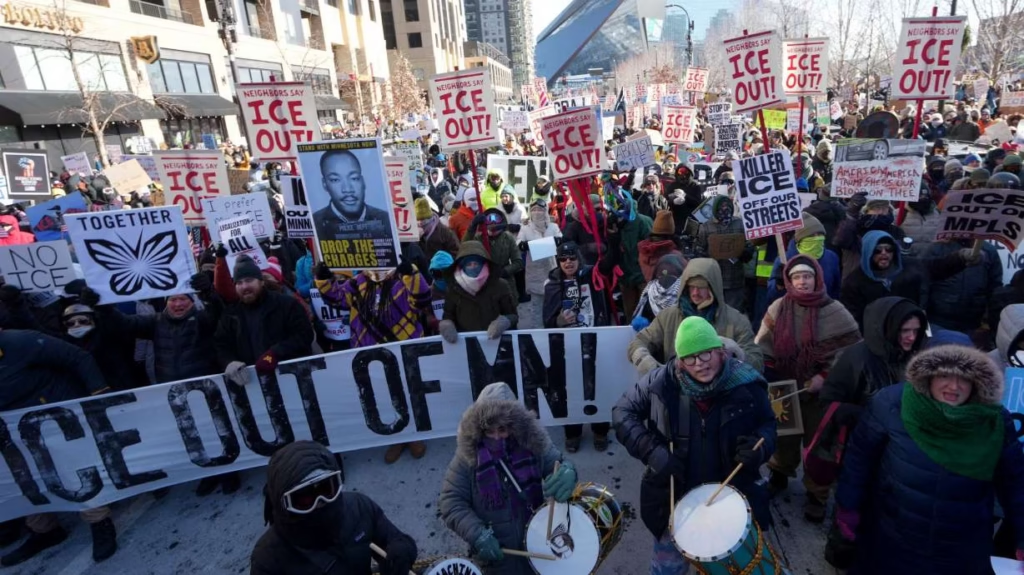
    ICE OUT OF MINNESOTAPosted by Truthout. Credit: AFP via Getty Images, Creator: CHARLY TRIBALLEAU

    FULL TRANSCRIPT\This is a rush transcript. Copy may not be in its final form.

    ANJALI KAMAT: Operation Puppet Master. That’s the name of an expansive surveillance program launched by the federal government against activists, left-leaning political organizations, labor unions and other groups in Minnesota last winter as hundreds of thousands of residents joined protests demanding an end to the violent mass deportation campaign in the state by ICE and other federal agencies, known as Operation Metro Surge.

    The spying program was launched by HSI, Homeland Security Investigations, four days after federal agents shot and killed Alex Pretti, a nurse and protester, and just weeks after agents shot another protester, Renee Good.

    The spying program came to light in court documents filed in federal district court in Minnesota and first reported on by The New York Times. The documents were filed by defense attorney Kevin Riach in the federal case against 15 purported antifa members, Minnesotans accused of conspiracy to, quote, “impede or injure federal officers” and to, quote, “violently oppose immigration law enforcement.” Riach represents one of the accused, Isaac Sant.

    AMY GOODMAN: In Kevin Riach’s motion, he reveals that undercover agents posing as protesters spied on community members at meetings in churches, parks, libraries, schools and union halls, and that HSI secretly obtained the financial records of national labor unions, including the SEIU and the Communication Workers of America, CWA, as well as national nonprofits like the Sunrise Movement. The financial records go back three years.

    Democracy Now! spoke to Kieran Knutson, president of the CWA Local 7250, on Sunday to get his response.

    KIERAN KNUTSON: We were outraged, but not surprised, to learn this news. You know, the federal government was conducting an illegal and murderous campaign of terror against immigrant and working-class people in the Twin Cities, so it’s not a surprise to us that they were using these methods to try and infiltrate and map the folks who were organizing opposition to their campaign. And, you know, it’s our understanding that they’ve surveilled our members, that they have infiltrated meetings that we co-sponsored, and possibly even entered our office once as undercover cops for the federal government as part of this operation. So, yeah, it just shows what kind of government we’re up against.

    ANJALI KAMAT: In the motion filed with the court, attorney Kevin Riach writes, quote, “With no evidence, the government alleged to the grand jury that the conspiracy in this case extends far beyond the defendants to include the AFLCIO, the Minneapolis Federation of Educators, the Minnesota Association of Professional Employees, Monarca, Veterans for Peace, and the Grease Pit bicycle repair shop, among others.” So far, none of the groups targeted by the HSI inquiry have faced charges.

    The executive director of the Sunrise Movement, Aru Shiney-Ajay, said, quote, “While federal agents repeatedly broke the law, ordinary people exercised their First Amendment rights to protect their neighbors.”

    The surveillance operation arose from a White House directive known as National Security Presidential Memo 7, NSPM-7, which identifies a potential domestic terrorist as someone expressing, quote, “anti-Christian, anti-capitalist, or anti-American views.”

    AMY GOODMAN: For more, we’re joined by two guests. Isaac Sant is a healthcare worker in St. Paul, Minnesota, one of the 15 protesters charged by the federal government in June. It was his attorney, Kevin Riach, who filed this motion and released these documents on Thursday. And Emilia González Avalos is executive director of Unidos MN, a grassroots group and immigrant advocacy organization that was also spied on by the federal government.

    We welcome you both to Democracy Now! I wanted to turn first to Isaac Sant in St. Paul. It’s your attorney who released these documents. It has been explosive around the country to see the federal government, after the killing of Alex Pretti and Renee Good, investigating who? The activists who were protesting these killings and the deadly immigrant crackdown. Now, your attorney advised you not to speak today, but you’ve chosen to. Why? Talk about what’s happened in the Twin Cities.

    ISAAC SANT: Hi, Amy. Thanks for having me.

    I believe this case is a blatant act of political repression against anybody who was brave enough to protest against ICE’s terroristic rampage through our streets in December and January. And I think the calculus here is a little different than in a normal criminal trial. I think these are politically motivated charges intended to quell dissent, and that my little organization is not really the target of these. I’m under indictment, and it’s obviously very stressful, but the whole community is really the target here. This is intended to have a chilling effect on protest and to intimidate people out of the street.

    ANJALI KAMAT: Isaac, were you one of the groups that was under surveillance? And did you suspect anything during the time?

    ISAAC SANT: I did suspect that we might have been under surveillance. I mean, I was at a mass meeting immediately after the brutal murder of Renee Good, and I thought there might be undercovers in the room, sure. But what I didn’t know was that —

    AMY GOODMAN: What were you indicted for, Isaac?

    ISAAC SANT: I was indicted for conspiracy to impede or injure a federal officer and also for interstate stalking.

    ANJALI KAMAT: I want to bring in Emilia González Avalos into the conversation, executive director of Unidos MN. Emilia, can you talk about your organization? I’m looking at this chart of — that Homeland Security Investigations put out called “The Conspiracy,” and there’s a group called Monarca right at the top. And this is a project of Unidos, your group. Can you talk about your experience with federal surveillance?

    EMILIA GONZÁLEZ AVALOS: Of course. Well, Monarca is, as you said, our constitutional observing program. It is an on-ramp for community organizing where we developed these massive forums for people to learn about how to legally and constitutionally observe what was happening in our streets with the deadly force being used upon our immigrant families. And that’s all we did. We were teaching people how to use their First Amendment; what does a warrant, an administrative warrant, looks like differently from a judicial warrant; what were the rights and opportunities that we have to protect the rights of immigrants in detention or while they are being detained; how do you locate a person that has just been detained? We also talked about Fourth Amendment rights.

    And this program grew to almost 30,000 people before Metro Surge and reached to 50,000 people after Metro Surge, and it continues to grow. And so, we were shocked. We were sick to hear that we were also in this list of people that were organizing using their First Amendment rights and the right to petition to their government, but also not surprised. We have learned through history that this is one of the tactics they have used across the world to repress and scare and disrupt movements that are organizing with other people against racism, that are organizing for justice, and that are organizing for a multiracial, high-functioning democracy.

    AMY GOODMAN: I want to go to what the U.S. attorney for Minnesota said in a news conference. He refused to answer repeated questions about whether any federal agents or officers were injured by the defendants.

    DANIEL ROSEN: Whether or not they actually, at the end of the day, cause bodily harm is not the measure of whether or not they committed a serious federal crime. And I would dare say, you know, we just cannot have in this country all of all — people getting together, engaging in all of these violent acts, and then simply saying, “Well, you know, nobody got hurt, so how bad could it have been?”

    AMY GOODMAN: That was the U.S. Attorney for Minnesota Daniel Rosen, who also suggested there could be more charges related to ongoing investigations into anti-ICE activism during so-called Operation Metro Surge.

    DANIEL ROSEN: If you are actively conspiring to impede law enforcement, actively conspiring to commit the acts that today’s indictment alleges, you ought to go on the assumption that we’re watching you and that we’ll get you.

    AMY GOODMAN: I mean, this is quite something. When there are accusations of violence, the U.S. attorney cannot name one example of violence that the defendants were involved with. Can you respond to this, Isaac Sant?

    ISAAC SANT: On the advice of my attorney, I’m not going to talk about the details of any overt act I’m alleged to have committed in the indictment. But what I can tell you is that our activism, me and all of my co-defendants, was nonviolent throughout Metro Surge, and that, as I said, this is a naked act of political repression. This is not about what we did. This is about who we are and what we believe. This is about the suppression of our politics and, more broadly, of any opposition to ICE’s campaign of terror across the country.

    And yeah, I didn’t hurt anyone. I’m not alleged to have hurt anyone. And there’s nothing in the indictment that I’m accused of that tens of thousands of people also didn’t participate in as acts of protest when ICE was rampaging through our streets.

    ANJALI KAMAT: I want to bring Emilia back into this conversation. This indictment against the 15 defendants, you know, accuse them of everything from throwing ice chunks to setting up blockades. But the surveillance documents released last week now show the government was monitoring peaceful library meetings about deescalation tactics. What are your thoughts on the kind of evidence being gathered by the Trump administration and the financial records that have been collected of the SEIU, Sunrise Movement, three years of financial records?

    EMILIA GONZÁLEZ AVALOS: Well, I am not an attorney, and I also have never experienced or witnessed a network of surveillance that tries to fish and hunt for the behaviors that they want to polarize, and then act using that, acting with the strength of the Department of Justice. It is also said that in this administration, a ham sandwich can get an indictment. And so, it is very dangerous, the times that we’re living, the discretion in which the rule of law is being used.

    And I hold two things at the same time: Courts decide on individual conduct, and everybody has the right to due process. Everybody gets a defense. And a government that puts a bicycle collective and a teachers’ union and a network of regular people like Unidos on a conspiracy chart, in my opinion, loses the right to be believed about who the dangerous people are.

    AMY GOODMAN: Emilia González Avalos, thank you so much for being with us, executive director of Unidos MN, and Isaac Sant, healthcare worker and activist in St. Paul, one of the 15 Minnesotans charged with conspiracy to impede federal officers during their immigration crackdown last winter. It was his attorney who released the documents.

    Coming up, in an exclusive interview, the prominent British human rights attorney Rajiv Menon, speaking out on being charged with contempt of court for what he said during his closing argument in defense of his client, a protester with Palestine Action. We’ll go to London. Stay with us. [See separate post.]

    [break]

    AMY GOODMAN: “I Keep Faith” by the British musician Billy Bragg, performing in our Democracy Now! studio.
    The original content of this program is licensed under a Creative Commons Attribution-Noncommercial-No Derivative Works 3.0 United States License. Please attribute legal copies of this work to democracynow.org. Some of the work(s) that this program incorporates, however, may be separately licensed. For further information or additional permissions, contact us.


  • PROTEST as TEACHER: The 21st Century Has Come of Age

    PROTEST as TEACHER: The 21st Century Has Come of Age

    A ballooning generational shift is challenging aged authority.

    PROTEST as TEACHER: The 21st Century Has Come of Age

    By Susu Jeffrey / Original to Wings of Change / April 8, 2026

    Melissa Olson’s (Minnesota Public Radio 3/9/26) article on the Native “Prayer Camp” at Mni Owe Sni (Coldwater) National Park lacked historic background. Indian people getting evicted from their land is an old story. At Coldwater Spring on May 5, 1820, Lt. Col. Henry Leavenworth marched to the spring and the U.S. government has never left. The military assumed exclusive control over the water and land that is still considered federally “owned” despite a doubtable treaty

    Olson actually wrote that the campers would leave the Prayer Camp in three days (on March 11). That did not happen. Protestors said no—no decision had been made and they wondered about the source of the information—if it was wishful (obedient) thinking in print.

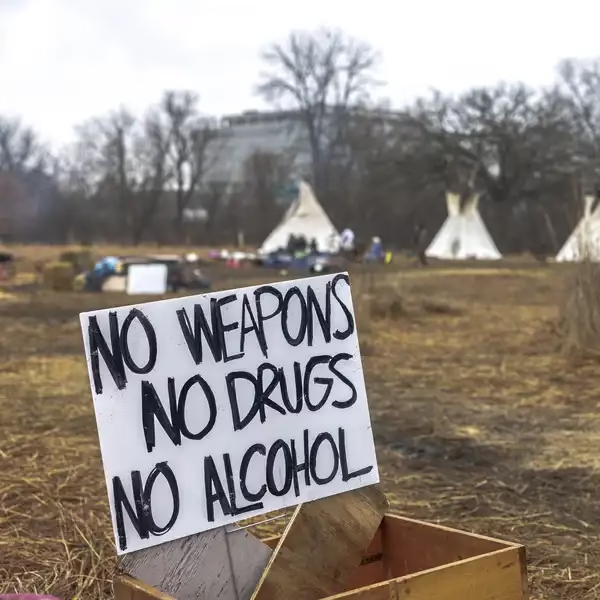
    Indigenous Your camp across from Whipple Building

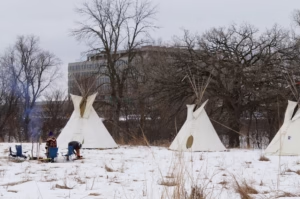
    The Whipple Federal Building where ICE and Border agents have run Operation Metro Surge for the last several months looms in the background of the Coldwater Springs camp near Fort Snelling. (Photo by Alex Baumhardt/Minnesota Reformer)

    Indigenous youth established the Prayer Camp on February 9, 2026 in order to hold a four-day ceremony on traditional Dakota sacred land in support of resident “illegal aliens” being incarcerated in what we now know are substandard prison-like conditions. Federal agents were using non-legal methods to capture foreign-looking civilians based on appearance, deception, location, lies and threats and in pursuit of fulfilling mandated 2,000 people per day arrest quotas.

    The Whipple federal seven-story building housing ICE (Immigrant and Customs Enforcement) and Border Patrol (CBP, Customs and Border Patrol) is an office building, not a jail where, for example, beds, medical personnel and toilet facilities for groups are not available. Whipple is the backdrop of the Prayer Camp.

    Simultaneously war fever was raging. The Trump and Netanyahu regimes were threatening war against Iran. Indeed on February 28, 2026, the U.S. and Israel launched hundreds and hundreds of missiles against Iranian leadership and military installations. The U.S.-Israeli War has been deemed illegal under international ”laws of war.” On April 7, President Trump threatened to “bomb Iran back to the stone age.” Ninety minutes before his deadline the president pulled his fourth “taco” (Trump always  chickens out), retreated, and called for a two-week ceasefire which Israel violated on April 8 by bombing Lebanon.

    The Whipple Building is located within Fort Snelling at 1 Federal Drive, federal land since the contentious 1805 “Pike” Treaty, just across the freeway from Mni Owe Sni parkland. Prayer Camp tipis, the camp ceremonial staff and sacred fire were set up in view of Whipple.

    Who Are the Real Indians?

    The real Indians are people enrolled in federally recognized tribes, sometimes called casino Indians. Thousands of people who consider themselves Indigenous, who observe Indian lifestyle practices in dress, food, holidays, religion and philosophy are excluded from the culture they identify with.

    There is a growing generational shift among younger Native-identified people who are challenging federally recognized Indian authority. A group of “legal” Indians amassed (at least one armed) at the Prayer Camp on March 5 and interrupted ceremonial plans. A confrontation of the legals with six younger camp leaders ensued with one legal getting arrested and the nonviolent campers feeling unheard. Prayer Camp organizers did not immediately agree to pack-up and leave as was expected.

    This armed, violent breech of the Native ethic of peaceful behavior in a sacred, therefore “neutral” place, was a profound cultural blow to the young prayer campers. The youths had set up a camp according to strict traditional practices, they were fasting, sweating, praying and smudging, and in come angry Dakota federally recognized officials trying to force a stop.

    The interrupters were apparently organized by Franky Jackson, Historic Preservation Officer for Prairie Island Reservation where more than 500 mounds have been counted from the long Native occupation of that Mississippi island area. Tragically now the island is home to two nuclear power reactors and a vast amount of hot nuclear waste. There is no national nuclear waste depository and no plan to ever move the dangerous garbage off-island. Instead the Indigenous people are being relocated.

    Another Prairie Islander, the late spiritual leader Chris Leith, was very involved in the earlier 1998-99 Minneapolis protest encampment. Leith taught that water is the first medicine for all living things. He said Coldwater is one of the dwelling places of Unktehi, a powerful Dakota water spirit with life-giving as well as destructive qualities.

    Leith instructed people to acknowledge, honor and respect this spirit by visiting and gifting the spring. He urged people to gather the medicine water whenever needed. Chris Leith’s gentle, positive teachings resulted in the Friends of Coldwater walks held on the day of the full moon each month for more than 25 years. In addition to a spiritual renewal walkers are treated to the changing roll of the wheel of the year.

    Franky Jackson and the legal Indians having failed to dislodge the younger Prayer Camp activists called-in Arvol Looking Horse, 72, from South Dakota, 19th generation carrier of the white buffalo calf pipe, spiritual leader of Lakota, Nakota and Dakota peoples. In an hours-long meeting around the sacred fire with Whipple Building lights glowing in the background, Looking Horse, wearing regalia, said the Prayer Camp should be abandoned because it was located on burial grounds.

    Mni Owe Sni (water-spring-cold) is not a place of burials. It is a drinking water source, a 10,000-year-old spring running even under the last (Wisconsin) glacier down the Mississippi River gorge. All springs are sacred because all life requires water and springs are neutral, belonging to all, sites of life and peace.

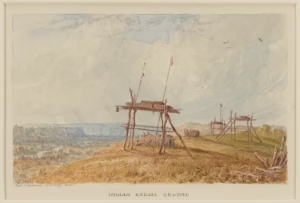
    INDIAN BURIAL GROUND “Indian graves at the mouth of the St. Peter’s” river (now Minnesota River) a watercolor by Seth Eastman. Pilot Knob, across from Ft. Snelling with the confluence of the Mississippi and Minnesota rivers below, was where birds would clean the bodies, the bones would fall to earth and be collected and interred.
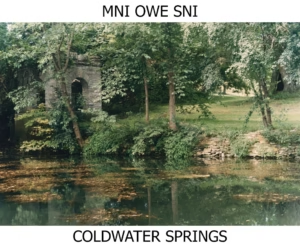
    Photo: Minneapolis Institute of Art

    Adult bodies are about 70 percent water which corrupts and leaks out. That’s why you bury on a hill—and it’s closer to the sky god(s). Water obeys gravity and runs downhill. Springs surface when underground water veins run into bedrock. Springs are places where you have to bow, as in respect, to collect water.

    Jim Redsky Anderson, late cultural spokesman for the Mendota Mdewakanton Dakota Tribal Community, talked about Dakota burials west of Minneapolis on a hill above Lake Minnetonka since “all the good places were already taken.” Indigenous existence in the area of the rivers confluence was documented by state archaeologist Dr. Robert Clouse who found a 9,000-year-old bison spear point.

    Caught in the backwaters muck of the great rivers confluence the bison would have been brought down by a group of hunters and butchered on the spot, Clouse said, painting a word picture of the scene. The spear was rock from upstream near Mankato, Minnesota, where in 1862, 38 Dakota men were hanged in the largest mass hanging in the United States.

    It is unclear who misinformed Looking Horse about the history of Coldwater being a burial site since it is named Mni (water). Indian people are trained to respect elders, to never interrupt, to listen respectfully but it broke Looking Horse’s  credibility.

    The legal Minnesota tribes were not involved in the long 17-month encampment. The four recognized tribes are located outstate (away from the central business/government Minneapolis/St. Paul area) and did not support or participate in the earlier encampment that saved Coldwater from becoming a Twin Cities off-site airport parking lot.

    The 1998-99 Minnehaha Free State and Four Trees Spiritual Encampment protestors stayed and stayed (17 months) until the trees they were trying to save were cut along with the safety harnesses of people in the tree-sits. The road was built; however, the Minnesota Department of Transportation (MnDOT) was forced to raise the level of Highway 55 to protect underground flows to Coldwater Spring.

    The encampment slowed down the destruction/construction business-as-usual process and led to saving 27 acres of Mississippi bluff top, now a National Park. It allowed tribes time to apply for (paper) recognition of Coldwater as a Dakota Sacred Site according to the National Park Service’s many rules. For campers it was a commitment to the common goal, personal dignity and the power of nonviolent protest producing a class of healers, listeners and citizens risking “good trouble” rather than a plod-along life.

    In October 2005 two Dakota Natives and one non-native were ticketed at Coldwater Spring by federal authorities for “failure to obey a legal order.” Officials had blocked the entry to Coldwater with a locked gate and the three got inside, refused to leave and were ticketed. After fiddling around with the case for more than a year federal charges were dropped. It was not a ‘legal order,’ said the late Indian rights attorney Larry Leventhal because the Pike Treaty of 1805 was never verified. It’s hoo-ha.

    Had the case gone to trial the federals could lose nine miles of land on either side of the Mississippi from the confluence of the Minnesota and Mississippi (the b’dota) upstream to the falls now called St. Anthony. That would mean losing Minneapolis, a chance the U.S. government did not want to take.

    In other words, this is the seed of the Dakota Land Back argument. Leventhal said the case was the third time the question of the legality of the 1805 “Pike” treaty reached federal court, only to have charges dismissed rather than to possibly lose Minneapolis, the economic engine of Minnesota, to the Dakota oyate (nation).

    1805 to 1945

    Two years after the 1803 Louisiana Purchase, Lt. Zebulon Pike led a small detachment up the Mississippi River to see what the United States actually purchased from France. Without authority, Pike treated with two (of seven) Dakota headmen who agreed to the construction of two forts along the Mississippi but retained the rights “to pass, repass, hunt or make other uses of the said districts, as they have formerly done.”

    The 1805 (Pike) Treaty with the Sioux was ratified but never “proclaimed” and has always been of murky legality. Nevertheless the U.S. government and the state of Minnesota (admitted to the Union in 1858) has consistently acted as if the Coldwater property was signed over to the U.S. The Dakota wanted guns and European trade goods; the Americans wanted to establish authority and profitability. The warring of Dakota and Anishinabe was bad for the fur trade business. By the late 1830s military forces began to forcibly evict civilians away from the pioneer settlement called Camp Coldwater ostensibly to preserve game and firewood.

    In 1838 pioneer leader Abraham Perry, his wife and their six children were dispossessed when soldiers smashed their household goods, ripped off the roof and set the cabin on fire. Marie Ann Perry’s broken Spode China pieces still pop out of the ground in Spring after the thaw. She was the village midwife.

    Coldwater is considered by some to be ”The Birthplace of Minnesota” since the soldiers who built Fort Snelling 1820-23 lived beside the spring. Coldwater was the potable water source for the Fort for nearly a century and also for the civilian community that supported the Fort with wives, babysitters, servants, translators, guides, missionaries and further off-site, liquor. The village of Swiss, Canadian, Irish, English, Native and African Americans included the community midwife, farms, trading posts, B.F. Baker’s stone warehouse, a steamboat landing, the St. Louis Hotel, blacksmith shops and stables.

    Probably the most famous resident of Camp Coldwater and Fort Snelling was Dred Scott, who after returning to Missouri sued for his freedom from slavery in 1857 and lost because slaves were not considered citizens and therefore had no right to sue in the courts. The Dred Scott case is one of the most important cases in American history.

    Fort Snelling was supplied with drinking water from barrels filled at Coldwater reservoir and hauled by horse-drawn wagons. Four to ten wagons a day were required with six horses each and two men from 1823 until after the Civil War.

    In 1879-80 a coal-fired engine drew 921,600 gallons daily out of the Coldwater reservoir for storage in the water towers to supply Fort Snelling. From 1904 to 1930 supplemental water was drawn from a well at the base of a bluff along the Minnesota River. After 1930 Fort Snelling switched to water from the City of St. Paul. The nearby Veterans Administration used Minneapolis water beginning in the 1920s.

    1945 to 1991, the Cold War and After

    Coldwater was considered open parkland south of Minnehaha Regional Park until after World War II when by 1955 it was fenced off and developed into a secure Bureau of Mines cold war mining and metallurgy research facility. The research on venting mine air to prevent black lung disease was successful and spread worldwide as part of American postwar soft power largess. With the end of the Cold War in 1991 Russia lost its empire and the Bureau of Mines campus closed. Eleven buildings with offices, laboratories and warehouses were simply vacated and left to deteriorate.

    The invitingly empty land and buildings began to be frequented by neighborhood kids, the homeless and street drug business. At the same time the Sierra Club formed a lobby group of volunteers to Stop the Reroute of Highway 55 and Save the (Minnehaha) Park. Park and River Alliance collected 12,000 dogwalker signatures against the road expansion but no government office would accept the petitions. Their lawsuit against MnDOT was dismissed on a technicality.

    There was one emergency during the post-war Cold War period when national security was overruled and the public got past the six-foot chain link Coldwater fences. “In 1976 after months of draught,” wrote Carolyn Lyschik (10/21/2006) then of Minneapolis, “the city water developed an algae that was putrid and undrinkable by my husband who was very ill at the time. I made trips every other day to Coldwater Spring and stood in line to get the best tasting fresh water. We were so thankful for this vital resource. If it is still not polluted it should be a National Treasure!”

    In 1880 the Coldwater reservoir could furnish 921,600 gallons of water pumped out daily. (Historical Study, Former U.S. Bureau of Mines, Twin Cities Research Center, final report by Barbara J. Henning, 10/2002, p. 22.) The next flow rate measure was reported in the early 1990s with the Highway 55 reroute dispute as 130,00 gallons per day (gpd). In the intervening century-plus ten years “development” happened with the loss of 791,000 gpd. More recently the 2024 Minnesota National River and Recreation Area flow rate for Coldwater Spring for the year 2024 was 69,552 gpd.

    Yes, we have a water crisis in the state and city named after the Dakota word for water, MniMni waconi, pronounced Min-ne wa-cho-ni, translated “Water is life,” literally, water makes life.

    A looming emergency could be the thirst of AI when nuclear power’s electrically generated need for cooling water as well as data centers and electronic tech’s requirement for pristine water collide with domestic use. We can make a lot of things but not water (Desalinization plants don’t make water. They remove salt from some water and recycle the salt as hyper-saline coastal water piped out about a half mile where most edible sea life exists.)

    Unfortunately, the Great Medicine Spring in Minneapolis’ Theodore Wirth Park was dewatered for Interstate-394 in the 1980s. Native people were known to come from “hundreds of miles” to collect the healing properties of that medicine, now forever gone. The only other major water source in Hennepin County is Frederick Miller Spring in Eden Prairie which was recently saved from another upscale housing development.

    When Saying NO Isn’t Heard

    The “cult” around environmentalism started to take hold with noticeable climate changes. It was the mid-1990s; the proposed Highway 55 “reroute,” a freeway, got reduced to a four-lane highway. MnDOT really had to eat crow when Oklahoma Seminole repatriation expert Michael Haney testified about Iowa Indian remains in the area. State archeologist Dr. Robert Clouse found a 9,000-year-old bison spear point at the b’dota (Mississippi-Minnesota confluence) in Mendota in 1997. Polite opposition lost patience.

    In the fall of 1998 local enviro groups and national Earth First! began an encampment in south Minneapolis, soon joined by the Mendota Mdewakanton Dakota (non-federally recognized) Tribal Community. Neighbors hated the nightly drumming and singing. The press loved it and a bounty of public curiosity and donations poured in

    Finally on December 20th of Christmas week in 1998, 803 police descended on the camp to arrest about 30 people at a reported cost of $15,000 per arrest. A blizzard was roaring, the police were savage, protestors were stunned. The coffee, donuts, muffins and box lunches for police totaled $7,309.90. Three days later a new sacred fire was lit a few blocks south on open state land nearer Coldwater Springs and the Four Sacred Trees Spiritual Encampment was established.

    Unnecessarily brutal arrests continued throughout the Spring, Summer and Fall of 1999 as did community support. Trees were felled, tree-sits were devised to confront deforestation. On Thanksgiving seventeen turkeys were donated. On December 11, the second raid occurred with 26 arrests and the end of the four sacred trees.

    During the 1999 trial from the second raid the state maintained that “the oaks could not have been sacred because they were only 137 years old.” Subtract 137 from 1999 and you get 1862, the year of the Dakota Uprising. Thirteen-hundred Dakota people were imprisoned over winter on the Mississippi flats below Fort Snelling. The mass hanging of 38 Dakota men occurred the day after Christmas.

    It is believed the trees were planted when prisoner/hunters were released to provide meat for prisoners’ survival. The State wasn’t going to feed them. The state cruelly offered $200 for each Indian scalp, even into the early 1900s. Many Dakota and Ho Chunk people fled east to Wisconsin, north into Canada or west and south to become the Lakota and Nakota peoples.

    “We know that the falls which came to be known as Minnehaha Falls, was a sacred place, was a neutral place, a place for many nations to come,” the late Eddie Benton Benai, a fullblood Anishinabe from northern Wisconsin and Grand Chief of the Mdewiwin Lodge (Medicine Society), said in court-ordered testimony (3/19/99). “Between the falls and that point (where the rivers meet) there were sacred grounds that were mutually held to be a sacred place. And that all nations used to draw the sacred water for the ceremony.”

    Benai continued, “My grandfather who lived to be 108, died in 1942 (born 1834). Many times he retold how we traveled, how he and his family, he as a small boy traveled by foot, by horse, by canoe to this great place to where there would be these great religious, spiritual events. And that they always camped between the falls and the sacred water place.” Benai identified the Anishinabe (Ojibwe) along with the Dakota Nation, the Sauk and Fox (Mesquakie), and the Potowatamie as mutually using the land and agreeing “that it is forever a neutral place and forever a sacred place.”

    The arrests and clearing of the Four Trees in December 1999 for road construction was called ”the last raid”; however now, 27 years later, a new camp was born. On February 9, 2026 on acknowledged sacred Dakota land a “Prayer Camp” was established by Indigenous youth in this dark time of immigrant abuse and another Middle East War (possibly World War III). Their demand was to be able to hold a four-day ceremony.

    It took until March 15, 35 days, to hold the uninterrupted four-day ceremony and clear the Prayer Camp. It was as popular as a skunk to establishment Indian and white authorities.

    In 1999 both Dakota and Anishinabe elders testified about planting four trees in the cardinal directions to point to sacred landscapes. Several examples are known to exist. Meanwhile Dan the Oakman cut tips of the horizontal great oaks as instructed by the International Oak Society, dipped them in hydrogen peroxide, sealed them in wax and shipped them off to southern Illinois to be grafted onto baby burr oaks. “You can’t graft oaks,” they say. Two years later former campers took a road trip to bring home the sacred oaks which were planted on a Mississippi bluff in Mendota and are producing lots of acorns.

    In 2003 the late U.S. Representative Martin O. Sabo secured a $750,000 appropriation to update the Bureau of Mines Cold War research campus from an abandoned industrial site to “open green space.” It was a great disappointment to MAC; the Metropolitan Airports Commission wanted the land above the Mississippi gorge for off-site parking. Every federally recognized Minnesota  Indigenous group plus others in the Great Lakes and Midwest applied to manage Coldwater. Dakota and Lakota tribes in Minnesota and neighboring states filled out the paperwork to have Coldwater declared a Dakota sacred site. One National Park superintendent had the audacity to claim “we own Coldwater.”

    COLDWATER SPRINGSOwning water is a slippery concept. In favor of peace and neutrality Representative Sabo had the wisdom to legislate Coldwater Spring/Mni Owe Sni into “open green space,” a place of its own, a place apart. We are 26 years into a new millennium facing “global water bankruptcy” with aged authorities making war against each other using suicidal weaponry. Meanwhile eight million Americans are demonstrating for change and Native youth are fasting and praying for life. Consider ever-flowing 10,000-year-old Coldwater.
    Susu Jeffrey is a poet and writer living in Minneapolis.


    Wings of Change is entirely reader supported.
    Wings invites you to subscribe.
    To subscribe: Join us on Wings of Change

    In this critical time hearing voices of truth is all the more important although censorship and attacks on truth-tellers are common. Support WingsofChange.me as we bring you important articles and journalism beyond the mainstream corporate media on the Wings of Change website and Rise Up Times on social media. Donate now to sustain Wings of Change.

    Access is always free, but if you would like to help:
    A donation of $25 or whatever you can donate will bring you articles and opinions from independent websites, writers, and journalists as well as a blog with the opinions and creative contributions by myself and others.

    Join us on Wings of Change

    We still have much work to continue to do as many activists and organizations address current threats to our democracy and unjust actions against people of color and are making plans for the upcoming years. Wings of Change is a part of that work through education, information, and inspiration. Here in Minnesota we are particularly targeted by the Trump regime with ICE immigrant law enforcement illegally arresting and deporting our neighbors who are mostly people of color. In spite of promises to withdraw ICE, the arrests continue. Other cities have been targeted as well, and they will try to target more to fill the detention centers they are building all over the country.

    Sue Ann Martinson, Editor Wings of Change

    “We don’t have to engage in grand, heroic actions
    to participate in the process of change.
    Small acts, when multiplied by millions of people,
    can transform the world.”

    — Howard Zinn

  • Minneapolis, MINNEAPOLIS! by Susu Jeffrey

    Minneapolis, MINNEAPOLIS! by Susu Jeffrey

    Minneapolis, MINNEAPOLIS! 

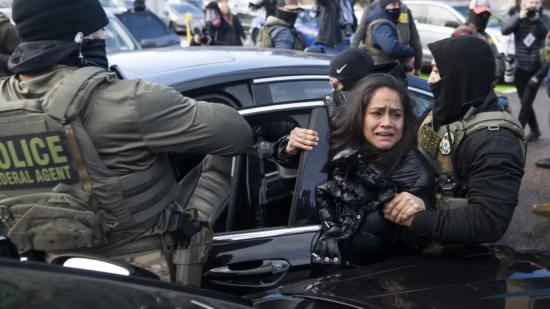
    The unprecedented ICE surge has the hallmarks of an occupation in some neighborhoods, as masked and heavily armed agents drive around in large SUVs, tussle with protesters and observers, and break into people’s cars and houses to make arrests.  —Axios

    By Susu Jeffrey / Original to Wings of Change / March 2, 2026

    What an honor when The Nation nominated Minneapolis for the 2026 Nobel Peace Prize! The initial butterfly-in-the-stomach thrill dissipated with the thought of what President Trump would do (next) if we got his award. The revenge-dealing, super bully apparently stays awake imagining schemes on his social media site while we make new signs for the next NO KINGS demonstration and grocery lists for shut-in neighbors.

    NO HATE, NO FEAR! IMMIGRANTS ARE WELCOME HERE!
    In Minneapolis hard times make good neighbors. If we want to eat tomatoes or reroof our buildings we need to pay local people willing to do the work. The law of economics requires low wage, compliant workers in Minneapolis like every other American city. We need childcare, eldercare, healthcare, farm workers, meat packers, independent restaurants and all the oil that lubricates western society where the dream of a richer future is the hook.

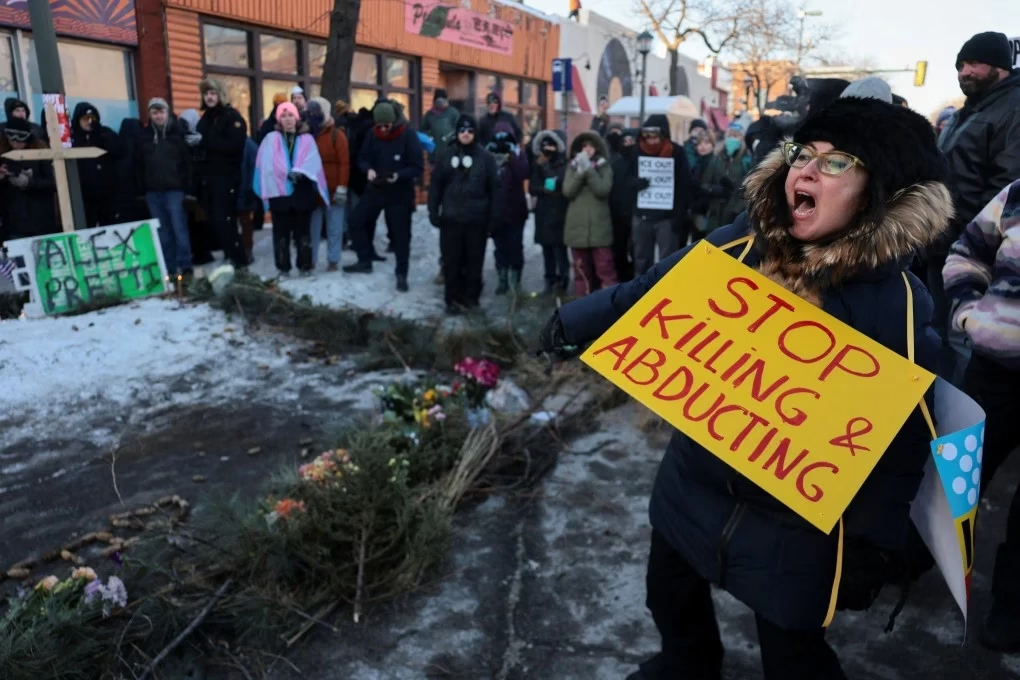
    The Americana rainbow of Minneapolis is like “Eat Street,” (Nicollet Avenue and 26th Street) where Alex Pretti was shot to death by federal agents. My favorite restaurant is across the street from the people’s Alex Pretti memorial. They serve Vietnamese pho soup and cream cheese wontons or you could go donuts-coffee and local bands, Mexican, Vietnamese-French-bread sandwiches, Greek, Middle East, Malaysian, pizza or burgers and fries. Minneapolis has the population of a stew, a toothsome mix of ingredients harmonizing in one pot.

    Why Minneapolis?

    Why did President Trump decide to sic ICE (Immigration and Customs Enforcement) and Border Control (Customs and Border Control) on the Twin Cities of Minneapolis-St. Paul? Minnesota is the state that ranks 28th among the 50 United States hosting “illegal aliens”? Trump has a perfect zero political success rating here; he does not study history (for example George Floyd) and he has difficulty separating his ego from reality.

    Since the 1934 truckers strike where two people were shot dead by zealous enforcers (sound familiar) the Minneapolis model of citizen support for everyday people’s rights has echoed across the nation. The appalling executions of Renee Good and Alex Pretti caused Gov. Tim Walz to label the president’s agents “untrained, aggressive” and noted that Trump “picked the wrong state to make an example of.” (CBS nightly news). This comment from the vice-presidential candidate who charmed his way through the 2024 campaign like a fatherly and practical human being who doesn’t lie.

    Part of the Minneapolis social scene is political activism. Minneapolis-based peace groups were associated with the 1997 Nobel Peace Prize nomination for the Campaign to Ban Landmines and the 2017 prize to ICAN, the International Campaign to Abolish Nuclear Weapons.

    Furthermore Minnesota has the highest voter turnout in the nation. The midterm elections are coming up in November this year. Statistically the president’s party loses congressional seats in the midterms.

    Since December 1, 2025, the 3,000 Gestapo agents of Operation Metro Surge made 4,000 arrests (they had a 2,000 per day quota) which the existing incarceration and judicial systems could not process. Among the innocent victims were two Native American children (to which rez would they be extradited), 5-year-old Liam Ramos in his blue bunny hat, and an Asian man wearing handcuffs, boxer shorts and plastic slip-on shoes in minus 9-degree weather who lived in a house formerly occupied by a man already in prison.

    ICE Agent Who Shot Renee Good Self-Deports

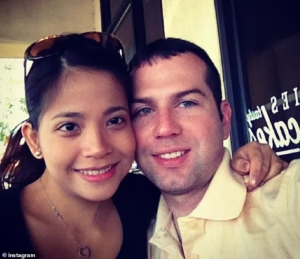
    Jonathan Ross and his second wife
    Image: Daily Mail


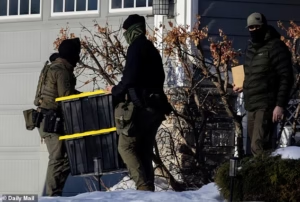
    Masked agents remove several large storsge boxes from Jonathan Ross home
    Masked agents move household items from the Ross home. Image: Daily Mail


    Agent Ross, 43, of Chaska, Minnesota, an upscale southwest Minneapolis suburb, fled his half-million-dollar home with his family after shooting Renee Good to death on January 7. He was quickly identified. Two nights after Ross killed Renee Good a Special Response Team in masks was seen removing boxes including electronics and family photos from Ross’s home. Ross told neighbors he was a biologist. Neighbors described him as a hardcore MAGA supporter. His father labelled him a “conservative Christian.”

    The last words Renee Good spoke was to tell Ross “I’m not mad at you” while he circled her car making a video. Then there were shots and Ross is heard saying “f—ing bitch.”

    Renee_Good_DHS_agent_perspective

    Renee as captured by Ross’s camera just before he executed her. Image Wikipedia

    “They had guns. We had whistles,” said Renee Good’s widow.

    On the night of February 17 the Renee Good sidewalk flower bedecked memorial between 33rd and 34th Streets on Portland Avenue South was sprinkled with gasoline and set afire. A volunteer night guard discouraged the arson vandals, preventing damage from spreading.

    Church, State, Media and the Public React

    Catholic Cardinal Joseph W. Tobin of Newark, New Jersey called ICE a “lawless organization” and remarked on the importance of human dignity in a televised Christiane Amanpour interview. Pope Leo XIV urged people to “fast from violent language,” especially during Lent and Ramadan.

    National Public Radio’s 1A program (1-1-2026) noted the frequency of the president’s people “ignoring judicial orders. The Trump administration doesn’t follow laws they don’t like.”

    So pooh-pooh to the laws of God and the State. Still, most of us await the arrests of Jonathan Ross and Texas-based Border Patrol agents Jesus Ochoa, 43, and Raymundo Gutierez, 35, for the first-degree murders (intentional killing) of Renee Good and Alex Pretti.

    What is To Be Done?

    Vote.

    ICE’s budget has metastasized from $10 billion to $85 billion. “They have the kind of budget you would give to a standing army to fight an actual war,” David Miller wrote on Facebook. Miller advocates “neighborism.”

    Congress controls the budget, “the power of the purse.” Congress can also impeach. Trump was impeached twice during his first term.

    First Trump was impeached by the House of Representatives for “incitement of insurrection” of the January 7th rebellion in and around the Capitol building which was thoroughly filmed. However our 100 U.S. senators failed to reach the required 66 votes getting just 57 votes for inciting an insurrection.

    Then the state of Georgia impeached Trump for his post-election interference: “I just want to find 11,780 votes….” But that effort was dismissed by the Department of Justice  policy of avoiding to prosecute a sitting president.

    On January 28, 2026, the FBI seized those 2020 ballots from the Biden/Trump Fulton County Georgia elections warehouse even though they had been counted and recounted three times, by hand and by machine. Trump’s inability to accept his failed reelection bid bodes ill for the upcoming 2026 midterm elections. It is a nutter world when black and white paper proof translates into Alice in Wonderland technicolor.

    In reality it’s another practice run by Trump at not believing our lying eyes. Here are the videos, here are the ballots. Minnesota is a voting state. Voting is a form of neighborism.

    It feels good to vote, especially in overwhelming numbers, and you get one of those little red I VOTED stickers.

    Voting feels like I-AM-DOING-SOMETHING:

    I AM — SOMEBODY (A chant made famous by Jesse Jackson)

    It is the next step after 100,000 people marched against Operation Metro “Siege.” The crowd was so dense an American flag-carrying friend said it almost felt claustrophobic.

    The comb-overs, Trump, Putin and Netanyahu, plan to divide up the world with their bombs and guys in masks with guns. Look again at those old men hiding their shiny pates, white-knuckled trying to hold onto their fictions. America has been multicultural since the Vikings and the Conquistadores invaded. What would baseball be without immigrants?

    George  Floyd, Renee Good, Alex Pretti

    George Floyd’s murder by Minneapolis policeman Derek Chauvin put him in prison for 22.5 years and that was for “unintentional” murder, murder two. The murder one, intentional killings using three bullets for Renee Good and nine or ten bullets to execute Alex Pretti are proof of intention.

    “Democracy is stronger than fear,” says Minnesota state Sen. John Hoffman, who survived an eight-bullet assassination attempt. Hoffman has just returned to his seat in the state capitol.


    Wings of Change is entirely reader supported.
    Wings invites you to subscribe.
    To subscribe: Join us on Wings of Change

    In this critical time hearing voices of truth is all the more important although censorship and attacks on truth-tellers are common. Support WingsofChange.me as we bring you important articles and journalism beyond the mainstream corporate media on the Wings of Change website and Rise Up Times on social media. Donate now to sustain Wings of Change.

    Access is always free, but if you would like to help:
    A donation of $25 or whatever you can donate will bring you articles and opinions from independent websites, writers, and journalists as well as a blog with the opinions and creative contributions by myself and others.

    Join us on Wings of Change

    We still have much work to continue to do as many activists and organizations address current threats to our democracy and unjust actions against people of color and are making plans for the upcoming years. Wings of Change is a part of that work through education, information, and inspiration. Here in Minnesota we are particularly targeted by the Trump regime with ICE immigrant law enforcement illegally arresting and deporting our neighbors who are mostly people of color. In spite of promises to withdraw ICE, the arrests continue. Other cities have been targeted as well, and they will try to target more to fill the detention centers they are building all over the country.

    Sue Ann Martinson, Editor Wings of Change

    “We don’t have to engage in grand, heroic actions
    to participate in the process of change.
    Small acts, when multiplied by millions of people,
    can transform the world.”

    — Howard Zinn