Tag: Medicaid

  • Nobel Prize-Winning Economist Joseph Stiglitz Slams Trump’s Myths About Tariffs, Affordability

    Nobel Prize-Winning Economist Joseph Stiglitz Slams Trump’s Myths About Tariffs, Affordability

    Nobel Prize-Winning Economist Debunks President Trump’s Tariffs

    Nobel Prize-winning economist Joseph Stiglitz responds to Donald Trump’s State of the Union address on Tuesday, when the president repeatedly touted his tariffs as saving the country money and boosting the economy. Stiglitz says Trump’s “lies” about tariffs can’t erase the truth about how they have raised costs for most U.S. residents. “It is estimated the average family is paying somewhere between $1,000 and $1,700 in extra money because of the tariffs,” says Stiglitz. “His policies have failed.”

    Transcript

    This is a rush transcript. Copy may not be in its final form.

    This is Democracy Now!Democracynow.org, the War and Peace Report. I’m Amy Goodman. During his State of the Union, President Trump repeatedly hailed his economic record over the past year. He also openly criticized the Supreme Court again for striking down his global tariffs in a decision that’s having major implications on the global economy. Less than half, four of the nine Supreme Court justices, attended the speech. This is part of what Trump said.

    PRESIDENT DONALD TRUMP: Everything was working well. Countries that were ripping us off for decades are now paying us hundreds of billions of dollars. They were ripping us so badly, you all know that. Everybody knows it. Even the Democrats know it, they just don’t want to say it. And yet these countries are now happy and so are we. We made deals. The deals are all done and they’re happy. They’re not making money like they used to but we’re making a lot of money. There was no inflation, tremendous growth. And the big story was how Donald Trump called the economy correctly and 22 Nobel Prize winners in economics didn’t. They got it totally wrong. They got it really wrong. And then just four days ago, an unfortunate ruling from the United States Supreme Court, it just came down. It came down.

    PEOPLE: [applause]

    PRESIDENT DONALD TRUMP: Very unfortunate ruling.

    PEOPLE: [cheers and applause]

    PRESIDENT DONALD TRUMP: But the good news is that almost all countries and corporations want to keep the deal that they already made. Right, Scott? Knowing that the legal power that I as president have to make a new deal could be far worse for them. And therefore, they will continue to work along the same successful path that we had negotiated before the Supreme Court’s unfortunate involvement.

    So despite the disappointing ruling, these powerful country-saving — it’s saving our country, the kind of money we’re taking in — peace-protecting — many of the wars I settled was because of the threat of tariffs, I wouldn’t have been able to settle them without — will remain in place under fully approved and tested alternative legal statutes, and they have been tested for a long time — they’re a little more complex but they’re actually probably better — leading to a solution that will be even stronger than before.

    Congressional action will not be necessary. It’s already time-tested and approved. And as time goes by, I believe the tariffs, paid for by foreign countries, will like in the past substantially replace the modern-day system of income tax, taking a great financial burden off the people that I love.

    PEOPLE: [applause]

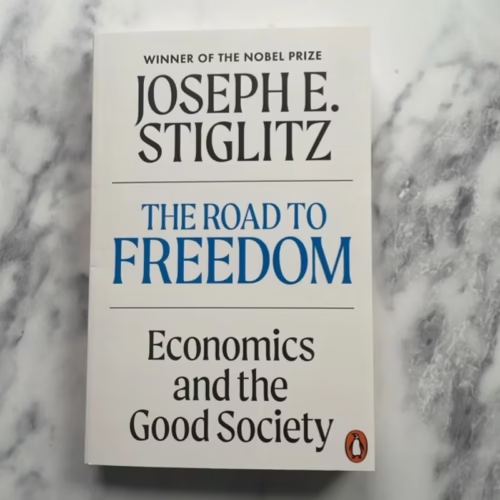
    AMY GOODMAN: We are joined now by Joseph Stiglitz, Nobel Prize-winning economist, Columbia University professor, former chair of the Council of Economic Advisers. Professor Stiglitz is also currently the chief economist of the Roosevelt Institute. His latest book just out in paperback this week, The Road to Freedom: Economics and the Good Society.

    Professor Stiglitz, welcome back to Democracy Now! Your response? You were among the signatories, the economists who have signed a letter against the tariffs. Talk about the president’s State of the Union and his argument for tariffs and against the Supreme Court. Two of his own appointees ruled against him.

    JOSEPH STIGLITZ: Well, the speech was characteristic of Trump — lies, misleading statements.
    I was with a group of a large number of Nobel Prize winners who predicted that he would be bad for the economy and we were right. The tariffs are paid by Americans. They’re not paid for by the foreigners. He says they didn’t have any effect on inflation. We saw inflation was going down, and if we compare where inflation would have been with where we are today, it is estimated the average family is paying somewhere between $1,000 and $1,700 in extra money because of the tariffs.

    The irony is he said it was going to bring back manufacturing jobs. Manufacturing jobs are down in the United States in 2025 when they were up under President Biden. He doesn’t talk about that. In fact, last year was one of the slowest growth in jobs ever in recent memory, about a quarter of what it was under President Biden. And interestingly, most or more than 100% of the jobs that were created were in the healthcare sector, nothing to do with his tariffs at all.

    AMY GOODMAN: Trump said in the past, “We have the most people working in history.” What is the state of unemployment, of livable employment, the overall economy?

    JOSEPH STIGLITZ: Well, when the economy — more people in the country? Yes, there are going to be more people working. That’s true. The fact is that labor force participation has not gone up. The unemployment rate has gone up a little bit, not a lot. But what is striking is how weak the job market is. As I said before, we have not created very many jobs, less than a quarter of what we had created under President Biden. And anybody with friends trying to get jobs knows what a difficult labor market today’s labor market is.

    AMY GOODMAN: I want to go back to President Trump speaking last night.

    PRESIDENT DONALD TRUMP: Now the same people in this chamber who voted for those disasters suddenly use the word “affordability,” a word — they just used it, somebody gave it to them — knowing full well that they caused and created the increased prices that all of our citizens had to endure. You caused that problem. You caused that problem.

    AMY GOODMAN: “Affordability,” Professor Stiglitz. We are speaking to you here in New York. Of course the new mayor Zohran Mamdani sent the message to people all over the country, especially those who are considering elected office or to diehard politicians, senators, congressmembers, that affordability was the word, was the issue people are most concerned about. What about President Trump mocking it?

    JOSEPH STIGLITZ: I think he is mocking the American people when he mocks the issue of affordability. The reason people worry about affordability is things are not affordable. And the other way of putting it is that their real incomes adjusted for inflation are down. Now, one of the striking things about what President Trump has done, he talked about this tax cut, the biggest tax cut in history. He was wrong about that. As a percentage of GDP, it doesn’t even rank near the top.

    But where it does rank at the top is that it was the most regressive tax cut. That is to say the benefits went to the millionaires, the billionaires, the corporations, and those at the bottom paid the price. They paid the price with almost a $1 trillion cut in Medicaid. That was why the Democrats had insisted on the government shutdown. They said, “You can’t do that! That’s not right!” That you would be giving a tax cut for billionaires and asking the poorest Americans not to have adequate healthcare in a country where healthcare has been so bad, so bad that life expectancy even before the pandemic was on the down.

    AMY GOODMAN: Your final comments, Professor Stiglitz, coming off of what’s considered one of the longest State of the Unions, an assessment of this country, in modern history?

    JOSEPH STIGLITZ: Well, long speeches like that reminds me of Castro and other demagogues who just love — they get the platform and they just talk and talk and talk. But I think the striking thing is that in spite of the tariffs that were supposed to bring back manufacturing jobs, manufacturing jobs are actually down. And in spite of the tariffs that were supposed to eliminate the huge trade deficit in goods, the trade deficit in goods is actually up. So his policies have failed even in the areas where he — in the objectives that he set forth. So, yes, his speech was filled with misleading statements, with lies. We’ve come to expect that. But in the core aspect of his agenda, the numbers show that he has dramatically failed to do what he promised.

    AMY GOODMAN: Joseph Stiglitz, Nobel Prize-winning economist, Columbia University professor, and former chair of the Council of Economic Advisers. Professor Stiglitz is also currently the chief economist of the Roosevelt Institute. His new book just out in paperback this week, The Road to Freedom: Economics and the Good Society.

    The original content of this program is licensed under a Creative Commons Attribution-Noncommercial-No Derivative Works 3.0 United States License. Please attribute legal copies of this work to democracynow.org. Some of the work(s) that this program incorporates, however, may be separately licensed. For further information or additional permissions, contact us.

    Next story from this daily show

    Rep. Summer Lee on Boycotting Trump Speech, Jesse Jackson, Voting Rights, “Endless Wars” & More


    Wings of Change is entirely reader supported.
    Wings invites you to subscribe.
    To subscribe: Join us on Wings of Change

    In this critical time hearing voices of truth is all the more important although censorship and attacks on truth-tellers are common. Support WingsofChange.me as we bring you important articles and journalism beyond the mainstream corporate media on the Wings of Change website and Rise Up Times on social media. Donate now to sustain Wings of Change.

    Access is always free, but if you would like to help:
    A donation of $25 or whatever you can donate will bring you articles and opinions from independent websites, writers, and journalists as well as a blog with the opinions and creative contributions by myself and others.

    Join us on Wings of Change

    We still have much work to continue to do as many activists and organizations address current threats to our democracy and unjust actions against people of color and activists and make plans for the upcoming years. Wings of Change is a part of that work through education, information, and inspiration. Here in Minnesota we are particularly targeted by the Trump regime with ICE immigrant law enforcement illegally arresting and deporting our neighbors who are mostly people of color. In spite of promises to withdraw ICE, the arrests continue. Other cities have been targeted as well, and they will try to target more.

    Sue Ann Martinson, Editor Wings of Change

    “We don’t have to engage in grand, heroic actions
    to participate in the process of change.
    Small acts, when multiplied by millions of people,
    can transform the world.”

    — Howard Zinn
  • Robert Reich on the Government Shutdown and Ralph Nader on the Democratic Party with Chris Hedges

    Robert Reich on the Government Shutdown and Ralph Nader on the Democratic Party with Chris Hedges

    Reich explains the stakes and how we got there. . . Nader decries the impotence of the Democrats and why. . .

    Why This Is Not a Normal Government Shutdown


    Why the Democrats WON’T Save Us…


    In this critical time in hearing the voices of truth is all the more important although censorship and attacks on truth-tellers are common. Support WingsofChange.me as we bring you important articles and journalism beyond the mainstream corporate media on the Wings of Change website and Rise Up Times on social media  Access is alway free, but if you would like to help:
    A donation of $25 or whatever you can donate will bring you articles and opinions from independent websites, writers, and journalists as well as a blog with the opinions and creative contributions by myself and others

    Rise Up Times is entirely reader supported.

    Sue Ann Martinson, Writer, Editor Wings of Change

  • The Political Blowback to GOP’s Medicaid Cuts Has Already Begun

    The Political Blowback to GOP’s Medicaid Cuts Has Already Begun

    Cuts to Medicaid and SNAP don’t just harm individuals. They impact whole communities.”

    Joel Berg, CEO of Hunger Free America, told Truthout that since Trump took office in January, $1.5 billion has been cut in assistance to food banks and pantries.

    Lin says that the combination of camaraderie and affordability will keep her coming back to the center for as long as she’s physically able. “My income — a $1,400 Social Security check and a pension of slightly more than $300 a month — doesn’t leave much left over. My rent is $1,000 and I have to pay for utilities and a phone,” she says. “So many of us seniors live doubled-up or in substandard housing. We deserve better, but the government, and Donald Trump in particular, treat us like garbage.”

    Low-income seniors and their advocates agree and say that pending cuts to food and nutrition programs — including funding for meals at senior centers, and cuts to the Supplemental Nutrition Assistance Program (SNAP) and Meals on Wheels —will increase hunger and malnutrition.

    Both are already big problems.

    Support the WingsofChange.me website and Rise Up Times on social media as we to bring you important articles and journalism beyond the mainstream corporate media. Access is alway free. If you would like to help click here.

    According to Feeding America, a national network of food banks and pantries, food insecurity is nothing new, and even before Trump’s Big Bad Bill championed slashing social welfare spending, 6.9 million people over the age of 65 faced hunger in the U.S. The group estimates that in 2022, one in 11 people aged 60 and older, and one in eight between the ages of 50 and 59, lacked adequate food.

    Part of the reason is poverty, but isolation, the inability to shop or cook, trouble chewing and swallowing, cognitive decline, depression, a diminished sense of smell and/or taste, and the side effects of medication can also contribute to malnutrition in American seniors. These factors, in concert with economic precarity, make it difficult for many elders to remain healthy and well-nourished.

    But money, unsurprisingly, is crucial to eating well, and many seniors like Elisabeth and Lin have too little of it.

    According to the Social Security Administration, as of May 2025, the average monthly Social Security payment was $2,002. Millions, however, are ineligible for retirement benefits and instead rely on Supplemental Security Income (SSI), a benefit provided to disabled people who did not work for the required 40 quarters needed to collect Social Security. Their monthly benefits amount to $967 for individuals and $1,450 for couples. More than 2 million adults over 65 receive SSI, with 39 percent living below the poverty line.

    “Cuts to Medicaid and SNAP don’t just harm individuals. They impact whole communities.”

    Pre-Trump, even the federal government recognized the toll of poverty on older people’s quality of life. A July 2024 report issued by the National Institute on Aging, a department of the National Institutes of Health, noted that over the past two decades, “food insecurity among families that include adults over the age of 60 had almost doubled, affecting nearly 25 percent of such families.” The report further acknowledged that hunger and lack of access to nutritious food has had a disproportionate impact on Black, Brown and Indigenous households.

    And it’s likely to get much worse.

    Joel Berg, CEO of Hunger Free America, told Truthout that since Trump took office in January, $1.5 billion has been cut in assistance to food banks and pantries, including a $130 million administrative cut to the 43-year-old Federal Emergency Management Agency’s emergency food and shelter program.

    “They are working to make the ‘Golden Years’ the ‘Hungry Years,’” he said. “Seniors used to be the third rail of American politics, but that rule is no longer sacrosanct. I think that Congressmembers who support these cuts are following their leader off a cliff. They apparently want seniors, children, and veterans to pay for tax cuts for billionaires.”

    Markell Lewis Miller has seen the impact of these cuts directly. As the director of community food programs at Food Gatherers, a food bank in Washtenaw County, Michigan, she oversaw the distribution of 9.9 million pounds of food to hungry Michiganders in 2024, many of them seniors.

    But two months into the Trump administration, the organization’s food supply took a tremendous hit.

    “The U.S. Department of Agriculture is one of the largest sources of food for us, through the emergency food assistance program,” Miller told Truthout. “In March of this year, there was an administrative action, and with no warning whatsoever, we experienced a cut, by half, of what we used to get through the [emergency food assistance] program. This amounts to 15 percent of the food we give out annually. Short-term, we’ve used our reserve funds and fundraised to generate money to purchase food to replace what was lost.”

    The impact, she says, has been severe. According to Miller, prior to the cut, Food Gatherers spent approximately $4 million a year purchasing food. Replacing lost items from the Department of Agriculture, she says, will require them to spend an additional $2.5 million, money that will have to be raised through philanthropic and individual donations.

    Other issues also have staff worried. “Cuts to Medicaid and SNAP don’t just harm individuals. They impact whole communities,” Miller says. “Grocery stores will see their sales plummet and some will close; people will also see their health decline if they lose access to fresh, affordable, and nutritious food, which can lead to malnutrition.” The cascading impact, she adds, can lead to calcium and vitamin deficiencies, as well as health issues such as depression, cognitive disorders, slower wound healing, loss of muscle mass, and frailty syndrome.

    “Every dollar matters to people on fixed incomes,” she says.

    What’s more, Miller and her colleagues worry that the imposition of work requirements on older SNAP recipients will further restrict access to healthy meals.

    Cutting the SNAP Rolls by Making People Ineligible
    for Benefits

    Gina Plata-Nino, deputy director of SNAP programs at the Food Research & Action Center, sees the proposed work requirements — a mandate that SNAP recipients work a minimum of 80 hours a month until they reach age 64 — as a way to thin the rolls. “Failure to secure work will mean that people can only receive SNAP for three months in a three-year period,” she told Truthout. “But this requirement does not come with a job offer or transportation to and from a job. People who live in areas, particularly rural areas, where few jobs exist, or who are grandparents doing unpaid (but essential) child care, will not be exempted. Raising the threshold from age 54 does not take these realities into account.”

    “Right now, 12,000 people a day are turning 65, and we have not created the infrastructure to support them.”

    Other changes to SNAP will also have a deleterious impact, Plata-Nino says. “Previously, if you had a child under 18 in the household, you were exempted from the work rules. Now, the House version of the bill exempts only those people with a child under 7. They also want to exclude the cost of internet service when calculating SNAP eligibility. People with kids in school and folks with disabilities will be particularly harmed by getting rid of this deduction since they have to have the internet in their homes to function.”

    Plata-Nino sounds furious as she speaks. “These changes are meant to give a tax cut to the top 1 percent,” she says. “For seniors who worked incredibly hard their whole lives, finding a part-time job is often impossible, and if they fail, they’ll lose their access to food. It’s cruel. In addition, many seniors own their own homes, but they’re still financially stressed because their property taxes have not stopped. Their fuel and utility costs have not stopped. Boilers break, and with climate change, people need air conditioners as well as heat. We know time limits on eligibility do not increase employment. But they do keep people off the program and scrambling to eat.”

    Meals on Wheels Faces Cutbacks

    Meals on Wheels, a national food delivery service (and congregate meal provider in some locales) has filled nutritional gaps for more than 70 years. Like SNAP, it is also on the chopping block.

    Josh Protas, the group’s chief advocacy and policy officer, told Truthout that about 37 percent of funding for the 5,000 local Meals on Wheels programs that exist nationwide comes through the federal Older Americans Act.

    “About 90 percent of our programs get federal money, and many get half or more of their funding from federal social service block grants, community development block grants, or other federal funding streams, some of which are now threatened,” he says. “In some states, Medicaid has allowed special medically tailored meals to be reimbursed for people in renal failure or with heart conditions. In other places, SNAP can be used to make voluntary contributions to offset the cost of meals. We don’t know if these specialized programs will survive.”

    All told, he says, Meals on Wheels provides food to about 2.2 million older adults annually. But this barely scratches the surface of need. “There are many older adults we’re not reaching,” Protas says. “We estimate that at least 2.5 million low-income seniors are eligible for Meals on Wheels but are not served. One in three of our programs has a waiting list with waits ranging from a few months to years.”

    To tell an adult who is unable to leave their home that they have to wait is painful, he adds, “but it’s even worse when an opening comes up and we discover that the person died while waiting.”

    In addition to providing food, Protas reports that Meals on Wheels provides a secondary function: assessing the meal recipient’s living situation and providing a few minutes of conversation and social engagement each day.

    “Right now, 12,000 people a day are turning 65, and we have not created the infrastructure to support them,” he says. “The needs of older adults do not get prioritized. Money from the federal government has always helped unlock philanthropic dollars, but the truth is that less than 1 percent of foundation grants go to seniors. People gravitate to causes benefiting kids and animals; older adults get second-tier consideration. Even more concerning, one of the fastest-growing unhoused populations is older people, folks who did what they could to earn a living and who still end up on the streets with nothing.”

    Cuts, he concludes, will exacerbate this shameful legacy.

    But seniors, disabled adults, and their advocates are fighting back. Led by the Leadership Council of Aging Organizations and the Coalition on Human Needs, they are making their opposition to SNAP cuts, Medicaid cuts, and Medicare cuts loud and clear, as well as urging for support for national programs like Meals on Wheels and local food banks like Food Gatherers. In addition, an unprecedented coalition of state attorneys general, led by Washington, D.C.’s Karl A. Racine and New York’s Letitia James, have sued the administration to stop the SNAP cuts from taking effect.

    “Many older Americans rely on Medicaid and if they slash it, people will have less money to pay for food and medicine,” Joel Berg of Hunger Free America predicts. “Imagine being 63. You’ve worked in a steel plant for 20 years. The plant closes and, because of age discrimination, you can’t find another job. You will lose your SNAP benefits after three months and won’t be eligible again for three years unless you find a 20-hour-a-week job. Seniors are being attacked from land, sea, and air, and these cuts are happening on top of significant cuts that have been imposed over the last few years. People are increasingly going hungry. The nonprofit sector is a bit shell-shocked, but people are pushing back and coalescing with farmers and the food industry to pressure lawmakers.”

    Note: A correction has been made to fix a typo in Gina Plata-Nino’s name.