Now there’s many new words and many new names; Uniforms have changed but the knock is the same
This performance took place in Northampton, MA on
Sunday, January 11, 2026
On January 31, 2026, this performance was staged at a rally outside the Northwestern District Attorney’s office, where protestors called on DA David E. Sullivan to immediately drop the charges against Worcester City Councilor Etel Haxhiaj. The charges—assault and interfering with police—stemmed from her attempt to de-escalate an ICE raid on May 8, 2025—an obvious retaliatory prosecution for her criticism of the Worcester Police Department.
“Come Out Ye Cowards ICE” (Intro: 00:00; Song: 00:52) Original song: “Come Out Ye Black and Tans” by Dominic Behan (1960s) Adaptation by Carsie Blanton Additional verses by Sophie Schleicher Further adaptation and performance by Ben Grosscup.
Wings of Change is entirely reader supported.
Wings invites you to subscribe. Join us on Wings of Change
In this critical time hearing voices of truth is all the more important although censorship and attacks on truth-tellers are common. Support WingsofChange.me as we bring you important articles and journalism beyond the mainstream corporate media on the Wings of Change website and Rise Up Times on social media
Please join me on Wings of Change. It’s only the beginning as we still have so much work to continue to do as many activists and organizations address current threats to our democracy and unjust actions against people of color and activists and make plans for the upcoming years. Wings of Change is pleased and excited to be a part of that work through education, information, and inspiration.
“We don’t have to engage in grand, heroic actions to participate in the process of change. Small acts, when multiplied by millions of people,
can transform the world.” — Howard Zinn
It is past time to unmask the violent agents targeting people like Narciso, and halt Trump’s racist, xenophobic mass detentions and deportations.
Time to Unmask Trump’s Detention and Deportation Squads
By Amy Goodman & Denis Moynihan/ Democracy Now / Column / June 26, 2025
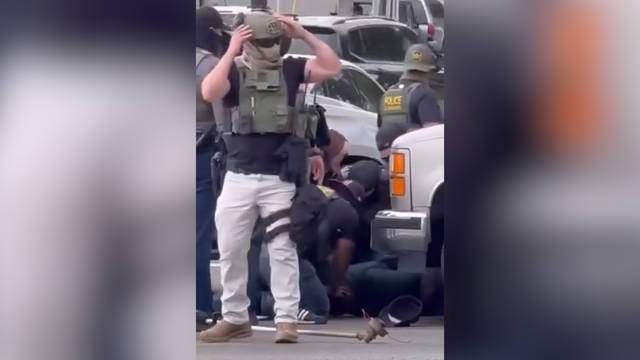
With each passing day, the violence wielded by ICE, U.S. Immigration and Customs Enforcement, grows more intense and widespread. One grotesquely emblematic example of this was the recent violent arrest of 48-year-old Narciso Barranco in Santa Ana, California. Narciso, a hardworking immigrant laborer who came from Mexico over thirty years ago, is the father of three US Marines. While landscaping outside an IHOP restaurant on June 21st, he was assaulted by at least seven armed, masked men, who tackled him and repeatedly punched him in the head. They handcuffed him and shoved him into an unmarked SUV. The plainclothes agents wore face masks, bullet-proof vests and military-grade helmets. Some of the vests read, “Police–US Border Patrol” on the back, but to anyone confronted by these gangs, no identifying marks, names, or badges were visible.
Image Credit: Instagram/@santaanaproblems
One of Narciso’s sons, Alejandro Barranco, a US Marine Corps veteran, was able to visit his father in jail. Narciso was still wearing the same work clothes that were bloodied in the assault.
“He looked beat up, he looked rough, he looked defeated, he was sad,” Alejandro said on the Democracy Now! news hour. “Anybody would be scared if they see these guys come up to them, masked, not in uniform, guns out.”
City of Santa Ana councilmember Jonathan Hernandez, also on Democracy Now!, added, “We are watching violence unfold, racial profiling increase in cities like Santa Ana, where 41% of our residents are migrants, 70% are of Latino descent…agents come into our community, and they’re refusing to identify themselves, they don’t have judicial warrants and these ICE raids are an example of the government’s overreach.”
In mid-June, President Trump briefly paused immigration raids on farms, hotels and restaurants, ostensibly to ensure these key industries that have supported him in the past continue to do so. “Our great Farmers and people in the Hotel and Leisure business have been stating that our very aggressive policy on immigration is taking very good, long time workers away from them, with those jobs being almost impossible to replace,” Trump wrote.
Soon after, he reversed himself. The short pause revealed a fundamental truth about undocumented immigrants: the US economy doesn’t function without them. Nevertheless, urged on by White House Deputy Chief of Staff Stephen Miller, ICE, Homeland Security and Border agents are snatching and deporting the very workers on whom our economy depends.
There are some sectors of the economy that are thriving amidst the mass deportations. GEO Group, the private prison corporation, has seen its stock rise by over 50% since Trump’s election. Palantir, the tech and AI firm co-founded by Trump backer, billionaire Peter Thiel, has seen its stock rise over 500% in the past year. It was recently reported that Palantir is building tools to allow near real-time tracking of immigrants in the US. The Program on Government Oversight, POGO, reported that Stephen Miller’s financial disclosure reveals he owns up to $250,000 in Palantir stock.
Meanwhile, the Republican majority on the US Supreme Court has handed Trump a deportation-related victory. Several immigrants sued the government to stop or reverse deportations to Guatemala, South Sudan and Libya. A federal judge in Massachusetts issued an injunction against these so-called “third party nation removals.” This week, the Supreme Court’s six conservative justices overturned that injunction, without comment. Justices Sonia Sotomayor, Elena Kagan and Ketanji Brown Jackson dissented, writing that the Trump administration’s “flagrantly unlawful conduct,” backed by the Supreme Court, is “exposing thousands to the risk of torture or death.”
Resistance is active, growing and making a difference. Grassroots pressure and legal battles have won the release of international students targeted for their solidarity with Palestinians, among them Rümeysa Öztürk, Mohsen Mahdawi, and the first such student arrested and threatened with deportation, Mahmoud Khalil.
Likewise, grassroots, legal and Congressional pressure forced the Trump administration to bring Kilmar Abrego Garcia back to the United States. The Maryland father received asylum during Trump’s first term, in 2019, based on credible threats from an El Salvador gang. Then, this past March 12th, he was snatched from a parking lot and sent, against a court order, to El Salvador.
Under enormous legal and grassroots pressure, the federal government finally returned Abrego Garcia to the US. Despite that victory, upon his return the federal government promptly rearrested him, charging him with human trafficking for allegedly driving undocumented immigrants several years ago. He remains in federal custody in Tennessee, and, if released, ICE will likely attempt to deport him.
Meanwhile, Narciso Barranco sits in ICE detention, with his two sons still on active duty in the US Marines not far away, at Fort Pendleton. It is past time to unmask the violent agents targeting people like Narciso, and halt Trump’s racist, xenophobic mass detentions and deportations.
The original content of this program is licensed under a Creative Commons Attribution-Noncommercial-No Derivative Works 3.0 United States License. Please attribute legal copies of this work to democracynow.org. Some of the work(s) that this program incorporates, however, may be separately licensed. For further information or additional permissions, contact us.
Related
Story Jul 02, 2025
“Arrest Now, Ask Questions Later”: Why Did L.A. ICE Agents Arrest and Jail U.S. Citizen Andrea Velez?
Our Daily Digest brings Democracy Now! to your inbox each morning.
You are all an inspiration to me. Please join me on Wings of Change. It’s only the beginning as we still have so much work to do as many activists and organizations make plans for the upcoming years.Wings of Change is pleased and excited to be a part of that work through education, information, and inspiration.
New Federal Task Forces Under 287(g) Could Form ‘ICE Army’ From National Guard, State, Local & College Police
Demonstrators clash with officers as ICE, other federal officers, Minneapolis police, and other state officers raid Las Cuatro Milpas in Minneapolis, Minnesota Tuesday, June 3, 2025. (Photo by Nicole Neri/Minnesota Reformer) Link to MN Reformer article here.
The Trump Administration has dramatically ramped up arrests and sweeps of people residing in the U.S., with new highly visible incidents and court cases unfolding every week and reaching new heights by mid-May. A new development could spell much larger scales of activity on American streets under 287(g) agreements between state and local law enforcement agencies and Immigration and Customs Enforcement (ICE). While 287(g) is mostly known for changing how arrestees are processed in county jails by sheriffs’ departments, there is a mode of agreement called the “task force model” which would make police available from local or state agencies to work as extensions of federal immigration police. This would make it vastly more likely for immigrants to get detained during routine law enforcement encounters, and massively expand how many local police could participate in federally-managed “sweep” operations.
One such sweep recently netted around 196 arrests of undocumented residents in Nashville. It was carried out by the Tennessee Highway Patrol and ICE using the 287(g) program. The operation “quickly emptied the pews of several Spanish-speaking parishes in the Diocese of Nashville,” according to the Catholic OSV News Service: “Tennessee Highway Patrol officers have been conducting traffic stops to identify and detain persons in predominantly Latino neighborhoods.” This is the pattern of activity that the 287(g) program is intended to intensify, because there aren’t enough federal agents to screen traffic at this scale.
In our experience covering high-level police structures and programs, personnel, manpower and coordination are usually quite constrained. Various state and local governments work around this by creating key documents like “memoranda of understanding” (MOU) and “memoranda of agreement” (MOA).
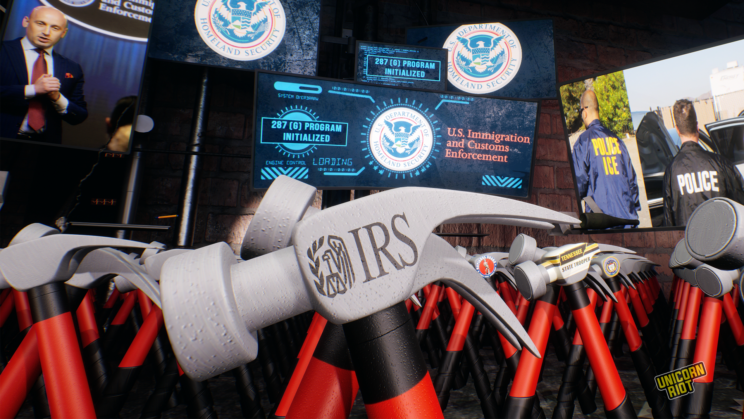
The controversial agreement between the Internal Revenue Service (IRS) and ICE which surfaced on May 13 in American Oversight’s court case, is a great example of how these MOUs work. (A section on ICE and the IRS is below.)
The FBI is also possibly allocating one-third of its agents’ time in some field offices to civil immigration enforcement. Drug Enforcement Agency (DEA), U.S Marshals Service (USMS) and Bureau of Alcohol Tobacco Firearms and Explosives (ATF) are similarly getting tasked this way. (We have heard additional reports about other federal agents getting pulled from normal work and put onto this kind of activity but the full picture remains murky.)
Similar to the post-9/11 era, when the FBI fixated on ‘counterterrorism,’ a lot of other types of investigations these agencies are charged with, like weapons trafficking, white collar crime and human trafficking rings, will have to wait until the Trump Administration has sated itself or until other branches of the federal government intervene.
Arpaio’s overall model, which included spectacular mass confinement for the media and detainee exposure to desert conditions, was a forerunner of the Trump mass detention style. The American Immigration Council warned at the time, “the practice of allowing local law enforcement to enforce federal immigration law increases the likelihood of racial profiling and pretextual arrests which leads to disastrous results for entire communities.”
As of May 28, there are 628 MOAs in 40 states. 99 agencies in 25 states have “jail enforcement model” agreements, 223 agencies in 30 states have “warrant service officer” agreements, and 306 agencies in 30 states have “task force model” agreements (Excel file). An additional 72 applications are pending: 8 jail enforcement models, 23 warrant service officers, and 41 pending task force model agreements (Excel file).
The interface to 287(g) could also include local regulations and policies about policing, immigration sweeps, joint operations, checklists for arrest encounters, and similar processes that should be available to the public and local policymakers. It has proven difficult for county boards and civil society groups to obtain policies about immigration sweeps.
The Miami Herald outlined 287(g) task force structures in detail: it “allows officers to challenge people on the street about their immigration status — and possibly arrest them… State and local officers are trained and deputized by ICE so they can question, detain and arrest individuals they suspect of violating civil immigration laws while officers are out policing the communities they are sworn to protect.”
In Florida, many police and state agencies have joined up in “task force” mode, which means they can try to enforce administrative warrants from executive branch immigration officials. There was a flashy sweep a few weeks ago to promote this. Even college campus police have been getting in on these task forces, bringing federal immigration enforcement down to the student dormitory level.
With little direct oversight from any bloc of public voters, college police departments will likely to be a tempting target for expanding immigration crackdown powers nationwide through systems like the 287(g) task force model.
According to ICE records, Florida higher ed policing for federal civil immigration now includes task force model agreements at Florida A&M University Board of Trustees, Florida Southwestern State College Police Department, Northwest Florida State College Police Department, and New College of Florida (a high profile takeover target of conservative education policy crusaders).
The Texas Observer reported on this “ICE Army” concept with Kristin Etter at the Texas Immigration Law Council warning it’s a “force multiplier of federal immigration agencies” with “officers in the streets stopping, detaining, questioning, interrogating, arresting” people. Law enforcement agencies have been joining 287(g) task forces as well, including the Texas National Guard and Attorney General’s Office. (Texas also has a separate MOU between the Texas National Guard and U.S. Customs and Border Protection under 8 USC section 1103(a)(10), 1357, 28 CFR section 65.80-85 and DHS Delegation 7010.3.2, as well as the Texas governor executive order GA-54; it says they use “State Active Duty” status and authority under Title 8 to “exercise the functions and duties of an immigration officer” under “supervision and direction of CBP [Customs and Border Protection] officials.”)
Immigration rights advocates in Maryland pushed to get a moratorium on 287(g) enrollments by state and local police, for at least the third year since 2020. However, as the legislative session wound down they came up empty-handed. Maryland resident Kilmar Abrego Garcia has become an international symbol this year after getting dumped into El Salvador’s notorious CECOT prison. The U.S. Supreme Court ordered the Trump administration to “facilitate” returning Abrego Garcia to this country but it has not done so.
Maryland sheriffs’ departments are joining 287(g) en masse, particularly along the northern side of the state. According to a Bolts report, the Democratic Party-controlled Maryland Legislature may not have realized the aggressive nature of 287(g) until it was too late in the policy cycle, despite the pleas of immigration rights advocates.
State Senator Karen Lewis Young told Bolts, “I think if [Abrego Garcia’s detention] had happened earlier in session, the 287(g) bill might have moved, because I think it gave everybody a much more realistic awareness of how dangerous that program can be.” However, Abrego Garcia was not detained under 287(g).
The ACLU of Maryland outlined how Intergovernmental Services Agreements (IGSA) are another avenue for the feds to get money to local police, as ICE rents jail beds to function as immigration detention centers. This allows Frederick, Howard and Worcester counties to generate revenue. The State Criminal Alien Assistance Program (SCAAP) is another similar revenue system.
The Maryland public defender’s office released a report (pdf) saying 287(g) agreements “undermine due process and make innocence irrelevant by requiring local law enforcement officials to screen, interrogate and detain without judicial authorization any arrestee suspected of being removable under civil immigration law. There is no exception for someone arrested based on mistaken identity.”
In Pennsylvania, the suburban political bellwether of Bucks County, outside Philadelphia, is the latest 287(g) flashpoint. Sheriff Fred Harran has been trying to enter into 287(g) without approval of the county commissioners, which the ACLU of Pennsylvania claims is illegal. In April, Harran confirmed he applied to get a “task force” model 287(g) program for about a dozen of his deputy sheriffs to act as ICE officers — not the more limited program that only applies to detention screening at the jail. On May 21 the Board of Commissioners voted 2-1 to oppose this enrollment.
Harran called the ACLU “lunatics” and his local critics “liars” in a “crabby rant” on a right-wing podcast. On May 13, ICE approved Harran’s 287(g) “Task force model” application.
According to the Bucks County Beacon, which uncovered the policy, Harran has not provided any written policy even though he claims his practices “would not include sweeps or raids, stating he has a ‘policy’ in place to prevent round ups.” On May 7, a number of civil society groups held a press conference in Doylestown before a county commissioners meeting (YouTube).
California, Illinois, and New Jersey ban 287(g) agreements statewide. In Minnesota, Cass, Crow Wing and Itasca counties have “task force model” agreements. Crow Wing, Freeborn, and Jackson counties have “warrant service officer” agreements. Jackson is the only Minnesota county with a “jail enforcement model” agreement.
How Task Forces and Multi-Agency Groups Get Constructed by Officials
We can compare 287(g) to other task force systems around the government, which are not often discussed.
Back on January 20, 2025, a White House “Presidential Action” statement, “Protecting the American People Against Invasion” declared that “Homeland Security Task Forces” (HSTF) should be created in all 50 states, although groups with that kind of name already existed in some areas. (Org charts for these kind of task forces are attached to the Florida plan linked below.) A DHS “finding of a mass influx of aliens” was signed on January 23, 2025 (pdf) to further justify these measures.
Unicorn Riot found that the Emergency Management Assistance Compact (EMAC) is commonly used to assemble and pay for counter-protest riot squads across state lines, including for the 2024 Republican National Convention in Milwaukee and large crackdowns via Morton County at Standing Rock in 2016-2017 (using state troopers from Nebraska and Wisconsin, and police officers from various other states). The National Sheriffs Association was also an important actor in supporting EMAC activities, an adjunct effort to their “information war” against #NoDAPL protesters in the water protector movement against the Dakota Access Pipeline.
The period around the police killing of Daunte Wright and Derek Chauvin’s trial in Minnesota also saw a massive EMAC pull from Ohio and Nebraska. This also includes temporarily deputizing law enforcement officers, insurance provisions, and arrangements for paid services, off a menu-like arrangement, including munitions, travel, and wages. (Typically, a local sheriff or police chief, and someone in the state Department of Public Safety would sign off on EMAC requests from other states.)
Earlier, we also found that the High-Intensity Drug Task Force (HIDTA) in Minnesota is doing biometrics for the Minneapolis police without a listed nexus to drug cases at all. HIDTA units can also include staff from state National Guard offices and advanced technologies to cross-index people and run investigations. HIDTA are usually not considered to be “fusion centers” although their capabilities are similar, if not more robust. The Washington/Baltimore HIDTA was established in 1994 by the Office of National Drug Control Policy and covers 26 counties and 11 cities, including DC and parts of Maryland, Virginia and West Virginia.
Besides HIDTA there are also Joint Terrorism Task Forces (JTTF) in most metro areas. JTTF often has deputized local law enforcement with federal authorities attached, making oversight over such specially empowered local police a puzzling matter.
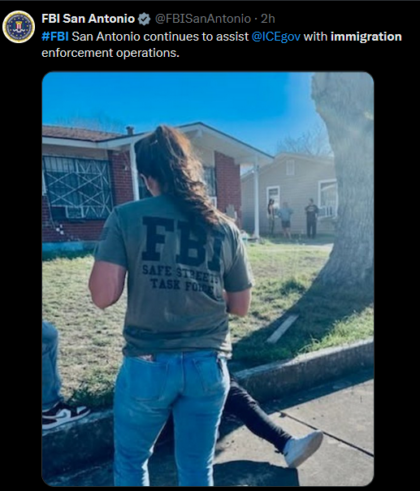
In recent days, an FBI social media account posted a photo, apparently with one of their agents wearing a Safe Streets Task Force during some kind of activity at a residence, in reference to immigration. Here is an SSTF MOU between Fort Myers and the FBI (pdf) and the 2021 agenda item (pdf).
There is also some option for deputizing U.S. Marshals although the details are unclear. On May 12, Florida Governor Ron DeSantis (R) claimed that 100 Florida Highway Patrol officers are now “special deputy U.S. Marshals” that can enforce immigration laws themselves. This is connected to a 37-page Immigration Enforcement Operations Plan (pdf) although the role of deputization isn’t specified within.
It’s worth considering how open conflicts between local governments and aggressive federal agencies will affect joint task forces like HIDTA, JTTF and UASI groups. For example, San Francisco police pulled out of JTTF for a time in 2017.
ImmigrationOS: Where is the Data Stored for an “ICE Army”?
Many in the U.S. government have tried to make large databases cross-connected from disparate departments for political ends. These type of super-databases have been considered political hot potatoes since the Watergate era; the Privacy Act was passed in 1974 to force the executive branch to outline the nature of these data systems as well as privacy protection measures. These policies were intended to prevent various abuses, like, say, Richard Nixon using the IRS to go after his enemies list.
Additional ICE RFIs in recent years showed that ICE is interested in “release and reporting management,”which includes tracking devices and “monitoring technology” for people who are not being held in detention centers.
The IRS-ICE Agreement that Shook Tax Agency Leadership
This IRS-ICE agreement obtained by American Oversight was produced after the acting commissioner Melanie Krause in resigned in April in objection to this agreement. Acting chief counsel William Paul was removed and replaced with Andrew De Mello to force this through as well. Why so much resistance from the top levels?
After Watergate, the Privacy Act was passed to constrain the use of “systems of records” for law enforcement and other purposes. This MoU tries to give assurances that everything will be handled by trained personnel. American Oversight says“the MOU fails to include any meaningful independent oversight of when and how the information is to be shared, relying on internal compliance and self-reporting and raising questions about how the public can ensure the government is following its own rules.” It showed the government redacted that the IRS would disclose “address information” of taxpayers to ICE, but the court forced these passages to be released.
“Project Homecoming” and Expanding Domestic National Guard Activity, via 287(g)
In a May 9 “proclamation” from the White House entitled “Establishing Project Homecoming,” buried at the end is yet another expansion of armed force in the works.
“[…]the Secretary of Homeland Security shall supplement existing enforcement and removal operations by deputizing and contracting with State and local law enforcement officers, former Federal officers, officers and personnel within other Federal agencies, and other individuals to increase the enforcement and removal operations force of the Department of Homeland Security by no less than 20,000 officers in order to conduct an intensive campaign to remove illegal aliens who have failed to depart voluntarily.”
In our research we found that the National Guard state agencies in Florida and Texas are already approved by ICE for the 287(g) task force model. Thus, the National Guard would not have to be “federalized” to do more operations for the feds, it could just use 287(g). Likewise, CNN reported the Guard units could be under state authority, not federal Title 32 mobilization. As the Brennan Center explains, National Guard personnel managed by their governor and adjutant general are not subject to the limitations of the Posse Comitatus Act.
It appears some of the militarized machinery here involves the concept of “force protection” as a way to coerce state and local governments to cooperate with the immigration crackdown, as liberal news site Talking Points Memo noted. An ominous release from the U.S. Army on April 15, “Joint Task Force Southern Guard protection cell secures the mission” describes how military “force protection” assets “address every possible security and safety scenario in support of a Department of Homeland Security (DHS)-led illegal alien holding operation (IAHO).” Southern Guard has been a very expensive operation to dump migrant detainees in the Pentagon’s offshore base in Guantanamo Bay, Cuba; it is led by U.S. Southern Command (SOUTHCOM).
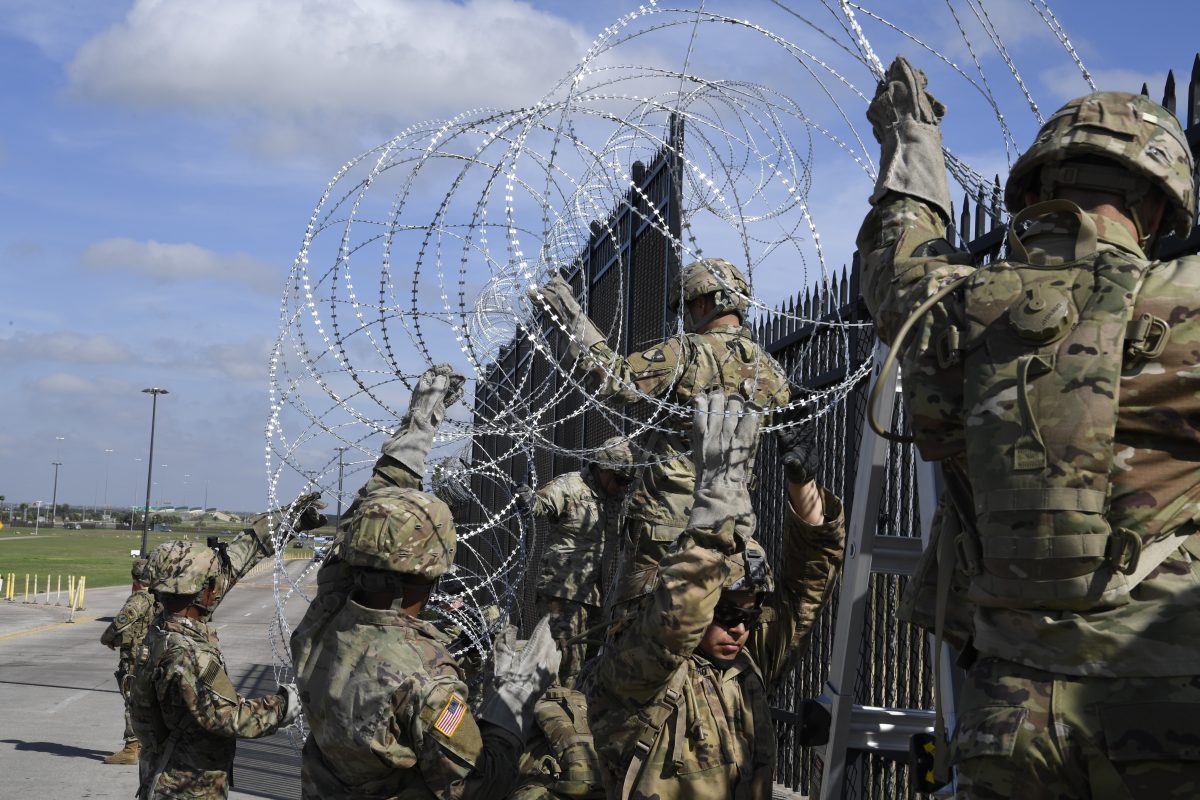
Soldiers in engineering units install concertina wire on Nov. 5, 2018, at the Anzalduas International Bridge, Texas, part of a “military support” effort of U.S. Northern Command for DHS & Customs and Border Protection (CBP). (US Air Force photo by Airman First Class Daniel A. Hernandez)
Tension in Newark; Additional Detention Centers Sought for ICE Operations
On May 1, a federal lawsuit was heard in which New Jersey is trying to block all privately operated immigration prisons, with the state arguing it can control the private prison market, overriding the federal government’s hope to run a large facility in the region that it desperately needs to scale its mass detention and deportation agenda.
Report: Project 2025 Working Group Proposed Huge Police Command Network Under White House Control
A new report by Beau Hodai for Phoenix New Times/Cochise Regional News introduces elements of a major plan by the previously unreported Project 2025 Border Security Work Group, which offers some vision for a vast expansion and centralization of policing in the United States. Project 2025, a “900-page policy ‘wish list’,” was developed by several conservative think tanks such as the Heritage Foundation to guide Trump Administration policies in a more focused fashion than the first term. The plans, developed by September 2024, include both a security policy and a propagandistic “strategic communications plan” to convince the American public that dreaded “terrorists” are loose in the land and only their extreme policies can save the day.
Hodai writes, “several of the policy proposals contained in the documents have already been executed,” including the IRS policy, dumping immigrants in Guantanamo, militarizing the U.S. border, and widespread revocation of immigrant parole programs and other legal status cancellations. Many “lines of operation” are proposed in the documents, and four new tiers of command controlled ultimately by the White House: Regional Command, State Command, District Command and one Headquarters Command.
In addition, Hodai found that “documents contemplate waiving 287(g) training requirements for sheriff’s deputies and municipal police working in ‘regional command’ units,” because watching 40 hours of training videos is apparently too high a bar to cross. Not surprisingly, the documents also “contemplated invoking the Insurrection Act” and “mobilization of up to one million troops to aid in proposed domestic security operations.”
Plugging leaks in this apparatus would be a serious program as well: “An active counter-intelligence effort must be organized, integrated across all levels, and actively conducted to identify and prosecute any individuals working for and providing classified or operationally sensitive information on border security plans and activities.” More details about these documents are expected to be released in the coming weeks.
All of these subjects can seem a bit overwhelming, but it is worth keeping in mind that the building blocks of this political situation were put in place more than two decades ago, after the September 11 attacks.
Many groups are working on opposing different aspects of the immigration crackdown, including by obtaining evidence of the policies, filing lawsuits, seeking injunctions, and challenging the vast levels of spending pouring out of the executive branch.
Subscribe to the Newsletter: You are all an inspiration to me. Please join me on Wings of Change. It’s only the beginning as we still have so much work to do as many activists and organizations make plans for the upcoming years. Wings of Change is pleased and excited to be a part of that work through education, information, and inspiration.