Tag: genocide

  • “Time to Cut Ties with Israel”: U.N. Expert Francesca Albanese on Gaza Hospital Bombing

    “Time to Cut Ties with Israel”: U.N. Expert Francesca Albanese on Gaza Hospital Bombing

    “There has been a tolerance of Israel’s impunity for decades,” says Albanese. “However, the United States is the single most important factor of crisis in the United Nations.”

    Israel’s war on Gaza is the deadliest conflict for journalists in recorded history. In an attack on Nasser Hospital in Gaza Monday, Israel killed five more journalists in addition to over a dozen others. Israeli Prime Minister Benjamin Netanyahu claimed the hospital attack was a “tragic mishap,” but just hours later, Israeli forces killed a sixth journalist. “There is a pattern of targeting and killing journalists that lets us think that there is an intention,” says Francesca Albanese, U.N. special rapporteur on the occupied Palestinian territory.

    As countries prepare for the U.N. General Assembly, Albanese notes the complicity of Western states in the genocide in Gaza, particularly the United States. “There has been a tolerance of Israel’s impunity for decades,” says Albanese. “However, the United States is the single most important factor of crisis in the United Nations.”

    Note: Video also included below: “Chicago Leaders Prepare to Face the Dictator Head On” Below the Chicago video is the full transcript of Franceca Albanese’s intertiew video with Amy Goodman of Democracy Now!

    “We Must Defeat Fascism”: Chicago Alderman on Trump’s Threat to Deploy Troops to City

    Transcript for Francesca Albanese

    This is a rush transcript. Copy may not be in its final form.

    AMY GOODMAN: Human rights and press freedom groups are denouncing Israel’s attack on Nasser Hospital in Gaza Monday that killed at least 21 journalists — that killed at least 21 people, including five journalists. According to eyewitnesses, Israel carried out a double-tap strike on the hospital. In the initial strike, a drone hit Hussam al-Masri, a cameraman who worked for Reuters. Then another strike, minutes later, hit journalists and rescue workers who were responding to the initial strike.

    Israeli Prime Minister Benjamin Netanyahu claimed the hospital attack was a, quote, “tragic mishap.” But just hours later, Israeli forces killed a sixth journalist, Hassan Douhan, a well-known editor at Al-Hayat Al-Jadida. He was killed when an Israeli tank shelled a tent sheltering displaced people in Khan Younis.

    Over the past 23 months, Israel has barred all foreign journalists from reporting inside Gaza, while systematically killing Palestinian journalists. According to one count, Israel has killed least 245 journalists. On Monday, Thibaut Bruttin, the director general of Reporters Without Borders, denounced Israel’s attack on journalists.

    THIBAUT BRUTTIN: When and where is it going to end? Are we going to let the Israel Defense Forces continue the repeated killing of journalists? There is international law. There are guarantees that should be granted to journalists covering conflicts. And none of that seems to be applying. So, we need to be very clear about the fact that none of the journalists that are allegedly terrorists are terrorists. They are professional journalists working for legacy professional media, like, for example, Reuters or, for example, AP.

    AMY GOODMAN: In other news from Gaza, three more Palestinians have starved to death, bringing the total to at least 303.

    We’re joined right now by Francesca Albanese, the U.N. special rapporteur on the occupied Palestinian territory. She’s joining us from Tunis, Tunisia.

    Welcome back to Democracy Now!, Francesca Albanese. Can you start off by responding to the killing of the, at this point, in the last day, six journalists, five of them in a double-tap strike on Nasser Hospital?

    FRANCESCA ALBANESE: Thank you, Amy. Yeah, of course.

    Look, in a situation of conflicts, targeting or killing journalists is unlawful. Journalists, like doctors and medical personnel and rescues, all those who have been killed in this attack, are civilians, so killing them is unlawful. They are protected under international humanitarian law.

    However, here, it’s not an isolated incident. Journalists have been killed in such high numbers. Some say 200 have been documented. Al Jazeera speaks of 270 journalists killed. So there is a pattern of targeting and killing journalists, that let us think that there is an intention behind it. There is a widespread and systematic attack against them, like there is a systematic and widespread attack against civilians. And this might qualify as also as a crime against humanity in and of itself.

    However, however, I want to remind everyone that we are on the 688th day of the assault against Gaza, which an increasing consensus denounces as genocidal. And there is famine, and there is this complete destruction of landscapes in Gaza. So, the question is: What are member states waiting exactly to intervene and stop this carnage?

    JUAN GONZÁLEZ: And, Francesca Albanese, you have said that there have to be response. You’ve called for sanctions against Israel. Could you talk about how those might work, especially, as you mentioned, the fact that state governments are not taking any action?

    FRANCESCA ALBANESE: Oh, absolutely. Look, I would like people to understand this in the broader context of international law. No later than last year, the International Court of Justice has confirmed that Israel’s presence in the West Bank, the Gaza Strip and East Jerusalem is unlawful, must be dismantled totally and unconditionally. And the General Assembly has also given Israel a very generous deadline of one year to do so, which will expire in a month from now. In the face of this, member states have an obligation not to aid and assist in any possible ways a state like Israel in maintaining the situation created by Israel’s unlawful presence. So, while it is abhorrent that they are not stopping Israel, this delay increases their level of responsibility, their violation of international law, and possibly their complicity with the crimes that Israel is committing.

    This is why my recommendations are for member states who do not want to incur in this legal — in their legal responsibilities, and also out of humanity, to break the siege. Member states who have a port in the Mediterranean Sea must absolutely send their navies, under their national flag, with humanitarian aid and doctors, with food and baby formula, because 500,000 people, according to the United Nations, are close to — are really close to starvation. But also, as we see the Sumud Flotilla, so ordinary citizens jumping on boats and trying to do what member states are not doing, I feel that it’s totally immoral and irresponsible to let individuals like this take this risk, when it’s a state obligation to break the siege.

    But also, it’s time to cut ties with Israel, to cut trade, because this is also what the ICJ has reminded member states they need to take all steps to prevent trade and investment relations that are assisting in the maintenance of Israel’s unlawful presence. And we must recall that while Israel is committing genocide in Gaza, it’s also advancing, as it was said in the beginning, annexation at an incredible, incredible speed. So there is no way out of this other than a firm, robust action from member states.

    JUAN GONZÁLEZ: And I wanted to ask you — the Trump administration, instead of heeding your calls as the special rapporteur, have instead imposed sanctions on you, supposedly claiming that your naming of dozens of companies that are profiting from the Israeli occupation and genocide in Gaza. And Secretary of State Marco Rubio said, quote, “Albanese’s campaign of political and economic warfare against the United States and Israel will no longer be tolerated.” Your response to these kinds of words from leaders of the United States?

    FRANCESCA ALBANESE: Well, first of all, as a non-American, but as someone who has lived in the United States, I wonder how American people understand this, because, of course, it’s a violation of the First Amendment, right? I mean, I’ve just done my job, which is a pro bono job. I’ve been requested by the United Nations to investigate and report on the most prominent violations of international law that occur in the occupied Palestinian territory. And I’ve simply stated facts, according due process to businesses, saying there is an economy of the occupation, and this is the reason why Israel has profited and has allowed private entities, arms manufacturers, even banks, pension funds, universities, really, to help and profit — to help it and profit from Israel’s maintenance of the unlawful occupation. Now, this occupation has also turned into genocidal over the past 688 days, and I’ve denounced it. I’ve said, “How come that Israelis were becoming — many Israelis were becoming poorer and poorer, and Israeli stocks exchange kept on going up?”

    Because of that, I’ve been sanctioned, which is something unprecedented, that no states in 80 years of life of the United Nations have ever attempted, had ever dared, because it’s absolute — it’s a violation of international law, of the U.N. Charter, of the Convention on Privileges and Immunities. And still, the United Nations — the United States maintains a sanction, which are now entering the second month. It’s abominable. And this is the situation. But you understand, against a person who has just written a report, I have been called a threat to global economy. It’s clear that I’ve hit a nerve, but this is not the way to react to this.

    AMY GOODMAN: I want to turn to the last story that the Reuters cameraman Hussam al-Masri filmed before he was killed by Israel on Monday at Nasser Hospital. On Saturday, just two days before, al-Masri shot this interview with Hikmat Fojo, a Palestinian woman whose relatives were killed in another Israeli strike.

    HIKMAT FOJO: [translated] While they were sleeping, they were hit by missiles. While they were sleeping, an entire family was lost. And he was praying. He was praying. He was praying. His children were gone. Two were martyred. They were born after 10 years of waiting. One was sleeping. And the woman’s hands and legs, but, God willing, it’s all right. God willing, it doesn’t matter. If my nephew’s hand remains amputated, it doesn’t matter, but may he stay alive, O Lord.

    AMY GOODMAN: So, that was the — one of the last pieces of video that the Palestinian journalist, the Reuters journalist Hussam al-Masri filmed before he was killed Monday in that double-tap strike. He had — apparently was setting up a live stream at the fourth-floor balcony, which journalists used, when he was hit. So, now I want to go to Reuters reporter Steve Holland, who questioned President Trump about this in the Oval Office.

    STEVE HOLLAND: If we could get your reaction, sir? The Israelis bombed a hospital in Gaza, that killed 20 people, including five journalists. Are you —

    PRESIDENT DONALD TRUMP: When did this happen?

    STEVE HOLLAND: This happened overnight today.

    PRESIDENT DONALD TRUMP: I didn’t know that.

    STEVE HOLLAND: Any reaction to this? Are you going to talk to Prime Minister —

    PRESIDENT DONALD TRUMP: Well, I’m not happy about it. I don’t want to see it. At the same time, we have to end that whole nightmare. I’m the one that got the hostages out. I got them out, all of them.

    AMY GOODMAN: That was President Trump. Francesca Albanese, can you talk about the responsibility of the United States? And tell us more about the mechanisms at the U.N., since it’s very clear they block any kind of action at the U.N. Security Council.

    FRANCESCA ALBANESE: Yeah, as I said, there are clear indication, clear instructions from International Court of Justice on how to deal with the situation. The only lawful thing that Israel can do in the occupied Palestinian territory is to withdraw, withdraw the troops, dismantle the settlements, stop exploiting Palestinian resources.

    In the face of this, any aid, any support, any exchange of commerce, military intelligence and others from the United States or others is a breach of the obligation not to render aid and assistance in maintaining the situation. However, on top of this, there are proceedings for genocide pending before the International Court of Justice, which trigger an obligation to prevent, which, as a minimum, as the ICJ has said in the case of Nicaragua v. Germany, entails the ban on transfer of weapons to a country, to a state which is committing violations of international humanitarian law, meaning even war crimes. You know, we don’t even need to go and bother the Genocide Convention. So, yet again, another layer of responsibility of the United States.

    And then there are proceedings against Benjamin Netanyahu and Yoav Gallant for war crimes and crimes against humanity, including starvation. Because of this, even if the United States is not a party to the ICC, it should be respectful of international law, international criminal law. And instead of giving — of receiving the ICC-wanted Netanyahu as if he was really a war hero, as is being defined, the United States should facilitate justice and accountability. Instead, they are waging a war against the ICC itself, not just me. All the judges of the ICC have been sanctioned, and so the prosecutor of the court. So, this is the situation.

    Of course, there are complicities on the side of this administration, and, in my opinion, even in the — on the previous one. But this is something that belongs to the American people. It’s the American people that need to, or the American — the American political landscape that needs to, take action on this.

    JUAN GONZÁLEZ: And, Francesca Albanese, I wanted to ask you — in a few weeks, the U.N. — the annual meeting of the U.N. General Assembly will take place. Leaders from all over the world will come and give speeches to the U.N. General Assembly. Do you think this is a defining moment for the United Nations as an institution in its inability of the member states or the unwillingness of the member states to stop a genocide that the entire world has been witnessing now for —

    FRANCESCA ALBANESE: Yeah.

    JUAN GONZÁLEZ: — two years?

    FRANCESCA ALBANESE: Yeah, I will take the opportunity to also answer the other part of Amy’s question, which I dropped, but it’s — yeah, I think that it’s a — it’s an historical moment, the one we live in, and it’s a defining one. We will not get out of this genocide with the same pretense of innocence that we had when we entered. The crimes of Israel against the Palestinians were already 56-plus years old when the assault against Gaza on the terrible — after the terrible day that October 7 was — and there is no question about that. So, there have been a tolerance of Israel’s impunity for decades.

    However, the United States is the single most important factor of crisis in the United Nations system at the moment, because the United Nations are clearly paralyzed in the face of a crisis which is political, legal and humanitarian, and the United States have contributed to that paralysis by also — for example, what are the mechanisms to impose sanctions or to dispose of coercive or noncoercive measures against Israel within the U.N. would be through the Security Council, and the United States have firmly and steadily sheltered Israel from most important instances of accountability. A rare exception is the 2016 Security Council resolution that recognized the illegality of the settlements under international law.

    So, it’s a catch-22 situation. But at the same time, I want to remind everyone that the international community is constituted by 193 member states, and the other 191, that does not — are not part of the Gaza genocide as much as Israel in the United States, should do the utmost not only to stop the genocide, but also to salvage what remains of the multilateral system, because so far it has protected — I wouldn’t say all of us, but most of us, especially in the West. And it seems that we are really giving it for granted. But we will miss human rights very much when we don’t have them anymore.

    AMY GOODMAN: Francesca Albanese, the International Criminal Court has said it deplores new U.S. sanctions on its judges and prosecutors. Last week, the U.S. State Department announced new sanctions on two judges and two prosecutors in the ICC for engaging in efforts to prosecute U.S. and Israeli citizens. The ICC statement said, “These sanctions are a flagrant attack against the independence of an impartial judicial institution which operates under the mandate from 125 States Parties from all regions. They constitute also an affront against the Court’s States Parties, the rules-based international order and, above all, millions of innocent victims across the world.” I’m wondering if you can comment on this latest development, the sanctions against the ICC prosecutors and judges, and also your own situation. You are the U.N. special rapporteur on the occupied Palestinian territory, and the U.S. has sanctioned you. And if you can talk exactly about what that means?

    FRANCESCA ALBANESE: Look, the sanctions are very heavy and, frankly, an awful, awful instrument, when targeting, when directed at people whose job and whose efforts are in the — in the pursuit of justice and accountability. So, look at the absurdity of using an instrument, which is meant to protect U.S., U.S. interests and U.S. citizens, being used to punish people who are trying to stop and make account — make people responsible for crimes accountable. Where is the harm to the U.S. citizens? What is harmed — and this is why I often say these sanctions are a sign of fragility of those who use it — who use them. I mean, they are — what’s the harm that is done to the American interest, other than to the illegality that is denounced?

    Yes, the special rapporteur has put on notice 48 businesses. And what? Why didn’t they defend themselves? Why didn’t they interact with me, most of them, surely the American companies? Why did they went to complain to the American administration, who put me on notice not to continue this investigation already made? Again, look, I come from a place which has been plagued by Mafia-style logics, techniques, and I’m fully familiar with this way of behaving. And this kind of threats win only if they meet fear. But the people, united, must resist this. And this is why I’m not going to step back, and I’m not going to stop my work.

    AMY GOODMAN: And I wanted to ask a final question about the West Bank. As we went air, I think something like 24 people have been injured in Ramallah in an Israeli military raid. This is not Gaza. This is Ramallah. At the same time, you have the far-right ministers talking about starting to annex the West Bank this week. What does this mean?

    FRANCESCA ALBANESE: Yeah.

    AMY GOODMAN: And what role does the U.N. have in this?

    FRANCESCA ALBANESE: Yes, two things. First, when we say this is not Gaza, last week, the Israeli newspaper +972/Local Call issued a report based on a leaked document by the Israeli army, which admitted that only one of six of the people killed in Gaza were Hamas combatants. And I want to — I want to underscore that Israel’s definition of “combatant” is much broader than what is, in fact, afforded by international law. So, it confirms and actually aggravates the accusations of the U.N., independent experts and others that the death toll has steadily been 70 — at least 70% women and children, and therefore civilians. So, they are saying that, in fact, 80%-plus of the death toll in Gaza is made of civilians.

    The situation is not different from the West Bank, where Israel is advancing its ethnic cleansing agenda through annexation. This is not new. In February 2023, the coalition government passed an agreement that basically transferred to Bezalel Smotrich, so the minister of finance, control over large swathes of the West Bank. This was yet another act of annexation, but formalizing what Israel has been doing for 57 years, creating settlements, which are war crime, in occupied territories for Israeli Jews only that were on — were on stolen land and were resulting in forcibly — dispossession and forcible displacement of Palestinians. Of course, today, this has reached abysmal proportion, because there is — there is even that veneer of respect of international humanitarian law has gone. There are settlers and soldiers ravaging the West Bank, and the Jordan Valley is unprotected, other than from by a few Israeli activists who go there night and day and try to protect shepherds and pastoralist communities.

    But, look, the situation is abominable, abominable. And now the state of Palestine has requested an intervention from the international community. Some presidents, like some authorities, like the Irish president, has called for a military intervention. And I understand that everything must pass up, in accordance with international law, through the Security Council. And at the same time, because Israel has no sovereignty whatsoever over Gaza, the West Bank and East Jerusalem, it’s about time that a protection — the deployment of a protection presence is considered, because there is no other way to stop what Israel is doing.

    AMY GOODMAN: Francesca Albanese, we want to thank you for being with us, U.N. special rapporteur on the occupied Palestinian territory. We were hoping to reach a doctor at Nasser Hospital, but could not reach him today.

    Coming up, we go to Chicago as local and state officials push back against President Trump’s threat to send in the National Guard. We’ll also look at Trump’s new executive orders ending so-called cashless bail. Stay with us.

    [break]

    AMY GOODMAN: The late folk singer-songwriter Michael Hurley performing “What’s Buggin’ You Baby?” at our Democracy Now! studio.

    The original content of this program is licensed under a Creative Commons Attribution-Noncommercial-No Derivative Works 3.0 United States License. Please attribute legal copies of this work to democracynow.org. Some of the work(s) that this program incorporates, however, may be separately licensed. For further information or additional permissions, contact us.


    In this critical time in our country hearing the voices of truth and engaging in honest discussion for critical issues is all the more important while censorship (and outright lies) along with attacks on truth-tellers are common. Support the WingsofChange.me website and Rise Up Times on social media as we to bring you important articles and journalism beyond the mainstream corporate media. Access is alway free, but if you would like to help:
    Wings of Change FeatherWhatever you are able donate will bring you articles and opinions from independent websites, writers, and journalists as well as a blog with the opinions and creative contributions.
    One place to begin is with reason and truth, and how fundamental they are to creating critically engaged citizens and communities. 

    —Henry A. Giroux

  • DN!: “I’m a Genocide Scholar. I Know It When I See It””: Prof. Omer Bartov on the Growing Consensus on Gaza

    DN!: “I’m a Genocide Scholar. I Know It When I See It””: Prof. Omer Bartov on the Growing Consensus on Gaza

    “Israel is trying to concentrate the population of Gaza in the southernmost parts of the strip, to enclose them and to enforce, eventually, either that they would just die out there or that they would be removed from the Gaza Strip altogether.”

    We speak with leading Israeli American historian Omer Bartov about his latest essay for The New York Times, headlined “I’m a Genocide Scholar. I Know It When I See It.” Bartov cites the United Nations definition of “genocide,” which includes an intent to destroy a group of people that makes it impossible for the group to reconstitute itself. “This is precisely what Israel is trying to do,” he says. “Israel is trying to concentrate the population of Gaza in the southernmost parts of the strip, to enclose them and to enforce, eventually, either that they would just die out there or that they would be removed from the Gaza Strip altogether.”

    Related
    Writer Adam Shatz on How Oct. 7 & Israel’s Brutality in Gaza Reshaped the World
    STARVING CHILDREN OF GAZA
    Palestinians gather to receive food cooked by a charity kitchen, amid a hunger crisis, as the Israel-Gaza conflict continues, in Khan Younis in the southern Gaza Strip, December 4, 2024. REUTERS/Mohammed

    NERMEEN SHAIKH: Israel’s military is continuing to attack civilians across the Gaza Strip, with at least 93 Palestinians killed over the past 24 hours, bringing the total number of deaths in Gaza to 58,000, most of them women and children. This number is believed to be a vast undercount. At least 10,000 are believed to be buried under the rubble. The U.N. estimates approximately 92% of all residential buildings in Gaza, around 436,000 homes, have been damaged or destroyed.

    As the situation continues to deteriorate, an emergency meeting of the Hague Group convened in Bogotá, Colombia, to discuss the conflict. It concluded with the announcement of a series of measures aimed at halting Israel’s attacks on Palestine and ending the, quote, “era of impunity.” The Hague Group came together in January as a bloc of Global South countries committed to coordinating legal and diplomatic measures in defense of international law and solidarity with the Palestinian people. There are now 30 member states. The action steps announced at the conclusion of the summit include banning arms sales to Israel and reviewing ties with companies who profit from the occupation of Palestine. So far, only 12 states have agreed to implement the steps. The summit was co-chaired by South Africa and Colombia. This is Colombia’s President Gustavo Petro.

    PRESIDENT GUSTAVO PETRO: [translated] We need to leave NATO. We need to form an army of light with all the peoples of the world who want to. And we need to tell Europe that if it wants to be with Latin America or Africa, it must stop helping the Nazis. And we need to tell the American people of all colors, because they are now of all colors, to stop helping the Nazis.

    NERMEEN SHAIKH: The Hague Group’s joint statement affirms the commitment to, quote, “Comply with our obligations to ensure accountability for the most serious crimes under international law through robust, impartial and independent investigations and prosecutions at national or international levels, in compliance with our obligation to ensure justice for all victims and the prevention of future crimes,” end-quote.

    AMY GOODMAN: Well, there’s perhaps no greater crime than genocide. Our next guest, Omer Bartov, is professor of Holocaust and genocide studies at Brown University. He is an Israeli American scholar who’s been described [by] the U.S. Holocaust Memorial Museum as one of the world’s leading specialists on the subject of genocide. And he’s just written an op-ed for The New York Times headlined “I’m a Genocide Scholar. I Know It When I See It.” Professor Bartov joins us from Cambridge, Massachusetts.

    Well, why don’t you, Professor Bartov — and thanks for joining us again — lay out your case?

    OMER BARTOV: Well, thanks for having me again.

    The case that I made in the article and that I’ve been making for a while is that at the beginning, immediately after October 7th, the Hamas attack on October 7th, Israeli political and military leaders made a series of pronouncements which could be interpreted as calling for genocide. But there was still no — at that point, there was no evidence that this was being implemented.

    Over time, and I would say by May of 2024, it became apparent that these statements were not only made in the heat of the moment following the massacre by Hamas, but were actually being implemented in a manner that would make it impossible for people to live in Gaza, make the entire Gaza Strip uninhabitable and make life there impossible, as well as destroy all the institutions that would be there for that group to reconstitute itself as a social, cultural, political group once the violence was over. Of course, it’s not over yet. I started thinking that in May. In August that year, I wrote an article that explained that.

    But the violence has only continued, and the attempt, as you just reported, to destroy Gaza entirely has continued since. And it is now clear that Israel is trying to concentrate the population of Gaza in the southernmost parts of the strip, to enclose them and to enforce, eventually, either that they would just die out there or that they would be removed from the Gaza Strip altogether.

    NERMEEN SHAIKH: And, I mean, obviously, the points that you’ve made, Professor Omer Bartov, makes it completely indisputable, the argument that you make in the piece, indeed, that there is a genocide ongoing and that that is the long-term plan of Israel. You point out in the piece, though, that genocide scholars are often hesitant about applying the term “genocide” to contemporary events, in part because, as you write, quote, “it often serves more to express outrage than to identify a particular crime.” Of course, there are people who believe that that’s the case even today with respect to Gaza. If you could respond to that?

    OMER BARTOV: Correct. So, this is one reason that I did not come out right after October 7th and say, “Well, Israel is about to commit genocide,” because, despite those statements, one had to observe and see what was actually happening on the ground. And yes, it is true that the term “genocide” has been used more as an expression of outrage when seeing massacres, mass killings, but that does not necessarily mean that what you’re watching is genocide. “Genocide” is well defined in a U.N. convention from 1948. And under international law, only events that can — that conform to the definition can be seen as genocide. And that means that you have to show both that there is an intent to destroy a particular group, in whole or in part, as such, and that that intent is being implemented. And that, obviously and unfortunately, takes time to adjudicate.

    I think that the term, while problematic, is very important, because it does identify a very particular crime. It talks about the attempt to destroy not simply people in large numbers, but to destroy them as members of a group. The intent is to destroy the group itself. And it doesn’t mean that you have to kill everyone. It means that the group will be destroyed and that it will not be able to reconstitute itself as a group. And to my mind, this is precisely what Israel is trying to do. And many of its spokespersons, to this day, keep reiterating that, to the extent that it’s somewhat bizarre that so much of the rest of the world is not taking them seriously.

    NERMEEN SHAIKH: Professor Bartov, could you also talk about — I mean, you are an Israeli American scholar and are in touch with people in Israel. How do you see perceptions of Israel’s ongoing assault on Gaza changing within Israel? And where are people getting their information there? There’s been talk of basically self-censorship of the mainstream media, but, of course, so many of these images and information are circulating not in the mainstream press, but on social media.

    OMER BARTOV: So, look, I should say first I am — I was born and raised in Israel. I spent the first half of my life in Israel. I served in the Israeli military. And for me, to see what is happening is personally, not only just as a mere human being, but also as an Israeli, heartbreaking.

    What I see in the Israeli public is an extraordinary indifference by large parts of the public to what Israel is doing and what it’s done in the name of Israeli citizens in Gaza. In part, it has to do with the fact that the Israeli media has decided not to report on the horrors that the IDF is perpetrating in Gaza. You simply will not see it on Israeli television. If some pictures happen to come in, they are presented only as material that might be used by foreign propaganda against Israel. Now, Israeli citizens can, of course, use other media resources. We can all do that. But most of them prefer not to. And I would say that while about 30% of the population in Israel is completely in favor of what is happening, and, in fact, is egging the government and the army on, I think the vast majority of the population simply does not want to know about it. And that goes back both to the inability to see anything on their own TVs and, in response to October 7th, a sense that after that — and that’s a widespread sense in Israel — after that, there is no way of finding any solution with the Palestinians, and the only way to deal with that issue is to eradicate it.

    AMY GOODMAN: Professor Bartov, can you talk about the genocide scholars across the world who have come to the same conclusion?

    OMER BARTOV: Yes. So, as I wrote in the op-ed, over time, many genocide scholars who are — and legal experts, experts in international law, who, like me, have been very cautious about applying this term, have gradually come to the conclusion that what we’re watching is genocide. And that’s important, in the sense that there is now, I think, a growing consensus over that view.

    As I wrote in the piece, unfortunately, scholars and institutions dedicated to researching and commemorating the Holocaust have generally, with few very courageous exceptions, have generally refused to say anything, to express themselves in any way, about what is happening in Gaza. And to my mind, by doing that, they, first of all, betrayed the very idea of “never again,” because “never again” was never about “never again the Holocaust,” it was “never again genocide and such other crimes against humanity.” So, there’s now a rift between genocide scholars, who have generally come to agree on Gaza being an Israeli genocidal operation, and Holocaust scholars and institutions that have remained mum.

    AMY GOODMAN: Can you talk about how the term “genocide” came into use? Can you talk about the Polish lawyer Raphael Lemkin?

    OMER BARTOV: Yeah, so, Raphael Lemkin was a Polish Jewish lawyer who, already in the 1930s, was trying to find some kind of terminology that would describe and legally define that particular crime of trying to destroy a group. And the example that he had at the time was the genocide of the Armenians during World War I by the Ottoman Empire. During World War II, he had to escape Poland as a Jew. Most of his family was murdered. He ended up in the United States. And in 1944, he published a book in which he defined what he understood as the crime of genocide, a term that he coined, which is a combination of Greek and Latin, meaning killing a group or an ethnic group. And he struggled for a few more years to have the U.N., the United Nations, just established in 1945, to recognize that crime, and he succeeded in doing so in 1948.

    NERMEEN SHAIKH: Professor Bartov, I want to ask you about a question, indeed, that you ask in your piece, which is, quote, “How will Israel’s future be affected by the inevitable demolition of its incontestable morality, derived from its birth in the ashes of the Holocaust?” What’s the answer to that question?

    OMER BARTOV: Look, I mean, this is beside the horrific killing of human beings in Gaza. And I should just say, because you mentioned the distribution points of food, that between late May, when this so-called humanitarian group started distributing food, and today, more Palestinian civilians have been killed at these distribution groups than Israeli civilians were killed in the Hamas attack.

    Now, what is the — what does all this mean for Israel? As I suggested in the piece, first of all, I think Israel will no longer be able to draw on the credit, if you like, of having been the state that was created after the Holocaust as an answer to the Holocaust. It will no longer be able to say, “We can do whatever we like, because we were a nation subjected to genocide.” You cannot continue to use this argument following the mass killing of another group.

    I hope — and I write that, too — I hope that future generations of Israelis, who will not be clean of that stain — that stain will remain — but will at least be liberated from this shadow of the Holocaust and will start to look at reality as it is, and start to think of how can they reconstitute their own nation, not as a response to the genocide against the Jews, as a response to the Holocaust, but rather as a nation that knows how to share this land, where 7 million Jews and 7 million Palestinians live side by side between the Jordan and the sea, to share it with them with equality and dignity, and not with the use of bombs and violence.

    AMY GOODMAN: Can you talk about this plan to make, build a so-called humanitarian city — the defense minister, Israel Katz, has proposed this idea — on the rubble of Rafah, and the opposition of two former prime ministers? You have Ehud Olmert, you have Yair Lapid. They’re saying if there is no exit, this is a concentration camp. The significance of these men saying this?

    OMER BARTOV: Well, I think it’s very important that Lapid, who’s been sort of on all parts of this debate, said something and that Olmert spoke out, although Olmert no longer has any political power in Israel.

    The plan itself, again, using the typical euphemisms that are used by organizations and states that carry out such crimes, calling that a humanitarian city, which would be a vast concentration camp, a sort of combination of ghetto and concentration camp, that would be built, as you said, on the ruins of Rafah — Rafah has been completely destroyed, there’s nothing there — build a tent city on top of it, bring in initially 600,000 people, who would be brought back from the Mawasi area, from the beach area, to which they were displaced when the IDF went in to destroy Rafah, enclose them there. The plan does not say that Israel would supply them with any humanitarian assistance in the camp, but some other international organizations yet to be determined. But they would not be able to leave unless they leave the Gaza Strip altogether. So, this is — and in continuation to that, the rest of the population is supposed to then join this camp, with a goal of removing them. So, this is extraordinary. The state of Israel publicly is speaking about the creation of a vast concentration camp whose goal is removal of the population to countries that have unanimously said they are not going to take them in.

    NERMEEN SHAIKH: Well, Professor Bartov, I want to ask about the U.S.’s position on this, of course, their continuing support for Israel, which has enabled the assault to continue. I want to go back to the former president, Biden, his administration, the State Department spokesperson at the time, Matt Miller, who admitted earlier this year, in May, that he believes Israel committed war crimes in Gaza. This reversal came after more than a year, as the face of the Biden administration’s foreign policy, repeatedly defending Israel against allegations of war crimes and genocide. This was Miller speaking earlier this year — last year.

    MATTHEW MILLER: We have been very clear that we want to see Israel do everything it can to minimize civilian casualties. We have made clear that they need to do every — that they need to operate at all times in full compliance with international humanitarian law. At the same time, we are committed to Israel’s right to self-defense.

    NERMEEN SHAIKH: But during an interview with Sky News last month, in June, Matt Miller says he believes Israel has committed war crimes in Gaza and that Israeli soldiers are not being held accountable.

    MATTHEW MILLER: I don’t think it’s a genocide, but I think the — I think it is, without a doubt, true that Israel has committed war crimes.

    MARK STONE: You wouldn’t have said that at the podium.

    MATTHEW MILLER: Yeah, look, because I — I mean, when you’re at the podium, you’re not expressing your personal opinion. You’re expressing the conclusions of the United States government.

    NERMEEN SHAIKH: So, Professor Bartov, your response to that, and also your perception of how the Trump administration has both broken with and continued Biden’s policies on Gaza?

    OMER BARTOV: Well, you know, in November 2023, I published an op-ed in The New York Times in which I said that war crimes and crimes against humanity were clearly happening in Gaza, and that if this continued, it would become a genocidal operation. I was hoping at the time that someone in the administration would actually pay attention, because the United States, in November or December 2023, could have stopped all of this. It was not very difficult to do. Israel cannot act as it has without constant supply of arms from the United States and Germany — these are the two major suppliers; the U.S. supplies between 70 and 80% of all munitions to Israel — and without diplomatic cover — Israel has a diplomatic Iron Dome created by the U.S. veto in the Security Council. That did not happen. And, of course, the evidence was there. And so, first of all, one has to say that the Biden administration is complicit in what happened in Gaza.

    Secondly, when Trump came in, curiously, the first thing that happened, the day before he came into office, was that he forced a ceasefire on Israel. And that ceasefire, in January this year, made it possible to exchange Palestinian prisoners for a large number of hostages, but not all of them. The plan was to complete that exchange and to stop the fighting. But in March, Israel unilaterally broke that ceasefire without any interference from the United States, and, since then, has continued. And what is particularly galling is the fact that when Trump floated his plan, if you recall that, that the population of Gaza would be removed, and then Gaza would be made into a beautiful resort area, he later on didn’t really repeat that. But in Israel, that was seen as license to do exactly what is being done now — that is, using hundreds of bulldozers, engineers, explosives to systematically destroy every building in Gaza so that nobody would be able to live in, in that area, and then, well, maybe turn it into a resort area, more likely be an area for Jewish settlers.

    AMY GOODMAN: I wanted to name names here, that you do in your piece. “In November, a little more than a year into the war, the Israeli genocide scholar Shmuel Lederman joined the growing chorus of opinion that Israel was engaged in genocidal actions. The Canadian international lawyer William Schabas came to the same conclusion … and has recently described Israel’s military campaign in Gaza as ‘absolutely’ a genocide.

    “Other genocide experts, [like] Melanie O’Brien, president of the International Association of Genocide Scholars, and the British specialist Martin Shaw (who has also said … the Hamas attack was genocidal), have reached the same [conclusion], while the Australian scholar A. Dirk Moses [of] the City University of New York described these events in the Dutch publication NRC as a ‘mix of genocidal and military logic.’ In the same article, Uğur Ümit Üngör, a professor at the Amsterdam-based NIOD Institute for War, Holocaust and Genocide Studies, said there are probably scholars who still do not think it’s genocide, but ‘I don’t know them.’”

    Professor Bartov, as we begin to wrap up, can you talk about this consensus and whether Holocaust museums, which often address a number of holocausts, will be taking on what Israel has done in Gaza?

    OMER BARTOV: Well, so, as I said before, I think there is a growing consensus among genocide scholars and legal experts. William Schabas is a very good example, because he’s a highly respected expert. He’s very conservative. He took a long time to reach that conclusion. And he has. I just spoke with him recently in Europe, and he very strongly believes that what Israel is doing now is genocide.

    But the other side of it, as you indicate, is the tragedy that most Holocaust scholars and all of the institutions that I know that are dedicated to commemorating and researching the Holocaust have refused to say anything. And some, again, a minority of Holocaust scholars, have come out and claimed that genocide scholars speaking about genocide in Gaza are antisemitic, that this is an antisemitic argument. And that use of the term “antisemitism,” which, as you know, of course, and we spoke about, was also a tool to silence any protest last spring on American campuses, this abuse of the term is now creating a rift between Holocaust scholars and genocide scholars.

    And what I fear — and that’s what I write at the end of this piece — what I fear is that this will mean that the Holocaust, which had come, over decades, to be recognized as an event of universal importance, as an event that we have to learn from, because of the silence, because of the betrayal of the notion of “never again” by these institutions and these scholars, will go back to become a sort of ethnic enclave, only something that the Jews talk about among themselves.

    AMY GOODMAN: Omer Bartov, we want to thank you for being with us, professor of Holocaust and genocide studies at Brown University and an Israeli American scholar, described by the U.S. Holocaust Memorial Museum as one of the world’s leading specialists in the subject of genocide. His forthcoming book, Israel: What Went Wrong? His previous books, Genocide, the Holocaust and Israel-Palestine. We’ll link to your piece in The New York Times, “I’m a Genocide Scholar. I Know It When I See It.”

    The original content of this program is licensed under a Creative Commons Attribution-Noncommercial-No Derivative Works 3.0 United States License. Please attribute legal copies of this work to democracynow.org. Some of the work(s) that this program incorporates, however, may be separately licensed. For further information or additional permissions, contact us.


  • Chris Hedges: Trump’s Useful Idiots

    Chris Hedges: Trump’s Useful Idiots

    The perpetuation of the fiction of widespread antisemitism, which of course exists but which is not fostered or condoned by these institutions, coupled with the refusal to say out loud what is being live streamed to the world, has shattered what little moral authority these institutions and liberals had left. It gives credibility to Trump’s effort to cripple and destroy all institutions that sustain a liberal democracy.
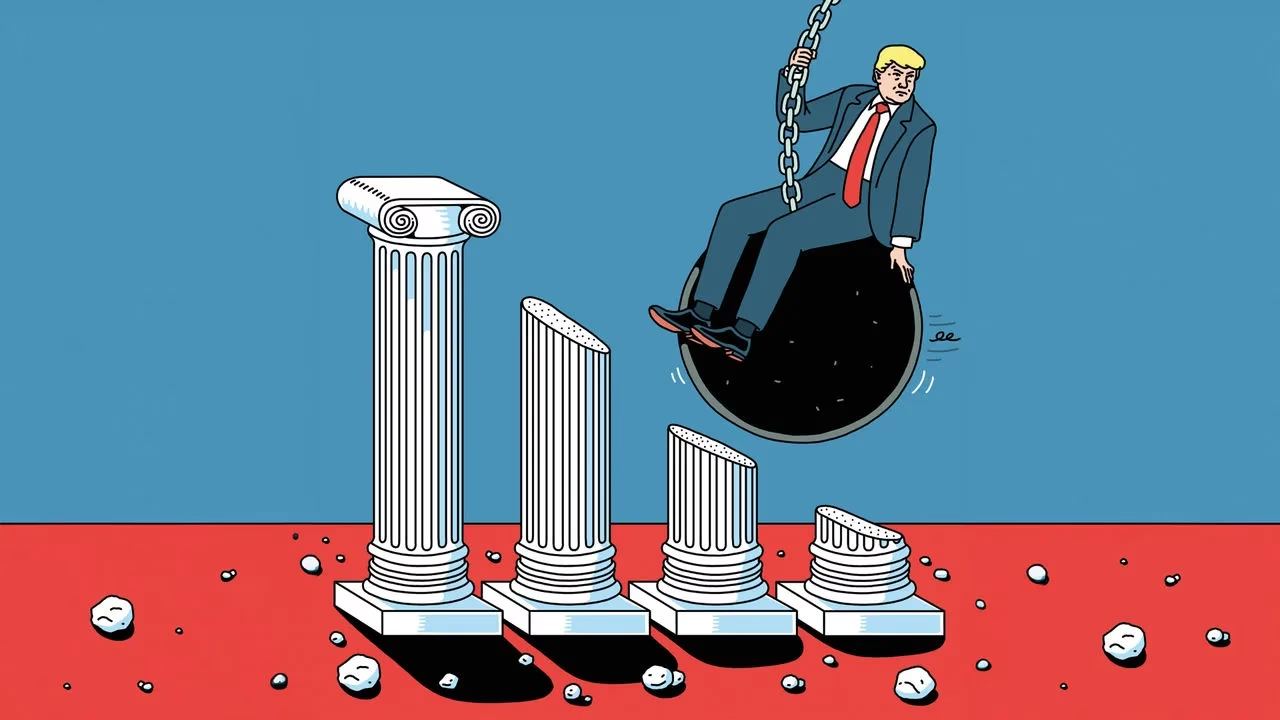
    Trump’s Useful Idiots – by Mr. Fish

       by Chris Hedges/ Original to ScheerPost/ May 27, 2025

    The media, universities, the Democratic Party and liberals, by embracing the fiction of “rampant antisemitism,” laid the groundwork for their own demise. Columbia and Princeton, where I have taught, and Harvard, which I attended, are not incubators of hatred towards Jews. The New York Times, where I worked for fifteen years and which Trump calls “an enemy of the people,” is slavishly subservient to the Zionist narrative. What these institutions have in common is not antisemitism, but liberalism. And liberalism, with its creed of pluralism and inclusiveness, is slated by our authoritarian regime for obliteration.

    The conflation of outrage over the genocide with antisemitism is a sleazy tactic to silence protest and placate Zionist donors, the billionaire class and advertisers. These liberal institutions, weaponizing antisemitism, aggressively silenced and expelled critics, banned student groups such as Jewish Voice for Peace and Students for Justice in Palestine, allowed police to make hundreds of arrests of peaceful protests on campuses, purged professors and groveled before Congress. Use the words ‘apartheid’ and ‘genocide’ and you are fired or excoriated.

    Zionist Jews, in this fictional narrative, are the oppressed. Jews who protest the genocide are slandered as Hamas stooges and punished. Good Jews. Bad Jews. One group deserves protection. The other deserves to be thrown to the wolves. This odious bifurcation exposes the charade.

    In April 2024, Columbia University President Minouche Shafik, along with two board members and a law professor, testified before the House of Representative education committee. They accepted the premise that antisemitism was a significant problem at Columbia and other higher education institutions.

    When Co-Chair of the Board of Trustees of Columbia University David Greenwald and others told the committee that they believed  “from the river to the sea” and “long live the intifada” were antisemitic statements, Shafik agreed. She threw students and faculty under the bus, including long-time professor Joseph Massad.

    The day after the hearings, Shafik suspended all the students at the Columbia protests and called in the New York City Police Department (NYPD), who arrested at least 108 students.

    “I have determined that the encampment and related disruptions pose a clear and present danger to the substantial functioning of the University,” Shafik wrote in her letter to the police.

    NYPD Chief John Chell, however, told the press, “the students that were arrested were peaceful, offered no resistance whatsoever, and were saying what they wanted to say in a peaceful manner.”

    “What disciplinary action has been taken against that professor?” Representative Elise Stefanik asked in the hearing about Columbia law Professor Katherine Franke.

    Shafik volunteered that Franke, who is Jewish and whose position at the law school where she had taught for 25 years was terminated, and other professors, were being investigated. In an apparent reference to visiting Columbia Professor Mohamed Abdou, she claimed he was “terminated” and promised he “will never teach at Columbia again.” Professor Abdou is suing Columbia for defamation, discrimination, harassment and financial and professional loss.

    The Center for Constitutional Rights wrote of the betrayal of Franke:

    In an egregious attack on both academic freedom and Palestinian rights advocacy, Columbia University has entered into an “agreement” with Katherine Franke to leave her teaching position after an esteemed 25-year career. The move — “a termination dressed up in more palatable terms,” according to Franke’s statement — stems from her advocacy for students who speak out in support of Palestinian rights.

    Her ostensible offense was a comment expressing concern about Columbia’s failure to address harassment of Palestinians and their allies by Israeli students who come to campus straight from military service — after Israeli students sprayed Palestinian rights protestors with a toxic chemical. For this, she was investigated for harassment and found to be in violation of Columbia’s policies. The actual cause of her forced departure is the crackdown on dissent at Columbia resulting from historic protests opposing Israel’s genocide of Palestinians in Gaza. Franke’s fate was sealed when former Columbia president Minouche Shafik threw her under the bus during her cowardly appearance before Congress.

    You can see my [Hedges] interview with Franke here.

    Despite her capitulation to the Zionist lobby, Shark resigned a little more than a year after assuming her position as head of the university.

    The crackdown at Columbia continues, with an estimated 80 people arrested and over 65 students suspended following a protest in the library in the first week of May. Former television journalist and Columbia’s acting president Claire Shipman condemned the protest, stating, “Disruptions to our academic activities will not be tolerated and are violations of our rules and policies…Columbia strongly condemns violence on our campus, antisemitism and all forms of hate and discrimination, some of which we witnessed today.”

    Of course, appeasement does not work. This witch hunt, whether under the Biden or Trump administration, was never grounded in good faith. It was about decapitating Israel’s critics and marginalizing the liberal class and the left. It is sustained by lies and slander, which these institutions continue to embrace.

    Watching these liberal institutions, who are hostile to the left, be smeared by Trump for harboring “Marxist lunatics,” “radical leftists,” and “communists,” exposes another failing of the liberal class. It was the left that could have saved these institutions or at least given them the fortitude, not to mention analysis, to take a principled stand. The left at least calls apartheid apartheid and genocide genocide.

    Media outlets regularly publish articles and OpEds uncritically accepting claims made by Zionist students and faculty. They fail to clarify the distinction between being Jewish and being Zionist. They demonize student protesters. They never bothered reporting with any depth or honesty from the student encampments where Jews, Muslims and Christians made common cause. They routinely mischaracterize anti-Zionist, anti-genocide and pro-Palestinian liberation slogans and policy demands as hate speech, antisemitic, or contributing to Jewish students feeling unsafe.

    Examples include, The New York Times: “Why the Campus Protests Are So Troubling,” “I’m a Columbia Professor. The Protests on My Campus Are Not Justice,” and “Universities Face an Urgent Question: What Makes a Protest Antisemitic?”; The Washington Post: “Call the campus protests what they are” “At Columbia, excuse the students, but not the faculty”; The Atlantic: “Campus Protest Encampments Are Unethical” and “Columbia University’s anti-Semitism Problem”; Slate: “When Pro-Palestine Protests Cross Into Antisemitism”; Vox: The Rising Tide of Antisemitism on College Campuses Amid Gaza Protests”; Mother Jones: “How Pro-Palestine Protests Spark Antisemitism on Campus”; The Cut (New York Magazine): “The Problem With Pro-Palestine Protests on Campus”; and The Daily Beast: “Antisemitism Surges Amid Pro-Palestine Protests at U.S. Universities.”

    The New York Times, in a decision worthy of George Orwell, instructed its reporters to eschew words such “refugee camps,” “occupied territory,” “slaughter,” “massacre,” “carnage,” “genocide” and “ethnic cleansing,” when writing about Palestine, according to an internal memo obtained by The Intercept. It discourages the very use of the word “Palestine” in routine text and headlines.

    In December 2023, Democratic Governor of New York Kathy Hochul sent a letter to university and college presidents who failed to condemn and address “antisemitism,” and calls for the “genocide of any group.” She warned that they would be subjected to “aggressive enforcement action” by New York State. The following year, in late August, Hochul repeated these warnings during a virtual meeting with 200 university and college leaders.

    Hochul made clear in October 2024 that she considered pro-Palestine slogans  to be explicit calls for genocide of Jews.

    “There are laws on the books – human rights laws, state and federal laws – that I will enforce if you allow for the discrimination of our students on campus, even calling for the genocide of the Jewish people which is what is meant by ‘From the river to the sea,’ by the way,” she said at a memorial event at the Temple Israel Center in White Plains. “Those are not innocent sounding words. They’re filled with hate.”

    The Governor successfully pressured City University of New York (CUNY) to remove a job posting for a Palestinian studies professorship at Hunter College which referenced “settler colonialism,” “genocide” and “apartheid.”

    Senate Minority Leader Chuck Schumer in his new book “Antisemitism in America: A Warning,” leads efforts by the Democratic Party — which has a dismal 27 percent approval rating in a recent NBC News poll — to denounce those protesting the genocide as carrying out a “blood libel” against Jews.

    “Whatever one’s view of how the war in Gaza was conducted, it is not and has never been the policy of the Israeli government to exterminate the Palestinian people,” he writes, ignoring hundreds of calls by Israeli officials to wipe Palestinians from the face of the earth during 19 months of saturation bombing and enforced starvation.

    The grisly truth, openly acknowledged by Israeli officials, is far different.

    “We are disassembling Gaza, and leaving it as piles of rubble, with total destruction [which has] no precedent globally. And the world isn’t stopping us,” gloats Israel’s Finance Minister Bezalel Smotrich.

    “Last night, almost 100 Gazans were killed…it doesn’t interest anyone. Everyone has gotten used to [the fact] that [we can] kill 100 Gazans in one night during a war and nobody cares in the world,” Israeli Knesset member Zvi Sukkottold Israel’s Channel 12 on May 16.

    The perpetuation of the fiction of widespread antisemitism, which of course exists but which is not fostered or condoned by these institutions, coupled with the refusal to say out loud what is being live streamed to the world, has shattered what little moral authority these institutions and liberals had left. It gives credibility to Trump’s effort to cripple and destroy all institutions that sustain a liberal democracy.

    Trump surrounds himself with neo-Nazi sympathizers such as Elon Musk, and Christian fascists who condemn Jews for crucifying Christ. But antisemitism by the right gets a free pass since these “good” antisemites cheer on Israel’s settler colonial project of extermination, one these neo-Nazis and Christian fascists would like to replicate on Brown and Black in the name of the great replacement theory. Trump trumpets the fiction of “white genocide” in South Africa. He signed an executive order in February that fast-tracked immigration to the U.S. for Afrikaners — white South Africans.

    Harvard, which is attempting to save itself from the wrecking ball of the Trump administration, was as complicit in this witch hunt as everyone else, flagellating itself for not being more repressive towards campus critics of the genocide.

    The university’s former president Claudine Gay condemned the pro-Palestine slogan “From the river to the sea, Palestine will be free,” which demands the right of an independent Palestinian state alongside Israel, as bearing “specific historical meanings that to a great many people imply the eradication of Jews from Israel.”

    Harvard substantially tightened its regulations regarding student protests, in January 2024, and increased the police presence on its campus. It barred 13 students from graduating, citing alleged policy violations linked to their participation in a protest encampment, despite an earlier agreement to avoid punitive measures. It placed more than 20 students on “involuntary leave” and in some cases evicted students from their housing.

    Such policies were replicated across the country.

    The capitulations and crackdowns on pro-Palestine activism, academic freedom, freedom of speech, suspensions, expulsions and firings, since Oct. 7, 2023, have not spared U.S. colleges and universities from further attacks.

    Since Trump took office, at least $11 billion in federal research grants and contracts have been cut or frozen nationwide according to NPR. This includes Harvard ($3 billion), Columbia ($400 million), University of Pennsylvania ($175 million) and Brandeis ($6-7.5 million annually).

    On May 22, the Trump administration intensified its attacks on Harvard by terminating its ability to enroll international students that make up around 27 percent of the student body.

    “This administration is holding Harvard accountable for fostering violence, antisemitism, and coordinating with the Chinese Communist Party on its campus,” Kristi Noem, DHS Secretary wrote on X, when posting screenshots of the letter she sent to Harvard revoking foreign student enrollment. “Let this serve as a warning to all universities and academic institutions across the country.”

    Harvard, like Columbia, the media, the Democratic Party and the liberal class, misread power. By refusing to acknowledge or name the genocide in Gaza, and persecuting those who do, they provided the bullets to their executioners.

    They are paying the price for their stupidity and cowardice.


    NOTE TO SCHEERPOST READERS FROM CHRIS HEDGES: There is now no way left for me to continue to write a weekly column for ScheerPost and produce my weekly television show without your help. The walls are closing in, with startling rapidity, on independent journalism, with the elites, including the Democratic Party elites, clamoring for more and more censorship. Bob Scheer, who runs ScheerPost on a shoestring budget, and I will not waver in our commitment to independent and honest journalism, and we will never put ScheerPost behind a paywall, charge a subscription for it, sell your data or accept advertising. Please, if you can, sign up at chrishedges.substack.com so I can continue to post my now weekly Monday column on ScheerPost and produce my weekly television show, The Chris Hedges Report.


    Wings of Change.

    Independent media is essential. Truth is not fake news, misinformation or disinformation.  “Reasonable minds can disagree on solutions, but making progress as a society requires a willingness to learn facts, appreciate nuance, and engage in meaningful debate.” Barbara McQuade, Introduction, Attack from Within, How Disinformation is sabotaging America.
    Please donate to Wings of Change and share this article to support meaningful debate in America
    Wings of Change