The US is at war. It has always been at war. Whether a world war, a proxy conflict, an armed intervention, a psyop, or a regime change mission, the United States has not enjoyed a single moment of true, unadulterated peace.
And it’s not just at war with nations abroad. The US is also at war with itself.
Empires Eat Themselves: Trump’s Absurd War on Education
Positive peace is not just the absence of violence, but also the absence of oppression. In all the years of this country’s existence, oppression has flourished, leaching away the lies told about the land of the free. Many pretend not to see the institutional apartheid and chronic subjection of minorities, but it lurks in every city, town, and neighborhood, right under the nose of the social theater we all take part in.
Well, the US is in hospice, and it’s lashing out—a last gasping breath of the inhumane, psychopathic systems that perpetuate violence, at home and abroad.
As Ariel Durant wrote, “A great civilization is not conquered from without until it has destroyed itself from within.” No country needs to declare war on the United States—it’s caught in its own self-destructive web.
There are many casualties in war other than people. Truth was killed a long time ago, a necessary death for the proliferation of our military and the subjugation of countries and people that act against our interests. The next casualties will be the very values we tell ourselves we stand for, written boldly in our Constitution—though weren’t they also a lie? Overseas, human rights are meaningless. We’ve bombed and murdered scores of people, over and over and over again, and we’ve smiled with rotting teeth and declared it was all for the greater good.
Turns out the rot was coming from within.
If the US is at war with the world and itself, then every battlefield is a frontline—Ukraine, Gaza, China, the entire exploited global south, the self-declared allies with no true sovereignty… and here, university campuses are merely one more frontline.
Universities have a particular power in the US. They generally enjoy the ability to intellectually critique the US, its subjection of people, and the crimes it has inflicted on the global population. They are meant to have a level of separation from government interference and operate as beacons of education and places of global interaction and community. This doesn’t always happen, but sometimes it does.
Why are educational institutions a threat? Because they have the tools needed to see through the cognitive shroud of militarized capitalism and talk about it. Students are the real change-makers because they haven’t spent a lifetime beaten down by the system, exhausted by its impossibilities, and bent hopeless by the apparent futility of trying to make change. Change is slow, but students are young, energized, hopeful, open-minded, and visionary. They are also the future.
Students observe injustice, and they act on it. They’ve protested every war we’ve decided was wrong long after the fact—Vietnam, Korea, Iraq, Afghanistan, and now Palestine. And every time, the government has cracked down on students, demanding arrests and university compliance with its global agenda. The Trump administration is not doing anything new—they’ve just crossed a few more lines and been obvious about it.
University protests and encampments protesting the Gaza genocide were the major catalyst for the most recent crackdowns on academia, providing the government justification for launching probes to investigate “antisemitism” on campuses. The Trump administration has also been actively targeting what they perceive to be “anti-American” fields of study, like postcolonialism, critical race theory, gender studies, and social theory—the very fields that act as tools to outthink the militarized capitalism thinking bubble. They emphasize a need for “patriotic education,” which is the newest terminology for imperialist propaganda.
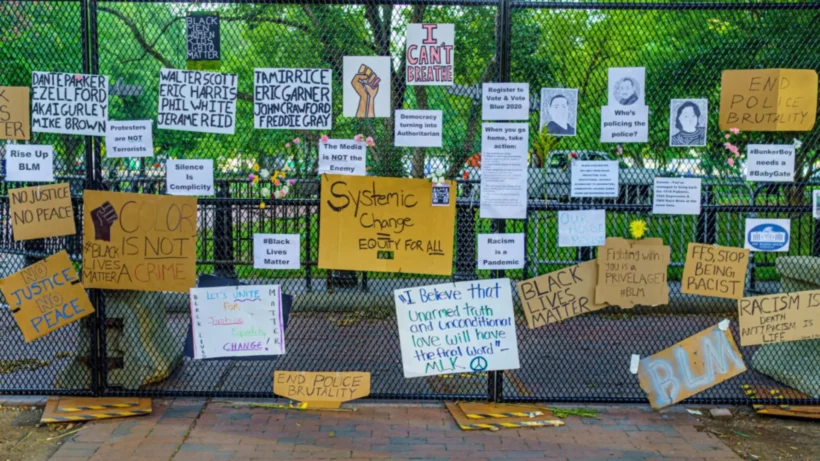
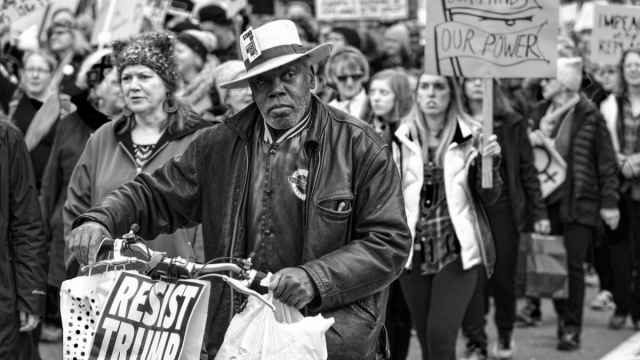
A wall of protest over police brutality. As many Americans and U.S. institutions have attempted a true reckoning with the role that race and racism play in American history and society, certain Republican legislators and conservative activists have capitalized on this backlash. (Image by Ted Eytan/Creative Commons)
These actions coincided with unprecedented persecution of students and professors who have actively criticized the Gaza genocide and the United States’ role in funding it. Visa and green card holders alike have been arrested and face ongoing deportations merely for having an opinion that acts in opposition to state interests… the very definition of fascism.
Harvard is an interesting case. Widely seen as a symbol of American elitism, it almost seems counterintuitive for an oligarchic government to oppose. But there are no rules here, and the internal power systems have gone rabid, turning on themselves in an effort to choke out their own active failings. Trump plays the populist card well, but he’s hiding behind a mirror of his own gross corruption. He calls to “drain the swamp,” while bringing his ragtag group of billionaire friends into the White House and giving them political power they should never have—a blatant contradiction many choose to ignore.
Initially, Harvard University refused to capitulate to Trump’s demands, arguing they directly violated the university’s independence and constitutional rights. In response, Trump ordered federal agencies to freeze over $100 million in funds and attempted to revoke Harvard’s ability to enroll international students.
Harvard president Alan Gerber remains steadfast in his refusal to surrender, saying that Harvard must “stand firm” and set an example for other universities that will continue to be targeted.
To counter Harvard’s steadfastness, the administration’s most recent move reached absurd new heights. Last week, a joint letter from three congressional committees accused Harvard of partaking in global supervillain-esque activities such as training genocidal paramilitary groups from China, partnering with the Chinese military using US defense funds, collaborating with Iranian government-backed scientists, and even potentially helping to develop next-gen spy robots and transplant technology with illegal organ-harvesters.
The letter was ridiculous, reading less like a serious national security inquiry and more like a bureaucratic fever dream fueled by a conspiracy-laced Wikipedia binge. The “training” of a Chinese paramilitary group was actually a public health course that was attended by members of a Chinese administrative body. The accusations of Iran funding was regarding medical research on the bacterial properties of particles done in conjunction between Imam Khomeini International University, Harvard Medical School, and Zhejiang University-University of Edinburgh Joint Institute—a great display of an international, collaborative scientific study that could help improve the lives of all people (There is clearly a profound misunderstanding on how scientific and medical research works. These fields are collaborative by design, and all nearly of these studies are public, peer-reviewed work).
And the most bizarre claim of all is that Harvard’s liver regeneration research is somehow aiding and abetting organ harvesting conspiracies. Do I even need to speak to that?
Ultimately, this letter has nothing to do with national security concerns and is merely another weapon for the current administration to throw at Harvard in its efforts to get it to capitulate to their demands. And if the anti-China warhawks can push their agenda a bit more by using their red-baiting, xenophobic grab-bag of buzzwords, then what’s stopping them? They will conflate academic exchange with espionage, collaboration with treason, and conference panels with covert operations as long as it helps obtain their end goal of wiping independent thinking off syllabuses and replacing it with strictly I-love-America propaganda. At the end of the day, they don’t want you to know how to think—they want to tell you what to think.
If the Trump administration thinks that defunding our top academic institutions will improve the already lagging education systems, and that censoring free speech and prohibiting collaborative research will be a boon for progress and productivity, they have another thing coming. These actions will only hurt the US and drag it further behind on its last-ditch efforts to maintain its slipping grasp on world domination.
Montesquieu wrote, “The corruption of each government almost always begins with that of its principles.” Well, the US has never represented the principles that it’s long claimed to stand for. Men have never been treated equally, speech has never been free, and liberty and liberation have always been things to strive for, never things that are. This is not a change that spontaneously occurred, but something that is inherent within the imperialist system. And now the decay is becoming visible, and the empire with its “immoderate greatness” is turning on itself—eating itself—and we are all vulnerable to its collapse.
Megan Russell is CODEPINK’s China is Not Our Enemy Campaign Coordinator. She graduated from the London School of Economics with a Master’s Degree in Conflict Studies. Prior to that, she attended NY, where she studied Conflict, Culture, and International Law. Megan spent one year studying in Shanghai and over eight years studying Mandarin Chinese. Her research focuses on the intersection between US-China affairs, peacebuilding, and international development.
To be hopeful in bad times is not just foolishly romantic … If we see only the worst, it destroys our capacity to do something. —Howard Zinn
We live in a world where the funeral matters more than the dead, the wedding more than love and the physical rather than the intellect. We live in the container culture, which despises the content. —Eduardo Galeano
At the heart of this book lies a stark truth: Americans, and people worldwide, are facing a moment of grave danger. This is not just a political crisis but a moral one, demanding that the search for truth be met with an urgent recognition—both individual and collective—that democracy itself is under siege. The United States is embroiled in a historic battle over the soul of democracy, the values that sustain it, and the institutions that create citizens ready to defend it. Civic culture, shared values, and the commitment to the public good are being dismantled by the rise of twenty-first-century authoritarians who camouflage their disdain for democracy by championing unreservedly for “illiberal democracy”—a deceptive code for a new breed of fascism. In an age of shrinking political horizons, the unpalatable and unthinkable have not only been normalized but airbrushed into acceptability.
Democracy’s promise is being suffocated under a growing pall of cynicism, leaving behind what David Graeber so powerfully described as an “apparatus of hopelessness.” This system is engineered to murder dreams and extinguish any vision of an alternative future, crushing not only democratic ideals but the very hope required to imagine and fight for a better world. What remains is a calculated assault on possibility, designed to suppress resistance and ensure submission to authoritarianism.
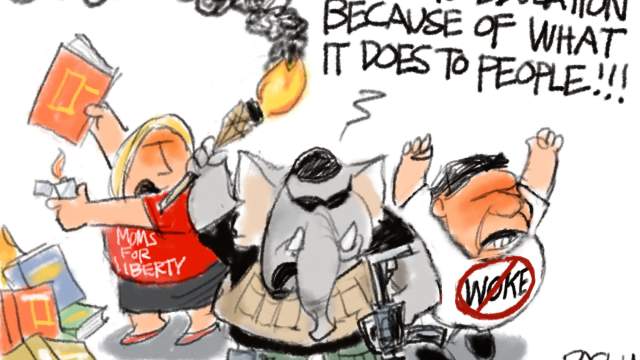
The flirtation with authoritarian rule in the United States, Hungary, Italy, Turkey, India, and other countries has given way to an unabashed embrace of the ideological fictions of despotic power, racial capitalism, and white supremacy. In the current historical moment, morality and responsibility are no longer at the forefront of shaping identity, agency, and politics. Neoliberal’s obsession with privatization, accumulating wealth, and unfettered markets is matched by its delusional call for endless growth and a disdain for the common good and social state. One outcome has been a growing collective anger and bitterness over what Tony Judt presciently identified as “growing inequalities of wealth and opportunity; injustices of class and caste; economic exploitation at home and abroad; corruption and money and privilege occluding the arteries of democracy.” Add to this the right-wing war on education, the assault on women’s reproductive rights and gay rights, along with the acceleration of systemic racism and police violence, and relentless environmental devastation.
Crisis of Conscience
In addition, students on college campuses across the country protesting against Israel’s war on Gaza and the rights of Palestinians have been and continue to be subject to suspension, expulsion, police violence, and arrests. Once again, it is important to stress that weapons of war are now being used against Black and Brown youth, college students, and journalists who are fighting for human rights, the ethic of self-determination, and are expressing resistance and mutual responsibility against injustices at home and abroad.
With the looming threats of nuclear war, accelerating climate change, staggering increases in global poverty, and the erosion of democracy worldwide, it is imperative, as Herman Kahn once urged, to start “thinking about the unthinkable.” Neither the survival of the planet nor the preservation of democracy can be assumed any longer. Rogue militarism, rampant war crimes, and the scourge of ultra-nationalism now threaten not only the elimination of Palestinians in Gaza but the outbreak of a full-scale war in the Middle East. A UN expert has warned that “at the current rate of killing and death, 15 to 20% of Gaza’s population could be dead by the end of the year … and almost entirely exterminated within a few years.” These current political earthquakes have engulfed many people into a state of “shock and stunned silence.” In an era marked by the rise of emerging fascism, the body politic finds itself submerged in moral blindness, a crisis of thought, and culture of fear. These factors have impacted large segments of the American public, preventing them from confronting the unspeakable with a sense of responsibility, dignity, and the courage to act in the service of a social justice. Under the regime of gangster capitalism, with its “alliance between globally integrated corporate capital and local neofascist elements, it is becoming increasingly challenging to imagine what a just society might resemble.” As neoliberalism loses its capacity to address social issues and fulfill its guarantees of social mobility and a fair level of economic equality, it has morphed into a rebranded from of fascism.
This transformation is particularly evident under the influence of Trump and the MAGA movement, as seen in its demonization of the “other,” the exercise of repressive political power, the propagation of a culture of lies, the embrace of white replacement theory, and the fascist militarization and organization of civil society. The latter is most notable in the emergence of white supremacists, far-right militias, nativist movements, and an amalgamation of neo-Nazis and other far-right extremist groups. As Anne Applebaum points out, dictators from Russia, Iran, Hungary, and China are now collaborating through complex networks in a coordinated effort to suppress anyone—whether individuals, groups, or governments—who dares to challenge their relentless assault on the principles of democracy. These regimes, she argues, are “bound not by ideology but by a shared, ruthless commitment to preserving their personal wealth and power.” This global alliance of autocrats, aptly named “Autocracy, Inc.,” threatens the very ideals and promises of any viable democracy. Social and historical amnesia are now paralleled by ongoing attempts by far-right politicians across the globe to eradicate the notion that emancipatory policies are inseparable from critical thought and the institutions that facilitate it. References to the public good and shared responsibilities have morphed into terms of contempt. This disdain of the social state and social provisions has deep roots, evident in the works of theorists such as Friedrich Hayek and Milton Friedman (unashamed supporters of the murderous Pinochet) as well as in the policies of neoliberal politicians such as Ronald Reagan and Margaret Thatcher.
Reagan famously stated in his 1981 inaugural address that “government is not the solution to our problem; government is the problem,” while Thatcher expanded on this piece of political rhetoric by declaring that “there is no such thing as society, there are only individuals and families.” This is the language of social and moral irresponsibility shaped by a malignant politics that easily succumbs to the service of violence. As Maaza Mengiste notes it is:
A rhetoric of desperation and devastation molded into the incomprehensible, then vomited out in images and words that we cannot ignore though we have tried. It is a language that uses trick mirrors, that employs trapdoors through which meaning can slip and hide. It is strong enough to reside in troubling landscapes, malleable enough to be both poetic and cruel. It has the capacity to draw us in and push us back and send us spinning with speechless grief.
Dire threats to democracy, if not humanity itself, must be addressed, in part, through the crucial recognition that education is a fundamental element of mass social change. It is not an exaggeration to state that education has become the great civil rights issue of our era. Educators, workers, young people, cultural workers, and others are increasingly heeding the words of the great abolitionist Frederick Douglass, who rightly argued that freedom is an empty abstraction if people fail to act on their anger and beliefs,and that “if there is no struggle, there is no progress.” Nowhere is this more evident than in the collective resistance of hundreds of students and faculty on campuses across American who have used their voices and bodies to protest against Israel’s savage and inhumane war on Gaza and the Palestinian people.
At stake here is the question of what our responsibility might be in the face of the unspeakable. What has become unspeakable is the INTRODUCTION force of staggering inequality and its intersection with race, gender, and class oppression. As Keeanga-Yamahtta Taylor has observed, we need a new language that allows us think of major social issues such as racism, sexism, disposability, and war “in big and broad strokes.” Rather than address such issues independently and in a fragmented and isolated way, social problems such as job discrimination, book censorship, poverty, a broken healthcare system, the burden of alienating misery, and the war on women, it is crucial to think in historical, relational, and comprehensive terms. This becomes more difficult in a neoliberal age governed by market mania, excessive self-interest, unattached individualism, and short-term goals. Under such circumstances, the language of public purpose, shared responsibility, and social cohesion is subordinated to the fatuous vocabulary of measurement, quantification, commercial exchange, and increasingly lies, conspiracy theories, and the theatrics of shock and awe.
It is important to analyze the anti-democratic economic, social, and culturally driven forces at work in America as a unified, single system and integrated totality. Only then will it be possible to understand the true nature of the amalgamated forces of racial capitalism at work historically and in the present moment, leading to twenty-first-century fascism. Within a broader notion of totality, it will be possible to recognize the magnitude of the perils that face American democracy and to act on the obligations of justice that speak to the imperatives of moral dignity, equality, and freedom, demanding attention from our individual and collective conscience. Under such circumstances, it will become possible to overcome deepening divisions in American society in order to form what Nancy Fraser calls a new hegemonic bloc capable of dismantling the shared roots of race, class, and the intensive suffering under cannibal capitalism. Moreover, as the bankruptcy of gangster capitalism becomes more evident, visible, and subject to debate, the terms of criticism can shift from a liberal call for simple reforms to a more critical struggle for a social and economic transformation of society.
As Mengiste notes, what is our responsibility to democracy when it is in peril? How do we fight a language that erodes our humanity, which positions us to stand numb and silent? What language can be used “to expand the reach of justice, prevent us from turning away and inform our actions with greater empathy,” compassion, and the will to fight for a future free of the scourge of neoliberal capitalism and the authoritarians, demagogues, and corrupt pundits and politicians who benefit from it?
Politics follows culture, implying that the urgent task of resistance begins with shaping mass consciousness. This is a central aspect of education and cultural politics, necessitating that progressives and others communicate with people in a manner that resonates with their everyday lives and hopes while inspiring their engagement in a mass struggle for political, personal, and economic rights. Such a task calls for placing morality and social responsibility at the forefront of agency and the center of politics, embracing the idea and practice of radical democracy. Silence should be understood and interrogated as a form of complicity, and political indifference as a foundation that normalizes authoritarianism.
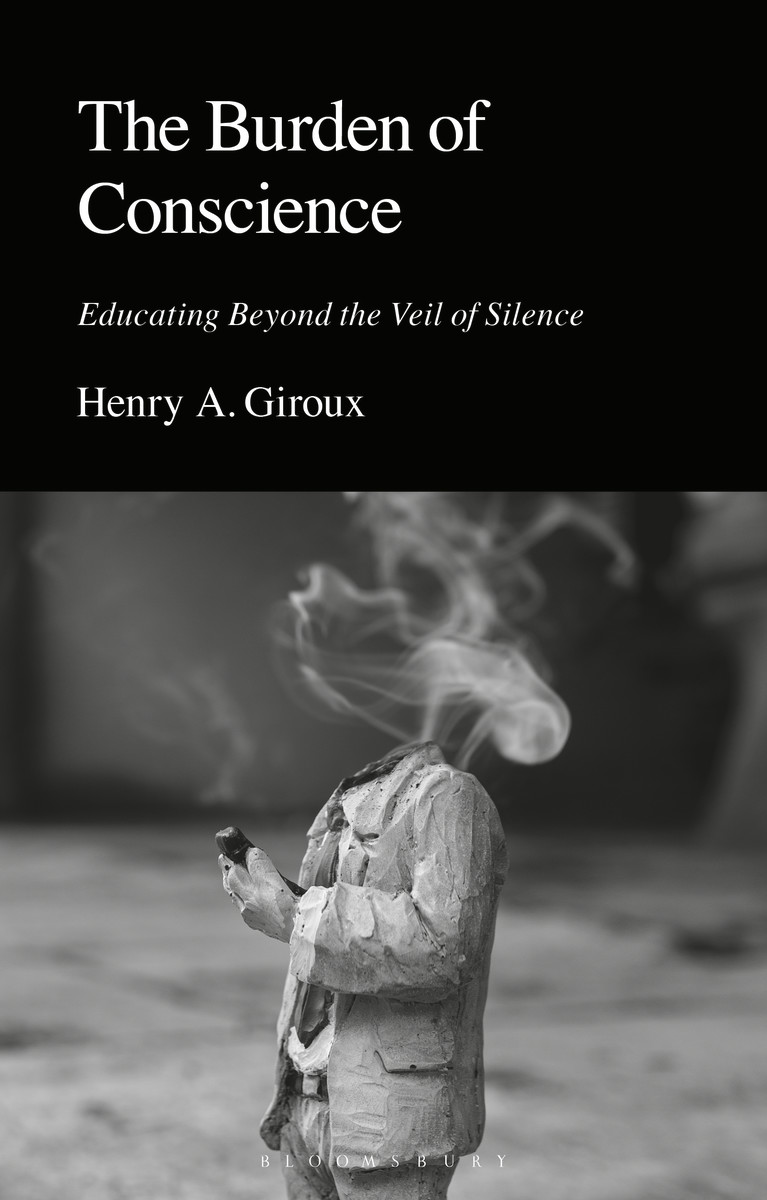
The Burden of Conscience focuses on how the personal and the political inform each other, emphasizing how the act of translation creates spaces for resistance and struggle. It aims to expose the harsh realities of living under neoliberalism, massive structures of inequality, a pandemic of despair and loneliness, a carnival of violence, and the burdens of systemic racial capitalism. It attempts to make power visible, dismantle those social formations and politics that render people voiceless while unleashing the capacity among the public to imagine a future where economic, social, and political rights and justice form the cornerstone of a radical democracy. Crucial in this project is to illuminate a central question and pedagogical intervention, connecting matters of agency and identity to the conditions, narratives, and social forms of oppression people are forced to endure—all of which are necessary for blasting open neoliberal hegemony, creating sites of rupture, and glimpsing the possibility of a renewed critical cultural politics.
Central to The Burden of Conscience is the call for educated hope, and a revival of the public imagination as central elements in the struggle for freedom, equality, and social justice. This is a call for militant hope that places individual and collective agency at the core of education, emphasizing the need to change the way people think, act, feel, and identify themselves and their relations to others. Yet, it goes beyond a call for a pedagogical awakening; it calls for civic courage—a space where truth can emerge, where risks are essential, and where systems of injustice can be dismantled, overcome, and replaced with a mass-collective movement for social change. Central to this challenge is addressing how critical education can fulfill its civic function at a time when there is a massive flight from morality and social responsibility.
Zygmunt Bauman and Ezio Mauro in their book, Babel, are right in arguing that we live at a time in which feeling no responsibility means rejecting any sense of critical agency and refusing to recognize the bonds we share with others. Under such circumstances, to borrow a phrase from Ayana Mathis, many Americans have not only “descended into the deep canyons of grief,” but have also become depoliticized and lost their ability to cut through their “numbness and denial.”
This book serves as an appeal to recognize those who have been left behind by authoritarian politicians and fascist political parties. It calls upon the public “to think big,” aiming to connect the personal, political, cultural, and historical in a modern interpretation of C. Wright Mills’s sociological imagination. Capitalism’s alleged truths often remain obscured behind the veil of spectacles, false promises, diversions, and lies. As the Palestinian poet Fady Joudah reminds us: “language dies when it is no longer able or willing to decode the petrified, the coded. Language dies when it is too certain of itself. Language dies when totalitarian thinking convinces us that it is not totalitarian thought, because we are eternally incapable of totalitarian thought. Language dies when the memory that speaks it rots.”
Simultaneously, language flourishes and thrives in the discourse of critique, possibility, and mass struggle. It finds vitality when it impels individual and collective conscience to action, rooted in a profound commitment to justice, dignity, freedom, and solidarity. Fortunately, students on campuses across the United States are currently revitalizing the language of critique, resistance, and hope as they fight for the freedom of the Palestinian people.
Language and politics flourish when spaces are created wherein the unimaginable becomes possible, and the capacity to think differently empowers us to act differently. Confronting the weight of conscience serves as a potent catalyst for imagining a future where justice reigns. It also furnishes the inspiration and vigor to connect understanding, critique, and militant hope in pursuit of a radical democracy. Moral witnessing, alongside the insights of history, lays the groundwork wherein thought and action imbue what Judith Butler calls “our relational obligations as an interdependent global community.”
Racism, militarism, war, poverty, and ecological devastation are covered over in a blistering and ahistorical disdain for Trump, his authoritarianism, and his politics of violence. Martin Luther King’s call to confront “the evil of racism, the evil of poverty, and the evil of war” has been sidelined in both liberal and conservative discourse and politics, erased from the moral framework of the current era.
Morality increasingly collapses under the weight of historical amnesia, the repression of dissent, and the ruination of civic culture. Right-wing attacks on historical consciousness and memory shore up a defense against moral witnessing while providing a cover for willful ignorance. Right-wing politics and culture mangles language in a sea of lies and deceits. As MAGA politicians turn language into a weapon while weaponizing their disimagination machines, language loses its ability to awaken consciousness under the suffocating weight of the spectacle and the crazed vocabulary of demagogues. Ruth Ben-Ghiat rightly argues that authoritarians increasingly in the service of a fascist politics use language as a tool of violence, extinguish meaning, and in doing so destroy hope. She writes:
So, authoritarians turn language into a weapon, as well as emptying key words in the political life of a nation such as patriotism, honor, and freedom of meaning. We are well on our way in America to what I call the “upside-down world of authoritarianism,” where the rule of law gives way to rule by the lawless; where those who take our rights away and jail us pose as protectors of freedom; where the thugs who assaulted the Capitol on Jan. 6 are turned into patriots; and where “leadership means killing people,” as Tucker Carlson put it recently, justifying Vladimir Putin’s killing of Alexei Navalny.
Social responsibility is adrift and is no longer associated with how American society lives up to its democratic ideals. Civic culture has become the enemy of those far-right and neoliberal warriors who fear that public spheres offer a critical space to challenge anti-democratic ideas, values, and social relations. In the age of emerging fascism, the politics of the void replaces the energized spaces of critical thought, dialogue, civic engagement, and social movements. As Elie Wiesel once argued, we live in “a strange and unnatural state in which the lines blur between light and darkness, dusk and dawn, crime and punishment, cruelty and compassion, good and evil.”
With the exception of the rising tide of youth resistance on many fronts, Americans increasingly inhabit a politics of the void marked by a culture of cruelty and indifference. This is a politics in which the suffering of others is avoided, unnoticed, or disparaged. Under such circumstances, memory is erased or rewritten in the language of lies, pain is overlooked, and hope is exiled to the world of silence. As Wiesel notes, “Of course, indifference can be tempting—more than that, seductive. It is so much easier to look away from victims. It is so much easier to avoid such rude interruptions to our work, our dreams, our hopes.” In contemporary terms, this means looking away from the suffering in Gaza, refugee camps, the impoverished, and those others reduced to an abstraction.
The politicians and entrepreneurs of death ignore the blood produced by their weapons and invest heavily without accountability in state and global terrorism. Entire families, children, schools, hospitals, and places of worship are bombed, and women and children are killed as the barbarians of fascism and the arms industries gloat over their mounting profits made from bloodshed and unimaginable suffering. As Chris Hedges has argued, gangster capitalism has reached its logical and toxic conclusion, “fertilized by widespread despair, feelings of exclusion, worthlessness, powerlessness and economic deprivation.” The outcome is a slide into a fascist politics that portends the death of the idea and promise of democracy in the United States.
The Vichy journalists and media outlets now more than ever trade in “objectivity” and calls for even handedness as violence escalates at all levels of society. Trump is treated as a normal candidate for the 2024 presidency despite embracing nihilistic forms of lawlessness. He spews racism, hatred, and endless threats of violence, indifferent to calls for accountability, however timid. Cowardice hides behind the false appeal of a wobbly notion of balance. The mainstream media have a greater affinity for the bottom line than for the truth. Their silence amounts to a form of complicity.
The Republican Party is now mostly a vehicle for fascist politics. The United States has reached the endpoint of a cruel economic and political system that resembles a dead-man walking—a zombie politics that thrives on the exploitation of the working class, immigrants, the poor, dispossessed, and helpless children dying under the bombed-out rubble of state terrorism. White Christian nationalism merges with the most extreme elements of capitalism to enforce cruel and heartless policies of dispossession, elimination, and a politics of savagery. Mouthfuls of blood saturate the language of authoritarianism, and policies of destruction, exploitation, and utter despair follow. Public time based on notions of equality, the common good, and justice fade into the dustbin of a whitewashed history. As James Baldwin once noted, until the Nazis knock on their door, these “let’s be balanced” types refuse to have the courage to name fascism for what it is.
In the face of emergency time, it is crucial to develop a great awakening of consciousness, a massive broad-based movement for the defense of public goods, and a mobilization of educators and youth who can both say no and fight for a socialist democracy. The fight against fascism cannot take place without innovative ideas, vision, and the ability to translate them into action. Dangerous memories and the resuscitation of historical consciousness are even more necessary as democracy is choking on the filth of demagogues, white nationalism, class warfare, militarism, and Christian nationalism. Those Americans who believe in democracy and justice can no longer accept being reduced to a nation of spectators; they can no longer define democracy by reducing it to a voting machine controlled by the rich; nor they can equate it with the corpse of capitalism. They can no longer allow the silence of the press to function as a disimagination machine that depoliticizes the public; they can no longer allow education to be pushed as a machinery of repression, historical amnesia, and ignorance.
I am not engaging in a paralyzing pessimism, but rather highlighting the urgency of a historical moment that is on the verge of spelling the death knell for America as an idea, as a promise of what a radical democracy might presume for the future. We live in an era of emergency time—a flurry of crises in which time has become a disadvantage, and public time has become a necessity and call for militant thought and action. Without agency there is no possibility of imagining a future that does not echo the fascism of the past; without possibility there is no reason to acknowledge the very real material and ideological threats currently faced by the United States and the rest of the globe.F
Fascism is no longer interred in history. The spirit of Weimar 1933 is being replayed. How does one explain Trump’s openly fascist claim that he plans, once elected, to imprison political dissidents in prison camps? Or his pledge “to root out the communist, Marxist, fascist, and the radical left thugs that live like vermin within the confines of our country, that lie and steal and cheat on elections and will do anything possible—they’ll do anything, whether legally or illegally—to destroy America and to destroy the American dream.” Trump’s belligerent rhetoric merges a vocabulary of dehumanization with a language of racial cleansing and repeated threats of violence. He claims that immigrants are “poisoning the blood of our country,” states that “the former chairperson of the Joint Chiefs of Staff deserves to be executed,” and encourages police officers to shoot shoplifters.
In his 2024 campaign, Trump has brazenly embraced authoritarianism, openly stating with a smirk that he desires to be a dictator. This is far from a surprising claim. Trump has a long history of expressing admiration for autocrats and strongmen, consistently praising dictators throughout his political career. His delusions of grandeur are nothing new—he has repeatedly fantasized about wielding unchecked power, reinforcing his dangerous ambition to undermine democratic institutions. Trump has “hosted Hungarian dictator Viktor Orbán—another blood-and-soil exponent of nationalist ethnic purity and an eager helpmeet of Vladimir Putin.” At a Dayton rally, Trump was caught on a hot mic declaring that North Korean dictator Kim Jong Un was also his kind of guy: “‘He speaks, and his people sit up in attention. I want my people to do the same’.” In addition, he has repeated endlessly the big lie about the 2020 election being stolen, has promised a “bloodbath for the country” if he is not elected in 2024, and claimed that if elected he would pardon the convicted criminals who tried on January 6 to overthrow the presidential election by force. Timothy Snyder observes that Trump gives voice to the notion “that violent insurrection is the best form of politics.” Snyder puts Trump’s lies and threats in a context which echoes a history of fascist violence. He writes:
The cult of criminals as martyrs also suggests a historical context: the fascist politics of violence … The fascist-style martyrdom cult justifies violence, in two ways. It makes a hero of criminals, thereby making criminality exemplary. And it establishes prior innocence—we suffered first, and therefore anything we do to make others suffer will always be justified … For fascists, political opponents are enemies because they are animals or are associated with animals.
For the far right and MAGA politicians, fascist politics is now displayed and enacted as a badge of honor. There is more at work here than an echo of former authoritarian regimes. The ensuing threats from Trump and his warrior-soldier types lead directly to the Gulags and camps in a former age of authoritarianism. The spirit of the Confederacy along with an upgraded and Americanized version of fascism is back. The corpse-like orthodoxies of militarism, racial cleansing, and neoliberal fascism point to the bankruptcy of conscience, an instance in which language fails and morality collapses into barbarism, and a politics where any vestige of democracy is both mocked and attacked.
What is clear is that there is a massive rebellion against democracy taking place in the United States and across the globe. And it is not simply being imposed from above through military dictatorships. People now vote for fascist politics. MAGA Republicans openly celebrate politicians who not only unabashedly dismiss democracy but also make racist remarks. CNN reported that Mark Robinson, the Republican nominee for governor of North Carolina, once referred to himself as a “black NAZI” and “expressed support for reinstating slavery” on a pornography website’s message board over a decade ago. Hannah Knowles writing in The Washinton Postoffered the following deluge of offensive comments Robinson made before winning the GOP nomination for governor. She provides the following summary:
There was the time he called school shooting survivors “media prosti-tots” for advocating for gun-control policies. The meme mocking a Harvey Weinstein accuser, and the other meme mocking actresses for wearing “whore dresses to protest sexual harassment.” The prediction that rising acceptance of homosexuality would lead to pedophilia and “the END of civilization as we know it”; the talk of arresting transgender people for their bathroom choice; the use of antisemitic tropes; the Facebook posts calling Hillary Clinton a “heifer” and Michelle Obama a man.
Despite the fact that Robinson has a long history of making misogynist, racist, and anti-transgender comments, Trump has enthusiastically endorsed him, absurdly calling Robinson “Martin Luther King on steroids.” The latter comment made in spite of the fact that Robinson once accused King Jr. “of being a white supremacist.” This shocking alignment with unapologetic racists and would-be fascists underscores how far the party has strayed from democratic and moral principles.
Disimagination machines such as the mainstream media and far-right online platforms, many of which have become platforms for billionaires spreading conspiracy theories, have become powerful ideological fictions—pedagogical machineries of political illiteracy inflicting upon the American people an astonishing vacancy that amounts to a moral and political coma. As one writer for New York Magazine succinctly summarized, powerful social media platforms are now home to dangerous, illiterate fictions. He writes:
Bill Ackman, a wealthy hedge fund manager turned Trump supporter began posting uncontrollably about a right-wing theory that there is (or was) a whistleblower at ABC News, who claims the network gave its questions to Harris in advance of the presidential debate, and then perished in a car crash. [He adds that] Elon Musk, one of the world’s wealthiest people and a large financial supporter of Trump’s ground operation, predicted on his social media platform that Harris’s first act if elected will be to ban X and arrest Musk.
The rapid spread of such unfounded conspiracies and lies highlights the dangerous intersection of wealth, political influence, and misinformation. Stacked atop the ever-growing mountain of lies and relentless conspiracy theories pushed by the right-wing financial elite and others are the ceaseless media stories peddling the absurd and grotesque falsehoods that sacrifice the truth and social responsibility for mindless and often cruel political theater. Trump and his supine backers have ushered in an age of fabricated narratives that become clickbait for an ethically spineless media landscape, where both centrist and right-wing outlets spectacularize eye-popping stories for profit. Let’s be clear, this ploy goes beyond a politics of mere distraction.
The merging of lies, ignorance, and violence was on full display when Trump in a presidential debate with Vice President Kamala Harris falsely claimed that Haitian immigrants were stealing and eating pets in Springfield, Ohio. These racist lies did more than spur endless memes and jokes on the social media and late night comedy shows, “they also produced a familiar pattern in which the city was subject to bomb threats that shut down the elementary schools … swatting attacks meant to intimidate community members, [and a series] of high-speed-networked harassment that over the last few years has largely focused on community events for queer and trans people.” Such lies give Trump’s merry band of white supremacists and proto Nazis the opportunity to smear immigrants, people of color, and anyone else considered “other.” In this instance, such language is more than a vehicle for spreading lies and misinformation. As Toni Morrison reminds us, this systemic looting of language … does more than represent violence; it is violence.”
What is often overlooked in mainstream media discussions of attacks on immigrants, Black people and other marginalized groups are the driving force of white nationalism. For example, Trump’s attacks on Haitian immigrants are frequently reduced to simple racism, when in fact they should be recognized as part of a broader white nationalist agenda. These attacks are about more than just racism; they are a key aspect of white nationalism, which targets anyone who is not a white, wealthy, straight, Christian male. Under the guise of white replacement theory, a wide range of people—beyond just people of color—are “othered.”
This broader agenda is glaringly evident in the assault on women’s reproductive rights, which seeks to control women’s bodies, particularly encouraging white women to have more children out of fear that people of color are increasing in number. What we are witnessing is a calculated and deliberate assault on the very foundations of democracy, undermining the fabric of society with each repeated lie. Under such circumstances, the underlying causes of poverty, dispossession, exploitation, misery, and massive suffering disappear in a spectacularized culture of silence, commodification, and cult-like mystifications. As civic culture collapses, the distinction between truth and falsehoods dissolves, and with it a public consciousness able to discern the difference between good and evil. Too many Americans have internalized what Paulo Freire once called the tools of the oppressor. They not only accept the shift in American politics towards authoritarianism, but they also support the idea itself. Trump’s enduring public support is a chilling reflection of his overt embrace of fascist politics. He openly calls for revoking the Constitution, boasts of wanting to be a “terminate the constitution,” and threatens to weaponize the presidency to imprison political opponents like Liz Cheney if he regains power. This dangerous rhetoric, rather than alienating his base, seems to strengthen it—revealing a disturbing willingness among many to abandon democratic principles for authoritarian rule.
On the side of resistance, Les Leopold is right in arguing that the fight against Trump’s brand of neoliberal fascism will never succeed until both “our sense of the possible expands” and we take seriously “that real education about big picture issues can make a difference in how people see the world.” At the same time, any commanding vision of the future must embrace’ as part of a viable pedagogical struggle, anti-capitalist values capable of mobilizing a broad-based movement in which the call for political and personal rights is matched by the demand for economic rights. The late Václav Havel, the world-renowned playwright, statesperson, and human activist, astutely noted the need for a massive resistance against the leveling of meaning, language, subjectivity, and social responsibility. His call for a revolution in human consciousness echoes that of Martin Luther King Jr.’s similar appeal for a revolution of values. For Havel, morality had to be put ahead of politics, economics, and science, and for that to happen he states that “the main task in the coming era is … a radical renewal of our sense of responsibility. Our conscience must catch up to our reason—otherwise we are lost.”
For Havel, matters of consciousness, subjectivity, and agency are a crucial part of a politics of resistance. But they are only the beginning of the long struggle towards a radical restructuring of society. Ideas have to be articulated to action in order to address the political pathologies of our time. There can be no viable resistance without a massive campaign against both gangster capitalism—with its destructive emphasis on economic inequality, the plundering of the environment, and widespread attacks on social justice—and a movement to restructure rather than reform society based on democratic socialist values. Militant critique must be matched by a militant sense of possibility. Howard Zinn got it right when he argued that:
To be hopeful in bad times is not just foolishly romantic … If we see only the worst, it destroys our capacity to do something. If we remember those times and places—and there are so many—where people have behaved magnificently, this gives us the energy to act, and at least the possibility of sending this spinning top of a world in a different direction … The future is an infinite succession of presents, and to live now as we think human beings should live, in defiance of all that is bad around us, is itself a marvelous victory.
We live in an era of dire emergencies. The urgency of the times demands a politics that recognizes the looming threat of fascism. Such recognition presents us with a historical moment in which it is crucial not to give up on the imagination, to enact the allegedly impossible as possible, and to embrace a vision of the future and a sense of collective struggle in which there is life beyond gangster capitalism and its updated twenty-first-century fascist politics. Against this authoritarian nightmare is the need for a politics rooted in creating a broad-based multiracial working-class movement that embodies a sense of moral courage and civic imagination capable of both a revolution of values and a commitment to social change. Resistance must begin with the question of what kind of world we want to live in. Wendy Brown sums up well the importance of this question. She writes:
The question of what kind of world you want to live in … has bearing when your life is in your own hands, when you have a little or a lot of power or latitude, when you decide every day what to support or decry, nourish or fight. The question of what kind of world you want to live in asks you to become responsible to and for a world that you didn’t build, where the terms of entry are not fair and can be hard.
At the heart of this call for resistance is a notion of education that instructs young people, cultural workers, and those on the margins of society that morality and responsibility have to be at the forefront of agency, politics, resistance, and social change. With the death of the ethical imagination, the bonds of sociality and reciprocity disintegrate, vital public spheres are eliminated, and the demands of justice, equity, and freedom become relics of history. We live in a time when the habits of democracy are disappearing just as the existing culture of fear and lying depoliticizes people. With the rupturing of the social bonds that provide meaning, dignity, and security, fascism begins with the language of dehumanization, the murder of dreams, and an imposition of hopelessness. Memory has no home in an anti-democratic culture of repression and violence. With Donald Trump’s re-election, the United States stands on the brink of a fascist resurgence. Now, more than ever, it is essential to interrogate the past to understand how history’s lessons can illuminate a path forward against this authoritarian threat. Only by confronting these dark realities can we hope to defend the future of democracy. Katharine Hodgkin and Susannah Radstone are right in arguing that “the past has strategic, political, and ethical consequences [and that] contests over the meaning of the past are also contests over the meaning of the present and over ways of taking the past forward.” Not only is it time to rethink the kind of world we want to live in and take it forward, it is also time to make education central to a politics in which it becomes possible “to challenge and imagine futures beyond our current situation.” This suggests rethinking politics and everyday experience through the power of historical memory, language, education, and culture in order to connect the personal, historical, and larger social forces.
The opinions expressed here are solely the author’s and do not reflect the opinions or beliefs of the LA Progressive.
Henry A. Giroux currently holds the McMaster University Chair for Scholarship in the Public Interest in the English and Cultural Studies Department and is the Paulo Freire Distinguished Scholar in Critical Pedagogy. His most recent books include: The Terror of the Unforeseen (Los Angeles Review of books, 2019), On Critical Pedagogy, 2nd edition (Bloomsbury, 2020); Race, Politics, and Pandemic Pedagogy: Education in a Time of Crisis (Bloomsbury 2021); Pedagogy of Resistance: Against Manufactured Ignorance in the Age of Counter-Revolutionary Politics (Bloomsbury, 2023), and coauthored with Anthony DiMaggio, Fascism on Trial: Education and the Possibility of Democracy (Bloomsbury, 2025). Giroux is also a member of Truthout’s board of directors.