Roger Waters This is Not a Drill Live From Prague – The Movie Saturday, November 15, 2025, 1:00 pm- 3:45 pm 4:00 pm: Roger Waters LIVE with Q and A: He will join us live via Zoom after the screening for a Q and A session.
Holy Trinity Church: 2730 E. 31st Street Minneapolis MN 55406. Enter on East side of the building. The parking lot entrance off Lake Street is between 28th and 29th Avenues – next to the “Trinity on Lake” building.
Cosponsored by Veterans for Peace
Chapter 27 Minneapolis
This is Not a Drill: Live From Prague is a 2023 concert film by Pink Floyd cofounder Roger Waters, featuring a live performance by Roger and the band. The film combines songs from his 60-year career with Pink Floyd and his solo work, and is described as a stunning “cinematic extravaganza” with political commentary that includes elaborate staging and visual effects.
The show is an indictment of the militarism, perpetual war, imperialism, settler colonialism, and the “corporate dystopia” we all struggle to survive and a call to action to love, protect and share our precious and precarious planet home.
This is Not A Drill, with a message of love, hope and unity, is “dedicated to brothers and sisters all over the world who are engaged in the existential battle for the soul of humanity.”
Roger is known worldwide for not only his music, but his work for justice and peace. In 2025 he won the Artistic War Abolisher of 2025 Awardfrom World Beyond War for his “incredibly powerful combination of songwriting, singing, speaking and performing against the horrors of war,” in the words of David Swanson, World Beyond War executive director.
Directors: Roger Waters, Sean Evans / Distributed by Trafalgar, Released 2025 / 2 h 24 m
Film cosponsors are Women Against Military Madness and Veterans For Peace Chapter 27, with thanks to Holy Trinity Church for their support.
“There has been a tolerance of Israel’s impunity for decades,” says Albanese. “However, the United States is the single most important factor of crisis in the United Nations.”
Israel’s war on Gaza is the deadliest conflict for journalists in recorded history. In an attack on Nasser Hospital in Gaza Monday, Israel killed five more journalists in addition to over a dozen others. Israeli Prime Minister Benjamin Netanyahu claimed the hospital attack was a “tragic mishap,” but just hours later, Israeli forces killed a sixth journalist. “There is a pattern of targeting and killing journalists that lets us think that there is an intention,” says Francesca Albanese, U.N. special rapporteur on the occupied Palestinian territory.
As countries prepare for the U.N. General Assembly, Albanese notes the complicity of Western states in the genocide in Gaza, particularly the United States. “There has been a tolerance of Israel’s impunity for decades,” says Albanese. “However, the United States is the single most important factor of crisis in the United Nations.”
Note: Video also included below: “Chicago Leaders Prepare to Face the Dictator Head On” Below the Chicago video is the full transcript of Franceca Albanese’s intertiew video with Amy Goodman of Democracy Now!
“We Must Defeat Fascism”: Chicago Alderman on Trump’s Threat to Deploy Troops to City
Transcript for Francesca Albanese
This is a rush transcript. Copy may not be in its final form.
AMYGOODMAN: Human rights and press freedom groups are denouncing Israel’s attack on Nasser Hospital in Gaza Monday that killed at least 21 journalists — that killed at least 21 people, including five journalists. According to eyewitnesses, Israel carried out a double-tap strike on the hospital. In the initial strike, a drone hit Hussam al-Masri, a cameraman who worked for Reuters. Then another strike, minutes later, hit journalists and rescue workers who were responding to the initial strike.
Israeli Prime Minister Benjamin Netanyahu claimed the hospital attack was a, quote, “tragic mishap.” But just hours later, Israeli forces killed a sixth journalist, Hassan Douhan, a well-known editor at Al-Hayat Al-Jadida. He was killed when an Israeli tank shelled a tent sheltering displaced people in Khan Younis.
Over the past 23 months, Israel has barred all foreign journalists from reporting inside Gaza, while systematically killing Palestinian journalists. According to one count, Israel has killed least 245 journalists. On Monday, Thibaut Bruttin, the director general of Reporters Without Borders, denounced Israel’s attack on journalists.
THIBAUTBRUTTIN: When and where is it going to end? Are we going to let the Israel Defense Forces continue the repeated killing of journalists? There is international law. There are guarantees that should be granted to journalists covering conflicts. And none of that seems to be applying. So, we need to be very clear about the fact that none of the journalists that are allegedly terrorists are terrorists. They are professional journalists working for legacy professional media, like, for example, Reuters or, for example, AP.
AMYGOODMAN: In other news from Gaza, three more Palestinians have starved to death, bringing the total to at least 303.
We’re joined right now by Francesca Albanese, the U.N. special rapporteur on the occupied Palestinian territory. She’s joining us from Tunis, Tunisia.
Welcome back to Democracy Now!, Francesca Albanese. Can you start off by responding to the killing of the, at this point, in the last day, six journalists, five of them in a double-tap strike on Nasser Hospital?
FRANCESCAALBANESE: Thank you, Amy. Yeah, of course.
Look, in a situation of conflicts, targeting or killing journalists is unlawful. Journalists, like doctors and medical personnel and rescues, all those who have been killed in this attack, are civilians, so killing them is unlawful. They are protected under international humanitarian law.
However, here, it’s not an isolated incident. Journalists have been killed in such high numbers. Some say 200 have been documented. Al Jazeera speaks of 270 journalists killed. So there is a pattern of targeting and killing journalists, that let us think that there is an intention behind it. There is a widespread and systematic attack against them, like there is a systematic and widespread attack against civilians. And this might qualify as also as a crime against humanity in and of itself.
However, however, I want to remind everyone that we are on the 688th day of the assault against Gaza, which an increasing consensus denounces as genocidal. And there is famine, and there is this complete destruction of landscapes in Gaza. So, the question is: What are member states waiting exactly to intervene and stop this carnage?
JUAN GONZÁLEZ: And, Francesca Albanese, you have said that there have to be response. You’ve called for sanctions against Israel. Could you talk about how those might work, especially, as you mentioned, the fact that state governments are not taking any action?
FRANCESCAALBANESE: Oh, absolutely. Look, I would like people to understand this in the broader context of international law. No later than last year, the International Court of Justice has confirmed that Israel’s presence in the West Bank, the Gaza Strip and East Jerusalem is unlawful, must be dismantled totally and unconditionally. And the General Assembly has also given Israel a very generous deadline of one year to do so, which will expire in a month from now. In the face of this, member states have an obligation not to aid and assist in any possible ways a state like Israel in maintaining the situation created by Israel’s unlawful presence. So, while it is abhorrent that they are not stopping Israel, this delay increases their level of responsibility, their violation of international law, and possibly their complicity with the crimes that Israel is committing.
This is why my recommendations are for member states who do not want to incur in this legal — in their legal responsibilities, and also out of humanity, to break the siege. Member states who have a port in the Mediterranean Sea must absolutely send their navies, under their national flag, with humanitarian aid and doctors, with food and baby formula, because 500,000 people, according to the United Nations, are close to — are really close to starvation. But also, as we see the Sumud Flotilla, so ordinary citizens jumping on boats and trying to do what member states are not doing, I feel that it’s totally immoral and irresponsible to let individuals like this take this risk, when it’s a state obligation to break the siege.
But also, it’s time to cut ties with Israel, to cut trade, because this is also what the ICJ has reminded member states they need to take all steps to prevent trade and investment relations that are assisting in the maintenance of Israel’s unlawful presence. And we must recall that while Israel is committing genocide in Gaza, it’s also advancing, as it was said in the beginning, annexation at an incredible, incredible speed. So there is no way out of this other than a firm, robust action from member states.
JUAN GONZÁLEZ: And I wanted to ask you — the Trump administration, instead of heeding your calls as the special rapporteur, have instead imposed sanctions on you, supposedly claiming that your naming of dozens of companies that are profiting from the Israeli occupation and genocide in Gaza. And Secretary of State Marco Rubio said, quote, “Albanese’s campaign of political and economic warfare against the United States and Israel will no longer be tolerated.” Your response to these kinds of words from leaders of the United States?
FRANCESCAALBANESE: Well, first of all, as a non-American, but as someone who has lived in the United States, I wonder how American people understand this, because, of course, it’s a violation of the First Amendment, right? I mean, I’ve just done my job, which is a pro bono job. I’ve been requested by the United Nations to investigate and report on the most prominent violations of international law that occur in the occupied Palestinian territory. And I’ve simply stated facts, according due process to businesses, saying there is an economy of the occupation, and this is the reason why Israel has profited and has allowed private entities, arms manufacturers, even banks, pension funds, universities, really, to help and profit — to help it and profit from Israel’s maintenance of the unlawful occupation. Now, this occupation has also turned into genocidal over the past 688 days, and I’ve denounced it. I’ve said, “How come that Israelis were becoming — many Israelis were becoming poorer and poorer, and Israeli stocks exchange kept on going up?”
Because of that, I’ve been sanctioned, which is something unprecedented, that no states in 80 years of life of the United Nations have ever attempted, had ever dared, because it’s absolute — it’s a violation of international law, of the U.N. Charter, of the Convention on Privileges and Immunities. And still, the United Nations — the United States maintains a sanction, which are now entering the second month. It’s abominable. And this is the situation. But you understand, against a person who has just written a report, I have been called a threat to global economy. It’s clear that I’ve hit a nerve, but this is not the way to react to this.
AMYGOODMAN: I want to turn to the last story that the Reuters cameraman Hussam al-Masri filmed before he was killed by Israel on Monday at Nasser Hospital. On Saturday, just two days before, al-Masri shot this interview with Hikmat Fojo, a Palestinian woman whose relatives were killed in another Israeli strike.
HIKMATFOJO: [translated] While they were sleeping, they were hit by missiles. While they were sleeping, an entire family was lost. And he was praying. He was praying. He was praying. His children were gone. Two were martyred. They were born after 10 years of waiting. One was sleeping. And the woman’s hands and legs, but, God willing, it’s all right. God willing, it doesn’t matter. If my nephew’s hand remains amputated, it doesn’t matter, but may he stay alive, O Lord.
AMYGOODMAN: So, that was the — one of the last pieces of video that the Palestinian journalist, the Reuters journalist Hussam al-Masri filmed before he was killed Monday in that double-tap strike. He had — apparently was setting up a live stream at the fourth-floor balcony, which journalists used, when he was hit. So, now I want to go to Reuters reporter Steve Holland, who questioned President Trump about this in the Oval Office.
STEVEHOLLAND: If we could get your reaction, sir? The Israelis bombed a hospital in Gaza, that killed 20 people, including five journalists. Are you —
PRESIDENTDONALDTRUMP: When did this happen?
STEVEHOLLAND: This happened overnight today.
PRESIDENTDONALDTRUMP: I didn’t know that.
STEVEHOLLAND: Any reaction to this? Are you going to talk to Prime Minister —
PRESIDENTDONALDTRUMP: Well, I’m not happy about it. I don’t want to see it. At the same time, we have to end that whole nightmare. I’m the one that got the hostages out. I got them out, all of them.
AMYGOODMAN: That was President Trump. Francesca Albanese, can you talk about the responsibility of the United States? And tell us more about the mechanisms at the U.N., since it’s very clear they block any kind of action at the U.N. Security Council.
FRANCESCAALBANESE: Yeah, as I said, there are clear indication, clear instructions from International Court of Justice on how to deal with the situation. The only lawful thing that Israel can do in the occupied Palestinian territory is to withdraw, withdraw the troops, dismantle the settlements, stop exploiting Palestinian resources.
In the face of this, any aid, any support, any exchange of commerce, military intelligence and others from the United States or others is a breach of the obligation not to render aid and assistance in maintaining the situation. However, on top of this, there are proceedings for genocide pending before the International Court of Justice, which trigger an obligation to prevent, which, as a minimum, as the ICJ has said in the case of Nicaragua v. Germany, entails the ban on transfer of weapons to a country, to a state which is committing violations of international humanitarian law, meaning even war crimes. You know, we don’t even need to go and bother the Genocide Convention. So, yet again, another layer of responsibility of the United States.
And then there are proceedings against Benjamin Netanyahu and Yoav Gallant for war crimes and crimes against humanity, including starvation. Because of this, even if the United States is not a party to the ICC, it should be respectful of international law, international criminal law. And instead of giving — of receiving the ICC-wanted Netanyahu as if he was really a war hero, as is being defined, the United States should facilitate justice and accountability. Instead, they are waging a war against the ICC itself, not just me. All the judges of the ICC have been sanctioned, and so the prosecutor of the court. So, this is the situation.
Of course, there are complicities on the side of this administration, and, in my opinion, even in the — on the previous one. But this is something that belongs to the American people. It’s the American people that need to, or the American — the American political landscape that needs to, take action on this.
JUAN GONZÁLEZ: And, Francesca Albanese, I wanted to ask you — in a few weeks, the U.N. — the annual meeting of the U.N. General Assembly will take place. Leaders from all over the world will come and give speeches to the U.N. General Assembly. Do you think this is a defining moment for the United Nations as an institution in its inability of the member states or the unwillingness of the member states to stop a genocide that the entire world has been witnessing now for —
FRANCESCAALBANESE: Yeah.
JUAN GONZÁLEZ: — two years?
FRANCESCAALBANESE: Yeah, I will take the opportunity to also answer the other part of Amy’s question, which I dropped, but it’s — yeah, I think that it’s a — it’s an historical moment, the one we live in, and it’s a defining one. We will not get out of this genocide with the same pretense of innocence that we had when we entered. The crimes of Israel against the Palestinians were already 56-plus years old when the assault against Gaza on the terrible — after the terrible day that October 7 was — and there is no question about that. So, there have been a tolerance of Israel’s impunity for decades.
However, the United States is the single most important factor of crisis in the United Nations system at the moment, because the United Nations are clearly paralyzed in the face of a crisis which is political, legal and humanitarian, and the United States have contributed to that paralysis by also — for example, what are the mechanisms to impose sanctions or to dispose of coercive or noncoercive measures against Israel within the U.N. would be through the Security Council, and the United States have firmly and steadily sheltered Israel from most important instances of accountability. A rare exception is the 2016 Security Council resolution that recognized the illegality of the settlements under international law.
So, it’s a catch-22 situation. But at the same time, I want to remind everyone that the international community is constituted by 193 member states, and the other 191, that does not — are not part of the Gaza genocide as much as Israel in the United States, should do the utmost not only to stop the genocide, but also to salvage what remains of the multilateral system, because so far it has protected — I wouldn’t say all of us, but most of us, especially in the West. And it seems that we are really giving it for granted. But we will miss human rights very much when we don’t have them anymore.
AMYGOODMAN: Francesca Albanese, the International Criminal Court has said it deplores new U.S. sanctions on its judges and prosecutors. Last week, the U.S. State Department announced new sanctions on two judges and two prosecutors in the ICC for engaging in efforts to prosecute U.S. and Israeli citizens. The ICC statement said, “These sanctions are a flagrant attack against the independence of an impartial judicial institution which operates under the mandate from 125 States Parties from all regions. They constitute also an affront against the Court’s States Parties, the rules-based international order and, above all, millions of innocent victims across the world.” I’m wondering if you can comment on this latest development, the sanctions against the ICC prosecutors and judges, and also your own situation. You are the U.N. special rapporteur on the occupied Palestinian territory, and the U.S. has sanctioned you. And if you can talk exactly about what that means?
FRANCESCAALBANESE: Look, the sanctions are very heavy and, frankly, an awful, awful instrument, when targeting, when directed at people whose job and whose efforts are in the — in the pursuit of justice and accountability. So, look at the absurdity of using an instrument, which is meant to protect U.S., U.S. interests and U.S. citizens, being used to punish people who are trying to stop and make account — make people responsible for crimes accountable. Where is the harm to the U.S. citizens? What is harmed — and this is why I often say these sanctions are a sign of fragility of those who use it — who use them. I mean, they are — what’s the harm that is done to the American interest, other than to the illegality that is denounced?
Yes, the special rapporteur has put on notice 48 businesses. And what? Why didn’t they defend themselves? Why didn’t they interact with me, most of them, surely the American companies? Why did they went to complain to the American administration, who put me on notice not to continue this investigation already made? Again, look, I come from a place which has been plagued by Mafia-style logics, techniques, and I’m fully familiar with this way of behaving. And this kind of threats win only if they meet fear. But the people, united, must resist this. And this is why I’m not going to step back, and I’m not going to stop my work.
AMYGOODMAN: And I wanted to ask a final question about the West Bank. As we went air, I think something like 24 people have been injured in Ramallah in an Israeli military raid. This is not Gaza. This is Ramallah. At the same time, you have the far-right ministers talking about starting to annex the West Bank this week. What does this mean?
FRANCESCAALBANESE: Yeah.
AMYGOODMAN: And what role does the U.N. have in this?
FRANCESCAALBANESE: Yes, two things. First, when we say this is not Gaza, last week, the Israeli newspaper +972/Local Call issued a report based on a leaked document by the Israeli army, which admitted that only one of six of the people killed in Gaza were Hamas combatants. And I want to — I want to underscore that Israel’s definition of “combatant” is much broader than what is, in fact, afforded by international law. So, it confirms and actually aggravates the accusations of the U.N., independent experts and others that the death toll has steadily been 70 — at least 70% women and children, and therefore civilians. So, they are saying that, in fact, 80%-plus of the death toll in Gaza is made of civilians.
The situation is not different from the West Bank, where Israel is advancing its ethnic cleansing agenda through annexation. This is not new. In February 2023, the coalition government passed an agreement that basically transferred to Bezalel Smotrich, so the minister of finance, control over large swathes of the West Bank. This was yet another act of annexation, but formalizing what Israel has been doing for 57 years, creating settlements, which are war crime, in occupied territories for Israeli Jews only that were on — were on stolen land and were resulting in forcibly — dispossession and forcible displacement of Palestinians. Of course, today, this has reached abysmal proportion, because there is — there is even that veneer of respect of international humanitarian law has gone. There are settlers and soldiers ravaging the West Bank, and the Jordan Valley is unprotected, other than from by a few Israeli activists who go there night and day and try to protect shepherds and pastoralist communities.
But, look, the situation is abominable, abominable. And now the state of Palestine has requested an intervention from the international community. Some presidents, like some authorities, like the Irish president, has called for a military intervention. And I understand that everything must pass up, in accordance with international law, through the Security Council. And at the same time, because Israel has no sovereignty whatsoever over Gaza, the West Bank and East Jerusalem, it’s about time that a protection — the deployment of a protection presence is considered, because there is no other way to stop what Israel is doing.
AMYGOODMAN: Francesca Albanese, we want to thank you for being with us, U.N. special rapporteur on the occupied Palestinian territory. We were hoping to reach a doctor at Nasser Hospital, but could not reach him today.
Coming up, we go to Chicago as local and state officials push back against President Trump’s threat to send in the National Guard. We’ll also look at Trump’s new executive orders ending so-called cashless bail. Stay with us.
[break]
AMYGOODMAN: The late folk singer-songwriter Michael Hurley performing “What’s Buggin’ You Baby?” at our Democracy Now! studio.
The original content of this program is licensed under a Creative Commons Attribution-Noncommercial-No Derivative Works 3.0 United States License. Please attribute legal copies of this work to democracynow.org. Some of the work(s) that this program incorporates, however, may be separately licensed. For further information or additional permissions, contact us.
The government, if it has a policy or is pursuing things that are unpopular, especially among its own voters, can just try and confuse things by claiming that people’s descriptions of what they’re doing is untrue and false and trying to just confuse people with a bunch of irrelevancies or false claims. And then a lot of people don’t know what to make of it.
We are witnessing the imminent emergence of new forms of resistance willing to support broad-based struggles intent on producing ongoing forms of nonviolent resistance at all levels of society.
—Henry A. Giroux
Facing the Challenge of Fascism. Photo by Roger Ballen
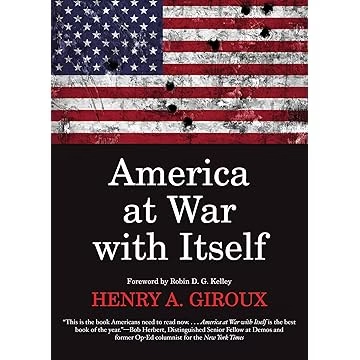
In “Staring into the Authoritarian Abyss,” the introduction to his book American Nightmare: Facing the Challenge of Fascism, Henry A. Giroux wrote the following:
Under the economic, religious, and political extremists Trump has been installing in positions of power, intolerance and militarization will intensify. Financial capital will be deregulated in order to be free to engage in behavior that puts the American public and the planet in danger. Institutions that embody the common good, such as public schools, will be defunded or privatized, and as a culture of greed and selfishness reaches new heights, there will be a further retreat from civil literacy and a growing abandonment by the state of any allegiance to the public interest. The free-market mentality that gained prominence under the presidency of Ronald Regan will advance under Trump and will continue to drive politics, destroy many social protections, further privilege the wealthy, and deregulate economic activity.[1]
Published in 2018, the analysis in American Nightmare could have been created yesterday. Giroux goes on to explain Trump’s tax reform bill of his first term which bears more than a passing resemblance to the Big Beautiful [Ugly] Bill recently passed by Congress. He explains that the bill:
largely favors the ultra-rich and and major corporations and would eventually leave 83 million middle-class and poor families paying more in taxes. Moreover, the increase in the deficit caused by these tax cuts enables the Republicans to wage and justify a major assault on the welfare state and its chief social provisions, such as social security, Medicare, and Medicaid. And what other rationale is there for Trump’s war on the environment, evident not only in his withdrawing from the Paris climate agreement but also in his opening up billions of acres of land on both the Pacific and Atlantic coasts for oil drilling? This is beyond shameful. It constitutes an act of war on the planet and the health of millions of adults and children.[2]
This pro-corporate fascism will make all human activities, practices, and institutions subject to market principles and commercialization. In other words, “there will be no place for morality and no place for compassion. Principles of equality, egalitarianism, and meritocracy however frail, are no longer espoused by the major political parties.”[3] The result is a morally bankrupt government of and by corporations that denigrates and ignores the people, the common ‘man’: the workers, the working class, whether they be black, brown, red or white, and whether they are recent arrivals or their ancestors were immigrants decades ago. Some were forced to come to these shores, especially as Black slaves, others have come of their own free will. We are, from the Mayflower on, a nation of immigrants. The native indigenous peoples were of course already in the Americas; in the U.S. they are most often called Native Americans.
What do we do to challenge this fascism that is overtaking our country?
Giroux says “One place to begin is with reason and truth, and how fundamental they are to creating critically engaged citizens and communities.”
Both reason and truth are under attack and it is essential to create “social formations within authoritarian societies to advance social justice, egalitarianism, political tolerance, cultural diversity, and vibrant democracy-centered communities.”[4]
Giroux calls these communities “democracies in exile.” These groups are resistant to Trumpian fascist politics and “are grounded in community building, economic justice, and a discourse of critique, hope, social justice, and self-reflection,” a concept he explains and illustrates throughout the book in the process of his detailed analysis.
Since 2018 when this book was published many such communities have flourished. At the national level the Poor People’s Campaign led by Liz Theoharis and William Barber is a re-establishing of Martin Luther King’s Poor People’s Campaign after his death.
Local communities have been building their own groups, often as social structures, to support action around a particular issue whether it be housing, food scarcity, immigration and deportation, blatant racism and DEI, widespread poverty, voting rights and defending Social Security, Medicare, Medicaid, and SNAP (food for low income families and many elders, who need this source to eat.)
Peace and justice groups are anti-militarism. Since this book was written they have taken on the issue of genocide in Gaza/Palestine and opposed Israel’s cruelty with the bombing and now starvation and genocide of Gazans. Support with constant demonstrations and actions critical of U.S. aid to Israel has spread worldwide where millions have marched against their governments’ support of Israel. Peace and justice groups that have for many years opposed Israeli apartheid in Israel/Palestine and supported equality in Israel/Palestine have activly opposed Israel’s Zionism, They have been accused, along with the many who have joined them, of antisemitism but are actually anti-Zionist not antisemitic, Zionism being an imperialistic political system created in the late 19th century and not to be confused with the ancient religion of Judaism.
Professor George Yancy, Professor of Philosophy at Emory Univeresity who wrote the Foreword to Giroux’s book about the American nightmare, fittingly ends his commentary with a quote from the poet James Baldwin:
People who shut their eyes to reality simply invite their own destruction, and anyone who insists on remaining in a state of innocence long after that innocence is dead turns himself [sic] into a monster.[5]
Some thoughts about this book from Sue Ann Martinson —
What I have always liked about Giroux’s thinking and writing is the way he makes the connections between often seemingly disparate facts and actions and this book is no exception. In the case of Trump, Giroux weaves what appear to be isolated attacks and outrageous statements into a tapestry that shows what often may be easily dismissed as simple nonsense but instead show greater purpose: He holds these lies, deceits, and vagaries as a system that melds together with greater intent and purpose and takes Trump out of the level of con man and baffoon into the realm of an authoritarian dictator who is power and greed crazy and into a totalitarian and fascistic state held together by the concept of White Supremacy.[6]
Giroux shows how before Trump the seeds of totalitarianism and fascism were already deep in the soil of 20th century America from earlier centuries and how Trump is both the messenger and tool of unearthing them. He is now bringing them to fruition in this his second term.
Fascistic programs that were foreshadowed in his first presidential term are now being carried out as Trump’s authoritarianism has rapidly deteriorated into cruelty.
This book is long, and I have read only part of it so far. It is also scholarly and dense. Full of fascinating and illuminating detail and references to other scholars, it is well-documented. I am going to fast forward to the last chapter and conclusion of the book. I will finish reading it because it contains so much information, discussion and many insights that are relevant to now and to our future. I encourage others to read it as well.
Foreshadowing the Present
Professor George Yancy entitled his Foreword “Facing the Challenges: the Urgency of Now.” It echos the urgency in the title of Martin Luther King’s book Why We Can’t Wait.
Giroux’s title for his last chapter is “Toward a Politics of Ungovernability.” He prefaces the chapter with a quote from James Baldwin: “In this country we are menaced−intolerably menaced−by a lack of vision. . . .” Giroux begins the chapter with a reference to MLK’s famous Riverside speech where King:
…spoke eloquently about what it meant to use nonviolent direct action as part of a broader struggle to connect racism, militarism, and war. His call to address a “society gone mad on war” and the need to “address the fierce urgency of now” was rooted in an intersectional politics. one that recognized a comprehensive view of oppression, struggle, and politics itself. Racism, poverty, and disposability could not be abstracted from the issue of militarism and how those modes of oppression informed each other.[7]
Restoring Historical Memory
Giroux also emphasizes the need for historical memory. How American history is taught is a major target of the Trump administration as they attempt to bury any history that does not support white supremacy. The point is to not include the attempted genocide of native peoples and the treatment of Blacks in American history and of others as well that we used to call ‘minorities.’ Their truths contradict the idealized America the Trumpites have invented that has the appearance of the clean slate that MAGA wishes to impose.[8]
This erasure of memory also includes the banning of books that is taking place in many states. Most of these books are about people of color and about LGBTQIA+ people. Many are classics and award-winning books.
DEI (Diversity, Equity, and Inclusion) is another program that is under attack. Trump has asked corporations to drop DEI guidelines in their workplaces and organizational guidelines. Many corporations have agreed, such as Target who dropped the program and is being boycotted, but others such as Costco have resisted and kept the DEI policies.
Shutting Down American Style Authoritarianism
“A successful resistance struggle must be comprehensive and at the same time embrace a vision that is unified, democratic, and equitable,”[9] says Giroux: A tall order. One that is “both political and pedagogical.” (Pedagogy refers to teaching, methods and strategies used in education.). Grioux calls for “democracy in exile” a concept that he defines in the book’s Conclusion but that infuses his commentary made throughout the book.
We need a new vision that refuses to equate capitalism and democracy, normalize greed and excessive competition and accept self-interest as the highest form of motivation. We need a language, vision, and understanding of power to enable the conditions in which education is linked to social change and the capacity to promote human agency through the registers of cooperation, compassion, care, love, equality, and respect for difference.” [10]
Resistance
Right now in L.A., a city under siege because of the high-handed arrest and deportation of especially immigrants of hispanic origin by ICE that has of course met the resistance of many people. Trump has called out California’s national guard although he is unauthorized to do so and has then sent troops to L.A. as the people of L.A. continue to resist with national support. “Democracy in Exile” organizing is taking place as documented by Amy Goodman’s Democracy Now! on August 11, 2025. On the one hand attorney generals nationwide met regarding L.A. to discuss their existing legal actions and their determination to plan more. These attorney generals may be considered a’”community’ in that they share the common thread of their work and in this case of shared vision.
On the other hand, on the ground in L.A. a group called Union del Bario from its smaller base organized many collaborative organizations. Recently they were able to film a young woman getting arrested by ICE. Eventually they got her released with a call-in that was local in L.A. but also went out nationally. Over 500 people responded.
This type of organizing, “a resurgent act of witnessing and moral outrage [that] will grow and provide the basis for a new kind of politics, a fierce wind of resistance, and a struggle too powerful to be defeated,” what Giroux calls “democracy in exile,” is able to take many forms by many seemingly unrelated groups of people.
The two examples juxtaposed on Democracy Now! are, although quite different, valid forms of resistance and are also collaborative within their scopes of influence. And now, in 2025, such collaborative community groups of many backgrounds are forming and growing in both local and national forms with an overall goal of restoring a functioning democracy. International groups are also challenging and influencing governments worldwide, especially in regard to the genocide in Gaza/Palestine.
Yet another recent example is the Miccosukee tribe in Florida. They have won a temporary lawsuit to halt construction of “Allegator Alcatraz,” a federal ‘concentration camp’ to hold deportees, on the grounds that no environmental impact statement (EIS), as required by federal law, has been conducted and that their tribal lands are threatened. Their tribal cultural center was recently burned to the ground:
The tribe is concerned about the facility’s potential impact on their ancestral lands, sacred sites, traditional hunting grounds, and other areas of cultural significance. They also fear environmental degradation, including potential pollution of water resources and impacts on endangered species like the Florida panther.
Radical Democracy
Those who believe in a radical democracy must find a way to make this nation ungovernable by the powers that currently claim governing authority. Small-scale defiance and local actions are important, but there is a more urgent need to mobilize through a comprehensive vision and politics that is capable of generating massive teach-ins all over the United States so as to enable a collective struggle aimed at producing powerful events such as a nationwide boycott, sit-ins, and a general strike in order to bring the country to a halt. The promise of such resistance must be rooted in the creation of a new political movement of democratic socialists, one whose power is grounded in the organization of novel political organizations, unions, educators, workers, young people, religious groups and others who constitute a progressive base.”[11]
Conclusion
Democracy in Exile
“The concept of democracy in exile is grounded in community building, economic justice, and a discourse of critique, hope, social justice and self-reflection.”[12]
Ever the educator, Giroux asks, “What role could a resuscitated critical education play in challenging the deadly neoliberal claim that all problems are individual when the roots of such problems lie in larger systemic forces?”
He also asks what role universities might play. Sadly, many universities have capitulated to restrictions of free speech around genocide in Gaza/Palestine as Trump blackmails them by threatening to withhold federal funding necessary for research and other programs and insists they punish students and faculty who decry the genocide.
Giroux calls upon leaders of the past for inspiration; often they sre Black because their resistance to white supremacy and oppression in the U.S. was/is bold and fearless. He quotes Frederick Douglas:
It is not light that is needed, but fire; it is not the gentle shower, but thunder. We need the storm, the whirlwind, the earthquake. The feeling of the nation must be quickened; the conscience of the nation must be roused; the propriety of the nation must be startled; the hypocracy of the nation must be exposed; and the crimes against God and man must be proclaimed and denounced.
Giroux continues: “The political oppression of our times requires that we work together to redefine politics and challenge the pro-corporate two-party system.”
As a warning, he has included the words of James Baldwin’s letter to Angela Davis:
Some of us, white [red, yellow] and black, know how great a price has already been paid to bring into existence a new consciousness, a new people, an unprecedented nation. If we know and do nothing, we are worse than the murderers hired in our name. If we know then we must fight for your life as though it were our own−which it is−and render impassable with our bodies the corridor to the gas chamber. For, if they take you in the morning, they will be coming for us in the night.
“In the end,” Giroux says, “there is no democracy without informed citizens, no justice without a language critical of injustice, and no change without a broad-based movement of collective resistance.”[13]
It is possible to see if you open your eyes that Trump and his cohorts and the Trump administration with their fascist authoritarianism are trying to destroy the paths to informed citizens, to the use of language for truth to expose hypocrisy and lies and replace them with justice, and to the formation of a broad-based collaborative movement of collective resistance. They continue their attacks on Social Security (now to be called a Federal Benefit program even though every bit of money received has been earned by recipients in their working years), Medicare, Medicaid and SNAP (money for food) as well as cultural organizations like the Smithsonian where they are demanding that any artwork that is negative about Trump and the Trump administration be removed.
Now nationwide. and also to some extent worldwide. we are in the throes of resistance and creation, refusing to accept authoritarian fascist government with the creation of broad-based collective resistance.ß
Henry A. Giroux is a renowned American and Canadian scholar, cultural critic, and public intellectual, widely recognized as a founding theorist of critical pedagogy in the United States. He is known for his work in public pedagogy, cultural studies, youth studies, higher education, and media studies. He currently holds the McMaster University Chair for Scholarship in the Public Interest and is the Paulo Freire Distinguished Scholar in Critical Pedagogy.
Sue Ann Martinson is the editor and publisher of Wings of Change.
Notes
[1] Henry A, Giroux, American Nightmare: Facing the Challenge of Fascism (San Francisco: City Lights Books, 2018) p,40
Co-founder of the legendary rock group Pink Floyd Roger Waters discusses the genocide in Gaza, the deterioration of the West, and his new movie on this episode of The Chris Hedges Report.
“THIS IS NOT A DRILL” with Roger Waters / The Chris Hedges Report
There are few artists or musicians who— have stood as doggedly on the side of the oppressed as Roger Waters, the co-founder, basist, singer, and songwriter for Pink Floyd. He has been an outspoken defender of Palestinian rights and critic of the apartheid state of Israel long before the genocide. He was one of the principal signers of an open letter called artists against apartheid and supporter of the boycott, divestment and sanctions movement denouncing musicians who performed in Israel.
Roger called out the fabrications disseminated by Israel that Hamas carried out systematic sexual assaults on October 7th. He attacked labor leader Kier Starmer for his backing of the genocide and headlined a concert for Palestine with Cat Stevens and the rapper Loki.
Roger came to the defense of the British punk rap band Bob Villain who at this year’s Glastonberry Festival led the chant of death to the IDF referring to the Israeli Defense Force after the British government banned Palestine action, labeling it a terrorist group in the UK under the Terrorism Act of 2000 and then arresting 100 people for expressing their support for the group. Roger posted a video to X in which he praised Palestine Action as a quote great organization, noting they were nonviolent and quote absolutely not terrorists in any way.
Editor’s Note: Those are only the more recent of the many many actions that Roger has taken for justice and peace and for human rights.
“Israel is trying to concentrate the population of Gaza in the southernmost parts of the strip, to enclose them and to enforce, eventually, either that they would just die out there or that they would be removed from the Gaza Strip altogether.”
We speak with leading Israeli American historian Omer Bartov about his latest essay for The New York Times, headlined “I’m a Genocide Scholar. I Know It When I See It.” Bartov cites the United Nations definition of “genocide,” which includes an intent to destroy a group of people that makes it impossible for the group to reconstitute itself. “This is precisely what Israel is trying to do,” he says. “Israel is trying to concentrate the population of Gaza in the southernmost parts of the strip, to enclose them and to enforce, eventually, either that they would just die out there or that they would be removed from the Gaza Strip altogether.”
Palestinians gather to receive food cooked by a charity kitchen, amid a hunger crisis, as the Israel-Gaza conflict continues, in Khan Younis in the southern Gaza Strip, December 4, 2024. REUTERS/Mohammed
Transcript This is a rush transcript. Copy may not be in its final form.
NERMEENSHAIKH: Israel’s military is continuing to attack civilians across the Gaza Strip, with at least 93 Palestinians killed over the past 24 hours, bringing the total number of deaths in Gaza to 58,000, most of them women and children. This number is believed to be a vast undercount. At least 10,000 are believed to be buried under the rubble. The U.N. estimates approximately 92% of all residential buildings in Gaza, around 436,000 homes, have been damaged or destroyed.
As the situation continues to deteriorate, an emergency meeting of the Hague Group convened in Bogotá, Colombia, to discuss the conflict. It concluded with the announcement of a series of measures aimed at halting Israel’s attacks on Palestine and ending the, quote, “era of impunity.” The Hague Group came together in January as a bloc of Global South countries committed to coordinating legal and diplomatic measures in defense of international law and solidarity with the Palestinian people. There are now 30 member states. The action steps announced at the conclusion of the summit include banning arms sales to Israel and reviewing ties with companies who profit from the occupation of Palestine. So far, only 12 states have agreed to implement the steps. The summit was co-chaired by South Africa and Colombia. This is Colombia’s President Gustavo Petro.
PRESIDENTGUSTAVOPETRO: [translated] We need to leave NATO. We need to form an army of light with all the peoples of the world who want to. And we need to tell Europe that if it wants to be with Latin America or Africa, it must stop helping the Nazis. And we need to tell the American people of all colors, because they are now of all colors, to stop helping the Nazis.
NERMEENSHAIKH: The Hague Group’s joint statement affirms the commitment to, quote, “Comply with our obligations to ensure accountability for the most serious crimes under international law through robust, impartial and independent investigations and prosecutions at national or international levels, in compliance with our obligation to ensure justice for all victims and the prevention of future crimes,” end-quote.
AMYGOODMAN: Well, there’s perhaps no greater crime than genocide. Our next guest, Omer Bartov, is professor of Holocaust and genocide studies at Brown University. He is an Israeli American scholar who’s been described [by] the U.S. Holocaust Memorial Museum as one of the world’s leading specialists on the subject of genocide. And he’s just written an op-ed for The New York Times headlined “I’m a Genocide Scholar. I Know It When I See It.” Professor Bartov joins us from Cambridge, Massachusetts.
Well, why don’t you, Professor Bartov — and thanks for joining us again — lay out your case?
OMERBARTOV: Well, thanks for having me again.
The case that I made in the article and that I’ve been making for a while is that at the beginning, immediately after October 7th, the Hamas attack on October 7th, Israeli political and military leaders made a series of pronouncements which could be interpreted as calling for genocide. But there was still no — at that point, there was no evidence that this was being implemented.
Over time, and I would say by May of 2024, it became apparent that these statements were not only made in the heat of the moment following the massacre by Hamas, but were actually being implemented in a manner that would make it impossible for people to live in Gaza, make the entire Gaza Strip uninhabitable and make life there impossible, as well as destroy all the institutions that would be there for that group to reconstitute itself as a social, cultural, political group once the violence was over. Of course, it’s not over yet. I started thinking that in May. In August that year, I wrote an article that explained that.
But the violence has only continued, and the attempt, as you just reported, to destroy Gaza entirely has continued since. And it is now clear that Israel is trying to concentrate the population of Gaza in the southernmost parts of the strip, to enclose them and to enforce, eventually, either that they would just die out there or that they would be removed from the Gaza Strip altogether.
NERMEENSHAIKH: And, I mean, obviously, the points that you’ve made, Professor Omer Bartov, makes it completely indisputable, the argument that you make in the piece, indeed, that there is a genocide ongoing and that that is the long-term plan of Israel. You point out in the piece, though, that genocide scholars are often hesitant about applying the term “genocide” to contemporary events, in part because, as you write, quote, “it often serves more to express outrage than to identify a particular crime.” Of course, there are people who believe that that’s the case even today with respect to Gaza. If you could respond to that?
OMERBARTOV: Correct. So, this is one reason that I did not come out right after October 7th and say, “Well, Israel is about to commit genocide,” because, despite those statements, one had to observe and see what was actually happening on the ground. And yes, it is true that the term “genocide” has been used more as an expression of outrage when seeing massacres, mass killings, but that does not necessarily mean that what you’re watching is genocide. “Genocide” is well defined in a U.N. convention from 1948. And under international law, only events that can — that conform to the definition can be seen as genocide. And that means that you have to show both that there is an intent to destroy a particular group, in whole or in part, as such, and that that intent is being implemented. And that, obviously and unfortunately, takes time to adjudicate.
I think that the term, while problematic, is very important, because it does identify a very particular crime. It talks about the attempt to destroy not simply people in large numbers, but to destroy them as members of a group. The intent is to destroy the group itself. And it doesn’t mean that you have to kill everyone. It means that the group will be destroyed and that it will not be able to reconstitute itself as a group. And to my mind, this is precisely what Israel is trying to do. And many of its spokespersons, to this day, keep reiterating that, to the extent that it’s somewhat bizarre that so much of the rest of the world is not taking them seriously.
NERMEENSHAIKH: Professor Bartov, could you also talk about — I mean, you are an Israeli American scholar and are in touch with people in Israel. How do you see perceptions of Israel’s ongoing assault on Gaza changing within Israel? And where are people getting their information there? There’s been talk of basically self-censorship of the mainstream media, but, of course, so many of these images and information are circulating not in the mainstream press, but on social media.
OMERBARTOV: So, look, I should say first I am — I was born and raised in Israel. I spent the first half of my life in Israel. I served in the Israeli military. And for me, to see what is happening is personally, not only just as a mere human being, but also as an Israeli, heartbreaking.
What I see in the Israeli public is an extraordinary indifference by large parts of the public to what Israel is doing and what it’s done in the name of Israeli citizens in Gaza. In part, it has to do with the fact that the Israeli media has decided not to report on the horrors that the IDF is perpetrating in Gaza. You simply will not see it on Israeli television. If some pictures happen to come in, they are presented only as material that might be used by foreign propaganda against Israel. Now, Israeli citizens can, of course, use other media resources. We can all do that. But most of them prefer not to. And I would say that while about 30% of the population in Israel is completely in favor of what is happening, and, in fact, is egging the government and the army on, I think the vast majority of the population simply does not want to know about it. And that goes back both to the inability to see anything on their own TVs and, in response to October 7th, a sense that after that — and that’s a widespread sense in Israel — after that, there is no way of finding any solution with the Palestinians, and the only way to deal with that issue is to eradicate it.
AMYGOODMAN: Professor Bartov, can you talk about the genocide scholars across the world who have come to the same conclusion?
OMERBARTOV: Yes. So, as I wrote in the op-ed, over time, many genocide scholars who are — and legal experts, experts in international law, who, like me, have been very cautious about applying this term, have gradually come to the conclusion that what we’re watching is genocide. And that’s important, in the sense that there is now, I think, a growing consensus over that view.
As I wrote in the piece, unfortunately, scholars and institutions dedicated to researching and commemorating the Holocaust have generally, with few very courageous exceptions, have generally refused to say anything, to express themselves in any way, about what is happening in Gaza. And to my mind, by doing that, they, first of all, betrayed the very idea of “never again,” because “never again” was never about “never again the Holocaust,” it was “never again genocide and such other crimes against humanity.” So, there’s now a rift between genocide scholars, who have generally come to agree on Gaza being an Israeli genocidal operation, and Holocaust scholars and institutions that have remained mum.
AMYGOODMAN: Can you talk about how the term “genocide” came into use? Can you talk about the Polish lawyer Raphael Lemkin?
OMERBARTOV: Yeah, so, Raphael Lemkin was a Polish Jewish lawyer who, already in the 1930s, was trying to find some kind of terminology that would describe and legally define that particular crime of trying to destroy a group. And the example that he had at the time was the genocide of the Armenians during World War I by the Ottoman Empire. During World War II, he had to escape Poland as a Jew. Most of his family was murdered. He ended up in the United States. And in 1944, he published a book in which he defined what he understood as the crime of genocide, a term that he coined, which is a combination of Greek and Latin, meaning killing a group or an ethnic group. And he struggled for a few more years to have the U.N., the United Nations, just established in 1945, to recognize that crime, and he succeeded in doing so in 1948.
NERMEENSHAIKH: Professor Bartov, I want to ask you about a question, indeed, that you ask in your piece, which is, quote, “How will Israel’s future be affected by the inevitable demolition of its incontestable morality, derived from its birth in the ashes of the Holocaust?” What’s the answer to that question?
OMERBARTOV: Look, I mean, this is beside the horrific killing of human beings in Gaza. And I should just say, because you mentioned the distribution points of food, that between late May, when this so-called humanitarian group started distributing food, and today, more Palestinian civilians have been killed at these distribution groups than Israeli civilians were killed in the Hamas attack.
Now, what is the — what does all this mean for Israel? As I suggested in the piece, first of all, I think Israel will no longer be able to draw on the credit, if you like, of having been the state that was created after the Holocaust as an answer to the Holocaust. It will no longer be able to say, “We can do whatever we like, because we were a nation subjected to genocide.” You cannot continue to use this argument following the mass killing of another group.
I hope — and I write that, too — I hope that future generations of Israelis, who will not be clean of that stain — that stain will remain — but will at least be liberated from this shadow of the Holocaust and will start to look at reality as it is, and start to think of how can they reconstitute their own nation, not as a response to the genocide against the Jews, as a response to the Holocaust, but rather as a nation that knows how to share this land, where 7 million Jews and 7 million Palestinians live side by side between the Jordan and the sea, to share it with them with equality and dignity, and not with the use of bombs and violence.
AMYGOODMAN: Can you talk about this plan to make, build a so-called humanitarian city — the defense minister, Israel Katz, has proposed this idea — on the rubble of Rafah, and the opposition of two former prime ministers? You have Ehud Olmert, you have Yair Lapid. They’re saying if there is no exit, this is a concentration camp. The significance of these men saying this?
OMERBARTOV: Well, I think it’s very important that Lapid, who’s been sort of on all parts of this debate, said something and that Olmert spoke out, although Olmert no longer has any political power in Israel.
The plan itself, again, using the typical euphemisms that are used by organizations and states that carry out such crimes, calling that a humanitarian city, which would be a vast concentration camp, a sort of combination of ghetto and concentration camp, that would be built, as you said, on the ruins of Rafah — Rafah has been completely destroyed, there’s nothing there — build a tent city on top of it, bring in initially 600,000 people, who would be brought back from the Mawasi area, from the beach area, to which they were displaced when the IDF went in to destroy Rafah, enclose them there. The plan does not say that Israel would supply them with any humanitarian assistance in the camp, but some other international organizations yet to be determined. But they would not be able to leave unless they leave the Gaza Strip altogether. So, this is — and in continuation to that, the rest of the population is supposed to then join this camp, with a goal of removing them. So, this is extraordinary. The state of Israel publicly is speaking about the creation of a vast concentration camp whose goal is removal of the population to countries that have unanimously said they are not going to take them in.
NERMEENSHAIKH: Well, Professor Bartov, I want to ask about the U.S.’s position on this, of course, their continuing support for Israel, which has enabled the assault to continue. I want to go back to the former president, Biden, his administration, the State Department spokesperson at the time, Matt Miller, who admitted earlier this year, in May, that he believes Israel committed war crimes in Gaza. This reversal came after more than a year, as the face of the Biden administration’s foreign policy, repeatedly defending Israel against allegations of war crimes and genocide. This was Miller speaking earlier this year — last year.
MATTHEWMILLER: We have been very clear that we want to see Israel do everything it can to minimize civilian casualties. We have made clear that they need to do every — that they need to operate at all times in full compliance with international humanitarian law. At the same time, we are committed to Israel’s right to self-defense.
NERMEENSHAIKH: But during an interview with Sky News last month, in June, Matt Miller says he believes Israel has committed war crimes in Gaza and that Israeli soldiers are not being held accountable.
MATTHEWMILLER: I don’t think it’s a genocide, but I think the — I think it is, without a doubt, true that Israel has committed war crimes.
MARKSTONE: You wouldn’t have said that at the podium.
MATTHEWMILLER: Yeah, look, because I — I mean, when you’re at the podium, you’re not expressing your personal opinion. You’re expressing the conclusions of the United States government.
NERMEENSHAIKH: So, Professor Bartov, your response to that, and also your perception of how the Trump administration has both broken with and continued Biden’s policies on Gaza?
OMERBARTOV: Well, you know, in November 2023, I published an op-ed in The New York Times in which I said that war crimes and crimes against humanity were clearly happening in Gaza, and that if this continued, it would become a genocidal operation. I was hoping at the time that someone in the administration would actually pay attention, because the United States, in November or December 2023, could have stopped all of this. It was not very difficult to do. Israel cannot act as it has without constant supply of arms from the United States and Germany — these are the two major suppliers; the U.S. supplies between 70 and 80% of all munitions to Israel — and without diplomatic cover — Israel has a diplomatic Iron Dome created by the U.S. veto in the Security Council. That did not happen. And, of course, the evidence was there. And so, first of all, one has to say that the Biden administration is complicit in what happened in Gaza.
Secondly, when Trump came in, curiously, the first thing that happened, the day before he came into office, was that he forced a ceasefire on Israel. And that ceasefire, in January this year, made it possible to exchange Palestinian prisoners for a large number of hostages, but not all of them. The plan was to complete that exchange and to stop the fighting. But in March, Israel unilaterally broke that ceasefire without any interference from the United States, and, since then, has continued. And what is particularly galling is the fact that when Trump floated his plan, if you recall that, that the population of Gaza would be removed, and then Gaza would be made into a beautiful resort area, he later on didn’t really repeat that. But in Israel, that was seen as license to do exactly what is being done now — that is, using hundreds of bulldozers, engineers, explosives to systematically destroy every building in Gaza so that nobody would be able to live in, in that area, and then, well, maybe turn it into a resort area, more likely be an area for Jewish settlers.
AMYGOODMAN: I wanted to name names here, that you do in your piece. “In November, a little more than a year into the war, the Israeli genocide scholar Shmuel Lederman joined the growing chorus of opinion that Israel was engaged in genocidal actions. The Canadian international lawyer William Schabas came to the same conclusion … and has recently described Israel’s military campaign in Gaza as ‘absolutely’ a genocide.
“Other genocide experts, [like] Melanie O’Brien, president of the International Association of Genocide Scholars, and the British specialist Martin Shaw (who has also said … the Hamas attack was genocidal), have reached the same [conclusion], while the Australian scholar A. Dirk Moses [of] the City University of New York described these events in the Dutch publication NRC as a ‘mix of genocidal and military logic.’ In the same article, Uğur Ümit Üngör, a professor at the Amsterdam-based NIOD Institute for War, Holocaust and Genocide Studies, said there are probably scholars who still do not think it’s genocide, but ‘I don’t know them.’”
Professor Bartov, as we begin to wrap up, can you talk about this consensus and whether Holocaust museums, which often address a number of holocausts, will be taking on what Israel has done in Gaza?
OMERBARTOV: Well, so, as I said before, I think there is a growing consensus among genocide scholars and legal experts. William Schabas is a very good example, because he’s a highly respected expert. He’s very conservative. He took a long time to reach that conclusion. And he has. I just spoke with him recently in Europe, and he very strongly believes that what Israel is doing now is genocide.
But the other side of it, as you indicate, is the tragedy that most Holocaust scholars and all of the institutions that I know that are dedicated to commemorating and researching the Holocaust have refused to say anything. And some, again, a minority of Holocaust scholars, have come out and claimed that genocide scholars speaking about genocide in Gaza are antisemitic, that this is an antisemitic argument. And that use of the term “antisemitism,” which, as you know, of course, and we spoke about, was also a tool to silence any protest last spring on American campuses, this abuse of the term is now creating a rift between Holocaust scholars and genocide scholars.
And what I fear — and that’s what I write at the end of this piece — what I fear is that this will mean that the Holocaust, which had come, over decades, to be recognized as an event of universal importance, as an event that we have to learn from, because of the silence, because of the betrayal of the notion of “never again” by these institutions and these scholars, will go back to become a sort of ethnic enclave, only something that the Jews talk about among themselves.
AMYGOODMAN: Omer Bartov, we want to thank you for being with us, professor of Holocaust and genocide studies at Brown University and an Israeli American scholar, described by the U.S. Holocaust Memorial Museum as one of the world’s leading specialists in the subject of genocide. His forthcoming book, Israel: What Went Wrong? His previous books, Genocide, the Holocaust and Israel-Palestine. We’ll link to your piece in The New York Times, “I’m a Genocide Scholar. I Know It When I See It.”
The original content of this program is licensed under a Creative Commons Attribution-Noncommercial-No Derivative Works 3.0 United States License. Please attribute legal copies of this work to democracynow.org. Some of the work(s) that this program incorporates, however, may be separately licensed. For further information or additional permissions, contact us.
If Roosevelt had lived what was his vision for the country and for the world?
The Unraveling of the New Deal, FDR’s Vision, Part 4
By Sue Ann Martinson / Wings of Change / June 30, 2025
FDR: The Four Freedoms
FDR, besides the New Deal, left this legacy of a New Bill of Rights as well. He had been elected for a fourth term and these were his promises. What America would be like now if he had been able to carry them out we can only speculate. But certainly as a nation we would not have been in the autocratic state we in now and people would have been more secure economically and with the comfort of being who the are without outside definitions created by others that are derogatory.
Having corporate overmasters is unconstitutional and yet another way to deconstruct a democracy that is “of the people, for the people and by the people.” Idealistic? Yes. But FDR more than any other president attempted to make a people’s government.
National and International Intentions After the War
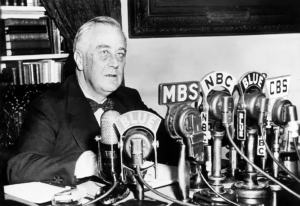
On January 6, 1941 ─ after the invasion of Poland in 1939 when England declared war on Germany ─ FDR was focusing on the state of the world. He gave a State of the Union address in which he named the Four Freedoms for the world. In this speech he addressed the need to achieve world peace and peace for America.
This speech is 80 years to the day when on January 6, 2021, the United States Capitol in Washington, D.C., was attacked by a mob of supporters of President Donald Trump in an attempted self-coup, two months after his defeat in the 2020 presidential election.
The Four Freedoms:
Equality of opportunity for youth and for others:
Jobs for those who can work.
Security for those who need it
The ending of special privilege for the few
The preservation of civil liberties for all.
Many subjects connected with our social economy call for immediate improvement. As examples:
We should bring more citizens under the coverage of old-age pensions and unemployment insurance.
We should widen the opportunities for adequate medical care.
We should plan a better system by which persons deserving or needing gainful employment may obtain it.
FDR also outlined U.S. foreign policy at that time:
Just as our national policy in internal affairs has been based upon a decent respect for the rights and the dignity of all our fellow men within our gates, so our national policy in foreign affairs has been based on a decent respect for the rights and dignity of all nations, large and small. And the justice of morality must and will win in the end.
Our national policy is this:
First, by an impressive expression of the public will and without regard to partisanship, we are committed to all-inclusive national defense.
Second, by an impressive expression of the public will and without regard to partisanship,we are committed to full support of all those resolute peoples, everywhere, who are resisting aggression and are thereby keeping war away from our Hemisphere. By this support, we express our determination that the democratic cause shall prevail; and we strengthen the defense and the security of our own nation.
Third, by an impressive expression of the public will and without regard to partisanship, we are committed to the proposition that principles of morality and considerations for our own security will never permit us to acquiesce in a peace dictated by aggressors and sponsored by appeasers. We know that enduring peace cannot be bought at the cost of other people’s freedom.
In the recent national election there was no substantial difference between the two great parties in respect to that national policy. No issue was fought out on this line before the American electorate. Today it is abundantly evident that American citizens everywhere are demanding and supporting speedy and complete action in recognition of obvious danger.
No realistic American can expect from a dictator’s peace international generosity, or return of true independence, or world disarmament, or freedom of expression, or freedom of religion ─ or even good business.
Such a peace would bring no security for us or for our neighbors. “Those, who would give up essential liberty to purchase a little temporary safety, deserve neither liberty nor safety.”
As a nation, we may take pride in the fact that we are softhearted; but we cannot afford to be soft-headed.
In a later State of the Union speech on January 11, 1944, FDR explained his vision of a New Bill of Rights:
FDR’s New Deal and his “Four Freedoms” speech outlined a broader “New Bill of Rights” that included economic security, a concept distinct from the traditional Bill of Rights which focused on individual liberties. The “New Bill of Rights” encompassed the right to a job, adequate living standards, healthcare, education, and protection from economic hardship, as outlined in FDR’s “Second Bill of Rights.”
The Four Freedoms are the foundation for the Universal Declaration of Human Rights that was adopted by the United Nations on December 10, 1948. After the death of FDR Eleanor carried the torch forward as chair of the UN Commission on Human Rights that created the document.
Although the war was not yet over, in his State of the Union address on January 11, 1944 FDR, planning ahead for the war-end, reiterated a commitment to a New Bill of Rights for the American people.
On June 11, 1944 FDR repeated the full text of the speech in one of his Fireside Chats for the nation to hear.
Perhaps FDR had been reading Thoreau’s essay on civil disobedience that calls for an even more perfect Union in the United States than existed in the Constitution. Thoreau said:
The authority of government, even such as I am willing to submit to — for I will cheerfully obey those who know and can do better than I, and in many things even those who neither know nor can do so well — is still an impure one: to be strictly just, it must have the sanction and consent of the governed. It can have no pure right over my person and property but what I concede to it.
The progress from an absolute to a limited monarchy, from a limited monarchy to a democracy, is a progress toward a true respect for the individual…. Is a democracy, such as we know it, the last improvement possible in government?
Thoreau goes on to say:
Is it not possible to take a step further towards recognizing and organizing the rights of man? There will never be a really free and enlightened State, until the State comes to recognize the individual as a higher and independent power, from which all its own power and authority are derived, and treats him accordingly.
I please myself with imagining a State at last which can afford to be just to all men, and to treat the individual with respect as a neighbor; which even would not think it inconsistent with its own repose, if a few were to live aloof from it, not meddling with it, nor embraced by it, who fulfilled all the duties of neighbors and fellow-men.
First Thoreau is taking about himself as a good neighbor. We tend to think of neighborhoods as small units. But what if it were another country? What if all countries considered themselves a good neighbor to the countries next to them? He goes from the microcosm to the macrocosm. That interpretation seems to fit with FDR’s idea of the Four Freedoms as he expresses it in relation to Russia and Great Britain, remembering that settler colonialism was still prevalent and Western European countries held empires, including the British Empire, which was dominant.
Here is how Thoreau concludes:
A State which bore this kind of fruit, and suffered it to drop off as fast as it ripened, would prepare the way for a still more perfect and glorious State, which also I have imagined, but not yet anywhere seen.
State of the Union, January 11, 1944
“Necessitous men are not free men.” People who are hungry and out of a job are the stuff of which dictatorships are made.
FDR, in the January 11, 1944, State of the Union Speech addressed his vision for a second Bill of Rights and explains that these rights are true security and that “The best interests of each Nation, large and small, demand that all freedom-loving Nations shall join together in a just and durable system of peace.”
It is our duty now to begin to lay the plans and determine the strategy for the winning of a lasting peace and the establishment of an American standard of living higher than ever before known. We cannot be content, no matter how high that general standard of living may be, if some fraction of our people—whether it be one-third or one-fifth or one-tenth- is ill-fed, ill-clothed, ill housed, and insecure..
This Republic had its beginning, and grew to its present strength, under the protection of certain inalienable political rights—among them the right of free speech, free press, free worship, trial by jury, freedom from unreasonable searches and seizures. They were our rights to life and liberty.
As our Nation has grown in size and stature, however—as our industrial economy expanded—these political rights proved inadequate to assure us equality in the pursuit of happiness.
We have come to a clear realization of the fact that true individual freedom cannot exist without economic security and independence. “Necessitous men are not free men.” People who are hungry and out of a job are the stuff of which dictatorships are made.
In our day these economic truths have become accepted as self-evident. We have accepted, so to speak, a second Bill of Rights under which a new basis of security and prosperity can be established for all regardless of station, race, or creed.
Among these are:
The right to a useful and remunerative job in the industries or shops or farms or mines of the Nation;
The right to earn enough to provide adequate food and clothing and recreation;
The right of every farmer to raise and sell his products at a return which will give him and his family a decent living;
The right of every businessman, large and small, to trade in an atmosphere of freedom from unfair competition and domination by monopolies at home or abroad;
The right of every family to a decent home;
The right to adequate medical care and the opportunity to achieve and enjoy good health;
The right to adequate protection from the economic fears of old age, sickness, accident, and unemployment;
The right to a good education.
All of these rights spell security. And after this war is won we must be prepared to move forward, in the implementation of these rights, to new goals of human happiness and well-being.
America’s own rightful place in the world depends in large part upon how fully these and similar rights have been carried into practice for our citizens. For unless there is security here at home there cannot be lasting peace in the world.
One of the great American industrialists of our day, a man who has rendered yeoman service to his country in this crisis-recently emphasized the grave dangers of “rightist reaction” in this Nation. All clear-thinking businessmen share his concern. Indeed, if such reaction should develop—if history were to repeat itself and we were to return to the so-called “normalcy” of the 1920’s—then it is certain that even though we shall have conquered our enemies on the battlefields abroad, we shall have yielded to the spirit of Fascism here at home.
I ask the Congress to explore the means for implementing this economic bill of rights ─ for it is definitely the responsibility of the Congress so to do.
Flash Forward
Los Angeles (LA) June 2025
From the Brennan Foundation: A panel discussion re the sending in the military to LA. Is it legal? What are the ramifications for the future?
The deployment of Marines and federalized National Guard members to police protests in Los Angeles poses a serious threat to American democracy. The president’s memorandum appears to preemptively allow the deployment of federal forces anywhere there are protests against immigration raids nationwide, regardless of whether or not they are peaceful. This broad authorization suggests that the troop deployments go beyond protecting federal property or law enforcement — they are about suppressing disagreement against the government.
— Elizabeth Goitein in a Just Security expert panel discussion.
Note FDR words above:
…the grave dangers of “rightist reaction” in this Nation.
…we shall have yielded to the spirit of Fascism here at home.
Yet now Congress has fallen under thrall to that “rightist reaction” under the influence of those forces of fascism daily are that being forced upon us that is the opposite of “a new basis of security and prosperity can be established for all regardless of station, race, or creed.” Instead social welfare programs that support that vision are being slashed with support for money for corporate needs growing and for the military while the rest of the citizenry is ignored, funds for social programs decimated. Thousands have lost their jobs, their retirement savings, even their homes while the New Bill of Rights is decimated. Education, a core of democracy, is being defunded.
Yet FDR is very clear: these are the rights worldwide that bring true security, not the building up of the military:
In the plain down-to-earth talks that I had with the Generalissimo Chiang Kai Chek and Marshal Stalin and Prime Minister Churchill, it was abundantly clear that they are all most deeply interested in the resumption of peaceful progress by their own peoples—progress toward a better life. All our allies want freedom to develop their lands and resources, to build up industry, to increase education and individual opportunity, and to raise standards of living.
All our allies have learned by bitter experience that real development will not be possible if they are to be diverted from their purpose by repeated wars—or even threats of war.
Those leaders of primary world powers are now dead and the lessons learned from WWI and WWII have faded from consciousness. Endless War prevails. The monies taken from the social programs is instead to be used to increase the military might of America with Trump’s proposed Golden Dome, similar to the Iron Dome in Israel only four times larger to somehow protect the whole of the United States. But did the Iron Dome protect Israel from attack by Hamas?
Instead we now have a government that has embraced the “rightest reaction” and taken much of the nation with it through propaganda and lies. Our so-called president (not my president) becomes more autocratic every day. He blatantly declares his racism by word and deed. He is as he has always been basically a misogynist. The women he has appointed to positions are women who just do what they are told, yes-women. He openly flaunts the Constitution and tries to silence anyone who attempts to defy him. He calls himself a king. He allows his “flock” of fundamentalists to worship him as if he were divine. The “divine right of kings.” That went out in the Middle Ages.
“The law stands high above the king.” Magna Carta, 1215
The lords of England issued a writ that they would no longer be subservient to the king. The “divine right of kings” absolute authority was challenged. It included the right to a speedy trial, now known as habeas corpus.
A wise person once observed that it takes the support of the middle class for a revolution to succeed. Although it was the nobility of England who rebelled, they were in the middle, as the king with his divine right was above them and the peasants below them..
The Magna Carta still forms an important symbol of liberty today, often cited by politicians and campaigners, and is held in great respect by the British and American legal communities, Lord Denning describing it in 1956 as “the greatest constitutional document of all times—the foundation of the freedom of the individual against the arbitrary authority of the despot.”
Back to the Law
U.S. judges, have often, if not consistently, challenged Trump’s edicts, that is, executive orders, as being unconstitutional or breaking established laws. Trump has attempted to go after them of course, but different judges keep cropping up to challenge his often anti-Constitutional and law-breaking declarations. So far the idea of law above the king is functioning, resembling some semblance of law and order, not with guns, but with THE LAW as judges nationwide intervene against many of Trump’s edicts as unconstitutional or otherwise illegal. Most recent as I write this is a judge ruling the release of Mahmoud Khalil, the student from Columbia arrested for his pro-Palestinian activities although he has a green card and is married to a U.S. citizen.
Flash Forward, June 27, 2025
To stop the lower courts from challenging his unconstitutional executive orders Trump and his pro-fascist cohorts has had their allies in the U.S. Supreme Court state that the lower courts can no longer challenge Trump’s executive orders that undermine the Constitution although it will not go into effect immediately. As reported in Reuters, “The ruling also did not address the legality of the policy, part of Trump’s hardline approach toward immigration.”
Relevant Diversion
The U.S. system of law, while it was heavily influenced by French philosophers of the Enlightenment, is still based on English common law. The most predominant French influencers were Locke, Montesquieu, and Rousseau. But in turn Locke and Montesquieu were heavily influenced by English law in their contributions to the structure of the Constitution and the shaping of the U.S. government as it still stands today.
Rousseau’s primary contribution was the idea of laws created directly by the vote of the people. He also introduced the idea of “neighborhoods,” an idea that Thoreau elaborated on in his essay on civil disobedience. The idea of neighborhoods still exists in many cities, including Minneapolis which is divided into neighborhoods that have governing bodies that create and manage programs that deal with neighborhood-specific issues.
Locke believed in what he called a social contract and influenced Thomas Jefferson’s writing of the Declaration of Independence. Locke favored a representative government. Montesquieu advocated for the separation of powers.
The Senate is debating the “Big Beautiful Bill” that further destroys the Pillars of Democracy and Violates FDR’s Four Freedoms.
If I remember my civics class correctly (that was ninth grade ─ do they teach it anymore?) the executive, legislative, and judicial sections of government were meant to balance each other. The legislative branch today is often impotent on many issues, controlled by Trump’s and the GOP’s yes-men and women. As noted, by one vote on May 22, 2025, the House passed the “Big Ugly Budget” that steals money from the people of the United States.
These cuts, if they are allowed, will cause significantly more struggling to survive for millions of Americans. In some cases they will cause preventable deaths because of the cuts to Medicare and Medicaid. In the case of Social Security, cuts that are a lifeline for many Americans could be seriously cut down.
But not for corporate America: They are being pampered with money for investments and new laws are allowing them to develop fossil fuel that will further pollute the planet and hasten the global crisis. (There is no Planet B!)
Will the Senate show any backbone in accepting this Big Ugly Budget or not? That is not hopeful as they are controlled by the GOP. Sad, but true. That is the real fraud against the American people. We cannot go back (MAGA), even if we wanted to, and millions of us do not want to, as evidenced by the Hands Off and No Kings demonstrations. Many of us joined in the demonstrations not because we are Democrats (or Republicans either), but because we are antiwar and anti-genocide in Gaza because of its obvious inhumanity. We are also opposed to the illegal DOGE actions by Elon Musk and approved by Trump after creating DOGE as a government department by a presidential executive order not approved by Congress.
Elon Musk has left of DOGE and has actually criticized Trump’s platform and fascistic plans. In part this may be because the sales of his Tesla have greatly decreased, although it is only one way he makes money. He has been pilloried for the cuts he is responsible for, including USAid which affects millions worldwide.
Most members of Congress are supporters of Israel. Because so many of us support Palestine and are adamantly opposed the the genocide being perpetrated by Israel on Palestine, we are accused of being supporters of Hamas. We are what we say we are: antiwar and pro-Palestine. Having been involved in support of Palestine in educational programs and demonstrations, I can honestly say that we do not support Hamas per se. It has not come up in 20 years of pro-Palestine activities, not even since October 7, 2023. No chants I know of glorify or support Hamas.
Those who have worked on Middle East issues for 20 years or more such as Boycott, Divestment and Sanctions (BDS) and the WAMM Middle East Committee see Hamas as part of the very complicated geopolitics in the Middle East. What is not complicated is that genocide is a crime against humanity and no amount of Israel’s denial, even with the support of the U.S., can change the moral outrage at the wholesale death of a people. That was also true of the Holocaust, of course, but what Israel has become in its zealous Zionism backed by the U.S. is NOW, not then.
What About Now?
Shame hangs over the U.S. like a shroud.
As I write this the Senate is still deliberating about the Big ‘Beautiful’ Budget Bill and has not yet voted. Once they do settle on a version it has to go back to the House where members may wish to make changes. A final version of the bill may still take some time to be decided.
Trump, Congress, and the Supreme Court and 2025 supporters attack the Pillars of Democracy
Trump’s ravaging of the Constitution and American values in the Constitution and as they have developed in Constitutional additions over the years is a denial and attempt to crush democracy. These additions have become laws, such as the right of people of color to vote, of women to vote, laws against child labor, and union rights like collective bargaining. Many became law over the years of our existence since 1787 when the U.S. Constitution went into effect after being approved by the individual states. Some of these laws were created under the influence of socialism, such as the eight-hour work day, social security, the minimum wage, better working conditions, rights and healthcare for veterans, even Obama’s more recent healthcare law, and more. It’s how a democracy works.
These amendments to the Constitution and these laws have also improved our democracy over the years.
These additions and changes did not happen automatically but were fought for with much sacrifice by many Americans of all races, colors, and religions. Not the least are the laws against discrimination based on race, color, national origin, religion, age, gender, disabilities, etc., in the Civil Rights Act of 1964 and related legislation.
MAGA is an unachievable myth, at least the way Trump and project 2025 define it. The U.S. Empire is losing hold, as all empires in the history of the world do. We can dance out gracefully and still be who our best selves are.
We can choose to be what and who we would like to be in our most positive forms, created by the original Constitution and by the laws and Constitutional amendments added over the years of our country’s existence that were chosen by the people, not by corporate rule or some ruling elite that consider themselves superior; but they are not. Many Americans who came from poor circumstances have distinguished themselves in their areas of expertise while many of the “elite” have been lackluster or incompetent, as evidenced by many current public officials. On the other side are those who still have moral fiber and refuse to go along with the destruction of democracy that the Trump administration is engaged in. They include but are not limited to the current Supreme Court judges who wrote the dissenting opinions regarding Trump’s most recent efforts as he and his cohorts continue to attack democracy.
We can become an utter failure as a people and as a nation, or we can protest and actively fight for our rights against legislation like the Big Beautiful Budget that is really a Big Ugly Budget that does the opposite of what we strive for in equality, that is, it robs from the poor and gives to the rich. We can protest the obscene build-up of the military and the constant endless wars that support the oil industry and the war industry machine. We can continue to protest and fight the corporate entities that defile our planet with pollution and cause death in other parts of the world and in ours unusually severe weather patterns of storms, tornados, hurricanes. Our planet as a living organism strives to survive our mistreatment and desperately continues to need our help, which we can continue to offer in as many ways possible.
In spite of the shameful actions of our collective governments, that is, both Republicans and Democrats, we can especially protest in regard to what is clearly a genocide in Gaza/Palestine and a weaponization of anti-Semitism that is an insult to the ancient religion of Judaism and to those who died and those who survived the Holocaust. We can protest and actively defy the recent executive orders and autocracy of our current president and those he represents in cruel and anti-democratic actions that lean into fascism. Instead we can support those values that reflect our better selves in the Constitution. the amendments to the Constitution, and the laws created around equal rights and civil liberties that support those American democratic values.
In these most perilous times support independent media. Wings of Change gets no funding except from our readers.
Oh, sacred world
now wounded,
we pledge to make you free,
of hate, of war,
and selfish cruelty,
and here in our small corner
we plant a tiny seed,
and it will grow to beauty
to shame the face of greed.
The US is at war. It has always been at war. Whether a world war, a proxy conflict, an armed intervention, a psyop, or a regime change mission, the United States has not enjoyed a single moment of true, unadulterated peace.
And it’s not just at war with nations abroad. The US is also at war with itself.
Empires Eat Themselves: Trump’s Absurd War on Education
Positive peace is not just the absence of violence, but also the absence of oppression. In all the years of this country’s existence, oppression has flourished, leaching away the lies told about the land of the free. Many pretend not to see the institutional apartheid and chronic subjection of minorities, but it lurks in every city, town, and neighborhood, right under the nose of the social theater we all take part in.
Well, the US is in hospice, and it’s lashing out—a last gasping breath of the inhumane, psychopathic systems that perpetuate violence, at home and abroad.
As Ariel Durant wrote, “A great civilization is not conquered from without until it has destroyed itself from within.” No country needs to declare war on the United States—it’s caught in its own self-destructive web.
There are many casualties in war other than people. Truth was killed a long time ago, a necessary death for the proliferation of our military and the subjugation of countries and people that act against our interests. The next casualties will be the very values we tell ourselves we stand for, written boldly in our Constitution—though weren’t they also a lie? Overseas, human rights are meaningless. We’ve bombed and murdered scores of people, over and over and over again, and we’ve smiled with rotting teeth and declared it was all for the greater good.
Turns out the rot was coming from within.
If the US is at war with the world and itself, then every battlefield is a frontline—Ukraine, Gaza, China, the entire exploited global south, the self-declared allies with no true sovereignty… and here, university campuses are merely one more frontline.
Universities have a particular power in the US. They generally enjoy the ability to intellectually critique the US, its subjection of people, and the crimes it has inflicted on the global population. They are meant to have a level of separation from government interference and operate as beacons of education and places of global interaction and community. This doesn’t always happen, but sometimes it does.
Why are educational institutions a threat? Because they have the tools needed to see through the cognitive shroud of militarized capitalism and talk about it. Students are the real change-makers because they haven’t spent a lifetime beaten down by the system, exhausted by its impossibilities, and bent hopeless by the apparent futility of trying to make change. Change is slow, but students are young, energized, hopeful, open-minded, and visionary. They are also the future.
Students observe injustice, and they act on it. They’ve protested every war we’ve decided was wrong long after the fact—Vietnam, Korea, Iraq, Afghanistan, and now Palestine. And every time, the government has cracked down on students, demanding arrests and university compliance with its global agenda. The Trump administration is not doing anything new—they’ve just crossed a few more lines and been obvious about it.
University protests and encampments protesting the Gaza genocide were the major catalyst for the most recent crackdowns on academia, providing the government justification for launching probes to investigate “antisemitism” on campuses. The Trump administration has also been actively targeting what they perceive to be “anti-American” fields of study, like postcolonialism, critical race theory, gender studies, and social theory—the very fields that act as tools to outthink the militarized capitalism thinking bubble. They emphasize a need for “patriotic education,” which is the newest terminology for imperialist propaganda.
A wall of protest over police brutality. As many Americans and U.S. institutions have attempted a true reckoning with the role that race and racism play in American history and society, certain Republican legislators and conservative activists have capitalized on this backlash. (Image by Ted Eytan/Creative Commons)
These actions coincided with unprecedented persecution of students and professors who have actively criticized the Gaza genocide and the United States’ role in funding it. Visa and green card holders alike have been arrested and face ongoing deportations merely for having an opinion that acts in opposition to state interests… the very definition of fascism.
Harvard is an interesting case. Widely seen as a symbol of American elitism, it almost seems counterintuitive for an oligarchic government to oppose. But there are no rules here, and the internal power systems have gone rabid, turning on themselves in an effort to choke out their own active failings. Trump plays the populist card well, but he’s hiding behind a mirror of his own gross corruption. He calls to “drain the swamp,” while bringing his ragtag group of billionaire friends into the White House and giving them political power they should never have—a blatant contradiction many choose to ignore.
Initially, Harvard University refused to capitulate to Trump’s demands, arguing they directly violated the university’s independence and constitutional rights. In response, Trump ordered federal agencies to freeze over $100 million in funds and attempted to revoke Harvard’s ability to enroll international students.
Harvard president Alan Gerber remains steadfast in his refusal to surrender, saying that Harvard must “stand firm” and set an example for other universities that will continue to be targeted.
To counter Harvard’s steadfastness, the administration’s most recent move reached absurd new heights. Last week, a joint letter from three congressional committees accused Harvard of partaking in global supervillain-esque activities such as training genocidal paramilitary groups from China, partnering with the Chinese military using US defense funds, collaborating with Iranian government-backed scientists, and even potentially helping to develop next-gen spy robots and transplant technology with illegal organ-harvesters.
The letter was ridiculous, reading less like a serious national security inquiry and more like a bureaucratic fever dream fueled by a conspiracy-laced Wikipedia binge. The “training” of a Chinese paramilitary group was actually a public health course that was attended by members of a Chinese administrative body. The accusations of Iran funding was regarding medical research on the bacterial properties of particles done in conjunction between Imam Khomeini International University, Harvard Medical School, and Zhejiang University-University of Edinburgh Joint Institute—a great display of an international, collaborative scientific study that could help improve the lives of all people (There is clearly a profound misunderstanding on how scientific and medical research works. These fields are collaborative by design, and all nearly of these studies are public, peer-reviewed work).
And the most bizarre claim of all is that Harvard’s liver regeneration research is somehow aiding and abetting organ harvesting conspiracies. Do I even need to speak to that?
Ultimately, this letter has nothing to do with national security concerns and is merely another weapon for the current administration to throw at Harvard in its efforts to get it to capitulate to their demands. And if the anti-China warhawks can push their agenda a bit more by using their red-baiting, xenophobic grab-bag of buzzwords, then what’s stopping them? They will conflate academic exchange with espionage, collaboration with treason, and conference panels with covert operations as long as it helps obtain their end goal of wiping independent thinking off syllabuses and replacing it with strictly I-love-America propaganda. At the end of the day, they don’t want you to know how to think—they want to tell you what to think.
If the Trump administration thinks that defunding our top academic institutions will improve the already lagging education systems, and that censoring free speech and prohibiting collaborative research will be a boon for progress and productivity, they have another thing coming. These actions will only hurt the US and drag it further behind on its last-ditch efforts to maintain its slipping grasp on world domination.
Montesquieu wrote, “The corruption of each government almost always begins with that of its principles.” Well, the US has never represented the principles that it’s long claimed to stand for. Men have never been treated equally, speech has never been free, and liberty and liberation have always been things to strive for, never things that are. This is not a change that spontaneously occurred, but something that is inherent within the imperialist system. And now the decay is becoming visible, and the empire with its “immoderate greatness” is turning on itself—eating itself—and we are all vulnerable to its collapse.
Megan Russell is CODEPINK’s China is Not Our Enemy Campaign Coordinator. She graduated from the London School of Economics with a Master’s Degree in Conflict Studies. Prior to that, she attended NY, where she studied Conflict, Culture, and International Law. Megan spent one year studying in Shanghai and over eight years studying Mandarin Chinese. Her research focuses on the intersection between US-China affairs, peacebuilding, and international development.
To be hopeful in bad times is not just foolishly romantic … If we see only the worst, it destroys our capacity to do something. —Howard Zinn
We live in a world where the funeral matters more than the dead, the wedding more than love and the physical rather than the intellect. We live in the container culture, which despises the content. —Eduardo Galeano
At the heart of this book lies a stark truth: Americans, and people worldwide, are facing a moment of grave danger. This is not just a political crisis but a moral one, demanding that the search for truth be met with an urgent recognition—both individual and collective—that democracy itself is under siege. The United States is embroiled in a historic battle over the soul of democracy, the values that sustain it, and the institutions that create citizens ready to defend it. Civic culture, shared values, and the commitment to the public good are being dismantled by the rise of twenty-first-century authoritarians who camouflage their disdain for democracy by championing unreservedly for “illiberal democracy”—a deceptive code for a new breed of fascism. In an age of shrinking political horizons, the unpalatable and unthinkable have not only been normalized but airbrushed into acceptability.
Democracy’s promise is being suffocated under a growing pall of cynicism, leaving behind what David Graeber so powerfully described as an “apparatus of hopelessness.” This system is engineered to murder dreams and extinguish any vision of an alternative future, crushing not only democratic ideals but the very hope required to imagine and fight for a better world. What remains is a calculated assault on possibility, designed to suppress resistance and ensure submission to authoritarianism.
The flirtation with authoritarian rule in the United States, Hungary, Italy, Turkey, India, and other countries has given way to an unabashed embrace of the ideological fictions of despotic power, racial capitalism, and white supremacy. In the current historical moment, morality and responsibility are no longer at the forefront of shaping identity, agency, and politics. Neoliberal’s obsession with privatization, accumulating wealth, and unfettered markets is matched by its delusional call for endless growth and a disdain for the common good and social state. One outcome has been a growing collective anger and bitterness over what Tony Judt presciently identified as “growing inequalities of wealth and opportunity; injustices of class and caste; economic exploitation at home and abroad; corruption and money and privilege occluding the arteries of democracy.” Add to this the right-wing war on education, the assault on women’s reproductive rights and gay rights, along with the acceleration of systemic racism and police violence, and relentless environmental devastation.
Crisis of Conscience
In addition, students on college campuses across the country protesting against Israel’s war on Gaza and the rights of Palestinians have been and continue to be subject to suspension, expulsion, police violence, and arrests. Once again, it is important to stress that weapons of war are now being used against Black and Brown youth, college students, and journalists who are fighting for human rights, the ethic of self-determination, and are expressing resistance and mutual responsibility against injustices at home and abroad.
With the looming threats of nuclear war, accelerating climate change, staggering increases in global poverty, and the erosion of democracy worldwide, it is imperative, as Herman Kahn once urged, to start “thinking about the unthinkable.” Neither the survival of the planet nor the preservation of democracy can be assumed any longer. Rogue militarism, rampant war crimes, and the scourge of ultra-nationalism now threaten not only the elimination of Palestinians in Gaza but the outbreak of a full-scale war in the Middle East. A UN expert has warned that “at the current rate of killing and death, 15 to 20% of Gaza’s population could be dead by the end of the year … and almost entirely exterminated within a few years.” These current political earthquakes have engulfed many people into a state of “shock and stunned silence.” In an era marked by the rise of emerging fascism, the body politic finds itself submerged in moral blindness, a crisis of thought, and culture of fear. These factors have impacted large segments of the American public, preventing them from confronting the unspeakable with a sense of responsibility, dignity, and the courage to act in the service of a social justice. Under the regime of gangster capitalism, with its “alliance between globally integrated corporate capital and local neofascist elements, it is becoming increasingly challenging to imagine what a just society might resemble.” As neoliberalism loses its capacity to address social issues and fulfill its guarantees of social mobility and a fair level of economic equality, it has morphed into a rebranded from of fascism.
This transformation is particularly evident under the influence of Trump and the MAGA movement, as seen in its demonization of the “other,” the exercise of repressive political power, the propagation of a culture of lies, the embrace of white replacement theory, and the fascist militarization and organization of civil society. The latter is most notable in the emergence of white supremacists, far-right militias, nativist movements, and an amalgamation of neo-Nazis and other far-right extremist groups. As Anne Applebaum points out, dictators from Russia, Iran, Hungary, and China are now collaborating through complex networks in a coordinated effort to suppress anyone—whether individuals, groups, or governments—who dares to challenge their relentless assault on the principles of democracy. These regimes, she argues, are “bound not by ideology but by a shared, ruthless commitment to preserving their personal wealth and power.” This global alliance of autocrats, aptly named “Autocracy, Inc.,” threatens the very ideals and promises of any viable democracy. Social and historical amnesia are now paralleled by ongoing attempts by far-right politicians across the globe to eradicate the notion that emancipatory policies are inseparable from critical thought and the institutions that facilitate it. References to the public good and shared responsibilities have morphed into terms of contempt. This disdain of the social state and social provisions has deep roots, evident in the works of theorists such as Friedrich Hayek and Milton Friedman (unashamed supporters of the murderous Pinochet) as well as in the policies of neoliberal politicians such as Ronald Reagan and Margaret Thatcher.
Reagan famously stated in his 1981 inaugural address that “government is not the solution to our problem; government is the problem,” while Thatcher expanded on this piece of political rhetoric by declaring that “there is no such thing as society, there are only individuals and families.” This is the language of social and moral irresponsibility shaped by a malignant politics that easily succumbs to the service of violence. As Maaza Mengiste notes it is:
A rhetoric of desperation and devastation molded into the incomprehensible, then vomited out in images and words that we cannot ignore though we have tried. It is a language that uses trick mirrors, that employs trapdoors through which meaning can slip and hide. It is strong enough to reside in troubling landscapes, malleable enough to be both poetic and cruel. It has the capacity to draw us in and push us back and send us spinning with speechless grief.
Dire threats to democracy, if not humanity itself, must be addressed, in part, through the crucial recognition that education is a fundamental element of mass social change. It is not an exaggeration to state that education has become the great civil rights issue of our era. Educators, workers, young people, cultural workers, and others are increasingly heeding the words of the great abolitionist Frederick Douglass, who rightly argued that freedom is an empty abstraction if people fail to act on their anger and beliefs,and that “if there is no struggle, there is no progress.” Nowhere is this more evident than in the collective resistance of hundreds of students and faculty on campuses across American who have used their voices and bodies to protest against Israel’s savage and inhumane war on Gaza and the Palestinian people.
At stake here is the question of what our responsibility might be in the face of the unspeakable. What has become unspeakable is the INTRODUCTION force of staggering inequality and its intersection with race, gender, and class oppression. As Keeanga-Yamahtta Taylor has observed, we need a new language that allows us think of major social issues such as racism, sexism, disposability, and war “in big and broad strokes.” Rather than address such issues independently and in a fragmented and isolated way, social problems such as job discrimination, book censorship, poverty, a broken healthcare system, the burden of alienating misery, and the war on women, it is crucial to think in historical, relational, and comprehensive terms. This becomes more difficult in a neoliberal age governed by market mania, excessive self-interest, unattached individualism, and short-term goals. Under such circumstances, the language of public purpose, shared responsibility, and social cohesion is subordinated to the fatuous vocabulary of measurement, quantification, commercial exchange, and increasingly lies, conspiracy theories, and the theatrics of shock and awe.
It is important to analyze the anti-democratic economic, social, and culturally driven forces at work in America as a unified, single system and integrated totality. Only then will it be possible to understand the true nature of the amalgamated forces of racial capitalism at work historically and in the present moment, leading to twenty-first-century fascism. Within a broader notion of totality, it will be possible to recognize the magnitude of the perils that face American democracy and to act on the obligations of justice that speak to the imperatives of moral dignity, equality, and freedom, demanding attention from our individual and collective conscience. Under such circumstances, it will become possible to overcome deepening divisions in American society in order to form what Nancy Fraser calls a new hegemonic bloc capable of dismantling the shared roots of race, class, and the intensive suffering under cannibal capitalism. Moreover, as the bankruptcy of gangster capitalism becomes more evident, visible, and subject to debate, the terms of criticism can shift from a liberal call for simple reforms to a more critical struggle for a social and economic transformation of society.
As Mengiste notes, what is our responsibility to democracy when it is in peril? How do we fight a language that erodes our humanity, which positions us to stand numb and silent? What language can be used “to expand the reach of justice, prevent us from turning away and inform our actions with greater empathy,” compassion, and the will to fight for a future free of the scourge of neoliberal capitalism and the authoritarians, demagogues, and corrupt pundits and politicians who benefit from it?
Politics follows culture, implying that the urgent task of resistance begins with shaping mass consciousness. This is a central aspect of education and cultural politics, necessitating that progressives and others communicate with people in a manner that resonates with their everyday lives and hopes while inspiring their engagement in a mass struggle for political, personal, and economic rights. Such a task calls for placing morality and social responsibility at the forefront of agency and the center of politics, embracing the idea and practice of radical democracy. Silence should be understood and interrogated as a form of complicity, and political indifference as a foundation that normalizes authoritarianism.
The Burden of Conscience focuses on how the personal and the political inform each other, emphasizing how the act of translation creates spaces for resistance and struggle. It aims to expose the harsh realities of living under neoliberalism, massive structures of inequality, a pandemic of despair and loneliness, a carnival of violence, and the burdens of systemic racial capitalism. It attempts to make power visible, dismantle those social formations and politics that render people voiceless while unleashing the capacity among the public to imagine a future where economic, social, and political rights and justice form the cornerstone of a radical democracy. Crucial in this project is to illuminate a central question and pedagogical intervention, connecting matters of agency and identity to the conditions, narratives, and social forms of oppression people are forced to endure—all of which are necessary for blasting open neoliberal hegemony, creating sites of rupture, and glimpsing the possibility of a renewed critical cultural politics.
Central to The Burden of Conscience is the call for educated hope, and a revival of the public imagination as central elements in the struggle for freedom, equality, and social justice. This is a call for militant hope that places individual and collective agency at the core of education, emphasizing the need to change the way people think, act, feel, and identify themselves and their relations to others. Yet, it goes beyond a call for a pedagogical awakening; it calls for civic courage—a space where truth can emerge, where risks are essential, and where systems of injustice can be dismantled, overcome, and replaced with a mass-collective movement for social change. Central to this challenge is addressing how critical education can fulfill its civic function at a time when there is a massive flight from morality and social responsibility.
Zygmunt Bauman and Ezio Mauro in their book, Babel, are right in arguing that we live at a time in which feeling no responsibility means rejecting any sense of critical agency and refusing to recognize the bonds we share with others. Under such circumstances, to borrow a phrase from Ayana Mathis, many Americans have not only “descended into the deep canyons of grief,” but have also become depoliticized and lost their ability to cut through their “numbness and denial.”
This book serves as an appeal to recognize those who have been left behind by authoritarian politicians and fascist political parties. It calls upon the public “to think big,” aiming to connect the personal, political, cultural, and historical in a modern interpretation of C. Wright Mills’s sociological imagination. Capitalism’s alleged truths often remain obscured behind the veil of spectacles, false promises, diversions, and lies. As the Palestinian poet Fady Joudah reminds us: “language dies when it is no longer able or willing to decode the petrified, the coded. Language dies when it is too certain of itself. Language dies when totalitarian thinking convinces us that it is not totalitarian thought, because we are eternally incapable of totalitarian thought. Language dies when the memory that speaks it rots.”
Simultaneously, language flourishes and thrives in the discourse of critique, possibility, and mass struggle. It finds vitality when it impels individual and collective conscience to action, rooted in a profound commitment to justice, dignity, freedom, and solidarity. Fortunately, students on campuses across the United States are currently revitalizing the language of critique, resistance, and hope as they fight for the freedom of the Palestinian people.
Language and politics flourish when spaces are created wherein the unimaginable becomes possible, and the capacity to think differently empowers us to act differently. Confronting the weight of conscience serves as a potent catalyst for imagining a future where justice reigns. It also furnishes the inspiration and vigor to connect understanding, critique, and militant hope in pursuit of a radical democracy. Moral witnessing, alongside the insights of history, lays the groundwork wherein thought and action imbue what Judith Butler calls “our relational obligations as an interdependent global community.”
Racism, militarism, war, poverty, and ecological devastation are covered over in a blistering and ahistorical disdain for Trump, his authoritarianism, and his politics of violence. Martin Luther King’s call to confront “the evil of racism, the evil of poverty, and the evil of war” has been sidelined in both liberal and conservative discourse and politics, erased from the moral framework of the current era.
Morality increasingly collapses under the weight of historical amnesia, the repression of dissent, and the ruination of civic culture. Right-wing attacks on historical consciousness and memory shore up a defense against moral witnessing while providing a cover for willful ignorance. Right-wing politics and culture mangles language in a sea of lies and deceits. As MAGA politicians turn language into a weapon while weaponizing their disimagination machines, language loses its ability to awaken consciousness under the suffocating weight of the spectacle and the crazed vocabulary of demagogues. Ruth Ben-Ghiat rightly argues that authoritarians increasingly in the service of a fascist politics use language as a tool of violence, extinguish meaning, and in doing so destroy hope. She writes:
So, authoritarians turn language into a weapon, as well as emptying key words in the political life of a nation such as patriotism, honor, and freedom of meaning. We are well on our way in America to what I call the “upside-down world of authoritarianism,” where the rule of law gives way to rule by the lawless; where those who take our rights away and jail us pose as protectors of freedom; where the thugs who assaulted the Capitol on Jan. 6 are turned into patriots; and where “leadership means killing people,” as Tucker Carlson put it recently, justifying Vladimir Putin’s killing of Alexei Navalny.
Social responsibility is adrift and is no longer associated with how American society lives up to its democratic ideals. Civic culture has become the enemy of those far-right and neoliberal warriors who fear that public spheres offer a critical space to challenge anti-democratic ideas, values, and social relations. In the age of emerging fascism, the politics of the void replaces the energized spaces of critical thought, dialogue, civic engagement, and social movements. As Elie Wiesel once argued, we live in “a strange and unnatural state in which the lines blur between light and darkness, dusk and dawn, crime and punishment, cruelty and compassion, good and evil.”
With the exception of the rising tide of youth resistance on many fronts, Americans increasingly inhabit a politics of the void marked by a culture of cruelty and indifference. This is a politics in which the suffering of others is avoided, unnoticed, or disparaged. Under such circumstances, memory is erased or rewritten in the language of lies, pain is overlooked, and hope is exiled to the world of silence. As Wiesel notes, “Of course, indifference can be tempting—more than that, seductive. It is so much easier to look away from victims. It is so much easier to avoid such rude interruptions to our work, our dreams, our hopes.” In contemporary terms, this means looking away from the suffering in Gaza, refugee camps, the impoverished, and those others reduced to an abstraction.
The politicians and entrepreneurs of death ignore the blood produced by their weapons and invest heavily without accountability in state and global terrorism. Entire families, children, schools, hospitals, and places of worship are bombed, and women and children are killed as the barbarians of fascism and the arms industries gloat over their mounting profits made from bloodshed and unimaginable suffering. As Chris Hedges has argued, gangster capitalism has reached its logical and toxic conclusion, “fertilized by widespread despair, feelings of exclusion, worthlessness, powerlessness and economic deprivation.” The outcome is a slide into a fascist politics that portends the death of the idea and promise of democracy in the United States.
The Vichy journalists and media outlets now more than ever trade in “objectivity” and calls for even handedness as violence escalates at all levels of society. Trump is treated as a normal candidate for the 2024 presidency despite embracing nihilistic forms of lawlessness. He spews racism, hatred, and endless threats of violence, indifferent to calls for accountability, however timid. Cowardice hides behind the false appeal of a wobbly notion of balance. The mainstream media have a greater affinity for the bottom line than for the truth. Their silence amounts to a form of complicity.
The Republican Party is now mostly a vehicle for fascist politics. The United States has reached the endpoint of a cruel economic and political system that resembles a dead-man walking—a zombie politics that thrives on the exploitation of the working class, immigrants, the poor, dispossessed, and helpless children dying under the bombed-out rubble of state terrorism. White Christian nationalism merges with the most extreme elements of capitalism to enforce cruel and heartless policies of dispossession, elimination, and a politics of savagery. Mouthfuls of blood saturate the language of authoritarianism, and policies of destruction, exploitation, and utter despair follow. Public time based on notions of equality, the common good, and justice fade into the dustbin of a whitewashed history. As James Baldwin once noted, until the Nazis knock on their door, these “let’s be balanced” types refuse to have the courage to name fascism for what it is.
In the face of emergency time, it is crucial to develop a great awakening of consciousness, a massive broad-based movement for the defense of public goods, and a mobilization of educators and youth who can both say no and fight for a socialist democracy. The fight against fascism cannot take place without innovative ideas, vision, and the ability to translate them into action. Dangerous memories and the resuscitation of historical consciousness are even more necessary as democracy is choking on the filth of demagogues, white nationalism, class warfare, militarism, and Christian nationalism. Those Americans who believe in democracy and justice can no longer accept being reduced to a nation of spectators; they can no longer define democracy by reducing it to a voting machine controlled by the rich; nor they can equate it with the corpse of capitalism. They can no longer allow the silence of the press to function as a disimagination machine that depoliticizes the public; they can no longer allow education to be pushed as a machinery of repression, historical amnesia, and ignorance.
I am not engaging in a paralyzing pessimism, but rather highlighting the urgency of a historical moment that is on the verge of spelling the death knell for America as an idea, as a promise of what a radical democracy might presume for the future. We live in an era of emergency time—a flurry of crises in which time has become a disadvantage, and public time has become a necessity and call for militant thought and action. Without agency there is no possibility of imagining a future that does not echo the fascism of the past; without possibility there is no reason to acknowledge the very real material and ideological threats currently faced by the United States and the rest of the globe.F
Fascism is no longer interred in history. The spirit of Weimar 1933 is being replayed. How does one explain Trump’s openly fascist claim that he plans, once elected, to imprison political dissidents in prison camps? Or his pledge “to root out the communist, Marxist, fascist, and the radical left thugs that live like vermin within the confines of our country, that lie and steal and cheat on elections and will do anything possible—they’ll do anything, whether legally or illegally—to destroy America and to destroy the American dream.” Trump’s belligerent rhetoric merges a vocabulary of dehumanization with a language of racial cleansing and repeated threats of violence. He claims that immigrants are “poisoning the blood of our country,” states that “the former chairperson of the Joint Chiefs of Staff deserves to be executed,” and encourages police officers to shoot shoplifters.
In his 2024 campaign, Trump has brazenly embraced authoritarianism, openly stating with a smirk that he desires to be a dictator. This is far from a surprising claim. Trump has a long history of expressing admiration for autocrats and strongmen, consistently praising dictators throughout his political career. His delusions of grandeur are nothing new—he has repeatedly fantasized about wielding unchecked power, reinforcing his dangerous ambition to undermine democratic institutions. Trump has “hosted Hungarian dictator Viktor Orbán—another blood-and-soil exponent of nationalist ethnic purity and an eager helpmeet of Vladimir Putin.” At a Dayton rally, Trump was caught on a hot mic declaring that North Korean dictator Kim Jong Un was also his kind of guy: “‘He speaks, and his people sit up in attention. I want my people to do the same’.” In addition, he has repeated endlessly the big lie about the 2020 election being stolen, has promised a “bloodbath for the country” if he is not elected in 2024, and claimed that if elected he would pardon the convicted criminals who tried on January 6 to overthrow the presidential election by force. Timothy Snyder observes that Trump gives voice to the notion “that violent insurrection is the best form of politics.” Snyder puts Trump’s lies and threats in a context which echoes a history of fascist violence. He writes:
The cult of criminals as martyrs also suggests a historical context: the fascist politics of violence … The fascist-style martyrdom cult justifies violence, in two ways. It makes a hero of criminals, thereby making criminality exemplary. And it establishes prior innocence—we suffered first, and therefore anything we do to make others suffer will always be justified … For fascists, political opponents are enemies because they are animals or are associated with animals.
For the far right and MAGA politicians, fascist politics is now displayed and enacted as a badge of honor. There is more at work here than an echo of former authoritarian regimes. The ensuing threats from Trump and his warrior-soldier types lead directly to the Gulags and camps in a former age of authoritarianism. The spirit of the Confederacy along with an upgraded and Americanized version of fascism is back. The corpse-like orthodoxies of militarism, racial cleansing, and neoliberal fascism point to the bankruptcy of conscience, an instance in which language fails and morality collapses into barbarism, and a politics where any vestige of democracy is both mocked and attacked.
What is clear is that there is a massive rebellion against democracy taking place in the United States and across the globe. And it is not simply being imposed from above through military dictatorships. People now vote for fascist politics. MAGA Republicans openly celebrate politicians who not only unabashedly dismiss democracy but also make racist remarks. CNN reported that Mark Robinson, the Republican nominee for governor of North Carolina, once referred to himself as a “black NAZI” and “expressed support for reinstating slavery” on a pornography website’s message board over a decade ago. Hannah Knowles writing in The Washinton Postoffered the following deluge of offensive comments Robinson made before winning the GOP nomination for governor. She provides the following summary:
There was the time he called school shooting survivors “media prosti-tots” for advocating for gun-control policies. The meme mocking a Harvey Weinstein accuser, and the other meme mocking actresses for wearing “whore dresses to protest sexual harassment.” The prediction that rising acceptance of homosexuality would lead to pedophilia and “the END of civilization as we know it”; the talk of arresting transgender people for their bathroom choice; the use of antisemitic tropes; the Facebook posts calling Hillary Clinton a “heifer” and Michelle Obama a man.
Despite the fact that Robinson has a long history of making misogynist, racist, and anti-transgender comments, Trump has enthusiastically endorsed him, absurdly calling Robinson “Martin Luther King on steroids.” The latter comment made in spite of the fact that Robinson once accused King Jr. “of being a white supremacist.” This shocking alignment with unapologetic racists and would-be fascists underscores how far the party has strayed from democratic and moral principles.
Disimagination machines such as the mainstream media and far-right online platforms, many of which have become platforms for billionaires spreading conspiracy theories, have become powerful ideological fictions—pedagogical machineries of political illiteracy inflicting upon the American people an astonishing vacancy that amounts to a moral and political coma. As one writer for New York Magazine succinctly summarized, powerful social media platforms are now home to dangerous, illiterate fictions. He writes:
Bill Ackman, a wealthy hedge fund manager turned Trump supporter began posting uncontrollably about a right-wing theory that there is (or was) a whistleblower at ABC News, who claims the network gave its questions to Harris in advance of the presidential debate, and then perished in a car crash. [He adds that] Elon Musk, one of the world’s wealthiest people and a large financial supporter of Trump’s ground operation, predicted on his social media platform that Harris’s first act if elected will be to ban X and arrest Musk.
The rapid spread of such unfounded conspiracies and lies highlights the dangerous intersection of wealth, political influence, and misinformation. Stacked atop the ever-growing mountain of lies and relentless conspiracy theories pushed by the right-wing financial elite and others are the ceaseless media stories peddling the absurd and grotesque falsehoods that sacrifice the truth and social responsibility for mindless and often cruel political theater. Trump and his supine backers have ushered in an age of fabricated narratives that become clickbait for an ethically spineless media landscape, where both centrist and right-wing outlets spectacularize eye-popping stories for profit. Let’s be clear, this ploy goes beyond a politics of mere distraction.
The merging of lies, ignorance, and violence was on full display when Trump in a presidential debate with Vice President Kamala Harris falsely claimed that Haitian immigrants were stealing and eating pets in Springfield, Ohio. These racist lies did more than spur endless memes and jokes on the social media and late night comedy shows, “they also produced a familiar pattern in which the city was subject to bomb threats that shut down the elementary schools … swatting attacks meant to intimidate community members, [and a series] of high-speed-networked harassment that over the last few years has largely focused on community events for queer and trans people.” Such lies give Trump’s merry band of white supremacists and proto Nazis the opportunity to smear immigrants, people of color, and anyone else considered “other.” In this instance, such language is more than a vehicle for spreading lies and misinformation. As Toni Morrison reminds us, this systemic looting of language … does more than represent violence; it is violence.”
What is often overlooked in mainstream media discussions of attacks on immigrants, Black people and other marginalized groups are the driving force of white nationalism. For example, Trump’s attacks on Haitian immigrants are frequently reduced to simple racism, when in fact they should be recognized as part of a broader white nationalist agenda. These attacks are about more than just racism; they are a key aspect of white nationalism, which targets anyone who is not a white, wealthy, straight, Christian male. Under the guise of white replacement theory, a wide range of people—beyond just people of color—are “othered.”
This broader agenda is glaringly evident in the assault on women’s reproductive rights, which seeks to control women’s bodies, particularly encouraging white women to have more children out of fear that people of color are increasing in number. What we are witnessing is a calculated and deliberate assault on the very foundations of democracy, undermining the fabric of society with each repeated lie. Under such circumstances, the underlying causes of poverty, dispossession, exploitation, misery, and massive suffering disappear in a spectacularized culture of silence, commodification, and cult-like mystifications. As civic culture collapses, the distinction between truth and falsehoods dissolves, and with it a public consciousness able to discern the difference between good and evil. Too many Americans have internalized what Paulo Freire once called the tools of the oppressor. They not only accept the shift in American politics towards authoritarianism, but they also support the idea itself. Trump’s enduring public support is a chilling reflection of his overt embrace of fascist politics. He openly calls for revoking the Constitution, boasts of wanting to be a “terminate the constitution,” and threatens to weaponize the presidency to imprison political opponents like Liz Cheney if he regains power. This dangerous rhetoric, rather than alienating his base, seems to strengthen it—revealing a disturbing willingness among many to abandon democratic principles for authoritarian rule.
On the side of resistance, Les Leopold is right in arguing that the fight against Trump’s brand of neoliberal fascism will never succeed until both “our sense of the possible expands” and we take seriously “that real education about big picture issues can make a difference in how people see the world.” At the same time, any commanding vision of the future must embrace’ as part of a viable pedagogical struggle, anti-capitalist values capable of mobilizing a broad-based movement in which the call for political and personal rights is matched by the demand for economic rights. The late Václav Havel, the world-renowned playwright, statesperson, and human activist, astutely noted the need for a massive resistance against the leveling of meaning, language, subjectivity, and social responsibility. His call for a revolution in human consciousness echoes that of Martin Luther King Jr.’s similar appeal for a revolution of values. For Havel, morality had to be put ahead of politics, economics, and science, and for that to happen he states that “the main task in the coming era is … a radical renewal of our sense of responsibility. Our conscience must catch up to our reason—otherwise we are lost.”
For Havel, matters of consciousness, subjectivity, and agency are a crucial part of a politics of resistance. But they are only the beginning of the long struggle towards a radical restructuring of society. Ideas have to be articulated to action in order to address the political pathologies of our time. There can be no viable resistance without a massive campaign against both gangster capitalism—with its destructive emphasis on economic inequality, the plundering of the environment, and widespread attacks on social justice—and a movement to restructure rather than reform society based on democratic socialist values. Militant critique must be matched by a militant sense of possibility. Howard Zinn got it right when he argued that:
To be hopeful in bad times is not just foolishly romantic … If we see only the worst, it destroys our capacity to do something. If we remember those times and places—and there are so many—where people have behaved magnificently, this gives us the energy to act, and at least the possibility of sending this spinning top of a world in a different direction … The future is an infinite succession of presents, and to live now as we think human beings should live, in defiance of all that is bad around us, is itself a marvelous victory.
We live in an era of dire emergencies. The urgency of the times demands a politics that recognizes the looming threat of fascism. Such recognition presents us with a historical moment in which it is crucial not to give up on the imagination, to enact the allegedly impossible as possible, and to embrace a vision of the future and a sense of collective struggle in which there is life beyond gangster capitalism and its updated twenty-first-century fascist politics. Against this authoritarian nightmare is the need for a politics rooted in creating a broad-based multiracial working-class movement that embodies a sense of moral courage and civic imagination capable of both a revolution of values and a commitment to social change. Resistance must begin with the question of what kind of world we want to live in. Wendy Brown sums up well the importance of this question. She writes:
The question of what kind of world you want to live in … has bearing when your life is in your own hands, when you have a little or a lot of power or latitude, when you decide every day what to support or decry, nourish or fight. The question of what kind of world you want to live in asks you to become responsible to and for a world that you didn’t build, where the terms of entry are not fair and can be hard.
At the heart of this call for resistance is a notion of education that instructs young people, cultural workers, and those on the margins of society that morality and responsibility have to be at the forefront of agency, politics, resistance, and social change. With the death of the ethical imagination, the bonds of sociality and reciprocity disintegrate, vital public spheres are eliminated, and the demands of justice, equity, and freedom become relics of history. We live in a time when the habits of democracy are disappearing just as the existing culture of fear and lying depoliticizes people. With the rupturing of the social bonds that provide meaning, dignity, and security, fascism begins with the language of dehumanization, the murder of dreams, and an imposition of hopelessness. Memory has no home in an anti-democratic culture of repression and violence. With Donald Trump’s re-election, the United States stands on the brink of a fascist resurgence. Now, more than ever, it is essential to interrogate the past to understand how history’s lessons can illuminate a path forward against this authoritarian threat. Only by confronting these dark realities can we hope to defend the future of democracy. Katharine Hodgkin and Susannah Radstone are right in arguing that “the past has strategic, political, and ethical consequences [and that] contests over the meaning of the past are also contests over the meaning of the present and over ways of taking the past forward.” Not only is it time to rethink the kind of world we want to live in and take it forward, it is also time to make education central to a politics in which it becomes possible “to challenge and imagine futures beyond our current situation.” This suggests rethinking politics and everyday experience through the power of historical memory, language, education, and culture in order to connect the personal, historical, and larger social forces.
The opinions expressed here are solely the author’s and do not reflect the opinions or beliefs of the LA Progressive.
Henry A. Giroux currently holds the McMaster University Chair for Scholarship in the Public Interest in the English and Cultural Studies Department and is the Paulo Freire Distinguished Scholar in Critical Pedagogy. His most recent books include: The Terror of the Unforeseen (Los Angeles Review of books, 2019), On Critical Pedagogy, 2nd edition (Bloomsbury, 2020); Race, Politics, and Pandemic Pedagogy: Education in a Time of Crisis (Bloomsbury 2021); Pedagogy of Resistance: Against Manufactured Ignorance in the Age of Counter-Revolutionary Politics (Bloomsbury, 2023), and coauthored with Anthony DiMaggio, Fascism on Trial: Education and the Possibility of Democracy (Bloomsbury, 2025). Giroux is also a member of Truthout’s board of directors.

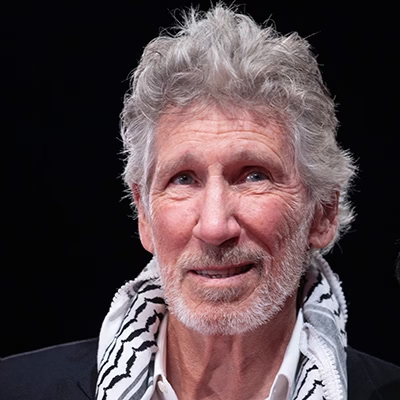

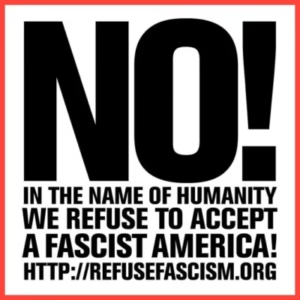 The show is an indictment of the militarism, perpetual war, imperialism, settler colonialism, and the “corporate dystopia” we all struggle to survive and a call to action to love, protect and share our precious and precarious planet home.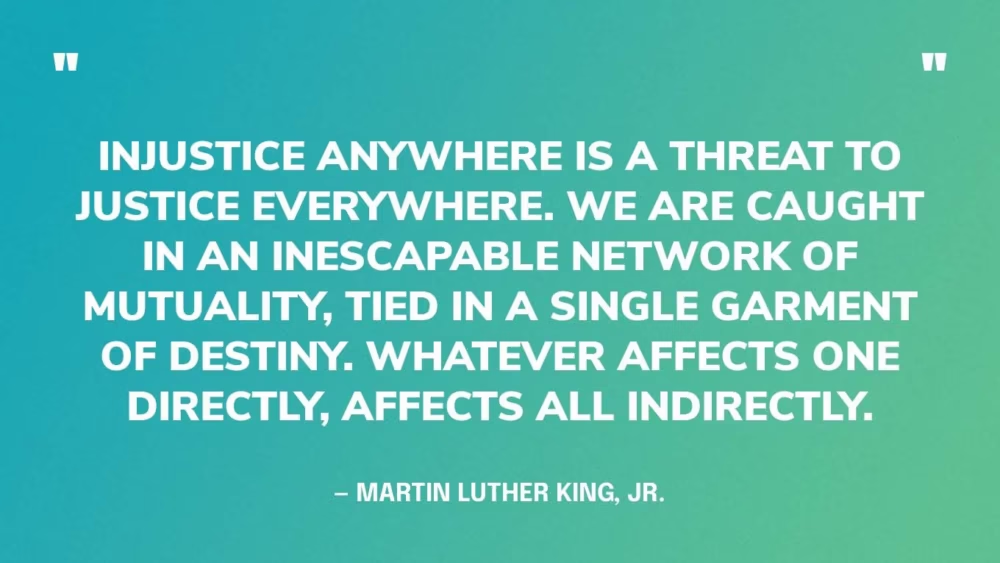
 Whatever you are able donate will bring you articles and opinions from independent websites, writers, and journalists as well as a blog with the opinions and creative contributions.

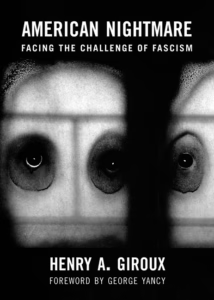
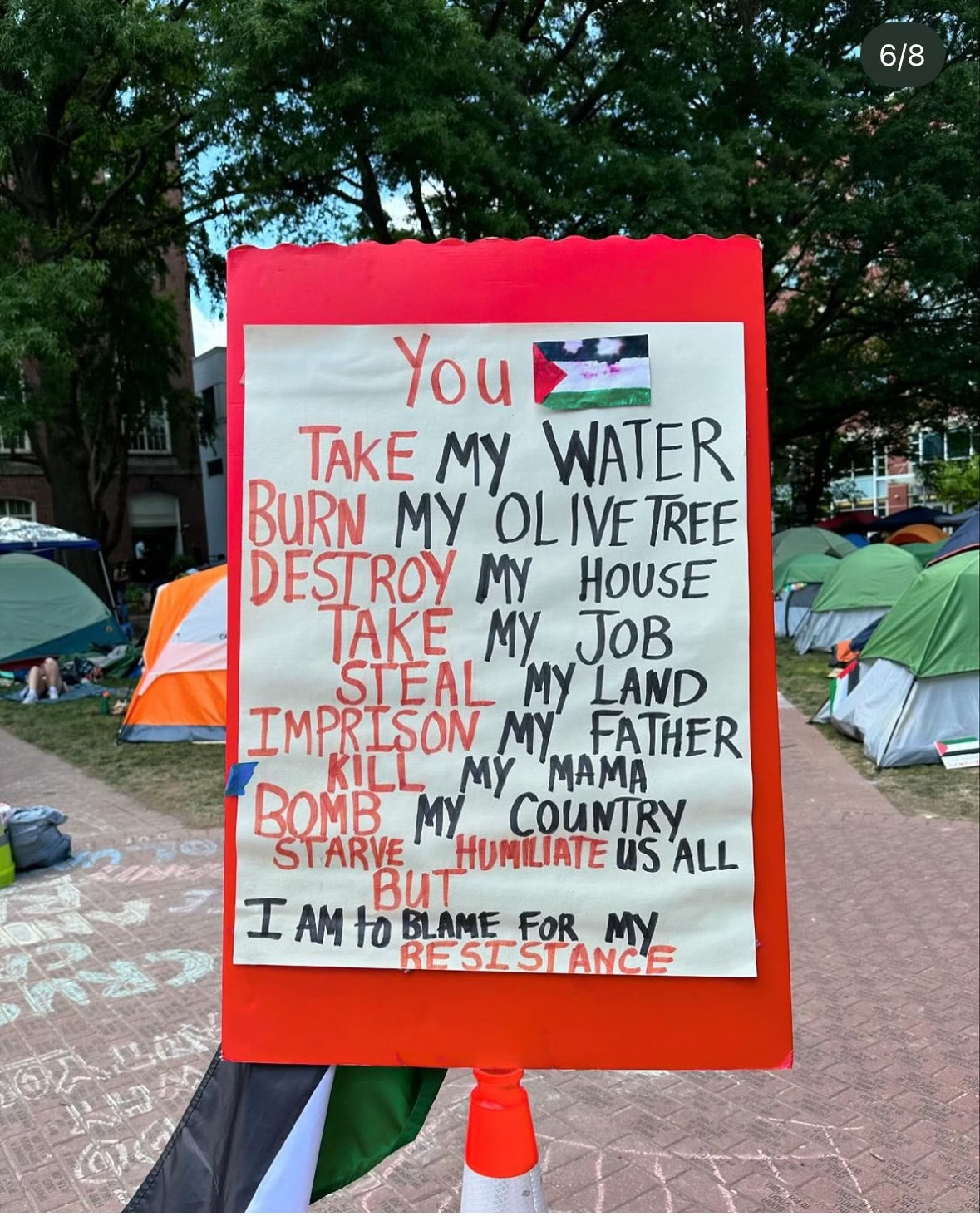
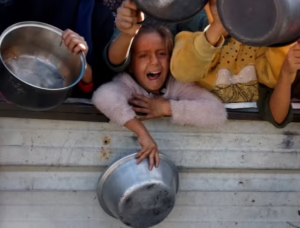

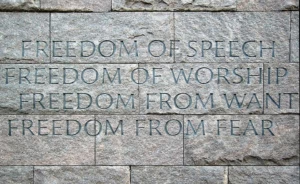 Engraving of the Four Freedoms at the