Tag: Elon Musk

  • “They’re Fascists”: Silicon Valley Journalist Gil Durán on “The Nerd Reich” Takeover of U.S. Politics

    “They’re Fascists”: Silicon Valley Journalist Gil Durán on “The Nerd Reich” Takeover of U.S. Politics

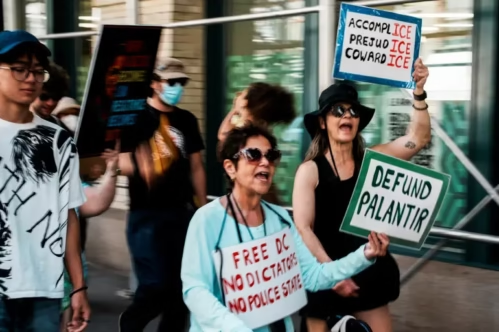
    Protesters demonstrate outside the Palantir offices in New York City [Eduardo Munoz/Reuters]

    When Silicon Valley says it is ‘‘moving fast and breaking things,’’ the world interprets the chaos as a necessary cost of innovation. Gil Durán reveals something far more sinister: a decades-long campaign to replace elected governments with corporate rule.
    —Simon and Schuster [Publisher]

    Full Transcript / This is a rush transcript. Copy may not be in its final form.

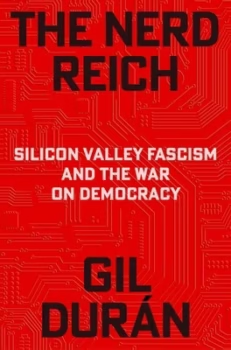
    AMY GOODMAN: This is Democracy Now!, democracynow.org, The War and Peace Report. I’m Amy Goodman, with Anjali Kamat, as we bring you Part 2 of our conversation with Gil Durán, author of The Nerd Reich: Silicon Valley Fascism and the War on Democracy.


    Gil Durán, in this Part 2 of the discussion, just start off by talking about: What is tech fascism?

    GIL DURÁN: Tech fascism is like classic fascism in most respects. It’s a cult of grievance and self-victimization that seeks to return to a mythical greatness by purging its demonized enemies, using propaganda focused on law and order, gender and sexuality, in order to impose a permanent hierarchical structure on the world. This hierarchy is what they consider the moral order of the world. And in their idea, it’s basically that rich white men should rule the world and the universe, and that’s the things — the way things should be.

    AMY GOODMAN: It’s very interesting. At the end of his presidential term, President Biden warned about the tech billionaires. Talk about what he said.

    GIL DURÁN: In his final speech as president, Biden said that the democracy was in danger from what he called a tech-industrial complex that had become radicalized and powerful and that was rising in our midst. And it’s not clear why he waited ’til his final speech to warn everybody, because this thing was growing in plain sight for a few years.

    But I start my book with that, because I want people to understand this is not just one journalist with a newsletter saying this. This is something that the president of the United States declared in his final speech, clearly intending to warn people about what was coming.

    And a few days later, Elon Musk stood behind the presidential seal at an inaugural event for Trump and threw a Hitler salute. And we’ve seen the rest of this regime, since then, follow these terrifying, scary contours of history, with masked, armed goons roaming around targeting immigrants, people being prosecuted for protesting, etc. So, I think that the president’s warning was important, but it came far too late.

    ANJALI KAMAT: Yet many of these same tech billionaires had supported President Obama before. What changed their mind and sort of cemented this fascist turn?

    GIL DURÁN: It was in their interest at the time, because Democrats had power.

    And, look, no one should be happier than the tech billionaires. They have won our system. They have all the money. They have tremendous influence and power. A lot of these guys, like Elon Musk and Peter Thiel and David Sacks, they’re immigrants. They weren’t even born here. They came to our country, and they became massively successful and wealthy.

    And now they’re full of anger, and they feel like it’s not enough, and they want more. And with Trump, they see now, in their own self-interest, or so they think, the opportunity to completely change how our country works, to disrupt democracy. This is largely what venture capitalists do: They bet on disruptive technologies that can provide a massive return of some kind in terms of profit. And they’ve bet on Trump and on fascism as a way to destroy democracy and make sure billionaires don’t have to worry about other people and the threat of the vote in the future. That’s very much the project they’re working on.

    AMY GOODMAN: Talk about the men who stood behind President Trump, and how unusual it was, in his second inauguration.

    GIL DURÁN: Definitely. You had Mark Zuckerberg, who had previously banned Trump from Facebook, at his inauguration. You had the head of Google, Sundar Pichai, there. You had Elon Musk, which is really no surprise; Jeff Bezos, who for many years seemed like a heroic guy to some people, the guy who was going to save The Washington Post, and now it’s become the opposite of that. The Washington Post editorial page, which in normal times would be a watchdog against corruption and excess, is now a lapdog for Donald Trump’s regime.

    AMY GOODMAN: Of course —

    GIL  DURÁN:  And — yeah.

    AMY GOODMAN: — it was Bezos who intervened when they were going to endorse Kamala Harris, and said there would be no endorsement.

    GIL DURÁN: Yeah, that’s where it started. And we’ve seen the results since then. It’s hard to even recognize the Post. I mean, there are good reporters there on the news side still, but the editorial page has become a complete lapdog for Donald Trump. And this is how that works, that it’s money chasing power, and power chasing money.

    AMY GOODMAN: So, for example, how did Zuckerberg change?

    GIL DURÁN: Zuckerberg is just doing what he thinks is in his own self-interest. I see Zuckerberg largely as a follower. The thing to keep in mind about Zuckerberg, though, is that the first major investor in Facebook was Peter Thiel. Wherever you look in the story of how Silicon Valley billionaires have become radicalized against democracy, you find the influence of Peter Thiel lurking not far away.

    If Kamala Harris had won the election, we would see an entirely different behavior out of these people. You know, they would be promoting diversity and putting people of color in important positions and espousing progressive values. But now the mask is fully off, and we see what these people truly are. You can’t go this hard in favor of an authoritarian regime and expect to ever recover your reputation. So they’re kind of locked in now, which makes them desperate and, I think, makes them more dangerous.

    ANJALI KAMAT: And who do they turn to for inspiration? Who are the world leaders in other countries that inspire them? And they’ve also set their sights beyond the United States, as well, their projects in Honduras, in Greenland.

    GIL DURÁN: Yeah, I mean, they love authoritarianism, because it’s more — especially authoritarianism that is open to capital investment, where you can buy what you want. I mean, it was Mark Zuckerberg who asked the dictator of China to name his child, and he refused. I mean, this is bizarre behavior from a tech CEO.

    In Honduras, though, they’ve created this project called Próspera, which is supposed to be this new territory, a wannabe nation where they make their own rules, laws and regulations. And you’re starting to see this idea pop up in different parts of the world. There’s one now being built in Kazakhstan, where the government plans a crypto megacity.

    And this comes from this same group of ideas, which some call the “network state cult,” this idea that we should invest in creating new territories that will become independent countries in the 21st century and give all of these billionaires escape routes when their prophesied apocalyptic collapse of democratic nations takes place.

    And Trump himself has promised to build 10 new “Freedom Cities” in the United States. These would be new private cities built by corporations on federal land. It was part of his 2024 platform. And what was interesting to me in my reporting was that, though people like Politico and others reported superficially that Trump had promised to build these cities, no one has ever explained: What’s a Freedom City? Why do we need Freedom Cities? And where does the idea come from? It comes from these crazy, radical Silicon Valley network state ideas.

    AMY GOODMAN: Can you talk about Peter Thiel both as founder of PayPal, but then Palantir, and the role Palantir has played, how it’s been used by militaries, domestic and foreign, for example, to spy on people?

    GIL DURÁN: What’s interesting about Peter Thiel is that for many years people described him as a libertarian. But for most of the time that Peter Thiel’s been in the public eye, he’s actually been a government surveillance and military intelligence contractor through Palantir, a company named after this all-seeing stone wielded by an evil wizard in The Lord of the Rings. And Palantir has quickly become one of the most well known and, I’d say, most hated tech companies in the country, because it’s being embedded in the military, in intelligence, in ICE operations, and as part of this massive surveillance apparatus coming out of Silicon Valley that is now partnering with an authoritarian regime.

    And something interesting about Peter Thiel, back in 2010, he gave a speech in which he said government was fundamentally evil. And this guy, he’s talking to a group of libertarians. He’s a government surveillance contractor, which is about as far away from the libertarian idea as you can get.

    And so, what you see is a group of men who opposed government until they saw the chance to claim government power for themselves. And Palantir is raking in billions of dollars in government contracts under Donald Trump as Silicon Valley pumps billions of dollars into the Trump family. It’s a tower — technology has proved to be a weapon of mass corruption in Washington. If you look at how much the crypto cartels are spending in our elections, they’re now the biggest spender in politics. Ten years ago, they weren’t even in existence in the political game.

    AMY GOODMAN: And explain what they are.

    GIL DURÁN: Yeah. Crypto? Crypto is a fake, digital, wannabe currency that’s mostly useful for scams, human trafficking, drug trafficking and crime, and gambling. And a very small percentage of Americans use crypto, less than 20%. Pew reported a few years ago it was 14%. But they are now the biggest moneyed force in American politics, basically holding our political system hostage by promising to spend tens of millions of dollars against any politician who dares to challenge crypto and doesn’t support crypto in any way. This would be like if a drug cartel suddenly entered American politics and threatened anybody who refused to legalize cocaine or heroin. This is what we’re watching here. Yet it’s become completely normalized.

    AMY GOODMAN: And how does President Trump and his family fit into that picture?

    GIL DURÁN: President Trump spent years describing crypto as a scam against the dollar. And on the day he returned to the White House, he became a crypto billionaire. And he is now the country’s crypto-bro-in-chief. His entire family is cashing in with bitcoin mining, with coin scams. Even Melania had a coin, that sucked money out of dummies and then enriched the Trump family. So, it’s amazing. At one point, The Wall Street Journal reported that the Trump family’s fortune had increased by $5 billion thanks to crypto. But because crypto’s so scammy and volatile, it’s now down to about 1.2, I think, in today’s news reporting.

    ANJALI KAMAT: I want to go back to Palantir. You were banned from X for criticizing Palantir? Can you talk about what happened?

    GIL DURÁN: In April, I was banned from X for criticizing Palantir’s manifesto, that they published, as fascism. I just said ”TLDR: Fascism,” Too long, didn’t read: Fascism.” But that follows a weird trend. The year before, Facebook banned links from my newsletter from being posted. And when I asked why, a representative said it’s because I write about the network state and I criticize tech figures, which was an amazing thing for a rep from Facebook to say. And after that got media attention, they reversed it. I was also banned by X when Elon Musk first bought it.

    And right now YouTube is threatening to take down my little podcast, because I’m being targeted by a campaign of false copyright claims, which is a tactic that’s emerging now. You can pay people, often emanating out of India, to just file constant copyright strikes. And YouTube’s answer to this problem is to just remove your channel permanently. And by Saturday, we’re supposed to be offline. So, I think my book is upsetting some people.

    AMY GOODMAN: You know, ABC reported last week that a Trump-appointed national bank regulator granted a wing of the Trump family’s crypto business conditional approval to establish a bank charter, opening the door to larger clients and potentially heightened profits. The decision marks the first time in U.S. history that a company owned by the sitting president’s family has been granted bank status.

    GIL DURÁN: A weapon of mass corruption, that’s what crypto is. We are basically living right now in a crypto banana republic. And it’s not clear why any Democrat or any Republican, for that matter, who loves this country is supporting crypto, taking crypto, legitimizing crypto. If you look at the history of crypto, it is openly designed as a way to undermine government authority and power. It was seen by cypherpunks as a way to escape from democracy, from rules and from law. So, why now do we have the president and his family starting a crypto bank, going into cryptocurrencies? You know, people are losing millions and billions of dollars to these scams. And, you know, it used to be that crypto was only useful for drug dealing, human trafficking, gambling and crime. Now it’s being used to buy power in order to break the country. And I think there has to be a real reckoning with the role of this pernicious technology, that is so — I mean, the corruption is so staggering, it’s almost hard to explain in words.

    AMY GOODMAN: So, the question is: Where does government fit into this picture? You quoted President Biden’s last speech, warning about the tech-bro-industry complex, the technology-industry complex, or TIC. But what are Democrats doing right now in Congress? And what are Republicans doing?

    GIL DURÁN: Largely not going after the Silicon Valley oligarchs who are behind Trump. You know, a lot of people are attacking Trump and criticizing his family, criticizing Vance. But we don’t see a lot of direct criticism of these billionaires who are enabling the entire thing. The way I look at it, Donald Trump is being paid billions of dollars to do these things, right? When’s the last time we had a president make billions of dollars while in office? This is direct transfer, including from foreign governments that are buying into and investing in his companies to curry favor.

    I think we need to see Democrats speaking directly against billionaire power, against tech billionaire power, against the crypto takeover of our country. You see all these Democrats trying to say, “Oh, AI innovation, Silicon Valley innovation.” Those are outdated talking points. Silicon Valley is no longer about innovation. Silicon Valley is about fascism and a race to control the future. And that future will not be good for most people. And it’s the job of our elected officials, especially on the Democratic side of things, to stand up for the people.

    There are a few people doing it. You see Bernie Sanders, James Talarico, Jasmine Crockett and others who have spoken directly to this, Chris Murphy, Ron Wyden. But people like Gavin Newsom and others are suspiciously avoiding any critique of Silicon Valley. And I don’t think we can have that going forward. People are waking up to this threat. We see it all across the country. And we need politicians who match the energy of the people, or we need those people to be the new politicians.

    ANJALI KAMAT: We’re seeing this massive movement against data centers, right? Across the country, people are opposing data centers. What’s happening in Silicon Valley? Is there some resistance to this massive takeover and this kind of ideology?

    GIL DURÁN: A little bit. Nothing too noteworthy. Most of the resistance is coming from communities that are being targeted by data centers, that are being targeted by Palantir surveillance and fascism aided by ICE. You see people resisting and rising up. There are also movements like Purge Palantir, which is boycotting any company that has Palantir products, raising awareness of the role of this company in our government, and putting a lot of pressure on the company. Same thing is happening to Flock surveillance, where people are starting to militate against putting these Big Brother facial recognition, license plate recognition cameras in every aspect of our lives.

    So, you see people waking up to that. And it’s not just Democrats, by the way. It’s also Republicans and independents. And it’s also people who are not activists. It’s people who are just becoming activated by the threat of this alien invasion of our country by these surveillance-mad, power-hungry billionaires. And it’s pretty inspiring to watch. It’s the grassroots, and I think the politics are going to have to catch up with that.

    AMY GOODMAN: As we begin to wrap up, what is missing from the whole debate around artificial intelligence?

    GIL DURÁN: The question is why we are pursuing this idea that we have this dangerous technology that is going to kill all of our jobs and potentially wipe out all of humanity. This is the marketing of the AI industry itself. And why is that being made to seem inevitable? I don’t think it’s inevitable at all. I think we have the right to reject this dystopian future that’s being imposed on us. How does it make sense to destroy our economy to enrich a handful of oligarchs who are already wealthy and whose wealth has driven them insane and hasn’t made them very happy?

    You know, we have this problem where it’s becoming a competition between democracy and capitalism, and which one is more important. You know, even before the tech bros came along, we were destroying the planet for a handful of fossil fuel companies. How does that make any sense? There has to be a different way to do this.

    And the same thing with AI. AI is being marketed as this destructive, terrifying force, and we all have to invest in it and adopt it or else. And I don’t think it has to be that way, and I think people need to push back harder on a policy level and stop trying to ingratiate themselves to the AI moguls, which is largely what’s happening now. Even the best politicians among us are playing along with this idea that this is an intelligence, which it’s not, and that this is inevitable, which it’s not.

    And so, I think we need to backtrack a bit and get off of this idea, and question the narrative that we have no choice except to bow down to this AI god these guys claim to be building, that it’s a religion. It’s a myth. It’s not real. I don’t think LLMs are completely useless. I think there’ll be some good applications for AI.

    ANJALI KAMAT: Explain what LLMs are.

    GIL DURÁN: Large language models, like Claude, etc. I don’t think these things have to be useless. I just don’t understand why they have to eat everything. They don’t. This is — this is the marketing for the investors. This is convincing people that you have to spend trillions of dollars on this, so we can create this massive thing that will then suck all of the value out of the economy and render every worker useless. This is absurd, it’s ridiculous, and it’s an apocalyptic cult.

    ANJALI KAMAT: You know, you’ve been spending time reading the statements and writings of all of these figures. What scares you the most?

    GIL DURÁN: What scares me is that you can be as anti-American and anti-democratic as Peter Thiel and still be a government contractor with investment from the CIA. I mean, Palantir was created with investment from the CIA. And I worked in government for many years for Democrats. I worked for Senator Feinstein when she was chair of the Intelligence Committee. And it boggles my mind that you can say that kind of stuff and believe these radical things and still be that deep in our intelligence infrastructure. I have a lot of questions about what went wrong there. I mean, to get into government, you have to pretend like you never smoked marijuana, and here you are smoking the most anti-American, anti-democratic dope in the world and becoming a billionaire off of government contracts. That’s what scares me.

    How did no one catch this? You know, trying to talk about what’s happening to our country without talking about these tech fascists is like trying to explain 9/11 without talking about al-Qaeda. This cult of dangerous billionaires has a very pronounced idea of what our future is, and it’s not going to have democracy in it. And I don’t understand how they got this far, this fast. Nobody — and even today, most people in the media and the political establishment aren’t really addressing it. And I hope my book can help change that.

    AMY GOODMAN: The name of the book is The Nerd Reich: Silicon Valley Fascism and the War on Democracy. The author, Gil Durán. To see Part 1 of our conversation, go to democracynow.org. I’m Amy Goodman, with Anjali Kamat. Thanks for joining us.
    The original content of this program is licensed under a Creative Commons Attribution-Noncommercial-No Derivative Works 3.0 United States License. Please attribute legal copies of this work to democracynow.org. Some of the work(s) that this program incorporates, however, may be separately licensed. For further information or additional permissions, contact us.
  • “The Nerd Reich”: Author Gil Durán on Big Tech Fascism, Peter Thiel, JD Vance and the War on Democracy

    “The Nerd Reich”: Author Gil Durán on Big Tech Fascism, Peter Thiel, JD Vance and the War on Democracy

    “The Nerd Reich: Silicon Valley Fascism and the War on Democracy” follows the rise of Vice President JD Vance, the former venture capitalist whose “outsider” campaign for Senate was bankrolled by the billionaire co-founder of PayPal and Palantir, Peter Thiel….“These guys were never libertarians,” says Durán. “Now that they are the government, we see their true face: They’re fascists, and they’re authoritarians.”

    “The Nerd Reich: Silicon Valley Fascism and the War on Democracy” follows the rise of Vice President JD Vance, the former venture capitalist whose “outsider” campaign for Senate was bankrolled by the billionaire co-founder of PayPal and Palantir, Peter Thiel. Durán traces the ideological lineage of the current Trump administration back from Vance to Thiel and the far-right-wing monarchist Curtis Yarvin, whose “right-libertarian” political theory has long made the rounds among Silicon Valley elite. “These guys were never libertarians,” says Durán. “Now that they are the government, we see their true face: They’re fascists, and they’re authoritarians.”

    Book published by Simon & Schuster.

    Subscribe to our Daily Email Digest: https://democracynow.org/subscribe

    THE NERD REICH

    Full Transcript/This is a rush transcript. Copy may not be in its final form.

    AMY GOODMAN: This is Democracy Now!, democracynow.org, The War and Peace Report. I’m Amy Goodman, with Anjali Kamat.

    ANJALI KAMAT: The Nerd Reich: Silicon Valley Fascism and the War on Democracy. That’s the name of a new book by our next guest, the journalist Gil Durán. The book looks at how tech billionaires, including Peter Thiel and Elon Musk, are pushing what Durán calls “tech fascism.”

    Gil Durán also documents how Thiel had played a pivotal role in JD Vance’s rise to power. Durán writes, quote, “Vance is almost entirely a creation of Thiel who bankrolled his brief stint as a Silicon Valley venture capitalist and United States senator. With Vance at Trump’s side — Silicon Valley had one of their own in the White House — a tech venture capitalist one heartbeat away from the presidency.”

    AMY GOODMAN: Gil Durán joins us here in New York. He’s the former opinion editor of The Sacramento Bee and editorial page editor at the San Francisco Examiner. He now publishes two newsletters: The Nerd Reich and FrameLab.

    Welcome to Democracy Now! So, let’s start with the title, The Nerd Reich: Silicon Valley Fascism and the War on Democracy. Why’d you choose it?

    GIL DURÁN: Well, in 2024, I wrote a series for The New Republic about the extremist ideological beliefs coming out of Silicon Valley. And after I’d written a story that went really viral and got me under attack by one of these guys, someone reached out to me from the crypto world and said, “You know, we’ve been calling these guys ‘the Nerd Reich’ for years.” And that blew my mind. And I saw that no one was really using that title, and so I rebranded my newsletter, which had some boring other name, as The Nerd Reich, and that became the main message of it. But I thought it was amazing that from within their own community, this was a label that was applied to them. People understood it was fascist and was echoing Nazism in nature.

    AMY GOODMAN: But I want to just say the billionaire tech bros, as they are known, another name for them, haven’t always been the way they are now, in fact, when Trump was first coming into office. Talk about how they have changed.

    GIL DURÁN: During the first Trump administration, we saw something called Tech Against Trump, where there were all these tech companies standing up to Trump, filing lawsuits, opposing his crackdowns on immigration. This time around, it’s completely different.

    AMY GOODMAN: He was removed from X.

    GIL DURÁN: Yeah, removed from X. Facebook banned him. Now we see the opposite happening.

    I think what happened is that Trump was able to tap into some undercurrents in Silicon Valley with his return to power. Billionaires had become radicalized by things like the #MeToo movement, by Occupy, by the Black Lives Matter movement, and then by the pandemic. And so, when Trump is able to return to power, they are now in a very different mentality. They’ve made billions and billions of more dollars. They’re even more against taxes and government, even though government is generally the basis for many of their fortunes.

    And so, now we see a complete alignment behind Trump. In fact, Trump is being funded and supported by Silicon Valley. He wouldn’t be able to do the things he’s doing without the billions of dollars he’s raking in in open crypto corruption.

    ANJALI KAMAT: You know, in the epigraph to your book, you quote Peter Thiel from 2010. So, in a way, they’ve changed, but this also goes back and has a longer history. And the end of that quote is “technology is this incredible alternative to politics.” Can you talk about what he meant by that and what that means in terms of the kind of influence Peter Thiel has?

    AMY GOODMAN: And who he is?

    GIL DURÁN: Yeah. Some billionaires appear to have changed, but Peter Thiel hasn’t really changed. He’s been right-wing for a very long time. Peter Thiel was born in Germany, came to the United States as a child, went to Stanford, became a lawyer, studied philosophy, and then got very lucky to be in Silicon Valley in the late 1990s as things were about to take off.

    In 1997, he read a book called The Sovereign Individual, which predicted that in the 21st century technology would overthrow democracy, specifically something called cybercurrency, or what we would today call crypto, which would undermine government authority, and advanced automation, which we would call AI, which would collapse the economy by destroying most jobs and concentrating wealth in the hands of a savvy few that were called the “sovereign individual.” And Peter Thiel has credited this crazy book with being the inspiration for PayPal, which he saw — which he says was an effort to get ahead of this digital currency.

    It didn’t quite work out that way, but it made him a billionaire, eventually, because it provided the basis for his fortune, and he’s been able to use his money to grow this influential cult of right-wing ideas in Silicon Valley, which, by the way, they were always there, this libertarian, it was called, vibe coming out of Silicon Valley in the ’80s and the ’90s. There were a handful of writers who wrote about it then. But what we’ve learned is these guys were never libertarians. They just wanted to be in charge of the government. They weren’t against the government, unless they don’t get to be the government. So, now that they are the government, we see their true face: They’re fascists, and they’re authoritarians.

    Peter Thiel [left]/Silicon Roundabout/Photo: The Guardian

    ANJALI KAMAT: You know, you tell this story in the book, a remarkable story, of a group of these billionaire tech bros. It’s not just Peter Thiel; it’s several other men. Can you talk about some of these other characters that you talk about? And what is their crusade against democracy?

    GIL DURÁN: They have this idea, largely stemming from this Sovereign Individual book, that technology means democracy is an obsolete software system, that the United States is an obsolete country, that it won’t survive the 21st century. And I want to say, I know this sounds crazy to people, but much of my book is told in the words of these men, from — in podcasts, in interviews, in long essays, they write about it. And their problem with democracy is that they don’t get to have all the power.

    ANJALI KAMAT: So, you didn’t have to get secret documents. I mean, you have some remarkable statements in this book. You have Balaji Srinivasan and also Curtis Yarvin, and Curtis Yarvin, I believe, talking about, in an early blog post perhaps, talking about San Francisco and what to do with the poor?

    GIL DURÁN: Yeah. So, this idea is that they’ve got — some call it the network state. Curtis Yarvin called it “patchworks.” Part of their apocalyptic vision for the future is that the country will be broken up. It will no longer be one country. It’ll be broken up into these sort of corporate zones or fiefdoms called patchworks or network states. And the new governing structure will be these autocratic, dictator-like corporations that will have total power over their citizens. Yarvin wrote that they could even turn unproductive people into biodiesel to fuel city buses. But he said he was just kidding about that, but that what we really need for the poor is a humane alternative to genocide.

    So, these are the kinds of ideas you see. And what’s disturbing is that Balaji Srinivasan, another Peter Thiel protégé, because Curtis Yarvin is funded by Peter Thiel — that’s the only reason anyone’s ever heard of him — goes on to create this idea called the network state, which is a more startup-friendly version of this, that corporations and billionaires should fund their own cities and countries. And we’re seeing that grow.

    AMY GOODMAN: Let’s go to Curtis Yarvin in his own words at the Institute of Art and Ideas, where he explained why he supports monarchical system of government.

    CURTIS YARVIN: Let’s debunk this concept of liberal democracy. There’s actually no such thing. Democracy in today’s world just means a good or legitimate government. It means a claim to a legitimate government. Just because you call yourself a democracy doesn’t mean anything. North Korea calls itself the DPRK, Democratic People’s Republic of Korea. That is three euphemisms for democracy, one place name, and it’s a monarchy. …

    Anything that works is a monarchy. So, for example, if you take your your iPhone and you look at the box that your iPhone comes in, it says, “Designed by Apple in California, manufactured in China.” So, that is two monarchies — Apple has a CEO, and China has a dictator — and one oligarchy, which is the government of California, which is, by the way, basically a single-party state. There are no longer competitive elections in California. So, when you try to imagine the state of California, in which I live, trying to build an iPhone or design an iPhone, the concept is ridiculous.

    AMY GOODMAN: Let’s go back to 2021, when JD Vance, then a candidate in Ohio for U.S. Senate, appeared on the conservative Jack Murphy Live podcast. Murphy asked Vance how to root out so-called wokeism from American institutions.

    JD VANCE: There’s this guy Curtis Yarvin, who’s written about some of these things. And so, one is to basically accept that this entire thing is going to fall in on itself, right? … I tend to think that we should seize the institutions of the left and turn them against the left, right? We need — we need like a de-Baathification program, but like a de-wokeification program in the United States, right?

    AMY GOODMAN: So, that was JD Vance back in 2021. The latest news, this out of The Washington Post, that President Donald Trump recently told donors in private that he wants to see his vice president, JD Vance, win the 2028 presidential election, a sign that he’s open to publicly backing JD Vance. There’s been this kind of war between JD Vance and Marco Rubio, the secretary of state. But talk about the significance of this and, as you said, JD Vance being a creation of Peter Thiel.

    GIL DURÁN: JD Vance is a dangerous extremist who embraces a set of ideas that should put a chill down the spine of every American. He went on in that interview to say that Donald Trump would likely win the 2024 election, and that when he did, he should purge the federal government, just like Yarvin had recommended, and, in fact, he should defy the courts and the law and challenge the Supreme Court justices to force him to follow their dictates. It’s pretty amazing that you have a man on the political stage in the White House a heartbeat away from the presidency, who has espoused such radically anti-American ideas.

    And I think people need to understand the degree to which he is so closely related to Peter Thiel. We wouldn’t have a JD Vance without a Peter Thiel. Peter Thiel is even the reason that JD Vance converted to Catholicism. He’s the reason JD Vance became a venture capitalist and a millionaire. He’s —

    AMY GOODMAN: How did they hook up?

    GIL DURÁN: Peter Thiel likes to go around speaking to schools and graduate schools. And in 2011, he went to Yale Law School and gave a speech. And JD Vance said it was one of the most significant moments of his life and that Peter Thiel was one of the most intelligent people he’d ever heard. And basically, that speech convinced him to not be a lawyer, and instead to become a venture capitalist. And at every step of JD Vance’s life since then, it has been Peter Thiel who has made him who he is, who has essentially created him whole cloth.

    ANJALI KAMAT: And it’s not just JD Vance, right? I mean, it’s — Bloomberg, I think, reported that 16 people connected to Thiel are in the Trump administration. Can you talk about, you know, what kind of effect this has had in terms of policies? Like, you know, when we hear these ideas, they sound a little outlandish, to say the least. It’s hard to see them being translated into policy. But then, what we’ve been living over the past two years, you’re seeing a lot of this coming to fruition. So, can you talk about, you know, DOGE, for example, or the, you know, mass layoffs at federal jobs, what happened to USAID, and where those ideas came from?

    GIL DURÁN: The main argument of Curtis Yarvin for a long time has been that a president should act as a dictator. And one of the ways to cement this dictator’s power is to purge the federal government of anyone who is unwilling to follow the orders of the dictator, basically to destroy the civil service. In addition — this is 15, almost 20 years ago — he recommended that the United States pretty much destroy its diplomatic standing in the world and eliminate international aid programs.

    We saw all of that happen during DOGE. In fact, Yarvin had updated his idea to say that it should be a CEO who the president should install as a dictator to run rampant over the federal government. And DOGE was an almost perfect expression of that. So, these ideas that used to be —

    ANJALI KAMAT: And what did Curtis call it? RAGE?

    GIL DURÁN: He called it RAGE — “Retire All Government Employees.” So, even the four-letter, all-caps acronym is an echo of Yarvin. And these are ideas that were on an anonymous, weird blog, marginal in Silicon Valley 15 years ago, and have now become policy under the Trump administration, because when you’re a billionaire, you have the power to impose these crazy ideas on everyone else.

    And that’s what’s happening. Peter Thiel’s entire inner circle has infiltrated government at the same time that the Trump family is now becoming tech venture capitalists and crypto cartel moguls. There’s this joining of forces. The corporate is becoming the state, and both of it’s combined with apocalyptic religious movements. And that is the heart of fascism.

    AMY GOODMAN: Where does Elon Musk fit into this picture?

    GIL DURÁN: Elon Musk and Peter Thiel go way back to PayPal. They started it together. They’ve had some tensions.

    AMY GOODMAN: The so-called PayPal Mafia?

    GIL DURÁN: The so-called PayPal Mafia. But you’ll note that Peter Thiel is considered the godfather of the PayPal Mafia, even though Elon Musk is the wealthiest man in the world. Musk is certainly aware of these ideas, and when he was thinking of starting his own political party after he left DOGE, he consulted with Curtis Yarvin about how to do that and what the party should say. So, here’s Yarvin, who knows nothing about anything, but he’s considered a genius by these billionaires, largely because he tells them what they want to hear.

    So, Elon Musk is clearly radicalized, is clearly open to these ideas. I’m not sure that he reads a lot about these things as much as he just believes the basic idea behind this, which is that wealthy, white technologists should be the ruler of the world, and then the galaxy and the universe. This is the cosmology coming out of Silicon Valley these days.

    AMY GOODMAN: Where do women and people of color fit into this picture?

    GIL DURÁN: At the bottom of the hierarchy, if they exist at all. Look at what’s happening with the USAID cuts: a targeted hit delivered against the poorest people in the world by the richest man in the world, with millions of people projected to die. These billionaires who promise abundance because of AI, well, we already have abundance, and we’re not sharing it. Look at what they’re doing to the poorest people today. And if you listen to the apocalyptic visions that AI will kill all jobs and transform everything, they say that, “Well, don’t worry. Everyone will get a share of the extreme universal wealth that’s created.” But that’s not what we’re seeing today, and we can’t really believe that when they say that. Fascism is about imposing a hierarchy, a moral order. And white, wealthy, Western men are at the top of that moral order in fascism.

    AMY GOODMAN: Gil Durán is author of The Nerd Reich: Silicon Valley Fascism and the War on Democracy. If you have time, we’re going to do Part 2 of this discussion, and then we’re going to post it online at democracynow.org. Again, the book, The Nerd Reich.

    I’ll be speaking after the screening of Steal This Story, Please! in Middlebury, Vermont, on August 28th. Check our website at democracynow.org. I’m Amy Goodman, with Anjali Kamat.

    The original content of this program is licensed under a Creative Commons Attribution-Noncommercial-No Derivative Works 3.0 United States License. Please attribute legal copies of this work to democracynow.org. Some of the work(s) that this program incorporates, however, may be separately licensed. For further information or additional permissions, contact us.
  • Glenn Greenwald: Palantir EXPOSED;  DN! “Purge Palantir”

    Glenn Greenwald: Palantir EXPOSED; DN! “Purge Palantir”

    “Everyone is converting to Palantir…”


    Palantir EXPOSED: The New Deep State

    By Glenn Greenwald / System Update / June 10, 2025

    This is a clip from the show SYSTEM UPDATE, now airing every weeknight at 7pm ET on Rumble. You can watch the full episode for FREE here: https://rumble.com/v6ujj1n-system-upd…


    Democracy Now! “Purge Palantir”: Day of Action Protests Firm’s Role in Gov’t Surveillance, ICE & Genocide in Gaza

    Protesters across the United States targeted Palantir Monday [7/14/25] in a day of action focused on the technology company’s work with ICE, facilitating President Trump’s expanding immigration crackdown, and work with the Israeli military. New York police arrested at least four people Monday after demonstrators blocked the entrance to the company’s Manhattan offices. Democracy Now! spoke to protesters, including some who work in the technology sector, about the “Purge Palantir” campaign and how Palantir’s data mining, surveillance and automation tools are being weaponized against vulnerable communities. We speak with Wired senior writer Makena Kelly, who has been covering Palantir and says many Silicon Valley firms are “trying to find opportunity in this chaos” as the Trump administration slashes government services and pursues mass deportations.

    Guests
    Makena Kelly
    Wired Senior Writer focused on the intersection of politics, power and technology.

    Links
    “This is DOGE 2.0”

    Please check back to Democracy now later for full transcript.

    The original content of this program is licensed under a Creative Commons Attribution-Noncommercial-No Derivative Works 3.0 United States License. Please attribute legal copies of this work to democracynow.org. Some of the work(s) that this program incorporates, however, may be separately licensed. For further information or additional permissions, contact us.

    More on Glenn Greenwald’s System Update:
    Now available as a podcast! Find full episodes here: https://linktr.ee/systemupdate_
    Join us LIVE on Rumble, weeknights at7pm ET: https://rumble.com/c/GGreenwald
    Become part of our Locals community:
    https://greenwald.locals.com/
    Follow Glenn: Twitter:   / ggreenwald  
    Instagram:
      / glenn.11.greenwald  
    Follow System Update:
    Twitter:
      / systemupdate_  
    Instagram:   / systemupdate__  
    TikTok:
      / systemupdate__  
    Facebook:
      / systemupdate.tv  
    LinkedIn:
      / systemupdate


    In this critical time in our country hearing the voices of truth is all the more important although censorship and attacks on truth-tellers is common. Support the WingsofChange.me website and Rise Up Times on social media. striving to bring you important articles and journalism beyond the mainstream corporate media. Access is alway free, but if you would like to help:
    Wings of Change FeatherA donation of $25 or whatever you can donate will bring you articles and opinions from independent websites, writers, and journalists as well as a blog with the opinions and creative contributions by myself and others. 

    Sue Ann Martinson, Writer, Editor Wings of Change

  • The Unraveling of the New Deal, Part 2

    The Unraveling of the New Deal, Part 2

    [FDR] changed the relationship between government, business and labor forever.
    —Doris Kerns Goodwin

    The Unraveling of the New Deal, Part 2

    Link to Part 1

    Minneapolis Union Strike of 2934

    The Minneapolis Teamster’s Strike, 1934

    Labor and Civil Rights and Civil Liberties

    Civil Rights and Civil Liberties are so much a part of Labor History in the United States that while they can also be separate, they are often inextricably tied to Labor in many instances. Immigration is linked to labor history as new immigrants were a labor force often mistreated and therefore became strong labor activists. For Black people the struggle for civil rights was constant and often linked to labor issues.

    Some Immigration History and Now

    Immigration is another area that Trump is active in, attempting to export as many refugees as possible, often in cases where they are actually in the U.S. legally. One example is Mahmoud Khalil, a young student with a green card who was arrested along with his pregnant wife, a U.S. citizen, for his pro-Palestine protests and activities, whose treatment is meant to make other protesters afraid.

    FDR did not single out any particular group of immigrants; he included them all. He recognized the contributions they were making to the U.S. economy and culture. The influx of immigrants was initially primarily from Europe with the exception of the Chinese on the west coast whose labor built the western railroads to connect with the east for rails to cross the continent in the 1860s. 

    They came from Ireland during the potato famine in the mid 1800s, and many as refugees from Europe after WWI, and were followed by those who came just before and after WWII. In more recent times they have come from countries in Asia as a result of the Vietnam War when many Vietnamese and Hmong came to Minnesota.

    The latest waves of immigrants have arrived from the Middle East wars and from Africa. Minnesota now has a large Somali population as many have immigrated due to our wars in their country. Many now are from other African countries as well, where settler colonialism has left them war-torn and the people destitute as multinational corporations from Western multinationals  have robbed them of their natural resources and in effect enslaved their people to do hard labor in their mines.

    Last, but certainly not least, many Spanish- or Portuguese-speaking people from South and Central America have left their countries to come to the United States, some fleeing from extreme dictatorships as political refugees and others from poor countries to better their economic situations. Their presence is evidenced by the need to have many formal government documents translated into Spanish, as well as Somali and other languages.

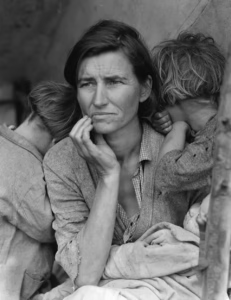
    “Migrant Mother,” taken by Dorothea Lange in 1936, depicting Florence Owens Thompson, a mother with her children, during the Great Depression. Source: Wikipedia. Photo now is in the Metropolitan Museum of Art.

    Many Hispanic people originally came to work in the large farms that grew fruits and vegetables in California. Some even came to Minnesota to work for Green Giant, resulting in an area on the west side of St. Paul where many settled and stayed.  The fight of these workers to unionize and to demand decent living accommodations and wages is well-documented in film, song and books that describe their struggle; often they feature union organizers Cesar Chavez and Delores Huerta.

    I might also add that the variety of ethnic groups represented as evidenced by the foods available from the many ethnic restaurants here in Minnesota— adding the food of the Black and Native cultures as well—speaks to America being a nation of immigrants, as it has been since the Mayflower.

    Trump’s current attacks on immigrants and immigrant rights are massive as he arrests and deports recent immigrants illegally and with cold-hearted precision. There has been information about the treatment of the deportees in, for example, El Salvador where the accommodations are similar to the Nazi death camps in Germany in WWII, if not worse. He is snatching people off the streets, including students, and sending them to an ICE facility in Louisiana that is reported to be the worst in the country with a reputation for prisoner abuse. How he could possibly care about people is beyond comprehension. The contributions of immigrants to American culture, science, and so on are well-documented in books, articles and on the web.

    Remembering Tammany Hall of legend in New York City, where the cops were all Irish: they had a stranglehold on the government and they were corrupt. I use that as an example because they were white, although sometimes were considered to be of another race to denigrate them. They also helped immigrants, particularly their own. The contributions of Tammany may have been somewhat negative, but they were not all the Irish who came to America during the famine. Men of Irish heritage fought on both the Confederate and the Union sides during the Civil War. Irish contributions to the culture of song and dance are immeasurable, especially when you live across the Mississippi River in Minneapolis and visit sister city St. Paul on St. Patrick’s Day. Or visit, in my case, my Irish heritage friends who have done so much good in this world, not to mention a brother of theirs who was in the state legislature for many years. These Catholic Sisters of St. Joseph were rightfully honored by St. Paul’s History Theater with a play of their own. The Irish have left their positive imprint all over the United States in spite of prejudice because of their  Roman Catholic religion. (“No Irish Need Apply.”)

    Now we have the immigrants from the Middle East, Africa, and those from across the southern border from South and Central America who work in the hotels and often as cleaners in various industries. From Somalia: many Somali men are taxi and truck drivers, at least here in Minnesota. Many are Muslims, and have built a number of mosques in Minneapolis and suburbs.

    The immigration starting basically during my lifetime includes refugees from Vietnam and then the Hmong; it continues to the present day where many new African immigrants work in senior or rehabilitation facilities as nurses or nurses’ aids along with jobs in industry. 

    In other words, they are assimilating. And no, I do not see them so often in the suburbs when I visit. I live in the city, but since George Floyd I see them more often than I used to. What is important is to understand the waves of immigrants who have come to this country and the contributions they have made and that not all white immigrants were good people. But then not all were bad either, and Trump’s attempt to lump all immigrants, especially immigrants of color, into one evil group is in itself an evil, as are his deportations: especially the Hispanics that he is deporting right and left and the pro-Palestinian young college students, as he targets especially those who have taken action against genocide in Gaza.

    In another racist/white supremacist move he has promised to restore all the monuments, the statues, torn down in the time of George Floyd protests that honored the Civil War Confederates in a glorification of both war and racism.

    Of course there is no such thing as one evil race. In the history of the world not only has evil come from all races, including white of course, but also so many of the brilliant people who have made contributions to world culture are from a variety different races; I think particularly of music, poetry and art, but also science, which, because of its nature in work often done away from the public eye, is not acknowledged as often. No one race can claim total superiority.  Or total evil either.

    Trump’s obsession with The Wall that is between the U.S. and Mexico is not MAGA, not Make America Great Again, but MEGA in the sense of huge as he has ordered new walls built and increased border patrols, a militarization of the border between the U.S. and Mexico.

    And he insists on drawing that “color line,” this time against Hispanics.

    Trump’s father once evicted Woody Guthrie because he couldn’t pay his rent. Woody immortalized it in song.

    I suppose that Old Man Trump knows just how much racial hate
    He stirred up in that bloodpot of human hearts
    When he drawed that color line
    Here at his Beach Haven family project

    Beach Haven ain’t my home!
    No, I just can’t pay this rent!
    My money’s down the drain,
    And my soul is badly bent!
    Beach Haven is Trump’s Tower
    Where no black folks come to roam,
    No, no, Old Man Trump!
    Old Beach Haven ain’t my home!

    But Trump of course is not alone in his efforts to destroy the good that America has done, the American values that so many have fought and died for and others have striven to not just preserve but make active and real in our daily lives, and continue to do so.

    The 2025 program that Trump embraces was created by the Heritage Foundation. Much of a Republican Congress and some Democrats also support what he is doing as he continues to destroy America: There is no other way to describe it. He stands at the titular head of it all with his narcissism and his greed for approval and power, a W.T. Barnum of politics as he centers himself in “the greatest show on earth” as the American Empire crumbles.

    Black People Under FDR

    FDR did more for Black people than any previous president. He had what was called a Black Cabinet that was involved in labor. The Black Cabinet was an unofficial group of African-American advisors to FDR. They ensured that thousands of Black women and men received the training that enabled them to work in the defense industry during World War II. And while helping reverse segregation in the federal workforce, they brought about the first anti-discrimination clauses in government contracts.

    Lynching Law

    Although not related directly to labor, the Roosevelt connection to a lynching law also needs to be mentioned. A law against lynching was controversial at the time, although Eleanor Roosevelt was an avid supporter of creating a federal law against it. She even arranged a meeting between Walter White of the NAACP and FDR. White was an American civil rights activist who led the National Association for the Advancement of Colored People (NAACP) for a quarter of a century, from 1929 until 1955. White directed a broad program of legal challenges to racial segregation and disfranchisement. But because of the southern senators who could block bills that FDR favored, especially Social Security, even though in private he expressed opposition to lynching, it took many years before a federal law took effect. (Ken Burns: The Roosevelts, Episode 5, PBS.) President Biden signed a federal bill making lynching a hate crime on March 29, 2022.

    “The Spirit of the “People”

    The spirit of the New Deal, with its emphasis on the people, a government “of the people, by the people, and for the people,” was not a government for what FDR called the “Economic Royalists,” who held power over the people. Today one name for them is the “ruling elite.” It is true that the U.S. Constitution as originally conceived favored white male landowners. That bias has to some extent been preserved; the white moneyed elite that today takes form in racism as white supremacists as personified by the Ku Klux Klan and in other racist myths that elevate the white race as superior. We currently have a president, with his fascist cohorts in Congress, leading in racist threats and comments and with exporting many people who have sought refuge and a better life in the United States.

    In the writing of the Constitution there were long and serious debates about the status of the Negro and the three-fifths compromise made that was clearly based on economic considerations of the time. Cotton was King and a major part of the economy, which succeeded on the plantations thanks to Black slave labor. The rights of women and of indigenous people were ignored.

    The movements and strikes around civil rights and liberties for people of color, for women, and for labor rights led to large protests early on and continue. often related to the right to unionize regarding pay and working conditions, no small thing.

    Paul Robeson singing about Joe Hill, a labor organizer who was accused of murder and executed in 1915 and who is still remembered as an inspiration for labor organizers.

    From the Chicago Haymarket Affair, a protest for an 8-hour workday in Chicago on May 4, 1886, to the organizing of the Hispanic farm workers in California in the 1960s and ‘70s for their right to unions, decent pay, and good working conditions. Today organizing continues to create unions in some professions or demand better pay and working conditions, as strikes have become a method to make demands of employers in the public sector and of corporations.

    Many unions went on strike during and after WWI and after WWII into the ‘20s, ‘30s, and ‘40s and ‘50s, and they have continued along with other forms of Union building. The history of strikes in the U.S. is well-documented in books, articles. songs, and online on the web.

    Judy Collins sings Bread and Roses. The slogan “Bread and Roses” originated in a poem of that name by James Oppenheim, published in American Magazine in December 1911, which attributed it to “the women in the West.” It is commonly associated with the textile strike in Lawrence, Massachusetts during January to March 1912, now often known as the “Bread and Roses strike.” The strike, which united dozens of immigrant communities under the leadership of the Industrial Workers of the World, was led to a large extent by women.

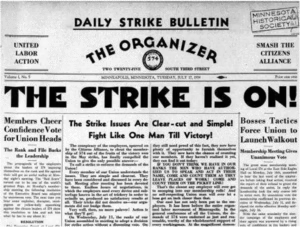
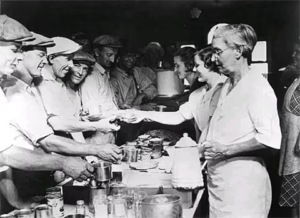
    In the Twin Cities we have an annual labor celebration to remember the strike of 1934 and other labor history. The writer Meridel LeSueur, who participated as a young woman in the 1934 Minneapolis Teamster strike later wrote, “No one can be neutral in the face of bullets ” in one of her short books, I Was Marching. She had joined the women working in the kitchen during the strike. As Minneapolis was a transportation center at the time, the strike attracted national attention. Two protesters were killed in that strike and 67 injured by the police.

    FOOD LINES BY WOMEN'S AUXILARY DURING TEAMSTER STRIKE

    A food line by the women’s auxiliary during the Teamster’s Strike. Photo: International Brotherhood of Teamsters

    Meridel LeSueur was blacklisted during the McCarthy era in the 1950s for her revolutionary writing.

    Collective Bargaining

    Collective bargaining is the process in which working people, through their unions, negotiate contracts with their employers to determine their terms of employment, including pay, benefits, hours, leave, job health and safety policies, ways to balance work and family, and more.

    According to the AFL-CIO, in 1935 the National Labor Relations Act clarified the bargaining rights of most private-sector workers and established collective bargaining as the “policy of the United States.” While it had been used in earlier strikes, it was not a federal law until 1935 during Roosevelt’s first term.

    In 1935, the National Labor Relations Act clarified the bargaining rights of most other private-sector workers and established collective bargaining as the “policy of the United States.” The right to collective bargaining also is recognized by international human rights conventions.

    The freedom to form and join a union is core to the U.N. Universal Declaration on Human Rights and is an “enabling” right—a fundamental right that ensures the ability to protect other rights.

    Eleanor Roosevelt was the Chairperson of the U.N. Commission on Human Rights that wrote the Declaration, and she contributed to its writing. The Universal Declaration of Human Rights (UDHR) was adopted by the United Nations General Assembly on December 10, 1948.

    Flash Forward. March/April 2025

    Statement from the AFL-CIO

    Trump and Musk are trying to destroy the right of collective bargaining. It’s on their list of practices that are “unfriendly” to corporate autocratic domination of America.

    March 27, 2025

    AFL-CIO President Liz Shuler issued a statement on a new executive order from the Trump administration stripping collective bargaining and union rights from workers across the federal government:
    Straight out of Project 2025, this executive order is the very definition of union-busting. It strips the fundamental right to unionize and collectively bargain from workers across the federal government at more than 30 agencies. The workers who make sure our food is safe to eat, care for our veterans, protect us from public health emergencies and much more will no longer have a voice on the job or the ability to organize with their coworkers for better conditions at work so they can efficiently provide the services the public relies upon. It’s clear that this order is punishment for unions who are leading the fight against the administration’s illegal actions in court—and a blatant attempt to silence us Trump and Musk have now declared war on collective bargaining, and the AFO-CIO has reacted as they have joined in civil resistance to the daredevil duo’s many undercuttings of the rights of the people, who they are attacking. 

    March, 2025

    The following is a statement that supports the United Farm Workers:

    We are in scary times. As we told you, even before Trump was inaugurated, a huge immigration operation has already begun in rural farm worker areas of Kern County, one of the top five most productive US agricultural counties. Border Patrol traveled 300+ miles from the US-Mexico border to profile the people who work so hard to harvest our food.

    Then Trump was inaugurated. On his first day, he signed frightening Executive Orders including on immigration—which are terrifying farm workers and their families who are already badly shaken up from these raids that appeared to come out of nowhere. We immediately began having “Know Your Rights” sessions for farm workers throughout CA and producing “Know Your Rights” materials that we are distributing and sharing on social media and our website. As we’ve been dealing with this, many of our offices have received hate mail from “Trump’s Coming” with no return address. They say, “Report illegal aliens at schools, at work, at church, at restaurants, in your neighborhood … There is nowhere to hide!” We are not allowing these fear and intimidation tactics to stop us from doing our priority work of letting farm workers know that regardless of their immigration status they have rights. Our organizers are in the fields and communities sharing the resources we’ve been rushing to put together.

    March 28, 2025

    Statement from UAW [United Auto Workers] President Shawn Fain on Attacks on Federal Workers

    Yesterday, President Trump signed an order that tramples on the union rights of more than a million federal workers, stripping them of their ability to negotiate over their working conditions. The 1 million members of the UAW stand with federal workers and their union, AFGE, against the attacks from the Trump administration.

    Update: April 25, 2025

    Summary

    • Order exempting agencies from bargaining blocked pending lawsuit
    • Trump said order was necessary to protect national security
    • Unions claim retaliation for legal challenges to Trump policies

    April 25 (Reuters) – A federal judge on Friday temporarily blocked the administration of President Donald Trump from stripping hundreds of thousands of federal employees of the ability to unionize and collectively bargain over working conditions.

    Senior U.S. District Judge Paul Friedman in Washington, D.C., blocked an executive order Trump issued in March from being implemented pending the outcome of a lawsuit by the National Treasury Employees Union, which represents about 160,000 federal employees.

    AFL-CIO President Applauds Ruling to Restore Federal Workers’ Collective Bargaining Rights

    AFL-CIO President Liz Shuler issued the following statement on a ruling from the U.S. District Court for the District of Columbia in case brought by the National Treasury Employees Union (NTEU) blocking the Trump administration’s executive order that illegally stripped thousands of federal workers of their collective bargaining rights:

    We commend the court for recognizing the Trump administration’s executive order stripping collective bargaining rights for what it was: illegal, retaliatory union-busting. This was the most significant attack on workers’ rights in history, and if Trump was allowed to do it to federal workers, he would be able to do it to every worker in America, in every workplace and every industry. So this ruling to restore federal workers’ collective bargaining rights and reinstate their existing contracts—even if temporarily while the case continues in court—is an important first step.

    But this fight isn’t over, and it isn’t limited to the courts. Every member of Congress who stands with working people needs to support and vote to pass the Protecting America’s Workforce Act (H.R. 2550), a bill that would reverse this outrageous executive order and restore workers’ union contracts. We won’t rest until this illegal order is struck down once and for all.

    May 16, 2025, Litigation Continues

    A federal appeals court has cleared the way for President Donald Trump‘s executive order to move forward, aiming to curtail collective bargaining rights for hundreds of thousands of federal workers while litigation continues.

    ***

    In a 2-1 decision, a panel of judges in Washington, D.C., ruled that unions representing federal employees lack standing to sue. The majority cited the administration’s assurance that no existing collective bargaining agreements would be terminated during the ongoing legal proceedings.

    Judges Karen Henderson, appointed by former President George H.W. Bush, and Justin Walker, appointed by Trump, supported the ruling; Judge Michelle Childs, appointed by former President Joe Biden, dissented.

    [FDR] changed the relationship between government, business and labor forever.

    —Doris Kerns Goodwin, Ken Burns: The Roosevelts,
    Episode 5, PBS

    Wings of Change


    Featured image:

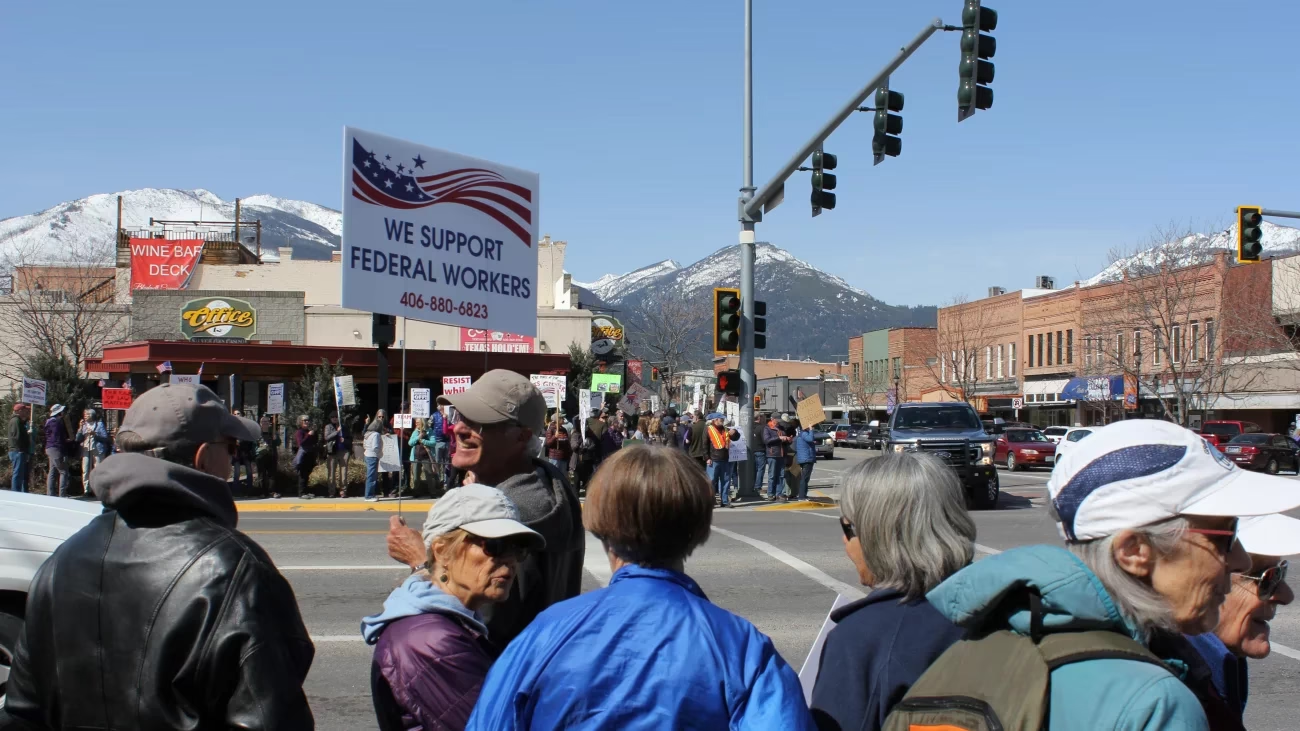
    “Hundreds of people join a protest in downtown Hamilton, Mont., in April supporting the work of federal employees as President Donald Trump oversees efforts to restructure the nation’s government. Federal scientific research and forestry work are part of this small town’s economic bedrock.” Photo: Katheryn Houghton/KFF Health News

    The Unraveling of the New Deal
    END OF PART 2

  • The Unraveling of the New Deal, Part 1

    These economic royalists complain that we seek to overthrow the institutions of America. What they really complain of is that we seek to take away their power. Our allegiance to American institutions requires the overthrow of this kind of power.

           ─Franklin Delano Roosevelt


    The Unraveling of the New Deal

    By Sue Ann Martinson/
    April 5, 2025

    There is a mysterious cycle in human events. To some generations much is given. Of other generations much is expected. This generation of Americans has a rendezvous with destiny.

    ─ Franklin D. Roosevelt, Acceptance Speech for the Renomination for the Presidency, Philadelphia, Pa.,
    June 27, 1936

    Nowadays we have generation this and generation that, all in categories with their own characteristics. But FDR was referring to collective generations inhabiting the United States at the time. His statement applies now to the current generations of Americans.

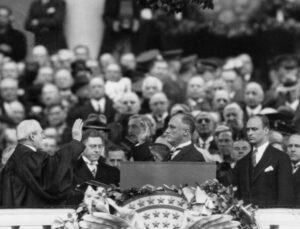
    In 1932 when FDR was running for president, he promised if elected a “New Deal” for the American people. At the time Herbert Hoover was president and the nation was in a deep depression caused by the stock market crash of 1929.

    Roosevelt introduced the phrase upon accepting the Democratic Party’s presidential nomination in 1932 before winning the election in a landslide over incumbent Herbert Hoover, whose administration was viewed by many as doing too little to help those affected.

    The following are the words of FDR in his Acceptance Speech for the Renomination for the Presidency on June 27, 1936. The full speech is included at the end of this post.

    For too many of us the political equality we once had won was meaningless in the face of economic inequality. A small group had concentrated into their own hands an almost complete control over other people’s property, other people’s money, other people’s labor—other people’s lives. For too many of us life was no longer free; liberty no longer real; men could no longer follow the pursuit of happiness. [underline emphasis by Wings of Change]

    ***

    These economic royalists complain that we seek to overthrow the institutions of America. What they really complain of is that we seek to take away their power. Our allegiance to American institutions requires the overthrow of this kind of power. In vain they seek to hide behind the Flag and the Constitution. In their blindness they forget what the Flag and the Constitution stand for. Now, as always, they stand for democracy, not tyranny; for freedom, not subjection; and against a dictatorship of mob rule and the over-privileged alike.
    [underlines emphasis by Wings of Change]

    Almost immediately after the Constitution was passed, the Bill of Rights, based on English Common Law, was added, protecting freedom of speech, freedom of the press, the right to assemble and petition, and freedom of religion, all in the First Amendment. The first ten amendments were the originals. New amendments were added to the original Bill of Rights over the years that reflect values and issues of importance to the American people. These rights along with the Constitution itself were the values that FDR championed.

    FDR kept his promise for a New Deal for the American people if they elected him on the heels of the Great Depression that began with the failure of the stock market in 1929. In 1933 during his first term as president he kept his word and initiated bold reforms that became law. Passed with both Republican and Democratic support in Congress, 15 key laws were passed during his first 100 days of office. They were bold reforms that were part of his promised New Deal.

    Among these laws was the Glass-Steagall Act that separated commercial and banking activities; other laws guaranteed bank deposits for depositors (no runs on banks as had previously occurred), loans to homeowners who faced losing their homes because of lack of mortgage payments, and keeping farm prices high by paying farmers not to produce. The Civilian Conservation Corp allowed single men between the ages of 18 and 25 to enlist in work programs to improve America’s public lands, forests, and parks, their room and board paid for, they sent $25 of their $30 pay home to their families.  The National Recovery Act (NRA) set prices and wages: two million employers in 541 industries signed up, promising to keep prices down and wages up. The Social Security Act was signed into law by FDR on August 14, 1935. It established a system of old-age pensions, unemployment insurance, and aid for dependent mothers and children, blind persons, and persons with disabilities, funded by payroll taxes.

    The Bottom Line ─ The Glass-Steagall Act (June 16, 1933)

    The Glass-Steagall Act prevented commercial banks from speculative risk-taking to avoid a financial crisis experienced during the Great Depression. Banks were limited to earning 10 percent of their income from investments. This legislation under FDR was a direct response to the stock market crash of 1929 and the resulting depression.

    The Gramm-Leach-Bliley Act, under President Clinton, eliminated the Glass-Steagall Act’s restrictions against affiliations between commercial and investment banks in 1999, so unfortunately, the parts of the law that separated investment and speculative commercial interests were repealed, and that repeal is considered to be a cause of the 2008 global recession by many. Some parts of the original Glass-Steagall were maintained, a most important being the Federal Deposit Insurance Corporation (FDIC) that still protects deposits and against runs on banks.

    But FDR’s influence was more than creating laws. FDR inspired people. As George Will said as quoted in Ken Burns, Episode 5 of “The Roosevelts” on PBS, he “changed the relationship of the citizen to the central government.“ He instituted the Fireside Chats on the radio, when citizens tuned in weekly to listen. He spoke to them as an equal, building courage and confidence. He established a progressive cabinet, including the first woman cabinet member, Frances Perkins, who oversaw the Works Progress Administration (WPA). Established in 1935, the WPA employed 8.5 million people in building projects and arts initiatives and spent more than $11 million in relief until it was discontinued during WWII.

    Some Background

    Some find it ironic that Roosevelt himself was part of the over-privileged class that was monied, as was Eleanor, his sixth cousin. President Theodore “Teddy” Roosevelt was her uncle and FDR’s fifth cousin.

    The original Roosevelt came to this country in the 1600s from the Netherlands, but not under the name Roosevelt which came later. He had two sons and the two sides of the Roosevelts in FDR’S generation were descended respectively from these two sons. Ken Burns goes into detail about the two different families and their activities in his series about the Roosevelts on public television. Some of the information used in this “unraveling” is from this series, which Burns calls The Roosevelts: An Intimate History, as he describes the relationships between the two parts of the family as each produced a president ─ first Theodore “Teddy” Roosevelt on one side and then FDR on the other. He discusses the effects that contracting polio had on FDR’s personal and political life. He also includes the journey of Eleanor Roosevelt from her shyness to becoming a strong person of influence herself and how that affected her relationship with FDR, remembering that she too was a Roosevelt.

    While this essay focuses on FDR’s politics rather than his personal life, the Burns series weaves the two together and is well worth watching. Note that the New Deal and FDR has its critics, while others hail FDR as the greatest president certainly of the 20th century, and even more in the history of America.

    The Present and the New Deal

    Like FDR, President Trump has moved boldly in these early days of the presidency. His first 100 days, always taken as a presidential measure, have been characterized by taking bold action. But the parallel ends there. What is obvious is that his goals are the opposite of the New Deal. Trump seeks to revoke or eviscerate many of the laws and programs that FDR put into place or convert them to private money-making entities that private corporations control. Without FDR and the New Deal there would be no unemployment insurance, no social security, no limit on working hours. no minimum wage, and the laws that regulate money systems, including the Federal Deposit Insurance Corporation that protects bank deposits.

    “These economic royalists complain that we seek to overthrow the institutions of America. What they really complain of is that we seek to take away their power,” said FDR. Yet it is these institutions that Trump and his cronies are attempting to destroy precisely because they do put controls on the power of these “economic royalists,” what today we often call the ruling elite. who, as FDR notes, “hide behind the Flag and the Constitution,” as Trump and Co. do by falsely exuding great Patriotism.

    When FDR was inaugurated there were 15,000 million unemployed in America. The New Deal programs he initiated greatly reduced that number by 1935 going into his second term. It’s as if Trump is trying again to reach that number of unemployed through layoffs, releasing thousands of worker, while he and Elon Musk, operating outside of Congress, raid our institutions with layoffs and cutbacks in funding, all the while giving perks via tax cuts and investments to corporations that have raised prices and that continue to destroy the environment and contribute to the current climate crisis as well as increasing the already bloated military budget by taking money from social programs (never from corporations, which the government continues to fund.

    Department of Government Efficiency (DOGE)

    Trump and his cohorts, especially Elon Musk, have created the so-called Department of Government Efficiency (DOGE). It was not created by Congress but by an executive order of Trump’s. Although DOGE is supposedly managed by the bipartisan DOGE Caucus whose purpose is “pave the way for the House of Representatives to streamline government operations and to save taxpayer money,” they are dismantling and cutting off funding for most programs that support ordinary citizens in need as well as some foreign programs like USAid.

    Despite its full name, DOGE is not an official government department, which would have had to be established by an act of Congress. Instead it came into being through one of Trump’s presidential executive orders, and operates as an advisory body with at least four employees dedicated to each government agency.

    Trump and Musk are conducting a hell-bent crusade against as many social programs as possible. While their actions may not directly be the repeal of all the same laws that were passed by Congress under FDR’s presidency, with so many people laid off it is as if Trump and his cronies are trying to match the 15 million people who were unemployed when FDR officially became president in 1933, along with the millions of immigrants Trump has deported or plans to deport, some of whom are American citizens or hold green cards.

    Musk and Trump, under the auspices of DOGE, are slashing programs that benefit the citizens of America with broad strokes. What they call a campaign against fraud in reality is a gutting of social programs that benefit ordinary citizens. At the same time Trump continues more than excessive military spending by funding foreign wars ─ most obviously the Ukraine War and the continuing genocide against the people of Palestine/Gaza being criminally perpetrated by Israel─ as well as maintaining an excessive and very expensive worldwide military network. At the same time they are gutting the Environmental Protective Agency (EPA) and increasing rather than curtailing the use of fossil fuels, a CO2 pollutant that is a major cause of the Climate Crisis that puts the whole planet at risk.

    The Trump administration and Trump himself pretend and encourage their followers to pretend that there is no relationship between the climate crisis and the use of fossil fuels, yet the Union of Concerned Scientists and other responsible and realistic academics as well as ordinary people have shown us otherwise with their analyses and activism alike. And the U.S. military continues to be the a major polluter in the world with its use of fossil fuels that release CO2 and methane gas into the atmosphere as well as by the pollution of water, especially by what are called PFAS pollutants, with the 1000 plus military bases and military installations worldwide.

    In addition Trump is acting in true autocratic manner in attempting to shut down free speech in the colleges where pro-Palestine students are attempting to exercise the right of free speech. This ban extends to all media by his demands that no critical articles be written about him and there be no critiques of his platform and actions. In addition, the Trump administration’s policies result in the threatening of academic freedom of college and university faculty members. His actions mimic Hitler’s seeing that Jewish professors and anyone opposed to him were fired from colleges and universities and punishing students who opposed his policies, such as the White Rose student group who were murdered by Hitler for distributing pamphlets against him. The book bans that are being legislated in many states are also an attack on free speech and approximate the book burnings under Hitler.

    As usual, Trump is pursuing his policy of hate and hyper-militarism for specious  reasons that attack the most basic American values such as free speech and the peoples’ right to assemble along with the right to petition the Government for a redress of grievances; they rationalize this Constitutional crisis with all the geopolitical ins and outs and machinations and excuses they can create. Congress keeps pouring money into weapons and then sending them to Ukraine for continued war and to Israel for the continued genocide against the people of Palestine, making sure the war industry is well-funded and much of the profits are returned to members of Congress for their election campaigns and personal use, Congress appears to have been brain-washed; when interviewed by Medea Benjamin and other Code Pink members in its halls in response to their questions, they shift all blame back to Hamas when it is the U.S. that is guilty of supporting Israel’s continuing apartheid and oppression of Palestine since 1948. It is the U.S. that keeps shipping weapons and money to Israel so they can continue with the genocide. Any attempts at forming a ceasefire Trump’s part have failed.

    End of Part 1, The Unraveling of the New Deal

    ++++++++++++++++++++

    FDR Acceptance Speech for the Renomination for Presidency on June 27, 1936. Full address:

    Senator Robinson, Members of the Democratic Convention, my friends:

    Here, and in every community throughout the land, we are met at a time of great moment to the future of the Nation. It is an occasion to be dedicated to the simple and sincere expression of an attitude toward problems, the determination of which will profoundly affect America.

    I come not only as a leader of a party, not only as a candidate for high office, but as one upon whom many critical hours have imposed and still impose a grave responsibility.

    For the sympathy, help and confidence with which Americans have sustained me in my task I am grateful. For their loyalty I salute the members of our great party, in and out of political life in every part of the Union. I salute those of other parties, especially those in the Congress of the United States who on so many occasions have put partisanship aside. I thank the Governors of the several States, their Legislatures, their State and local officials who participated unselfishly and regardless of party in our efforts to achieve recovery and destroy abuses. Above all I thank the millions of Americans who have borne disaster bravely and have dared to smile through the storm.

    America will not forget these recent years, will not forget that the rescue was not a mere party task. It was the concern of all of us. In our strength we rose together, rallied our energies together, applied the old rules of common sense, and together survived.

    In those days we feared fear. That was why we fought fear. And today, my friends, we have won against the most dangerous of our foes. We have conquered fear.

    But I cannot, with candor, tell you that all is well with the world. Clouds of suspicion, tides of ill-will and intolerance gather darkly in many places. In our own land we enjoy indeed a fullness of life greater than that of most Nations. But the rush of modern civilization itself has raised for us new difficulties, new problems which must be solved if we are to preserve to the United States the political and economic freedom for which Washington and Jefferson planned and fought.

    Philadelphia is a good city in which to write American history. This is fitting ground on which to reaffirm the faith of our fathers; to pledge ourselves to restore to the people a wider freedom; to give to 1936 as the founders gave to 1776—an American way of life.

    That very word freedom, in itself and of necessity, suggests freedom from some restraining power. In 1776 we sought freedom from the tyranny of a political autocracy—from the eighteenth century royalists who held special privileges from the crown. It was to perpetuate their privilege that they governed without the consent of the governed; that they denied the right of free assembly and free speech; that they restricted the worship of God; that they put the average man’s property and the average man’s life in pawn to the mercenaries of dynastic power; that they regimented the people.

    And so it was to win freedom from the tyranny of political autocracy that the American Revolution was fought. That victory gave the business of governing into the hands of the average man, who won the right with his neighbors to make and order his own destiny through his own Government. Political tyranny was wiped out at Philadelphia on July 4, 1776.

    Since that struggle, however, man’s inventive genius released new forces in our land which reordered the lives of our people.. The age of machinery, of railroads; of steam and electricity; the telegraph and the radio; mass production, mass distribution—all of these combined to bring forward a new civilization and with it a new problem for those who sought to remain free.

    For out of this modern civilization economic royalists carved new dynasties. New kingdoms were built upon concentration of control over material things. Through new uses of corporations, banks and securities, new machinery of industry and agriculture, of labor and capital—all undreamed of by the fathers—the whole structure of modern life was impressed into this royal service.

    There was no place among this royalty for our many thousands of small business men and merchants who sought to make a worthy use of the American system of initiative and profit. They were no more free than the worker or the farmer. Even honest and progressive-minded men of wealth, aware of their obligation to their generation, could never know just where they fitted into this dynastic scheme of things.

    It was natural and perhaps human that the privileged princes of these new economic dynasties, thirsting for power, reached out for control over Government itself. They created a new despotism and wrapped it in the robes of legal sanction. In its service new mercenaries sought to regiment the people, their labor, and their property. And as a result the average man once more confronts the problem that faced the Minute Man.

    The hours men and women worked, the wages they received, the conditions of their labor—these had passed beyond the control of the people, and were imposed by this new industrial dictatorship. The savings of the average family, the capital of the small business man, the investments set aside for old age—other people’s money—these were tools which the new economic royalty used to dig itself in.

    Those who tilled the soil no longer reaped the rewards which were their right. The small measure of their gains was decreed by men in distant cities.

    Throughout the Nation, opportunity was limited by monopoly. Individual initiative was crushed in the cogs of a great machine. The field open for free business was more and more restricted. Private enterprise, indeed, became too private. It became privileged enterprise, not free enterprise.

    An old English judge once said: “Necessitous men are not free men.” Liberty requires opportunity to make a living—a living decent according to the standard of the time, a living which gives man not only enough to live by, but something to live for.

    For too many of us the political equality we once had won was meaningless in the face of economic inequality. A small group had concentrated into their own hands an almost complete control over other people’s property, other people’s money, other people’s labor—other people’s lives. For too many of us life was no longer free; liberty no longer real; men could no longer follow the pursuit of happiness.

    Against economic tyranny such as this, the American citizen could appeal only to the organized power of Government. The collapse of 1929 showed up the despotism for what it was. The election of 1932 was the people’s mandate to end it. Under that mandate it is being ended.

    The royalists of the economic order have conceded that political freedom was the business of the Government, but they have maintained that economic slavery was nobody’s business. They granted that the Government could protect the citizen in his right to vote, but they denied that the Government could do anything to protect the citizen in his right to work and his right to live.

    Today we stand committed to the proposition that freedom is no half-and-half affair. If the average citizen is guaranteed equal opportunity in the polling place, he must have equal opportunity in the market place.

    These economic royalists complain that we seek to overthrow the institutions of America. What they really complain of is that we seek to take away their power. Our allegiance to American institutions requires the overthrow of this kind of power. In vain they seek to hide behind the Flag and the Constitution. In their blindness they forget what the Flag and the Constitution stand for. Now, as always, they stand for democracy, not tyranny; for freedom, not subjection; and against a dictatorship by mob rule and the over-privileged alike.

    The brave and clear platform adopted by this Convention, to which I heartily subscribe, sets forth that Government in a modern civilization has certain inescapable obligations to its citizens, among which are protection of the family and the home, the establishment of a democracy of opportunity, and aid to those overtaken by disaster.

    But the resolute enemy within our gates is ever ready to beat down our words unless in greater courage we will fight for them.

    For more than three years we have fought for them. This Convention, in every word and deed, has pledged that that fight will go on.

    The defeats and victories of these years have given to us as a people a new understanding of our Government and of ourselves. Never since the early days of the New England town meeting have the affairs of Government been so widely discussed and so clearly appreciated. It has been brought home to us that the only effective guide for the safety of this most worldly of worlds, the greatest guide of all, is moral principle.

    We do not see faith, hope and charity as unattainable ideals, but we use them as stout supports of a Nation fighting the fight for freedom in a modern civilization.

    Faith— in the soundness of democracy in the midst of dictatorships.

    Hope—renewed because we know so well the progress we have made.

    Charity— in the true spirit of that grand old word. For charity literally translated from the original means love, the love that understands, that does not merely share the wealth of the giver, but in true sympathy and wisdom helps men to help themselves.

    We seek not merely to make Government a mechanical implement, but to give it the vibrant personal character that is the very embodiment of human charity.

    We are poor indeed if this Nation cannot afford to lift from every recess of American life the dread fear of the unemployed that they are not needed in the world. We cannot afford to accumulate a deficit in the books of human fortitude.

    In the place of the palace of privilege we seek to build a temple out of faith and hope and charity.

    It is a sobering thing, my friends, to be a servant of this great cause. We try in our daily work to remember that the cause belongs not to us, but to the people. The standard is not in the hands of you and me alone. It is carried by America. We seek daily to profit from experience, to learn to do better as our task proceeds.

    Governments can err, Presidents do make mistakes, but the immortal Dante tells us that divine justice weighs the sins of the cold-blooded and the sins of the warm-hearted in different scales.

    Better the occasional faults of a Government that lives in a spirit of charity than the consistent omissions of a Government frozen in the ice of its own indifference.

    There is a mysterious cycle in human events. To some generations much is given. Of other generations much is expected. This generation of Americans has a rendezvous with destiny.

    In this world of ours in other lands, there are some people, who, in times past, have lived and fought for freedom, and seem to have grown too weary to carry on the fight. They have sold their heritage of freedom for the illusion of a living. They have yielded their democracy.

    I believe in my heart that only our success can stir their ancient hope. They begin to know that here in America we are waging a great and successful war. It is not alone a war against want and destitution and economic demoralization. It is more than that; it is a war for the survival of democracy. We are fighting to save a great and precious form of government for ourselves and for the world.

    I accept the commission you have tendered me. I join with you. I am enlisted for the duration of the war.

    Franklin D. Roosevelt, Acceptance Speech for the Renomination for the Presidency, Philadelphia, Pa. Online by Gerhard Peters and John T. Woolley, The American Presidency Project https://www.presidency.ucsb.edu/node/208917

    Wings of Change


    Wings of Change


    END OF PART 1