The most common misconception about the free press of the western world is that it exists.
By Caitlin Johnstone, December 1, 2025
Every fu**ing time. The mass media do this every fu**ing time the US empire gets war-horny. And the Murdoch press are always the most egregious offenders.
Reminds me of an old tweet by a man named Malcolm Price:
“I remember in the run-up to the Iraq War a friend I had known all my life suddenly said to me, ‘We must do something about this monster in Iraq.’ I said, ‘When did you first think that?’ He answered honestly, ‘A month ago’.”
Price’s friend had been swept up in the imperial war propaganda campaign that had recently begun, just like countless millions of others. Month after month after month western consciousness was hammered with false narratives about weapons of mass destruction, forced associations of Saddam Hussein with 9/11, and stories about how much better things will be for the people of Iraq once that evil tyrant is gone.
Normally it never would have occurred to the average westerner that a country on the other side of the planet should be invaded and its leader replaced with a puppet regime. That’s not the sort of thing that would have organically entered someone’s mind. It needed to be placed there.
So it was.
The most common misconception about the free press of the western world is that it exists. All the west’s most influential and far-reaching news media publications are here not to report factual stories about current events, but to manufacture consent for the pre-existing agendas of the US-centralized western empire.
They report many true things, to be sure, and if you acquire some media literacy you can actually learn how to glean a lot of useful information from the imperial press without losing your mind to the spin machine. But reporting true things is not their purpose. Their purpose is to manipulate public psychology at mass scale for the benefit of the empire they serve.
This doesn’t happen through some kind of centralized Ministry of Truth where sinister social engineers secretly conspire to deceive people. It happens because all mainstream press is controlled either by plutocrats or by western governments in the form of state broadcasters like the BBC, both of which have a vested interest in maintaining the imperial status quo. They control who the executives and lead editors of these outlets are, and those leaders shape the hiring and editing processes of the publication or broadcaster. Reporters come to understand that there are certain lines they need to color within if they want to get articles published and continue advancing their careers, so they either learn to toe the imperial line or they disappear from the mass media industry.
If people had a clear understanding of everything that’s really going on in our world, they would tear the empire apart brick by brick. If they could truly see how much evil is being done in their name and really wrap their minds around it, and if they could understand how much wealth the plutocrats are getting out of the imperial status quo compared to how little they themselves benefit from it, there would be immediate revolution. So the oligarchs and empire managers shore up narrative control in the form of media ownership, think tanks, Silicon Valley algorithm manipulation, imperial information ops like Wikipedia, and now increasingly through billionaire-owned AI chatbots to ensure that this never happens.
The entire empire is built on a foundation of lies. The whole power structure is held together by nonstop manipulation of the way westerners think, speak, act, shop, work, and vote. If truth ever finds a way to get a word in edgewise, the entire thing would collapse.
We know this is true because the oligarchs and empire managers pour so much wealth and energy into manipulating our minds. They’re not doing this for fun, they’re doing it because they need to. If they didn’t need to, it wouldn’t be happening.
So what they are doing is intensely creepy and destructive, but it’s also empowering, because it shows us right where their weak spot is. They’re pouring all this energy into controlling the dominant narrative because that’s the weakest point in the armor of the imperial machine.
What we need, then, is a grassroots effort to help truth get a word in. Help people understand that they’ve been propagandized and deceived about the world by western media and by their power-serving education systems every day of their lives, because propaganda only works if you don’t know it’s happening to you. Sow distrust in the imperial media and institutions. Open people’s eyes to the fact that they’re being lied to, and help them learn to see the truth. Anywhere the empire is sowing lies and distortions — whether that’s in Venezuela or Gaza or somewhere else — use that opportunity to help more people unplug their minds from the propaganda matrix.
A better world is possible. The first step in moving toward it is snapping people out of the propaganda-induced coma which dupes them into settling for this dystopian nightmare instead.
DEMOCRACY NOW! December 3, 2025
Today’s DN! Updates the ceasefire in Gaza that isn’t as Israel continues its deadly genocide, explaining about the attacks by groups of Israeli’s who are then just observed or are joined by Israeli military. These raids in the West Bank and Gazans are often by Israeli settlers who stole their homes and olive groves in thr first place. They also cover the exiting of Gazans from Palestine and whether or not they have the right to return.
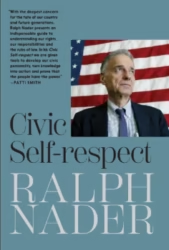
Amy and Juan then interview Ralph Nader who has been a watchdog of the Democratic Party and of Congress for 60-odd years. To cut to the chase he recommends Impeachment as the most effective way to render Trump’s dictatorship, which is blatantly unconstitutional as seen in so many of his actions. Another of Nader’s points is that America is not as divided on the issues as it seems. The consistent “blame the Democrats” knee-jerk reaction of Trump is designed to divide the American people because to divide them serves his propagandized platform and also a greedy mainstream corporate media they loves all conflict.
Nader discusses his new book CivicSelf-Respect and then stays around to comment on the next segment about a new film that documents the WTO demonstrations in Seattle in 1999. This was a nonviolent demonstration of at least 40,000 people from around the county. Larry Weiss, representing local labor groups, called a meeting (I was there) explaining the demonstration against corporate power and recruiting people to attend. And a contingency of Minnesotans did go to Seattle.
Another segment focused on Minneapolis/St. Paul and the attack by racist bully Trump on sending ICE against the large Somali population. Most of the Somali’s are here legally. Besides being small business and shop owners, many of the men are truck and taxi drivers. They are contributing to the economy. I see them often in various places, both men and women. I seriously question Trump’s statement that 88% are on welfare. We know he lies all the time to convince people to follow his cruel and barbarian policies.
Here the Nader interview:
For more information view on video (available on YouTube) or listen to the podcast of Dec. 3, 2025 of Democracy Now!
The Race to Save the Amazon: Top Brazilian Scientist Says Rainforest Is at “Tipping Point”
Amy Goodman interviews scientist Carlos Nobre / Democracy Now! / November 20, 2025
AMY GOODMAN : As we broadcast from the COP30 climate summit in Belém, Brazil, we are joined by one of Brazil’s most prominent scientists, [Nobel Prize winner] Carlos Nobre, who says the Amazon now produces more carbon emissions than it removes from the atmosphere, moving closer to a “tipping point” after which it will be impossible to save the world’s largest rainforest. “We need urgently to get to zero deforestation in all Brazilian biomes, especially the Amazon,” he argues. (See full transcript below.)
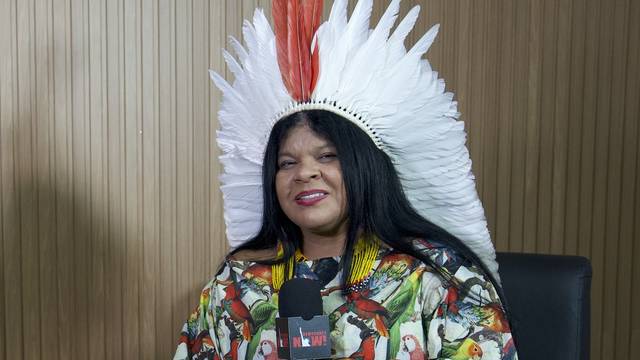
SÔNIA GUAJAJARA: [translated] It’s always a challenge. It’s really — it’s not simple. It’s hard, because there is a dispute, a big one, with the economic sectors, so that these changes do not happen. So we need to make sure that agreements done at COP and commitments done at COP can tackle this, because the world knows the impact that oil exploitation, fossil fuels does, the risk of us achieving the point of no return, but these sectors, the economic sectors, need to understand this is an emergency. So we need to have, like, a clear decision here in this conference to stop depending on fossil fuel.
“This is not abstract,” Nikki Reisch, director of climate and energy at the Center for International Environmental Law, says of climate-induced migration. “This is about real lives. It’s about survival. It’s about human rights and dignity, and, ultimately, about justice.”
Trump’s Response to COP30
Trump sends no formal U.S. delegation at COP30: Here is Trump’s response as he is determined to destroy the planet and continues his own version of genocide against the Least Developed Countires (LTC) that are most affected by global warming caused by fossil fuels. Meanwhile 80 nations at COP30 have signed on to plan to phase-out fossil fuels.
The Trump administration announced on Thursday new oil drilling off the California and Florida coasts for the first time in decades, advancing a project that critics say could harm coastal communities and ecosystems, as President Donald Trump seeks to expand U.S. oil production.
Countries from Africa, Asia, Latin America, Pacific and Europe plead for transition to be central outcome of talks.
Transcript This is a rush transcript. Copy may not be in its final form.
AMYGOODMAN: This is Democracy Now!, democracynow.org. We’re broadcasting at the U.N. climate summit, COP30, here in the Brazilian city of Belém, the gateway to the Amazon rainforest. I’m Amy Goodman, with Nermeen Shaikh. As we broadcast, there’s a protest right behind us by the Loss and Damage Youth Coalition, where they are holding a banner that reads, “From opinion to obligation, respond to loss and damage.”
NERMEENSHAIKH: We end today’s show with one of Brazil’s most prominent scientists, Dr. Carlos Nobre. He’s a senior researcher at the Institute of Advanced Studies at the University of São Paulo and co-chair of the Scientific Panel for the Amazon. He’s a lead author of the U.N.’s Intergovernmental Panel on Climate Change, or IPCC, that won a Nobel Peace Prize in 2007 for its reports on global warming.
AMYGOODMAN: For decades, Carlos Nobre has been warning the Amazon rainforest is being pushed beyond the tipping point. The Amazon rainforest is almost as large as the contiguous United States.
Carlos Nobre, welcome to Democracy Now! It’s an honor to be in your presence. You have been warning for quite some time, and now it’s getting more serious than ever. What is the tipping point? And for a lay audience around the world, explain to us why the biome of the Amazon rainforest is so important for the world.
CARLOSNOBRE: Good morning. Thank you very much.
Yes, I’ve been working for 43 years with the Amazon. I was the first scientist, 1990, 1991, publishing a science article saying if we continue with very high deforestation, the Amazon would cross the tipping point. But that was 1990, ’91, 36 years ago. Now the Amazon is very close to the tipping point.
Why do we say that? Because from the Atlantic to Bolivia, Peru and Colombia, this is 2.5 million square kilometers. The whole forest, close to 7 million square kilometers, but this southern portion, very close to tipping point. The dry season is four to five weeks’ length here — in 45 years, one week per decade. It was three, four months, but with rain during the dry season. Now it’s four to five months, 20, 30% drier, two, three degrees warmer. And also, tree mortality has increased a lot in these areas. In the southeastern Amazon, south of where we are, the forest has become a carbon source. It’s losing more carbon than removing.
So, if we continue — deforestation is about 18%, degradation 30% — if we reach 20, 25% deforestation, global warming close to two degrees, we cross permanently the tipping point. We are going to lose up to 70% of the Amazon within 30 to 50 years. If we continue with global warming, deforestation, we reach the tipping point by 2040. So, by 27 — 2100, we’re going to lose 70% of the Amazon. We’ll release more than 250 billion tons of carbon dioxide to the atmosphere, making it impossible to maintain the global warming at 1.5 degrees. We are going to lose the highest biodiversity in the planet. So, terrible.
And also, the Amazon recycles water so well that about 45% of the water vapor that comes from the Atlantic Ocean, transported by the trade winds, goes to the south of the Amazon and feeds more than 50% of rainfall on the tropical savanna south of the Amazon, so — and also the Atlantic rainforest. So, it’s really essential. If we lose the Amazon, not only the Amazon forest will disappear, but the tropical savanna, as well.
NERMEENSHAIKH: If you could also talk, Dr. Nobre — in addition to increasing heat and the dryness that you talked about, you’ve also said that livestock grazing is a form of ecological pollution. Now, Brazil is the world’s second-largest producer of beef. If you could talk about what the impact of cattle ranching has been on this deforestation of the Amazon?
CARLOSNOBRE: Yes, of course. I mean, 90% of the deforestation in the lowlands in the Amazon in Brazil is related to cattle ranches. And when we compute, Brazil is the only country in the world where 70% of fossil fuel emissions, greenhouse gas emissions, come from land use change, about 70% of emissions, 40% deforestation. And about 20, 25% of this comes from agriculture, but mostly for cattle ranches. Particularly, the cattle emits a lot of methane, so — all ruminants. So, we say 55% of emissions in Brazil related to livestock, you know, the deforestation for cattle ranches and also the cattle emitting methane.
So, really, we need urgently to get to zero deforestation in all Brazilian biomes, especially the Amazon, and also merging to the so-called regenerative livestock. Regenerative livestock. We have about 15% in Brazil of regenerative livestock, and very little. The regenerative livestock makes — reduces a lot emissions by livestock.
NERMEENSHAIKH: And, you know, in Brazil, as you well know, Brazil is one of the world’s largest agricultural exporters, which means the alternative that you mentioned may compensate, but presumably it would be a massive economic loss to Brazil if their agricultural production were to go down. But as you were mentioning earlier, though, there has been a commitment by countries here to work on a roadmap to get to zero deforestation by 2030. So there is an agreement there, whereas there is not a majority of countries signing up to the roadmap to phasing out fossil fuels. So, if you could just talk about, I mean, the countries that are, in part, dependent on agricultural exports, what would it mean to diminish cattle ranching? And, I mean, you’ve become, in fact, vegetarian as a result of this.
CARLOSNOBRE: Oh, listen, mostly livestock average productivity is very low. Brazil has about 1.5 heads of cattle per hectare. This is very little. Brazil has about 3.2 million square kilometers, mostly livestock and also agricultural. So, regenerative livestock will have three to five heads of cattle per hectare, reduce emission, and also the regenerative agriculture and livestock is much more resilient to the climate extremes. For instance, last year, Brazil had a record-breaking drought in the Amazon tropical savanna, Cerrado, and a record-breaking number — decline of agricultural productivity. So, therefore, Brazil can continue being a tremendous high producer of meat, agriculture, soy grains, using not 3.2 million square kilometers, but maximum 2 million square kilometers.
AMYGOODMAN: I want to ask you a question about climate science. You have said that it’s a mystery to you, the country which invested the most in climate science, a country with the largest number of climate scientists and very few who deny climate change, which contributed the most to the IPCC report — how is it possible this country elected a climate denier? And we’re talking about the United States. But talk about the significance of the billions of dollars being removed from science research in the United States, and the effect that has all over the world?
CARLOSNOBRE: Well, that’s a very good question, because, in fact, I mean, I create a name, because all tipping points that we know in the climate, more than 20, they are all associated with ecological, biological, hydrological, ocean-related tipping points. But I’m thinking how the world, in democracies, we are creating a, quote, quote-unquote, “a social/political tipping point,” which is — it’s not only in the U.S. In many countries in the world, democracies, we are electing more and more populist politicians — U.S. President Trump, Argentina President Milei. Brazil elected a former president, Bolsonaro, totally climate denier. Deforestation increased a lot in those four years. That’s happening all over the planet. So, this is a — I even gave a name in the West. I said this social/political tipping point is the “trumping point.” Why we are, in democracies — as you mentioned, the country with the top science on climate change, U.S., always, for decades — why U.S. democracy electors are electing a climate-denier president? This is very serious.
NERMEENSHAIKH: And you’ve said, Dr. Nobre — I mean, it’s remarkable, as you said, with these right-wing governments, being led in part by Donald Trump, the fact that this roadmap to deforestation was agreed. You’ve said that COP30 is a critical meeting of — a critical climate summit. Explain why, and what you hope is going to come out of this. It’s formally concluding tomorrow, but it regularly goes beyond that date.
CARLOSNOBRE: Yes, that’s a very good point, because all of us scientists, we say this COP30 has to be very important, I mean, as important as Paris Agreement, as important as COP26, when all countries agree in reducing emissions. But now we have to accelerate reducing emissions.
Yesterday, we, the Planetary Science Pavilion people, we hand-delivered our declaration to all negotiators, and I hand-delivered to President Lula, as well. We say, in addition to zero deforestation in all biomes, tropical forests by 2030, we have to accelerate reducing of emission by fossil fuels. We say, ideally, zero fossil fuel emissions by 2040, no longer than 2045 — no questions, because the temperature is reaching 1.5 degrees within five to 10 years permanently. If we only get to net-zero emissions by 2050, we may reach two degrees and even more. It will be a tragedy, an ecocide for the planet.
And when I presented this document to President Lula, he said also — four times, he said — I was in a meeting with him. He said, “This has to be the most important COP of all COPs.” Let’s hope, in two days now, countries will agree not only zero deforestation in all tropical forests by 2030, but zero fossil fuel emissions —
AMYGOODMAN: Ten seconds.
CARLOSNOBRE: — by 2040.
AMYGOODMAN: We want to thank you so much, Carlos Nobre, leading Brazilian scientist, world-renowned climatologist, senior researcher at the Institute of Advanced Studies at the University of São Paulo, co-chair of the Scientific Panel for the Amazon, where we are right now. We’re in Belém, the gateway of the Amazon. I’m Amy Goodman, with Nermeen Shaikh.
The original content of this program is licensed under a Creative Commons Attribution-Noncommercial-No Derivative Works 3.0 United States License. Please attribute legal copies of this work to democracynow.org. Some of the work(s) that this program incorporates, however, may be separately licensed. For further information or additional permissions, contact us.
“There has been a tolerance of Israel’s impunity for decades,” says Albanese. “However, the United States is the single most important factor of crisis in the United Nations.”
Israel’s war on Gaza is the deadliest conflict for journalists in recorded history. In an attack on Nasser Hospital in Gaza Monday, Israel killed five more journalists in addition to over a dozen others. Israeli Prime Minister Benjamin Netanyahu claimed the hospital attack was a “tragic mishap,” but just hours later, Israeli forces killed a sixth journalist. “There is a pattern of targeting and killing journalists that lets us think that there is an intention,” says Francesca Albanese, U.N. special rapporteur on the occupied Palestinian territory.
As countries prepare for the U.N. General Assembly, Albanese notes the complicity of Western states in the genocide in Gaza, particularly the United States. “There has been a tolerance of Israel’s impunity for decades,” says Albanese. “However, the United States is the single most important factor of crisis in the United Nations.”
Note: Video also included below: “Chicago Leaders Prepare to Face the Dictator Head On” Below the Chicago video is the full transcript of Franceca Albanese’s intertiew video with Amy Goodman of Democracy Now!
“We Must Defeat Fascism”: Chicago Alderman on Trump’s Threat to Deploy Troops to City
Transcript for Francesca Albanese
This is a rush transcript. Copy may not be in its final form.
AMYGOODMAN: Human rights and press freedom groups are denouncing Israel’s attack on Nasser Hospital in Gaza Monday that killed at least 21 journalists — that killed at least 21 people, including five journalists. According to eyewitnesses, Israel carried out a double-tap strike on the hospital. In the initial strike, a drone hit Hussam al-Masri, a cameraman who worked for Reuters. Then another strike, minutes later, hit journalists and rescue workers who were responding to the initial strike.
Israeli Prime Minister Benjamin Netanyahu claimed the hospital attack was a, quote, “tragic mishap.” But just hours later, Israeli forces killed a sixth journalist, Hassan Douhan, a well-known editor at Al-Hayat Al-Jadida. He was killed when an Israeli tank shelled a tent sheltering displaced people in Khan Younis.
Over the past 23 months, Israel has barred all foreign journalists from reporting inside Gaza, while systematically killing Palestinian journalists. According to one count, Israel has killed least 245 journalists. On Monday, Thibaut Bruttin, the director general of Reporters Without Borders, denounced Israel’s attack on journalists.
THIBAUTBRUTTIN: When and where is it going to end? Are we going to let the Israel Defense Forces continue the repeated killing of journalists? There is international law. There are guarantees that should be granted to journalists covering conflicts. And none of that seems to be applying. So, we need to be very clear about the fact that none of the journalists that are allegedly terrorists are terrorists. They are professional journalists working for legacy professional media, like, for example, Reuters or, for example, AP.
AMYGOODMAN: In other news from Gaza, three more Palestinians have starved to death, bringing the total to at least 303.
We’re joined right now by Francesca Albanese, the U.N. special rapporteur on the occupied Palestinian territory. She’s joining us from Tunis, Tunisia.
Welcome back to Democracy Now!, Francesca Albanese. Can you start off by responding to the killing of the, at this point, in the last day, six journalists, five of them in a double-tap strike on Nasser Hospital?
FRANCESCAALBANESE: Thank you, Amy. Yeah, of course.
Look, in a situation of conflicts, targeting or killing journalists is unlawful. Journalists, like doctors and medical personnel and rescues, all those who have been killed in this attack, are civilians, so killing them is unlawful. They are protected under international humanitarian law.
However, here, it’s not an isolated incident. Journalists have been killed in such high numbers. Some say 200 have been documented. Al Jazeera speaks of 270 journalists killed. So there is a pattern of targeting and killing journalists, that let us think that there is an intention behind it. There is a widespread and systematic attack against them, like there is a systematic and widespread attack against civilians. And this might qualify as also as a crime against humanity in and of itself.
However, however, I want to remind everyone that we are on the 688th day of the assault against Gaza, which an increasing consensus denounces as genocidal. And there is famine, and there is this complete destruction of landscapes in Gaza. So, the question is: What are member states waiting exactly to intervene and stop this carnage?
JUAN GONZÁLEZ: And, Francesca Albanese, you have said that there have to be response. You’ve called for sanctions against Israel. Could you talk about how those might work, especially, as you mentioned, the fact that state governments are not taking any action?
FRANCESCAALBANESE: Oh, absolutely. Look, I would like people to understand this in the broader context of international law. No later than last year, the International Court of Justice has confirmed that Israel’s presence in the West Bank, the Gaza Strip and East Jerusalem is unlawful, must be dismantled totally and unconditionally. And the General Assembly has also given Israel a very generous deadline of one year to do so, which will expire in a month from now. In the face of this, member states have an obligation not to aid and assist in any possible ways a state like Israel in maintaining the situation created by Israel’s unlawful presence. So, while it is abhorrent that they are not stopping Israel, this delay increases their level of responsibility, their violation of international law, and possibly their complicity with the crimes that Israel is committing.
This is why my recommendations are for member states who do not want to incur in this legal — in their legal responsibilities, and also out of humanity, to break the siege. Member states who have a port in the Mediterranean Sea must absolutely send their navies, under their national flag, with humanitarian aid and doctors, with food and baby formula, because 500,000 people, according to the United Nations, are close to — are really close to starvation. But also, as we see the Sumud Flotilla, so ordinary citizens jumping on boats and trying to do what member states are not doing, I feel that it’s totally immoral and irresponsible to let individuals like this take this risk, when it’s a state obligation to break the siege.
But also, it’s time to cut ties with Israel, to cut trade, because this is also what the ICJ has reminded member states they need to take all steps to prevent trade and investment relations that are assisting in the maintenance of Israel’s unlawful presence. And we must recall that while Israel is committing genocide in Gaza, it’s also advancing, as it was said in the beginning, annexation at an incredible, incredible speed. So there is no way out of this other than a firm, robust action from member states.
JUAN GONZÁLEZ: And I wanted to ask you — the Trump administration, instead of heeding your calls as the special rapporteur, have instead imposed sanctions on you, supposedly claiming that your naming of dozens of companies that are profiting from the Israeli occupation and genocide in Gaza. And Secretary of State Marco Rubio said, quote, “Albanese’s campaign of political and economic warfare against the United States and Israel will no longer be tolerated.” Your response to these kinds of words from leaders of the United States?
FRANCESCAALBANESE: Well, first of all, as a non-American, but as someone who has lived in the United States, I wonder how American people understand this, because, of course, it’s a violation of the First Amendment, right? I mean, I’ve just done my job, which is a pro bono job. I’ve been requested by the United Nations to investigate and report on the most prominent violations of international law that occur in the occupied Palestinian territory. And I’ve simply stated facts, according due process to businesses, saying there is an economy of the occupation, and this is the reason why Israel has profited and has allowed private entities, arms manufacturers, even banks, pension funds, universities, really, to help and profit — to help it and profit from Israel’s maintenance of the unlawful occupation. Now, this occupation has also turned into genocidal over the past 688 days, and I’ve denounced it. I’ve said, “How come that Israelis were becoming — many Israelis were becoming poorer and poorer, and Israeli stocks exchange kept on going up?”
Because of that, I’ve been sanctioned, which is something unprecedented, that no states in 80 years of life of the United Nations have ever attempted, had ever dared, because it’s absolute — it’s a violation of international law, of the U.N. Charter, of the Convention on Privileges and Immunities. And still, the United Nations — the United States maintains a sanction, which are now entering the second month. It’s abominable. And this is the situation. But you understand, against a person who has just written a report, I have been called a threat to global economy. It’s clear that I’ve hit a nerve, but this is not the way to react to this.
AMYGOODMAN: I want to turn to the last story that the Reuters cameraman Hussam al-Masri filmed before he was killed by Israel on Monday at Nasser Hospital. On Saturday, just two days before, al-Masri shot this interview with Hikmat Fojo, a Palestinian woman whose relatives were killed in another Israeli strike.
HIKMATFOJO: [translated] While they were sleeping, they were hit by missiles. While they were sleeping, an entire family was lost. And he was praying. He was praying. He was praying. His children were gone. Two were martyred. They were born after 10 years of waiting. One was sleeping. And the woman’s hands and legs, but, God willing, it’s all right. God willing, it doesn’t matter. If my nephew’s hand remains amputated, it doesn’t matter, but may he stay alive, O Lord.
AMYGOODMAN: So, that was the — one of the last pieces of video that the Palestinian journalist, the Reuters journalist Hussam al-Masri filmed before he was killed Monday in that double-tap strike. He had — apparently was setting up a live stream at the fourth-floor balcony, which journalists used, when he was hit. So, now I want to go to Reuters reporter Steve Holland, who questioned President Trump about this in the Oval Office.
STEVEHOLLAND: If we could get your reaction, sir? The Israelis bombed a hospital in Gaza, that killed 20 people, including five journalists. Are you —
PRESIDENTDONALDTRUMP: When did this happen?
STEVEHOLLAND: This happened overnight today.
PRESIDENTDONALDTRUMP: I didn’t know that.
STEVEHOLLAND: Any reaction to this? Are you going to talk to Prime Minister —
PRESIDENTDONALDTRUMP: Well, I’m not happy about it. I don’t want to see it. At the same time, we have to end that whole nightmare. I’m the one that got the hostages out. I got them out, all of them.
AMYGOODMAN: That was President Trump. Francesca Albanese, can you talk about the responsibility of the United States? And tell us more about the mechanisms at the U.N., since it’s very clear they block any kind of action at the U.N. Security Council.
FRANCESCAALBANESE: Yeah, as I said, there are clear indication, clear instructions from International Court of Justice on how to deal with the situation. The only lawful thing that Israel can do in the occupied Palestinian territory is to withdraw, withdraw the troops, dismantle the settlements, stop exploiting Palestinian resources.
In the face of this, any aid, any support, any exchange of commerce, military intelligence and others from the United States or others is a breach of the obligation not to render aid and assistance in maintaining the situation. However, on top of this, there are proceedings for genocide pending before the International Court of Justice, which trigger an obligation to prevent, which, as a minimum, as the ICJ has said in the case of Nicaragua v. Germany, entails the ban on transfer of weapons to a country, to a state which is committing violations of international humanitarian law, meaning even war crimes. You know, we don’t even need to go and bother the Genocide Convention. So, yet again, another layer of responsibility of the United States.
And then there are proceedings against Benjamin Netanyahu and Yoav Gallant for war crimes and crimes against humanity, including starvation. Because of this, even if the United States is not a party to the ICC, it should be respectful of international law, international criminal law. And instead of giving — of receiving the ICC-wanted Netanyahu as if he was really a war hero, as is being defined, the United States should facilitate justice and accountability. Instead, they are waging a war against the ICC itself, not just me. All the judges of the ICC have been sanctioned, and so the prosecutor of the court. So, this is the situation.
Of course, there are complicities on the side of this administration, and, in my opinion, even in the — on the previous one. But this is something that belongs to the American people. It’s the American people that need to, or the American — the American political landscape that needs to, take action on this.
JUAN GONZÁLEZ: And, Francesca Albanese, I wanted to ask you — in a few weeks, the U.N. — the annual meeting of the U.N. General Assembly will take place. Leaders from all over the world will come and give speeches to the U.N. General Assembly. Do you think this is a defining moment for the United Nations as an institution in its inability of the member states or the unwillingness of the member states to stop a genocide that the entire world has been witnessing now for —
FRANCESCAALBANESE: Yeah.
JUAN GONZÁLEZ: — two years?
FRANCESCAALBANESE: Yeah, I will take the opportunity to also answer the other part of Amy’s question, which I dropped, but it’s — yeah, I think that it’s a — it’s an historical moment, the one we live in, and it’s a defining one. We will not get out of this genocide with the same pretense of innocence that we had when we entered. The crimes of Israel against the Palestinians were already 56-plus years old when the assault against Gaza on the terrible — after the terrible day that October 7 was — and there is no question about that. So, there have been a tolerance of Israel’s impunity for decades.
However, the United States is the single most important factor of crisis in the United Nations system at the moment, because the United Nations are clearly paralyzed in the face of a crisis which is political, legal and humanitarian, and the United States have contributed to that paralysis by also — for example, what are the mechanisms to impose sanctions or to dispose of coercive or noncoercive measures against Israel within the U.N. would be through the Security Council, and the United States have firmly and steadily sheltered Israel from most important instances of accountability. A rare exception is the 2016 Security Council resolution that recognized the illegality of the settlements under international law.
So, it’s a catch-22 situation. But at the same time, I want to remind everyone that the international community is constituted by 193 member states, and the other 191, that does not — are not part of the Gaza genocide as much as Israel in the United States, should do the utmost not only to stop the genocide, but also to salvage what remains of the multilateral system, because so far it has protected — I wouldn’t say all of us, but most of us, especially in the West. And it seems that we are really giving it for granted. But we will miss human rights very much when we don’t have them anymore.
AMYGOODMAN: Francesca Albanese, the International Criminal Court has said it deplores new U.S. sanctions on its judges and prosecutors. Last week, the U.S. State Department announced new sanctions on two judges and two prosecutors in the ICC for engaging in efforts to prosecute U.S. and Israeli citizens. The ICC statement said, “These sanctions are a flagrant attack against the independence of an impartial judicial institution which operates under the mandate from 125 States Parties from all regions. They constitute also an affront against the Court’s States Parties, the rules-based international order and, above all, millions of innocent victims across the world.” I’m wondering if you can comment on this latest development, the sanctions against the ICC prosecutors and judges, and also your own situation. You are the U.N. special rapporteur on the occupied Palestinian territory, and the U.S. has sanctioned you. And if you can talk exactly about what that means?
FRANCESCAALBANESE: Look, the sanctions are very heavy and, frankly, an awful, awful instrument, when targeting, when directed at people whose job and whose efforts are in the — in the pursuit of justice and accountability. So, look at the absurdity of using an instrument, which is meant to protect U.S., U.S. interests and U.S. citizens, being used to punish people who are trying to stop and make account — make people responsible for crimes accountable. Where is the harm to the U.S. citizens? What is harmed — and this is why I often say these sanctions are a sign of fragility of those who use it — who use them. I mean, they are — what’s the harm that is done to the American interest, other than to the illegality that is denounced?
Yes, the special rapporteur has put on notice 48 businesses. And what? Why didn’t they defend themselves? Why didn’t they interact with me, most of them, surely the American companies? Why did they went to complain to the American administration, who put me on notice not to continue this investigation already made? Again, look, I come from a place which has been plagued by Mafia-style logics, techniques, and I’m fully familiar with this way of behaving. And this kind of threats win only if they meet fear. But the people, united, must resist this. And this is why I’m not going to step back, and I’m not going to stop my work.
AMYGOODMAN: And I wanted to ask a final question about the West Bank. As we went air, I think something like 24 people have been injured in Ramallah in an Israeli military raid. This is not Gaza. This is Ramallah. At the same time, you have the far-right ministers talking about starting to annex the West Bank this week. What does this mean?
FRANCESCAALBANESE: Yeah.
AMYGOODMAN: And what role does the U.N. have in this?
FRANCESCAALBANESE: Yes, two things. First, when we say this is not Gaza, last week, the Israeli newspaper +972/Local Call issued a report based on a leaked document by the Israeli army, which admitted that only one of six of the people killed in Gaza were Hamas combatants. And I want to — I want to underscore that Israel’s definition of “combatant” is much broader than what is, in fact, afforded by international law. So, it confirms and actually aggravates the accusations of the U.N., independent experts and others that the death toll has steadily been 70 — at least 70% women and children, and therefore civilians. So, they are saying that, in fact, 80%-plus of the death toll in Gaza is made of civilians.
The situation is not different from the West Bank, where Israel is advancing its ethnic cleansing agenda through annexation. This is not new. In February 2023, the coalition government passed an agreement that basically transferred to Bezalel Smotrich, so the minister of finance, control over large swathes of the West Bank. This was yet another act of annexation, but formalizing what Israel has been doing for 57 years, creating settlements, which are war crime, in occupied territories for Israeli Jews only that were on — were on stolen land and were resulting in forcibly — dispossession and forcible displacement of Palestinians. Of course, today, this has reached abysmal proportion, because there is — there is even that veneer of respect of international humanitarian law has gone. There are settlers and soldiers ravaging the West Bank, and the Jordan Valley is unprotected, other than from by a few Israeli activists who go there night and day and try to protect shepherds and pastoralist communities.
But, look, the situation is abominable, abominable. And now the state of Palestine has requested an intervention from the international community. Some presidents, like some authorities, like the Irish president, has called for a military intervention. And I understand that everything must pass up, in accordance with international law, through the Security Council. And at the same time, because Israel has no sovereignty whatsoever over Gaza, the West Bank and East Jerusalem, it’s about time that a protection — the deployment of a protection presence is considered, because there is no other way to stop what Israel is doing.
AMYGOODMAN: Francesca Albanese, we want to thank you for being with us, U.N. special rapporteur on the occupied Palestinian territory. We were hoping to reach a doctor at Nasser Hospital, but could not reach him today.
Coming up, we go to Chicago as local and state officials push back against President Trump’s threat to send in the National Guard. We’ll also look at Trump’s new executive orders ending so-called cashless bail. Stay with us.
[break]
AMYGOODMAN: The late folk singer-songwriter Michael Hurley performing “What’s Buggin’ You Baby?” at our Democracy Now! studio.
The original content of this program is licensed under a Creative Commons Attribution-Noncommercial-No Derivative Works 3.0 United States License. Please attribute legal copies of this work to democracynow.org. Some of the work(s) that this program incorporates, however, may be separately licensed. For further information or additional permissions, contact us.
Despite a strong desire from the public to get to the bottom of the Jeffrey Epstein case, which saw the trafficking and sexual exploitation of thousands of young girls, the cabal associated with Epstein continues its conspiracy to suppress the ugly truth of the ruling class.
By Chris Hedges: Epstein, Donald Trump and Sexual Blackmail Networks (w/ Nick Bryant) / The Chris Hedges Report / July 16, 2025
Journalist and author Nick Bryant spent seven years investigating a child sex trafficking network that was covered up by state and federal authorities, culminating in the book The Franklin Scandal: A Story of Powerbrokers, Child Abuse, and Betrayal.
Journalist and author Chris Hedges is a Pulitzer Prize–winning journalist who was a foreign correspondent for fifteen years for The New York Times. He previously worked overseas for several major news media. Hedges has written several books and hosts The Chris Hedges Report.
Amy Goodman interviews Jeffrey Epstein Survivor / July 18, 2025
Guests
Teresa HelmA survivor of sexual abuse perpetrated by Jeffrey Epstein and facilitated by Ghislaine Maxwell.
This is a rush transcript. Copy may not be in its final form.
AMYGOODMAN:Democracy Now!, democracynow.org, The War and Peace Report. I’m Amy Goodman.
We speak to a survivor of sexual abuse perpetrated by Jeffrey Epstein and enabled by his partner Ghislaine Maxwell. Teresa Helm was sexually assaulted by Epstein at what she was told was a job interview in the early 2000s. She now works as the survivor services coordinator for the National Center on Sexual Exploitation and joins many voices calling for the release of federal documents pertaining to Epstein’s criminal case, though Helm emphasizes that the goal of their release must be to promote accountability and justice for victims, not as a form of political score-settling. “I really urge everyone to focus their commitment, their intention, all this time, effort and energy onto … these survivors and their healing,” says Helm. “We’re talking about people’s lives, and it should not be weaponized either way, in any administration.”
Missing in much of the MAGA frenzy over the Jeffrey Epstein files are the voices of survivors of the sexual abuse he perpetrated against them. Many, like our next guest, have joined the call for transparency and for the Trump administration to release the files as promised.
This comes as Virginia Giuffre, an outspoken survivor of sex trafficking by Jeffrey Epstein, died, apparently by suicide, at age 41 in April. She was the first survivor to come out publicly against Epstein and his co-conspirator, Ghislaine Maxwell, who remains in prison. She also sued Prince Andrew for sexually assaulting her when she was 17. The disgraced prince was forced to step away from his royal duties and settle with Giuffre in 2022. Her family said in a statement, quote, “Virginia was a fierce warrior in the fight against sexual abuse and sex trafficking. She was the light that lifted so many survivors,” unquote.
Just last week, when the FBI and Department of Justice announced there was, quote, “no incriminating client list,” it also said Epstein harmed over 1,000 victims over two decades, far more than previously known.
For more, we’re joined by Teresa Helm, who is a survivor of sexual abuse by Jeffrey Epstein, facilitated by Ghislaine Maxwell. She was assaulted by Epstein in the early 2000s. She now works as the survivor services coordinator for the National Center on Sexual Exploitation. Her 2024 piece for Newsweek is headlined “I’m a Jeffrey Epstein Survivor. The Documents Are an Opportunity.”
Thank you so much for joining us. You, Teresa Helm, have talked about the dangers of grooming. As you see all of this taking place, the uprising within the MAGA movement, lost are what sexual violence survivors go through. Talk about how you first met Jeffrey Epstein, how you were brought to him, how you were groomed.
TERESAHELM: Well, hello. Good morning. I can certainly talk to that.
So, I was attending college out in California at the time and was a full-time student and a full-time employee there. And so, that began the process of recruitment to grooming, passed along the line from various people as far as “This is an opportunity that I’d like for you to see if you’re interested in, and go talk to this person.” So, after speaking with a couple young women about an opportunity that I thought I was being blessed with at the time, I eventually met with Ghislaine Maxwell, who really — what she did was pretty astounding, in the fact that within a day I was convinced that I was in a safe, healthy, wonderful environment, blessed with an opportunity to pursue a career that I could — had only dreamed of having. In fact, that was my dream, to do what she had stated I would do alongside her, working for her. She was very polite and kind. She built trust in a very — you know, within hours, I thought that I had really landed the opportunity of a lifetime. My family was very pleased that I was there interviewing with her, which is what — the intention. That’s what the — that’s what I thought I was there for, was an interview. And things went so amazingly well. And then, she was so successful in all of that very, I would call it, you know, master manipulation. She was very calculated in her craft and did it very well.
I was very young. I mean, I was an adult, 22 years old. However, I had such big dreams and aspirations and determination and really wanted to make the most of this opportunity that I thought that I was getting, to the point where at the end of my time with Ghislaine Maxwell, although I hadn’t known that there was a partner, as she referred to him, that I would be meeting at the end of my time with her — I hadn’t heard Jeffrey or any other person’s name the entire time, from beginning, sitting behind the desk at work in California at the college, to meeting Sarah Kellen at the beach to — who then introduced me to Ghislaine. I had no idea that there was a final person that I was going to go meet.
And once I learned of him, by the name of Jeffrey, I did not — I paused and thought about some things, waived any kind of red flag in my mind, because, again, she was so — Ghislaine was so, so good at what she had done and built that trust in me. And so, then I walked — I walked myself to Jeffrey’s home later that day to what I thought was to interview with him, without really a lot of question, actually being quite excited, because I thought, “Well, if I was so successful here with Ghislaine, which she has really made me believe that I have been, now I get the opportunity to go complete this, like a second round of the interview.” And that was — really, I walked myself into tragedy. I had no idea. I could — I actually should and I will reframe that. I didn’t walk myself into tragedy. I was lured there. I was coaxed there, coerced there, under false and fraudulent, you know, conditions and expectations.
AMYGOODMAN: And it was there —
TERESAHELM: And that’s how I —
AMYGOODMAN: It was then that Jeffrey Epstein assaulted you?
TERESAHELM: That’s right, there in his very big, beautiful home there in Manhattan, you know, the home that Ghislaine was raving about after I had been complimenting her on her home and speaking about the different various buildings and the architecture and how much I enjoyed it and comparing different cities to New York. And then she raved about his: If I thought hers was great, wait ’til I see his. Yeah, so, it was there.
AMYGOODMAN: So, you have joined the call for the Epstein files to be released. Can you explain why you feel this is so important?
TERESAHELM: Where I stand with all of this is in, you know, utter solidarity with survivors of this entire nightmare that’s just been ongoing for decades with these people that have gotten away with so much for so long, you know, whether it was a failure of the system back in the ’90s, whether failure of the system again in the early 2000s. There are so many women and, at the time, even, you know, children that have been harmed by these people.
I really urge everyone to focus the — you know, the commitment, the intention, all this time, effort and energy onto bringing to light what needs to bring to light for these survivors and their healing, and less about political weaponization of anything, because at the end of the day, that’s what we’re talking about. We’re talking about people’s lives, and it should not be weaponized either way in any administration, no matter who’s in control at the time, who did what, when, who’s doing what now. Transparency is key, because we cannot move forward as a society and as a culture without these fundamental changes of — these fundamental changes of doing the right thing and holding people accountable, because we can’t continue to have systems of power that just get away, or people — whether it’s a system or a person, we cannot continue to have these people or systems continue to get away with anything that they can get away with, because they’re not — they’re skating through. They’re dodging accountability. There’s too much money involved, so, you know, people silenced through money.
We have got to change the — it’s degrading our society to continue to allow these predators and perpetrators to get away with harming so many people. You know, those that harm and exploit, they have to be silenced, not the survivors continuing to be silenced, because when you don’t have accountability, you don’t have justice. We are so far out of balance with justice. It’s almost like, you know, Lady Liberty, she can take us a small step to the ground, because we’re so uneven, where survivors are holding on, clinging on to hope, which tends to be, you know, one thing that you can’t take away from a survivor. It’s how we get here. We survive through it because we have so much hope. But hope tends to get shattered often. And it’s like the onus is on us to pick up the pieces and try to get louder and louder. You know, our silence is not — it’s very loud within us. We have to then — you know, we’re tasked with rising back up, fighting bigger, fighting louder, you know, screaming from the mountaintops.
Like, who is going to do something? Because we are setting horrible, horrible influences to our children and to our youth of what you can and can’t get away with, depending on who you are, what position you are in. And as I said, I just feel like, you know, oftentimes we have these huge-profile cases where people are harming others, and there’s just such a big — you know, “Did this really happen to you? Well, if it did, what about this?” We have to get to the point where we are survivor-focused in the justice system, because we’re such a huge part of it that we have to stop politicizing everything and listen to the survivors, listen to the ones that have the lived experience. You cannot take this experience — people can say there’s nothing there. You cannot take the lived experience away from us, not that we wanted it in the first place, but here it is. It lives with us. It remains with us. We’re fighting for justice. You cannot take away our lived experience.
AMYGOODMAN: Well, Teresa Helm, I want to thank you so much for being with us. We’re going to link to your piece, “I’m a Jeffrey Epstein Survivor. The Documents Are an Opportunity.”
When we come back, we’re going to go to Ro Khanna in the Capitol, who is introducing a bill to deal with the Epstein files, to have them released. Stay with us.
[break]
AMYGOODMAN: “Garner Poem” by Mourning [A] BLKstar in our Democracy Now! studio. Thursday marked the 11th anniversary of the police killing of Eric Garner, who died after a New York police officer held him in a chokehold. Eric Garner’s pleas of “I can’t breathe,” captured on video by a witness, became a global rallying cry against police brutality. The now ex-NYPD officer Daniel Pantaleo remains a free man after a jury and the Justice Department declined to charge him for the killing of Eric Garner.
The original content of this program is licensed under a Creative Commons Attribution-Noncommercial-No Derivative Works 3.0 United States License. Please attribute legal copies of this work to democracynow.org. Some of the work(s) that this program incorporates, however, may be separately licensed. For further information or additional permissions, contact us.
The protests highlighted the overwhelming popularity and the dire need for a massive, independent movement against Trumpism.
Demonstrators take part in the “No Kings” protest on June 14, 2025, in Portland, Ore. (AP Photo/Jenny Kane)
The ‘No Kings’ Protests Were Historic. We Can’t Stop There
The huge decentralized turnout for No Kings Day has shown that grassroots power can be a major force against the momentum of the Trump regime. The protests were auspicious, with 5 million people participating in 2,100 gatherings nationwide. Activists are doing what the national Democratic Party leadership has failed to do — organize effectively and inspire mass action.
What we don’t need now is for newly activated people to catch a ride on plodding Democratic donkeys. The party’s top leadership and a large majority of its elected officials are just too conformist and traditional to creatively confront the magnitude of the unprecedented Trumpist threat to what remains of democracy in the United States.
Two key realities are contradictions that fully coexist in the real world: The Democratic Party, led by the likes of Sen. Chuck Schumer and Rep. Hakeem Jeffries, is in well-earned disrepute, having scant credibility even with most people who detest President Donald Trump. And yet, Democratic Party candidates will be the only way possible to end Republican control of Congress via midterm elections next year.
Few congressional Democrats have been able to articulate and fight for a truly progressive populist agenda — to directly challenge the pseudo-populism of MAGA Republicans. Instead, what implicitly comes across is a chorus of calls for a return to the incremental politics of the Joe Biden era.
Activists are doing what the national Democratic Party leadership has failed to do.
Awash in corporate cash and milquetoast rhetoric, most Democratic incumbents sound inauthentic while posturing as champions of the working class. For activists to simply cheer them on is hardly the best way to end GOP rule.
With top-ranking Democrats in Washington exuding mediocrity if not hackery, more and more progressive organizers are taking matters into their own creative hands, mindful that vocal reframing of public discourse can go a long way toward transforming public consciousness and the electoral terrain. The Occupy movement did it early in the 2010s. The Bernie Sanders presidential campaigns did it later in the decade. The Black Lives Matter movement did it several years ago.
In contrast, playing follow-the-leader by deferring to the party hierarchy is a trip on a political train to further disaster. The kind of leadership now exemplified by Schumer and Jeffries amounts to the kind of often devious partisan maneuvering that dragged this country into its current abyss, after protracted mendacity claiming that Biden was fit to run for re-election.
Today, realism tells us that the future will get worse before it might get better — and it can only get better if we reject fatalism and get on with organizing. Republicans are sure to maintain control over the federal government’s executive branch for another 43 months and to retain full control over Congress for the next year and a half. While lawsuits and the like are vital tools, people who anticipate that the court system will rescue democracy are mistaken.
The current siege against democracy by Trump forces will be prolonged, and a united front against them will be essential to mitigate the damage as much as possible. The need is to engage in day-to-day pushback against those forces, while doing methodical groundwork to oust Trump’s party from the congressional majority in 2026 and then the White House in 2028.
But the need for a united front against Trump should not blind us to the political character of aspiring politicians. Widely touted as the Democratic Party’s next presidential nominee, Gov. Gavin Newsom is a cautionary case in point. Outside of California, few are aware that he has repeatedly vetoed state legislation that would have helped domestic workers, farm workers, undocumented immigrants and striking workers.
Last weekend, under the breathless headline “Newsom Becomes a Fighter, and Democrats Beyond California Are Cheering,” The Hill senior political correspondent Amie Parnes wrote that he “is meeting the moment, Democrats say” — “he’s punching back, and he’s going on offense.”
Newsom provided clarity when he said in a June 10 speech, “If some of us can be snatched off the streets without a warrant — based only on suspicion or skin color — then none of us are safe. Authoritarian regimes begin by targeting people who are least able to defend themselves, but they do not stop there.”
Yet touting Newsom as a working-class hero would be a tough sell. He signaled his elitist proclivities months ago when he sent prepaid phones to 100 heads of major corporations along with notes inviting them to use the speed-dial programming to reach him directly. “If you ever need anything, I’m a phone call away,” Newsom wrote to a tech firm CEO. No such solicitude has gone to advocates for the millions of Californians in desperate economic straits while he pushes to slash the state’s social safety net.
People can unite to lead so that leaders will follow and justice can prevail.
The Democratic Party will need a very different orientation to regain support from the millions of working-class voters whose non-voting or defection to Trump last fall put him back in the White House.
Progressive populist agendas — such as enhanced Medicare for all, increases in Social Security benefits, higher taxes on the wealthy, free public college tuition and measures against price-gouging — appeal to big majorities of working people and retirees. But the Democratic Party is mostly run by people who want to remain on the neoliberal pathway that led to Trump’s electoral triumphs. The same approach still dominates in mass-media debates over how the party might revive itself.
In effect, the Democratic establishment keeps insisting that the way to get out of the current terrible situation is the same way that we got into it in the first place — with the party catering to corporate America while fueling wars with an ever-bigger military budget and refusing to really fight for people being crushed by modern capitalism.
But people can unite to lead so that leaders will follow and justice can prevail. The imperative is to work together and make such possibilities come true. ♥
As I post Part 3 of The Unraveling the breaking news I cannot ignore is that Trump has bombed Iran, ostensibly to take out Iran’s nuclear facilities, in total collusion with Israel, Zionism, and imperialism, never really giving any negotiations a chance. Much has appeared online about it already and more will follow. Being antiwar I am of course totally opposed to this bombing. I think Trump has an itchy trigger finger and needed to prove himself as “strong,” (it takes more strength to be nonviolent than violent) to regain what was lost in his self-respect when the Kings Day March in Washington DC was essentially a washout. He still has very low opinion polls. He should not have put the nation at risk of a nuclear war or even of a new “hot war” in the Middle East as is being discussed by news outlets, journalists and others online now.
His alliance with Israel and their genocidal Zionist policies is of course morally and culturally just plain evil. His imperialism along with Israel cloaked in the weaponization of antisemitism is anti-American.
On June 14th 5 million Americans spoke out on the streets on No Kings Day. For everyone who was there, there are many who for one reason or another, could not take to the streets (like me). For everyone on the streets at least one more could not be: That means a mandate of at least 10 million Americans opposed to not just Trump but to the 2025 program he endorses. And to his new Big Beautiful Budget Bill that destroys or cuts services essential for so many Americans just to survive, be healthy and while not rich at least comfortable while the rich get richer and the poor get poorer.
Democrats should pound away with their own form of economic populism and avoid playing on Republican turf.
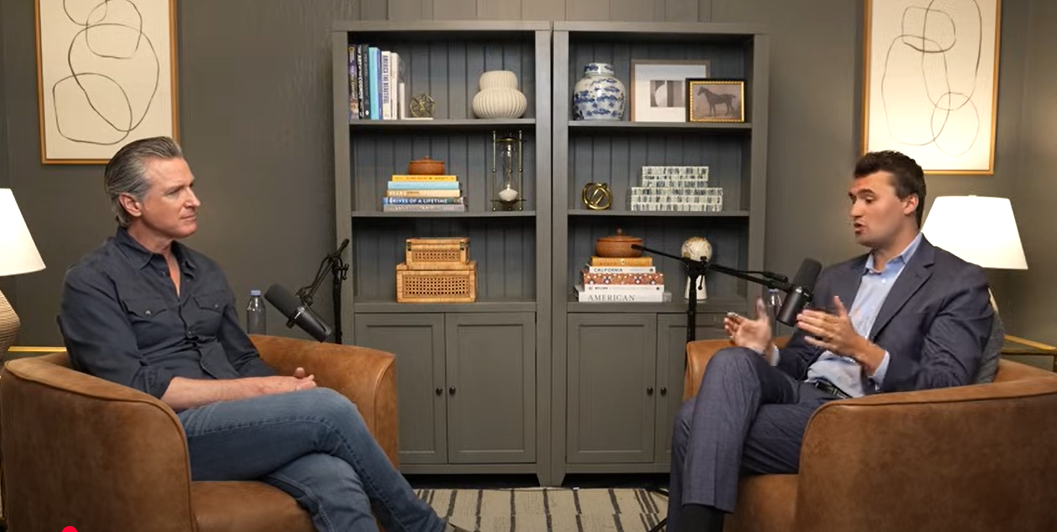
California Gov. Gavin Newsom, left, and MAGA influencer Charlie Kirk on Newsom’s podcast. (Via This is Gavin Newsom on YouTube)
Some leading Democrats are engaged in what’s being called the “Great Un-Awokening.”
Former ambassador to Japan Rahm Emanuel calls Democrats “weak and woke.”
Democratic Maryland Gov. Wes Moore, who is Black, vetoes a bill passed by his Democratic-dominated state legislature that took steps toward reparations.
Democratic California Gov. Gavin Newsom calls it “unfair” to allow transgender athletes to participate in female college and youth sports.
Michigan’s Democratic Sen. Elissa Slotkin says the party needs more “alpha energy.”
Former Transportation Secretary Pete Buttigieg removes his pronouns from his social media bio.
Hello?
None of this gives the Democrats a message for the future. None responds to the central issues Americans care about.
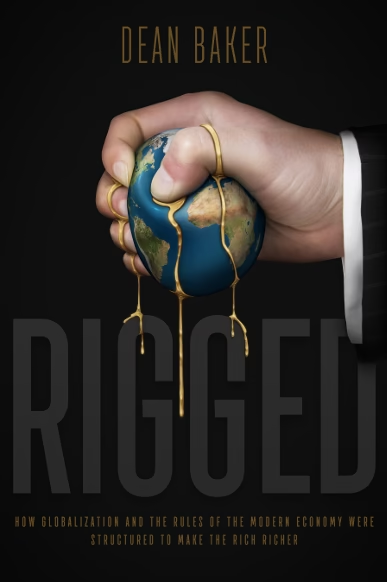
The largest force in American politics is antiestablishment fury at a rigged system. There is no longer a big-government left or a small-government right or a moderate “center” in between.
There’s only right-wing cultural populism — taking aim at immigrants, transgender people, the “deep state,” “DEI,” “woke-ism”, “socialism,” critical race theory and other Trump Republican bogeymen.
Democrats cannot win by giving in to Republican cultural populism.
Or economic populism — aiming at the real causes of the nation’s soaring inequality and the legalized bribery of politicians: large corporations that insist on regulatory rollbacks, their fat-cat CEOs (now earning 350 times their typical employees) who want bigger tax loopholes, and other hugely wealthy Americans who are demanding larger tax cuts.
Democrats cannot win by giving in to Republican cultural populism. They must hammer economic populism.
We are at a time in the nation’s history when inequality has soared to record highs, when big money from large corporations and the rich has engulfed our politics, when CEOs are raking in record compensation compared to average workers, when a president has surrounded himself with billionaires and pledged a huge tax cut that will mainly benefit the rich at the expense of programs on which the poor and working class depend, and when American democracy is in imminent danger of succumbing to a dictatorship.
Democrats must move the national conversation to the terrain they occupied the last time inequality and corruption exploded in America.
1. The era of the Democrats’ economic populism
In the early 20th century, Americans reclaimed the economy and democracy from the robber barons of the first Gilded Age.
The Progressive Era, as it was called, emerged because millions of Americans saw that wealth and power concentrated at the top was undermining democracy and stacking the economic deck.
Wisconsin’s “Fighting Bob” La Follette instituted the nation’s first minimum-wage law. Presidential candidate William Jennings Bryan attacked the big railroads, giant banks and insurance companies. Ohio’s Sen. John Sherman led the way to America’s first antitrust legislation.
American democracy is in imminent danger of succumbing to a dictatorship.
President Theodore Roosevelt used that legislation to bust up the giant trusts. Suffragists like Susan B. Anthony helped secure women the right to vote. Reformers like Jane Addams successfully pushed for laws protecting children and the public’s health. Organizers like Mary Harris “Mother” Jones spearheaded labor unions.
In 1910, Roosevelt warned that “a small class of enormously wealthy and economically powerful men, whose chief object is to hold and increase their power” could destroy American democracy. Roosevelt’s answer was to tax wealth. The estate tax was enacted in 1916 and the capital gains tax in 1922.
Teddy Roosevelt’s fifth cousin, Franklin D. Roosevelt, saw in the 1929 stock market crash an opportunity to renegotiate the relationship between capitalism and democracy. He attacked corporate and financial power by giving workers the right to unionize, the 40-hour workweek, unemployment insurance and Social Security.
FDR also instituted a high marginal income tax on the wealthy — those making more than $5 million a year were taxed up to 75 percent — and regulated finance.
Accepting nomination for reelection as president in 1936, FDR spoke of the need to redeem American democracy from the despotism of concentrated economic power. He reviewed what had led to the Great Crash:
Through new uses of corporations, banks and securities, [an] industrial dictatorship [now] reached out for control over Government itself. … The political equality we once had won was meaningless in the face of economic inequality. A small group had concentrated into their own hands an almost complete control over other people’s property, other people’s money, other people’s labor — other people’s lives. … Against economic tyranny such as this, the American citizen could appeal only to the organized power of Government. The collapse of 1929 showed up the despotism for what it was. The election of 1932 was the people’s mandate to end it.
Roosevelt warned the nation against the “economic royalists” who had pressed the whole of society into service. “The hours men and women worked, the wages they received, the conditions of their labor … these had passed beyond the control of the people and were imposed by this new industrial dictatorship,” he thundered. What was at stake, he said, was nothing less that the “survival of democracy.”
On the eve of his 1936 reelection, FDR told the American people that big business and finance were determined to unseat him. He said that during his first term of office:
We had to struggle with the old enemies of peace — business and financial monopoly, speculation, reckless banking, class antagonism, sectionalism, war profiteering.
They had begun to consider the Government of the United States as a mere appendage to their own affairs. We know now that Government by organized money is just as dangerous as Government by organized mob.
Never before in all our history have these forces been so united against one candidate as they stand today. They are unanimous in their hate for me — and I welcome their hatred.
2. Why the Democratic Party gave up economic populism
By the 1950s, the Democratic Party had given up economic populism. Gone from their presidential campaigns were tales of greedy businessmen and unscrupulous financiers.
Postwar prosperity had created the largest middle class in the history of the world and reduced the gap between rich and poor. By the mid-1950s, a third of all private-sector employees were unionized, and blue-collar workers regularly received generous wage and benefit increases.
Keynesianism had become a widely accepted antidote to economic downturns — substituting the management of aggregate demand for class antagonism. Even Richard Nixon purportedly claimed “we’re all Keynesians now.” Who needed economic populism when fiscal and monetary policy could even out the business cycle, and when the rewards of growth were so widely shared?
Postwar fears of Soviet communism also put a damper on the older Democratic class politics.
“Democrats have lost support with all working-class voters across the electorate.”
Then the civil rights and anti-Vietnam War movements spawned an antiestablishment, anti-authoritarian New Left that distrusted government as much as it distrusted Wall Street and big business, if not more. The split eventually gave rise to a struggle within the Democratic Party between Bernie Sanders’ populists and Hillary Clinton’s mainstream Democrats.
As Democratic pollster Stanley Greenberg concluded after the 2016 election, “Democrats don’t have a ‘white working-class’ problem. They have a ‘working-class problem’ which progressives have been reluctant to address honestly or boldly. The fact is that Democrats have lost support with all working-class voters across the electorate.”
Before Donald Trump’s election in 2016, Democrats had occupied the White House for 16 out of 24 years. During the first two years of the Clinton and Obama administrations, Democrats controlled both houses of Congress.
They scored some important victories for working families, including the Affordable Care Act, an expanded Earned Income Tax Credit, and the Family and Medical Leave Act.
I’m proud of having been part of a Democratic administration during that time.
But I was also terribly frustrated during those years by the New Democrat political operatives who focused on suburban swing voters and ignored the old Democratic working class, and the corporate Democrats in Congress who refused to do more for average workers and who failed to see that if the middle class continued to shrink, authoritarianism would only grow.
Bill Clinton used his political capital to pass free trade agreements without providing millions of blue-collar workers who consequently lost their jobs the means of getting new ones that paid at least as well. His North American Free Trade Agreement and acquiescence to China’s joining the World Trade Organization undermined the wages and economic security of manufacturing workers across the nation, hollowing out the Rust Belt.
Both Clinton and Obama stood by as corporations busted trade unions, the backbone of the working class. Neither Clinton nor Obama spent any political capital to reform labor laws by allowing workers to form unions with a simple up-or-down majority vote, or even to impose meaningful penalties on companies that fired workers for trying to form unions.
Both Clinton and Obama stood by as corporations busted trade unions.
During the 2008 campaign, Obama was instructed to not even use the words “labor union,” since most workers were not members and unions were thought to be unpopular.
Labor unions don’t just give workers more bargaining leverage to get higher wages and benefits. They also used to be a political counterweight to the power of large corporations and Wall Street.
Yet under Clinton and Obama, corporate power continued to rise and union membership to fall as a portion of the workforce. Antitrust enforcement continued to ossify.
Both Clinton and Obama depended on big money from corporations and the wealthy. Both turned their backs on campaign finance reform. In 2008, Obama was the first presidential nominee since Nixon to reject public financing in his primary and general election campaigns, yet he never followed up on his reelection promise to pursue a constitutional amendment to overturn the Citizens United v. FEC decision.
3. The Republican Party’s embrace of cultural populism
The Democrats’ failure to embrace economic populism as they did under FDR enabled Republican cultural populism to fill the void, offering Americans who have been losing ground an explanation for what’s gone wrong and a set of villains to blame for what has happened to them.
Nixon and his protégé Pat Buchanan saw in cultural populism a means of destroying the New Deal coalition and attracting the white working class to the Republican Party.
Ronald Reagan deployed cultural populism in claiming that Washington insiders and arrogant bureaucrats had stifled the economy and hobbled individual achievement. The rot at the top of America was a cultural elite out of touch with average working Americans and who coddled the poor — including “welfare queens,” Reagan’s racist dog-whistle.
In the 2004 presidential election, Republicans described Democrats as an effete group of “latte-drinking, sushi-eating, Volvo-driving, New York Times-reading, body-piercing [and] Hollywood-loving” jerks out of touch with the real America.
Meanwhile, big money poured into the American political system. By the 2016 election, the richest 100th of 1 percent of Americans — 24,949 extraordinarily wealthy people — accounted for a record-breaking 40 percent of all campaign contributions flowing to both parties. That year, corporations flooded the presidential, Senate and House elections with $3.4 billion in donations.
Labor unions no longer provided any countervailing power, contributing only $213 million.
By the 2020s, Republicans saw the culture wars as the central struggle of American public life.
Enter Trump.
4. The consequence
In the decades immediately after World War II, college graduates voted Republican. Republican legislators were significantly more likely than Democratic legislators to hail from Ivy League universities.
It’s the reverse today. Between the 1980s and 2020s, the Democratic Party went from being the party of American workers to the party of college-educated professionals.
Trump is the consequence rather than the source of these trends.
Yet Republican cultural populism is entirely bogus. The biggest change over the previous four decades — the change lurking behind the insecurities and resentments of the working class — has had nothing to do with identity politics, “woke”-ism, critical race theory, transgender kids, immigration, “cat ladies” or any other Republican cultural bogeymen.
Trump is the consequence rather than the source of these trends.
It has been a giant upward shift in the distribution of income and wealth; in the power that has accompanied that shift; and in the injuries to the pride, status and self-esteem of those who have been left behind.
The so-called “Great Un-Awokening” in the Democratic Party is a dangerous diversion from where the party should be — a deflection from what has really happened to a very large number of Americans.
If Democrats have learned anything from what has occurred in America, it should be that they must reverse the distribution of income and wealth. Counter the upward shift in power. Strive to heal the injuries borne by those who have been left behind.
In short, they must embrace economic populism. Otherwise, why have a Democratic Party?
These economic royalists complain that we seek to overthrow the institutions of America. What they really complain of is that we seek to take away their power. Our allegiance to American institutions requires the overthrow of this kind of power.
─Franklin Delano Roosevelt
The Unraveling of the New Deal
By Sue Ann Martinson/ April 5, 2025
There is a mysterious cycle in human events. To some generations much is given. Of other generations much is expected. This generation of Americans has a rendezvous with destiny.
─ Franklin D. Roosevelt, Acceptance Speech for the Renomination for the Presidency, Philadelphia, Pa.,
June 27, 1936
Nowadays we have generation this and generation that, all in categories with their own characteristics. But FDR was referring to collective generations inhabiting the United States at the time. His statement applies now to the current generations of Americans.
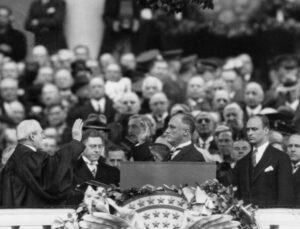
In 1932 when FDR was running for president, he promised if elected a “New Deal” for the American people. At the time Herbert Hoover was president and the nation was in a deep depression caused by the stock market crash of 1929.
Roosevelt introduced the phrase upon accepting the Democratic Party’s presidential nomination in 1932 before winning the election in a landslide over incumbent Herbert Hoover, whose administration was viewed by many as doing too little to help those affected.
The following are the words of FDR in his Acceptance Speech for the Renomination for the Presidency on June 27, 1936. The full speech is included at the end of this post.
For too many of us the political equality we once had won was meaningless in the face of economic inequality. A small group had concentrated into their own hands an almost complete control over other people’s property, other people’s money, other people’s labor—other people’s lives. For too many of us life was no longer free; liberty no longer real; men could no longer follow the pursuit of happiness. [underline emphasis by Wings of Change]
***
These economic royalists complain that we seek to overthrow the institutions of America. What they really complain of is that we seek to take away their power. Our allegiance to American institutions requires the overthrow of this kind of power. In vain they seek to hide behind the Flag and the Constitution. In their blindness they forget what the Flag and the Constitution stand for. Now, as always, they stand for democracy, not tyranny; for freedom, not subjection; and against a dictatorship of mob rule and the over-privileged alike.
[underlines emphasis by Wings of Change]
Almost immediately after the Constitution was passed, the Bill of Rights, based on English Common Law, was added, protecting freedom of speech, freedom of the press, the right to assemble and petition, and freedom of religion, all in the First Amendment. The first ten amendments were the originals. New amendments were added to the original Bill of Rights over the years that reflect values and issues of importance to the American people. These rights along with the Constitution itself were the values that FDR championed.
FDR kept his promise for a New Deal for the American people if they elected him on the heels of the Great Depression that began with the failure of the stock market in 1929. In 1933 during his first term as president he kept his word and initiated bold reforms that became law. Passed with both Republican and Democratic support in Congress, 15 key laws were passed during his first 100 days of office. They were bold reforms that were part of his promised New Deal.
Among these laws was the Glass-Steagall Act that separated commercial and banking activities; other laws guaranteed bank deposits for depositors (no runs on banks as had previously occurred), loans to homeowners who faced losing their homes because of lack of mortgage payments, and keeping farm prices high by paying farmers not to produce. The Civilian Conservation Corp allowed single men between the ages of 18 and 25 to enlist in work programs to improve America’s public lands, forests, and parks, their room and board paid for, they sent $25 of their $30 pay home to their families. The National Recovery Act (NRA) set prices and wages: two million employers in 541 industries signed up, promising to keep prices down and wages up. The Social Security Act was signed into law by FDR on August 14, 1935. It established a system of old-age pensions, unemployment insurance, and aid for dependent mothers and children, blind persons, and persons with disabilities, funded by payroll taxes.
The Bottom Line ─ The Glass-Steagall Act (June 16, 1933)
The Glass-Steagall Act prevented commercial banks from speculative risk-taking to avoid a financial crisis experienced during the Great Depression. Banks were limited to earning 10 percent of their income from investments. This legislation under FDR was a direct response to the stock market crash of 1929 and the resulting depression.
The Gramm-Leach-Bliley Act, under President Clinton, eliminated the Glass-Steagall Act’s restrictions against affiliations between commercial and investment banks in 1999, so unfortunately, the parts of the law that separated investment and speculative commercial interests were repealed, and that repeal is considered to be a cause of the 2008 global recession by many. Some parts of the original Glass-Steagall were maintained, a most important being the Federal Deposit Insurance Corporation (FDIC) that still protects deposits and against runs on banks.
But FDR’s influence was more than creating laws. FDR inspired people. As George Will said as quoted in Ken Burns, Episode 5 of “The Roosevelts” on PBS, he “changed the relationship of the citizen to the central government.“ He instituted the Fireside Chats on the radio, when citizens tuned in weekly to listen. He spoke to them as an equal, building courage and confidence. He established a progressive cabinet, including the first woman cabinet member, Frances Perkins, who oversaw the Works Progress Administration (WPA). Established in 1935, the WPA employed 8.5 million people in building projects and arts initiatives and spent more than $11 million in relief until it was discontinued during WWII.
Some Background
Some find it ironic that Roosevelt himself was part of the over-privileged class that was monied, as was Eleanor, his sixth cousin. President Theodore “Teddy” Roosevelt was her uncle and FDR’s fifth cousin.
The original Roosevelt came to this country in the 1600s from the Netherlands, but not under the name Roosevelt which came later. He had two sons and the two sides of the Roosevelts in FDR’S generation were descended respectively from these two sons. Ken Burns goes into detail about the two different families and their activities in his series about the Roosevelts on public television. Some of the information used in this “unraveling” is from this series, which Burns calls The Roosevelts: An Intimate History, as he describes the relationships between the two parts of the family as each produced a president ─ first Theodore “Teddy” Roosevelt on one side and then FDR on the other. He discusses the effects that contracting polio had on FDR’s personal and political life. He also includes the journey of Eleanor Roosevelt from her shyness to becoming a strong person of influence herself and how that affected her relationship with FDR, remembering that she too was a Roosevelt.
While this essay focuses on FDR’s politics rather than his personal life, the Burns series weaves the two together and is well worth watching. Note that the New Deal and FDR has its critics, while others hail FDR as the greatest president certainly of the 20th century, and even more in the history of America.
The Present and the New Deal
Like FDR, President Trump has moved boldly in these early days of the presidency. His first 100 days, always taken as a presidential measure, have been characterized by taking bold action. But the parallel ends there.What is obvious is that his goals are the opposite of the New Deal. Trump seeks to revoke or eviscerate many of the laws and programs that FDR put into place or convert them to private money-making entities that private corporations control. Without FDR and the New Deal there would be no unemployment insurance, no social security, no limit on working hours. no minimum wage, and the laws that regulate money systems, including the Federal Deposit Insurance Corporation that protects bank deposits.
“These economic royalists complain that we seek to overthrow the institutions of America. What they really complain of is that we seek to take away their power,” said FDR. Yet it is these institutions that Trump and his cronies are attempting to destroy precisely because they do put controls on the power of these “economic royalists,” what today we often call the ruling elite. who, as FDR notes, “hide behind the Flag and the Constitution,” as Trump and Co. do by falsely exuding great Patriotism.
When FDR was inaugurated there were 15,000 million unemployed in America. The New Deal programs he initiated greatly reduced that number by 1935 going into his second term. It’s as if Trump is trying again to reach that number of unemployed through layoffs, releasing thousands of worker, while he and Elon Musk, operating outside of Congress, raid our institutions with layoffs and cutbacks in funding, all the while giving perks via tax cuts and investments to corporations that have raised prices and that continue to destroy the environment and contribute to the current climate crisis as well as increasing the already bloated military budget by taking money from social programs (never from corporations, which the government continues to fund.
Department of Government Efficiency (DOGE)
Trump and his cohorts, especially Elon Musk, have created the so-called Department of Government Efficiency (DOGE). It was not created by Congress but by an executive order of Trump’s. Although DOGE is supposedly managed by the bipartisan DOGE Caucus whose purpose is “pave the way for the House of Representatives to streamline government operations and to save taxpayer money,” they are dismantling and cutting off funding for most programs that support ordinary citizens in need as well as some foreign programs like USAid.
Despite its full name, DOGE is not an official government department, which would have had to be established by an act of Congress. Instead it came into being through one of Trump’s presidential executive orders, and operates as an advisory body with at least four employees dedicated to each government agency.
Trump and Musk are conducting a hell-bent crusade against as many social programs as possible. While their actions may not directly be the repeal of all the same laws that were passed by Congress under FDR’s presidency, with so many people laid off it is as if Trump and his cronies are trying to match the 15 million people who were unemployed when FDR officially became president in 1933, along with the millions of immigrants Trump has deported or plans to deport, some of whom are American citizens or hold green cards.
Musk and Trump, under the auspices of DOGE, are slashing programs that benefit the citizens of America with broad strokes. What they call a campaign against fraud in reality is a gutting of social programs that benefit ordinary citizens. At the same time Trump continues more than excessive military spending by funding foreign wars ─ most obviously the Ukraine War and the continuing genocide against the people of Palestine/Gaza being criminally perpetrated by Israel─ as well as maintaining an excessive and very expensive worldwide military network. At the same time they are gutting the Environmental Protective Agency (EPA) and increasing rather than curtailing the use of fossil fuels, a CO2 pollutant that is a major cause of the Climate Crisis that puts the whole planet at risk.
The Trump administration and Trump himself pretend and encourage their followers to pretend that there is no relationship between the climate crisis and the use of fossil fuels, yet the Union of Concerned Scientists and other responsible and realistic academics as well as ordinary people have shown us otherwise with their analyses and activism alike. And the U.S. military continues to be the a major polluter in the world with its use of fossil fuels that release CO2 and methane gas into the atmosphere as well as by the pollution of water, especially by what are called PFAS pollutants, with the 1000 plus military bases and military installations worldwide.
In addition Trump is acting in true autocratic manner in attempting to shut down free speech in the colleges where pro-Palestine students are attempting to exercise the right of free speech. This ban extends to all media by his demands that no critical articles be written about him and there be no critiques of his platform and actions. In addition, the Trump administration’s policies result in the threatening of academic freedom of college and university faculty members. His actions mimic Hitler’s seeing that Jewish professors and anyone opposed to him were fired from colleges and universities and punishing students who opposed his policies, such as the White Rose student group who were murdered by Hitler for distributing pamphlets against him. The book bans that are being legislated in many states are also an attack on free speech and approximate the book burnings under Hitler.
As usual, Trump is pursuing his policy of hate and hyper-militarism for specious reasons that attack the most basic American values such as free speech and the peoples’ right to assemble along with the right to petition the Government for a redress of grievances; they rationalize this Constitutional crisis with all the geopolitical ins and outs and machinations and excuses they can create. Congress keeps pouring money into weapons and then sending them to Ukraine for continued war and to Israel for the continued genocide against the people of Palestine, making sure the war industry is well-funded and much of the profits are returned to members of Congress for their election campaigns and personal use, Congress appears to have been brain-washed; when interviewed by Medea Benjamin and other Code Pink members in its halls in response to their questions, they shift all blame back to Hamas when it is the U.S. that is guilty of supporting Israel’s continuing apartheid and oppression of Palestine since 1948. It is the U.S. that keeps shipping weapons and money to Israel so they can continue with the genocide. Any attempts at forming a ceasefire Trump’s part have failed.
End of Part 1, The Unraveling of the New Deal
++++++++++++++++++++
FDR Acceptance Speech for the Renomination for Presidency on June 27, 1936. Full address:
Senator Robinson, Members of the Democratic Convention, my friends:
Here, and in every community throughout the land, we are met at a time of great moment to the future of the Nation. It is an occasion to be dedicated to the simple and sincere expression of an attitude toward problems, the determination of which will profoundly affect America.
I come not only as a leader of a party, not only as a candidate for high office, but as one upon whom many critical hours have imposed and still impose a grave responsibility.
For the sympathy, help and confidence with which Americans have sustained me in my task I am grateful. For their loyalty I salute the members of our great party, in and out of political life in every part of the Union. I salute those of other parties, especially those in the Congress of the United States who on so many occasions have put partisanship aside. I thank the Governors of the several States, their Legislatures, their State and local officials who participated unselfishly and regardless of party in our efforts to achieve recovery and destroy abuses. Above all I thank the millions of Americans who have borne disaster bravely and have dared to smile through the storm.
America will not forget these recent years, will not forget that the rescue was not a mere party task. It was the concern of all of us. In our strength we rose together, rallied our energies together, applied the old rules of common sense, and together survived.
In those days we feared fear. That was why we fought fear. And today, my friends, we have won against the most dangerous of our foes. We have conquered fear.
But I cannot, with candor, tell you that all is well with the world. Clouds of suspicion, tides of ill-will and intolerance gather darkly in many places. In our own land we enjoy indeed a fullness of life greater than that of most Nations. But the rush of modern civilization itself has raised for us new difficulties, new problems which must be solved if we are to preserve to the United States the political and economic freedom for which Washington and Jefferson planned and fought.
Philadelphia is a good city in which to write American history. This is fitting ground on which to reaffirm the faith of our fathers; to pledge ourselves to restore to the people a wider freedom; to give to 1936 as the founders gave to 1776—an American way of life.
That very word freedom, in itself and of necessity, suggests freedom from some restraining power. In 1776 we sought freedom from the tyranny of a political autocracy—from the eighteenth century royalists who held special privileges from the crown. It was to perpetuate their privilege that they governed without the consent of the governed; that they denied the right of free assembly and free speech; that they restricted the worship of God; that they put the average man’s property and the average man’s life in pawn to the mercenaries of dynastic power; that they regimented the people.
And so it was to win freedom from the tyranny of political autocracy that the American Revolution was fought. That victory gave the business of governing into the hands of the average man, who won the right with his neighbors to make and order his own destiny through his own Government. Political tyranny was wiped out at Philadelphia on July 4, 1776.
Since that struggle, however, man’s inventive genius released new forces in our land which reordered the lives of our people.. The age of machinery, of railroads; of steam and electricity; the telegraph and the radio; mass production, mass distribution—all of these combined to bring forward a new civilization and with it a new problem for those who sought to remain free.
For out of this modern civilization economic royalists carved new dynasties. New kingdoms were built upon concentration of control over material things. Through new uses of corporations, banks and securities, new machinery of industry and agriculture, of labor and capital—all undreamed of by the fathers—the whole structure of modern life was impressed into this royal service.
There was no place among this royalty for our many thousands of small business men and merchants who sought to make a worthy use of the American system of initiative and profit. They were no more free than the worker or the farmer. Even honest and progressive-minded men of wealth, aware of their obligation to their generation, could never know just where they fitted into this dynastic scheme of things.
It was natural and perhaps human that the privileged princes of these new economic dynasties, thirsting for power, reached out for control over Government itself. They created a new despotism and wrapped it in the robes of legal sanction. In its service new mercenaries sought to regiment the people, their labor, and their property. And as a result the average man once more confronts the problem that faced the Minute Man.
The hours men and women worked, the wages they received, the conditions of their labor—these had passed beyond the control of the people, and were imposed by this new industrial dictatorship. The savings of the average family, the capital of the small business man, the investments set aside for old age—other people’s money—these were tools which the new economic royalty used to dig itself in.
Those who tilled the soil no longer reaped the rewards which were their right. The small measure of their gains was decreed by men in distant cities.
Throughout the Nation, opportunity was limited by monopoly. Individual initiative was crushed in the cogs of a great machine. The field open for free business was more and more restricted. Private enterprise, indeed, became too private. It became privileged enterprise, not free enterprise.
An old English judge once said: “Necessitous men are not free men.” Liberty requires opportunity to make a living—a living decent according to the standard of the time, a living which gives man not only enough to live by, but something to live for.
For too many of us the political equality we once had won was meaningless in the face of economic inequality. A small group had concentrated into their own hands an almost complete control over other people’s property, other people’s money, other people’s labor—other people’s lives. For too many of us life was no longer free; liberty no longer real; men could no longer follow the pursuit of happiness.
Against economic tyranny such as this, the American citizen could appeal only to the organized power of Government. The collapse of 1929 showed up the despotism for what it was. The election of 1932 was the people’s mandate to end it. Under that mandate it is being ended.
The royalists of the economic order have conceded that political freedom was the business of the Government, but they have maintained that economic slavery was nobody’s business. They granted that the Government could protect the citizen in his right to vote, but they denied that the Government could do anything to protect the citizen in his right to work and his right to live.
Today we stand committed to the proposition that freedom is no half-and-half affair. If the average citizen is guaranteed equal opportunity in the polling place, he must have equal opportunity in the market place.
These economic royalists complain that we seek to overthrow the institutions of America. What they really complain of is that we seek to take away their power. Our allegiance to American institutions requires the overthrow of this kind of power. In vain they seek to hide behind the Flag and the Constitution. In their blindness they forget what the Flag and the Constitution stand for. Now, as always, they stand for democracy, not tyranny; for freedom, not subjection; and against a dictatorship by mob rule and the over-privileged alike.
The brave and clear platform adopted by this Convention, to which I heartily subscribe, sets forth that Government in a modern civilization has certain inescapable obligations to its citizens, among which are protection of the family and the home, the establishment of a democracy of opportunity, and aid to those overtaken by disaster.
But the resolute enemy within our gates is ever ready to beat down our words unless in greater courage we will fight for them.
For more than three years we have fought for them. This Convention, in every word and deed, has pledged that that fight will go on.
The defeats and victories of these years have given to us as a people a new understanding of our Government and of ourselves. Never since the early days of the New England town meeting have the affairs of Government been so widely discussed and so clearly appreciated. It has been brought home to us that the only effective guide for the safety of this most worldly of worlds, the greatest guide of all, is moral principle.
We do not see faith, hope and charity as unattainable ideals, but we use them as stout supports of a Nation fighting the fight for freedom in a modern civilization.
Faith— in the soundness of democracy in the midst of dictatorships.
Hope—renewed because we know so well the progress we have made.
Charity— in the true spirit of that grand old word. For charity literally translated from the original means love, the love that understands, that does not merely share the wealth of the giver, but in true sympathy and wisdom helps men to help themselves.
We seek not merely to make Government a mechanical implement, but to give it the vibrant personal character that is the very embodiment of human charity.
We are poor indeed if this Nation cannot afford to lift from every recess of American life the dread fear of the unemployed that they are not needed in the world. We cannot afford to accumulate a deficit in the books of human fortitude.
In the place of the palace of privilege we seek to build a temple out of faith and hope and charity.
It is a sobering thing, my friends, to be a servant of this great cause. We try in our daily work to remember that the cause belongs not to us, but to the people. The standard is not in the hands of you and me alone. It is carried by America. We seek daily to profit from experience, to learn to do better as our task proceeds.
Governments can err, Presidents do make mistakes, but the immortal Dante tells us that divine justice weighs the sins of the cold-blooded and the sins of the warm-hearted in different scales.
Better the occasional faults of a Government that lives in a spirit of charity than the consistent omissions of a Government frozen in the ice of its own indifference.
There is a mysterious cycle in human events. To some generations much is given. Of other generations much is expected. This generation of Americans has a rendezvous with destiny.
In this world of ours in other lands, there are some people, who, in times past, have lived and fought for freedom, and seem to have grown too weary to carry on the fight. They have sold their heritage of freedom for the illusion of a living. They have yielded their democracy.
I believe in my heart that only our success can stir their ancient hope. They begin to know that here in America we are waging a great and successful war. It is not alone a war against want and destitution and economic demoralization. It is more than that; it is a war for the survival of democracy. We are fighting to save a great and precious form of government for ourselves and for the world.
I accept the commission you have tendered me. I join with you. I am enlisted for the duration of the war.
Franklin D. Roosevelt, Acceptance Speech for the Renomination for the Presidency, Philadelphia, Pa. Online by Gerhard Peters and John T. Woolley, The American Presidency Project https://www.presidency.ucsb.edu/node/208917
To be hopeful in bad times is not just foolishly romantic … If we see only the worst, it destroys our capacity to do something. —Howard Zinn
We live in a world where the funeral matters more than the dead, the wedding more than love and the physical rather than the intellect. We live in the container culture, which despises the content. —Eduardo Galeano
At the heart of this book lies a stark truth: Americans, and people worldwide, are facing a moment of grave danger. This is not just a political crisis but a moral one, demanding that the search for truth be met with an urgent recognition—both individual and collective—that democracy itself is under siege. The United States is embroiled in a historic battle over the soul of democracy, the values that sustain it, and the institutions that create citizens ready to defend it. Civic culture, shared values, and the commitment to the public good are being dismantled by the rise of twenty-first-century authoritarians who camouflage their disdain for democracy by championing unreservedly for “illiberal democracy”—a deceptive code for a new breed of fascism. In an age of shrinking political horizons, the unpalatable and unthinkable have not only been normalized but airbrushed into acceptability.
Democracy’s promise is being suffocated under a growing pall of cynicism, leaving behind what David Graeber so powerfully described as an “apparatus of hopelessness.” This system is engineered to murder dreams and extinguish any vision of an alternative future, crushing not only democratic ideals but the very hope required to imagine and fight for a better world. What remains is a calculated assault on possibility, designed to suppress resistance and ensure submission to authoritarianism.
The flirtation with authoritarian rule in the United States, Hungary, Italy, Turkey, India, and other countries has given way to an unabashed embrace of the ideological fictions of despotic power, racial capitalism, and white supremacy. In the current historical moment, morality and responsibility are no longer at the forefront of shaping identity, agency, and politics. Neoliberal’s obsession with privatization, accumulating wealth, and unfettered markets is matched by its delusional call for endless growth and a disdain for the common good and social state. One outcome has been a growing collective anger and bitterness over what Tony Judt presciently identified as “growing inequalities of wealth and opportunity; injustices of class and caste; economic exploitation at home and abroad; corruption and money and privilege occluding the arteries of democracy.” Add to this the right-wing war on education, the assault on women’s reproductive rights and gay rights, along with the acceleration of systemic racism and police violence, and relentless environmental devastation.
Crisis of Conscience
In addition, students on college campuses across the country protesting against Israel’s war on Gaza and the rights of Palestinians have been and continue to be subject to suspension, expulsion, police violence, and arrests. Once again, it is important to stress that weapons of war are now being used against Black and Brown youth, college students, and journalists who are fighting for human rights, the ethic of self-determination, and are expressing resistance and mutual responsibility against injustices at home and abroad.
With the looming threats of nuclear war, accelerating climate change, staggering increases in global poverty, and the erosion of democracy worldwide, it is imperative, as Herman Kahn once urged, to start “thinking about the unthinkable.” Neither the survival of the planet nor the preservation of democracy can be assumed any longer. Rogue militarism, rampant war crimes, and the scourge of ultra-nationalism now threaten not only the elimination of Palestinians in Gaza but the outbreak of a full-scale war in the Middle East. A UN expert has warned that “at the current rate of killing and death, 15 to 20% of Gaza’s population could be dead by the end of the year … and almost entirely exterminated within a few years.” These current political earthquakes have engulfed many people into a state of “shock and stunned silence.” In an era marked by the rise of emerging fascism, the body politic finds itself submerged in moral blindness, a crisis of thought, and culture of fear. These factors have impacted large segments of the American public, preventing them from confronting the unspeakable with a sense of responsibility, dignity, and the courage to act in the service of a social justice. Under the regime of gangster capitalism, with its “alliance between globally integrated corporate capital and local neofascist elements, it is becoming increasingly challenging to imagine what a just society might resemble.” As neoliberalism loses its capacity to address social issues and fulfill its guarantees of social mobility and a fair level of economic equality, it has morphed into a rebranded from of fascism.
This transformation is particularly evident under the influence of Trump and the MAGA movement, as seen in its demonization of the “other,” the exercise of repressive political power, the propagation of a culture of lies, the embrace of white replacement theory, and the fascist militarization and organization of civil society. The latter is most notable in the emergence of white supremacists, far-right militias, nativist movements, and an amalgamation of neo-Nazis and other far-right extremist groups. As Anne Applebaum points out, dictators from Russia, Iran, Hungary, and China are now collaborating through complex networks in a coordinated effort to suppress anyone—whether individuals, groups, or governments—who dares to challenge their relentless assault on the principles of democracy. These regimes, she argues, are “bound not by ideology but by a shared, ruthless commitment to preserving their personal wealth and power.” This global alliance of autocrats, aptly named “Autocracy, Inc.,” threatens the very ideals and promises of any viable democracy. Social and historical amnesia are now paralleled by ongoing attempts by far-right politicians across the globe to eradicate the notion that emancipatory policies are inseparable from critical thought and the institutions that facilitate it. References to the public good and shared responsibilities have morphed into terms of contempt. This disdain of the social state and social provisions has deep roots, evident in the works of theorists such as Friedrich Hayek and Milton Friedman (unashamed supporters of the murderous Pinochet) as well as in the policies of neoliberal politicians such as Ronald Reagan and Margaret Thatcher.
Reagan famously stated in his 1981 inaugural address that “government is not the solution to our problem; government is the problem,” while Thatcher expanded on this piece of political rhetoric by declaring that “there is no such thing as society, there are only individuals and families.” This is the language of social and moral irresponsibility shaped by a malignant politics that easily succumbs to the service of violence. As Maaza Mengiste notes it is:
A rhetoric of desperation and devastation molded into the incomprehensible, then vomited out in images and words that we cannot ignore though we have tried. It is a language that uses trick mirrors, that employs trapdoors through which meaning can slip and hide. It is strong enough to reside in troubling landscapes, malleable enough to be both poetic and cruel. It has the capacity to draw us in and push us back and send us spinning with speechless grief.
Dire threats to democracy, if not humanity itself, must be addressed, in part, through the crucial recognition that education is a fundamental element of mass social change. It is not an exaggeration to state that education has become the great civil rights issue of our era. Educators, workers, young people, cultural workers, and others are increasingly heeding the words of the great abolitionist Frederick Douglass, who rightly argued that freedom is an empty abstraction if people fail to act on their anger and beliefs,and that “if there is no struggle, there is no progress.” Nowhere is this more evident than in the collective resistance of hundreds of students and faculty on campuses across American who have used their voices and bodies to protest against Israel’s savage and inhumane war on Gaza and the Palestinian people.
At stake here is the question of what our responsibility might be in the face of the unspeakable. What has become unspeakable is the INTRODUCTION force of staggering inequality and its intersection with race, gender, and class oppression. As Keeanga-Yamahtta Taylor has observed, we need a new language that allows us think of major social issues such as racism, sexism, disposability, and war “in big and broad strokes.” Rather than address such issues independently and in a fragmented and isolated way, social problems such as job discrimination, book censorship, poverty, a broken healthcare system, the burden of alienating misery, and the war on women, it is crucial to think in historical, relational, and comprehensive terms. This becomes more difficult in a neoliberal age governed by market mania, excessive self-interest, unattached individualism, and short-term goals. Under such circumstances, the language of public purpose, shared responsibility, and social cohesion is subordinated to the fatuous vocabulary of measurement, quantification, commercial exchange, and increasingly lies, conspiracy theories, and the theatrics of shock and awe.
It is important to analyze the anti-democratic economic, social, and culturally driven forces at work in America as a unified, single system and integrated totality. Only then will it be possible to understand the true nature of the amalgamated forces of racial capitalism at work historically and in the present moment, leading to twenty-first-century fascism. Within a broader notion of totality, it will be possible to recognize the magnitude of the perils that face American democracy and to act on the obligations of justice that speak to the imperatives of moral dignity, equality, and freedom, demanding attention from our individual and collective conscience. Under such circumstances, it will become possible to overcome deepening divisions in American society in order to form what Nancy Fraser calls a new hegemonic bloc capable of dismantling the shared roots of race, class, and the intensive suffering under cannibal capitalism. Moreover, as the bankruptcy of gangster capitalism becomes more evident, visible, and subject to debate, the terms of criticism can shift from a liberal call for simple reforms to a more critical struggle for a social and economic transformation of society.
As Mengiste notes, what is our responsibility to democracy when it is in peril? How do we fight a language that erodes our humanity, which positions us to stand numb and silent? What language can be used “to expand the reach of justice, prevent us from turning away and inform our actions with greater empathy,” compassion, and the will to fight for a future free of the scourge of neoliberal capitalism and the authoritarians, demagogues, and corrupt pundits and politicians who benefit from it?
Politics follows culture, implying that the urgent task of resistance begins with shaping mass consciousness. This is a central aspect of education and cultural politics, necessitating that progressives and others communicate with people in a manner that resonates with their everyday lives and hopes while inspiring their engagement in a mass struggle for political, personal, and economic rights. Such a task calls for placing morality and social responsibility at the forefront of agency and the center of politics, embracing the idea and practice of radical democracy. Silence should be understood and interrogated as a form of complicity, and political indifference as a foundation that normalizes authoritarianism.
The Burden of Conscience focuses on how the personal and the political inform each other, emphasizing how the act of translation creates spaces for resistance and struggle. It aims to expose the harsh realities of living under neoliberalism, massive structures of inequality, a pandemic of despair and loneliness, a carnival of violence, and the burdens of systemic racial capitalism. It attempts to make power visible, dismantle those social formations and politics that render people voiceless while unleashing the capacity among the public to imagine a future where economic, social, and political rights and justice form the cornerstone of a radical democracy. Crucial in this project is to illuminate a central question and pedagogical intervention, connecting matters of agency and identity to the conditions, narratives, and social forms of oppression people are forced to endure—all of which are necessary for blasting open neoliberal hegemony, creating sites of rupture, and glimpsing the possibility of a renewed critical cultural politics.
Central to The Burden of Conscience is the call for educated hope, and a revival of the public imagination as central elements in the struggle for freedom, equality, and social justice. This is a call for militant hope that places individual and collective agency at the core of education, emphasizing the need to change the way people think, act, feel, and identify themselves and their relations to others. Yet, it goes beyond a call for a pedagogical awakening; it calls for civic courage—a space where truth can emerge, where risks are essential, and where systems of injustice can be dismantled, overcome, and replaced with a mass-collective movement for social change. Central to this challenge is addressing how critical education can fulfill its civic function at a time when there is a massive flight from morality and social responsibility.
Zygmunt Bauman and Ezio Mauro in their book, Babel, are right in arguing that we live at a time in which feeling no responsibility means rejecting any sense of critical agency and refusing to recognize the bonds we share with others. Under such circumstances, to borrow a phrase from Ayana Mathis, many Americans have not only “descended into the deep canyons of grief,” but have also become depoliticized and lost their ability to cut through their “numbness and denial.”
This book serves as an appeal to recognize those who have been left behind by authoritarian politicians and fascist political parties. It calls upon the public “to think big,” aiming to connect the personal, political, cultural, and historical in a modern interpretation of C. Wright Mills’s sociological imagination. Capitalism’s alleged truths often remain obscured behind the veil of spectacles, false promises, diversions, and lies. As the Palestinian poet Fady Joudah reminds us: “language dies when it is no longer able or willing to decode the petrified, the coded. Language dies when it is too certain of itself. Language dies when totalitarian thinking convinces us that it is not totalitarian thought, because we are eternally incapable of totalitarian thought. Language dies when the memory that speaks it rots.”
Simultaneously, language flourishes and thrives in the discourse of critique, possibility, and mass struggle. It finds vitality when it impels individual and collective conscience to action, rooted in a profound commitment to justice, dignity, freedom, and solidarity. Fortunately, students on campuses across the United States are currently revitalizing the language of critique, resistance, and hope as they fight for the freedom of the Palestinian people.
Language and politics flourish when spaces are created wherein the unimaginable becomes possible, and the capacity to think differently empowers us to act differently. Confronting the weight of conscience serves as a potent catalyst for imagining a future where justice reigns. It also furnishes the inspiration and vigor to connect understanding, critique, and militant hope in pursuit of a radical democracy. Moral witnessing, alongside the insights of history, lays the groundwork wherein thought and action imbue what Judith Butler calls “our relational obligations as an interdependent global community.”
Racism, militarism, war, poverty, and ecological devastation are covered over in a blistering and ahistorical disdain for Trump, his authoritarianism, and his politics of violence. Martin Luther King’s call to confront “the evil of racism, the evil of poverty, and the evil of war” has been sidelined in both liberal and conservative discourse and politics, erased from the moral framework of the current era.
Morality increasingly collapses under the weight of historical amnesia, the repression of dissent, and the ruination of civic culture. Right-wing attacks on historical consciousness and memory shore up a defense against moral witnessing while providing a cover for willful ignorance. Right-wing politics and culture mangles language in a sea of lies and deceits. As MAGA politicians turn language into a weapon while weaponizing their disimagination machines, language loses its ability to awaken consciousness under the suffocating weight of the spectacle and the crazed vocabulary of demagogues. Ruth Ben-Ghiat rightly argues that authoritarians increasingly in the service of a fascist politics use language as a tool of violence, extinguish meaning, and in doing so destroy hope. She writes:
So, authoritarians turn language into a weapon, as well as emptying key words in the political life of a nation such as patriotism, honor, and freedom of meaning. We are well on our way in America to what I call the “upside-down world of authoritarianism,” where the rule of law gives way to rule by the lawless; where those who take our rights away and jail us pose as protectors of freedom; where the thugs who assaulted the Capitol on Jan. 6 are turned into patriots; and where “leadership means killing people,” as Tucker Carlson put it recently, justifying Vladimir Putin’s killing of Alexei Navalny.
Social responsibility is adrift and is no longer associated with how American society lives up to its democratic ideals. Civic culture has become the enemy of those far-right and neoliberal warriors who fear that public spheres offer a critical space to challenge anti-democratic ideas, values, and social relations. In the age of emerging fascism, the politics of the void replaces the energized spaces of critical thought, dialogue, civic engagement, and social movements. As Elie Wiesel once argued, we live in “a strange and unnatural state in which the lines blur between light and darkness, dusk and dawn, crime and punishment, cruelty and compassion, good and evil.”
With the exception of the rising tide of youth resistance on many fronts, Americans increasingly inhabit a politics of the void marked by a culture of cruelty and indifference. This is a politics in which the suffering of others is avoided, unnoticed, or disparaged. Under such circumstances, memory is erased or rewritten in the language of lies, pain is overlooked, and hope is exiled to the world of silence. As Wiesel notes, “Of course, indifference can be tempting—more than that, seductive. It is so much easier to look away from victims. It is so much easier to avoid such rude interruptions to our work, our dreams, our hopes.” In contemporary terms, this means looking away from the suffering in Gaza, refugee camps, the impoverished, and those others reduced to an abstraction.
The politicians and entrepreneurs of death ignore the blood produced by their weapons and invest heavily without accountability in state and global terrorism. Entire families, children, schools, hospitals, and places of worship are bombed, and women and children are killed as the barbarians of fascism and the arms industries gloat over their mounting profits made from bloodshed and unimaginable suffering. As Chris Hedges has argued, gangster capitalism has reached its logical and toxic conclusion, “fertilized by widespread despair, feelings of exclusion, worthlessness, powerlessness and economic deprivation.” The outcome is a slide into a fascist politics that portends the death of the idea and promise of democracy in the United States.
The Vichy journalists and media outlets now more than ever trade in “objectivity” and calls for even handedness as violence escalates at all levels of society. Trump is treated as a normal candidate for the 2024 presidency despite embracing nihilistic forms of lawlessness. He spews racism, hatred, and endless threats of violence, indifferent to calls for accountability, however timid. Cowardice hides behind the false appeal of a wobbly notion of balance. The mainstream media have a greater affinity for the bottom line than for the truth. Their silence amounts to a form of complicity.
The Republican Party is now mostly a vehicle for fascist politics. The United States has reached the endpoint of a cruel economic and political system that resembles a dead-man walking—a zombie politics that thrives on the exploitation of the working class, immigrants, the poor, dispossessed, and helpless children dying under the bombed-out rubble of state terrorism. White Christian nationalism merges with the most extreme elements of capitalism to enforce cruel and heartless policies of dispossession, elimination, and a politics of savagery. Mouthfuls of blood saturate the language of authoritarianism, and policies of destruction, exploitation, and utter despair follow. Public time based on notions of equality, the common good, and justice fade into the dustbin of a whitewashed history. As James Baldwin once noted, until the Nazis knock on their door, these “let’s be balanced” types refuse to have the courage to name fascism for what it is.
In the face of emergency time, it is crucial to develop a great awakening of consciousness, a massive broad-based movement for the defense of public goods, and a mobilization of educators and youth who can both say no and fight for a socialist democracy. The fight against fascism cannot take place without innovative ideas, vision, and the ability to translate them into action. Dangerous memories and the resuscitation of historical consciousness are even more necessary as democracy is choking on the filth of demagogues, white nationalism, class warfare, militarism, and Christian nationalism. Those Americans who believe in democracy and justice can no longer accept being reduced to a nation of spectators; they can no longer define democracy by reducing it to a voting machine controlled by the rich; nor they can equate it with the corpse of capitalism. They can no longer allow the silence of the press to function as a disimagination machine that depoliticizes the public; they can no longer allow education to be pushed as a machinery of repression, historical amnesia, and ignorance.
I am not engaging in a paralyzing pessimism, but rather highlighting the urgency of a historical moment that is on the verge of spelling the death knell for America as an idea, as a promise of what a radical democracy might presume for the future. We live in an era of emergency time—a flurry of crises in which time has become a disadvantage, and public time has become a necessity and call for militant thought and action. Without agency there is no possibility of imagining a future that does not echo the fascism of the past; without possibility there is no reason to acknowledge the very real material and ideological threats currently faced by the United States and the rest of the globe.F
Fascism is no longer interred in history. The spirit of Weimar 1933 is being replayed. How does one explain Trump’s openly fascist claim that he plans, once elected, to imprison political dissidents in prison camps? Or his pledge “to root out the communist, Marxist, fascist, and the radical left thugs that live like vermin within the confines of our country, that lie and steal and cheat on elections and will do anything possible—they’ll do anything, whether legally or illegally—to destroy America and to destroy the American dream.” Trump’s belligerent rhetoric merges a vocabulary of dehumanization with a language of racial cleansing and repeated threats of violence. He claims that immigrants are “poisoning the blood of our country,” states that “the former chairperson of the Joint Chiefs of Staff deserves to be executed,” and encourages police officers to shoot shoplifters.
In his 2024 campaign, Trump has brazenly embraced authoritarianism, openly stating with a smirk that he desires to be a dictator. This is far from a surprising claim. Trump has a long history of expressing admiration for autocrats and strongmen, consistently praising dictators throughout his political career. His delusions of grandeur are nothing new—he has repeatedly fantasized about wielding unchecked power, reinforcing his dangerous ambition to undermine democratic institutions. Trump has “hosted Hungarian dictator Viktor Orbán—another blood-and-soil exponent of nationalist ethnic purity and an eager helpmeet of Vladimir Putin.” At a Dayton rally, Trump was caught on a hot mic declaring that North Korean dictator Kim Jong Un was also his kind of guy: “‘He speaks, and his people sit up in attention. I want my people to do the same’.” In addition, he has repeated endlessly the big lie about the 2020 election being stolen, has promised a “bloodbath for the country” if he is not elected in 2024, and claimed that if elected he would pardon the convicted criminals who tried on January 6 to overthrow the presidential election by force. Timothy Snyder observes that Trump gives voice to the notion “that violent insurrection is the best form of politics.” Snyder puts Trump’s lies and threats in a context which echoes a history of fascist violence. He writes:
The cult of criminals as martyrs also suggests a historical context: the fascist politics of violence … The fascist-style martyrdom cult justifies violence, in two ways. It makes a hero of criminals, thereby making criminality exemplary. And it establishes prior innocence—we suffered first, and therefore anything we do to make others suffer will always be justified … For fascists, political opponents are enemies because they are animals or are associated with animals.
For the far right and MAGA politicians, fascist politics is now displayed and enacted as a badge of honor. There is more at work here than an echo of former authoritarian regimes. The ensuing threats from Trump and his warrior-soldier types lead directly to the Gulags and camps in a former age of authoritarianism. The spirit of the Confederacy along with an upgraded and Americanized version of fascism is back. The corpse-like orthodoxies of militarism, racial cleansing, and neoliberal fascism point to the bankruptcy of conscience, an instance in which language fails and morality collapses into barbarism, and a politics where any vestige of democracy is both mocked and attacked.
What is clear is that there is a massive rebellion against democracy taking place in the United States and across the globe. And it is not simply being imposed from above through military dictatorships. People now vote for fascist politics. MAGA Republicans openly celebrate politicians who not only unabashedly dismiss democracy but also make racist remarks. CNN reported that Mark Robinson, the Republican nominee for governor of North Carolina, once referred to himself as a “black NAZI” and “expressed support for reinstating slavery” on a pornography website’s message board over a decade ago. Hannah Knowles writing in The Washinton Postoffered the following deluge of offensive comments Robinson made before winning the GOP nomination for governor. She provides the following summary:
There was the time he called school shooting survivors “media prosti-tots” for advocating for gun-control policies. The meme mocking a Harvey Weinstein accuser, and the other meme mocking actresses for wearing “whore dresses to protest sexual harassment.” The prediction that rising acceptance of homosexuality would lead to pedophilia and “the END of civilization as we know it”; the talk of arresting transgender people for their bathroom choice; the use of antisemitic tropes; the Facebook posts calling Hillary Clinton a “heifer” and Michelle Obama a man.
Despite the fact that Robinson has a long history of making misogynist, racist, and anti-transgender comments, Trump has enthusiastically endorsed him, absurdly calling Robinson “Martin Luther King on steroids.” The latter comment made in spite of the fact that Robinson once accused King Jr. “of being a white supremacist.” This shocking alignment with unapologetic racists and would-be fascists underscores how far the party has strayed from democratic and moral principles.
Disimagination machines such as the mainstream media and far-right online platforms, many of which have become platforms for billionaires spreading conspiracy theories, have become powerful ideological fictions—pedagogical machineries of political illiteracy inflicting upon the American people an astonishing vacancy that amounts to a moral and political coma. As one writer for New York Magazine succinctly summarized, powerful social media platforms are now home to dangerous, illiterate fictions. He writes:
Bill Ackman, a wealthy hedge fund manager turned Trump supporter began posting uncontrollably about a right-wing theory that there is (or was) a whistleblower at ABC News, who claims the network gave its questions to Harris in advance of the presidential debate, and then perished in a car crash. [He adds that] Elon Musk, one of the world’s wealthiest people and a large financial supporter of Trump’s ground operation, predicted on his social media platform that Harris’s first act if elected will be to ban X and arrest Musk.
The rapid spread of such unfounded conspiracies and lies highlights the dangerous intersection of wealth, political influence, and misinformation. Stacked atop the ever-growing mountain of lies and relentless conspiracy theories pushed by the right-wing financial elite and others are the ceaseless media stories peddling the absurd and grotesque falsehoods that sacrifice the truth and social responsibility for mindless and often cruel political theater. Trump and his supine backers have ushered in an age of fabricated narratives that become clickbait for an ethically spineless media landscape, where both centrist and right-wing outlets spectacularize eye-popping stories for profit. Let’s be clear, this ploy goes beyond a politics of mere distraction.
The merging of lies, ignorance, and violence was on full display when Trump in a presidential debate with Vice President Kamala Harris falsely claimed that Haitian immigrants were stealing and eating pets in Springfield, Ohio. These racist lies did more than spur endless memes and jokes on the social media and late night comedy shows, “they also produced a familiar pattern in which the city was subject to bomb threats that shut down the elementary schools … swatting attacks meant to intimidate community members, [and a series] of high-speed-networked harassment that over the last few years has largely focused on community events for queer and trans people.” Such lies give Trump’s merry band of white supremacists and proto Nazis the opportunity to smear immigrants, people of color, and anyone else considered “other.” In this instance, such language is more than a vehicle for spreading lies and misinformation. As Toni Morrison reminds us, this systemic looting of language … does more than represent violence; it is violence.”
What is often overlooked in mainstream media discussions of attacks on immigrants, Black people and other marginalized groups are the driving force of white nationalism. For example, Trump’s attacks on Haitian immigrants are frequently reduced to simple racism, when in fact they should be recognized as part of a broader white nationalist agenda. These attacks are about more than just racism; they are a key aspect of white nationalism, which targets anyone who is not a white, wealthy, straight, Christian male. Under the guise of white replacement theory, a wide range of people—beyond just people of color—are “othered.”
This broader agenda is glaringly evident in the assault on women’s reproductive rights, which seeks to control women’s bodies, particularly encouraging white women to have more children out of fear that people of color are increasing in number. What we are witnessing is a calculated and deliberate assault on the very foundations of democracy, undermining the fabric of society with each repeated lie. Under such circumstances, the underlying causes of poverty, dispossession, exploitation, misery, and massive suffering disappear in a spectacularized culture of silence, commodification, and cult-like mystifications. As civic culture collapses, the distinction between truth and falsehoods dissolves, and with it a public consciousness able to discern the difference between good and evil. Too many Americans have internalized what Paulo Freire once called the tools of the oppressor. They not only accept the shift in American politics towards authoritarianism, but they also support the idea itself. Trump’s enduring public support is a chilling reflection of his overt embrace of fascist politics. He openly calls for revoking the Constitution, boasts of wanting to be a “terminate the constitution,” and threatens to weaponize the presidency to imprison political opponents like Liz Cheney if he regains power. This dangerous rhetoric, rather than alienating his base, seems to strengthen it—revealing a disturbing willingness among many to abandon democratic principles for authoritarian rule.
On the side of resistance, Les Leopold is right in arguing that the fight against Trump’s brand of neoliberal fascism will never succeed until both “our sense of the possible expands” and we take seriously “that real education about big picture issues can make a difference in how people see the world.” At the same time, any commanding vision of the future must embrace’ as part of a viable pedagogical struggle, anti-capitalist values capable of mobilizing a broad-based movement in which the call for political and personal rights is matched by the demand for economic rights. The late Václav Havel, the world-renowned playwright, statesperson, and human activist, astutely noted the need for a massive resistance against the leveling of meaning, language, subjectivity, and social responsibility. His call for a revolution in human consciousness echoes that of Martin Luther King Jr.’s similar appeal for a revolution of values. For Havel, morality had to be put ahead of politics, economics, and science, and for that to happen he states that “the main task in the coming era is … a radical renewal of our sense of responsibility. Our conscience must catch up to our reason—otherwise we are lost.”
For Havel, matters of consciousness, subjectivity, and agency are a crucial part of a politics of resistance. But they are only the beginning of the long struggle towards a radical restructuring of society. Ideas have to be articulated to action in order to address the political pathologies of our time. There can be no viable resistance without a massive campaign against both gangster capitalism—with its destructive emphasis on economic inequality, the plundering of the environment, and widespread attacks on social justice—and a movement to restructure rather than reform society based on democratic socialist values. Militant critique must be matched by a militant sense of possibility. Howard Zinn got it right when he argued that:
To be hopeful in bad times is not just foolishly romantic … If we see only the worst, it destroys our capacity to do something. If we remember those times and places—and there are so many—where people have behaved magnificently, this gives us the energy to act, and at least the possibility of sending this spinning top of a world in a different direction … The future is an infinite succession of presents, and to live now as we think human beings should live, in defiance of all that is bad around us, is itself a marvelous victory.
We live in an era of dire emergencies. The urgency of the times demands a politics that recognizes the looming threat of fascism. Such recognition presents us with a historical moment in which it is crucial not to give up on the imagination, to enact the allegedly impossible as possible, and to embrace a vision of the future and a sense of collective struggle in which there is life beyond gangster capitalism and its updated twenty-first-century fascist politics. Against this authoritarian nightmare is the need for a politics rooted in creating a broad-based multiracial working-class movement that embodies a sense of moral courage and civic imagination capable of both a revolution of values and a commitment to social change. Resistance must begin with the question of what kind of world we want to live in. Wendy Brown sums up well the importance of this question. She writes:
The question of what kind of world you want to live in … has bearing when your life is in your own hands, when you have a little or a lot of power or latitude, when you decide every day what to support or decry, nourish or fight. The question of what kind of world you want to live in asks you to become responsible to and for a world that you didn’t build, where the terms of entry are not fair and can be hard.
At the heart of this call for resistance is a notion of education that instructs young people, cultural workers, and those on the margins of society that morality and responsibility have to be at the forefront of agency, politics, resistance, and social change. With the death of the ethical imagination, the bonds of sociality and reciprocity disintegrate, vital public spheres are eliminated, and the demands of justice, equity, and freedom become relics of history. We live in a time when the habits of democracy are disappearing just as the existing culture of fear and lying depoliticizes people. With the rupturing of the social bonds that provide meaning, dignity, and security, fascism begins with the language of dehumanization, the murder of dreams, and an imposition of hopelessness. Memory has no home in an anti-democratic culture of repression and violence. With Donald Trump’s re-election, the United States stands on the brink of a fascist resurgence. Now, more than ever, it is essential to interrogate the past to understand how history’s lessons can illuminate a path forward against this authoritarian threat. Only by confronting these dark realities can we hope to defend the future of democracy. Katharine Hodgkin and Susannah Radstone are right in arguing that “the past has strategic, political, and ethical consequences [and that] contests over the meaning of the past are also contests over the meaning of the present and over ways of taking the past forward.” Not only is it time to rethink the kind of world we want to live in and take it forward, it is also time to make education central to a politics in which it becomes possible “to challenge and imagine futures beyond our current situation.” This suggests rethinking politics and everyday experience through the power of historical memory, language, education, and culture in order to connect the personal, historical, and larger social forces.
The opinions expressed here are solely the author’s and do not reflect the opinions or beliefs of the LA Progressive.
Henry A. Giroux currently holds the McMaster University Chair for Scholarship in the Public Interest in the English and Cultural Studies Department and is the Paulo Freire Distinguished Scholar in Critical Pedagogy. His most recent books include: The Terror of the Unforeseen (Los Angeles Review of books, 2019), On Critical Pedagogy, 2nd edition (Bloomsbury, 2020); Race, Politics, and Pandemic Pedagogy: Education in a Time of Crisis (Bloomsbury 2021); Pedagogy of Resistance: Against Manufactured Ignorance in the Age of Counter-Revolutionary Politics (Bloomsbury, 2023), and coauthored with Anthony DiMaggio, Fascism on Trial: Education and the Possibility of Democracy (Bloomsbury, 2025). Giroux is also a member of Truthout’s board of directors.