Tag: Democracy Now!

  • “Time to Cut Ties with Israel”: U.N. Expert Francesca Albanese on Gaza Hospital Bombing

    “Time to Cut Ties with Israel”: U.N. Expert Francesca Albanese on Gaza Hospital Bombing

    “There has been a tolerance of Israel’s impunity for decades,” says Albanese. “However, the United States is the single most important factor of crisis in the United Nations.”

    Israel’s war on Gaza is the deadliest conflict for journalists in recorded history. In an attack on Nasser Hospital in Gaza Monday, Israel killed five more journalists in addition to over a dozen others. Israeli Prime Minister Benjamin Netanyahu claimed the hospital attack was a “tragic mishap,” but just hours later, Israeli forces killed a sixth journalist. “There is a pattern of targeting and killing journalists that lets us think that there is an intention,” says Francesca Albanese, U.N. special rapporteur on the occupied Palestinian territory.

    As countries prepare for the U.N. General Assembly, Albanese notes the complicity of Western states in the genocide in Gaza, particularly the United States. “There has been a tolerance of Israel’s impunity for decades,” says Albanese. “However, the United States is the single most important factor of crisis in the United Nations.”

    Note: Video also included below: “Chicago Leaders Prepare to Face the Dictator Head On” Below the Chicago video is the full transcript of Franceca Albanese’s intertiew video with Amy Goodman of Democracy Now!

    “We Must Defeat Fascism”: Chicago Alderman on Trump’s Threat to Deploy Troops to City

    Transcript for Francesca Albanese

    This is a rush transcript. Copy may not be in its final form.

    AMY GOODMAN: Human rights and press freedom groups are denouncing Israel’s attack on Nasser Hospital in Gaza Monday that killed at least 21 journalists — that killed at least 21 people, including five journalists. According to eyewitnesses, Israel carried out a double-tap strike on the hospital. In the initial strike, a drone hit Hussam al-Masri, a cameraman who worked for Reuters. Then another strike, minutes later, hit journalists and rescue workers who were responding to the initial strike.

    Israeli Prime Minister Benjamin Netanyahu claimed the hospital attack was a, quote, “tragic mishap.” But just hours later, Israeli forces killed a sixth journalist, Hassan Douhan, a well-known editor at Al-Hayat Al-Jadida. He was killed when an Israeli tank shelled a tent sheltering displaced people in Khan Younis.

    Over the past 23 months, Israel has barred all foreign journalists from reporting inside Gaza, while systematically killing Palestinian journalists. According to one count, Israel has killed least 245 journalists. On Monday, Thibaut Bruttin, the director general of Reporters Without Borders, denounced Israel’s attack on journalists.

    THIBAUT BRUTTIN: When and where is it going to end? Are we going to let the Israel Defense Forces continue the repeated killing of journalists? There is international law. There are guarantees that should be granted to journalists covering conflicts. And none of that seems to be applying. So, we need to be very clear about the fact that none of the journalists that are allegedly terrorists are terrorists. They are professional journalists working for legacy professional media, like, for example, Reuters or, for example, AP.

    AMY GOODMAN: In other news from Gaza, three more Palestinians have starved to death, bringing the total to at least 303.

    We’re joined right now by Francesca Albanese, the U.N. special rapporteur on the occupied Palestinian territory. She’s joining us from Tunis, Tunisia.

    Welcome back to Democracy Now!, Francesca Albanese. Can you start off by responding to the killing of the, at this point, in the last day, six journalists, five of them in a double-tap strike on Nasser Hospital?

    FRANCESCA ALBANESE: Thank you, Amy. Yeah, of course.

    Look, in a situation of conflicts, targeting or killing journalists is unlawful. Journalists, like doctors and medical personnel and rescues, all those who have been killed in this attack, are civilians, so killing them is unlawful. They are protected under international humanitarian law.

    However, here, it’s not an isolated incident. Journalists have been killed in such high numbers. Some say 200 have been documented. Al Jazeera speaks of 270 journalists killed. So there is a pattern of targeting and killing journalists, that let us think that there is an intention behind it. There is a widespread and systematic attack against them, like there is a systematic and widespread attack against civilians. And this might qualify as also as a crime against humanity in and of itself.

    However, however, I want to remind everyone that we are on the 688th day of the assault against Gaza, which an increasing consensus denounces as genocidal. And there is famine, and there is this complete destruction of landscapes in Gaza. So, the question is: What are member states waiting exactly to intervene and stop this carnage?

    JUAN GONZÁLEZ: And, Francesca Albanese, you have said that there have to be response. You’ve called for sanctions against Israel. Could you talk about how those might work, especially, as you mentioned, the fact that state governments are not taking any action?

    FRANCESCA ALBANESE: Oh, absolutely. Look, I would like people to understand this in the broader context of international law. No later than last year, the International Court of Justice has confirmed that Israel’s presence in the West Bank, the Gaza Strip and East Jerusalem is unlawful, must be dismantled totally and unconditionally. And the General Assembly has also given Israel a very generous deadline of one year to do so, which will expire in a month from now. In the face of this, member states have an obligation not to aid and assist in any possible ways a state like Israel in maintaining the situation created by Israel’s unlawful presence. So, while it is abhorrent that they are not stopping Israel, this delay increases their level of responsibility, their violation of international law, and possibly their complicity with the crimes that Israel is committing.

    This is why my recommendations are for member states who do not want to incur in this legal — in their legal responsibilities, and also out of humanity, to break the siege. Member states who have a port in the Mediterranean Sea must absolutely send their navies, under their national flag, with humanitarian aid and doctors, with food and baby formula, because 500,000 people, according to the United Nations, are close to — are really close to starvation. But also, as we see the Sumud Flotilla, so ordinary citizens jumping on boats and trying to do what member states are not doing, I feel that it’s totally immoral and irresponsible to let individuals like this take this risk, when it’s a state obligation to break the siege.

    But also, it’s time to cut ties with Israel, to cut trade, because this is also what the ICJ has reminded member states they need to take all steps to prevent trade and investment relations that are assisting in the maintenance of Israel’s unlawful presence. And we must recall that while Israel is committing genocide in Gaza, it’s also advancing, as it was said in the beginning, annexation at an incredible, incredible speed. So there is no way out of this other than a firm, robust action from member states.

    JUAN GONZÁLEZ: And I wanted to ask you — the Trump administration, instead of heeding your calls as the special rapporteur, have instead imposed sanctions on you, supposedly claiming that your naming of dozens of companies that are profiting from the Israeli occupation and genocide in Gaza. And Secretary of State Marco Rubio said, quote, “Albanese’s campaign of political and economic warfare against the United States and Israel will no longer be tolerated.” Your response to these kinds of words from leaders of the United States?

    FRANCESCA ALBANESE: Well, first of all, as a non-American, but as someone who has lived in the United States, I wonder how American people understand this, because, of course, it’s a violation of the First Amendment, right? I mean, I’ve just done my job, which is a pro bono job. I’ve been requested by the United Nations to investigate and report on the most prominent violations of international law that occur in the occupied Palestinian territory. And I’ve simply stated facts, according due process to businesses, saying there is an economy of the occupation, and this is the reason why Israel has profited and has allowed private entities, arms manufacturers, even banks, pension funds, universities, really, to help and profit — to help it and profit from Israel’s maintenance of the unlawful occupation. Now, this occupation has also turned into genocidal over the past 688 days, and I’ve denounced it. I’ve said, “How come that Israelis were becoming — many Israelis were becoming poorer and poorer, and Israeli stocks exchange kept on going up?”

    Because of that, I’ve been sanctioned, which is something unprecedented, that no states in 80 years of life of the United Nations have ever attempted, had ever dared, because it’s absolute — it’s a violation of international law, of the U.N. Charter, of the Convention on Privileges and Immunities. And still, the United Nations — the United States maintains a sanction, which are now entering the second month. It’s abominable. And this is the situation. But you understand, against a person who has just written a report, I have been called a threat to global economy. It’s clear that I’ve hit a nerve, but this is not the way to react to this.

    AMY GOODMAN: I want to turn to the last story that the Reuters cameraman Hussam al-Masri filmed before he was killed by Israel on Monday at Nasser Hospital. On Saturday, just two days before, al-Masri shot this interview with Hikmat Fojo, a Palestinian woman whose relatives were killed in another Israeli strike.

    HIKMAT FOJO: [translated] While they were sleeping, they were hit by missiles. While they were sleeping, an entire family was lost. And he was praying. He was praying. He was praying. His children were gone. Two were martyred. They were born after 10 years of waiting. One was sleeping. And the woman’s hands and legs, but, God willing, it’s all right. God willing, it doesn’t matter. If my nephew’s hand remains amputated, it doesn’t matter, but may he stay alive, O Lord.

    AMY GOODMAN: So, that was the — one of the last pieces of video that the Palestinian journalist, the Reuters journalist Hussam al-Masri filmed before he was killed Monday in that double-tap strike. He had — apparently was setting up a live stream at the fourth-floor balcony, which journalists used, when he was hit. So, now I want to go to Reuters reporter Steve Holland, who questioned President Trump about this in the Oval Office.

    STEVE HOLLAND: If we could get your reaction, sir? The Israelis bombed a hospital in Gaza, that killed 20 people, including five journalists. Are you —

    PRESIDENT DONALD TRUMP: When did this happen?

    STEVE HOLLAND: This happened overnight today.

    PRESIDENT DONALD TRUMP: I didn’t know that.

    STEVE HOLLAND: Any reaction to this? Are you going to talk to Prime Minister —

    PRESIDENT DONALD TRUMP: Well, I’m not happy about it. I don’t want to see it. At the same time, we have to end that whole nightmare. I’m the one that got the hostages out. I got them out, all of them.

    AMY GOODMAN: That was President Trump. Francesca Albanese, can you talk about the responsibility of the United States? And tell us more about the mechanisms at the U.N., since it’s very clear they block any kind of action at the U.N. Security Council.

    FRANCESCA ALBANESE: Yeah, as I said, there are clear indication, clear instructions from International Court of Justice on how to deal with the situation. The only lawful thing that Israel can do in the occupied Palestinian territory is to withdraw, withdraw the troops, dismantle the settlements, stop exploiting Palestinian resources.

    In the face of this, any aid, any support, any exchange of commerce, military intelligence and others from the United States or others is a breach of the obligation not to render aid and assistance in maintaining the situation. However, on top of this, there are proceedings for genocide pending before the International Court of Justice, which trigger an obligation to prevent, which, as a minimum, as the ICJ has said in the case of Nicaragua v. Germany, entails the ban on transfer of weapons to a country, to a state which is committing violations of international humanitarian law, meaning even war crimes. You know, we don’t even need to go and bother the Genocide Convention. So, yet again, another layer of responsibility of the United States.

    And then there are proceedings against Benjamin Netanyahu and Yoav Gallant for war crimes and crimes against humanity, including starvation. Because of this, even if the United States is not a party to the ICC, it should be respectful of international law, international criminal law. And instead of giving — of receiving the ICC-wanted Netanyahu as if he was really a war hero, as is being defined, the United States should facilitate justice and accountability. Instead, they are waging a war against the ICC itself, not just me. All the judges of the ICC have been sanctioned, and so the prosecutor of the court. So, this is the situation.

    Of course, there are complicities on the side of this administration, and, in my opinion, even in the — on the previous one. But this is something that belongs to the American people. It’s the American people that need to, or the American — the American political landscape that needs to, take action on this.

    JUAN GONZÁLEZ: And, Francesca Albanese, I wanted to ask you — in a few weeks, the U.N. — the annual meeting of the U.N. General Assembly will take place. Leaders from all over the world will come and give speeches to the U.N. General Assembly. Do you think this is a defining moment for the United Nations as an institution in its inability of the member states or the unwillingness of the member states to stop a genocide that the entire world has been witnessing now for —

    FRANCESCA ALBANESE: Yeah.

    JUAN GONZÁLEZ: — two years?

    FRANCESCA ALBANESE: Yeah, I will take the opportunity to also answer the other part of Amy’s question, which I dropped, but it’s — yeah, I think that it’s a — it’s an historical moment, the one we live in, and it’s a defining one. We will not get out of this genocide with the same pretense of innocence that we had when we entered. The crimes of Israel against the Palestinians were already 56-plus years old when the assault against Gaza on the terrible — after the terrible day that October 7 was — and there is no question about that. So, there have been a tolerance of Israel’s impunity for decades.

    However, the United States is the single most important factor of crisis in the United Nations system at the moment, because the United Nations are clearly paralyzed in the face of a crisis which is political, legal and humanitarian, and the United States have contributed to that paralysis by also — for example, what are the mechanisms to impose sanctions or to dispose of coercive or noncoercive measures against Israel within the U.N. would be through the Security Council, and the United States have firmly and steadily sheltered Israel from most important instances of accountability. A rare exception is the 2016 Security Council resolution that recognized the illegality of the settlements under international law.

    So, it’s a catch-22 situation. But at the same time, I want to remind everyone that the international community is constituted by 193 member states, and the other 191, that does not — are not part of the Gaza genocide as much as Israel in the United States, should do the utmost not only to stop the genocide, but also to salvage what remains of the multilateral system, because so far it has protected — I wouldn’t say all of us, but most of us, especially in the West. And it seems that we are really giving it for granted. But we will miss human rights very much when we don’t have them anymore.

    AMY GOODMAN: Francesca Albanese, the International Criminal Court has said it deplores new U.S. sanctions on its judges and prosecutors. Last week, the U.S. State Department announced new sanctions on two judges and two prosecutors in the ICC for engaging in efforts to prosecute U.S. and Israeli citizens. The ICC statement said, “These sanctions are a flagrant attack against the independence of an impartial judicial institution which operates under the mandate from 125 States Parties from all regions. They constitute also an affront against the Court’s States Parties, the rules-based international order and, above all, millions of innocent victims across the world.” I’m wondering if you can comment on this latest development, the sanctions against the ICC prosecutors and judges, and also your own situation. You are the U.N. special rapporteur on the occupied Palestinian territory, and the U.S. has sanctioned you. And if you can talk exactly about what that means?

    FRANCESCA ALBANESE: Look, the sanctions are very heavy and, frankly, an awful, awful instrument, when targeting, when directed at people whose job and whose efforts are in the — in the pursuit of justice and accountability. So, look at the absurdity of using an instrument, which is meant to protect U.S., U.S. interests and U.S. citizens, being used to punish people who are trying to stop and make account — make people responsible for crimes accountable. Where is the harm to the U.S. citizens? What is harmed — and this is why I often say these sanctions are a sign of fragility of those who use it — who use them. I mean, they are — what’s the harm that is done to the American interest, other than to the illegality that is denounced?

    Yes, the special rapporteur has put on notice 48 businesses. And what? Why didn’t they defend themselves? Why didn’t they interact with me, most of them, surely the American companies? Why did they went to complain to the American administration, who put me on notice not to continue this investigation already made? Again, look, I come from a place which has been plagued by Mafia-style logics, techniques, and I’m fully familiar with this way of behaving. And this kind of threats win only if they meet fear. But the people, united, must resist this. And this is why I’m not going to step back, and I’m not going to stop my work.

    AMY GOODMAN: And I wanted to ask a final question about the West Bank. As we went air, I think something like 24 people have been injured in Ramallah in an Israeli military raid. This is not Gaza. This is Ramallah. At the same time, you have the far-right ministers talking about starting to annex the West Bank this week. What does this mean?

    FRANCESCA ALBANESE: Yeah.

    AMY GOODMAN: And what role does the U.N. have in this?

    FRANCESCA ALBANESE: Yes, two things. First, when we say this is not Gaza, last week, the Israeli newspaper +972/Local Call issued a report based on a leaked document by the Israeli army, which admitted that only one of six of the people killed in Gaza were Hamas combatants. And I want to — I want to underscore that Israel’s definition of “combatant” is much broader than what is, in fact, afforded by international law. So, it confirms and actually aggravates the accusations of the U.N., independent experts and others that the death toll has steadily been 70 — at least 70% women and children, and therefore civilians. So, they are saying that, in fact, 80%-plus of the death toll in Gaza is made of civilians.

    The situation is not different from the West Bank, where Israel is advancing its ethnic cleansing agenda through annexation. This is not new. In February 2023, the coalition government passed an agreement that basically transferred to Bezalel Smotrich, so the minister of finance, control over large swathes of the West Bank. This was yet another act of annexation, but formalizing what Israel has been doing for 57 years, creating settlements, which are war crime, in occupied territories for Israeli Jews only that were on — were on stolen land and were resulting in forcibly — dispossession and forcible displacement of Palestinians. Of course, today, this has reached abysmal proportion, because there is — there is even that veneer of respect of international humanitarian law has gone. There are settlers and soldiers ravaging the West Bank, and the Jordan Valley is unprotected, other than from by a few Israeli activists who go there night and day and try to protect shepherds and pastoralist communities.

    But, look, the situation is abominable, abominable. And now the state of Palestine has requested an intervention from the international community. Some presidents, like some authorities, like the Irish president, has called for a military intervention. And I understand that everything must pass up, in accordance with international law, through the Security Council. And at the same time, because Israel has no sovereignty whatsoever over Gaza, the West Bank and East Jerusalem, it’s about time that a protection — the deployment of a protection presence is considered, because there is no other way to stop what Israel is doing.

    AMY GOODMAN: Francesca Albanese, we want to thank you for being with us, U.N. special rapporteur on the occupied Palestinian territory. We were hoping to reach a doctor at Nasser Hospital, but could not reach him today.

    Coming up, we go to Chicago as local and state officials push back against President Trump’s threat to send in the National Guard. We’ll also look at Trump’s new executive orders ending so-called cashless bail. Stay with us.

    [break]

    AMY GOODMAN: The late folk singer-songwriter Michael Hurley performing “What’s Buggin’ You Baby?” at our Democracy Now! studio.

    The original content of this program is licensed under a Creative Commons Attribution-Noncommercial-No Derivative Works 3.0 United States License. Please attribute legal copies of this work to democracynow.org. Some of the work(s) that this program incorporates, however, may be separately licensed. For further information or additional permissions, contact us.


    In this critical time in our country hearing the voices of truth and engaging in honest discussion for critical issues is all the more important while censorship (and outright lies) along with attacks on truth-tellers are common. Support the WingsofChange.me website and Rise Up Times on social media as we to bring you important articles and journalism beyond the mainstream corporate media. Access is alway free, but if you would like to help:
    Wings of Change FeatherWhatever you are able donate will bring you articles and opinions from independent websites, writers, and journalists as well as a blog with the opinions and creative contributions.

    One place to begin is with reason and truth, and how fundamental they are to creating critically engaged citizens and communities. 

    —Henry A. Giroux

  • DN! “Duty to Repair”: IJC Declares States Legally Responsible for Climate Harm

    DN! “Duty to Repair”: IJC Declares States Legally Responsible for Climate Harm

    CLIMATE: “Duty to Repair”

    Vanuatu Climate Minister on World Court Ruling Countries Must Address Climate

    In a landmark decision, the International Court of Justice found that polluting countries are now legally obligated to address global warming. In a unanimous ruling by a panel of 15 judges, the court said high-emitting countries do have legal obligations under international law to address the “urgent and existential threat” of climate change. The case was brought forward by the island nation Vanuatu, which has faced the brunt of the climate crisis with extreme weather events and rising sea levels.


    In this critical time in our country hearing the voices of truth and engaging in honest discussion for critical issues is all the more important while censorship (and outright lies) along with attacks on truth-tellers are common. Support the WingsofChange.me website and Rise Up Times on social media as we to bring you important articles and journalism beyond the mainstream corporate media. Access is alway free, but if you would like to help:
    Whatever you are able donate will bring you articles and opinions from independent websites, writers, and journalists as well as a blog with the opinions and creative contributions.

    Rise Up Times is still active on social media under the name Rise Up Times.

    Or mail a check to Sue Ann Martinson to 2900 11th Ave So, Unit #209, Minneapolis MN  55407 with “Wings” on the Memo line.

    PLEASE SHARE WIDELY ON RISE UP TIMES SOCIAL MEDIA

    • Visit, and encourage your friends to visit, the Rise Up Times Facebook page and from Messenger or the Tumblr, Linked In, and Pinterest Rise Up Times pages or my personal Facebook page, Sue Ann Martinson
    • On Instagram and Tik Tok under Rise Up Times.
    • Also on Instagram, my personal page under Sue Ann Martinson, seas.nun
    • Read and Retweet from Rise Up Times Twitter [X] account @touchpeace.
    • Articles can also be shared from the social media listed above as well as from the Rise Up Times Instagram and Tik Tok pages.
    • Print copies of articles or visuals in Rise Up Times and leave them in your favorite bookstore, coffee shop, etc. and share with friends.
    Wings of Change Feather“We don’t have to engage in grand, heroic actions
    to participate in the process of change.
    Small acts, when multiplied by millions of people,
    can transform the world.”

  • Epstein: Chris Hedges, Sexual Blackmail, DN! A Survivor Testifies

    Epstein: Chris Hedges, Sexual Blackmail, DN! A Survivor Testifies

    Journalist and author Nick Bryant spent seven years investigating a child sex trafficking network that was covered up by state and federal authorities, culminating in the book  The Franklin Scandal: A Story of Powerbrokers, Child Abuse, and Betrayal.

    Journalist and author Chris Hedges is a Pulitzer Prize–winning journalist who was a foreign correspondent for fifteen years for The New York Times. He previously worked overseas for several major news media. Hedges has written several books and hosts The Chris Hedges Report.


    Amy Goodman interviews Jeffrey Epstein Survivor / July 18, 2025

    Guests

    Teresa Helm   A survivor of sexual abuse perpetrated by Jeffrey Epstein and facilitated by Ghislaine Maxwell.

    Transcript
    This is a rush transcript. Copy may not be in its final form.

    AMY GOODMAN: Democracy Now!, democracynow.org, The War and Peace Report. I’m Amy Goodman.

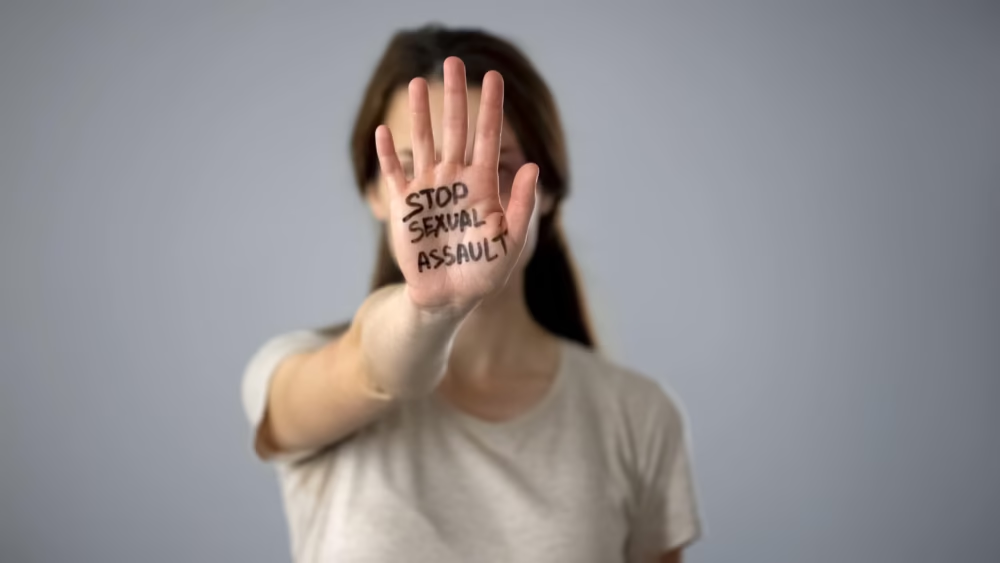
    We speak to a survivor of sexual abuse perpetrated by Jeffrey Epstein and enabled by his partner Ghislaine Maxwell. Teresa Helm was sexually assaulted by Epstein at what she was told was a job interview in the early 2000s. She now works as the survivor services coordinator for the National Center on Sexual Exploitation and joins many voices calling for the release of federal documents pertaining to Epstein’s criminal case, though Helm emphasizes that the goal of their release must be to promote accountability and justice for victims, not as a form of political score-settling. “I really urge everyone to focus their commitment, their intention, all this time, effort and energy onto … these survivors and their healing,” says Helm. “We’re talking about people’s lives, and it should not be weaponized either way, in any administration.”

    Missing in much of the MAGA frenzy over the Jeffrey Epstein files are the voices of survivors of the sexual abuse he perpetrated against them. Many, like our next guest, have joined the call for transparency and for the Trump administration to release the files as promised.

    This comes as Virginia Giuffre, an outspoken survivor of sex trafficking by Jeffrey Epstein, died, apparently by suicide, at age 41 in April. She was the first survivor to come out publicly against Epstein and his co-conspirator, Ghislaine Maxwell, who remains in prison. She also sued Prince Andrew for sexually assaulting her when she was 17. The disgraced prince was forced to step away from his royal duties and settle with Giuffre in 2022. Her family said in a statement, quote, “Virginia was a fierce warrior in the fight against sexual abuse and sex trafficking. She was the light that lifted so many survivors,” unquote.

    Just last week, when the FBI and Department of Justice announced there was, quote, “no incriminating client list,” it also said Epstein harmed over 1,000 victims over two decades, far more than previously known.

    For more, we’re joined by Teresa Helm, who is a survivor of sexual abuse by Jeffrey Epstein, facilitated by Ghislaine Maxwell. She was assaulted by Epstein in the early 2000s. She now works as the survivor services coordinator for the National Center on Sexual Exploitation. Her 2024 piece for Newsweek is headlined “I’m a Jeffrey Epstein Survivor. The Documents Are an Opportunity.”

    Thank you so much for joining us. You, Teresa Helm, have talked about the dangers of grooming. As you see all of this taking place, the uprising within the MAGA movement, lost are what sexual violence survivors go through. Talk about how you first met Jeffrey Epstein, how you were brought to him, how you were groomed.

    TERESA HELM: Well, hello. Good morning. I can certainly talk to that.

    So, I was attending college out in California at the time and was a full-time student and a full-time employee there. And so, that began the process of recruitment to grooming, passed along the line from various people as far as “This is an opportunity that I’d like for you to see if you’re interested in, and go talk to this person.” So, after speaking with a couple young women about an opportunity that I thought I was being blessed with at the time, I eventually met with Ghislaine Maxwell, who really — what she did was pretty astounding, in the fact that within a day I was convinced that I was in a safe, healthy, wonderful environment, blessed with an opportunity to pursue a career that I could — had only dreamed of having. In fact, that was my dream, to do what she had stated I would do alongside her, working for her. She was very polite and kind. She built trust in a very — you know, within hours, I thought that I had really landed the opportunity of a lifetime. My family was very pleased that I was there interviewing with her, which is what — the intention. That’s what the — that’s what I thought I was there for, was an interview. And things went so amazingly well. And then, she was so successful in all of that very, I would call it, you know, master manipulation. She was very calculated in her craft and did it very well.

    I was very young. I mean, I was an adult, 22 years old. However, I had such big dreams and aspirations and determination and really wanted to make the most of this opportunity that I thought that I was getting, to the point where at the end of my time with Ghislaine Maxwell, although I hadn’t known that there was a partner, as she referred to him, that I would be meeting at the end of my time with her — I hadn’t heard Jeffrey or any other person’s name the entire time, from beginning, sitting behind the desk at work in California at the college, to meeting Sarah Kellen at the beach to — who then introduced me to Ghislaine. I had no idea that there was a final person that I was going to go meet.

    And once I learned of him, by the name of Jeffrey, I did not — I paused and thought about some things, waived any kind of red flag in my mind, because, again, she was so — Ghislaine was so, so good at what she had done and built that trust in me. And so, then I walked — I walked myself to Jeffrey’s home later that day to what I thought was to interview with him, without really a lot of question, actually being quite excited, because I thought, “Well, if I was so successful here with Ghislaine, which she has really made me believe that I have been, now I get the opportunity to go complete this, like a second round of the interview.” And that was — really, I walked myself into tragedy. I had no idea. I could — I actually should and I will reframe that. I didn’t walk myself into tragedy. I was lured there. I was coaxed there, coerced there, under false and fraudulent, you know, conditions and expectations.

    AMY GOODMAN: And it was there —

    TERESA HELM: And that’s how I —

    AMY GOODMAN: It was then that Jeffrey Epstein assaulted you?

    TERESA HELM: That’s right, there in his very big, beautiful home there in Manhattan, you know, the home that Ghislaine was raving about after I had been complimenting her on her home and speaking about the different various buildings and the architecture and how much I enjoyed it and comparing different cities to New York. And then she raved about his: If I thought hers was great, wait ’til I see his. Yeah, so, it was there.

    AMY GOODMAN: So, you have joined the call for the Epstein files to be released. Can you explain why you feel this is so important?

    TERESA HELM: Where I stand with all of this is in, you know, utter solidarity with survivors of this entire nightmare that’s just been ongoing for decades with these people that have gotten away with so much for so long, you know, whether it was a failure of the system back in the ’90s, whether failure of the system again in the early 2000s. There are so many women and, at the time, even, you know, children that have been harmed by these people.

    I really urge everyone to focus the — you know, the commitment, the intention, all this time, effort and energy onto bringing to light what needs to bring to light for these survivors and their healing, and less about political weaponization of anything, because at the end of the day, that’s what we’re talking about. We’re talking about people’s lives, and it should not be weaponized either way in any administration, no matter who’s in control at the time, who did what, when, who’s doing what now. Transparency is key, because we cannot move forward as a society and as a culture without these fundamental changes of — these fundamental changes of doing the right thing and holding people accountable, because we can’t continue to have systems of power that just get away, or people — whether it’s a system or a person, we cannot continue to have these people or systems continue to get away with anything that they can get away with, because they’re not — they’re skating through. They’re dodging accountability. There’s too much money involved, so, you know, people silenced through money.

    We have got to change the — it’s degrading our society to continue to allow these predators and perpetrators to get away with harming so many people. You know, those that harm and exploit, they have to be silenced, not the survivors continuing to be silenced, because when you don’t have accountability, you don’t have justice. We are so far out of balance with justice. It’s almost like, you know, Lady Liberty, she can take us a small step to the ground, because we’re so uneven, where survivors are holding on, clinging on to hope, which tends to be, you know, one thing that you can’t take away from a survivor. It’s how we get here. We survive through it because we have so much hope. But hope tends to get shattered often. And it’s like the onus is on us to pick up the pieces and try to get louder and louder. You know, our silence is not — it’s very loud within us. We have to then — you know, we’re tasked with rising back up, fighting bigger, fighting louder, you know, screaming from the mountaintops.

    Like, who is going to do something? Because we are setting horrible, horrible influences to our children and to our youth of what you can and can’t get away with, depending on who you are, what position you are in. And as I said, I just feel like, you know, oftentimes we have these huge-profile cases where people are harming others, and there’s just such a big — you know, “Did this really happen to you? Well, if it did, what about this?” We have to get to the point where we are survivor-focused in the justice system, because we’re such a huge part of it that we have to stop politicizing everything and listen to the survivors, listen to the ones that have the lived experience. You cannot take this experience — people can say there’s nothing there. You cannot take the lived experience away from us, not that we wanted it in the first place, but here it is. It lives with us. It remains with us. We’re fighting for justice. You cannot take away our lived experience.

    AMY GOODMAN: Well, Teresa Helm, I want to thank you so much for being with us. We’re going to link to your piece, “I’m a Jeffrey Epstein Survivor. The Documents Are an Opportunity.”

    When we come back, we’re going to go to Ro Khanna in the Capitol, who is introducing a bill to deal with the Epstein files, to have them released. Stay with us.

    [break]

    AMY GOODMAN: “Garner Poem” by Mourning [A] BLKstar in our Democracy Now! studio. Thursday marked the 11th anniversary of the police killing of Eric Garner, who died after a New York police officer held him in a chokehold. Eric Garner’s pleas of “I can’t breathe,” captured on video by a witness, became a global rallying cry against police brutality. The now ex-NYPD officer Daniel Pantaleo remains a free man after a jury and the Justice Department declined to charge him for the killing of Eric Garner.

    The original content of this program is licensed under a Creative Commons Attribution-Noncommercial-No Derivative Works 3.0 United States License. Please attribute legal copies of this work to democracynow.org. Some of the work(s) that this program incorporates, however, may be separately licensed. For further information or additional permissions, contact us.


    In this critical time in our country hearing the voices of truth is all the more important although censorship and attacks on truth-tellers is common. Support the WingsofChange.me website and Rise Up Times on social media. striving to bring you important articles and journalism beyond the mainstream corporate media. Access is alway free, but if you would like to help:
    Wings of Change FeatherA donation of $25 or whatever you can donate will bring you articles and opinions from independent websites, writers, and journalists as well as a blog with the opinions and creative contributions by myself and others

    Sue Ann Martinson, Writer, Editor Wings of Change

  • DN!: “I’m a Genocide Scholar. I Know It When I See It””: Prof. Omer Bartov on the Growing Consensus on Gaza

    DN!: “I’m a Genocide Scholar. I Know It When I See It””: Prof. Omer Bartov on the Growing Consensus on Gaza

    “Israel is trying to concentrate the population of Gaza in the southernmost parts of the strip, to enclose them and to enforce, eventually, either that they would just die out there or that they would be removed from the Gaza Strip altogether.”

    We speak with leading Israeli American historian Omer Bartov about his latest essay for The New York Times, headlined “I’m a Genocide Scholar. I Know It When I See It.” Bartov cites the United Nations definition of “genocide,” which includes an intent to destroy a group of people that makes it impossible for the group to reconstitute itself. “This is precisely what Israel is trying to do,” he says. “Israel is trying to concentrate the population of Gaza in the southernmost parts of the strip, to enclose them and to enforce, eventually, either that they would just die out there or that they would be removed from the Gaza Strip altogether.”

    Related
    Writer Adam Shatz on How Oct. 7 & Israel’s Brutality in Gaza Reshaped the World
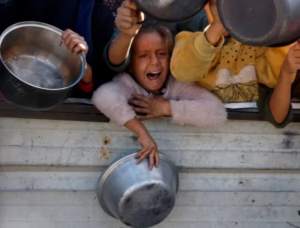
    STARVING CHILDREN OF GAZA
    Palestinians gather to receive food cooked by a charity kitchen, amid a hunger crisis, as the Israel-Gaza conflict continues, in Khan Younis in the southern Gaza Strip, December 4, 2024. REUTERS/Mohammed

    NERMEEN SHAIKH: Israel’s military is continuing to attack civilians across the Gaza Strip, with at least 93 Palestinians killed over the past 24 hours, bringing the total number of deaths in Gaza to 58,000, most of them women and children. This number is believed to be a vast undercount. At least 10,000 are believed to be buried under the rubble. The U.N. estimates approximately 92% of all residential buildings in Gaza, around 436,000 homes, have been damaged or destroyed.

    As the situation continues to deteriorate, an emergency meeting of the Hague Group convened in Bogotá, Colombia, to discuss the conflict. It concluded with the announcement of a series of measures aimed at halting Israel’s attacks on Palestine and ending the, quote, “era of impunity.” The Hague Group came together in January as a bloc of Global South countries committed to coordinating legal and diplomatic measures in defense of international law and solidarity with the Palestinian people. There are now 30 member states. The action steps announced at the conclusion of the summit include banning arms sales to Israel and reviewing ties with companies who profit from the occupation of Palestine. So far, only 12 states have agreed to implement the steps. The summit was co-chaired by South Africa and Colombia. This is Colombia’s President Gustavo Petro.

    PRESIDENT GUSTAVO PETRO: [translated] We need to leave NATO. We need to form an army of light with all the peoples of the world who want to. And we need to tell Europe that if it wants to be with Latin America or Africa, it must stop helping the Nazis. And we need to tell the American people of all colors, because they are now of all colors, to stop helping the Nazis.

    NERMEEN SHAIKH: The Hague Group’s joint statement affirms the commitment to, quote, “Comply with our obligations to ensure accountability for the most serious crimes under international law through robust, impartial and independent investigations and prosecutions at national or international levels, in compliance with our obligation to ensure justice for all victims and the prevention of future crimes,” end-quote.

    AMY GOODMAN: Well, there’s perhaps no greater crime than genocide. Our next guest, Omer Bartov, is professor of Holocaust and genocide studies at Brown University. He is an Israeli American scholar who’s been described [by] the U.S. Holocaust Memorial Museum as one of the world’s leading specialists on the subject of genocide. And he’s just written an op-ed for The New York Times headlined “I’m a Genocide Scholar. I Know It When I See It.” Professor Bartov joins us from Cambridge, Massachusetts.

    Well, why don’t you, Professor Bartov — and thanks for joining us again — lay out your case?

    OMER BARTOV: Well, thanks for having me again.

    The case that I made in the article and that I’ve been making for a while is that at the beginning, immediately after October 7th, the Hamas attack on October 7th, Israeli political and military leaders made a series of pronouncements which could be interpreted as calling for genocide. But there was still no — at that point, there was no evidence that this was being implemented.

    Over time, and I would say by May of 2024, it became apparent that these statements were not only made in the heat of the moment following the massacre by Hamas, but were actually being implemented in a manner that would make it impossible for people to live in Gaza, make the entire Gaza Strip uninhabitable and make life there impossible, as well as destroy all the institutions that would be there for that group to reconstitute itself as a social, cultural, political group once the violence was over. Of course, it’s not over yet. I started thinking that in May. In August that year, I wrote an article that explained that.

    But the violence has only continued, and the attempt, as you just reported, to destroy Gaza entirely has continued since. And it is now clear that Israel is trying to concentrate the population of Gaza in the southernmost parts of the strip, to enclose them and to enforce, eventually, either that they would just die out there or that they would be removed from the Gaza Strip altogether.

    NERMEEN SHAIKH: And, I mean, obviously, the points that you’ve made, Professor Omer Bartov, makes it completely indisputable, the argument that you make in the piece, indeed, that there is a genocide ongoing and that that is the long-term plan of Israel. You point out in the piece, though, that genocide scholars are often hesitant about applying the term “genocide” to contemporary events, in part because, as you write, quote, “it often serves more to express outrage than to identify a particular crime.” Of course, there are people who believe that that’s the case even today with respect to Gaza. If you could respond to that?

    OMER BARTOV: Correct. So, this is one reason that I did not come out right after October 7th and say, “Well, Israel is about to commit genocide,” because, despite those statements, one had to observe and see what was actually happening on the ground. And yes, it is true that the term “genocide” has been used more as an expression of outrage when seeing massacres, mass killings, but that does not necessarily mean that what you’re watching is genocide. “Genocide” is well defined in a U.N. convention from 1948. And under international law, only events that can — that conform to the definition can be seen as genocide. And that means that you have to show both that there is an intent to destroy a particular group, in whole or in part, as such, and that that intent is being implemented. And that, obviously and unfortunately, takes time to adjudicate.

    I think that the term, while problematic, is very important, because it does identify a very particular crime. It talks about the attempt to destroy not simply people in large numbers, but to destroy them as members of a group. The intent is to destroy the group itself. And it doesn’t mean that you have to kill everyone. It means that the group will be destroyed and that it will not be able to reconstitute itself as a group. And to my mind, this is precisely what Israel is trying to do. And many of its spokespersons, to this day, keep reiterating that, to the extent that it’s somewhat bizarre that so much of the rest of the world is not taking them seriously.

    NERMEEN SHAIKH: Professor Bartov, could you also talk about — I mean, you are an Israeli American scholar and are in touch with people in Israel. How do you see perceptions of Israel’s ongoing assault on Gaza changing within Israel? And where are people getting their information there? There’s been talk of basically self-censorship of the mainstream media, but, of course, so many of these images and information are circulating not in the mainstream press, but on social media.

    OMER BARTOV: So, look, I should say first I am — I was born and raised in Israel. I spent the first half of my life in Israel. I served in the Israeli military. And for me, to see what is happening is personally, not only just as a mere human being, but also as an Israeli, heartbreaking.

    What I see in the Israeli public is an extraordinary indifference by large parts of the public to what Israel is doing and what it’s done in the name of Israeli citizens in Gaza. In part, it has to do with the fact that the Israeli media has decided not to report on the horrors that the IDF is perpetrating in Gaza. You simply will not see it on Israeli television. If some pictures happen to come in, they are presented only as material that might be used by foreign propaganda against Israel. Now, Israeli citizens can, of course, use other media resources. We can all do that. But most of them prefer not to. And I would say that while about 30% of the population in Israel is completely in favor of what is happening, and, in fact, is egging the government and the army on, I think the vast majority of the population simply does not want to know about it. And that goes back both to the inability to see anything on their own TVs and, in response to October 7th, a sense that after that — and that’s a widespread sense in Israel — after that, there is no way of finding any solution with the Palestinians, and the only way to deal with that issue is to eradicate it.

    AMY GOODMAN: Professor Bartov, can you talk about the genocide scholars across the world who have come to the same conclusion?

    OMER BARTOV: Yes. So, as I wrote in the op-ed, over time, many genocide scholars who are — and legal experts, experts in international law, who, like me, have been very cautious about applying this term, have gradually come to the conclusion that what we’re watching is genocide. And that’s important, in the sense that there is now, I think, a growing consensus over that view.

    As I wrote in the piece, unfortunately, scholars and institutions dedicated to researching and commemorating the Holocaust have generally, with few very courageous exceptions, have generally refused to say anything, to express themselves in any way, about what is happening in Gaza. And to my mind, by doing that, they, first of all, betrayed the very idea of “never again,” because “never again” was never about “never again the Holocaust,” it was “never again genocide and such other crimes against humanity.” So, there’s now a rift between genocide scholars, who have generally come to agree on Gaza being an Israeli genocidal operation, and Holocaust scholars and institutions that have remained mum.

    AMY GOODMAN: Can you talk about how the term “genocide” came into use? Can you talk about the Polish lawyer Raphael Lemkin?

    OMER BARTOV: Yeah, so, Raphael Lemkin was a Polish Jewish lawyer who, already in the 1930s, was trying to find some kind of terminology that would describe and legally define that particular crime of trying to destroy a group. And the example that he had at the time was the genocide of the Armenians during World War I by the Ottoman Empire. During World War II, he had to escape Poland as a Jew. Most of his family was murdered. He ended up in the United States. And in 1944, he published a book in which he defined what he understood as the crime of genocide, a term that he coined, which is a combination of Greek and Latin, meaning killing a group or an ethnic group. And he struggled for a few more years to have the U.N., the United Nations, just established in 1945, to recognize that crime, and he succeeded in doing so in 1948.

    NERMEEN SHAIKH: Professor Bartov, I want to ask you about a question, indeed, that you ask in your piece, which is, quote, “How will Israel’s future be affected by the inevitable demolition of its incontestable morality, derived from its birth in the ashes of the Holocaust?” What’s the answer to that question?

    OMER BARTOV: Look, I mean, this is beside the horrific killing of human beings in Gaza. And I should just say, because you mentioned the distribution points of food, that between late May, when this so-called humanitarian group started distributing food, and today, more Palestinian civilians have been killed at these distribution groups than Israeli civilians were killed in the Hamas attack.

    Now, what is the — what does all this mean for Israel? As I suggested in the piece, first of all, I think Israel will no longer be able to draw on the credit, if you like, of having been the state that was created after the Holocaust as an answer to the Holocaust. It will no longer be able to say, “We can do whatever we like, because we were a nation subjected to genocide.” You cannot continue to use this argument following the mass killing of another group.

    I hope — and I write that, too — I hope that future generations of Israelis, who will not be clean of that stain — that stain will remain — but will at least be liberated from this shadow of the Holocaust and will start to look at reality as it is, and start to think of how can they reconstitute their own nation, not as a response to the genocide against the Jews, as a response to the Holocaust, but rather as a nation that knows how to share this land, where 7 million Jews and 7 million Palestinians live side by side between the Jordan and the sea, to share it with them with equality and dignity, and not with the use of bombs and violence.

    AMY GOODMAN: Can you talk about this plan to make, build a so-called humanitarian city — the defense minister, Israel Katz, has proposed this idea — on the rubble of Rafah, and the opposition of two former prime ministers? You have Ehud Olmert, you have Yair Lapid. They’re saying if there is no exit, this is a concentration camp. The significance of these men saying this?

    OMER BARTOV: Well, I think it’s very important that Lapid, who’s been sort of on all parts of this debate, said something and that Olmert spoke out, although Olmert no longer has any political power in Israel.

    The plan itself, again, using the typical euphemisms that are used by organizations and states that carry out such crimes, calling that a humanitarian city, which would be a vast concentration camp, a sort of combination of ghetto and concentration camp, that would be built, as you said, on the ruins of Rafah — Rafah has been completely destroyed, there’s nothing there — build a tent city on top of it, bring in initially 600,000 people, who would be brought back from the Mawasi area, from the beach area, to which they were displaced when the IDF went in to destroy Rafah, enclose them there. The plan does not say that Israel would supply them with any humanitarian assistance in the camp, but some other international organizations yet to be determined. But they would not be able to leave unless they leave the Gaza Strip altogether. So, this is — and in continuation to that, the rest of the population is supposed to then join this camp, with a goal of removing them. So, this is extraordinary. The state of Israel publicly is speaking about the creation of a vast concentration camp whose goal is removal of the population to countries that have unanimously said they are not going to take them in.

    NERMEEN SHAIKH: Well, Professor Bartov, I want to ask about the U.S.’s position on this, of course, their continuing support for Israel, which has enabled the assault to continue. I want to go back to the former president, Biden, his administration, the State Department spokesperson at the time, Matt Miller, who admitted earlier this year, in May, that he believes Israel committed war crimes in Gaza. This reversal came after more than a year, as the face of the Biden administration’s foreign policy, repeatedly defending Israel against allegations of war crimes and genocide. This was Miller speaking earlier this year — last year.

    MATTHEW MILLER: We have been very clear that we want to see Israel do everything it can to minimize civilian casualties. We have made clear that they need to do every — that they need to operate at all times in full compliance with international humanitarian law. At the same time, we are committed to Israel’s right to self-defense.

    NERMEEN SHAIKH: But during an interview with Sky News last month, in June, Matt Miller says he believes Israel has committed war crimes in Gaza and that Israeli soldiers are not being held accountable.

    MATTHEW MILLER: I don’t think it’s a genocide, but I think the — I think it is, without a doubt, true that Israel has committed war crimes.

    MARK STONE: You wouldn’t have said that at the podium.

    MATTHEW MILLER: Yeah, look, because I — I mean, when you’re at the podium, you’re not expressing your personal opinion. You’re expressing the conclusions of the United States government.

    NERMEEN SHAIKH: So, Professor Bartov, your response to that, and also your perception of how the Trump administration has both broken with and continued Biden’s policies on Gaza?

    OMER BARTOV: Well, you know, in November 2023, I published an op-ed in The New York Times in which I said that war crimes and crimes against humanity were clearly happening in Gaza, and that if this continued, it would become a genocidal operation. I was hoping at the time that someone in the administration would actually pay attention, because the United States, in November or December 2023, could have stopped all of this. It was not very difficult to do. Israel cannot act as it has without constant supply of arms from the United States and Germany — these are the two major suppliers; the U.S. supplies between 70 and 80% of all munitions to Israel — and without diplomatic cover — Israel has a diplomatic Iron Dome created by the U.S. veto in the Security Council. That did not happen. And, of course, the evidence was there. And so, first of all, one has to say that the Biden administration is complicit in what happened in Gaza.

    Secondly, when Trump came in, curiously, the first thing that happened, the day before he came into office, was that he forced a ceasefire on Israel. And that ceasefire, in January this year, made it possible to exchange Palestinian prisoners for a large number of hostages, but not all of them. The plan was to complete that exchange and to stop the fighting. But in March, Israel unilaterally broke that ceasefire without any interference from the United States, and, since then, has continued. And what is particularly galling is the fact that when Trump floated his plan, if you recall that, that the population of Gaza would be removed, and then Gaza would be made into a beautiful resort area, he later on didn’t really repeat that. But in Israel, that was seen as license to do exactly what is being done now — that is, using hundreds of bulldozers, engineers, explosives to systematically destroy every building in Gaza so that nobody would be able to live in, in that area, and then, well, maybe turn it into a resort area, more likely be an area for Jewish settlers.

    AMY GOODMAN: I wanted to name names here, that you do in your piece. “In November, a little more than a year into the war, the Israeli genocide scholar Shmuel Lederman joined the growing chorus of opinion that Israel was engaged in genocidal actions. The Canadian international lawyer William Schabas came to the same conclusion … and has recently described Israel’s military campaign in Gaza as ‘absolutely’ a genocide.

    “Other genocide experts, [like] Melanie O’Brien, president of the International Association of Genocide Scholars, and the British specialist Martin Shaw (who has also said … the Hamas attack was genocidal), have reached the same [conclusion], while the Australian scholar A. Dirk Moses [of] the City University of New York described these events in the Dutch publication NRC as a ‘mix of genocidal and military logic.’ In the same article, Uğur Ümit Üngör, a professor at the Amsterdam-based NIOD Institute for War, Holocaust and Genocide Studies, said there are probably scholars who still do not think it’s genocide, but ‘I don’t know them.’”

    Professor Bartov, as we begin to wrap up, can you talk about this consensus and whether Holocaust museums, which often address a number of holocausts, will be taking on what Israel has done in Gaza?

    OMER BARTOV: Well, so, as I said before, I think there is a growing consensus among genocide scholars and legal experts. William Schabas is a very good example, because he’s a highly respected expert. He’s very conservative. He took a long time to reach that conclusion. And he has. I just spoke with him recently in Europe, and he very strongly believes that what Israel is doing now is genocide.

    But the other side of it, as you indicate, is the tragedy that most Holocaust scholars and all of the institutions that I know that are dedicated to commemorating and researching the Holocaust have refused to say anything. And some, again, a minority of Holocaust scholars, have come out and claimed that genocide scholars speaking about genocide in Gaza are antisemitic, that this is an antisemitic argument. And that use of the term “antisemitism,” which, as you know, of course, and we spoke about, was also a tool to silence any protest last spring on American campuses, this abuse of the term is now creating a rift between Holocaust scholars and genocide scholars.

    And what I fear — and that’s what I write at the end of this piece — what I fear is that this will mean that the Holocaust, which had come, over decades, to be recognized as an event of universal importance, as an event that we have to learn from, because of the silence, because of the betrayal of the notion of “never again” by these institutions and these scholars, will go back to become a sort of ethnic enclave, only something that the Jews talk about among themselves.

    AMY GOODMAN: Omer Bartov, we want to thank you for being with us, professor of Holocaust and genocide studies at Brown University and an Israeli American scholar, described by the U.S. Holocaust Memorial Museum as one of the world’s leading specialists in the subject of genocide. His forthcoming book, Israel: What Went Wrong? His previous books, Genocide, the Holocaust and Israel-Palestine. We’ll link to your piece in The New York Times, “I’m a Genocide Scholar. I Know It When I See It.”

    The original content of this program is licensed under a Creative Commons Attribution-Noncommercial-No Derivative Works 3.0 United States License. Please attribute legal copies of this work to democracynow.org. Some of the work(s) that this program incorporates, however, may be separately licensed. For further information or additional permissions, contact us.


  • Glenn Greenwald: Palantir EXPOSED;  DN! “Purge Palantir”

    Glenn Greenwald: Palantir EXPOSED; DN! “Purge Palantir”

    “Everyone is converting to Palantir…”


    Palantir EXPOSED: The New Deep State

    By Glenn Greenwald / System Update / June 10, 2025

    This is a clip from the show SYSTEM UPDATE, now airing every weeknight at 7pm ET on Rumble. You can watch the full episode for FREE here: https://rumble.com/v6ujj1n-system-upd…


    Democracy Now! “Purge Palantir”: Day of Action Protests Firm’s Role in Gov’t Surveillance, ICE & Genocide in Gaza

    Protesters across the United States targeted Palantir Monday [7/14/25] in a day of action focused on the technology company’s work with ICE, facilitating President Trump’s expanding immigration crackdown, and work with the Israeli military. New York police arrested at least four people Monday after demonstrators blocked the entrance to the company’s Manhattan offices. Democracy Now! spoke to protesters, including some who work in the technology sector, about the “Purge Palantir” campaign and how Palantir’s data mining, surveillance and automation tools are being weaponized against vulnerable communities. We speak with Wired senior writer Makena Kelly, who has been covering Palantir and says many Silicon Valley firms are “trying to find opportunity in this chaos” as the Trump administration slashes government services and pursues mass deportations.

    Guests
    Makena Kelly
    Wired Senior Writer focused on the intersection of politics, power and technology.

    Links
    “This is DOGE 2.0”

    Please check back to Democracy now later for full transcript.

    The original content of this program is licensed under a Creative Commons Attribution-Noncommercial-No Derivative Works 3.0 United States License. Please attribute legal copies of this work to democracynow.org. Some of the work(s) that this program incorporates, however, may be separately licensed. For further information or additional permissions, contact us.

    More on Glenn Greenwald’s System Update:
    Now available as a podcast! Find full episodes here: https://linktr.ee/systemupdate_
    Join us LIVE on Rumble, weeknights at7pm ET: https://rumble.com/c/GGreenwald
    Become part of our Locals community:
    https://greenwald.locals.com/
    Follow Glenn: Twitter:   / ggreenwald  
    Instagram:
      / glenn.11.greenwald  
    Follow System Update:
    Twitter:
      / systemupdate_  
    Instagram:   / systemupdate__  
    TikTok:
      / systemupdate__  
    Facebook:
      / systemupdate.tv  
    LinkedIn:
      / systemupdate


    In this critical time in our country hearing the voices of truth is all the more important although censorship and attacks on truth-tellers is common. Support the WingsofChange.me website and Rise Up Times on social media. striving to bring you important articles and journalism beyond the mainstream corporate media. Access is alway free, but if you would like to help:
    Wings of Change FeatherA donation of $25 or whatever you can donate will bring you articles and opinions from independent websites, writers, and journalists as well as a blog with the opinions and creative contributions by myself and others

    Sue Ann Martinson, Writer, Editor Wings of Change

  • Democracy Now! interviews Francesca Albanese on the “Economy of Genocide”

    Democracy Now! interviews Francesca Albanese on the “Economy of Genocide”

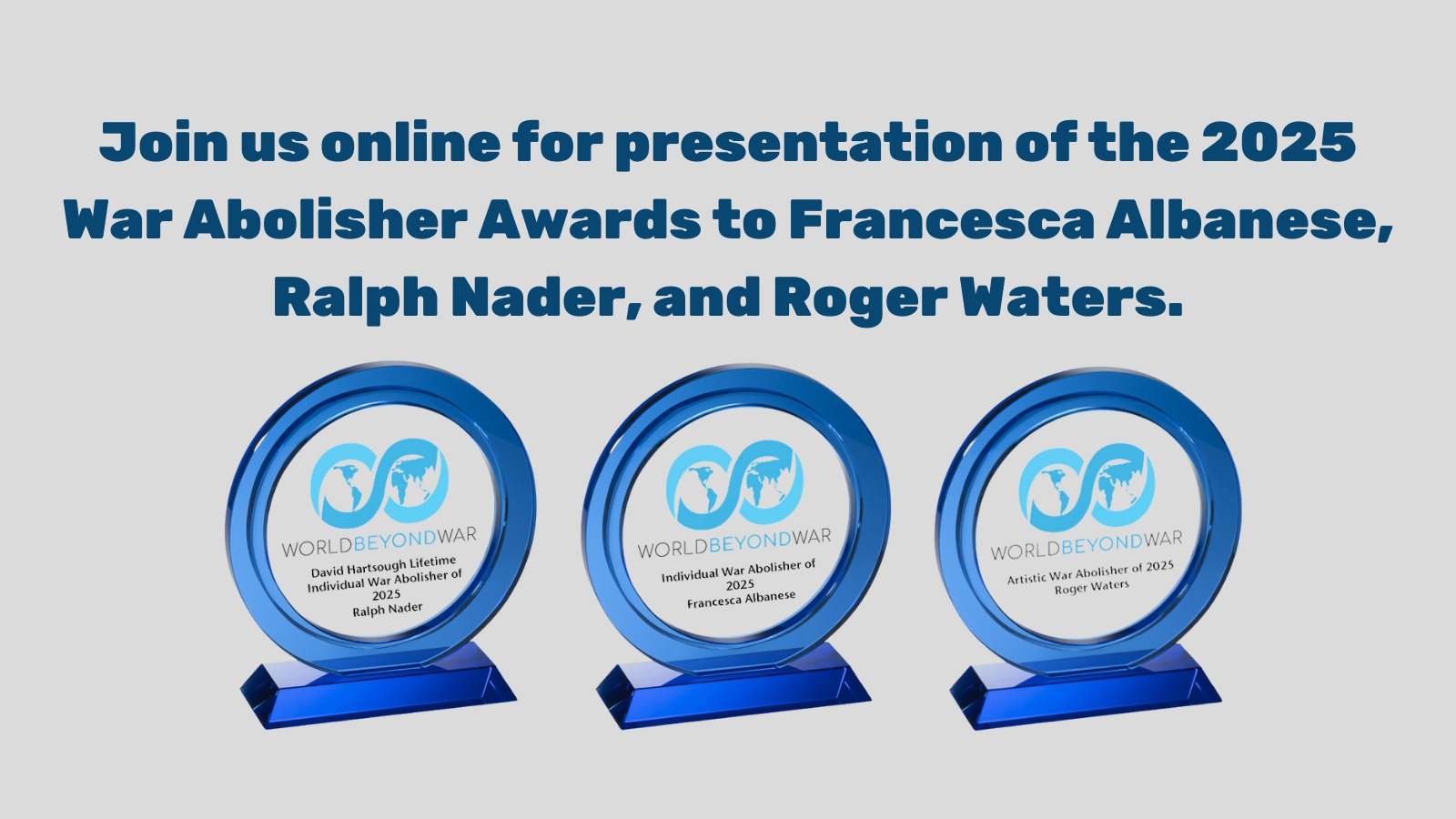
    The Individual War Abolisher of 2025 award by World Beyond War goes to Francesca Albanese, the United Nations Special Rapporteur on the Palestinian territories occupied since 1967, for her fearless, incisive, and eloquent reporting on the genocide in Gaza.

    RELATED

    Glenn Greenwald interviews Francesca Albanese.

    Information about Francesa and the 2025 War Abolisher Awards from World Beyond War.


    Please join World Beyond War for the presentation of the 2025 War Abolisher Awards to Ralph Nader, Roger Waters, and Francesca Albanese.

    The event is free and open to the public.

    War Abolisher Awards 2025

    The event begins on July 24, 2025, at 18:30 UTC, which is 6:30 a.m. in Auckland, 8:30 a.m. in Honolulu, 11:30 a.m. in Los Angeles, 12:30 p.m. in Mexico City, 2:30 p.m. in New York, 7:30 p.m. in Yaoundé, 8:30 p.m. in Berlin, and 10 p.m. in Tehran.

    World BEYOND War’s Fifth Annual War Abolisher Awards will recognize the work of individuals who directly support one or more of the three segments of World BEYOND War’s strategy for reducing and eliminating war as outlined in the book A Global Security System, An Alternative to War. They are: Demilitarizing Security, Managing Conflict Without Violence, and Building a Culture of Peace.

    The awardees for 2025 are Ralph Nader, Roger Waters, and Francesca Albanese.

    The Artistic War Abolisher of 2025 award goes to Roger Waters for his incredibly powerful combination of song-writing, singing, speaking, and performing against the horrors of war. During the event, we will play a new 8-minute song pre-recorded by Roger Waters called Sumud.

    The David Hartsough Lifetime Individual War Abolisher of 2025 award — named for the late co-founder of World BEYOND War — goes to Ralph Nader for his brilliant and relentless advocacy, educating, organizing, analyzing, and criticizing war and related crimes and abuses.

    The Individual War Abolisher of 2025 award goes to Francesca Albanese, the United Nations Special Rapporteur on the Palestinian territories occupied since 1967, for her fearless, incisive, and eloquent reporting on the genocide in Gaza.

    Register for the award event July 24th:
    https://worldbeyondwar.org/war-abolisher-awards/?clear_id=true


    In this critical time in our country hearing the voices of truth is all the more important although censorship and attacks on truth-tellers is common. Support the WingsofChange.me website and Rise Up Times on social media. striving to bring you important articles and journalism beyond the mainstream corporate media. Access is alway free, but if you would like to help:
    Wings of Change FeatherA donation of $25 or whatever you can donate will bring you articles and opinions from independent websites, writers, and journalists as well as a blog with the opinions and creative contributions by myself and others

    Sue Ann Martinson, Writer, Editor Wings of Change

  • Time to Unmask Trump’s Detention and Deportation Squads

    Time to Unmask Trump’s Detention and Deportation Squads

    It is past time to unmask the violent agents targeting people like Narciso, and halt Trump’s racist, xenophobic mass detentions and deportations.

    Time to Unmask Trump’s Detention and Deportation Squads

    By Amy Goodman & Denis Moynihan/ Democracy Now / Column / June 26, 2025 

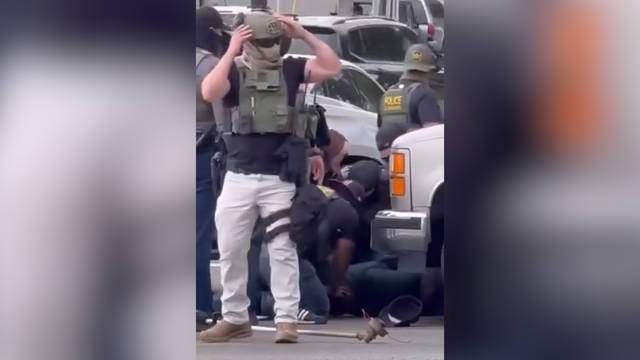
    With each passing day, the violence wielded by ICE, U.S. Immigration and Customs Enforcement, grows more intense and widespread. One grotesquely emblematic example of this was the recent violent arrest of 48-year-old Narciso Barranco in Santa Ana, California. Narciso, a hardworking immigrant laborer who came from Mexico over thirty years ago, is the father of three US Marines. While landscaping outside an IHOP restaurant on June 21st, he was assaulted by at least seven armed, masked men, who tackled him and repeatedly punched him in the head. They handcuffed him and shoved him into an unmarked SUV. The plainclothes agents wore face masks, bullet-proof vests and military-grade helmets. Some of the vests read, “Police–US Border Patrol” on the back, but to anyone confronted by these gangs, no identifying marks, names, or badges were visible.

    Image Credit: Instagram/@santaanaproblems

    One of Narciso’s sons, Alejandro Barranco, a US Marine Corps veteran, was able to visit his father in jail. Narciso was still wearing the same work clothes that were bloodied in the assault.

    “He looked beat up, he looked rough, he looked defeated, he was sad,” Alejandro said on the Democracy Now! news hour. “Anybody would be scared if they see these guys come up to them, masked, not in uniform, guns out.”

    City of Santa Ana councilmember Jonathan Hernandez, also on Democracy Now!, added, “We are watching violence unfold, racial profiling increase in cities like Santa Ana, where 41% of our residents are migrants, 70% are of Latino descent…agents come into our community, and they’re refusing to identify themselves, they don’t have judicial warrants and these ICE raids are an example of the government’s overreach.”

    In mid-June, President Trump briefly paused immigration raids on farms, hotels and restaurants, ostensibly to ensure these key industries that have supported him in the past continue to do so. “Our great Farmers and people in the Hotel and Leisure business have been stating that our very aggressive policy on immigration is taking very good, long time workers away from them, with those jobs being almost impossible to replace,” Trump wrote.

    Soon after, he reversed himself. The short pause revealed a fundamental truth about undocumented immigrants: the US economy doesn’t function without them. Nevertheless, urged on by White House Deputy Chief of Staff Stephen Miller, ICE, Homeland Security and Border agents are snatching and deporting the very workers on whom our economy depends.

    There are some sectors of the economy that are thriving amidst the mass deportations. GEO Group, the private prison corporation, has seen its stock rise by over 50% since Trump’s election. Palantir, the tech and AI firm co-founded by Trump backer, billionaire Peter Thiel, has seen its stock rise over 500% in the past year. It was recently reported that Palantir is building tools to allow near real-time tracking of immigrants in the US. The Program on Government Oversight, POGO, reported that Stephen Miller’s financial disclosure reveals he owns up to $250,000 in Palantir stock.

    Meanwhile, the Republican majority on the US Supreme Court has handed Trump a deportation-related victory. Several immigrants sued the government to stop or reverse deportations to Guatemala, South Sudan and Libya. A federal judge in Massachusetts issued an injunction against these so-called “third party nation removals.” This week, the Supreme Court’s six conservative justices overturned that injunction, without comment. Justices Sonia Sotomayor, Elena Kagan and Ketanji Brown Jackson dissented, writing that the Trump administration’s “flagrantly unlawful conduct,” backed by the Supreme Court, is “exposing thousands to the risk of torture or death.”

    Resistance is active, growing and making a difference. Grassroots pressure and legal battles have won the release of international students targeted for their solidarity with Palestinians, among them Rümeysa Öztürk, Mohsen Mahdawi, and the first such student arrested and threatened with deportation, Mahmoud Khalil.

    Likewise, grassroots, legal and Congressional pressure forced the Trump administration to bring Kilmar Abrego Garcia back to the United States. The Maryland father received asylum during Trump’s first term, in 2019, based on credible threats from an El Salvador gang. Then, this past March 12th, he was snatched from a parking lot and sent, against a court order, to El Salvador.

    Under enormous legal and grassroots pressure, the federal government finally returned Abrego Garcia to the US. Despite that victory, upon his return the federal government promptly rearrested him, charging him with human trafficking for allegedly driving undocumented immigrants several years ago. He remains in federal custody in Tennessee, and, if released, ICE will likely attempt to deport him.

    Meanwhile, Narciso Barranco sits in ICE detention, with his two sons still on active duty in the US Marines not far away, at Fort Pendleton. It is past time to unmask the violent agents targeting people like Narciso, and halt Trump’s racist, xenophobic mass detentions and deportations.

    The original content of this program is licensed under a Creative Commons Attribution-Noncommercial-No Derivative Works 3.0 United States License. Please attribute legal copies of this work to democracynow.org. Some of the work(s) that this program incorporates, however, may be separately licensed. For further information or additional permissions, contact us.