Tag: Democracy Now!

  • DN! “Destroying Knowledge”: Trump Dismantles Vital Climate Research Center, by Michael Mann

    DN! “Destroying Knowledge”: Trump Dismantles Vital Climate Research Center, by Michael Mann

    Trump Dismantles Vital Climate Research Center

    Climate scientists and meteorologists are sounding the alarm after White House budget director Russell Vought announced the Trump administration will break up the National Center for Atmospheric Research in Boulder, Colorado, known as NCAR.

    “He is executing the playbook of Project 2025,” says Michael Mann, scientist and co-author of Science Under Siege. Without NCAR, “we will not have the sorts of observational data and climate models that we need to inform climate policy.”

    Transcript
    This is a rush transcript. Copy may not be in its final form.

    AMY GOODMAN: This is Democracy Now!, democracynow.org. I’m Amy Goodman.

    In Colorado, hundreds of protesters gathered in Boulder Saturday to condemn the Trump administration’s plan to dismantle the National Center for Atmospheric Research – NCAR, a federally funded climate and weather research institute based in Boulder. Last week, White House budget director Russell Vought called NCAR “one of the largest sources of climate alarmism in the country,” unquote.

    Democratic lawmakers have suggested Trump targeted the climate facility in retaliation for Colorado’s refusal to release Tina Peters, a former county clerk convicted of tampering with voting machines during the 2020 presidential election. She was sentenced to nine years. Trump recently pardoned her, but he doesn’t have the legal authority to overturn a state court conviction.

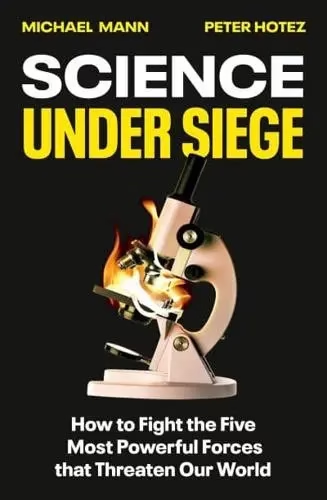
    We’re joined now by climate scientist Michael Mann, professor at the University of Pennsylvania. His new book with Dr. Peter Hotez is titled Science Under Siege. He has a new piece out today in The Guardian on Trump’s shuttering of the National Center for Atmospheric Research.

    Can you talk about the significance, Michael, Professor Mann, of the closing? Are they closing this facility? What it means, I mean, even right now, as Colorado is under a wildfire alert because there has been so little rain and the winds are so intense?

    MICHAEL MANN: Yeah. It’s good to be with you, Amy.

    Unfortunately, this does sort of underscore just how absurd this latest action by the Trump administration is. We’re literally seeing the devastating consequences of climate change play out in this state. You’re not supposed to get wildfires in the middle of the winter in Colorado, but that’s the world we live in now because of the warming of the planet and the more extreme weather that we’re seeing as a result.

    And, you know, I think there are a lot of things that Donald Trump could have tried to do to hurt the state of Colorado. I think the reason that he chose NCAR is that it is the crown jewel of climate science. For more than a half-century, it has been a leader when it comes to American advancement in the science of climate modeling. And he is executing the playbook of Project 2025, the Heritage Foundation, of course, playing a major part in this dismantling of climate infrastructure, the infrastructure for doing climate science, the infrastructure for doing something about the climate crisis. So, it isn’t a coincidence that he’s going after this, you know, iconic climate institution.

    AMY GOODMAN: So, talk about, overall, the Trump administration now when it comes to climate change. And what does it mean to take NCAR basically offline? And what happens to this facility in Boulder right now?

    MICHAEL MANN: Yeah, it’s unclear at this point. And this will play out in the courts, almost certainly, so we don’t know the full consequences of this yet. But the models that NCAR creates are used around the world. They’re among the leading models of Earth’s climate system. I have benefited tremendously in my own research from the work that NCAR does when it comes to climate modeling, when it comes to observational climate data sets that allow us to document the changes that are taking place. So this will hurt climate science, certainly, writ large.

    But it will also ensure that the United States fall to the back of the line, essentially. We used to lead in all areas of science, and certainly in climate science. And now what we’re — you know, these sorts of actions are going to mean that the rest of the world moves ahead of us. Scientists are going to leave the United States for opportunities in other countries. And we are going to, essentially, fall behind in terms of our scientific leadership and our scientific stature in the world.

    But the actual practical consequences are that we will not have the sorts of observational data and climate models that we need to inform climate policy, to, you know, help us understand what sorts of adaptive measures will need to be changed to protect people from the devastating consequences of climate change as it continues on.

    AMY GOODMAN: The Trump administration recently denied Colorado Governor Jared Polis’s disaster declaration request for major wildfires and flooding across Colorado. The Boulder area experienced hurricane-force winds of nearly 100 miles per hour over the weekend and increased fire danger, prompting NCAR to close for safety reasons. The significance of this?

    MICHAEL MANN: Yeah, I mean, it’s ironic, isn’t it? Not only are they trying, is Trump and, you know, the Koch brothers and the other sort of plutocrats behind these actions — not only are they trying to dismantle climate science, they’re trying to dismantle our ability to protect people from the devastating consequences of climate change. So, it’s cruel. It is — you know, it’s going to cost lives. I mean, these actions are — you know, it may be a little bit more subtle than the lives cost because of their anti-science actions when it comes to vaccines and COVID-19 and protecting — you know, protecting public health in that arena, but millions of people ultimately will die from the consequences of extreme weather events, coastal inundation, all of these impacts that are made worse by the, you know, warming of the planet, that’s due to the burning of fossil fuels, the burning of fossil fuels by the very companies and plutocrats and petrostates that are behind the policies of this administration.

    AMY GOODMAN: [You] said, “Not since the ransacking of the Library of Alexandria have we witnessed such a wanton, intentional assault on scientific knowledge.” We have 30 seconds, Professor Mann.

    MICHAEL MANN: Yeah, it’s a line from my commentary. And, you know, there’s some question as to the veracity of that story, but I think it captures sort of the insanity of what we’re doing. We’re literally destroying knowledge. And we have to look back to ancient times to see eras similar, you know, when barbarians tried to destroy knowledge. That’s what this administration is doing. They’re trying to destroy knowledge.

    AMY GOODMAN: Michael Mann, professor at the University of Pennsylvania, co-author of the book Science Under Siege with Dr. Peter Hotez. We will link to your new piece, out today in The Guardian.

    The original content of this program is licensed under a Creative Commons Attribution-Noncommercial-No Derivative Works 3.0 United States License. Please attribute legal copies of this work to democracynow.org. Some of the work(s) that this program incorporates, however, may be separately licensed. For further information or additional permissions, contact us.


    Just Transition”: Polluting Countries Must Take Responsibility for Extreme Climate Change


    Wings of Change is entirely reader supported.
    Wings invites you to subscribe.
    Join us on Wings of Change

    In this critical time hearing the voices of truth is all the more important although censorship and attacks on truth-tellers are common. Support WingsofChange.me as we bring you important articles and journalism beyond the mainstream corporate media on the Wings of Change website and Rise Up Times on social media  Access is alway free, but if you would like to help:
    A donation of $25 or whatever you can donate will bring you articles and opinions from independent websites, writers, and journalists as well as a blog with the opinions and creative contributions by myself and others

    Sue Ann Martinson, Editor Wings of Change

  • Highlights from Caitlin Johnstone and Democracy Now!

    Highlights from Caitlin Johnstone and Democracy Now!

    The most common misconception about the free press of the western world is that it exists.

    By Caitlin Johnstone, December 1, 2025

    Every fu**ing time. The mass media do this every fu**ing time the US empire gets war-horny. And the Murdoch press are always the most egregious offenders.

    Reminds me of an old tweet by a man named Malcolm Price:

    “I remember in the run-up to the Iraq War a friend I had known all my life suddenly said to me, ‘We must do something about this monster in Iraq.’ I said, ‘When did you first think that?’ He answered honestly, ‘A month ago’.”

    Price’s friend had been swept up in the imperial war propaganda campaign that had recently begun, just like countless millions of others. Month after month after month western consciousness was hammered with false narratives about weapons of mass destruction, forced associations of Saddam Hussein with 9/11, and stories about how much better things will be for the people of Iraq once that evil tyrant is gone.

    Normally it never would have occurred to the average westerner that a country on the other side of the planet should be invaded and its leader replaced with a puppet regime. That’s not the sort of thing that would have organically entered someone’s mind. It needed to be placed there.

    So it was.

    The most common misconception about the free press of the western world is that it exists. All the west’s most influential and far-reaching news media publications are here not to report factual stories about current events, but to manufacture consent for the pre-existing agendas of the US-centralized western empire.

    They report many true things, to be sure, and if you acquire some media literacy you can actually learn how to glean a lot of useful information from the imperial press without losing your mind to the spin machine. But reporting true things is not their purpose. Their purpose is to manipulate public psychology at mass scale for the benefit of the empire they serve.

    This doesn’t happen through some kind of centralized Ministry of Truth where sinister social engineers secretly conspire to deceive people. It happens because all mainstream press is controlled either by plutocrats or by western governments in the form of state broadcasters like the BBC, both of which have a vested interest in maintaining the imperial status quo. They control who the executives and lead editors of these outlets are, and those leaders shape the hiring and editing processes of the publication or broadcaster. Reporters come to understand that there are certain lines they need to color within if they want to get articles published and continue advancing their careers, so they either learn to toe the imperial line or they disappear from the mass media industry.

    If people had a clear understanding of everything that’s really going on in our world, they would tear the empire apart brick by brick. If they could truly see how much evil is being done in their name and really wrap their minds around it, and if they could understand how much wealth the plutocrats are getting out of the imperial status quo compared to how little they themselves benefit from it, there would be immediate revolution. So the oligarchs and empire managers shore up narrative control in the form of media ownership, think tanks, Silicon Valley algorithm manipulation, imperial information ops like Wikipedia, and now increasingly through billionaire-owned AI chatbots to ensure that this never happens.

    The entire empire is built on a foundation of lies. The whole power structure is held together by nonstop manipulation of the way westerners think, speak, act, shop, work, and vote. If truth ever finds a way to get a word in edgewise, the entire thing would collapse.

    We know this is true because the oligarchs and empire managers pour so much wealth and energy into manipulating our minds. They’re not doing this for fun, they’re doing it because they need to. If they didn’t need to, it wouldn’t be happening.

    So what they are doing is intensely creepy and destructive, but it’s also empowering, because it shows us right where their weak spot is. They’re pouring all this energy into controlling the dominant narrative because that’s the weakest point in the armor of the imperial machine.

    What we need, then, is a grassroots effort to help truth get a word in. Help people understand that they’ve been propagandized and deceived about the world by western media and by their power-serving education systems every day of their lives, because propaganda only works if you don’t know it’s happening to you. Sow distrust in the imperial media and institutions. Open people’s eyes to the fact that they’re being lied to, and help them learn to see the truth. Anywhere the empire is sowing lies and distortions — whether that’s in Venezuela or Gaza or somewhere else — use that opportunity to help more people unplug their minds from the propaganda matrix.

    A better world is possible. The first step in moving toward it is snapping people out of the propaganda-induced coma which dupes them into settling for this dystopian nightmare instead.

    DEMOCRACY NOW! December 3, 2025

    Today’s DN! Updates the ceasefire in Gaza that isn’t as Israel continues its deadly genocide, explaining about the attacks by groups of Israeli’s who are then just observed or are joined by Israeli military. These raids in the West Bank and Gazans are often by Israeli settlers who stole their homes and olive groves in thr first place. They also cover the exiting of Gazans from Palestine and whether or not they have the right to­­ return.

    Amy and Juan then interview Ralph Nader who has been a watchdog of the Democratic Party and of Congress for 60-odd years. To cut to the chase he recommends Impeachment as the most effective way to render Trump’s dictatorship, which is blatantly unconstitutional as seen in so   many of his actions.  Another of Nader’s points is that America is not as divided on the issues as it seems. The consistent “blame the Democrats” knee-jerk reaction of Trump is designed to divide the American people because to divide them serves his propagandized platform and also a greedy mainstream corporate media they loves all conflict.

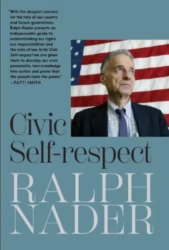
    Nader discusses his new book Civic Self-Respect and then stays around to comment on the next segment about a new film that documents the WTO demonstrations in Seattle in 1999. This was a nonviolent demonstration of at least 40,000 people from around the county. Larry Weiss, representing local labor groups, called a meeting (I was there) explaining the demonstration against corporate power and recruiting people to attend. And a contingency of Minnesotans did go to Seattle.

    Another segment focused on Minneapolis/St. Paul and the attack by racist bully Trump on sending ICE against the large Somali population. Most of the Somali’s are here legally. Besides being small business and shop owners, many of the men are truck and taxi drivers. They are contributing to the economy. I see them often in various places, both men and women. I seriously question Trump’s statement that 88% are on welfare. We know he lies all the time to convince people to follow his cruel and barbarian policies.

    Here the Nader interview:

    For more information view on video (available on YouTube) or listen to the podcast of Dec. 3, 2025 of Democracy Now!


    In this critical time in hearing the voices of truth is all the more important although censorship and attacks on truth-tellers are common. Support WingsofChange.me as we bring you important articles and journalism beyond the mainstream corporate media on the Wings of Change website and Rise Up Times on social media  Access is alway free, but if you would like to help:
    A donation of $25 or whatever you can donate will bring you articles and opinions from independent websites, writers, and journalists as well as a blog with the opinions and creative contributions by myself and others

    Rise Up Times is entirely reader supported.

    Sue Ann Martinson, Editor Wings of Change

  • DN! COP30 Report: The Amazon Tipping Point, Fossil Fuel Phaseout, Climate-induced Migration

    DN! COP30 Report: The Amazon Tipping Point, Fossil Fuel Phaseout, Climate-induced Migration

    The Race to Save the Amazon: Top Brazilian Scientist Says Rainforest Is at “Tipping Point”

    Amy Goodman interviews scientist Carlos Nobre / Democracy Now! / November 20, 2025

    AMY GOODMAN : As we broadcast from the COP30 climate summit in Belém, Brazil, we are joined by one of Brazil’s most prominent scientists, [Nobel Prize winner] Carlos Nobre, who says the Amazon now produces more carbon emissions than it removes from the atmosphere, moving closer to a “tipping point” after which it will be impossible to save the world’s largest rainforest. “We need urgently to get to zero deforestation in all Brazilian biomes, especially the Amazon,” he argues. (See full transcript below.)


    StoryNov 20, 2025 Democracy Now!

    Brazilian Indigenous Minister Sônia Guajajara on Fossil Fuel Phaseout, Bolsonaro’s Conviction & More

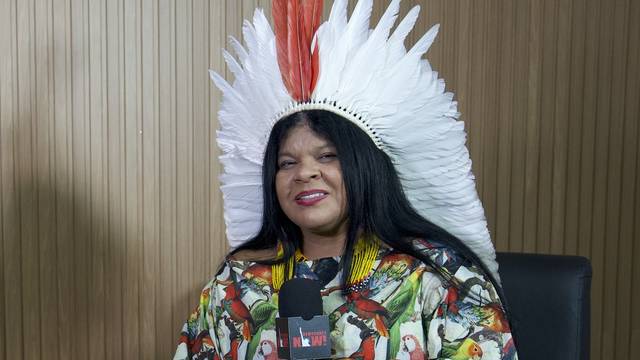
    SÔNIA GUAJAJARA[translated] It’s always a challenge. It’s really — it’s not simple. It’s hard, because there is a dispute, a big one, with the economic sectors, so that these changes do not happen. So we need to make sure that agreements done at COP and commitments done at COP can tackle this, because the world knows the impact that oil exploitation, fossil fuels does, the risk of us achieving the point of no return, but these sectors, the economic sectors, need to understand this is an emergency. So we need to have, like, a clear decision here in this conference to stop depending on fossil fuel.

    _____________________

    StoryNov 20, 2025  Democracy Now!

    Climate Crisis Displaces 250 Million Over a Decade While U.S. & Other Polluting Nations Close Borders

    “This is not abstract,” Nikki Reisch, director of climate and energy at the Center for International Environmental Law, says of climate-induced migration. “This is about real lives. It’s about survival. It’s about human rights and dignity, and, ultimately, about justice.”

    Trump’s Response to COP30

    Trump sends no formal U.S. delegation at COP30: Here is Trump’s response as he is determined to destroy the planet and continues his own version of genocide against the Least Developed Countires (LTC) that are most affected by global warming caused by fossil fuels. Meanwhile 80 nations at COP30 have signed on to plan to phase-out fossil fuels.

    Trump Saudi Arabia© Evan Vucci

    The Trump administration announced on Thursday new oil drilling off the California and Florida coasts for the first time in decades, advancing a project that critics say could harm coastal communities and ecosystems, as President Donald Trump seeks to expand U.S. oil production.

    More than 80 countries at Cop30 join call for roadmap to fossil fuel phaseout

    Countries from Africa, Asia, Latin America, Pacific and Europe plead for transition to be central outcome of talks.

    Transcript
    This is a rush transcript. Copy may not be in its final form.

    AMY GOODMAN: This is Democracy Now!, democracynow.org. We’re broadcasting at the U.N. climate summit, COP30, here in the Brazilian city of Belém, the gateway to the Amazon rainforest. I’m Amy Goodman, with Nermeen Shaikh. As we broadcast, there’s a protest right behind us by the Loss and Damage Youth Coalition, where they are holding a banner that reads, “From opinion to obligation, respond to loss and damage.”

    NERMEEN SHAIKH: We end today’s show with one of Brazil’s most prominent scientists, Dr. Carlos Nobre. He’s a senior researcher at the Institute of Advanced Studies at the University of São Paulo and co-chair of the Scientific Panel for the Amazon. He’s a lead author of the U.N.’s Intergovernmental Panel on Climate Change, or IPCC, that won a Nobel Peace Prize in 2007 for its reports on global warming.

    AMY GOODMAN: For decades, Carlos Nobre has been warning the Amazon rainforest is being pushed beyond the tipping point. The Amazon rainforest is almost as large as the contiguous United States.

    Carlos Nobre, welcome to Democracy Now! It’s an honor to be in your presence. You have been warning for quite some time, and now it’s getting more serious than ever. What is the tipping point? And for a lay audience around the world, explain to us why the biome of the Amazon rainforest is so important for the world.

    CARLOS NOBRE: Good morning. Thank you very much.

    Yes, I’ve been working for 43 years with the Amazon. I was the first scientist, 1990, 1991, publishing a science article saying if we continue with very high deforestation, the Amazon would cross the tipping point. But that was 1990, ’91, 36 years ago. Now the Amazon is very close to the tipping point.

    Why do we say that? Because from the Atlantic to Bolivia, Peru and Colombia, this is 2.5 million square kilometers. The whole forest, close to 7 million square kilometers, but this southern portion, very close to tipping point. The dry season is four to five weeks’ length here — in 45 years, one week per decade. It was three, four months, but with rain during the dry season. Now it’s four to five months, 20, 30% drier, two, three degrees warmer. And also, tree mortality has increased a lot in these areas. In the southeastern Amazon, south of where we are, the forest has become a carbon source. It’s losing more carbon than removing.

    So, if we continue — deforestation is about 18%, degradation 30% — if we reach 20, 25% deforestation, global warming close to two degrees, we cross permanently the tipping point. We are going to lose up to 70% of the Amazon within 30 to 50 years. If we continue with global warming, deforestation, we reach the tipping point by 2040. So, by 27 — 2100, we’re going to lose 70% of the Amazon. We’ll release more than 250 billion tons of carbon dioxide to the atmosphere, making it impossible to maintain the global warming at 1.5 degrees. We are going to lose the highest biodiversity in the planet. So, terrible.

    And also, the Amazon recycles water so well that about 45% of the water vapor that comes from the Atlantic Ocean, transported by the trade winds, goes to the south of the Amazon and feeds more than 50% of rainfall on the tropical savanna south of the Amazon, so — and also the Atlantic rainforest. So, it’s really essential. If we lose the Amazon, not only the Amazon forest will disappear, but the tropical savanna, as well.

    NERMEEN SHAIKH: If you could also talk, Dr. Nobre — in addition to increasing heat and the dryness that you talked about, you’ve also said that livestock grazing is a form of ecological pollution. Now, Brazil is the world’s second-largest producer of beef. If you could talk about what the impact of cattle ranching has been on this deforestation of the Amazon?

    CARLOS NOBRE: Yes, of course. I mean, 90% of the deforestation in the lowlands in the Amazon in Brazil is related to cattle ranches. And when we compute, Brazil is the only country in the world where 70% of fossil fuel emissions, greenhouse gas emissions, come from land use change, about 70% of emissions, 40% deforestation. And about 20, 25% of this comes from agriculture, but mostly for cattle ranches. Particularly, the cattle emits a lot of methane, so — all ruminants. So, we say 55% of emissions in Brazil related to livestock, you know, the deforestation for cattle ranches and also the cattle emitting methane.

    So, really, we need urgently to get to zero deforestation in all Brazilian biomes, especially the Amazon, and also merging to the so-called regenerative livestock. Regenerative livestock. We have about 15% in Brazil of regenerative livestock, and very little. The regenerative livestock makes — reduces a lot emissions by livestock.

    NERMEEN SHAIKH: And, you know, in Brazil, as you well know, Brazil is one of the world’s largest agricultural exporters, which means the alternative that you mentioned may compensate, but presumably it would be a massive economic loss to Brazil if their agricultural production were to go down. But as you were mentioning earlier, though, there has been a commitment by countries here to work on a roadmap to get to zero deforestation by 2030. So there is an agreement there, whereas there is not a majority of countries signing up to the roadmap to phasing out fossil fuels. So, if you could just talk about, I mean, the countries that are, in part, dependent on agricultural exports, what would it mean to diminish cattle ranching? And, I mean, you’ve become, in fact, vegetarian as a result of this.

    CARLOS NOBRE: Oh, listen, mostly livestock average productivity is very low. Brazil has about 1.5 heads of cattle per hectare. This is very little. Brazil has about 3.2 million square kilometers, mostly livestock and also agricultural. So, regenerative livestock will have three to five heads of cattle per hectare, reduce emission, and also the regenerative agriculture and livestock is much more resilient to the climate extremes. For instance, last year, Brazil had a record-breaking drought in the Amazon tropical savanna, Cerrado, and a record-breaking number — decline of agricultural productivity. So, therefore, Brazil can continue being a tremendous high producer of meat, agriculture, soy grains, using not 3.2 million square kilometers, but maximum 2 million square kilometers.

    AMY GOODMAN: I want to ask you a question about climate science. You have said that it’s a mystery to you, the country which invested the most in climate science, a country with the largest number of climate scientists and very few who deny climate change, which contributed the most to the IPCC report — how is it possible this country elected a climate denier? And we’re talking about the United States. But talk about the significance of the billions of dollars being removed from science research in the United States, and the effect that has all over the world?

    CARLOS NOBRE: Well, that’s a very good question, because, in fact, I mean, I create a name, because all tipping points that we know in the climate, more than 20, they are all associated with ecological, biological, hydrological, ocean-related tipping points. But I’m thinking how the world, in democracies, we are creating a, quote, quote-unquote, “a social/political tipping point,” which is — it’s not only in the U.S. In many countries in the world, democracies, we are electing more and more populist politicians — U.S. President Trump, Argentina President Milei. Brazil elected a former president, Bolsonaro, totally climate denier. Deforestation increased a lot in those four years. That’s happening all over the planet. So, this is a — I even gave a name in the West. I said this social/political tipping point is the “trumping point.” Why we are, in democracies — as you mentioned, the country with the top science on climate change, U.S., always, for decades — why U.S. democracy electors are electing a climate-denier president? This is very serious.

    NERMEEN SHAIKH: And you’ve said, Dr. Nobre — I mean, it’s remarkable, as you said, with these right-wing governments, being led in part by Donald Trump, the fact that this roadmap to deforestation was agreed. You’ve said that COP30 is a critical meeting of — a critical climate summit. Explain why, and what you hope is going to come out of this. It’s formally concluding tomorrow, but it regularly goes beyond that date.

    CARLOS NOBRE: Yes, that’s a very good point, because all of us scientists, we say this COP30 has to be very important, I mean, as important as Paris Agreement, as important as COP26, when all countries agree in reducing emissions. But now we have to accelerate reducing emissions.

    Yesterday, we, the Planetary Science Pavilion people, we hand-delivered our declaration to all negotiators, and I hand-delivered to President Lula, as well. We say, in addition to zero deforestation in all biomes, tropical forests by 2030, we have to accelerate reducing of emission by fossil fuels. We say, ideally, zero fossil fuel emissions by 2040, no longer than 2045 — no questions, because the temperature is reaching 1.5 degrees within five to 10 years permanently. If we only get to net-zero emissions by 2050, we may reach two degrees and even more. It will be a tragedy, an ecocide for the planet.

    And when I presented this document to President Lula, he said also — four times, he said — I was in a meeting with him. He said, “This has to be the most important COP of all COPs.” Let’s hope, in two days now, countries will agree not only zero deforestation in all tropical forests by 2030, but zero fossil fuel emissions —

    AMY GOODMAN: Ten seconds.

    CARLOS NOBRE: — by 2040.

    AMY GOODMAN: We want to thank you so much, Carlos Nobre, leading Brazilian scientist, world-renowned climatologist, senior researcher at the Institute of Advanced Studies at the University of São Paulo, co-chair of the Scientific Panel for the Amazon, where we are right now. We’re in Belém, the gateway of the Amazon. I’m Amy Goodman, with Nermeen Shaikh.

    The original content of this program is licensed under a Creative Commons Attribution-Noncommercial-No Derivative Works 3.0 United States License. Please attribute legal copies of this work to democracynow.org. Some of the work(s) that this program incorporates, however, may be separately licensed. For further information or additional permissions, contact us.


    Rise Up Times is entirely reader supported.

    In this critical time in hearing the voices of truth is all the more important although censorship and attacks on truth-tellers are common. Support WingsofChange.me as we bring you important articles and journalism beyond the mainstream corporate media on the Wings of Change website and Rise Up Times on social media  Access is alway free, but if you would like to help:
    A donation of $25 or whatever you can donate will bring you articles and opinions from independent websites, writers, and journalists as well as a blog with the opinions and creative contributions by myself and others

     Subscribe: Join us on Wings of Change

    Note: to reach the Wings of Change website quickly type the full .url in the search engine of your choice: wingsofchange.me

    Sue Ann Martinson, Writer, Editor Wings of Change

  • “The Trillion Dollar War Machine”: William Hartung on How U.S. Military Spending Fuels Wars

    “The Trillion Dollar War Machine”: William Hartung on How U.S. Military Spending Fuels Wars

    “The Trillion Dollar War Machine”: William Hartung on How U.S. Military Spending Fuels Wars

    By William Hartung / Democracy Now! / November 14, 2025

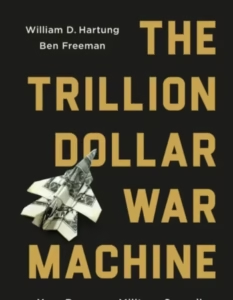
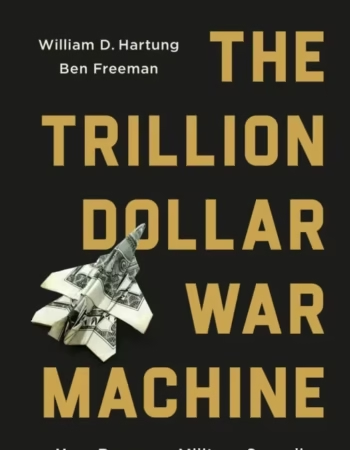
    Democracy Now! speaks to William Hartung about his new book The Trillion Dollar War Machine and who profits from the United States’ runaway military spending that fuels foreign wars. Hartung says that U.S. policy is “based on profit” and calls for a rethinking of our foreign entanglements. “We haven’t won a war in this century. We’ve caused immense harm. We’ve spent $8 trillion,” he says.

    Transcript
    This is a rush transcript. Copy may not be in its final form.

    AMY GOODMAN: This is Democracy Now!, democracynow.org. I’m Amy Goodman with Juan González.

    As the U.S. expands its military presence in Latin America, Defense Secretary Pete Hegseth declared earlier this week the Pentagon’s now on a war footing. In a major speech, Hegseth called for weapons companies executives to speed up production of weapons for the military.

    SECRETARY PETE HEGSETH: Every dollar squandered on redundancy, bureaucracy and waste is a dollar that could be used to outfit and supply the warfighter. We must wage an all-out campaign to streamline the Pentagon’s process to unshackle our people from unproductive work and to shift our resources from the bureaucracy to the battlefield.

    Our objective is simple: transform the entire acquisition system to operate on a wartime footing, to rapidly accelerate the fielding of capabilities and focus on results. Our objective is to build, rebuild the arsenal of freedom.

    AMY GOODMAN: We’re joined now by William Hartung, coauthor of the new book, The Trillion Dollar War Machine: How Runaway Military Spending Drives America into Foreign Wars and Bankrupts Us at Home. Bill Hartung is Senior Research Fellow at the Quincy Institute for Responsible Statecraft. Bill, welcome back to Democracy Now!.

    How unprecedented is the Pentagon budget at this point and what the military’s doing? For example, even President Trump, in his executive order, renaming the Department of Defense the Department of War, although only actually Congress can officially do that.

    WILLIAM HARTUNG: Well, the Pentagon budget has never hit a trillion dollars before. Even its most ardent supporters kind of didn’t believe we would ever hit this mark. But now that they’re there, all bets are off.

    And speeches like that by Pete Hegseth are basically saying, “Not only are we going to spend a trillion, there’s not going to be rules. We’re not going to have independent testing of these weapons, we’re not going to vet them for human rights when we export them.” It was basically a gift to the arms industry. And they talk about speeding it up. When it comes to weapons, speed kills.

    AMY GOODMAN: So – yeah, go ahead, Juan.

    JUAN GONZÁLEZ: Yeah, Bill, I wanted to ask you about the increasing shift in the military machine of the United States from actually troops to machines, this shift of this new defense industry that has arisen from Silicon Valley that, I guess, dreams of being able to fight wars without losing any human beings and just depending on remote-control killing abilities, robots, AI. Could you talk about to what degree this has moved forward?

    WILLIAM HARTUNG: Well, it’s definitely moving. In Washington, the two ways to make money, if you mention China, if you mention AI, or if you mention both, even better. It’s part of a long myth that technology can win wars, which didn’t happen in Vietnam, it didn’t happen in Iraq, didn’t happen with Reagan’s alleged leak-proof missile defense.

    So, they’re selling kind of a bill of goods that’s kind of stale. It’s old ideology with new software. And they’re much more aggressive than the head of, like, Lockheed Martin, who might say to his shareholders, “Oh, this turbulence is going to create business for us.”

    Palmer Luckey’s saying, “We’re going to have war with China in two years. We’re going to bury them. We’re going to have more ammunition.” They’re sort of acting like they’re in charge of our foreign policy, and they view themselves as almost the new technological messiahs. So, I think their ideology and their political influence is almost as dangerous as the weapons they want us to use.

    JUAN GONZÁLEZ: And in your book, you have an extensive discussion of the War on Gaza and how the Gaza War became big business for U.S. companies. Could you talk about that?

    WILLIAM HARTUNG: Yeah, well, there’s this mythology in the Pentagon that sending arms is better than sending troops because our troops aren’t at risk, and the countries will, quote, “Defend themselves.” But of course, Israel committed genocide in Gaza. It was not defense under any terms. And when you’re sending weapons, all the money goes to the companies. You’re not doing troops, you’re not doing logistics. It’s almost pure revenue.

    And when you say it’s military aid to Israel, it’s really military aid to Lockheed Martin and Palantir because the money rests in Israel, comes right back to them. Palantir even had its board meeting during the Gaza War and tried to get other companies profiting from the War to be more vocal in their support of Israel. Of course, they also gave them the software to accelerate the bombing.

    So, it’s one of the more shameful episodes in the history of an industry that, of course, is not based on morality, it’s based on profit. And I think unfortunately, a lot of people who are kind of into tech are like, “Oh, these are amazing people. They put rockets in space. It’ll be cheaper,” and so forth. But we’ll pay a big price if we put our trust in these companies.

    And of course, they’re very much into the Trump administration, including J. D. Vance, who was groomed in Silicon Valley, and is a creature of Silicon Valley and owes Peter Thiel, essentially, his career. When he was appointed VP, the champagne corks went off in Silicon Valley, and huge amounts of money came in behind Trump.

    So, they’re trying to basically displace these huge companies like Lockheed Martin, and what the government’s going to do is pay off both of them. Golden Dome is going to have hardware by Lockheed Martin, software by Anduril and other companies. So, that just means that trillion dollars is going to be in the rearview mirror in a few years if we don’t fight back and fight back hard, which means not accepting the myth of technological superiority.

    AMY GOODMAN: You have two fascinating chapters in this book, “The Militarization of American Science: Buying the Ivory Tower,” and, “Capturing the Media: How Propaganda Powers the War Machine.” Talk about both.

    WILLIAM HARTUNG: Well, this move towards AI and advanced tech means they need the university folks more because Lockheed Martin doesn’t have those kind of people. They’re prized now. And so, they’re doing much more recruiting, sending much more money. Johns Hopkins gets a billion dollars a year to work on things like ballistic missiles, but the average student there wouldn’t know it. The lab is 40 miles away. They’re occupied with other things.

    Berkeley helps run a nuclear weapons lab. If you walked into a student on the quad, likewise, they would not know that. So, they’re accelerating that. And also, the pipeline from engineering students into the weapons industry. And the media, well, between vetting Hollywood scripts, spokespersons from think tanks funded by the weapons industry, just the framing.

    Very few outlets now really do deep critiques of the military. And then, on top of that, they’re not covering it. Some papers don’t even have a Pentagon reporter anymore, so they just print up the Pentagon press release. And then, paragraph 32, somebody like Bill Hartung makes a little quote so they can say they’re being balanced. But the whole framing is pro-military.

    And there’s this notion that if something happens in the world, if we don’t respond with the military, we’re, quote-unquote, “Not doing anything.” Of course, whenever we do it, it’s disastrous. You have members saying, “Oh, peace through strength.” Well, we haven’t won a war in this century.

    We’ve caused immense harm, we’ve spent eight trillion dollars, we’ve got troops with PTSD in the hundreds of thousands, who we’re not taking care of. And yet, that myth persists. So, I think there’s kind of a cultural educational task that has to happen as well as pulling back the amount of money we’re throwing at these companies.

    JUAN GONZÁLEZ: And, Bill, you begin your book by citing Trump’s 2024 campaign speech in Wisconsin, where he pledged to end endless wars. But ultimately, as you point out, Trump wasn’t very different from Biden on many of these metrics. They both turned out to be staunch supporters of the U.S. war machine. Could you elaborate?

    WILLIAM HARTUNG: Yeah, well, Trump uses that tool when needed. Like, when he beat Jeb Bush and Hilary Clinton over the head about Iraq, which, of course, he did not oppose when it was happening. And I think this stuff about war profiteering is a message to those parts of his base who are sick of corporate welfare, sick of war, some even voted for him because they believed this idea that he was going to be less interventionist.

    But here we are, blowing innocent people out of the water off of Venezuela, continuing to arm genocide in Gaza, giving away the store to these companies. “We’ll give you money, we won’t regulate you, you’ll get to do pretty much what you want.” In his first term, he did a similar thing, until he cozied up to Saudi Arabia to sell them record amounts of arms and then claimed they were job creators in the United States.

    So, he really views the arms industry as a political ally, and he’s not going to go after them in any big way. But every once in a while, he’ll lapse into that, or he says we have too many nuclear weapons. But there’s no evidence in his policy. In fact, they’re increasing spending on nuclear weapons. So, he’s erratic, but there is a political purpose, which is just to keep that part of his base that’s skeptical of war feeling like he maybe will do something about it.

    AMY GOODMAN: Before we end, I wanted to ask you about Axios yesterday reporting Israel seeking a new 20-year security agreement with the United States, while the past agreement promised Israel around $4 billion per year in military aid, and Israel’s likely to seek at least that much going forward.

    WILLIAM HARTUNG: Well, yeah, they want to be kind of a permanent client of the United States and for us to pay for their aggression. And the current one that runs out had a few little things they didn’t like. Like, they used to be able to spend U.S. military aid to build up their own arms industry.

    That was supposed to come to an end. It certainly will be waived if it’s negotiated under the Trump administration. So, basically, they’re going to – if they do that, they’re permanently tying themselves to whatever Israel does in the region. For example, when Israel bombed Iran while the U.S. was supposed to be negotiating with them, Trump followed right behind with bombings and false claims about how they’d obliterated Iran’s nuclear program. He even chided some of his own people for acknowledging that that was not the case.

    STOP THE U.S. WAR MACHINE

    So, it’s one of the worst moves that could be made. It’s tying us to an archaic, damaging, destabilizing policy and egging on the worst forces in Israel. So, I’m hoping there’ll be some pushback. The problem is, these deals are often done behind closed doors.

    JUAN GONZÁLEZ: And, Bill, one more question about this. In this trade war between the United States and China, the issue of rare earths has continued to come up as a major weakness of the U.S. military establishment, and also, obviously, in other industry as well. How big an issue do you think this is and a weakness for the United States?

    WILLIAM HARTUNG: Well, it goes against their notion that they can create this self-sufficient garrison state because it’s a global economy, and they can’t do everything here. They don’t have every resource, don’t have every technical kind of expertise. So, this idea that they’re going to have this perfect system all controlled by the United States is a pipe dream.

    Even at the most dominant moments of the United States in history, we were never completely self-sufficient. So, Trump is actually selling a bill of goods that is not possible to actually fulfill, which, of course, is happening in other spheres as well, but is more dangerous when you’re talking about peace and security.


    William D. Hartung (Bio from Quincy Institute  where he is Senior Researcher)

    William D. Hartung focuses on the arms industry and US military budget. He was previously the director of the Arms and Security Program at the Center for International Policy and the co-director of the Center’s Sustainable Defense Task Force. Bill is the co-author, with Ben Freeman, of the recently released The Trillion Dollar War Machine: How Runaway Military Spending Drives America into Foreign Wars and Bankrupts Us at HomeHe is also the author of Prophets of War: Lockheed Martin and the Making of the Military-Industrial Complex (Nation Books, 2011) and the co-editor, with Miriam Pemberton, of Lessons from Iraq: Avoiding the Next War (Paradigm Press, 2008). And Weapons for All (HarperCollins, 1995) is a critique of US arms sales policies from the Nixon through Clinton administrations.

    Bill previously directed programs at the New America Foundation and the World Policy Institute. He also worked as a speechwriter and policy analyst for New York State Attorney General Robert Abrams. Hartung’s articles on security issues have appeared in the New York Times, the Washington Post, the Los Angeles Times, The Nation, and the World Policy Journal.

    He has been a featured expert on national security issues on CBS 60 Minutes, NBC Nightly News, the PBS Newshour, CNN, Fox News, and scores of local, regional, and international TV and radio outlets.

    The original content of this program is licensed under a Creative Commons Attribution-Noncommercial-No Derivative Works 3.0 United States License. Please attribute legal copies of this work to democracynow.org. Some of the work(s) that this program incorporates, however, may be separately licensed. For further information or additional permissions, contact us.


    Donate to Wings of Change   Your Donation Counts

    “We don’t have to engage in grand, heroic actions to participate in the process of change. Small acts, when multiplied by millions of people, can transform the world.”
    — Howard Zinn
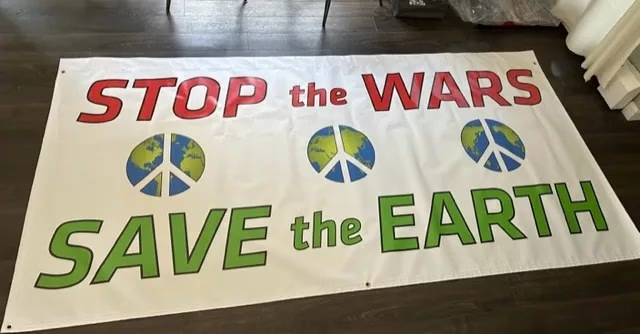
    Join us on Wings of Change  Subscribe Now


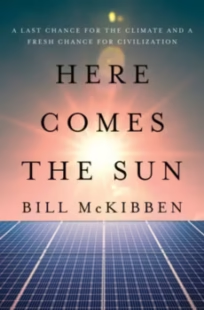
  • “Here Comes the Sun”: Bill McKibben on Renewable Energy, “Sun Day” & the “Last Chance” for Climate

    “Here Comes the Sun”: Bill McKibben on Renewable Energy, “Sun Day” & the “Last Chance” for Climate

    JUAN GONZÁLEZ: And but yet, here we are in the United States, going in the complete opposite direction from what China and the rest of the world are striving for. How do we deal with that situation here in this country?

    As the Trump administration grows increasingly hostile to renewable energy, we speak with acclaimed environmentalist Bill McKibben about his new book, Here Comes the Sun, in which he lays out a hopeful vision for the future that includes avoiding climate catastrophe, reshaping the economy and saving democracy. He says the key to unlock that future is fully embracing renewable energy over the fierce opposition of the fossil fuel industry and its political enablers. He notes that solar and wind are already the cheapest and fastest-growing power sources in history, with more green energy coming online every year.

    “It’s not that we’re going to stop global warming. It’s too late for that. It’s that we really have a chance to reboot the way the world and its economy and its geopolitics works right now,” says McKibben.

    Transcript
    This is a rush transcript. Copy may not be in its final form.

    AMY GOODMAN: This is Democracy Now!, democracynow.org, The War and Peace Report. I’m Amy Goodman, with Juan González.

    We turn now to the climate crisis. A new report by the clean energy tech research group Ember finds China is, quote, “creating the conditions for a decline in fossil fuel use,” unquote, as it leads the production of solar panels and wind turbines.

    Meanwhile, another new report confirms the Trump administration is openly hostile to renewable energy and has overseen, quote, “the most abrupt shift in energy and climate policy in recent memory,” unquote, which has led to a jump in greenhouse gas emissions in the first seven months of the Trump presidency. Trump’s so-called One Big Beautiful Bill not only ended subsidies for renewable power sources, but applies a new tax on solar and wind projects.

    On Friday, the Department of Energy wrote on social media, quote, “Wind and solar energy infrastructure is essentially worthless when it is dark outside, and the wind is not blowing,” they said.

    Trump criticized renewable energy efforts during a recent Cabinet meeting.

    PRESIDENT DONALD TRUMP: We don’t allow windmills. We’re not allowing any windmills to go up, I mean, unless there’s a legal situation where somebody committed to it a long time ago. We don’t allow windmills, and we don’t want the solar panels that I was speaking with the secretary about, because they take up, you know, thousands of acres of our farmland. You see these big, ugly patches of black plastic that comes from China.

    AMY GOODMAN: Despite all this, the Los Angeles Times reports today renewable energy reached nearly 25% of U.S. power generation in June, up from 18% last year.

    We spend the rest of the hour with Bill McKibben, co-founder of 350.org, founder of the group Third Act. His new book is titled Here Comes the Sun: A Last Chance for the Climate and a Fresh Chance for Civilization.

    You, actually, Bill McKibben, despite Trump going back on renewable energy, people fear going back decades, hold out great hope. You see this as a opportunity we’ve never had before.

    BILL McKIBBEN: Amy, Juan, you guys have been at this for a long time. This is as dark a moment as there’s ever been in our democracy, and our planet is overheating fast. In the midst of that, there is this one big good thing simultaneously happening, and it’s so big and so good that it might help with both the climate and the authoritarianism crisis. And that’s this rise in the last 36 months, a pretty untold story, of just extraordinary amounts of clean energy surging into the world’s energy system. It is centered in China, and the numbers are staggering. May is the last month we have data for. In May, the Chinese were putting up three gigawatts of solar panels a day, a gigawatt being the rough equivalent of a coal-fired power plant. They were putting up one of those, made out of solar panels, every eight hours.

    California, which has done more than any place in this country, reached some kind of tipping point in the last 18 months. Most days now, California supplies more than 100% of its electricity from renewable energy for long stretches. At night, the biggest source of supply on its grid is batteries that have been soaking up excess sunshine all afternoon. Bottom line, California, fourth-largest economy in the world, is using 40% less natural gas to produce electricity than they were two years ago. That’s the kind of number — that may be the most optimistic thing that I’ve — number that I’ve heard in the 40 years I’ve been working on the climate crisis. It’s the kind of number that begins to shave tenths of a degree off how hot the world eventually gets. And remember, every tenth of a degree means 100 million people moving from a safe climate zone to a dangerous one.

    So, it’s not that we’re going to stop global warming. It’s too late for that. It’s that we have really a chance to reboot the way the world and its economy and its geopolitics works right now.

    JUAN GONZÁLEZ: And, Bill, I wanted to ask you about this staggering investment that China has been putting into renewable energies. It accounts now for almost a third of all the clean energy investment in the world. It’s producing 80% of all the solar panels, 60% of the wind turbines. And so, all of this investment has actually driven the price of green energy down, so that now it’s in some — according to the Ember report, 90% of wind and solar projects commissioned worldwide produce power more cheaply than fossil fuel alternatives. So, isn’t this — doesn’t this mean that the Global South now will gobble up, the poorer nations of the world will gobble up clean energy alternatives to fossil fuel?

    BILL McKIBBEN: Absolutely, Juan. It’s really important to understand that as of about four years ago, we live on a planet where the cheapest way to produce energy is to point a sheet of glass at the sun. And China has been leading that effort. We know about petrostates. China is the world’s first electrostate. And now, as you say, that’s leaking out from across its borders.

    Pakistan, right next door, last year, Pakistanis, just basically using TikTok videos as their guide, installed enough solar panels to equal half the country’s national electric grid. Pakistani farmers, who were early adopters of this, because diesel to run their tube wells for irrigation is their biggest cost input, they bought millions of these solar panels. They lack the money to build the metal stanchions to point them at the sun, so, instead, they’re just laying them on the ground. Nonetheless, Pakistan was using 35% less diesel last year than the year before.

    Now this is leaking into Africa, not just the solar panels, but the things that make use of the clean energy that they provide. We’re used to thinking of Detroit as the center of the world’s auto industry. That is not true. It’s now two or three cities in China whose names I find difficult to pronounce. They’re producing the best and cheapest cars on the planet, and they are flooding the markets of the developing world. Forget about Ford. It’s BYD that’s going to be the car company of the future.

    JUAN GONZÁLEZ: And but yet, here we are in the United States, going in the complete opposite direction from what China and the rest of the world are striving for. How do we deal with that situation here in this country?

    BILL McKIBBEN: So, it’s what’s so fascinating. And it’s pretty easy, I think, to explain the success of renewable energy, which is good news for almost everyone on the planet, except the people who own oil wells and coal mines. And for them, it’s an existential threat.

    So, what did they do? You’ll recall candidate Trump last year telling the oil industry that for a billion dollars — I mean, it was kind of Austin Powers moment – for a billion dollars, they could have anything they wanted. They ended up raising about half a billion, between donations, advertising, lobbying, in the last election cycle. And clearly that was enough, because they’ve — the Trump administration has done everything that Big Oil could have hoped — and more, really.

    I mean, I don’t think anyone anticipated that they would actually shut down work on 80% complete wind farms off the coast of New England like they did last week. That’s just insane. I mean, if they keep with it, a thousand years from now, archeologists will be trying to explain how this aqueous Stonehenge emerged off the coast of Rhode Island. We’re — if we keep at this, our role in the world a decade from now will be as the kind of Colonial Williamsburg of internal combustion, a place where the rest of the planet, if they can get tourist visas, come to gawk at how people did things in the olden days.

    And that’s especially aggravating, or should be, for Americans, because this technology was invented here. I mean, the solar cell was invented 20 miles away, in Edison, New Jersey. The first industrial wind turbine was 30 miles south of my house in Vermont in the 1940s. And yet we’re just handing it all to China in order to appease the oil industry.

    AMY GOODMAN: You talk about California. You’re headed, what, to D.C. to speak at Politics and Prose, then the Petro Metro. That’s Houston. You’re headed to Texas.

    BILL McKIBBEN: Yeah.

    AMY GOODMAN: Texas might surprise people, when it comes to solar and wind energy.

    BILL McKIBBEN: Texas is now putting up clean energy faster than California, faster than any place in this country. Big Oil doesn’t like that. And they tried, in the state legislative session this year, to pass a number of laws, the most prominent of which people called ”DEI for natural gas.” It was going to force anybody who wanted to put up five megawatts of solar to also put up five megawatts of natural gas. People emerged from the hinterlands across rural Texas to say, “Don’t do this. This is how we pay property taxes in our county. This is what keeps the schools open.” And so the Legislature backed off, returned to their project of redistricting Texas to help Mr. Trump instead.

    It’s not clear that even in this country they can beat down the economics of renewable energy, though, obviously, they’re going to do much damage, which is precisely why we’re rallying across the country on September 21st for this thing we’re calling Sun Day.

    AMY GOODMAN: You’re wearing a T-shirt that says “Sun Day.”

    BILL McKIBBEN: Indeed, I am, because there are hundreds and hundreds and hundreds of events planned for that day. We obviously can’t change policy in Washington in the short term, but we can change policy in states and localities across the country to make it much, much easier to do solar power.

    Amy, it costs three times as much to put up solar panels in the U.S. as it does on your house in Australia or the EU. A tiny bit of that’s from tariffs on solar panels. Mostly it’s because we have 15,000 municipalities, each with their own building code and team of inspectors. It can take months to get done what takes days everyplace else. This can be changed with easy — with ease by local officials. California, Maryland and New Jersey have already adopted this thing called the SolarAPP, that allows a contractor to get instant permitting just by putting a few details into a computer program. We need that across the country, especially in light of federal intransigence.

    AMY GOODMAN: Sun Day is September 21st, the fall equinox?

    BILL McKIBBEN: The fall equinox, exactly right.

    JUAN GONZÁLEZ: And, Bill, I wanted to ask you — last month, the Environmental Protection Agency formally proposed revoking the Obama-era scientific determination that greenhouse gases are a danger to public health and welfare because they cause global warming. Your response to that, and what people can do?

    BILL McKIBBEN: I mean, it’s nonsense, of course. The EPA and the Trump administration can’t repeal the laws of physics, which are the problem here. That’s what’s driving climate change.

    But I think there’s something deeper going on, as we move into this possibility of a world that runs on clean energy. And I was really thinking about it as we were listening to Jeremy report from Middle East. I mean, think about — you guys have run The War and Peace Report for a long time. Think about what this show and this world would have been like for the last few decades if oil was of trivial value on this planet, how many wars and coups and assassination attempts would have been averted. Humans are, you know, altogether too good at starting wars, but figuring out how to start one over sunshine will be a trick.

    I think that this is not just a possibility for dealing with climate change. I think the fact that we have access now to energy that’s available to everyone everywhere, instead of being something concentrated in a few spots, controlled by a few autocrats and plutocrats, that’s a huge, huge potential gift.

    AMY GOODMAN: It’s a real challenge to capitalism, because, I mean, this is decentralized as you can get, unless the Big Oil companies, when they see their days are numbered, just switch over to try to control the access to the sun.

    BILL McKIBBEN: Even if they switch over, which I don’t think they will, I’m afraid, all they can do — and it’s very important, and you can make a lot of money doing it — is build the solar panels. But once you’ve built the solar panels, the sun delivers the energy for free every morning when it rises above the horizon. There’s no way to hoard it or hold it in reserve. The same charismatic object in our galaxy that brings us light and warmth and, via photosynthesis, our food is now willing to provide us with all the power we could ever want. That’s the kind of moment that changes civilization, as thoroughly as learning to harness the combustion of fossil fuel changed civilization. That’s what we call the Industrial Revolution.

    AMY GOODMAN: You’re here in New York. Zohran Mamdani has just shocked the Democratic establishment. Still, the Democratic leader in Congress from New York, Hakeem Jeffries, astonishingly, has not endorsed the Democratic primary candidate. But how do you see Zohran Mandani’s race for mayor of New York as a model for the rest of the country?

    BILL McKIBBEN: Well, I mean, the fact that he’s creative and full of good humor is a shocking thing in our political life, but it’s a real reminder of how much there is that we could do. Across Europe, in cities full of apartment dwellers like New York, millions of people have put up what we call balcony solar over the last three years. They just go to the Best Buy, come home with a solar panel designed to hang over the railing of their apartment balcony, plug it into the wall with a standard plug and producing 20% of the power they use. That’s illegal everywhere in the country, except in the state of Utah, where the state Legislature, that progressive bastion, enabled it by a unanimous vote earlier this year. I’m betting that within weeks of Mr. Mamdani becoming Mayor Mamdani, we’re going to see balcony solar installations sprouting across the five boroughs. And what a nice sign that will be.

    AMY GOODMAN: And you gave this — you started Sunday with another renegade mayor, and that is Michelle Wu of Boston, who Trump is trying to take on.

    BILL McKIBBEN: Michelle Wu, Zohran —

    AMY GOODMAN: We have 20 seconds.

    BILL McKIBBEN: — Zohran Mamdani, people like this, offer a real potential future. And they have an enormous ally in this new technology that really gives us a fresh kind of hope.

    AMY GOODMAN: Bill McKibben, co-founder of 350.org, founder of the organization Third Act. His new book is just out, Here Comes the Sun: A Last Chance for the Climate and a Fresh Chance for Civilization. He is on book tour. Tonight he’ll be in D.C. at Politics and Prose, tomorrow in Houston. And he’s organizing a national mobilization for September 21st, the fall equinox, called Sun Day 2025, celebrating solar and wind power. I’m Amy Goodman, with Juan González.

    This is viewer supported news. Please do your part today.

    The original content of this program is licensed under a Creative Commons Attribution-Noncommercial-No Derivative Works 3.0 United States License. Please attribute legal copies of this work to democracynow.org. Some of the work(s) that this program incorporates, however, may be separately licensed. For further information or additional permissions, contact us.


    Join me on Wings of Change. We still have so much work to do as activists and organizations make plans for the upcoming months and years. Wings of Change is pleased and excited to be a part of that work through education, information, and inspiration.

    Subscribe to Wings of Change here!

    Donate

    Whatever you are able donate will bring you articles and opinions from independent websites, writers, and journalists as well as a blog with opinions and creative contributions.

    Sue Ann Martinson

    One place to begin is with reason and truth, and how fundamental they are to creating critically engaged citizens and communities. 

    —Henry A. Giroux

  • DN! “The Border Is Invading America”: Jean Guerrero on the Bipartisan Failures of Immigration Policy

    DN! “The Border Is Invading America”: Jean Guerrero on the Bipartisan Failures of Immigration Policy

    The reality is that the border is invading us, and it’s coming not only for the rights of immigrants and for immigrants themselves, but for the rights of all of us.

    AMY GOODMAN: We speak to journalist Jean Guerrero about the Trump administration’s ongoing anti-immigrant crackdown and the bipartisan roots of “anti-immigrant cruelty” in the United States. Guerrero’s latest opinion piece in The New York Times is titled “The Border Is Invading America” and traces the development of U.S. border policies since the Clinton administration. “The brute force that the border once unleashed out of sight, in the desert or behind the locked doors of detention centers, is now erupting on our streets,” says Guerrero. “We desperately need a reckoning with the structural abuses embedded in our immigration system and with how both parties have played a role in sustaining them, because, otherwise, the border is going to continue to coil inward and to destroy our collective rights.”

    Transcript
    This is a rush transcript. Copy may not be in its final form.

    AMY GOODMAN: This is Democracy Now!, democracynow.org.

    As President Trump threatens to send the National Guard to Chicago and a federal judge rules against their deployment to quell ICE protests in Los Angeles, we turn now to Jean Guerrero, contributing opinion writer at The New York Times. Her new essay is headlined “The Border Is Invading America.” She writes, quote, “The U.S.-Mexico border is no longer just a line on a map; it is a roaming force, drifting through our cities and ravaging schools, courthouses and workplaces. It has become unmoored from geography, dragging its violence and impunity into the heart of American life.”

    Jean Guerrero is author of Hatemonger: Stephen Miller, Donald Trump, and the White Nationalist Agenda and a visiting professor at the University of Southern California Annenberg School of Communication and Journalism, joining us from Los Angeles.

    Jean, welcome back to Democracy Now! Why don’t you elaborate again on your piece, “The Border Is Invading America”?

    JEAN GUERRERO: Yeah, of course. Thank you, Amy.

    So, what we’re seeing across the U.S. is that the Border Patrol is now operating deep inside the country alongside ICE, and it’s bringing its Wild West mentality. You know, they’re wearing cowboy hats, and they’re treating Los Angeles and places across the United States like lawless outposts on a hostile frontier. They’ve been deputized to carry the border with them and to enforce its racialized logic wherever they go.

    As we know, the administration has asked the Supreme Court to allow it to continue to use racial profiling in immigration enforcement. And in Southern California, we are routinely seeing people targeted based on their skin color, which is why I wrote that the border is no longer something that only divides countries; it also snakes between white and Brown, between families and neighbors, between citizens and the rights that they once thought were inviolate.

    And the brute force that the border once unleashed out of sight, in the desert or behind the locked doors of detention centers, is now erupting on our streets. For example, in Southern California, we’re seeing fathers killed while fleeing immigration raids. We recently saw a family shot at in their car while trying to get away from agents. We are seeing people violently tackled and disappeared into unmarked vans. And too many Americans continue to believe that the border is meant to stop a, quote-unquote, “invasion.” But the reality is that the border is invading us, and it’s coming not only for the rights of immigrants and for immigrants themselves, but for the rights of all of us.

    JUAN GONZÁLEZ: And, Jean, in your piece, you basically also charge that Democratic leaders have been complicit now for decades in the stoking of anti-immigrant xenophobia in the U.S. You write at one point, quote, “I have repeatedly asked Trump voters about his immigration policies, such as his first term’s family separation. They tend to reply by shrugging their shoulders and pointing at similar actions by Democratic leaders, saying, ‘Obama put kids in cages’ or ‘Obama separated families, too.’” Could you talk about that?

    JEAN GUERRERO: Yeah, I think it’s important to talk about that, because what happened is that the Democratic Party normalized anti-immigrant cruelty alongside Republican administrations. And until we reckon with that bipartisan nature of our racialized immigration system, then we’re not going to be able to restrain it, because we need to hold our elected officials accountable in both parties for what they have created together.

    So, as I wrote in my piece, it was the Clinton administration that oversaw the initial militarization of the border in the 1990s, after which we have seen as many as 80,000 people who have died trying to cross the border. That’s a stadium of human beings who have died of dehydration in the desert, who have died of broken backs falling off of the border barriers, or even from Border Patrol agents’ bullets.

    And after Clinton’s border militarization, we saw President Obama deport 3 million people, more than any previous president. Oftentimes these are individuals who were deported to their deaths. And the Obama administration also oversaw — or, decided against removing exceptions for racial profiling in immigration enforcement. This is a decision that the Biden administration made, as well, and so both of these administrations affirmed a two-tiered system of justice, one in which immigrants and people who merely look like immigrants have fewer rights.

    However, when Trump came along, many Democrats treated his cruel policies as if they were shocking new horrors unique to Republicans. And this is a moral inconsistency and hypocrisy that Trump’s senior adviser Stephen Miller knew to exploit, which I can talk about in a moment. But the point is that Democratic leaders’ selective outrage on the immigration issue helped fuel the crisis that we’re living today, and we need to reckon with that, because right now too many Democratic Party leaders wrongly believe that we are where we are today because they were too nice to immigrants.

    JUAN GONZÁLEZ: Yeah, and I wanted to ask you particularly, again, about the role of Stephen Miller. There’s been really no one quite like him at the high echelons of federal government in terms of the emphasis on naked mass deportations. Can you talk about him, as well, as the architect of the Trump policies?

    JEAN GUERRERO: Yes, yeah, the architect of Trump’s immigration policies. So, as I wrote in my book Hatemonger, Stephen Miller is a student of liberal hypocrisy. He grew up in Santa Monica, California, where he saw the performative nature of many Democratic leaders’ compassion for immigrants. Santa Monica is a place where many working-class immigrant residents have been pushed into overcrowded apartments or out of the city altogether because of rising rents. So, as Trump’s speechwriter, it was not hard for Stephen Miller to make the case that Democratic Party leaders defend immigrants only as a source of cheap labor or because they want their votes, even though immigrants don’t vote, unless they’re citizens. But essentially, Miller knew that, in practice, if not in proclamation, Democratic Party leaders had normalized indifference and cruelty toward immigrants. And this long-standing indifference toward immigrants that the Democratic Party has, except when they’re wielding this issue as a cudgel against Trump, is something that has worked symbiotically with the racism of Republican leaders to enable the border’s violent encroachment on our lives, which we are now seeing.

    And unfortunately, Democratic leaders are now largely silent on immigration. They are convinced that to win back voters and to win back Americans’ trust, they have to either sidestep the immigration issue or they have to channel the right’s hostility toward immigrants. For example, we were seeing California Governor Newsom approve cutting back on healthcare benefits for the undocumented. He’s really had a more muted tone on sanctuary laws in California. I actually reached out to his office for comment on the deaths of immigrants that we saw this summer, and haven’t heard back. But as Democrats like him appear to see it, the party’s failure is not inhumanity or incoherence on the immigration issue, but rather an overabundance of compassion for the foreign-born. And this delusion would be comical if it wasn’t so costly. It’s a gift for restrictionists like Stephen Miller, who use the disconnectedness of Democratic Party elites to stoke resentment toward all liberals and to bolster the false perception that immigrants are to blame for everything.

    So, really, what I’m arguing for in the piece is that we need — we desperately need a reckoning with the structural abuses embedded in our immigration system and with how both parties have played a role in sustaining them, because, otherwise, the border is going to continue to coil inward and to destroy our collective rights.

    AMY GOODMAN: Jean Guerrero, we want to thank you so much for being with us, New York Times contributing opinion writer. We’ll link to your piece, “The Border Is Invading America.” Jean is also author of Hatemonger: Stephen Miller, Donald Trump, and the White Nationalist Agenda and visiting professor at USC Annenberg School for Communication and Journalism.

    The original content of this program is licensed under a Creative Commons Attribution-Noncommercial-No Derivative Works 3.0 United States License. Please attribute legal copies of this work to democracynow.org. Some of the work(s) that this program incorporates, however, may be separately licensed. For further information or additional permissions, contact us.
    Next story from this daily show

    Army Vet Charged with “Conspiracy” for ICE Protest as Trump Expands War on Dissent


    Join me on Wings of Change. We still have so much work to do as activists and organizations make plans for the upcoming months and years. Wings of Change is pleased and excited to be a part of that work through education, information, and inspiration.

    Subscribe to Wings of Change here!

    DonateWings of Change Feather

    Whatever you are able donate will bring you articles and opinions from independent websites, writers, and journalists as well as a blog with opinions and creative contributions.

    Sue Ann Martinson

    One place to begin is with reason and truth, and how fundamental they are to creating critically engaged citizens and communities. 
    —Henry A. Giroux
  • “Time to Cut Ties with Israel”: U.N. Expert Francesca Albanese on Gaza Hospital Bombing

    “Time to Cut Ties with Israel”: U.N. Expert Francesca Albanese on Gaza Hospital Bombing

    “There has been a tolerance of Israel’s impunity for decades,” says Albanese. “However, the United States is the single most important factor of crisis in the United Nations.”

    Israel’s war on Gaza is the deadliest conflict for journalists in recorded history. In an attack on Nasser Hospital in Gaza Monday, Israel killed five more journalists in addition to over a dozen others. Israeli Prime Minister Benjamin Netanyahu claimed the hospital attack was a “tragic mishap,” but just hours later, Israeli forces killed a sixth journalist. “There is a pattern of targeting and killing journalists that lets us think that there is an intention,” says Francesca Albanese, U.N. special rapporteur on the occupied Palestinian territory.

    As countries prepare for the U.N. General Assembly, Albanese notes the complicity of Western states in the genocide in Gaza, particularly the United States. “There has been a tolerance of Israel’s impunity for decades,” says Albanese. “However, the United States is the single most important factor of crisis in the United Nations.”

    Note: Video also included below: “Chicago Leaders Prepare to Face the Dictator Head On” Below the Chicago video is the full transcript of Franceca Albanese’s intertiew video with Amy Goodman of Democracy Now!

    “We Must Defeat Fascism”: Chicago Alderman on Trump’s Threat to Deploy Troops to City

    Transcript for Francesca Albanese

    This is a rush transcript. Copy may not be in its final form.

    AMY GOODMAN: Human rights and press freedom groups are denouncing Israel’s attack on Nasser Hospital in Gaza Monday that killed at least 21 journalists — that killed at least 21 people, including five journalists. According to eyewitnesses, Israel carried out a double-tap strike on the hospital. In the initial strike, a drone hit Hussam al-Masri, a cameraman who worked for Reuters. Then another strike, minutes later, hit journalists and rescue workers who were responding to the initial strike.

    Israeli Prime Minister Benjamin Netanyahu claimed the hospital attack was a, quote, “tragic mishap.” But just hours later, Israeli forces killed a sixth journalist, Hassan Douhan, a well-known editor at Al-Hayat Al-Jadida. He was killed when an Israeli tank shelled a tent sheltering displaced people in Khan Younis.

    Over the past 23 months, Israel has barred all foreign journalists from reporting inside Gaza, while systematically killing Palestinian journalists. According to one count, Israel has killed least 245 journalists. On Monday, Thibaut Bruttin, the director general of Reporters Without Borders, denounced Israel’s attack on journalists.

    THIBAUT BRUTTIN: When and where is it going to end? Are we going to let the Israel Defense Forces continue the repeated killing of journalists? There is international law. There are guarantees that should be granted to journalists covering conflicts. And none of that seems to be applying. So, we need to be very clear about the fact that none of the journalists that are allegedly terrorists are terrorists. They are professional journalists working for legacy professional media, like, for example, Reuters or, for example, AP.

    AMY GOODMAN: In other news from Gaza, three more Palestinians have starved to death, bringing the total to at least 303.

    We’re joined right now by Francesca Albanese, the U.N. special rapporteur on the occupied Palestinian territory. She’s joining us from Tunis, Tunisia.

    Welcome back to Democracy Now!, Francesca Albanese. Can you start off by responding to the killing of the, at this point, in the last day, six journalists, five of them in a double-tap strike on Nasser Hospital?

    FRANCESCA ALBANESE: Thank you, Amy. Yeah, of course.

    Look, in a situation of conflicts, targeting or killing journalists is unlawful. Journalists, like doctors and medical personnel and rescues, all those who have been killed in this attack, are civilians, so killing them is unlawful. They are protected under international humanitarian law.

    However, here, it’s not an isolated incident. Journalists have been killed in such high numbers. Some say 200 have been documented. Al Jazeera speaks of 270 journalists killed. So there is a pattern of targeting and killing journalists, that let us think that there is an intention behind it. There is a widespread and systematic attack against them, like there is a systematic and widespread attack against civilians. And this might qualify as also as a crime against humanity in and of itself.

    However, however, I want to remind everyone that we are on the 688th day of the assault against Gaza, which an increasing consensus denounces as genocidal. And there is famine, and there is this complete destruction of landscapes in Gaza. So, the question is: What are member states waiting exactly to intervene and stop this carnage?

    JUAN GONZÁLEZ: And, Francesca Albanese, you have said that there have to be response. You’ve called for sanctions against Israel. Could you talk about how those might work, especially, as you mentioned, the fact that state governments are not taking any action?

    FRANCESCA ALBANESE: Oh, absolutely. Look, I would like people to understand this in the broader context of international law. No later than last year, the International Court of Justice has confirmed that Israel’s presence in the West Bank, the Gaza Strip and East Jerusalem is unlawful, must be dismantled totally and unconditionally. And the General Assembly has also given Israel a very generous deadline of one year to do so, which will expire in a month from now. In the face of this, member states have an obligation not to aid and assist in any possible ways a state like Israel in maintaining the situation created by Israel’s unlawful presence. So, while it is abhorrent that they are not stopping Israel, this delay increases their level of responsibility, their violation of international law, and possibly their complicity with the crimes that Israel is committing.

    This is why my recommendations are for member states who do not want to incur in this legal — in their legal responsibilities, and also out of humanity, to break the siege. Member states who have a port in the Mediterranean Sea must absolutely send their navies, under their national flag, with humanitarian aid and doctors, with food and baby formula, because 500,000 people, according to the United Nations, are close to — are really close to starvation. But also, as we see the Sumud Flotilla, so ordinary citizens jumping on boats and trying to do what member states are not doing, I feel that it’s totally immoral and irresponsible to let individuals like this take this risk, when it’s a state obligation to break the siege.

    But also, it’s time to cut ties with Israel, to cut trade, because this is also what the ICJ has reminded member states they need to take all steps to prevent trade and investment relations that are assisting in the maintenance of Israel’s unlawful presence. And we must recall that while Israel is committing genocide in Gaza, it’s also advancing, as it was said in the beginning, annexation at an incredible, incredible speed. So there is no way out of this other than a firm, robust action from member states.

    JUAN GONZÁLEZ: And I wanted to ask you — the Trump administration, instead of heeding your calls as the special rapporteur, have instead imposed sanctions on you, supposedly claiming that your naming of dozens of companies that are profiting from the Israeli occupation and genocide in Gaza. And Secretary of State Marco Rubio said, quote, “Albanese’s campaign of political and economic warfare against the United States and Israel will no longer be tolerated.” Your response to these kinds of words from leaders of the United States?

    FRANCESCA ALBANESE: Well, first of all, as a non-American, but as someone who has lived in the United States, I wonder how American people understand this, because, of course, it’s a violation of the First Amendment, right? I mean, I’ve just done my job, which is a pro bono job. I’ve been requested by the United Nations to investigate and report on the most prominent violations of international law that occur in the occupied Palestinian territory. And I’ve simply stated facts, according due process to businesses, saying there is an economy of the occupation, and this is the reason why Israel has profited and has allowed private entities, arms manufacturers, even banks, pension funds, universities, really, to help and profit — to help it and profit from Israel’s maintenance of the unlawful occupation. Now, this occupation has also turned into genocidal over the past 688 days, and I’ve denounced it. I’ve said, “How come that Israelis were becoming — many Israelis were becoming poorer and poorer, and Israeli stocks exchange kept on going up?”

    Because of that, I’ve been sanctioned, which is something unprecedented, that no states in 80 years of life of the United Nations have ever attempted, had ever dared, because it’s absolute — it’s a violation of international law, of the U.N. Charter, of the Convention on Privileges and Immunities. And still, the United Nations — the United States maintains a sanction, which are now entering the second month. It’s abominable. And this is the situation. But you understand, against a person who has just written a report, I have been called a threat to global economy. It’s clear that I’ve hit a nerve, but this is not the way to react to this.

    AMY GOODMAN: I want to turn to the last story that the Reuters cameraman Hussam al-Masri filmed before he was killed by Israel on Monday at Nasser Hospital. On Saturday, just two days before, al-Masri shot this interview with Hikmat Fojo, a Palestinian woman whose relatives were killed in another Israeli strike.

    HIKMAT FOJO: [translated] While they were sleeping, they were hit by missiles. While they were sleeping, an entire family was lost. And he was praying. He was praying. He was praying. His children were gone. Two were martyred. They were born after 10 years of waiting. One was sleeping. And the woman’s hands and legs, but, God willing, it’s all right. God willing, it doesn’t matter. If my nephew’s hand remains amputated, it doesn’t matter, but may he stay alive, O Lord.

    AMY GOODMAN: So, that was the — one of the last pieces of video that the Palestinian journalist, the Reuters journalist Hussam al-Masri filmed before he was killed Monday in that double-tap strike. He had — apparently was setting up a live stream at the fourth-floor balcony, which journalists used, when he was hit. So, now I want to go to Reuters reporter Steve Holland, who questioned President Trump about this in the Oval Office.

    STEVE HOLLAND: If we could get your reaction, sir? The Israelis bombed a hospital in Gaza, that killed 20 people, including five journalists. Are you —

    PRESIDENT DONALD TRUMP: When did this happen?

    STEVE HOLLAND: This happened overnight today.

    PRESIDENT DONALD TRUMP: I didn’t know that.

    STEVE HOLLAND: Any reaction to this? Are you going to talk to Prime Minister —

    PRESIDENT DONALD TRUMP: Well, I’m not happy about it. I don’t want to see it. At the same time, we have to end that whole nightmare. I’m the one that got the hostages out. I got them out, all of them.

    AMY GOODMAN: That was President Trump. Francesca Albanese, can you talk about the responsibility of the United States? And tell us more about the mechanisms at the U.N., since it’s very clear they block any kind of action at the U.N. Security Council.

    FRANCESCA ALBANESE: Yeah, as I said, there are clear indication, clear instructions from International Court of Justice on how to deal with the situation. The only lawful thing that Israel can do in the occupied Palestinian territory is to withdraw, withdraw the troops, dismantle the settlements, stop exploiting Palestinian resources.

    In the face of this, any aid, any support, any exchange of commerce, military intelligence and others from the United States or others is a breach of the obligation not to render aid and assistance in maintaining the situation. However, on top of this, there are proceedings for genocide pending before the International Court of Justice, which trigger an obligation to prevent, which, as a minimum, as the ICJ has said in the case of Nicaragua v. Germany, entails the ban on transfer of weapons to a country, to a state which is committing violations of international humanitarian law, meaning even war crimes. You know, we don’t even need to go and bother the Genocide Convention. So, yet again, another layer of responsibility of the United States.

    And then there are proceedings against Benjamin Netanyahu and Yoav Gallant for war crimes and crimes against humanity, including starvation. Because of this, even if the United States is not a party to the ICC, it should be respectful of international law, international criminal law. And instead of giving — of receiving the ICC-wanted Netanyahu as if he was really a war hero, as is being defined, the United States should facilitate justice and accountability. Instead, they are waging a war against the ICC itself, not just me. All the judges of the ICC have been sanctioned, and so the prosecutor of the court. So, this is the situation.

    Of course, there are complicities on the side of this administration, and, in my opinion, even in the — on the previous one. But this is something that belongs to the American people. It’s the American people that need to, or the American — the American political landscape that needs to, take action on this.

    JUAN GONZÁLEZ: And, Francesca Albanese, I wanted to ask you — in a few weeks, the U.N. — the annual meeting of the U.N. General Assembly will take place. Leaders from all over the world will come and give speeches to the U.N. General Assembly. Do you think this is a defining moment for the United Nations as an institution in its inability of the member states or the unwillingness of the member states to stop a genocide that the entire world has been witnessing now for —

    FRANCESCA ALBANESE: Yeah.

    JUAN GONZÁLEZ: — two years?

    FRANCESCA ALBANESE: Yeah, I will take the opportunity to also answer the other part of Amy’s question, which I dropped, but it’s — yeah, I think that it’s a — it’s an historical moment, the one we live in, and it’s a defining one. We will not get out of this genocide with the same pretense of innocence that we had when we entered. The crimes of Israel against the Palestinians were already 56-plus years old when the assault against Gaza on the terrible — after the terrible day that October 7 was — and there is no question about that. So, there have been a tolerance of Israel’s impunity for decades.

    However, the United States is the single most important factor of crisis in the United Nations system at the moment, because the United Nations are clearly paralyzed in the face of a crisis which is political, legal and humanitarian, and the United States have contributed to that paralysis by also — for example, what are the mechanisms to impose sanctions or to dispose of coercive or noncoercive measures against Israel within the U.N. would be through the Security Council, and the United States have firmly and steadily sheltered Israel from most important instances of accountability. A rare exception is the 2016 Security Council resolution that recognized the illegality of the settlements under international law.

    So, it’s a catch-22 situation. But at the same time, I want to remind everyone that the international community is constituted by 193 member states, and the other 191, that does not — are not part of the Gaza genocide as much as Israel in the United States, should do the utmost not only to stop the genocide, but also to salvage what remains of the multilateral system, because so far it has protected — I wouldn’t say all of us, but most of us, especially in the West. And it seems that we are really giving it for granted. But we will miss human rights very much when we don’t have them anymore.

    AMY GOODMAN: Francesca Albanese, the International Criminal Court has said it deplores new U.S. sanctions on its judges and prosecutors. Last week, the U.S. State Department announced new sanctions on two judges and two prosecutors in the ICC for engaging in efforts to prosecute U.S. and Israeli citizens. The ICC statement said, “These sanctions are a flagrant attack against the independence of an impartial judicial institution which operates under the mandate from 125 States Parties from all regions. They constitute also an affront against the Court’s States Parties, the rules-based international order and, above all, millions of innocent victims across the world.” I’m wondering if you can comment on this latest development, the sanctions against the ICC prosecutors and judges, and also your own situation. You are the U.N. special rapporteur on the occupied Palestinian territory, and the U.S. has sanctioned you. And if you can talk exactly about what that means?

    FRANCESCA ALBANESE: Look, the sanctions are very heavy and, frankly, an awful, awful instrument, when targeting, when directed at people whose job and whose efforts are in the — in the pursuit of justice and accountability. So, look at the absurdity of using an instrument, which is meant to protect U.S., U.S. interests and U.S. citizens, being used to punish people who are trying to stop and make account — make people responsible for crimes accountable. Where is the harm to the U.S. citizens? What is harmed — and this is why I often say these sanctions are a sign of fragility of those who use it — who use them. I mean, they are — what’s the harm that is done to the American interest, other than to the illegality that is denounced?

    Yes, the special rapporteur has put on notice 48 businesses. And what? Why didn’t they defend themselves? Why didn’t they interact with me, most of them, surely the American companies? Why did they went to complain to the American administration, who put me on notice not to continue this investigation already made? Again, look, I come from a place which has been plagued by Mafia-style logics, techniques, and I’m fully familiar with this way of behaving. And this kind of threats win only if they meet fear. But the people, united, must resist this. And this is why I’m not going to step back, and I’m not going to stop my work.

    AMY GOODMAN: And I wanted to ask a final question about the West Bank. As we went air, I think something like 24 people have been injured in Ramallah in an Israeli military raid. This is not Gaza. This is Ramallah. At the same time, you have the far-right ministers talking about starting to annex the West Bank this week. What does this mean?

    FRANCESCA ALBANESE: Yeah.

    AMY GOODMAN: And what role does the U.N. have in this?

    FRANCESCA ALBANESE: Yes, two things. First, when we say this is not Gaza, last week, the Israeli newspaper +972/Local Call issued a report based on a leaked document by the Israeli army, which admitted that only one of six of the people killed in Gaza were Hamas combatants. And I want to — I want to underscore that Israel’s definition of “combatant” is much broader than what is, in fact, afforded by international law. So, it confirms and actually aggravates the accusations of the U.N., independent experts and others that the death toll has steadily been 70 — at least 70% women and children, and therefore civilians. So, they are saying that, in fact, 80%-plus of the death toll in Gaza is made of civilians.

    The situation is not different from the West Bank, where Israel is advancing its ethnic cleansing agenda through annexation. This is not new. In February 2023, the coalition government passed an agreement that basically transferred to Bezalel Smotrich, so the minister of finance, control over large swathes of the West Bank. This was yet another act of annexation, but formalizing what Israel has been doing for 57 years, creating settlements, which are war crime, in occupied territories for Israeli Jews only that were on — were on stolen land and were resulting in forcibly — dispossession and forcible displacement of Palestinians. Of course, today, this has reached abysmal proportion, because there is — there is even that veneer of respect of international humanitarian law has gone. There are settlers and soldiers ravaging the West Bank, and the Jordan Valley is unprotected, other than from by a few Israeli activists who go there night and day and try to protect shepherds and pastoralist communities.

    But, look, the situation is abominable, abominable. And now the state of Palestine has requested an intervention from the international community. Some presidents, like some authorities, like the Irish president, has called for a military intervention. And I understand that everything must pass up, in accordance with international law, through the Security Council. And at the same time, because Israel has no sovereignty whatsoever over Gaza, the West Bank and East Jerusalem, it’s about time that a protection — the deployment of a protection presence is considered, because there is no other way to stop what Israel is doing.

    AMY GOODMAN: Francesca Albanese, we want to thank you for being with us, U.N. special rapporteur on the occupied Palestinian territory. We were hoping to reach a doctor at Nasser Hospital, but could not reach him today.

    Coming up, we go to Chicago as local and state officials push back against President Trump’s threat to send in the National Guard. We’ll also look at Trump’s new executive orders ending so-called cashless bail. Stay with us.

    [break]

    AMY GOODMAN: The late folk singer-songwriter Michael Hurley performing “What’s Buggin’ You Baby?” at our Democracy Now! studio.

    The original content of this program is licensed under a Creative Commons Attribution-Noncommercial-No Derivative Works 3.0 United States License. Please attribute legal copies of this work to democracynow.org. Some of the work(s) that this program incorporates, however, may be separately licensed. For further information or additional permissions, contact us.


    In this critical time in our country hearing the voices of truth and engaging in honest discussion for critical issues is all the more important while censorship (and outright lies) along with attacks on truth-tellers are common. Support the WingsofChange.me website and Rise Up Times on social media as we to bring you important articles and journalism beyond the mainstream corporate media. Access is alway free, but if you would like to help:
    Wings of Change FeatherWhatever you are able donate will bring you articles and opinions from independent websites, writers, and journalists as well as a blog with the opinions and creative contributions.

    One place to begin is with reason and truth, and how fundamental they are to creating critically engaged citizens and communities. 

    —Henry A. Giroux

  • DN! “Duty to Repair”: IJC Declares States Legally Responsible for Climate Harm

    DN! “Duty to Repair”: IJC Declares States Legally Responsible for Climate Harm

    CLIMATE: “Duty to Repair”

    Vanuatu Climate Minister on World Court Ruling Countries Must Address Climate

    In a landmark decision, the International Court of Justice found that polluting countries are now legally obligated to address global warming. In a unanimous ruling by a panel of 15 judges, the court said high-emitting countries do have legal obligations under international law to address the “urgent and existential threat” of climate change. The case was brought forward by the island nation Vanuatu, which has faced the brunt of the climate crisis with extreme weather events and rising sea levels.


    In this critical time in our country hearing the voices of truth and engaging in honest discussion for critical issues is all the more important while censorship (and outright lies) along with attacks on truth-tellers are common. Support the WingsofChange.me website and Rise Up Times on social media as we to bring you important articles and journalism beyond the mainstream corporate media. Access is alway free, but if you would like to help:
    Whatever you are able donate will bring you articles and opinions from independent websites, writers, and journalists as well as a blog with the opinions and creative contributions.

    Rise Up Times is still active on social media under the name Rise Up Times.

    Or mail a check to Sue Ann Martinson to 2900 11th Ave So, Unit #209, Minneapolis MN  55407 with “Wings” on the Memo line.

    PLEASE SHARE WIDELY ON RISE UP TIMES SOCIAL MEDIA

    • Visit, and encourage your friends to visit, the Rise Up Times Facebook page and from Messenger or the Tumblr, Linked In, and Pinterest Rise Up Times pages or my personal Facebook page, Sue Ann Martinson
    • On Instagram and Tik Tok under Rise Up Times.
    • Also on Instagram, my personal page under Sue Ann Martinson, seas.nun
    • Read and Retweet from Rise Up Times Twitter [X] account @touchpeace.
    • Articles can also be shared from the social media listed above as well as from the Rise Up Times Instagram and Tik Tok pages.
    • Print copies of articles or visuals in Rise Up Times and leave them in your favorite bookstore, coffee shop, etc. and share with friends.
    Wings of Change Feather“We don’t have to engage in grand, heroic actions
    to participate in the process of change.
    Small acts, when multiplied by millions of people,
    can transform the world.”

  • Epstein: Chris Hedges, Sexual Blackmail, DN! A Survivor Testifies

    Epstein: Chris Hedges, Sexual Blackmail, DN! A Survivor Testifies

    Journalist and author Nick Bryant spent seven years investigating a child sex trafficking network that was covered up by state and federal authorities, culminating in the book  The Franklin Scandal: A Story of Powerbrokers, Child Abuse, and Betrayal.

    Journalist and author Chris Hedges is a Pulitzer Prize–winning journalist who was a foreign correspondent for fifteen years for The New York Times. He previously worked overseas for several major news media. Hedges has written several books and hosts The Chris Hedges Report.


    Amy Goodman interviews Jeffrey Epstein Survivor / July 18, 2025

    Guests

    Teresa Helm   A survivor of sexual abuse perpetrated by Jeffrey Epstein and facilitated by Ghislaine Maxwell.

    Transcript
    This is a rush transcript. Copy may not be in its final form.

    AMY GOODMAN: Democracy Now!, democracynow.org, The War and Peace Report. I’m Amy Goodman.

    We speak to a survivor of sexual abuse perpetrated by Jeffrey Epstein and enabled by his partner Ghislaine Maxwell. Teresa Helm was sexually assaulted by Epstein at what she was told was a job interview in the early 2000s. She now works as the survivor services coordinator for the National Center on Sexual Exploitation and joins many voices calling for the release of federal documents pertaining to Epstein’s criminal case, though Helm emphasizes that the goal of their release must be to promote accountability and justice for victims, not as a form of political score-settling. “I really urge everyone to focus their commitment, their intention, all this time, effort and energy onto … these survivors and their healing,” says Helm. “We’re talking about people’s lives, and it should not be weaponized either way, in any administration.”

    Missing in much of the MAGA frenzy over the Jeffrey Epstein files are the voices of survivors of the sexual abuse he perpetrated against them. Many, like our next guest, have joined the call for transparency and for the Trump administration to release the files as promised.

    This comes as Virginia Giuffre, an outspoken survivor of sex trafficking by Jeffrey Epstein, died, apparently by suicide, at age 41 in April. She was the first survivor to come out publicly against Epstein and his co-conspirator, Ghislaine Maxwell, who remains in prison. She also sued Prince Andrew for sexually assaulting her when she was 17. The disgraced prince was forced to step away from his royal duties and settle with Giuffre in 2022. Her family said in a statement, quote, “Virginia was a fierce warrior in the fight against sexual abuse and sex trafficking. She was the light that lifted so many survivors,” unquote.

    Just last week, when the FBI and Department of Justice announced there was, quote, “no incriminating client list,” it also said Epstein harmed over 1,000 victims over two decades, far more than previously known.

    For more, we’re joined by Teresa Helm, who is a survivor of sexual abuse by Jeffrey Epstein, facilitated by Ghislaine Maxwell. She was assaulted by Epstein in the early 2000s. She now works as the survivor services coordinator for the National Center on Sexual Exploitation. Her 2024 piece for Newsweek is headlined “I’m a Jeffrey Epstein Survivor. The Documents Are an Opportunity.”

    Thank you so much for joining us. You, Teresa Helm, have talked about the dangers of grooming. As you see all of this taking place, the uprising within the MAGA movement, lost are what sexual violence survivors go through. Talk about how you first met Jeffrey Epstein, how you were brought to him, how you were groomed.

    TERESA HELM: Well, hello. Good morning. I can certainly talk to that.

    So, I was attending college out in California at the time and was a full-time student and a full-time employee there. And so, that began the process of recruitment to grooming, passed along the line from various people as far as “This is an opportunity that I’d like for you to see if you’re interested in, and go talk to this person.” So, after speaking with a couple young women about an opportunity that I thought I was being blessed with at the time, I eventually met with Ghislaine Maxwell, who really — what she did was pretty astounding, in the fact that within a day I was convinced that I was in a safe, healthy, wonderful environment, blessed with an opportunity to pursue a career that I could — had only dreamed of having. In fact, that was my dream, to do what she had stated I would do alongside her, working for her. She was very polite and kind. She built trust in a very — you know, within hours, I thought that I had really landed the opportunity of a lifetime. My family was very pleased that I was there interviewing with her, which is what — the intention. That’s what the — that’s what I thought I was there for, was an interview. And things went so amazingly well. And then, she was so successful in all of that very, I would call it, you know, master manipulation. She was very calculated in her craft and did it very well.

    I was very young. I mean, I was an adult, 22 years old. However, I had such big dreams and aspirations and determination and really wanted to make the most of this opportunity that I thought that I was getting, to the point where at the end of my time with Ghislaine Maxwell, although I hadn’t known that there was a partner, as she referred to him, that I would be meeting at the end of my time with her — I hadn’t heard Jeffrey or any other person’s name the entire time, from beginning, sitting behind the desk at work in California at the college, to meeting Sarah Kellen at the beach to — who then introduced me to Ghislaine. I had no idea that there was a final person that I was going to go meet.

    And once I learned of him, by the name of Jeffrey, I did not — I paused and thought about some things, waived any kind of red flag in my mind, because, again, she was so — Ghislaine was so, so good at what she had done and built that trust in me. And so, then I walked — I walked myself to Jeffrey’s home later that day to what I thought was to interview with him, without really a lot of question, actually being quite excited, because I thought, “Well, if I was so successful here with Ghislaine, which she has really made me believe that I have been, now I get the opportunity to go complete this, like a second round of the interview.” And that was — really, I walked myself into tragedy. I had no idea. I could — I actually should and I will reframe that. I didn’t walk myself into tragedy. I was lured there. I was coaxed there, coerced there, under false and fraudulent, you know, conditions and expectations.

    AMY GOODMAN: And it was there —

    TERESA HELM: And that’s how I —

    AMY GOODMAN: It was then that Jeffrey Epstein assaulted you?

    TERESA HELM: That’s right, there in his very big, beautiful home there in Manhattan, you know, the home that Ghislaine was raving about after I had been complimenting her on her home and speaking about the different various buildings and the architecture and how much I enjoyed it and comparing different cities to New York. And then she raved about his: If I thought hers was great, wait ’til I see his. Yeah, so, it was there.

    AMY GOODMAN: So, you have joined the call for the Epstein files to be released. Can you explain why you feel this is so important?

    TERESA HELM: Where I stand with all of this is in, you know, utter solidarity with survivors of this entire nightmare that’s just been ongoing for decades with these people that have gotten away with so much for so long, you know, whether it was a failure of the system back in the ’90s, whether failure of the system again in the early 2000s. There are so many women and, at the time, even, you know, children that have been harmed by these people.

    I really urge everyone to focus the — you know, the commitment, the intention, all this time, effort and energy onto bringing to light what needs to bring to light for these survivors and their healing, and less about political weaponization of anything, because at the end of the day, that’s what we’re talking about. We’re talking about people’s lives, and it should not be weaponized either way in any administration, no matter who’s in control at the time, who did what, when, who’s doing what now. Transparency is key, because we cannot move forward as a society and as a culture without these fundamental changes of — these fundamental changes of doing the right thing and holding people accountable, because we can’t continue to have systems of power that just get away, or people — whether it’s a system or a person, we cannot continue to have these people or systems continue to get away with anything that they can get away with, because they’re not — they’re skating through. They’re dodging accountability. There’s too much money involved, so, you know, people silenced through money.

    We have got to change the — it’s degrading our society to continue to allow these predators and perpetrators to get away with harming so many people. You know, those that harm and exploit, they have to be silenced, not the survivors continuing to be silenced, because when you don’t have accountability, you don’t have justice. We are so far out of balance with justice. It’s almost like, you know, Lady Liberty, she can take us a small step to the ground, because we’re so uneven, where survivors are holding on, clinging on to hope, which tends to be, you know, one thing that you can’t take away from a survivor. It’s how we get here. We survive through it because we have so much hope. But hope tends to get shattered often. And it’s like the onus is on us to pick up the pieces and try to get louder and louder. You know, our silence is not — it’s very loud within us. We have to then — you know, we’re tasked with rising back up, fighting bigger, fighting louder, you know, screaming from the mountaintops.

    Like, who is going to do something? Because we are setting horrible, horrible influences to our children and to our youth of what you can and can’t get away with, depending on who you are, what position you are in. And as I said, I just feel like, you know, oftentimes we have these huge-profile cases where people are harming others, and there’s just such a big — you know, “Did this really happen to you? Well, if it did, what about this?” We have to get to the point where we are survivor-focused in the justice system, because we’re such a huge part of it that we have to stop politicizing everything and listen to the survivors, listen to the ones that have the lived experience. You cannot take this experience — people can say there’s nothing there. You cannot take the lived experience away from us, not that we wanted it in the first place, but here it is. It lives with us. It remains with us. We’re fighting for justice. You cannot take away our lived experience.

    AMY GOODMAN: Well, Teresa Helm, I want to thank you so much for being with us. We’re going to link to your piece, “I’m a Jeffrey Epstein Survivor. The Documents Are an Opportunity.”

    When we come back, we’re going to go to Ro Khanna in the Capitol, who is introducing a bill to deal with the Epstein files, to have them released. Stay with us.

    [break]

    AMY GOODMAN: “Garner Poem” by Mourning [A] BLKstar in our Democracy Now! studio. Thursday marked the 11th anniversary of the police killing of Eric Garner, who died after a New York police officer held him in a chokehold. Eric Garner’s pleas of “I can’t breathe,” captured on video by a witness, became a global rallying cry against police brutality. The now ex-NYPD officer Daniel Pantaleo remains a free man after a jury and the Justice Department declined to charge him for the killing of Eric Garner.

    The original content of this program is licensed under a Creative Commons Attribution-Noncommercial-No Derivative Works 3.0 United States License. Please attribute legal copies of this work to democracynow.org. Some of the work(s) that this program incorporates, however, may be separately licensed. For further information or additional permissions, contact us.


    In this critical time in our country hearing the voices of truth is all the more important although censorship and attacks on truth-tellers is common. Support the WingsofChange.me website and Rise Up Times on social media. striving to bring you important articles and journalism beyond the mainstream corporate media. Access is alway free, but if you would like to help:
    Wings of Change FeatherA donation of $25 or whatever you can donate will bring you articles and opinions from independent websites, writers, and journalists as well as a blog with the opinions and creative contributions by myself and others

    Sue Ann Martinson, Writer, Editor Wings of Change

  • DN!: “I’m a Genocide Scholar. I Know It When I See It””: Prof. Omer Bartov on the Growing Consensus on Gaza

    DN!: “I’m a Genocide Scholar. I Know It When I See It””: Prof. Omer Bartov on the Growing Consensus on Gaza

    “Israel is trying to concentrate the population of Gaza in the southernmost parts of the strip, to enclose them and to enforce, eventually, either that they would just die out there or that they would be removed from the Gaza Strip altogether.”

    We speak with leading Israeli American historian Omer Bartov about his latest essay for The New York Times, headlined “I’m a Genocide Scholar. I Know It When I See It.” Bartov cites the United Nations definition of “genocide,” which includes an intent to destroy a group of people that makes it impossible for the group to reconstitute itself. “This is precisely what Israel is trying to do,” he says. “Israel is trying to concentrate the population of Gaza in the southernmost parts of the strip, to enclose them and to enforce, eventually, either that they would just die out there or that they would be removed from the Gaza Strip altogether.”

    Related
    Writer Adam Shatz on How Oct. 7 & Israel’s Brutality in Gaza Reshaped the World
    STARVING CHILDREN OF GAZA
    Palestinians gather to receive food cooked by a charity kitchen, amid a hunger crisis, as the Israel-Gaza conflict continues, in Khan Younis in the southern Gaza Strip, December 4, 2024. REUTERS/Mohammed

    NERMEEN SHAIKH: Israel’s military is continuing to attack civilians across the Gaza Strip, with at least 93 Palestinians killed over the past 24 hours, bringing the total number of deaths in Gaza to 58,000, most of them women and children. This number is believed to be a vast undercount. At least 10,000 are believed to be buried under the rubble. The U.N. estimates approximately 92% of all residential buildings in Gaza, around 436,000 homes, have been damaged or destroyed.

    As the situation continues to deteriorate, an emergency meeting of the Hague Group convened in Bogotá, Colombia, to discuss the conflict. It concluded with the announcement of a series of measures aimed at halting Israel’s attacks on Palestine and ending the, quote, “era of impunity.” The Hague Group came together in January as a bloc of Global South countries committed to coordinating legal and diplomatic measures in defense of international law and solidarity with the Palestinian people. There are now 30 member states. The action steps announced at the conclusion of the summit include banning arms sales to Israel and reviewing ties with companies who profit from the occupation of Palestine. So far, only 12 states have agreed to implement the steps. The summit was co-chaired by South Africa and Colombia. This is Colombia’s President Gustavo Petro.

    PRESIDENT GUSTAVO PETRO: [translated] We need to leave NATO. We need to form an army of light with all the peoples of the world who want to. And we need to tell Europe that if it wants to be with Latin America or Africa, it must stop helping the Nazis. And we need to tell the American people of all colors, because they are now of all colors, to stop helping the Nazis.

    NERMEEN SHAIKH: The Hague Group’s joint statement affirms the commitment to, quote, “Comply with our obligations to ensure accountability for the most serious crimes under international law through robust, impartial and independent investigations and prosecutions at national or international levels, in compliance with our obligation to ensure justice for all victims and the prevention of future crimes,” end-quote.

    AMY GOODMAN: Well, there’s perhaps no greater crime than genocide. Our next guest, Omer Bartov, is professor of Holocaust and genocide studies at Brown University. He is an Israeli American scholar who’s been described [by] the U.S. Holocaust Memorial Museum as one of the world’s leading specialists on the subject of genocide. And he’s just written an op-ed for The New York Times headlined “I’m a Genocide Scholar. I Know It When I See It.” Professor Bartov joins us from Cambridge, Massachusetts.

    Well, why don’t you, Professor Bartov — and thanks for joining us again — lay out your case?

    OMER BARTOV: Well, thanks for having me again.

    The case that I made in the article and that I’ve been making for a while is that at the beginning, immediately after October 7th, the Hamas attack on October 7th, Israeli political and military leaders made a series of pronouncements which could be interpreted as calling for genocide. But there was still no — at that point, there was no evidence that this was being implemented.

    Over time, and I would say by May of 2024, it became apparent that these statements were not only made in the heat of the moment following the massacre by Hamas, but were actually being implemented in a manner that would make it impossible for people to live in Gaza, make the entire Gaza Strip uninhabitable and make life there impossible, as well as destroy all the institutions that would be there for that group to reconstitute itself as a social, cultural, political group once the violence was over. Of course, it’s not over yet. I started thinking that in May. In August that year, I wrote an article that explained that.

    But the violence has only continued, and the attempt, as you just reported, to destroy Gaza entirely has continued since. And it is now clear that Israel is trying to concentrate the population of Gaza in the southernmost parts of the strip, to enclose them and to enforce, eventually, either that they would just die out there or that they would be removed from the Gaza Strip altogether.

    NERMEEN SHAIKH: And, I mean, obviously, the points that you’ve made, Professor Omer Bartov, makes it completely indisputable, the argument that you make in the piece, indeed, that there is a genocide ongoing and that that is the long-term plan of Israel. You point out in the piece, though, that genocide scholars are often hesitant about applying the term “genocide” to contemporary events, in part because, as you write, quote, “it often serves more to express outrage than to identify a particular crime.” Of course, there are people who believe that that’s the case even today with respect to Gaza. If you could respond to that?

    OMER BARTOV: Correct. So, this is one reason that I did not come out right after October 7th and say, “Well, Israel is about to commit genocide,” because, despite those statements, one had to observe and see what was actually happening on the ground. And yes, it is true that the term “genocide” has been used more as an expression of outrage when seeing massacres, mass killings, but that does not necessarily mean that what you’re watching is genocide. “Genocide” is well defined in a U.N. convention from 1948. And under international law, only events that can — that conform to the definition can be seen as genocide. And that means that you have to show both that there is an intent to destroy a particular group, in whole or in part, as such, and that that intent is being implemented. And that, obviously and unfortunately, takes time to adjudicate.

    I think that the term, while problematic, is very important, because it does identify a very particular crime. It talks about the attempt to destroy not simply people in large numbers, but to destroy them as members of a group. The intent is to destroy the group itself. And it doesn’t mean that you have to kill everyone. It means that the group will be destroyed and that it will not be able to reconstitute itself as a group. And to my mind, this is precisely what Israel is trying to do. And many of its spokespersons, to this day, keep reiterating that, to the extent that it’s somewhat bizarre that so much of the rest of the world is not taking them seriously.

    NERMEEN SHAIKH: Professor Bartov, could you also talk about — I mean, you are an Israeli American scholar and are in touch with people in Israel. How do you see perceptions of Israel’s ongoing assault on Gaza changing within Israel? And where are people getting their information there? There’s been talk of basically self-censorship of the mainstream media, but, of course, so many of these images and information are circulating not in the mainstream press, but on social media.

    OMER BARTOV: So, look, I should say first I am — I was born and raised in Israel. I spent the first half of my life in Israel. I served in the Israeli military. And for me, to see what is happening is personally, not only just as a mere human being, but also as an Israeli, heartbreaking.

    What I see in the Israeli public is an extraordinary indifference by large parts of the public to what Israel is doing and what it’s done in the name of Israeli citizens in Gaza. In part, it has to do with the fact that the Israeli media has decided not to report on the horrors that the IDF is perpetrating in Gaza. You simply will not see it on Israeli television. If some pictures happen to come in, they are presented only as material that might be used by foreign propaganda against Israel. Now, Israeli citizens can, of course, use other media resources. We can all do that. But most of them prefer not to. And I would say that while about 30% of the population in Israel is completely in favor of what is happening, and, in fact, is egging the government and the army on, I think the vast majority of the population simply does not want to know about it. And that goes back both to the inability to see anything on their own TVs and, in response to October 7th, a sense that after that — and that’s a widespread sense in Israel — after that, there is no way of finding any solution with the Palestinians, and the only way to deal with that issue is to eradicate it.

    AMY GOODMAN: Professor Bartov, can you talk about the genocide scholars across the world who have come to the same conclusion?

    OMER BARTOV: Yes. So, as I wrote in the op-ed, over time, many genocide scholars who are — and legal experts, experts in international law, who, like me, have been very cautious about applying this term, have gradually come to the conclusion that what we’re watching is genocide. And that’s important, in the sense that there is now, I think, a growing consensus over that view.

    As I wrote in the piece, unfortunately, scholars and institutions dedicated to researching and commemorating the Holocaust have generally, with few very courageous exceptions, have generally refused to say anything, to express themselves in any way, about what is happening in Gaza. And to my mind, by doing that, they, first of all, betrayed the very idea of “never again,” because “never again” was never about “never again the Holocaust,” it was “never again genocide and such other crimes against humanity.” So, there’s now a rift between genocide scholars, who have generally come to agree on Gaza being an Israeli genocidal operation, and Holocaust scholars and institutions that have remained mum.

    AMY GOODMAN: Can you talk about how the term “genocide” came into use? Can you talk about the Polish lawyer Raphael Lemkin?

    OMER BARTOV: Yeah, so, Raphael Lemkin was a Polish Jewish lawyer who, already in the 1930s, was trying to find some kind of terminology that would describe and legally define that particular crime of trying to destroy a group. And the example that he had at the time was the genocide of the Armenians during World War I by the Ottoman Empire. During World War II, he had to escape Poland as a Jew. Most of his family was murdered. He ended up in the United States. And in 1944, he published a book in which he defined what he understood as the crime of genocide, a term that he coined, which is a combination of Greek and Latin, meaning killing a group or an ethnic group. And he struggled for a few more years to have the U.N., the United Nations, just established in 1945, to recognize that crime, and he succeeded in doing so in 1948.

    NERMEEN SHAIKH: Professor Bartov, I want to ask you about a question, indeed, that you ask in your piece, which is, quote, “How will Israel’s future be affected by the inevitable demolition of its incontestable morality, derived from its birth in the ashes of the Holocaust?” What’s the answer to that question?

    OMER BARTOV: Look, I mean, this is beside the horrific killing of human beings in Gaza. And I should just say, because you mentioned the distribution points of food, that between late May, when this so-called humanitarian group started distributing food, and today, more Palestinian civilians have been killed at these distribution groups than Israeli civilians were killed in the Hamas attack.

    Now, what is the — what does all this mean for Israel? As I suggested in the piece, first of all, I think Israel will no longer be able to draw on the credit, if you like, of having been the state that was created after the Holocaust as an answer to the Holocaust. It will no longer be able to say, “We can do whatever we like, because we were a nation subjected to genocide.” You cannot continue to use this argument following the mass killing of another group.

    I hope — and I write that, too — I hope that future generations of Israelis, who will not be clean of that stain — that stain will remain — but will at least be liberated from this shadow of the Holocaust and will start to look at reality as it is, and start to think of how can they reconstitute their own nation, not as a response to the genocide against the Jews, as a response to the Holocaust, but rather as a nation that knows how to share this land, where 7 million Jews and 7 million Palestinians live side by side between the Jordan and the sea, to share it with them with equality and dignity, and not with the use of bombs and violence.

    AMY GOODMAN: Can you talk about this plan to make, build a so-called humanitarian city — the defense minister, Israel Katz, has proposed this idea — on the rubble of Rafah, and the opposition of two former prime ministers? You have Ehud Olmert, you have Yair Lapid. They’re saying if there is no exit, this is a concentration camp. The significance of these men saying this?

    OMER BARTOV: Well, I think it’s very important that Lapid, who’s been sort of on all parts of this debate, said something and that Olmert spoke out, although Olmert no longer has any political power in Israel.

    The plan itself, again, using the typical euphemisms that are used by organizations and states that carry out such crimes, calling that a humanitarian city, which would be a vast concentration camp, a sort of combination of ghetto and concentration camp, that would be built, as you said, on the ruins of Rafah — Rafah has been completely destroyed, there’s nothing there — build a tent city on top of it, bring in initially 600,000 people, who would be brought back from the Mawasi area, from the beach area, to which they were displaced when the IDF went in to destroy Rafah, enclose them there. The plan does not say that Israel would supply them with any humanitarian assistance in the camp, but some other international organizations yet to be determined. But they would not be able to leave unless they leave the Gaza Strip altogether. So, this is — and in continuation to that, the rest of the population is supposed to then join this camp, with a goal of removing them. So, this is extraordinary. The state of Israel publicly is speaking about the creation of a vast concentration camp whose goal is removal of the population to countries that have unanimously said they are not going to take them in.

    NERMEEN SHAIKH: Well, Professor Bartov, I want to ask about the U.S.’s position on this, of course, their continuing support for Israel, which has enabled the assault to continue. I want to go back to the former president, Biden, his administration, the State Department spokesperson at the time, Matt Miller, who admitted earlier this year, in May, that he believes Israel committed war crimes in Gaza. This reversal came after more than a year, as the face of the Biden administration’s foreign policy, repeatedly defending Israel against allegations of war crimes and genocide. This was Miller speaking earlier this year — last year.

    MATTHEW MILLER: We have been very clear that we want to see Israel do everything it can to minimize civilian casualties. We have made clear that they need to do every — that they need to operate at all times in full compliance with international humanitarian law. At the same time, we are committed to Israel’s right to self-defense.

    NERMEEN SHAIKH: But during an interview with Sky News last month, in June, Matt Miller says he believes Israel has committed war crimes in Gaza and that Israeli soldiers are not being held accountable.

    MATTHEW MILLER: I don’t think it’s a genocide, but I think the — I think it is, without a doubt, true that Israel has committed war crimes.

    MARK STONE: You wouldn’t have said that at the podium.

    MATTHEW MILLER: Yeah, look, because I — I mean, when you’re at the podium, you’re not expressing your personal opinion. You’re expressing the conclusions of the United States government.

    NERMEEN SHAIKH: So, Professor Bartov, your response to that, and also your perception of how the Trump administration has both broken with and continued Biden’s policies on Gaza?

    OMER BARTOV: Well, you know, in November 2023, I published an op-ed in The New York Times in which I said that war crimes and crimes against humanity were clearly happening in Gaza, and that if this continued, it would become a genocidal operation. I was hoping at the time that someone in the administration would actually pay attention, because the United States, in November or December 2023, could have stopped all of this. It was not very difficult to do. Israel cannot act as it has without constant supply of arms from the United States and Germany — these are the two major suppliers; the U.S. supplies between 70 and 80% of all munitions to Israel — and without diplomatic cover — Israel has a diplomatic Iron Dome created by the U.S. veto in the Security Council. That did not happen. And, of course, the evidence was there. And so, first of all, one has to say that the Biden administration is complicit in what happened in Gaza.

    Secondly, when Trump came in, curiously, the first thing that happened, the day before he came into office, was that he forced a ceasefire on Israel. And that ceasefire, in January this year, made it possible to exchange Palestinian prisoners for a large number of hostages, but not all of them. The plan was to complete that exchange and to stop the fighting. But in March, Israel unilaterally broke that ceasefire without any interference from the United States, and, since then, has continued. And what is particularly galling is the fact that when Trump floated his plan, if you recall that, that the population of Gaza would be removed, and then Gaza would be made into a beautiful resort area, he later on didn’t really repeat that. But in Israel, that was seen as license to do exactly what is being done now — that is, using hundreds of bulldozers, engineers, explosives to systematically destroy every building in Gaza so that nobody would be able to live in, in that area, and then, well, maybe turn it into a resort area, more likely be an area for Jewish settlers.

    AMY GOODMAN: I wanted to name names here, that you do in your piece. “In November, a little more than a year into the war, the Israeli genocide scholar Shmuel Lederman joined the growing chorus of opinion that Israel was engaged in genocidal actions. The Canadian international lawyer William Schabas came to the same conclusion … and has recently described Israel’s military campaign in Gaza as ‘absolutely’ a genocide.

    “Other genocide experts, [like] Melanie O’Brien, president of the International Association of Genocide Scholars, and the British specialist Martin Shaw (who has also said … the Hamas attack was genocidal), have reached the same [conclusion], while the Australian scholar A. Dirk Moses [of] the City University of New York described these events in the Dutch publication NRC as a ‘mix of genocidal and military logic.’ In the same article, Uğur Ümit Üngör, a professor at the Amsterdam-based NIOD Institute for War, Holocaust and Genocide Studies, said there are probably scholars who still do not think it’s genocide, but ‘I don’t know them.’”

    Professor Bartov, as we begin to wrap up, can you talk about this consensus and whether Holocaust museums, which often address a number of holocausts, will be taking on what Israel has done in Gaza?

    OMER BARTOV: Well, so, as I said before, I think there is a growing consensus among genocide scholars and legal experts. William Schabas is a very good example, because he’s a highly respected expert. He’s very conservative. He took a long time to reach that conclusion. And he has. I just spoke with him recently in Europe, and he very strongly believes that what Israel is doing now is genocide.

    But the other side of it, as you indicate, is the tragedy that most Holocaust scholars and all of the institutions that I know that are dedicated to commemorating and researching the Holocaust have refused to say anything. And some, again, a minority of Holocaust scholars, have come out and claimed that genocide scholars speaking about genocide in Gaza are antisemitic, that this is an antisemitic argument. And that use of the term “antisemitism,” which, as you know, of course, and we spoke about, was also a tool to silence any protest last spring on American campuses, this abuse of the term is now creating a rift between Holocaust scholars and genocide scholars.

    And what I fear — and that’s what I write at the end of this piece — what I fear is that this will mean that the Holocaust, which had come, over decades, to be recognized as an event of universal importance, as an event that we have to learn from, because of the silence, because of the betrayal of the notion of “never again” by these institutions and these scholars, will go back to become a sort of ethnic enclave, only something that the Jews talk about among themselves.

    AMY GOODMAN: Omer Bartov, we want to thank you for being with us, professor of Holocaust and genocide studies at Brown University and an Israeli American scholar, described by the U.S. Holocaust Memorial Museum as one of the world’s leading specialists in the subject of genocide. His forthcoming book, Israel: What Went Wrong? His previous books, Genocide, the Holocaust and Israel-Palestine. We’ll link to your piece in The New York Times, “I’m a Genocide Scholar. I Know It When I See It.”

    The original content of this program is licensed under a Creative Commons Attribution-Noncommercial-No Derivative Works 3.0 United States License. Please attribute legal copies of this work to democracynow.org. Some of the work(s) that this program incorporates, however, may be separately licensed. For further information or additional permissions, contact us.