Tag: Coldwater Springs

  • Water, Dog-Lovers, Dakota Indians and the Law, by Susu Jeffrey

    Water, Dog-Lovers, Dakota Indians and the Law, by Susu Jeffrey

    Water, Dog-Lovers, Dakota Indians and the Law

    By Susu Jeffrey / Original to Wings of Change / July 5, 2026

    On June 17, the Minneapolis Park and Recreation Board voted to revoke the very popular Minnehaha Off-Leash Dog Park, effective at the end of 2026. It was inevitable. The Park Board meeting was standing room only and as  emotional as grand opera.

    More than 30, mostly dog-lovers, signed up to speak and were allotted one minute each. A lot of passion was packed into those single minutes,  punctuated with applause, sign waving, cheers, tears, curses and audience do-se-do-ing. We heard that dogs are not illegal, dogs are a part of the family, my dog is my best friend and I met my husband at the dog park. The dog park is a way of life.

    Overexploitation of Resources

    Minnehaha Off-Leash Dog Park access begins at the top of the Mississippi River gorge and descends a quarter mile to the muddy riverbank. It is dog heaven—no leash, water, playmates. For people it is the end of the day, social time, exercise, therapy.

    As soon as the National Park Service opened Coldwater Park in 2012 human resistance to dog traffic began. Dog walkers switched from paid parking at the south end of Minnehaha Park to free parking at Coldwater, just a half mile down the access road parallel to Highway 55. Dogs leapt from cars into the grass, pooped, and raced down to the Mississippi.

    The word went out to the dog-walk community. Phooey to the law that states  “all dogs must be on a leash no longer than six feet.” How can you leash a dog that’s already halfway to the river much less pick up after it? The National Park folks tried furnishing trash cans and then plastic baggies to no avail. It was disgusting. It was a dog waste field just a seven-minute walk to the outflow of 10,000-year-old sacred Coldwater Springs.

    Back when what is now Mni Owe Sni (water-spring-cold) Park was still a Cold War federal research campus the No Trespass government land was  protected by a 6-foot chain link fence topped with little steel barbed twist ties. After 1955 there was one (1) emergency that allowed the public inside the locked gates. “In 1976 after months of draught,” wrote Carolyn Lyschik (10/21/2006) then of Minneapolis, “the city water developed an alga that was putrid and undrinkable by my husband who was very ill at the time. I made trips every other day to Coldwater Spring and stood in line to get the best tasting fresh water. We were so thankful for this vital resource. If it is still not polluted it should be a National Treasure!”

    The Cold War ended with the 1991 collapse of the Soviet Empire and the Twin Cities U.S. Bureau of Mines research center (a Senator Hubert Humphrey project) shuttered. Coldwater’s privacy fencing was removed. In 1992 the Minnehaha Off-Leash Dog Park opened. Gradually the public explored the open land between Minnehaha Regional Park and federal Coldwater and Fort Snelling land. In 2010 Coldwater Park (a project of Congressman Martin Sabo) opened under the same name it had been known as from the 1880s to 1950.

    From the Mississippi to the top of the river gorge public parkland stretched from Minnehaha Falls past Coldwater Springs to Fort Snelling. Since the first Minneapolis dog park in 2001 their popularity mushroomed. However the dog park at Rev. Dr. Martin Luther King Jr. Park in Minneapolis was closed for cultural insensitivity. Dogs were sicced on Indian people too. In recent news Israeli prisoners have reported dogs trained to rape prisoners. Dog reputations range from life-threatening to warm and fuzzy.

    Opening Coldwater Park relieved pressure on Minnehaha dog park access overuse but city park and national park people wanted to educate people about the geologic and human history of the place. Imagine National Park Service dog poop strategy meetings.

    At first it was reduced free parking from a dozen spots to four cars with legal handicapped signs hanging from a rearview mirror. Then pay-parking meters lined the access road from Minnehaha Regional Park to the Coldwater entrance where park police patrolled for enforcement via fines. Signage was posted at the Coldwater Spring House outflow warning that the spring water’s safety was questionable. Some dogs jumped into the reservoir but it is about five feet deep and offers little leverage for climbing out. No, the dog park on the Mississippi bank was the draw for dogs and their people.

    Coldwater: literally the Birthplace of the State of Minnesota where the soldiers who built Fort Snelling camped 1820-23 and then a civilian community grew to service the fort; source for the army post’s potable water supply for nearly a century; Mississippi bluff-top land saved from becoming an airport off-site parking lot by a 17-month (1998-99) youth-led encampment that even 802 police could not dislodge. Coldwater then devolved into a squat-stop on the way to the Mississippi River dog park.

    Meanwhile Standing Rock resistance to the Dakota Access Pipeline (2016-17) erupted on the border of North and South Dakota with the next generation of American Indian leadership. They did not win but they were speaking up and being heard.

    In 2023 Minnesota’s four legally recognized Dakota tribal governments filed paperwork with the National Park Service to recognize Coldwater as “Traditional Cultural Property.” In other words, sacred to the Dakota oyate (nation). 

    The “Pike” Treaty of 1805

    The Minneapolis Park Board “had no authority to decide who could use” the land currently called the Minnehaha Off-Leash Dog Park is because that land never legally belonged to the United States of America.

    The 1805 Treaty With the Sioux (aka “the Pike Treaty”) was never proclaimed by the U.S. President, a necessary step in making treaties official. Therefore that treaty is not valid now and never was. This issue is not like common law marriage; this is federal treaty law.

    Sometimes Indigenous people call treaties “TP” as in toilet paper. Psychologists might call American Indian treaties wishful thinking from the perspective of white men writing laws on paper. Clearly Natives were encouraged to believe guarantees as real and enforceable. The dominant culture gave Indian treaties the longevity of writing in sand. Native practice made understandings concrete through ceremony. Legally this land is still Dakota territory where Dakota customs make verbal agreements binding.

    The 1805 Treaty With the Sioux was never proclaimed by the U.S. President, a necessary step in making treaties official. That treaty is not valid now and never was.

    The Language of the “Treaty With the Sioux’

    “The Sioux Nation grants unto the United States for the purpose of the establishment of military posts…from below the confluence of the Mississippi and St. Peters [Minnesota], up the Mississippi, to include the falls of St. Anthony, extending nine miles on each side of the river…the full sovereignty and power…forever… which when ratified and approved of by the proper authority, shall be binding.”

    But it was never approved by the proper authority. Furthermore 21-year-old Lt. Zebulon Pike did not have the authority to treat with the Sioux nation.

    In Article 3 of the treaty “The United States promise on their part to permit the Sioux to pass, repass, hunt or make other uses of the said districts, as they have formerly done….”

    Indian treaties have been disregarded and overwritten by each wave of manifest destiny. In Minnesota after the six-week Dakota Uprising in 1862, the mass hanging of 38 Dakota men in Mankato the day after Christmas, the expulsion of all Dakota and Ho Chunk people from the state, and the state’s offer of $200 cash for each Indian scalp delivered into the 1900s—well, the Indian problem quieted.

    The American Indian Movement was founded in 1968 in Minneapolis. Civil rights attorney, the late Larry Leventhal, activated the new generation of warriors by simply giving them a copy of the 1805 Treaty With the Sioux.

    The Minneapolis Park Board did the right thing by closing the off-leash dog park. They made the closing “legal.” The courts will increasingly be challenged to wrestle with original American treaty law as clean water becomes more scarce. We’ll see how long the “Pike” Treaty survives in an evolving courts system. Mni Owe Sni, listed in the National Register of Historic Places, encompasses the spring itself and the surrounding landscape down to the riverbank.

    In October 2005 two Dakota Natives and one non-native were ticketed at Coldwater Spring by federal authorities for “failure to obey a legal order.” “It was not a legal order,” said attorney Larry Leventhal because the Pike Treaty of 1805 was never reified.

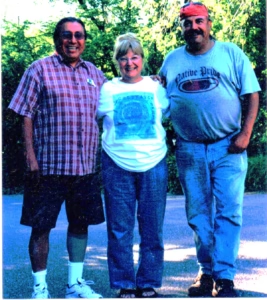
    Defendants in the 1805 Treaty trial (l. to r.) Chris Mato Nunpa (Two Bears), an elder from  Upper Sioux Reservation along the Minnesota River in Granite Falls, a Dakota first language speaker; Susu Jeffrey, FriendsofColdwater.org, and Jim Redsky Anderson, historian for the Mendota Mdewakanton Dakota Community.
    Had the case gone to trial the federals could lose nine miles of land on either side of the Mississippi from the confluence of the Minnesota and Mississippi (the b’dota) upstream to the falls called St. Anthony. That would mean losing Minneapolis, a chance the U.S. government did not want to take.

    This legality is the seed of the Dakota Land Back argument. Leventhal said the October 2005 “failure to obey a legal order” case was the third time the question of the legality of the 1805 “Pike” treaty reached federal court, only to have charges dismissed rather than to possibly lose Minneapolis, economic engine of Minnesota, to the Dakota oyate (nation).

    The Worldwide Water Crisis Comes Home

    In 1880 the Coldwater reservoir could furnish 921,600 gallons of water pumped out daily. (Historical Study, Former U.S. Bureau of Mines, Twin Cities Research Center, final report by Barbara J. Henning, 10/2002, p. 22.) The next flow rate measure was reported in the early 1990s with the Highway 55 reroute dispute as 130,00 gallons per day (gpd). In the intervening century-plus ten years “development” occurred with the loss of 791,000 gpd. More recently the 2024 Minnesota National River and Recreation Area flow rate for Coldwater Spring for the year 2024 was 69,552 gpd.

    Unfortunately, the Great Medicine Spring in Minneapolis’ Theodore Wirth Park was dewatered for Interstate-394 in the 1980s. Native people were known to come from “hundreds of miles” to collect the healing properties of that medicine, now forever gone. The only other major water source in Hennepin County is Frederick Miller Spring in Eden Prairie, which was recently saved from another upscale housing development.

    But for the people of Minneapolis only the much-reduced Mni Owe Sni, Coldwater, still flows. The ultimate irony of closing the dogs’ favorite dog park is that saving Coldwater Spring was the initiative of dog walkers throughout the 1990s. Hundreds and hundreds of signatures were collected by Park and River Alliance but no government office would accept the pile of citizen paperwork. The Alliance filed a lawsuit against the Highway 55 “reroute” through Minnehaha Park land and trees. The suit was dismissed on a technicality.

    “…Dogs are likely more sensitive than humans” to E.coli and blue green algae.  Apparently, the Minneapolis Chain of Lakes is not clean enough for dogs.

    While Park Board Commissioners voted out the Minnehaha Off-Leash Dog Park members repeatedly assured dog lovers that a new park featuring water would be on their to-do list. The problem is that the frequent toxicity of Minneapolis Lakes closes beaches with E.coli concentrations and blue-green algae blooms that sicken children and can quickly kill dogs.

    In a park commissioners’ move to mollify dog lovers, a new water park for dogs, probably at one of the lakes, would be located and opened. However Michael Sorenson, Water Resources Lead for the Minneapolis Park Board, says “it’s safest to keep dogs out of lakes. Dogs are likely more sensitive than humans” to E.coli and blue green algae. Apparently, the Minneapolis Chain of Lakes is not clean enough for dogs. He suggests giving dogs tap water to drink right before allowing them in a lake.
    In a park commissioners’ move to mollify dog lovers a new water park for dogs, probably at one of the lakes, would be located and opened. However Michael Sorenson, Water Resources Lead for the Minneapolis Park Board, says “it’s safest to keep dogs out of lakes. Dogs are likely more sensitive than humans” to E.coli and blue green algae. Apparently, the Minneapolis Chain of Lakes is not clean enough for dogs. He suggests giving dogs tap water to drink right before allowing them in a lake.

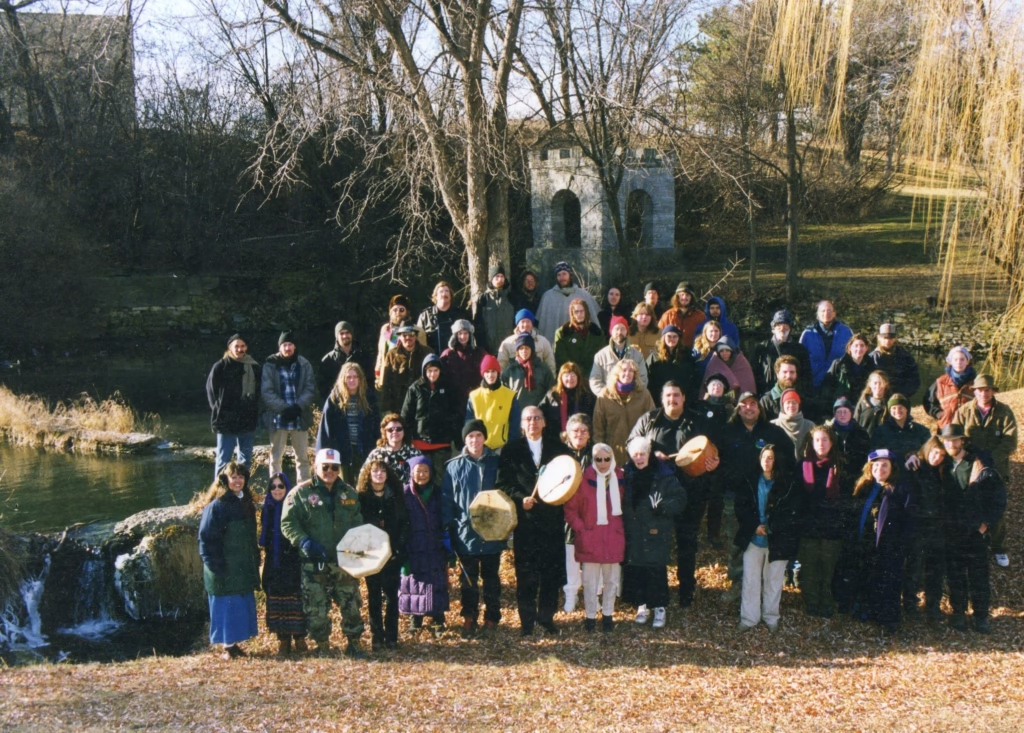
    COLDWATER GROUP PHOTO 1999

    Coldwater Nation at the pond and Spring House, 12/17/1999
    Photo: Dick Bancroft

    Coldwater is a survivor of the Highway 55 “reroute” dispute that resulted in the 17-month “Minnehaha Free State” encampment. Stop the Reroute/Save the Park featured the largest police action in Minnesota at the time with 802 officers arresting 38 land defenders at a cost of $15,000 per arrest during a blizzard on Christmas week 1998.

    The combination of earth protectors with federally recognized Indian leaders proved expensive for the city of Minneapolis, Hennepin County, the state of Minnesota, especially the Department of Transportation, but Coldwater
    became a popularity bonanza against government overreach. Two books and a movie documented the struggle and energized the Environment-Indian entente.

    The late Eddie Benton-Benai, a fullblood Anishinaabe from northern Wisconsin and Grand Chief of the Mdewiwin Lodge (Medicine Society), said the following in court-ordered testimony on 3/19/99. (Transcribed by Susu Jeffrey from an audio-visual tape of the testimony filmed by Michael Scott, documentarian, Mendota Mdewakanton Dakota Community.}

    We know that the falls which came to be known as Minnehaha Falls, was a sacred place, was a neutral place, a place for many nations to come. Between the falls and that point [where the rivers meet] there were sacred grounds that were mutually held to be a sacred place. And that all nations used to draw the sacred water for the ceremony.”

    Benai continued, “My grandfather who lived to be 108, died in 1942 [born 1834]. Many times he retold how we traveled, how he and his family, he as a small boy traveled by foot, by horse, by canoe to this great place to where there would be these great religious, spiritual events. And that they always camped between the falls and the sacred water place.”

    Benai identified the Anishinabe (Ojibwe) along with the Dakota Nation, the Sauk and Fox (Mesquakie), and the Pottawattamie as mutually using the land and agreeing “that it is forever a neutral place and forever a sacred place.”

    Susu Jeffrey is a poet and writer living in Minneapolis.


    Wings of Change is entirely reader supported.
    Wings invites you to subscribe.
    To subscribe: Join us on Wings of Change

    In this critical time hearing voices of truth is all the more important although censorship and attacks on truth-tellers are common. Support WingsofChange.me as we bring you important articles and journalism beyond the mainstream corporate media on the Wings of Change website and Rise Up Times on social media. Donate now to sustain Wings of Change.

    Access is always free, but if you would like to help:
    A donation of $25 or whatever you can donate will bring you articles and opinions from independent websites, writers, and journalists as well as a blog with the opinions and creative contributions by myself and others.

    Join us on Wings of Change

    We still have much work to continue to do as many activists and organizations address current threats to our democracy and unjust actions against people of color and are making plans for the upcoming years. Wings of Change is a part of that work through education, information, and inspiration.

    Sue Ann Martinson, Editor Wings of Change

    “We don’t have to engage in grand, heroic actions
    to participate in the process of change.
    Small acts, when multiplied by millions of people,
    can transform the world.”

    — Howard Zinn
  • PROTEST as TEACHER: The 21st Century Has Come of Age

    PROTEST as TEACHER: The 21st Century Has Come of Age

    A ballooning generational shift is challenging aged authority.

    PROTEST as TEACHER: The 21st Century Has Come of Age

    By Susu Jeffrey / Original to Wings of Change / April 8, 2026

    Melissa Olson’s (Minnesota Public Radio 3/9/26) article on the Native “Prayer Camp” at Mni Owe Sni (Coldwater) National Park lacked historic background. Indian people getting evicted from their land is an old story. At Coldwater Spring on May 5, 1820, Lt. Col. Henry Leavenworth marched to the spring and the U.S. government has never left. The military assumed exclusive control over the water and land that is still considered federally “owned” despite a doubtable treaty

    Olson actually wrote that the campers would leave the Prayer Camp in three days (on March 11). That did not happen. Protestors said no—no decision had been made and they wondered about the source of the information—if it was wishful (obedient) thinking in print.

    Indigenous Your camp across from Whipple Building

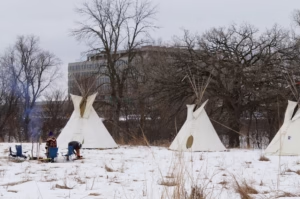
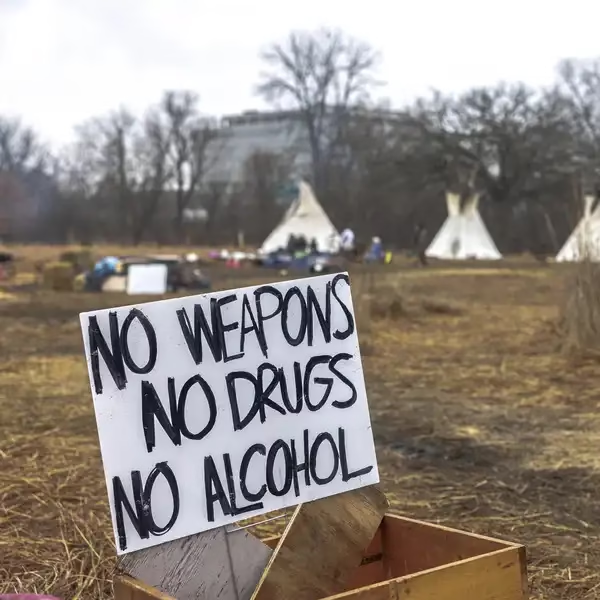
    The Whipple Federal Building where ICE and Border agents have run Operation Metro Surge for the last several months looms in the background of the Coldwater Springs camp near Fort Snelling. (Photo by Alex Baumhardt/Minnesota Reformer)

    Indigenous youth established the Prayer Camp on February 9, 2026 in order to hold a four-day ceremony on traditional Dakota sacred land in support of resident “illegal aliens” being incarcerated in what we now know are substandard prison-like conditions. Federal agents were using non-legal methods to capture foreign-looking civilians based on appearance, deception, location, lies and threats and in pursuit of fulfilling mandated 2,000 people per day arrest quotas.

    The Whipple federal seven-story building housing ICE (Immigrant and Customs Enforcement) and Border Patrol (CBP, Customs and Border Patrol) is an office building, not a jail where, for example, beds, medical personnel and toilet facilities for groups are not available. Whipple is the backdrop of the Prayer Camp.

    Simultaneously war fever was raging. The Trump and Netanyahu regimes were threatening war against Iran. Indeed on February 28, 2026, the U.S. and Israel launched hundreds and hundreds of missiles against Iranian leadership and military installations. The U.S.-Israeli War has been deemed illegal under international ”laws of war.” On April 7, President Trump threatened to “bomb Iran back to the stone age.” Ninety minutes before his deadline the president pulled his fourth “taco” (Trump always  chickens out), retreated, and called for a two-week ceasefire which Israel violated on April 8 by bombing Lebanon.

    The Whipple Building is located within Fort Snelling at 1 Federal Drive, federal land since the contentious 1805 “Pike” Treaty, just across the freeway from Mni Owe Sni parkland. Prayer Camp tipis, the camp ceremonial staff and sacred fire were set up in view of Whipple.

    Who Are the Real Indians?

    The real Indians are people enrolled in federally recognized tribes, sometimes called casino Indians. Thousands of people who consider themselves Indigenous, who observe Indian lifestyle practices in dress, food, holidays, religion and philosophy are excluded from the culture they identify with.

    There is a growing generational shift among younger Native-identified people who are challenging federally recognized Indian authority. A group of “legal” Indians amassed (at least one armed) at the Prayer Camp on March 5 and interrupted ceremonial plans. A confrontation of the legals with six younger camp leaders ensued with one legal getting arrested and the nonviolent campers feeling unheard. Prayer Camp organizers did not immediately agree to pack-up and leave as was expected.

    This armed, violent breech of the Native ethic of peaceful behavior in a sacred, therefore “neutral” place, was a profound cultural blow to the young prayer campers. The youths had set up a camp according to strict traditional practices, they were fasting, sweating, praying and smudging, and in come angry Dakota federally recognized officials trying to force a stop.

    The interrupters were apparently organized by Franky Jackson, Historic Preservation Officer for Prairie Island Reservation where more than 500 mounds have been counted from the long Native occupation of that Mississippi island area. Tragically now the island is home to two nuclear power reactors and a vast amount of hot nuclear waste. There is no national nuclear waste depository and no plan to ever move the dangerous garbage off-island. Instead the Indigenous people are being relocated.

    Another Prairie Islander, the late spiritual leader Chris Leith, was very involved in the earlier 1998-99 Minneapolis protest encampment. Leith taught that water is the first medicine for all living things. He said Coldwater is one of the dwelling places of Unktehi, a powerful Dakota water spirit with life-giving as well as destructive qualities.

    Leith instructed people to acknowledge, honor and respect this spirit by visiting and gifting the spring. He urged people to gather the medicine water whenever needed. Chris Leith’s gentle, positive teachings resulted in the Friends of Coldwater walks held on the day of the full moon each month for more than 25 years. In addition to a spiritual renewal walkers are treated to the changing roll of the wheel of the year.

    Franky Jackson and the legal Indians having failed to dislodge the younger Prayer Camp activists called-in Arvol Looking Horse, 72, from South Dakota, 19th generation carrier of the white buffalo calf pipe, spiritual leader of Lakota, Nakota and Dakota peoples. In an hours-long meeting around the sacred fire with Whipple Building lights glowing in the background, Looking Horse, wearing regalia, said the Prayer Camp should be abandoned because it was located on burial grounds.

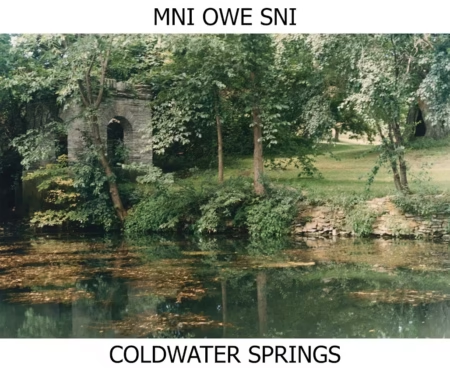
    Mni Owe Sni (water-spring-cold) is not a place of burials. It is a drinking water source, a 10,000-year-old spring running even under the last (Wisconsin) glacier down the Mississippi River gorge. All springs are sacred because all life requires water and springs are neutral, belonging to all, sites of life and peace.

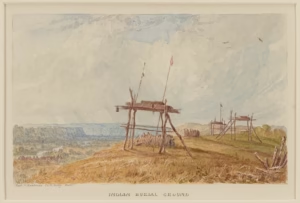
    INDIAN BURIAL GROUND “Indian graves at the mouth of the St. Peter’s” river (now Minnesota River) a watercolor by Seth Eastman. Pilot Knob, across from Ft. Snelling with the confluence of the Mississippi and Minnesota rivers below, was where birds would clean the bodies, the bones would fall to earth and be collected and interred.
    Photo: Minneapolis Institute of Art

    Adult bodies are about 70 percent water which corrupts and leaks out. That’s why you bury on a hill—and it’s closer to the sky god(s). Water obeys gravity and runs downhill. Springs surface when underground water veins run into bedrock. Springs are places where you have to bow, as in respect, to collect water.

    Jim Redsky Anderson, late cultural spokesman for the Mendota Mdewakanton Dakota Tribal Community, talked about Dakota burials west of Minneapolis on a hill above Lake Minnetonka since “all the good places were already taken.” Indigenous existence in the area of the rivers confluence was documented by state archaeologist Dr. Robert Clouse who found a 9,000-year-old bison spear point.

    Caught in the backwaters muck of the great rivers confluence the bison would have been brought down by a group of hunters and butchered on the spot, Clouse said, painting a word picture of the scene. The spear was rock from upstream near Mankato, Minnesota, where in 1862, 38 Dakota men were hanged in the largest mass hanging in the United States.

    It is unclear who misinformed Looking Horse about the history of Coldwater being a burial site since it is named Mni (water). Indian people are trained to respect elders, to never interrupt, to listen respectfully but it broke Looking Horse’s  credibility.

    The legal Minnesota tribes were not involved in the long 17-month encampment. The four recognized tribes are located outstate (away from the central business/government Minneapolis/St. Paul area) and did not support or participate in the earlier encampment that saved Coldwater from becoming a Twin Cities off-site airport parking lot.

    The 1998-99 Minnehaha Free State and Four Trees Spiritual Encampment protestors stayed and stayed (17 months) until the trees they were trying to save were cut along with the safety harnesses of people in the tree-sits. The road was built; however, the Minnesota Department of Transportation (MnDOT) was forced to raise the level of Highway 55 to protect underground flows to Coldwater Spring.

    The encampment slowed down the destruction/construction business-as-usual process and led to saving 27 acres of Mississippi bluff top, now a National Park. It allowed tribes time to apply for (paper) recognition of Coldwater as a Dakota Sacred Site according to the National Park Service’s many rules. For campers it was a commitment to the common goal, personal dignity and the power of nonviolent protest producing a class of healers, listeners and citizens risking “good trouble” rather than a plod-along life.

    In October 2005 two Dakota Natives and one non-native were ticketed at Coldwater Spring by federal authorities for “failure to obey a legal order.” Officials had blocked the entry to Coldwater with a locked gate and the three got inside, refused to leave and were ticketed. After fiddling around with the case for more than a year federal charges were dropped. It was not a ‘legal order,’ said the late Indian rights attorney Larry Leventhal because the Pike Treaty of 1805 was never verified. It’s hoo-ha.

    Had the case gone to trial the federals could lose nine miles of land on either side of the Mississippi from the confluence of the Minnesota and Mississippi (the b’dota) upstream to the falls now called St. Anthony. That would mean losing Minneapolis, a chance the U.S. government did not want to take.

    In other words, this is the seed of the Dakota Land Back argument. Leventhal said the case was the third time the question of the legality of the 1805 “Pike” treaty reached federal court, only to have charges dismissed rather than to possibly lose Minneapolis, the economic engine of Minnesota, to the Dakota oyate (nation).

    1805 to 1945

    Two years after the 1803 Louisiana Purchase, Lt. Zebulon Pike led a small detachment up the Mississippi River to see what the United States actually purchased from France. Without authority, Pike treated with two (of seven) Dakota headmen who agreed to the construction of two forts along the Mississippi but retained the rights “to pass, repass, hunt or make other uses of the said districts, as they have formerly done.”

    The 1805 (Pike) Treaty with the Sioux was ratified but never “proclaimed” and has always been of murky legality. Nevertheless the U.S. government and the state of Minnesota (admitted to the Union in 1858) has consistently acted as if the Coldwater property was signed over to the U.S. The Dakota wanted guns and European trade goods; the Americans wanted to establish authority and profitability. The warring of Dakota and Anishinabe was bad for the fur trade business. By the late 1830s military forces began to forcibly evict civilians away from the pioneer settlement called Camp Coldwater ostensibly to preserve game and firewood.

    In 1838 pioneer leader Abraham Perry, his wife and their six children were dispossessed when soldiers smashed their household goods, ripped off the roof and set the cabin on fire. Marie Ann Perry’s broken Spode China pieces still pop out of the ground in Spring after the thaw. She was the village midwife.

    Coldwater is considered by some to be ”The Birthplace of Minnesota” since the soldiers who built Fort Snelling 1820-23 lived beside the spring. Coldwater was the potable water source for the Fort for nearly a century and also for the civilian community that supported the Fort with wives, babysitters, servants, translators, guides, missionaries and further off-site, liquor. The village of Swiss, Canadian, Irish, English, Native and African Americans included the community midwife, farms, trading posts, B.F. Baker’s stone warehouse, a steamboat landing, the St. Louis Hotel, blacksmith shops and stables.

    Probably the most famous resident of Camp Coldwater and Fort Snelling was Dred Scott, who after returning to Missouri sued for his freedom from slavery in 1857 and lost because slaves were not considered citizens and therefore had no right to sue in the courts. The Dred Scott case is one of the most important cases in American history.

    Fort Snelling was supplied with drinking water from barrels filled at Coldwater reservoir and hauled by horse-drawn wagons. Four to ten wagons a day were required with six horses each and two men from 1823 until after the Civil War.

    In 1879-80 a coal-fired engine drew 921,600 gallons daily out of the Coldwater reservoir for storage in the water towers to supply Fort Snelling. From 1904 to 1930 supplemental water was drawn from a well at the base of a bluff along the Minnesota River. After 1930 Fort Snelling switched to water from the City of St. Paul. The nearby Veterans Administration used Minneapolis water beginning in the 1920s.

    1945 to 1991, the Cold War and After

    Coldwater was considered open parkland south of Minnehaha Regional Park until after World War II when by 1955 it was fenced off and developed into a secure Bureau of Mines cold war mining and metallurgy research facility. The research on venting mine air to prevent black lung disease was successful and spread worldwide as part of American postwar soft power largess. With the end of the Cold War in 1991 Russia lost its empire and the Bureau of Mines campus closed. Eleven buildings with offices, laboratories and warehouses were simply vacated and left to deteriorate.

    The invitingly empty land and buildings began to be frequented by neighborhood kids, the homeless and street drug business. At the same time the Sierra Club formed a lobby group of volunteers to Stop the Reroute of Highway 55 and Save the (Minnehaha) Park. Park and River Alliance collected 12,000 dogwalker signatures against the road expansion but no government office would accept the petitions. Their lawsuit against MnDOT was dismissed on a technicality.

    There was one emergency during the post-war Cold War period when national security was overruled and the public got past the six-foot chain link Coldwater fences. “In 1976 after months of draught,” wrote Carolyn Lyschik (10/21/2006) then of Minneapolis, “the city water developed an algae that was putrid and undrinkable by my husband who was very ill at the time. I made trips every other day to Coldwater Spring and stood in line to get the best tasting fresh water. We were so thankful for this vital resource. If it is still not polluted it should be a National Treasure!”

    In 1880 the Coldwater reservoir could furnish 921,600 gallons of water pumped out daily. (Historical Study, Former U.S. Bureau of Mines, Twin Cities Research Center, final report by Barbara J. Henning, 10/2002, p. 22.) The next flow rate measure was reported in the early 1990s with the Highway 55 reroute dispute as 130,00 gallons per day (gpd). In the intervening century-plus ten years “development” happened with the loss of 791,000 gpd. More recently the 2024 Minnesota National River and Recreation Area flow rate for Coldwater Spring for the year 2024 was 69,552 gpd.

    Yes, we have a water crisis in the state and city named after the Dakota word for water, MniMni waconi, pronounced Min-ne wa-cho-ni, translated “Water is life,” literally, water makes life.

    A looming emergency could be the thirst of AI when nuclear power’s electrically generated need for cooling water as well as data centers and electronic tech’s requirement for pristine water collide with domestic use. We can make a lot of things but not water (Desalinization plants don’t make water. They remove salt from some water and recycle the salt as hyper-saline coastal water piped out about a half mile where most edible sea life exists.)

    Unfortunately, the Great Medicine Spring in Minneapolis’ Theodore Wirth Park was dewatered for Interstate-394 in the 1980s. Native people were known to come from “hundreds of miles” to collect the healing properties of that medicine, now forever gone. The only other major water source in Hennepin County is Frederick Miller Spring in Eden Prairie which was recently saved from another upscale housing development.

    When Saying NO Isn’t Heard

    The “cult” around environmentalism started to take hold with noticeable climate changes. It was the mid-1990s; the proposed Highway 55 “reroute,” a freeway, got reduced to a four-lane highway. MnDOT really had to eat crow when Oklahoma Seminole repatriation expert Michael Haney testified about Iowa Indian remains in the area. State archeologist Dr. Robert Clouse found a 9,000-year-old bison spear point at the b’dota (Mississippi-Minnesota confluence) in Mendota in 1997. Polite opposition lost patience.

    In the fall of 1998 local enviro groups and national Earth First! began an encampment in south Minneapolis, soon joined by the Mendota Mdewakanton Dakota (non-federally recognized) Tribal Community. Neighbors hated the nightly drumming and singing. The press loved it and a bounty of public curiosity and donations poured in

    Finally on December 20th of Christmas week in 1998, 803 police descended on the camp to arrest about 30 people at a reported cost of $15,000 per arrest. A blizzard was roaring, the police were savage, protestors were stunned. The coffee, donuts, muffins and box lunches for police totaled $7,309.90. Three days later a new sacred fire was lit a few blocks south on open state land nearer Coldwater Springs and the Four Sacred Trees Spiritual Encampment was established.

    Unnecessarily brutal arrests continued throughout the Spring, Summer and Fall of 1999 as did community support. Trees were felled, tree-sits were devised to confront deforestation. On Thanksgiving seventeen turkeys were donated. On December 11, the second raid occurred with 26 arrests and the end of the four sacred trees.

    During the 1999 trial from the second raid the state maintained that “the oaks could not have been sacred because they were only 137 years old.” Subtract 137 from 1999 and you get 1862, the year of the Dakota Uprising. Thirteen-hundred Dakota people were imprisoned over winter on the Mississippi flats below Fort Snelling. The mass hanging of 38 Dakota men occurred the day after Christmas.

    It is believed the trees were planted when prisoner/hunters were released to provide meat for prisoners’ survival. The State wasn’t going to feed them. The state cruelly offered $200 for each Indian scalp, even into the early 1900s. Many Dakota and Ho Chunk people fled east to Wisconsin, north into Canada or west and south to become the Lakota and Nakota peoples.

    “We know that the falls which came to be known as Minnehaha Falls, was a sacred place, was a neutral place, a place for many nations to come,” the late Eddie Benton Benai, a fullblood Anishinabe from northern Wisconsin and Grand Chief of the Mdewiwin Lodge (Medicine Society), said in court-ordered testimony (3/19/99). “Between the falls and that point (where the rivers meet) there were sacred grounds that were mutually held to be a sacred place. And that all nations used to draw the sacred water for the ceremony.”

    Benai continued, “My grandfather who lived to be 108, died in 1942 (born 1834). Many times he retold how we traveled, how he and his family, he as a small boy traveled by foot, by horse, by canoe to this great place to where there would be these great religious, spiritual events. And that they always camped between the falls and the sacred water place.” Benai identified the Anishinabe (Ojibwe) along with the Dakota Nation, the Sauk and Fox (Mesquakie), and the Potowatamie as mutually using the land and agreeing “that it is forever a neutral place and forever a sacred place.”

    The arrests and clearing of the Four Trees in December 1999 for road construction was called ”the last raid”; however now, 27 years later, a new camp was born. On February 9, 2026 on acknowledged sacred Dakota land a “Prayer Camp” was established by Indigenous youth in this dark time of immigrant abuse and another Middle East War (possibly World War III). Their demand was to be able to hold a four-day ceremony.

    It took until March 15, 35 days, to hold the uninterrupted four-day ceremony and clear the Prayer Camp. It was as popular as a skunk to establishment Indian and white authorities.

    In 1999 both Dakota and Anishinabe elders testified about planting four trees in the cardinal directions to point to sacred landscapes. Several examples are known to exist. Meanwhile Dan the Oakman cut tips of the horizontal great oaks as instructed by the International Oak Society, dipped them in hydrogen peroxide, sealed them in wax and shipped them off to southern Illinois to be grafted onto baby burr oaks. “You can’t graft oaks,” they say. Two years later former campers took a road trip to bring home the sacred oaks which were planted on a Mississippi bluff in Mendota and are producing lots of acorns.

    In 2003 the late U.S. Representative Martin O. Sabo secured a $750,000 appropriation to update the Bureau of Mines Cold War research campus from an abandoned industrial site to “open green space.” It was a great disappointment to MAC; the Metropolitan Airports Commission wanted the land above the Mississippi gorge for off-site parking. Every federally recognized Minnesota  Indigenous group plus others in the Great Lakes and Midwest applied to manage Coldwater. Dakota and Lakota tribes in Minnesota and neighboring states filled out the paperwork to have Coldwater declared a Dakota sacred site. One National Park superintendent had the audacity to claim “we own Coldwater.”

    COLDWATER SPRINGSOwning water is a slippery concept. In favor of peace and neutrality Representative Sabo had the wisdom to legislate Coldwater Spring/Mni Owe Sni into “open green space,” a place of its own, a place apart. We are 26 years into a new millennium facing “global water bankruptcy” with aged authorities making war against each other using suicidal weaponry. Meanwhile eight million Americans are demonstrating for change and Native youth are fasting and praying for life. Consider ever-flowing 10,000-year-old Coldwater.

    Susu Jeffrey is a poet and writer living in Minneapolis.


    Wings of Change is entirely reader supported.
    Wings invites you to subscribe.
    To subscribe: Join us on Wings of Change

    In this critical time hearing voices of truth is all the more important although censorship and attacks on truth-tellers are common. Support WingsofChange.me as we bring you important articles and journalism beyond the mainstream corporate media on the Wings of Change website and Rise Up Times on social media. Donate now to sustain Wings of Change.

    Access is always free, but if you would like to help:
    A donation of $25 or whatever you can donate will bring you articles and opinions from independent websites, writers, and journalists as well as a blog with the opinions and creative contributions by myself and others.

    Join us on Wings of Change

    We still have much work to continue to do as many activists and organizations address current threats to our democracy and unjust actions against people of color and are making plans for the upcoming years. Wings of Change is a part of that work through education, information, and inspiration. Here in Minnesota we are particularly targeted by the Trump regime with ICE immigrant law enforcement illegally arresting and deporting our neighbors who are mostly people of color. In spite of promises to withdraw ICE, the arrests continue. Other cities have been targeted as well, and they will try to target more to fill the detention centers they are building all over the country.

    Sue Ann Martinson, Editor Wings of Change

    “We don’t have to engage in grand, heroic actions
    to participate in the process of change.
    Small acts, when multiplied by millions of people,
    can transform the world.”

    — Howard Zinn