Tag: climate crisis

  • DN! COP30 Report: The Amazon Tipping Point, Fossil Fuel Phaseout, Climate-induced Migration

    DN! COP30 Report: The Amazon Tipping Point, Fossil Fuel Phaseout, Climate-induced Migration

    The Race to Save the Amazon: Top Brazilian Scientist Says Rainforest Is at “Tipping Point”

    Amy Goodman interviews scientist Carlos Nobre / Democracy Now! / November 20, 2025

    AMY GOODMAN : As we broadcast from the COP30 climate summit in Belém, Brazil, we are joined by one of Brazil’s most prominent scientists, [Nobel Prize winner] Carlos Nobre, who says the Amazon now produces more carbon emissions than it removes from the atmosphere, moving closer to a “tipping point” after which it will be impossible to save the world’s largest rainforest. “We need urgently to get to zero deforestation in all Brazilian biomes, especially the Amazon,” he argues. (See full transcript below.)


    StoryNov 20, 2025 Democracy Now!

    Brazilian Indigenous Minister Sônia Guajajara on Fossil Fuel Phaseout, Bolsonaro’s Conviction & More

    SÔNIA GUAJAJARA[translated] It’s always a challenge. It’s really — it’s not simple. It’s hard, because there is a dispute, a big one, with the economic sectors, so that these changes do not happen. So we need to make sure that agreements done at COP and commitments done at COP can tackle this, because the world knows the impact that oil exploitation, fossil fuels does, the risk of us achieving the point of no return, but these sectors, the economic sectors, need to understand this is an emergency. So we need to have, like, a clear decision here in this conference to stop depending on fossil fuel.

    _____________________

    StoryNov 20, 2025  Democracy Now!

    Climate Crisis Displaces 250 Million Over a Decade While U.S. & Other Polluting Nations Close Borders

    “This is not abstract,” Nikki Reisch, director of climate and energy at the Center for International Environmental Law, says of climate-induced migration. “This is about real lives. It’s about survival. It’s about human rights and dignity, and, ultimately, about justice.”

    Trump’s Response to COP30

    Trump sends no formal U.S. delegation at COP30: Here is Trump’s response as he is determined to destroy the planet and continues his own version of genocide against the Least Developed Countires (LTC) that are most affected by global warming caused by fossil fuels. Meanwhile 80 nations at COP30 have signed on to plan to phase-out fossil fuels.

    Trump Saudi Arabia© Evan Vucci

    The Trump administration announced on Thursday new oil drilling off the California and Florida coasts for the first time in decades, advancing a project that critics say could harm coastal communities and ecosystems, as President Donald Trump seeks to expand U.S. oil production.

    More than 80 countries at Cop30 join call for roadmap to fossil fuel phaseout

    Countries from Africa, Asia, Latin America, Pacific and Europe plead for transition to be central outcome of talks.

    Transcript
    This is a rush transcript. Copy may not be in its final form.

    AMY GOODMAN: This is Democracy Now!, democracynow.org. We’re broadcasting at the U.N. climate summit, COP30, here in the Brazilian city of Belém, the gateway to the Amazon rainforest. I’m Amy Goodman, with Nermeen Shaikh. As we broadcast, there’s a protest right behind us by the Loss and Damage Youth Coalition, where they are holding a banner that reads, “From opinion to obligation, respond to loss and damage.”

    NERMEEN SHAIKH: We end today’s show with one of Brazil’s most prominent scientists, Dr. Carlos Nobre. He’s a senior researcher at the Institute of Advanced Studies at the University of São Paulo and co-chair of the Scientific Panel for the Amazon. He’s a lead author of the U.N.’s Intergovernmental Panel on Climate Change, or IPCC, that won a Nobel Peace Prize in 2007 for its reports on global warming.

    AMY GOODMAN: For decades, Carlos Nobre has been warning the Amazon rainforest is being pushed beyond the tipping point. The Amazon rainforest is almost as large as the contiguous United States.

    Carlos Nobre, welcome to Democracy Now! It’s an honor to be in your presence. You have been warning for quite some time, and now it’s getting more serious than ever. What is the tipping point? And for a lay audience around the world, explain to us why the biome of the Amazon rainforest is so important for the world.

    CARLOS NOBRE: Good morning. Thank you very much.

    Yes, I’ve been working for 43 years with the Amazon. I was the first scientist, 1990, 1991, publishing a science article saying if we continue with very high deforestation, the Amazon would cross the tipping point. But that was 1990, ’91, 36 years ago. Now the Amazon is very close to the tipping point.

    Why do we say that? Because from the Atlantic to Bolivia, Peru and Colombia, this is 2.5 million square kilometers. The whole forest, close to 7 million square kilometers, but this southern portion, very close to tipping point. The dry season is four to five weeks’ length here — in 45 years, one week per decade. It was three, four months, but with rain during the dry season. Now it’s four to five months, 20, 30% drier, two, three degrees warmer. And also, tree mortality has increased a lot in these areas. In the southeastern Amazon, south of where we are, the forest has become a carbon source. It’s losing more carbon than removing.

    So, if we continue — deforestation is about 18%, degradation 30% — if we reach 20, 25% deforestation, global warming close to two degrees, we cross permanently the tipping point. We are going to lose up to 70% of the Amazon within 30 to 50 years. If we continue with global warming, deforestation, we reach the tipping point by 2040. So, by 27 — 2100, we’re going to lose 70% of the Amazon. We’ll release more than 250 billion tons of carbon dioxide to the atmosphere, making it impossible to maintain the global warming at 1.5 degrees. We are going to lose the highest biodiversity in the planet. So, terrible.

    And also, the Amazon recycles water so well that about 45% of the water vapor that comes from the Atlantic Ocean, transported by the trade winds, goes to the south of the Amazon and feeds more than 50% of rainfall on the tropical savanna south of the Amazon, so — and also the Atlantic rainforest. So, it’s really essential. If we lose the Amazon, not only the Amazon forest will disappear, but the tropical savanna, as well.

    NERMEEN SHAIKH: If you could also talk, Dr. Nobre — in addition to increasing heat and the dryness that you talked about, you’ve also said that livestock grazing is a form of ecological pollution. Now, Brazil is the world’s second-largest producer of beef. If you could talk about what the impact of cattle ranching has been on this deforestation of the Amazon?

    CARLOS NOBRE: Yes, of course. I mean, 90% of the deforestation in the lowlands in the Amazon in Brazil is related to cattle ranches. And when we compute, Brazil is the only country in the world where 70% of fossil fuel emissions, greenhouse gas emissions, come from land use change, about 70% of emissions, 40% deforestation. And about 20, 25% of this comes from agriculture, but mostly for cattle ranches. Particularly, the cattle emits a lot of methane, so — all ruminants. So, we say 55% of emissions in Brazil related to livestock, you know, the deforestation for cattle ranches and also the cattle emitting methane.

    So, really, we need urgently to get to zero deforestation in all Brazilian biomes, especially the Amazon, and also merging to the so-called regenerative livestock. Regenerative livestock. We have about 15% in Brazil of regenerative livestock, and very little. The regenerative livestock makes — reduces a lot emissions by livestock.

    NERMEEN SHAIKH: And, you know, in Brazil, as you well know, Brazil is one of the world’s largest agricultural exporters, which means the alternative that you mentioned may compensate, but presumably it would be a massive economic loss to Brazil if their agricultural production were to go down. But as you were mentioning earlier, though, there has been a commitment by countries here to work on a roadmap to get to zero deforestation by 2030. So there is an agreement there, whereas there is not a majority of countries signing up to the roadmap to phasing out fossil fuels. So, if you could just talk about, I mean, the countries that are, in part, dependent on agricultural exports, what would it mean to diminish cattle ranching? And, I mean, you’ve become, in fact, vegetarian as a result of this.

    CARLOS NOBRE: Oh, listen, mostly livestock average productivity is very low. Brazil has about 1.5 heads of cattle per hectare. This is very little. Brazil has about 3.2 million square kilometers, mostly livestock and also agricultural. So, regenerative livestock will have three to five heads of cattle per hectare, reduce emission, and also the regenerative agriculture and livestock is much more resilient to the climate extremes. For instance, last year, Brazil had a record-breaking drought in the Amazon tropical savanna, Cerrado, and a record-breaking number — decline of agricultural productivity. So, therefore, Brazil can continue being a tremendous high producer of meat, agriculture, soy grains, using not 3.2 million square kilometers, but maximum 2 million square kilometers.

    AMY GOODMAN: I want to ask you a question about climate science. You have said that it’s a mystery to you, the country which invested the most in climate science, a country with the largest number of climate scientists and very few who deny climate change, which contributed the most to the IPCC report — how is it possible this country elected a climate denier? And we’re talking about the United States. But talk about the significance of the billions of dollars being removed from science research in the United States, and the effect that has all over the world?

    CARLOS NOBRE: Well, that’s a very good question, because, in fact, I mean, I create a name, because all tipping points that we know in the climate, more than 20, they are all associated with ecological, biological, hydrological, ocean-related tipping points. But I’m thinking how the world, in democracies, we are creating a, quote, quote-unquote, “a social/political tipping point,” which is — it’s not only in the U.S. In many countries in the world, democracies, we are electing more and more populist politicians — U.S. President Trump, Argentina President Milei. Brazil elected a former president, Bolsonaro, totally climate denier. Deforestation increased a lot in those four years. That’s happening all over the planet. So, this is a — I even gave a name in the West. I said this social/political tipping point is the “trumping point.” Why we are, in democracies — as you mentioned, the country with the top science on climate change, U.S., always, for decades — why U.S. democracy electors are electing a climate-denier president? This is very serious.

    NERMEEN SHAIKH: And you’ve said, Dr. Nobre — I mean, it’s remarkable, as you said, with these right-wing governments, being led in part by Donald Trump, the fact that this roadmap to deforestation was agreed. You’ve said that COP30 is a critical meeting of — a critical climate summit. Explain why, and what you hope is going to come out of this. It’s formally concluding tomorrow, but it regularly goes beyond that date.

    CARLOS NOBRE: Yes, that’s a very good point, because all of us scientists, we say this COP30 has to be very important, I mean, as important as Paris Agreement, as important as COP26, when all countries agree in reducing emissions. But now we have to accelerate reducing emissions.

    Yesterday, we, the Planetary Science Pavilion people, we hand-delivered our declaration to all negotiators, and I hand-delivered to President Lula, as well. We say, in addition to zero deforestation in all biomes, tropical forests by 2030, we have to accelerate reducing of emission by fossil fuels. We say, ideally, zero fossil fuel emissions by 2040, no longer than 2045 — no questions, because the temperature is reaching 1.5 degrees within five to 10 years permanently. If we only get to net-zero emissions by 2050, we may reach two degrees and even more. It will be a tragedy, an ecocide for the planet.

    And when I presented this document to President Lula, he said also — four times, he said — I was in a meeting with him. He said, “This has to be the most important COP of all COPs.” Let’s hope, in two days now, countries will agree not only zero deforestation in all tropical forests by 2030, but zero fossil fuel emissions —

    AMY GOODMAN: Ten seconds.

    CARLOS NOBRE: — by 2040.

    AMY GOODMAN: We want to thank you so much, Carlos Nobre, leading Brazilian scientist, world-renowned climatologist, senior researcher at the Institute of Advanced Studies at the University of São Paulo, co-chair of the Scientific Panel for the Amazon, where we are right now. We’re in Belém, the gateway of the Amazon. I’m Amy Goodman, with Nermeen Shaikh.

    The original content of this program is licensed under a Creative Commons Attribution-Noncommercial-No Derivative Works 3.0 United States License. Please attribute legal copies of this work to democracynow.org. Some of the work(s) that this program incorporates, however, may be separately licensed. For further information or additional permissions, contact us.


    Rise Up Times is entirely reader supported.

    In this critical time in hearing the voices of truth is all the more important although censorship and attacks on truth-tellers are common. Support WingsofChange.me as we bring you important articles and journalism beyond the mainstream corporate media on the Wings of Change website and Rise Up Times on social media  Access is alway free, but if you would like to help:
    A donation of $25 or whatever you can donate will bring you articles and opinions from independent websites, writers, and journalists as well as a blog with the opinions and creative contributions by myself and others

     Subscribe: Join us on Wings of Change

    Note: to reach the Wings of Change website quickly type the full .url in the search engine of your choice: wingsofchange.me

    Sue Ann Martinson, Writer, Editor Wings of Change

  • Scores of Climate Experts Condemn Trump Climate Report as ‘Junk Science’

    THERE IS JO PLANET BA 435-page review found the authors used standard climate denier tropes to produce a report riddled with errors.
     

    Scores of Climate Experts Condemn Trump Climate Report as ‘Junk Science’

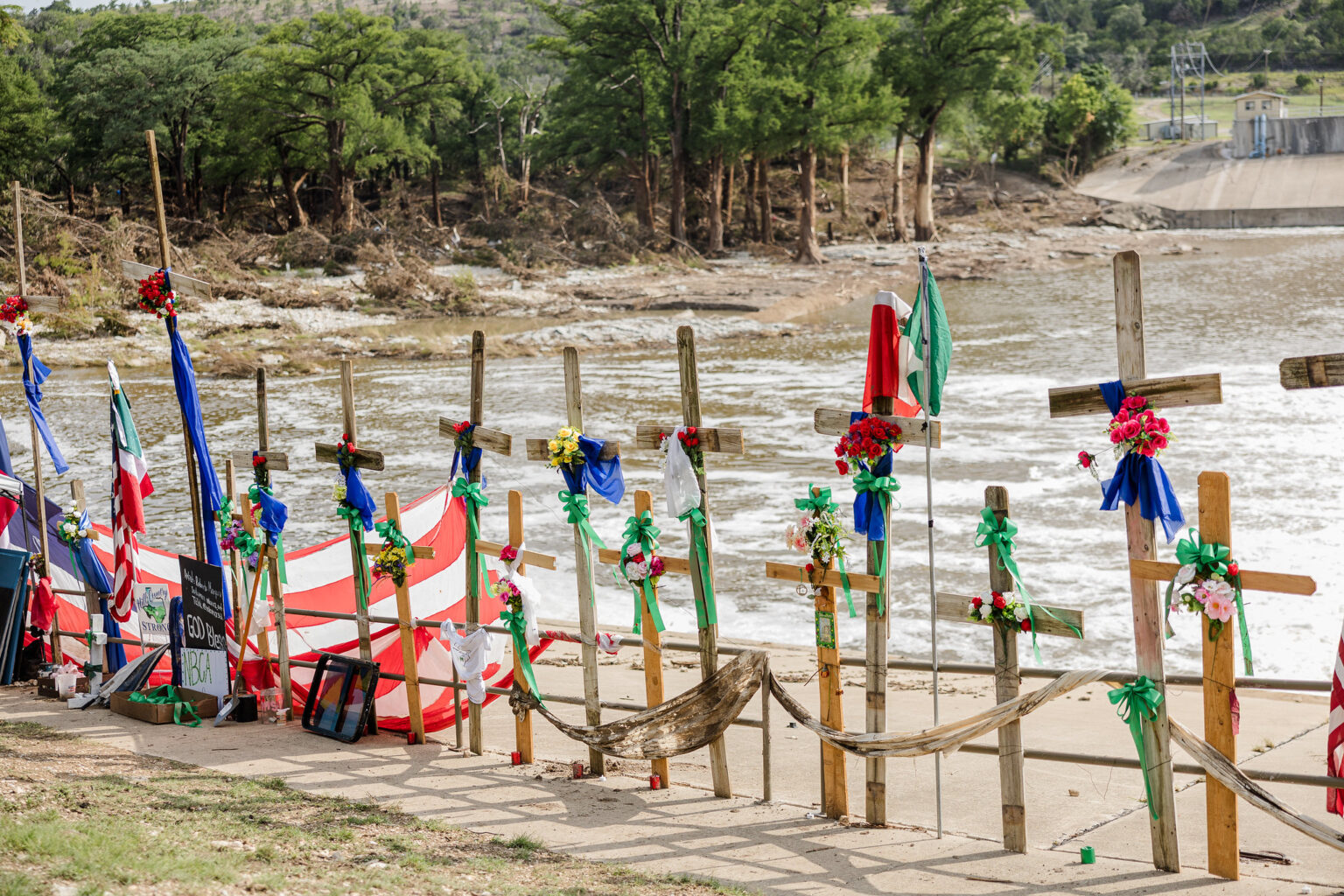
    A growing memorial of wooden crosses lines the banks of the Guadalupe River in Kerr County, part of a riverside installation by Dallas artist Roberto Marquez to honor the more than 100 victims of Central Texas’s deadly July 4 flash floods. The crosses — some fashioned from debris swept up by the torrent of the Guadalupe River — stand against the backdrop of its surging waters, the sound of rushing currents filling the air as the community continues to mourn and search for those still missing.Memorials for some of the more than 100 people killed in July 2025’s catastrophic flash flooding in central Texas, which was intensified by climate change. Credit: source/credit info: World Central Kitchen (CC BY 4.0)

    By Sharon Kelly and Emily J Gertz / DeSmog International / Series: MAGA

    Analysis

    A group of more than 85 climate experts today released a scathing review of the Trump administration’s “Climate Working Group” report on climate change science, condemning it as “biased, full of errors, and not fit to inform policymaking.”

    The reviewers include MacArthur “Genius” Fellows, a half-dozen members of the National Academy of SciencesRoyal Society fellows, and fellows from other prominent scientific organizations including the American Meteorological Society, which issued its own separate statement criticizing the Climate Working Group report.

    They found that the federal report “exhibits pervasive problems with misrepresentation and selective citation of the scientific literature, cherry-picking of data, and faulty or absent statistics” in order “to downplay the risks of record-breaking heat, intense rainfall, worsening wildfires, rising sea levels, and widespread health harms – all well-established by decades of peer-reviewed science.”

    The Trump administration’s report was authored by five longtime climate deniers — Steve KooninJohn ChristyRoss McKitrickJudith Curry, and Roy Spencer —as part of its effort to gut federal powers to regulate climate-heating pollution from cars, power plants, and other major sources. The Department of Energy (DOE) released it on July 29.

    On the same day the Trump report was released, Environmental Protection Agency Administrator Lee Zeldin announced the agency’s proposal to rescind the foundation of those regulations: its scientific “endangerment finding” affirming that carbon pollution threatens human health and welfare by creating dangerous planetary warming.

    Texas A&M climate scientist Andrew Dessler organized the volunteer effort to review the report, which is being submitted to the Department of Energy during the public comment period that closes on September 2. The public comment period on the EPA’s proposal is open through September 22.

    Announcing the release of the review this morning on his personal blog, Dessler termed the Trump report “a show trial for climate science.

    “Like any good Soviet trial, the outcome of this exercise by the Dept. of Energy is already known: climate science will be judged too uncertain to justify the endangerment finding,” Dessler said. “Once you understand that, everything about the DOE report makes total sense. You understand why the five contrarian authors were selected: The only way to get this report was to pick these authors. If any other writing team had been chosen, the report would have been 180° different.”

    The Trump report’s authors have previously defended their work, telling the journal Nature that they are “committed to a transparent and fact-based dialogue on climate science and know from long experience that scientific criticism and rebuttal are essential to that process.”

    In response to a request for comment, Curry referred reporters to her blog, where she described the Dessler review as “comprehensive” and a “laudable effort,” noting that it “was prepared in 30 days (sort of weakens the argument that the DOE report was written too quickly, ha ha).”

    The Energy Department’s public comment period on the report was set for 30 days, rather than a more typical 60 days. The agency has not announced an extension.

    After “skimming” the review, Curry said, she “didn’t spot anything in this report that would lead to changing any of the conclusions in the DOE Report.”

    The four other members of the Climate Working Group, as well as the Energy Department, did not immediately respond to a request for comment.

    “A Wonderful Example of Junk Science”

    The Trump report “is a travesty for U.S. scientific integrity,” said Ryan Katz-Rosene of the University of Ottawa, an expert on climate and sustainability policies and politics, in a statement. “It reads like a list of common climate skeptic tropes — long ago rebutted by the scientific community — being rehashed by a group of disgruntled scientists.”

    The 435-page expert review found that the Trump climate report exhibited a pattern of questionable reasoning, as well as dozens of factual and structural flaws — such as relying on “verifiably flawed and unrepresentative [scientific] literature.”

    It was also riddled with typos, scrambled citations, unsupported claims about climate science, and references to research or data that the reviewers could not find, along with at least one manufactured quote.

    These sorts of errors have become associated with AI slop, though the reviewers didn’t speculate whether the report’s five authors — who the expert reviewers described in a statement as a “tiny team of hand-picked contrarians” — used AI to write their report.

    “I always like to find a silver lining,” climate scientist Andy Miller, a 33-year EPA veteran, said in a statement. “In this case the silver lining is that this document is a wonderful example of junk science that can be used as an example for years to come.”

    Koonin, Curry, and their co-authors used several climate disinformation tactics in their report. Here are just a few.

    Omitting Evidence

    The review found many instances where the Trump report left out vital details — sometimes entire fields of study — that would undercut the administration’s case for deregulation.

    “The only mention of the oceans throughout the entire report is in the context of ocean acidification, coral reefs, and sea level rise,” the review noted. “The glaring omission of the myriad impacts of climate change on the ocean — marine heat waves, changing species distributions, changes in ocean circulation, increased harmful algal blooms, coastal erosion, and economic impacts on commercially valuable fisheries to name a few — is a significant problem with the report.”

    The report also has a bad case of “selection bias,” by elevating minor issues or weak science over well-established and strong science, or issues vital to climate action.

    In one instance, the Trump team heavily downplayed the scientific research at the heart of the Paris Agreement’s nitty-gritty methodologies for measuring carbon emissions, and put a more marginal approach at the center instead.

    “For a report claiming to be a ‘Critical Review’ of greenhouse gas impacts to entirely ignore the primary scientific framework for international and national climate policy is an inexplicable and scientifically unjustifiable omission,” the review concluded.

    In sections where Trump’s climate team claimed that there were no long-term extreme weather trends associated with climate change — such as more frequent and destructive floods and hurricanes —  the review found that they left out key findings that contradicted their conclusion, cherry-picked studies, quoted research out of context, and used outdated materials instead of the best available science.

    The five authors used similar tactics to slant sections on tornadoes and wildfires.

    Zombie Arguments

    The Trump administration report raises questions about climate change that have been asked and answered — repeatedly.  Rehashing these long-settled scientific debates created an opportunity for the report’s authors to deny the fundamental cause of the climate crisis: burning fossil fuels.

    “Those sorts of back-from-the-dead arguments [create] a ‘zombie argument’ that is inconsistent with the state of the best available science,” the expert review concluded.

    One such resurrected claim pointed to record-breaking high temperatures in the 1930s to dismiss climate change as a factor in recent heat waves. However, many of these records have fallen since 2000. “[I]n our calculation, the most recent few years have had as many record-breaking high temperatures as the 1930s,” the review notes. “In fact, the year with the most record-breaking hot days is 2023.”

    The federal report sometimes griped about the absence of their claims from recent Intergovernmental Panel on Climate Change surveys of the best-available science, without acknowledging that climate scientists have moved on from those questions for good reasons.

    “So much literature has been produced to refute the claims of the [Climate Working Group] report authors, and over so long a time period,” the review pointed out, “that these claims are no longer part of the active scientific debate.”

    Echo Chambers

    The Trump administration’s five authors relied heavily on citations to their own climate-related research and analyses, the review found.

    Overall, 11 percent of the report’s citations were self-citations, according to the review — roughly two to four times more than the self-citations in the climate science overview released by the Intergovernmental Panel on Climate Change in 2021.

    In a couple of chapters, the self-citations numbered more than one out of every four.

    This echo chamber of self-citations pushes out other, peer-reviewed and published science on the same topics, “of which there is plenty,” according to the expert review.

    Word Games

    The expert review found that conclusions reached by the Trump team sometimes relied on incorrect uses of scientific terms in ways that favored climate denial.

    In one example, reviewers explained that the term ocean acidification “is not used in a way to indicate that the ocean is becoming an acid,” but “the more commonly used term for the phenomena of ocean carbonate chemistry changes because it provides a straightforward terminology to describing the declining pH of the ocean.”

    Elsewhere, the Trump team uses the term “greening” in a misleading way that “implies ‘greening’ is an expansion of vegetation into areas that were previously non-vegetated,“ the review found. This is a key mistake because the report “thus incorrectly interprets the literature on ‘greening’ throughout this section.”

    The Endangerment Finding, Endangered

    Opponents of greenhouse gas cuts have worked for decades to block or overturn the federal government’s power to regulate them.

    The legal basis for this authority is the EPA endangerment finding that — despite being credited to the Obama-Biden administration by Trump officials — dates back to George W. Bush’s second term as president.

    In 2007, the U.S. Supreme Court ruled, in lawsuit brought by Massachusetts and several other states, that CO2, methane, and four other greenhouse gases are pollutants under the Clean Air Act. In the ruling the court also found that under the Clean Air Act, the EPA had a duty under to analyze whether they endanger public health or welfare and — if so — to regulate sources of carbon pollution.

    In response to this decision, the EPA produced its endangerment finding. Rather than regulate carbon pollution, however, the Bush White House suppressed the document.

    In 2009 the Obama White House released the finding, and began establishing rules under the Clean Air Act to cap and cut carbon pollution from motor vehicles as well as power plants and other industrial sources.

    Since then, as DeSmog has previously reported, a powerful anti-climate coalition of politicians, oil companies, trade groups, and right-wing networks has been trying to overturn the endangerment finding, culminating in Project 2025 — the extreme-right blueprint for transforming the federal government.

    Project 2025’s chapter on the EPA, which mentions “updating” the 2009 endangerment finding, was written in part by Aaron Szabo, now a high-level Trump appointee to the agency.

    The director of the White House Office of Management and Budget, Russ Vought, was one of the main architects of Project 2025, and has publicly supported rescinding the endangerment finding.

    Some members of the Trump climate working group were also part of his first administration. Steve Koonin, a physicist, advised the government on climate change during Trump’s first term, and atmospheric scientist John Christy was on the EPA’s Science Advisory Board.

    Another Trump report co-author, climatologist Judith Curry, was a paid witness for the state of Montana during a 2023 trial on whether the state’s promotion of fossil fuels violated its constitution. The 16 young Montana residents who sued the state won that case.

    UPDATE Sept. 2, 2025: This story has been updated to include a statement from Judith Curry, and to correct the end date of the public comment period for the EPA’s proposal to rescind the endangerment finding.


    Join me on Wings of Change. We still have so much work to do as activists and organizations make plans for the upcoming months and years. Wings of Change is pleased and excited to be a part of that work through education, information, and inspiration.

    Subscribe to Wings of Change here!

    Donate

    Whatever you are able donate will bring you articles and opinions from independent websites, writers, and journalists as well as a blog with opinions and creative contributions.

    Sue Ann Martinson

    One place to begin is with reason and truth, and how fundamental they are to creating critically engaged citizens and communities. 

    —Henry A. Giroux

  • DN! “Duty to Repair”: IJC Declares States Legally Responsible for Climate Harm

    DN! “Duty to Repair”: IJC Declares States Legally Responsible for Climate Harm

    CLIMATE: “Duty to Repair”

    Vanuatu Climate Minister on World Court Ruling Countries Must Address Climate

    In a landmark decision, the International Court of Justice found that polluting countries are now legally obligated to address global warming. In a unanimous ruling by a panel of 15 judges, the court said high-emitting countries do have legal obligations under international law to address the “urgent and existential threat” of climate change. The case was brought forward by the island nation Vanuatu, which has faced the brunt of the climate crisis with extreme weather events and rising sea levels.


    In this critical time in our country hearing the voices of truth and engaging in honest discussion for critical issues is all the more important while censorship (and outright lies) along with attacks on truth-tellers are common. Support the WingsofChange.me website and Rise Up Times on social media as we to bring you important articles and journalism beyond the mainstream corporate media. Access is alway free, but if you would like to help:
    Whatever you are able donate will bring you articles and opinions from independent websites, writers, and journalists as well as a blog with the opinions and creative contributions.

    Rise Up Times is still active on social media under the name Rise Up Times.

    Or mail a check to Sue Ann Martinson to 2900 11th Ave So, Unit #209, Minneapolis MN  55407 with “Wings” on the Memo line.

    PLEASE SHARE WIDELY ON RISE UP TIMES SOCIAL MEDIA

    • Visit, and encourage your friends to visit, the Rise Up Times Facebook page and from Messenger or the Tumblr, Linked In, and Pinterest Rise Up Times pages or my personal Facebook page, Sue Ann Martinson
    • On Instagram and Tik Tok under Rise Up Times.
    • Also on Instagram, my personal page under Sue Ann Martinson, seas.nun
    • Read and Retweet from Rise Up Times Twitter [X] account @touchpeace.
    • Articles can also be shared from the social media listed above as well as from the Rise Up Times Instagram and Tik Tok pages.
    • Print copies of articles or visuals in Rise Up Times and leave them in your favorite bookstore, coffee shop, etc. and share with friends.
    Wings of Change Feather“We don’t have to engage in grand, heroic actions
    to participate in the process of change.
    Small acts, when multiplied by millions of people,
    can transform the world.”