Tag: climate change

  • COP30: Handwringing at the UN Climate Talks, by Inside Climate News

    COP30: Handwringing at the UN Climate Talks, by Inside Climate News

    DONATE TO WINGS OF CHANGE TODAY

    Editor’s Note: Many analyses summarizing the COP30 Climate conference have appeared by mainstream corporate media and by others. This analysis is not mainstream corporate media. I found the analysis of the internal workings of the conference and paticularly the role of the U.S. even though there was no formal delegation this year, as Trump refused to attend and to send a delegation.

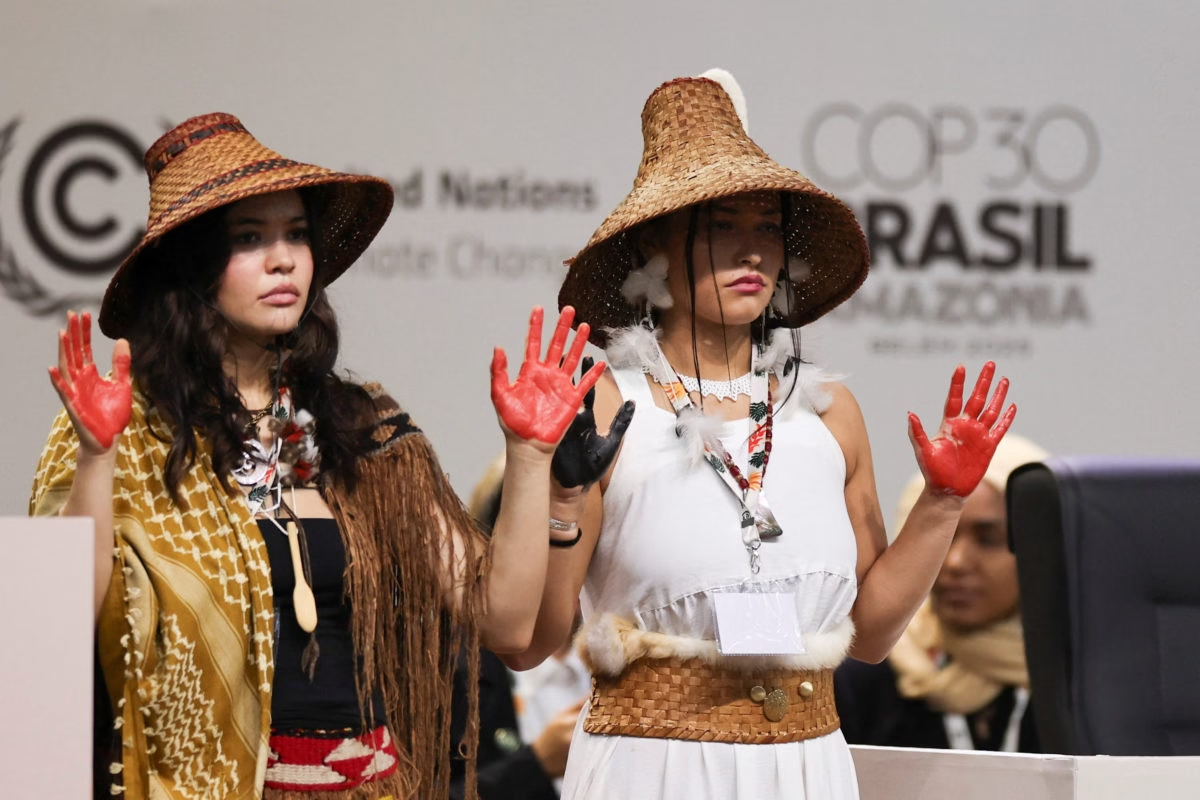
    Go behind the scenes with executive editor Vernon Loeb and climate science reporter Bob Berwyn as they break down the key outcomes of COP30. COP30 has wound down in Belém, Brazil – the U.N. climate change conference marked this year by Indigenous rights demonstrations, an actual fire, and not a lot of movement on global climate action. Before leaving Belém, Bob explains what happened at COP30, both within the formal proceedings and adjacent to them; how American influence was woven into the process; and what to look for leading up to next year’s COP31 in Turkey.


    The INC video above does not include mention of the announcement of this Initiative:

    Colombia and The Netherlands Announce First Fossil Fuel Non-Proliferation Initiative …

    The Fossil Fuel Non-Proliferation Treaty Initiative

    Belém, Brazil – As COP30 negotiations draw to an end, and the most recent text released this morning makes no mention of fossil fuels, the Governments of Colombia and the Netherlands show leadership by announcing they will co-host the First International Conference on the Just Transition Away from Fossil Fuels. The announcement was made by the Minister of Environment of Colombia, Irene Vélez Torres, and the Deputy Prime Minister and Minister for Climate Policy of the Netherlands, Sophie Hermans, during a high-level press conference in Belém.

    The conference will advance international cooperation on transitioning away from fossil fuel extraction.

    Two of many news reports on the results of COP30.

    BBC COP30: Five key takeaways from a deeply divisive climate …

    Many countries were livid when COP30 in Belém, Brazil ended on Saturday with no mention of the fossil fuels that have heated up the atmosphere.


    Subscribe! Sign Up for Updates

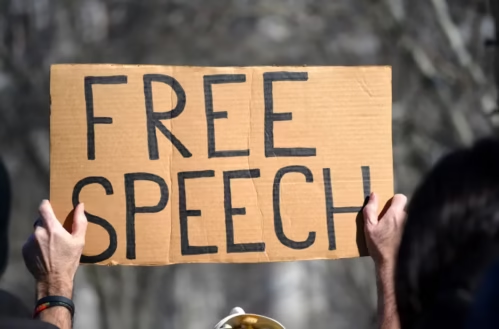
    FREE SPEECH

    Join Wings of Change! It’s only the beginning as we still have so much work to do as many activists and organizations make plans for the upcoming years. Wings of Change is pleased and passionate about being a part of that work through education, information, and inspiration.

    Updates Sign-up

    Never miss news articles on current issues  and Sue Ann’s blog! Sign up here for an email notice of new posts from Wings of Change.

  • DN! COP30 Report: The Amazon Tipping Point, Fossil Fuel Phaseout, Climate-induced Migration

    DN! COP30 Report: The Amazon Tipping Point, Fossil Fuel Phaseout, Climate-induced Migration

    The Race to Save the Amazon: Top Brazilian Scientist Says Rainforest Is at “Tipping Point”

    Amy Goodman interviews scientist Carlos Nobre / Democracy Now! / November 20, 2025

    AMY GOODMAN : As we broadcast from the COP30 climate summit in Belém, Brazil, we are joined by one of Brazil’s most prominent scientists, [Nobel Prize winner] Carlos Nobre, who says the Amazon now produces more carbon emissions than it removes from the atmosphere, moving closer to a “tipping point” after which it will be impossible to save the world’s largest rainforest. “We need urgently to get to zero deforestation in all Brazilian biomes, especially the Amazon,” he argues. (See full transcript below.)


    StoryNov 20, 2025 Democracy Now!

    Brazilian Indigenous Minister Sônia Guajajara on Fossil Fuel Phaseout, Bolsonaro’s Conviction & More

    SÔNIA GUAJAJARA[translated] It’s always a challenge. It’s really — it’s not simple. It’s hard, because there is a dispute, a big one, with the economic sectors, so that these changes do not happen. So we need to make sure that agreements done at COP and commitments done at COP can tackle this, because the world knows the impact that oil exploitation, fossil fuels does, the risk of us achieving the point of no return, but these sectors, the economic sectors, need to understand this is an emergency. So we need to have, like, a clear decision here in this conference to stop depending on fossil fuel.

    _____________________

    StoryNov 20, 2025  Democracy Now!

    Climate Crisis Displaces 250 Million Over a Decade While U.S. & Other Polluting Nations Close Borders

    “This is not abstract,” Nikki Reisch, director of climate and energy at the Center for International Environmental Law, says of climate-induced migration. “This is about real lives. It’s about survival. It’s about human rights and dignity, and, ultimately, about justice.”

    Trump’s Response to COP30

    Trump sends no formal U.S. delegation at COP30: Here is Trump’s response as he is determined to destroy the planet and continues his own version of genocide against the Least Developed Countires (LTC) that are most affected by global warming caused by fossil fuels. Meanwhile 80 nations at COP30 have signed on to plan to phase-out fossil fuels.

    Trump Saudi Arabia© Evan Vucci

    The Trump administration announced on Thursday new oil drilling off the California and Florida coasts for the first time in decades, advancing a project that critics say could harm coastal communities and ecosystems, as President Donald Trump seeks to expand U.S. oil production.

    More than 80 countries at Cop30 join call for roadmap to fossil fuel phaseout

    Countries from Africa, Asia, Latin America, Pacific and Europe plead for transition to be central outcome of talks.

    Transcript
    This is a rush transcript. Copy may not be in its final form.

    AMY GOODMAN: This is Democracy Now!, democracynow.org. We’re broadcasting at the U.N. climate summit, COP30, here in the Brazilian city of Belém, the gateway to the Amazon rainforest. I’m Amy Goodman, with Nermeen Shaikh. As we broadcast, there’s a protest right behind us by the Loss and Damage Youth Coalition, where they are holding a banner that reads, “From opinion to obligation, respond to loss and damage.”

    NERMEEN SHAIKH: We end today’s show with one of Brazil’s most prominent scientists, Dr. Carlos Nobre. He’s a senior researcher at the Institute of Advanced Studies at the University of São Paulo and co-chair of the Scientific Panel for the Amazon. He’s a lead author of the U.N.’s Intergovernmental Panel on Climate Change, or IPCC, that won a Nobel Peace Prize in 2007 for its reports on global warming.

    AMY GOODMAN: For decades, Carlos Nobre has been warning the Amazon rainforest is being pushed beyond the tipping point. The Amazon rainforest is almost as large as the contiguous United States.

    Carlos Nobre, welcome to Democracy Now! It’s an honor to be in your presence. You have been warning for quite some time, and now it’s getting more serious than ever. What is the tipping point? And for a lay audience around the world, explain to us why the biome of the Amazon rainforest is so important for the world.

    CARLOS NOBRE: Good morning. Thank you very much.

    Yes, I’ve been working for 43 years with the Amazon. I was the first scientist, 1990, 1991, publishing a science article saying if we continue with very high deforestation, the Amazon would cross the tipping point. But that was 1990, ’91, 36 years ago. Now the Amazon is very close to the tipping point.

    Why do we say that? Because from the Atlantic to Bolivia, Peru and Colombia, this is 2.5 million square kilometers. The whole forest, close to 7 million square kilometers, but this southern portion, very close to tipping point. The dry season is four to five weeks’ length here — in 45 years, one week per decade. It was three, four months, but with rain during the dry season. Now it’s four to five months, 20, 30% drier, two, three degrees warmer. And also, tree mortality has increased a lot in these areas. In the southeastern Amazon, south of where we are, the forest has become a carbon source. It’s losing more carbon than removing.

    So, if we continue — deforestation is about 18%, degradation 30% — if we reach 20, 25% deforestation, global warming close to two degrees, we cross permanently the tipping point. We are going to lose up to 70% of the Amazon within 30 to 50 years. If we continue with global warming, deforestation, we reach the tipping point by 2040. So, by 27 — 2100, we’re going to lose 70% of the Amazon. We’ll release more than 250 billion tons of carbon dioxide to the atmosphere, making it impossible to maintain the global warming at 1.5 degrees. We are going to lose the highest biodiversity in the planet. So, terrible.

    And also, the Amazon recycles water so well that about 45% of the water vapor that comes from the Atlantic Ocean, transported by the trade winds, goes to the south of the Amazon and feeds more than 50% of rainfall on the tropical savanna south of the Amazon, so — and also the Atlantic rainforest. So, it’s really essential. If we lose the Amazon, not only the Amazon forest will disappear, but the tropical savanna, as well.

    NERMEEN SHAIKH: If you could also talk, Dr. Nobre — in addition to increasing heat and the dryness that you talked about, you’ve also said that livestock grazing is a form of ecological pollution. Now, Brazil is the world’s second-largest producer of beef. If you could talk about what the impact of cattle ranching has been on this deforestation of the Amazon?

    CARLOS NOBRE: Yes, of course. I mean, 90% of the deforestation in the lowlands in the Amazon in Brazil is related to cattle ranches. And when we compute, Brazil is the only country in the world where 70% of fossil fuel emissions, greenhouse gas emissions, come from land use change, about 70% of emissions, 40% deforestation. And about 20, 25% of this comes from agriculture, but mostly for cattle ranches. Particularly, the cattle emits a lot of methane, so — all ruminants. So, we say 55% of emissions in Brazil related to livestock, you know, the deforestation for cattle ranches and also the cattle emitting methane.

    So, really, we need urgently to get to zero deforestation in all Brazilian biomes, especially the Amazon, and also merging to the so-called regenerative livestock. Regenerative livestock. We have about 15% in Brazil of regenerative livestock, and very little. The regenerative livestock makes — reduces a lot emissions by livestock.

    NERMEEN SHAIKH: And, you know, in Brazil, as you well know, Brazil is one of the world’s largest agricultural exporters, which means the alternative that you mentioned may compensate, but presumably it would be a massive economic loss to Brazil if their agricultural production were to go down. But as you were mentioning earlier, though, there has been a commitment by countries here to work on a roadmap to get to zero deforestation by 2030. So there is an agreement there, whereas there is not a majority of countries signing up to the roadmap to phasing out fossil fuels. So, if you could just talk about, I mean, the countries that are, in part, dependent on agricultural exports, what would it mean to diminish cattle ranching? And, I mean, you’ve become, in fact, vegetarian as a result of this.

    CARLOS NOBRE: Oh, listen, mostly livestock average productivity is very low. Brazil has about 1.5 heads of cattle per hectare. This is very little. Brazil has about 3.2 million square kilometers, mostly livestock and also agricultural. So, regenerative livestock will have three to five heads of cattle per hectare, reduce emission, and also the regenerative agriculture and livestock is much more resilient to the climate extremes. For instance, last year, Brazil had a record-breaking drought in the Amazon tropical savanna, Cerrado, and a record-breaking number — decline of agricultural productivity. So, therefore, Brazil can continue being a tremendous high producer of meat, agriculture, soy grains, using not 3.2 million square kilometers, but maximum 2 million square kilometers.

    AMY GOODMAN: I want to ask you a question about climate science. You have said that it’s a mystery to you, the country which invested the most in climate science, a country with the largest number of climate scientists and very few who deny climate change, which contributed the most to the IPCC report — how is it possible this country elected a climate denier? And we’re talking about the United States. But talk about the significance of the billions of dollars being removed from science research in the United States, and the effect that has all over the world?

    CARLOS NOBRE: Well, that’s a very good question, because, in fact, I mean, I create a name, because all tipping points that we know in the climate, more than 20, they are all associated with ecological, biological, hydrological, ocean-related tipping points. But I’m thinking how the world, in democracies, we are creating a, quote, quote-unquote, “a social/political tipping point,” which is — it’s not only in the U.S. In many countries in the world, democracies, we are electing more and more populist politicians — U.S. President Trump, Argentina President Milei. Brazil elected a former president, Bolsonaro, totally climate denier. Deforestation increased a lot in those four years. That’s happening all over the planet. So, this is a — I even gave a name in the West. I said this social/political tipping point is the “trumping point.” Why we are, in democracies — as you mentioned, the country with the top science on climate change, U.S., always, for decades — why U.S. democracy electors are electing a climate-denier president? This is very serious.

    NERMEEN SHAIKH: And you’ve said, Dr. Nobre — I mean, it’s remarkable, as you said, with these right-wing governments, being led in part by Donald Trump, the fact that this roadmap to deforestation was agreed. You’ve said that COP30 is a critical meeting of — a critical climate summit. Explain why, and what you hope is going to come out of this. It’s formally concluding tomorrow, but it regularly goes beyond that date.

    CARLOS NOBRE: Yes, that’s a very good point, because all of us scientists, we say this COP30 has to be very important, I mean, as important as Paris Agreement, as important as COP26, when all countries agree in reducing emissions. But now we have to accelerate reducing emissions.

    Yesterday, we, the Planetary Science Pavilion people, we hand-delivered our declaration to all negotiators, and I hand-delivered to President Lula, as well. We say, in addition to zero deforestation in all biomes, tropical forests by 2030, we have to accelerate reducing of emission by fossil fuels. We say, ideally, zero fossil fuel emissions by 2040, no longer than 2045 — no questions, because the temperature is reaching 1.5 degrees within five to 10 years permanently. If we only get to net-zero emissions by 2050, we may reach two degrees and even more. It will be a tragedy, an ecocide for the planet.

    And when I presented this document to President Lula, he said also — four times, he said — I was in a meeting with him. He said, “This has to be the most important COP of all COPs.” Let’s hope, in two days now, countries will agree not only zero deforestation in all tropical forests by 2030, but zero fossil fuel emissions —

    AMY GOODMAN: Ten seconds.

    CARLOS NOBRE: — by 2040.

    AMY GOODMAN: We want to thank you so much, Carlos Nobre, leading Brazilian scientist, world-renowned climatologist, senior researcher at the Institute of Advanced Studies at the University of São Paulo, co-chair of the Scientific Panel for the Amazon, where we are right now. We’re in Belém, the gateway of the Amazon. I’m Amy Goodman, with Nermeen Shaikh.

    The original content of this program is licensed under a Creative Commons Attribution-Noncommercial-No Derivative Works 3.0 United States License. Please attribute legal copies of this work to democracynow.org. Some of the work(s) that this program incorporates, however, may be separately licensed. For further information or additional permissions, contact us.


    Rise Up Times is entirely reader supported.

    In this critical time in hearing the voices of truth is all the more important although censorship and attacks on truth-tellers are common. Support WingsofChange.me as we bring you important articles and journalism beyond the mainstream corporate media on the Wings of Change website and Rise Up Times on social media  Access is alway free, but if you would like to help:
    A donation of $25 or whatever you can donate will bring you articles and opinions from independent websites, writers, and journalists as well as a blog with the opinions and creative contributions by myself and others

     Subscribe: Join us on Wings of Change

    Note: to reach the Wings of Change website quickly type the full .url in the search engine of your choice: wingsofchange.me

    Sue Ann Martinson, Writer, Editor Wings of Change

  • The Politics of Change: Why Global Democracy Needs Dissent, by Roland Bleiker

    The Politics of Change: Why Global Democracy Needs Dissent, by Roland Bleiker

    The Politics of Change: Why Global Democracy Needs Dissent

    By Roland Bleiker. Originally published in “Dynamics of Dissent” Georgetown Journal of International Affairs. Summer/Fall 2008 pp. 33-39. Used with permission of the author.

    Editors Note: This article was written before the genocide by Israel in Palestine but casts perspective on the global dissent around the genocide. It also invites considering the global significance of the No King’s Day demonstrations and other national acts of dissent in relation to the current U.S. administration. In addition, it addresses the issues of inclusion and dissent around climate change as paramount while the annual global COP conference in regard to the ongoing climate crisis is currenly taking place in Brazil.

    Dissidents are celebrated as heroes when they struggle against oppressive political regimes.1

    In democracies, however, dissent is all too often seen as a dangerous force that undermines stability, order, and the rule of law.

    Vilified as they are, dissidents nevertheless play an important role in democratic practice. This paper explores what may well be one of the key challenges of our day: extending democratic ideals to the global realm. Doing so is essential because processes of globalization increasingly undermine the traditional realm of democratic participation: the national state. Citizens’ daily lives are influenced by political, financial, and cultural forces that transgress state boundaries. For example, the effects of greenhouse gas emissions are global, even though most of them are caused by a relatively small number of developed countries. Any solution to the ensuing problems of climate change, from droughts to rising sea levels, can only be found through a concerted and coordinated global effort. People in all parts of the world should thus have a say in how the related issues are addressed, but many global institutions, international organizations, and multinational companies are neither transparent nor accountable to a democratic public.

    Extending democracy to the global level is, of course, a difficult task. Some very limited efforts are already in place. The UN, for instance, offers a forum in which states can debate issues of global concern. Some urge the UN to add an elected and globally repre-sentative assembly to its existing struc-ture, but such suggestions are a long way from being realized in practice.2 Even if they are adopted, a far more difficult underlying problem remains: Global democratic institutions must be embesdded in a global regulatory framework with the power to implement decisions if they are to play the same role as their state-based counterparts. Such a scenario is highly unlikely in the foreseeable future. If democracy is to have meaning and significance at the global level, then a more fundamental rethinking of the very notion of democracy is required. This essay recommends how one might productively approach some aspects of the challenges at stake.

    I first suggest, somewhat counter-intuitively, that dissident movements can make a positive contribution to the search for global democracy. This is pre-cisely because dissent disturbs existing political orders and the privileges they mask. I sustain this position through a brief engagement with the anti-globalization movement, focusing solely on the protest element of the movement. Anarchical, disruptive, and at times violent, the protest element is certainly the most contentious aspect of the movement. It also illustrates, however, how dissent can challenge institutionalized relations of power and, by doing so, generate public debate and perhaps even enforce a certain level of accountability otherwise impossible in a global realm that lacks viable democratic institutions. Arguing so is not to deny the importance of democratic institutions but to stress that without periodic political challenges, existing forms of governance tend to establish, uphold, and mask practices of domination and exclusion.

    The second point I wish to make is a conceptual reinforcement of the first: democracy must be viewed not only as a set of institutions, but also as an evolving attitude. Many theorists suggest that our conceptualization of democracy should go beyond institutional models and into a procedural realm.3 William Connolly, for instance, fosters a democratic ethos based not on fundamental principles but on the need to disturb these principles. Connolly is afraid that any institutional order that remains unchallenged poses a serious obstacle to a truly transnational democratic disposition. He thus advocates a “democratic politics of disturbance” and, far-fetched as it may seem, promotes respect for “multiple constituencies honoring different moral sources.” 4

    Globalization and the Changing Nature of Dissent

    Dissent is, at first sight, an unlikely ally in the search for global democracy. More specifically, the anti-globalization movement seems to highlight the problems of globalization rather than the search for democratic solutions.

    For one, the movement is disorganized, chaotic, and seemingly unable to come up with any coherent and positive strategy. Among the diverse and often polarized groups of the movement we find feminists, environmentalists, steel-workers, anarchists, farmers, and students. Their goals are far too diverse to produce a common agenda, and violent elements of the movement, even if they are in the minority, often derail a protest event that was meant to be peaceful. Skepticism is thus warranted about the extent to which such a chaotic dissident movement can make a positive contribution to global democracy. But is this skepticism really justified? A closer look reveals a surprisingly different picture.

    A crisis of legitimacy stems from the weak democratic accountability of the state and multilateral institutions.

    The movement’s first major event that attracted global media coverage was the so-called “Battle for Seattle,” which resulted in four days of massive street demonstrations against a December 1999 World Trade Organization (WTO) meeting in Seattle, Washington. Many commentators consider this event, which brought together some 40,000 demonstrators of different backgrounds and political persuasions, a watershed event in the public awakening to a global consciousness. They speak of an event that symbolized the world’s discontent with the spread of globalization and with policies that seemingly promoted free trade and corporate greed over the inter-ests of average people and the environment.5 Numerous other protest events followed in the years to come, including demonstrations against meetings of the World Economic Forum, the Interna-tional Monetary Fund (IMF), and the World Bank.

    The substantive claims of the anti-globalization movement are highly con-troversial. Its main targets are key liberal economic institutions of the world economy: the World Bank, the IMF, and the WTO. Protesters strongly lament the lack of democratic accountability within these organizations. The influential voice of journalist Vandana Shiva, who argues that the WTO is enforcing an “anti-people, anti-nature decision to enable corporations to steal the world’s harvests through secretive, undemocratic structures and processes,” is representative of many anti-globalization protesters.6 Many scholars and commentators dismiss such a pessimistic understanding of globalization. Instead, we often hear of the benign story of Western democracy and free market principles bringing progress and economic growth to previously undeveloped parts of the world.7

    The reality lies somewhere in between these extremes, but the message that the anti-globalization movement seeks to convey is perhaps less important than the manner in which it has managed to capture public attention. Since many people around the globe see street protests as the only opportunity to express their opinions, a crisis of legitimacy stems from the weak democratic accountability of the state and multilateral institutions. The anti-globalization movement demonstrates what Joan Bondurant identified as liberal thought’s primary flaw: “the failure to provide techniques of action for those critical occasions when the machinery of democratic government no longer functions to resolve large-scale, overt conflict.”8

    But the situation is not nearly as gloomy as anti-globalization movements claim it to be. The very fact that we are aware of this movement and of its various grievances demonstrates that globalization has provided populations with a new method of participating in political debates. There are at least two reasons for this transformation of dissent.

    First, recent technological innovations have provided dissidents with tools to organize and coordinate their actions. Many of the protesters that went to Seattle, for example, were united through e-mail correspondences and a variety of websites that organized resistance strategies, thus making the movement far less disorganized and aimless than it initially seemed. Mobile phones helped coordinate on-the-ground actions, which resulted in alliances between highly unlikely protest segments. In Seattle, again, the labor and environmental movements joined with anarchists and church groups to present a common front.9

    Second, global media networks have fundamentally transformed the nature and methodology of dissent. Media can deliver images of protest that reach a global audience. The Battle for Seattle will be remembered as a global media spectacle—a rallying call for anti-globalization political movements worldwide. As such, dissidents utilized another way to attack the global economic order.

    Global Democracy as a Politics of Disturbance

    So far I have suggest-ed that globalization empowers average citizens as much as it disempowers them. Effective protest actions may be able to induce political change at the global level. Dissenting protests may even become a new method of accruing power. Are dissenting protests a new kind of democratic participation, then, and do they make a meaningful contribution to the theory and practice of global democracy?

    When viewed from a traditional, institutional democratic perspective, protest actions do not seem to add a meaningful dimension to democratic deliberations. The situation looks more complex, however, if we push our understanding of democracy beyond an institutionalized framework of procedures, such as holding elections. Anti-globalization protests may then be understood as part of broader, transnational democratic processes.

    In an oppressive political environment, longed-for change will often come not from internal and institutionalized reforms, but from an externally induced politics of disturbance. William Connolly suggests that sometimes “it takes a militant, experimental, and persistent political movement to open up a line of flight from culturally induced suffering.”10 Certainly, democratic participation cannot be fully institutionalized. This is particularly the case in a global context that lacks democratic accountability and intuitions that might anchor and regulate popular participation in decision-making procedures. Regardless of the degree to which any political system has developed democratic procedures, it will necessarily include a structure of exclusion. Public scrutiny ensures the legitimacy of even the most democratically advanced society. This constant revisionist tendency promotes adequate and fair political foundations.

    The anti-globalization movement affirms this revisionist tendency because it makes globalization a constant topic of discussion. Protest actions formed around issues like environmental protection and indigenous rights ensure that these issues remain under scrutiny. Anti-globalization protests challenge what Manfred Steger calls globalism: “a political ideology that endows the concept of globalization with market-oriented norms, values, and meanings.”11 Steger argues that the neoliberal approach to globalization rose to such prominence in the 1990s that its fundamental values were beyond contention. Free trade and market expansion were considered politically benign; they were corollaries to globalization’s economic growth. So imperative were neoliberal norms that alternative development models were considered illegitimate, irrational, or even illusory and thus dismissed as protectionist, socialist, or utopian.12

    The preponderance of anti-globalization dissenting movements and world media coverage of their activities questions the belief that free market economics produce seamless global development. As society debates neo-liberalist ideology and considers other perspectives on globalization, belief in an alternative model is becoming more and more popular. Consider the charter of the World Social Forum, the loose institutional element of the global justice movement, which describes a set of values and goals that promote to a pacifist path of development.13 Although many people dis-agree with this agenda, the salient observation is that the anti-globalization movement has forced advocates of neo-liberalism to actively justify the ideology’s political foundations.

    Towards Global Democratic Accountability

    Important as it is, politics of dissent and disturbance are not enough to establish a new, global form of democracy. Yet, how would we justly define norms and prioritize policies when a society lacks a consensus of political opinion as well as a forum for mediating potential conflicts of interest?

    Although it may be too early to realistically imagine how democracy could work beyond the realm of the state, a contemplation of this scenario demands consideration of dissent as a positive force of globalization.

    What, then, are the practical implications of the conceptual arguments I have presented here? Democratic constituencies must make decision. They need to formulate particular positions and clearly distinguish right from wrong. Often, it is not possible to do so by consensus. Excluding certain views is desirable, even necessary—this is why dissent is inevitable in a democracy. But to keep the decision-making process as fair and transparent as possible, these dissident voices must be heard and taken into account in the deliberation process. Established state-based democracies have well worked out procedures to do so, but such procedures do not yet exist at the global level where power relations are far more prevalent than democratic principles. Multinational companies and international organizations are not run according to traditional principles of democratic accountability. The UN is the only truly global institution where most states have a say, but its decision-making procedures revolve around the veto powers of the Security Council, which is dominated by few powerful nations.

    Given the absence of a global institution that could facilitate and implement democratic ideals, dissent becomes an even more crucial tool in the global society. Dissent is often the only way for disenfranchised people to contribute to global affairs, and thus key actors in international politics must be more attuned to integrating outside dissident voices into their deliberations. Take the issue of climate change: The most powerful international actors, such as the United States, the EU, and China, will inevitably shape the types of policies that are being established and implemented in response to the challenges ahead. But the ensuing framework can only be democratically legitimate if the voices of disenfranchised  people—often  those most affected by climate change—are heard in global deliberations. When this is not the case, dissatisfaction grows until it is so widespread that popular resentment erupts in the form of mass protest, revolutionary upheaval, or a terrorist attack. A functioning democratic system, one that listens to and debates grievances and heeds dissident voices, is far more likely to generate political outcomes capable of avoiding such disruptive and often violent scenarios.

    Order is a necessary precondition for democracy, the rule of law, the provision of human rights, and human civilization itself.

    Appreciating the nexus between dissent and democracy requires rethinking the underlying relationship between order and change.14 Most politicians, diplomats, and philosophers have emphasized the importance of order over the forces that promote change. Existing orders tend to be accepted as good and desirable because they reflect the values and institutions that have emerged slowly over time. Alain Joxe, a fierce critic of current international regimes, asserts, “The most formidable enemy one must face in politics is disorder.” For Joxe, order “is always necessary because it pro-vides protection.”15 Most commentators would agree that order is desirable, if not essential because order is a necessary pre-condition for democracy, the rule of law, the provision of human rights, and human civilization itself.

    But the politics of order and the politics of disturbance are more intricate than they might seem. Many injustices, from domestic abuse to torture and genocide, occur not from a lack of order but under an unjust order. The concentration camps of Nazi Germany did not result from the absence of order, but from the meticulous infatuation with an order—which envisioned a racially “pure” state and was determined to pursue its racial agenda with all requisite action.

    Dissent can occasionally be required to challenge oppressive orders and to promote a more just global society. Doing so is an ongoing process and of particular importance in the current age of globalization, which witnesses sudden and unforeseen events that challenge and transform norms, identities, and values. Addressing the ensuing challenges demands a politics of order and a dissident democratic element capable of critically evaluating the value of competing orders. Institutionalizing this scrutinizing process is unrealistic. This is why a healthy dose of dissent is a beneficial—even essential—component in the search for global democracy.

    ***

    Roland Bleiker is professor of International Politics at the University of Queensland. His pubilcations include Popular Dissent, Human Agency, and Global Politics; Divided Korea: Toward a Culture of Reconciliation; and, as co-editor, Security and the War on Terror. The book Aesthetics and World Politics examines the emotional dimensions of security threats through a range of aesthetic sources, including literature and visual art.

    NOTES

    1. Thanks to Mark Chou and Emma Hutchison for comments on a This essay is an attempt to con-dense, but also further explore work I have previously presented on this topic, most recently in “Visualising Post-National Democracy,” in The New Pluralism: William Connolly and the Contemporary Global Condition, eds. Mort Schoolman and David Campbell, 121-142. Durham, NC: Duke University Press, 2008.
    2. Richard Falk and Andrew Strauss, “Toward glob-al parliament,” Foreign Affairs 80 (2001): 212-220; David Held, Democracy and Global Order (Oxford: Polity, 1995), 273; Robert E. Goodin, “Global Democracy: In the Beginning” (The University of Queensland, Brisbane, Australia, March 23, 2008).
    3. John Dryzek, Deliberative Democracy and Beyond: Liberals, Critics, Contestations (Oxford: Oxford University Press, 2000); Jürgen Habermas, Theorie des kommunika-tiven Handelns (Frankfurt: Suhrkamp, 1988).
    4. William Connolly, The Ethos of Pluralization (Minneapolis: University of Minnesota Press, 1995), 149, 154; Why I am not a Secularist (Minneapolis: University of Minnesota Press, 1999), 51, 155; Neuropolitics: Thinking, Culture, Speed (Minneapolis: University of Min-nesota Press, 2002), 195-196.
    5. Margaret Levi and David Olson, “The Battles for Seattle,” Politics and Society 3 (September 2000): 325.
    6. 6 Vandana Shiva, “This Round to the Citizens,” The Guardian, August 12,1999.
    7. Most prominently expressed by Thomas Friedman in The Lexus and the Olive Tree (New York: Farrar, Straus and Giroux, 2000) and The World is Flat: A Brief History of the Twenty-First Century (New York: Farrar, Straus and Giroux, 2006).
    8. Joan Bondurant, Conquest of Violence: The Gandhi-an Philosophy of Conflict (Berkeley: University of Califor-nia Press, 1967), x.
    9. See, for instance, Robert O’Brien, Anne Marie Goetz, Jan Aart Scholte, and Marc Williams, Contesting Global Governance: Multilateral Economic Institutions and Global Social Movements (Cambridge University Press, 2000), 7; Mark Rupert, “In the Belly of the Beast: Resisting Globalisation and War in a Neo-Imperial Moment,” in Critical Theories, World Politics and the Anti-Globalisation Movement, Catherine Eschle and Bice Maiguashca, 46-47 (London: Routledge, 2005; Ronald J. Deib-ert, “International Plug ‘n Play? Citizen Activism, the Internet and Global Public Policy,” International Studies Perspectives 1.3 (2000): 255-272; Michael Hardt, “Today’s Bandung?“ New Left Review, 14 (March/April 2002):117.
    10. Connolly, Why I am not a Secularist,
    11. Manfred Steger, Globalism: Market Ideology Meets Terrorism (Lanhan: Rowman & Littlefield, 2005), ix.
    12. Steger, Globalism, 8-9.
    13. World Social Forum, “World Social Forum Charter of Principles,” http://www.forumsocial-org.br/main.php?id_menu=4&cd_lan-guage=2 (date accessed March 2008).
    14. See William Connolly, Pluralism (Durham: Duke University Press, 2005), 121-126.
    15. Alain Joxe, Empire of Disorder, Ames Hodges (New York: Semiotext(e), 2002).