History is tethered to the present.
The Unraveling of the New Deal: the Legacies and MLK, Part 3
Civil Rights/Civil Liberties
Call to Action
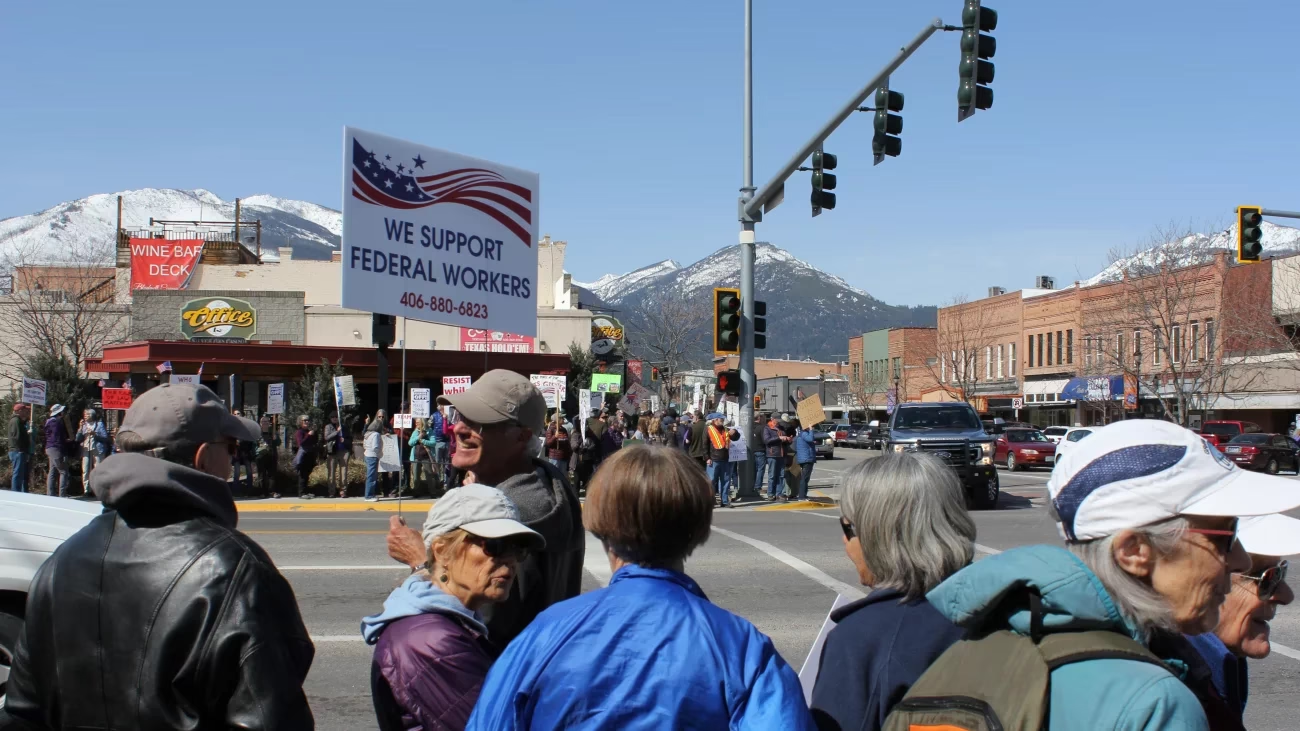
The streets and other public gathering areas rang with cries of freedom across the nation in the protest called by Indivisible they named Hands Off. In Minnesota about 20 separate demonstrations took place, not including the major one in St. Paul at the state capitol that thousands of Minnesotans.
Nationwide it was a reaction to Trump’s and Elon Musk’s riding roughshod over the American people in attempting to destroy the Constitution and reverse many of the programs for the people initially created by FDR’s New Deal as well as other important social programs.
This huge outpouring of people across the country taking to the streets in mass demonstrations like Hands Off are holding Trump accountable for attacks on civil rights and civil liberties. His racist statements are blatant; his deportation tactics are cruel and inhuman punishment. And saddest of all is the support he has in Congress from the GOP and by too many Democrats who have betrayed their party’s traditional base of the working people of America and supported book bans instituted by Republicans, union busting, denying voter rights, accepting white supremacy as the order of the day, and more.
Civil Rights and Liberties
The civil rights movement for Black people, and affecting other people of color as well, was led by Martin Luther King and so many others, too many to enumerate here. This legacy of voting rights and laws to stop so many racist practices were part of the New Deal in spirit and very much a part of the work of Eleanor Roosevelt, although many barriers were put in place to obstruct those rights, especially in southern states. After the Civil War and the Emancipation Proclamation most southern states created the Jim Crow laws that blocked people of color from voting. They found excuses to arrest especially Black men and put them on chain gangs for forced labor to get around the 13th Amendment that prohibited “involuntary servitude” except as punishment for a crime. Also, certain questions were posed that if they could not answer correctly they could not vote. Poll taxes were often used to prevent African Americans from voting as well.
In more recent years other methods were sought as documented in the book The New Jim Crow by Michelle Alexander. And as noted in Part 1, a federal law against lynching was not signed until March 29, 2022 by then President Biden
In 2020 in response to the murder of George Floyd, large demonstrations starting in Minneapolis spread first nationwide and then worldwide. Now millions of people worldwide have protested the genocide against Palestinians in Palestine/Gaza, which under Israel leads in the Middle East while Trump targets Muslim people inside the United States along with the deportation of people of Hispanic origins from Central and South America and others.
But my writing here is not reminiscence. It is a call to action, as so many of the good things about American values are being not just threatened but eviscerated by greedy men and women who have no problem, for example, sacrificing the people of Gaza/Palestine in genocide. They have now turned on the people of all colors in their own country.
The U.S.A. does not have a good record when it comes to treatment of people of color in America, as evidenced by the treatment of Black people and Native Americans and of Hispanic workers in the fields and even of the Chinese who built the railroads of the west over the mountains or the Japanese who built the northern route that joined east and west by rail.
During WWII camps were created for people of Japanese heritage who were forced to survive under difficult living conditions because it was feared that they would be spies; although not stated, revenge for the bombing of Pearl Harbor by the Japanese was most likely a factor. FDR approved these camps and initially so did Eleanor Roosevelt. But she visited the camps and saw that the only determining factor was race and therefore later opposed them. (Ken Burns: The Roosevelts, Episode 6, PBS.)
It needs to be noted that during WWII while people of German heritage were often disparaged or even shunned. they were not put into camps even though the source and execution of the war was from Germany. Their whiteness protected them.
The Targets Now
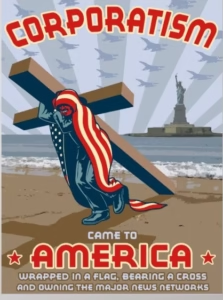
Bernie Sanders has named some targets of the Trump camp’s attacks as he has traveled the country giving talks, now joined by Alexandria Ocasio-Cortez (AOC). He says Trump, Musk and company want to privatize, and therefore make profitable for corporations: the USPS, the Veterans Administration, NASA, Medicare, Medicaid, and Social Security. SNAP is also under attack. Formerly called Food Stamps, SNAP provides food to many families, most especially children and elders.
In contrast, FDR ended his acceptance of the nomination for his second term with these words:
It is not alone a war against want and destitution and economic demoralization. It is more than that; it is a war for the survival of democracy. We are fighting to save a great and precious form of government for ourselves and for the world.
Franklin D. Roosevelt, Acceptance Speech for the Renomination for the Presidency, Philadelphia, Pa. Online by Gerhard Peters and John T. Woolley, The American Presidency Project
Today it is a fight to defend democracy, but it is even more. We are fighting the specters of nuclear war and of a climate crisis that could destroy our planet. These are both worldwide struggles against pernicious forces.
In many ways these struggles are encapsulated by what is happening on college campuses in the U.S. where young people are having face-offs about the genocide in Gaza. The sides are not Muslim vs. Jew. Students of many religions and backgrounds are involved, including young Jews who disagree with Israel’s genocide and with the aggressive empire-building imperialistic policies of Zionism.
These young protesters are the future, along with the many young people who are taking to the streets. The protesters on campuses who focus on the Palestine/Israel issues are also representing the future of education, and along with the faculty members who support them, the struggle for academic freedom. The administrations of these academic institutions, with some exceptions, are aggressively on the wrong side of these issues. In many cases they are firmly against free speech and academic freedom where the Palestine/Israel issues are involved.
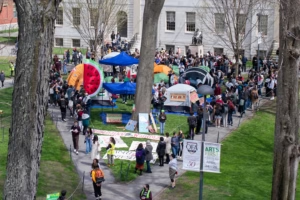
Dozens of pro-Palestine protesters occupied a patch of grass in front of the John Harvard statue in Harvard Yard. Photo by Frank S. Zhou, The Harvard Crimson
Harvard, one of the most elite colleges in the country and endowed with billions of dollars, has challenged Trump’s actions against the students. The administrations of other colleges have for the most part folded, placing strict penalties on students for pro-Palestine demonstrations, and in some cases firing professors for their support of the students and insistence on academic freedom. Some colleges, a few, refused to go along with the punishment of the protesters. Carlton College in Northfield Minnesota is an exception, although they did not agree to divest.
Chris Hedges has pointed out that Trump’s true target is the destruction of liberalism, replacing it with an autocratic government. Most of these colleges and universities have traditionally been liberal institutions.
Autocracy and Fascism
The techniques Trump and his camp are using overall are lifted directly from Hitler’s fascist playbook: books are banned (not burned), demands that only a white elitist history of the U.S. is to be taught in all schools (firing of Jewish professors and jailing of clergy who opposed Hitler), punishing of students (the execution of the White Rose students), and ICE is operating with impunity in making arrests for deportation and incarcerating them under poor living conditions or deporting them to impossible living conditions in detention in other countries, and more. They are not sending them to camps to exterminate them like Hitler’s Germany did but they are sending them to jails (camps) under impossible living conditions in the U.S. and other countries.
That denial of the colleges was also true in some respects during the protests on campuses during the Vietnam War. Protests involved hundreds and sometimes thousands. Not only did they occupy administrative offices, they shut down campuses. At the University of Minnesota they shut down major streets such as Washington and University Avenues and blocked access to nearby freeways. They set up a People’s Park in a vacant lot adjoining a commercial area in what is called Dinkytown. The police tear-gassed students on the main plaza near the main administration building, Morrill Hall.
This time I have seen clips of police violence worldwide. Because as was true during the George Floyd demonstrations in 2020 in Minneapolis that drew thousands of protesters, shut down freeways and city streets, and more, the police were violent toward the protesters and the press. As is always true from labor strikes to antiwar and civil rights protests, the police represent the authorities; they attempt to contain and stop the protesters; in most cases they do not hesitate to use violence to do so.
In the more recent case of the George Floyd in the Minneapolis/St. Paul protests there was looting and extensive burning of buildings. In some cases there were outside agitators who clearly led the burnings and later were picked up by federal agents in other parts of the country.
George Floyd Protest The Minnesota Reformer
The place where George Floyd was killed is hallowed ground
Yet the majority of protesters was nonviolent and in many cases attempted to rein in those were more violent. But the police did not hesitate to hurt people, especially going after journalists, as is happening currently in many protest situations around Gaza. While this violence may not be viewed on the mainstream corporate media, they are numerous examples on social media. They used and still use tactics that were meant for violent criminals on the protesters and the press.
Fortunately, although we have had and are still having large pro-Palestinian protests in Minneapolis and St. Paul, they have been nonviolent, with experienced organizers who have also conducted trainings for protesters in general and for civil disobedience. Following an extensive study with the federal Department of Justice and Communities United Against Police Brutality (CUAPB), new police guidelines have been put in place; these guidelines however have been threatened by the current Trump administration.
The same holds true in the Twin Cities for recent protests around immigration policies of the current U.S. Trump administration; while in large part pro-Palestine protests around the country and world have been nonviolent, the violence comes from the police or sometimes from counter protesters. That is not to say whether or not some pro-Palestinian protesters have crossed the line, but one never knows if these are genuine or a result of an oft-used tactic of planting violent protesters to make demonstrators look bad.
The LA Protests and Militarization
The most recent Hot Spot is Los Angeles. Trump has called out the National Guard, the Marines, and other law enforcement while the State of California suing Trump for doing so since he did not have the permission of the California governor to call out the National Guard or troops. Meanwhile the protests continue as I write this, and so do the lawsuits.
The first recent protests in Los Angeles in June 2025 took place on June 6, 2025, according to multiple sources. These protests were sparked by Immigration and Customs Enforcement (ICE) raids targeting individuals suspected of illegal immigration. The protests initially began peacefully but escalated into clashes with law enforcement, including the LAPD, near the Metropolitan Detention Center. (Ai, Google Search)
No Kings Day, June 14, 2025
When Trump decided to organize a military parade in the tradition of dictators to show his [supposed] strength on his birthday, Indivisible, the primary organizer of the Hands Off demonstrations, again called for nationwide resistance ─ and got it, with even more people than turned out for April 5, 2025. At the Minnesota state capitol grounds in St. Paul an estimated 80,000 people came with their good will, nonviolence and their signs and chants. A turnout of five million was estimated for the day, national and international.
This turnout in Minnesota was after a state politician and her husband were murdered by a lone gunman shortly before No Kings Day and another couple was seriously injured. Rather than cancel the events planned, which some had considered, a call went out to honor the people who were killed and attacked by taking part in the demonstrations at the capitol and elsewhere.
The Legacy of Martin Luther King, Jr.
I often speak of Trump’s Legacy of Hate, a legacy that is predominant now in the nation and worldwide: the racism, the taking away of rights guaranteed by the U.S. Constitution, the unraveling of so many programs started by Franklin Delano Roosevelt (FDR), and the weaponizing of anti-Semitism, not to mention Trump’s hate rants against Ilhan Omar, Fifth District representative in the House, or against just about anyone who crosses him.
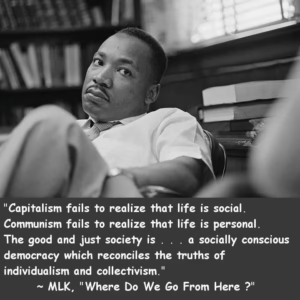
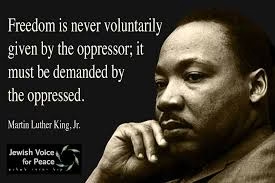
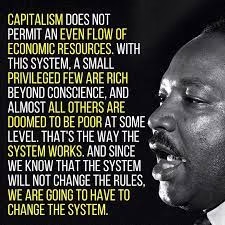
But now I would like to speak of another important legacy, that of Martin Luther King (MLK) and the Civil Rights Movement along, with the invaluable lessons of that movement from MLK.
Originally published in 1963, MLK’s book Why We Can’t Wait, is well-described by the publishers as ”Martin Luther King’s classic exploration of the events and forces behind the Civil Rights Movement.”
With the rise of white supremacy that disgracefully comes from the White House and Congress, the words of MLK are again relevant for Black people and other people of color, including people of Hispanic heritage and the Native Peoples.
Taking Action
It is more than that now though, as the Hands Off and No Kings Day demonstrations brought home to all of us: We cannot wait and must take action. This plight, this fight, this struggle is not essentially Democrats vs. Republicans as the mainstream media (MSM) (more accurately called the mainstream corporate media) likes to frame it. While it is for Black people and other people of color most definitely, it is also for all of us to form a movement against this insanity being perpetrated on us all by people who are demented in their treatment of other human beings, in their greed and insatiable quest for power, and in their attempts to maintain an imperialistic empire of settler colonialism that benefits the few. For them, Hegemony is All: Worldwide Domination. And it definitely is not a government ”of the people, for the people, by the people.”
From Why We Can’t Wait, the last chapter, “The Days to Come”
The hard truth is that the unity of the movement is a remarkable feature of major importance. The fact that different organizations place varying degrees of emphasis on certain technical approaches is not indicative of disunity. Unity has never meant uniformity. If it had, it would not have been possible for such dedicated democrats as Thomas Jefferson and George Washington, a radical such as Thomas Paine and an autocrat such as Alexander Hamilton to lead a unified American Revolution. Jefferson, Washington, Paine and Hamilton could collaborate because the urge of the colonials to be free had matured into a powerful mandate. This is what has happened to the determination of the Negro to liberate himself. When the cry for justice has hardened into a palpable force, it becomes irresistible. This is a truth which wise leadership and sensible society ultimately come to realize.
Martin Luther King, Jr. was a man of vision. He and many others fought for the rights of Blacks and people of color, but his vision went beyond. He spoke against the Vietnam War. He knew. He understood. And once again now, in this rise up times, “We Can’t Wait.” Once again his words reverberate with what we need to do.
To reiterate from Part 1 of The Unraveling of the New Deal
Trump and Elon Musk created the so-called Department of Government Efficiency (DOGE), which was not created by Congress but illegally by an executive order of Trump’s. Although DOGE is supposedly managed by the bipartisan DOGE Caucus whose purpose is “pave the way for the House of Representatives to streamline government operations and to save taxpayer money” they are dismantling and cutting off and/or reducing funding for many programs that support ordinary citizens in need as well as some foreign programs like USAid.
Trump and Musk are conducting a hell-bent crusade against as many social programs as possible that benefit ordinary people. They may not directly be the repeal of the same laws that were passed by Congress under FDR’s presidency but with the many layoffs in agencies, it is as if Trump and his cronies are trying to match the 15 million people who were unemployed when FDR officially became president in 1933. In addition are the the millions Trump has deported or plans to deport, some of whom are American citizens or hold green cards.
Elon Musk has now resigned from DOGE and has criticized Trump’s 2025 program. Regardless, Trump has vowed to go forward with the program. He has created what he calls The Big Beautiful Budget Bill which cuts many social service programs including Social Security and Medicaid. This bill passed the House by one vote, 215 to 214, and now goes to the Senate. Online articles, podcasts, etc. are constant at this time speculating about the bill and its contents. Most of this discussion is framed around party loyalty as Democrats vs. Republicans, although it affects all Americans of both parties who, are for example. on Medicaid or collecting social security and crosses party lines.
Trump and others plan to privatize all social service agencies, all agencies that serve the ordinary people, including social security. This privatization, with corporations holding the reins, would have disastrous results for the American people. Corporations ultimately have one goal, to make money for upper management and for their stockholders. Their stockholders are private individuals, not the average American citizen, who would have no rights under such a system.
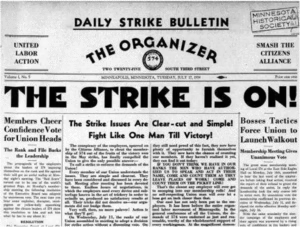
The right of the people to assemble is already under fire. The right of the people to petition the Government for a redress of grievances would not exist. They could perhaps try to petition the corporations but would be shut down. Union strikes? If they have a Union. Collective bargaining? Already under attack.
The right to peaceably assemble? We are already being attacked for peaceable protest gatherings, especially on college campuses. The students have been told for the most part in no uncertain terms they have no right to petition the campus presidents and boards to redress grievances and are instead being punished for what is an established right as set forth in the Bill of Rights although it does not apply to private groups, only the government. Of course, technically that right is the right to petition government, but their government on campus consists of these college officials. They are attempting to petition the government of their colleges and universities only to have the doors slammed in their faces as corporations are private entities and there are essentially no rights for the students.
A Note About Civil Disobedience
In an act of what we now call civil disobedience, colonial men climbed aboard a ship in Boston Harbor and threw the tea overboard in protest of the tax on tea by the British, now referred to as the Boston Tea Party. The colonial women women organized what we would now call a boycott of the tea as they were the ones who made such domestic purchases. What they were protesting of course was the oppression of the British government of their “colony.”
Protest is deep in American tradition. Whether you landed here by plane or boat, or walking across the Rio Grande, whether you arrived yesterday or your ancestors arrived those many years ago, we are all a part of that tradition. In his now famous lecture and essay on A Call of Duty for Civil Disobedience, where he coined the name, Henry David Thoreau names and discusses conscience and action by individuals and their relationship to government, using practical examples from his own neighborhood and state.
FDR: WWII Intervenes
I have chosen not to go into detail on FDR’s role during World War II. He was still president; he was in constant touch and met with Churchill several times before entering the war, which took place after the bombing of Pearl Harbor on June 6, 1943. The American public was opposed to entering another world war, but did not have full information about what was occurring in Germany and mainland Europe with the concentration camps and murders of much of the Jewish population. FDR had sources and did know, but not until Pearl Harbor did he act. The American people now understood how this war far from their borders affected them.
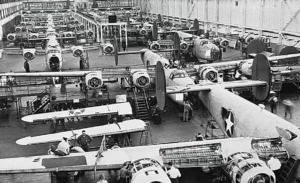
By mid-1944, the Willow Run assembly plant [Ford] was producing one B-24 per hour — accounting for half of all B-24s assembled that year. Photo: Assembly Magazine
When FDR acted he oversaw the industrialization of the United States into a full war economy. Instead of making cars, for example, Ford Motor Company, General Motors, and other major manufacturers converted their factories: some made turbine engines, some planes, some tanks, etc. While men went overseas as soldiers to several parts of the world where war was being waged, women worked in factories and stepped into many jobs previously held by men. Ken Burns: The Roosevelts, Episodes 6 and 7, PBS.
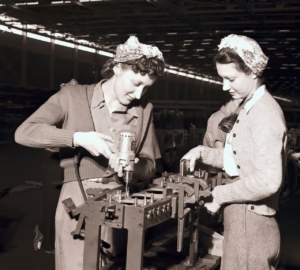
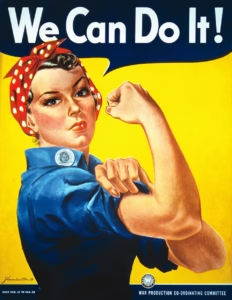
Rose Will Monroe worked on the Willow Run assembly line building B-29 and B24 “Liberator” military planes. While on duty, she caught the eye of Hollywood producers who were casting the part of a “riveter” for a promotional film encouraging Americans to buy war bonds. Her exposure in that film resulted in the popular “We Can Do It!” poster by J. Howard Miller. [The legend of “Rosie the Riveter” was born.] Photo: Ford Corporate
At the end of the war FDR met twice at Yalta with Churchill and Stalin. It was after the second of these meetings that he suffered a fatal stroke and died on on April 12, 1945. (Ken Burns: The Roosevelts, Episode 7, PBS.
UPDATE (OPINION)
As I post this the breaking news I cannot ignore is that Trump has bombed Iran, ostensibly to take out Iran’s nuclear facilities, in total collusion with Israel, Zionism, and imperialism, never really giving any negotiations a chance. Much has appeared online about it already and more will follow. Being antiwar I am of course totally opposed to this bombing. I think Trump has an itchy trigger finger and needed to prove himself as “strong,” (it takes more strength to be nonviolent than violent) to regain what was lost in his self-respect when the Kings Day March in Washington DC was essentially a washout. He still has very low opinion polls. He should not have put the nation at risk of a nuclear war or even of a new “hot war” in the Middle East as is being discussed by news outlets, journalists and others online now.
His alliance with Israel and their genocidal Zionist policies is of course morally and culturally just plain evil. His imperialism along with Israel cloaked in the weaponization of antisemitism is anti-American.
On June 14th 5 million Americans spoke out on the streets on No Kings Day. For everyone who was there, there are many who for one reason or another, could not take to the streets (like me). For everyone on the streets at least one more could not be: That means a mandate of at least 10 million Americans opposed to not just Trump but to the 2025 program he endorses. And to his new Big Beautiful Budget Bill that destroys or cuts services essential for so many Americans just to survive, be healthy and while not rich at least comfortable while the rich get richer and the poor get poorer.
Part 4, the last chapter of The Unraveling of the New Deal will be published soon.