
And I think we see that commitment to what we call “hereness” in the book in the movement against data centers that is sweeping the nation, in the resistance to ICE where people are saying, “No, I’m going to defend my community, defend my neighbors” and people standing up and fighting for labor rights, which fascists are always attacking. Fighting for the environment, fighting against detention centers.
Transcript This is a rush transcript. Copy may not be in its final form.
AMY GOODMAN: This is Democracy Now!, Democracynow.org, the War and Peace Report. I’m Amy Goodman in New York joined by Democracy Now! cohost Juan González in Chicago. Hi, Juan.
JUAN GONZÁLEZ: Hi, Amy, and welcome to all of our listeners and viewers across the country and around the world.
AMY GOODMAN: “The people building AI earnestly believe that it could kill us by the end of the decade.” That was the warning last week from former Anthropic researcher Jacob Coxon that set off an escalating debate over how to regulate increasingly powerful AI systems. Coxon spoke to the BBC.
COXON: So it’s not at all an exaggeration to say that the people who were involved with both founding these companies and building the tech believe there is a possibility of human extinction. And many of the people who are sort of deep in the weeds on actually coding the thing believe that there is like a greater than 10% chance or even greater—some smaller, but they all have different numbers—for a probability that humans might die. And they all keep this in their head on a daily basis while working on the technology.
AMY GOODMAN: Anthropic’s CEO Dario Amodei also called for the pace of development of artificial intelligence models to slow down. In an essay, he wrote that within six to 12 months a swarm of AI agents could be capable of taking over the entire internet and cause hundreds of billions of dollars in damage. He wrote, “The scale of damage would continue to increase from there if AI becomes more powerful without the necessary guardrails.” But President Trump has rejected growing calls for placing regulatory guardrails on the AI industry and has called concerns over AI a “hoax.” On Monday, Trump called Jensen Huang, the CEO of the computer chip maker Nvidia, while Huang was speaking at an AI summit in Los Angeles. Huang put the president on speakerphone.
PRES. TRUMP: The data centers are great and they make people wealthy and they make states wealthy and it’s the oil of the next 20, 25 years. It’s bigger than the Internet. And the AI, you know, much more so. And they are just playing right into the hands of a lot of people that don’t want to see it happen. And that could be political people; it could also be China. And we’re not going to let that happen. It’s a hoax. And [crosstalk]—
JENSEN HUANG [laughs] You’re right. We’re not going to let that happen, sir.
AUDIENCE: [applause]
PRES. TRUMP: No, we’re not going to let it happen. The robots are not going to be taking over the world.
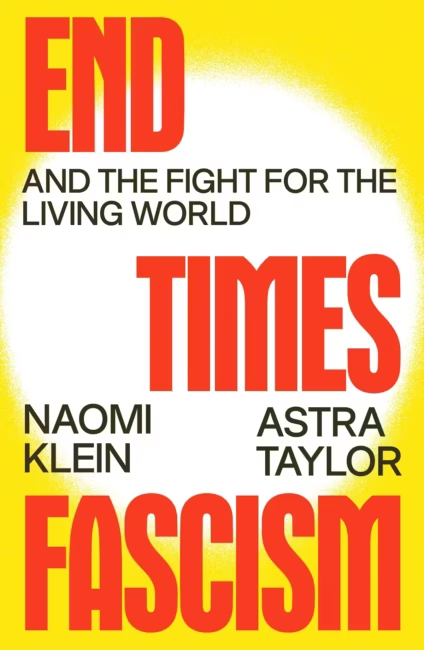
AMY GOODMAN: As the debate over AI intensifies, the award-winning journalists and writers Naomi Klein and Astra Taylor have a new book out today that is connected to all of this. It is titled End Times Fascism: And the Fight for the Living World. It examines how wealthy elites, including tech CEOs, are preparing for the end of the world even as they contribute to growing inequality, political instability, wars and the climate crisis. They will join us in a minute but first, here is a short excerpt from a video that was released with the book.
ASTRA TAYLOR: End-times fascism is not a monolith. It’s a dangerous and fractious alliance of three main groups.
NARRATOR: Religious end-timers.
ROBERT JEFFRESS: From the very beginning it has been clear that god has a special plan and purpose for the nation of Israel.
NARRATOR: Tech end-timers.
SAM ALTMAN: You know, I think AI will probably like most likely sort of lead to the end of the world. But in the meantime there will be great companies created.
NARRATOR: Ethnonationalist end-timers.
BENJAMIN NETANYAHU: America is fighting with Israel for a common goal—to protect our future, to protect civilization against these barbarians.
PERSON: That was a good take right there.
PERSON: Seig fucking Heil, let’s fucking go!
PERSON: You would prefer the human race to endure, right?
PERSON: Uh—
PERSON: You’re hesitant.
PERSON: Yeah, well, I—
PERSON: End-times fascists haven’t just given up on liberal democracy. They’ve given up on the possibility of a shared future for all of us.
PERSON: The most powerful people in the world—
PERSON: —are preparing for the end of the world—
PERSON: —an end they themselves are both accelerating—
PERSON: —and profiting from.
ELON MUSK: [laughs]
PERSON: We have imagined Armageddon so many times it can almost feel inevitable. Except it’s not. So, which side are you on?
PERSON: The side of bunkering down, abandoning Earth and profiting from apocalypse? Or staying loyal to this planet and its people—
PERSON: Who are you aligned with? Who are you protecting?
PERSON: —and making life here better?
AMY GOODMAN: A short video released in conjunction with the new book End Times Fascism: And the Fight for the Living World written by our guests in studio for the hour. Naomi Klein, award-winning journalist, documentary filmmaker, best-selling author of a number of books including Doppelganger and No Logo and The Shock Doctrine. Naomi Klein is also an associate professor and co-director of the Centre for Climate Justice at the University of British Columbia in Canada. Astra Taylor is an award-winning writer, activist and documentary filmmaker, the co-founder of the Debt Collective and author of several books including The Age of Insecurity: Coming Together as Things Fall Apart and The People’s Platform: Taking Back Power and Culture in the Digital Age. Thanks so much for spending the hour with us. Naomi, start off with a title, start off with End Times Fascism, why you chose this.
NAOMI KLEIN: First of all, thank you for having us here, Amy. It’s great to be launching the book on Democracy Now! It just came out this morning, as you said. And I think we have a long tradition of launching books together. We decided to call it End Times Fascism because we are trying to understand what is the same and what is different about our moment of far-right extremism. We know that far-right parties with lineages to the fascists of the 20th century are rising to power around the world. We just saw a fateful election in a German state, the first time the far right has won an election since the Second World War. We’re seeing very disturbing polls in France, for instance. And we’re seeing more and more open fascist expressions in the United States from very powerful people in government and in tech.
But we don’t believe that this is simply a rerun. We don’t believe that history repeats on a loop. We believe that we’re in something more like a sequel where the logics of fascism, which are the logics of dehumanization, of othering, of racial supremacy and hierarchy, are now being applied in a time of global existential crisis. This is not news to Democracy Now! listeners and viewers that we live in a time of a climate breakdown and collapse. We have tools like nuclear weapons, that were not known to Hitler and Mussolini, that have the ability to inflict apocalyptic levels of violence that were beyond their reach.
And fascism always emerges during times of systemic crises, and it actually emerges as a way to protect capitalism from systemic change. So if we think about 20th century fascism in Europe after the First World War, there was a rising socialist response to the wreckage of the First World War and then to the Great Depression. And fascism rises up—we call it “capitalism threat response” or “capitalism with bared teeth”—to make sure all of that popular public anger is pivoted toward the scapegoat. In our time, as we see these global crises—that could lead to systemic change or there can be this what we are calling “end times fascist” response that says, “let it burn,” and now it’s a fight for who’s going to survive the future.
Now it’s about building—as you saw in that film that we were fortunate to work with a great team of filmmakers on—it’s about building the bunkers and the rocket ships and the escape hatches. For religious end-timers, it’s literally about the bunker in the sky; it’s about the idea of the rapture. But that is almost like a template for these more secular stories that are also a kind of a rapture, but we call it in the book a “wealth rapture.” If you’ve got resources, you can rapture yourself away from the impacts of those threats that we are all in. So that’s why we call it End Times Fascism. It hasn’t won yet. And the reason we wrote the book is because people are fighting back. And we think if we are able to look at this very frightening reality with clear eyes, the more it is exposed to the light, the less popular it is because in fact those people cherish our one and only home and want to stay and want to make it better.
JUAN GONZÁLEZ: Naomi, how is this different, for example, if in the 1950s and 1960s when at the height of the Cold War there were Americans, especially upper-class Americans, building bomb shelters, convinced that there was going to be a nuclear war, and the rest of the population eventually began to organize in an anti-nuclear movement that peaked in the 1980s and that led really to capitalism being forced to restrain itself to some degree in terms of arms control treaties? Why is this different than back then?
NAOMI KLEIN: Well, Juan, I guess it’s different because the people we’re calling end-times fascists are systematically dismantling that precise international infrastructure. One of the things that all those three factions all agree on—whether it’s the religious fundamentalists, the tech extremists that we heard from in that video, or the ethnonationalists—they don’t agree on everything but they all agree they want to get rid of the United Nations. They all believe that that is the sort of antichrist of their story. Sometimes they literally call it the antichrist. And that chapter that you are describing, which we write about in the book, Juan—and I would actually love to bring Astra into the conversation because she went pretty deep into this research on the history of bunkering in the United States and how people shifted the tide, because we actually think that’s a really inspiring story that we need to know better.
Can I bring in Astra, my incredible co-author?
JUAN GONZÁLEZ: Sure.
ASTRA TAYLOR: Thank you so much. Again, thanks for having us. Yeah, it is—very quickly, in the 1950s, the government policy was to encourage people to build their own bomb shelters in their backyard, and that was the response to the nuclear threat. Only around 1%, 2% of households did that, in part because people revolted at the idea of protecting themselves and letting their neighbors perish. And there was a massive debate in magazines like TIME magazine, LIFE magazine that was around the idea of “gunning thy neighbor.” People said, “We don’t want to do that. We don’t want to be hiding in a hole in the ground with guns pointing outwards and turning the people we care about away.” That is part of the genesis of the movement for nuclear disarmament. It was ordinary people who put the right solution on the table, which is let’s get rid of nuclear bombs; let’s not turn on each other and bunker down. There’s a lesson in that for today.
NAOMI KLEIN: It’s so interesting because what they understood at the time is like either you bunker—either you just protect you and yours—or you get at the root cause of the crisis and you say, “Actually, we can’t live with these weapons.” Right? It’s just—”It’s too dangerous.” And as you both know, the nuclear disarmament movement had tremendous successes. In many ways, we argue in the book that it was a victim of its own success because many people in the disarmament movement believed that they had won so many victories that now the people in charge were just going to finish the job, because so many thousands of nuclear warheads were successfully disarmed that it seemed like there was a new era. The majority of the stockpiles were disarmed but not enough, and now there is a rearming and AI is being embedded in the nuclear arsenal. Which is why at the end of the book we call for a triple disarmament movement.
In fact, Juan, we have something that you might be interested in—a new coinage in the book—which is “the Stephen Miller test.” Basically the argument that we’re making is that eventually, the most powerful tools, the most powerful weapons, will meet the worst people in the world, and if you don’t want those tools to find themselves in the hands of Stephen Miller, then the tools should not exist. That applies to nuclear weapons. It applies to AI. It applies to the wealth concentration itself, which we believe should be now understood as a WMD. That this level of wealth that has accumulated at the top of our economy has itself become a weapon of mass destruction. And so we need to be disarming the wealth bombs, the tech bombs, and of course, the bomb-bombs. Because we are now seeing that these very dangerous, completely immoral people who seem to have such a casual attitude—and we see this from Donald Trump’s most recent post, just a kind of shrug in the face of apocalypse—they will find—they exert a magnetic pull towards one another.
JUAN GONZÁLEZ: I wanted to follow-up and ask either one of you if you want to answer this, because I did read the book in the last couple of days and really found it to be tremendously well written. At the same time, though, there were some concerns I had. For instance, there is very little mention of the rise of a multipolar world, of how the rise of East Asia, especially, the shift of the world’s industrial working class to China, Vietnam, India, Indonesia, Bangladesh, along with Brazil and Mexico—in the view of many, that is the single biggest impediment to U.S. economic dominance, of the capitalist markets’ expansion. And that’s also the biggest threat that many of these end-timers, as you label them, are concerned about. They are concerned about China, yet China and its impact on U.S. hegemony and capitalism is not mentioned at all in the book.
NAOMI KLEIN: Well, I think that the threat of China is really, really central to the unimpeded AI rollout. It’s really the only argument they have. We do write about that in the book, but you’re right, it’s not the central focus of the book. We are more focused on the United States and the way in particular this is being pushed through Latin America, because we think there—and Europe. But the threat of the multipolar world I do think is central, because the only argument that Donald Trump really has in the face of the threats that are now being articulated from inside the house, from inside the companies, is “But China, but China; if we don’t build it, they will.” It’s completely untrue that deregulated AI has to be built the way it’s being built or else China will build it. China is much more open to regulating these technologies, to rules within the multilateral system. It’s the U.S. that has been blowing up these agreements.
And when the Doomsday Clock was reset this year, it was a really—I mean, it’s always pretty harrowing, but this year it was particularly so; they moved it forward four seconds—and described not just the threats, whether it was biological weapons, nuclear weapons, AI, but the way the U.S. government under Donald Trump was going after all of the international agreements that governments like China had been a party to, and just saying, “We don’t need them.” So I think it’s the tools and the dismantling of any attempt to constrain those tools.
ASTRA TAYLOR: It’s also about the narrative that the people in power are telling themselves. We’re tracking how there’s a certain embrace of apocalyptic narrative, of Armageddon, of the end times, that doesn’t—every government in the world doesn’t have that narrative, right? It’s something that’s very powerful in certain branches of the United States political class, in Israel, in parts of Latin America. We’re not saying that it applies to every country around the entire world, and so that’s one reason that that isn’t—there are some very powerful international players that aren’t central to the thesis.
AMY GOODMAN: Astra and Naomi, you write about Peter Thiel, saying, “Today a staggering number of his former colleagues and acolytes occupy powerful positions in every part of the Trump Administration. The most consequential of them is JD Vance.” If you can explain, who is Peter Thiel? What does it mean to have his inner circle populating the inner circle of the United States? And talk about all of these figures that are so much in the news now, that were standing behind President Trump during his inauguration, people who were opposed to him before, who took him off their platforms. We are talking about people like Jeff Bezos, people like Mark Zuckerberg and others.
ASTRA TAYLOR: Yes. Peter Thiel is a powerful billionaire and venture capitalist who has been in Silicon Valley for a long time. He is part of the PayPal mafia so he founded PayPal with David Sacks, who was Trump’s former AI and crypto czar. And also Elon Musk, of course, who is now the president of SpaceX; everybody will know him. Peter Thiel is quite interesting because he has been on the far right very proudly for a long time since he was an undergraduate at Stanford when he and David Sacks actually wrote a book against political correctness. And he has been on the vanguard of being very much against democracy, very—quasi-libertarian but now just explicitly authoritarian—and has written things like “Democracy and freedom are incompatible.”
He was one of the first figures in Silicon Valley to come out for Trump in 2015.
And as we write in the book and as you said, many of his protégés are now in positions of power and the most influential one is JD Vance. JD Vance has written about how his life changed when he saw Peter Thiel give a lecture. This lecture inspired to Vance to go to Silicon Valley to become a venture capitalist—not a very illustrious one—and that’s where he met critical figures who would fund his political rise, including Thiel who gave what was a record-breaking donation of $15 million and kind of launched and made possible Vance’s bid to become a senator of Ohio. And it was Peter Thiel who also brokered the meeting at Mar-a-Lago where Vance was able to apologize for calling Donald Trump “Hitler.” So Vance is of course one of those figures who used to be opposed—
AMY GOODMAN: Explain that? That Vance said—
ASTRA TAYLOR: Yeah, Vance was once—he was once for green energy. He was against Donald Trump who he said misleads people and offers empty promises like building a wall which won’t actually improve people’s lives. But he’s also quite an opportunist, and Peter Thiel brokered peace among those two, and now we know Vance as the VC VP.
J.D. Vance is also critical in our book because he is who helped bring together the AI industry and Donald Trump. We remember from Donald Trump’s first term that he was against Big Tech. He was railing against Big Tech all the time. Thanks to JD Vance who hosted a dinner at David Sacks’ house, Trump got on the AI train. It was a fundraiser but it was also a pitch session. Vance’s Silicon Valley brethren told Donald Trump that AI would be good for the economy but it would be very good for the fossil fuel sector. And now we see that the Trump administration is all in on AI and not much else. So when we look at the famous image of the second Trump inauguration and we see all those tech execs given their front seats and they’re lined up, our position is that it was the promise of generative AI eating the economy that actually turned them fascist and caused this incredible alliance with the Trump regime that we’re seeing.
NAOMI KLEIN: Yeah, that that alliance has served them incredibly well. It has produced the first trillionaire. It has produced companies that are claiming valuations roughly equivalent to the entire U.S. economy. And what they wanted from Donald Trump was exactly what they got: a frontier. You hear this phrase used all the time now—”frontier AI”—but if you think about what a frontier is, a frontier is a wild West. It has no rules. And what they were upset about under the last administration was that there were some, you know, not radical, very simple rules like you have to label deepfakes, guardrails against precisely the scenarios that they are now talking about in terms of integration with weapons systems, and the prospect of a rogue AI. So all of this was on the table years ago. There were discussions at the United Nations.
It’s interesting that they’re always using China as the bogeyman of why they have to roll out AI without rules. China has many more rules regulating AI than the United States has,
including rules around not allowing children to have these like personal relationships with AI where there’s confusion about whether or not you are talking to a friend or a robot or a therapist or whatever it is. First of all, that’s a lie, and that’s just the fact that people are not educated about what China is doing that is allowing people to fall for this line of, like, “Oh, no, if we don’t do it, China will.” They just simply don’t know how China is regulating this.
But one of the things I’ve been thinking about is—and we have to be aware of how active this push was for the frontier, because now of course these CEOs are all coming forward and saying “Please regulate us, we’ll regulate ourselves, we know we need to be regulated,” as if they weren’t the ones who not only demanded this wild West frontier but bankrolled it and created the strategic alliance with Donald Trump so that he would deliver it to them. And now they’re realizing, “OK, maybe we’ve gone too far and have to look more credible.” And Donald Trump is going, “No way.”
Why is he saying, “No way”? Because he has tanked the entire U.S. economy and the only thing he has going for him is the AI stock bubble, and he’s terrified of this bubble bursting all over him before the midterm elections or before the next presidential. He also is very invested in it personally. He’s richer than he has ever been because of the rampant corruption of this administration, the money he has made from crypto but also many different ways that he and his family are invested in AI. So that’s why he’s doing these frantic things like calling Jensen Huang on stage to say, “Don’t worry, we’re not going to do anything.”
But if you’ll allow me, I was really struck because there’s this myth that—these sort of parables of the technology slipping out of the hands of the men who built it, right? The Sorcerer’s Apprentice, Frankenstein. Creating a monster right? That’s the myth that they’re all telling. “Oh no, we’ve created this powerful monster. It’s out of our hands and now it’s going to destroy us.” I would argue that that myth really is coming true but the monster is not AI, Amy; it’s Donald Trump. They created Donald Trump, he is their monster, he’s out of control and he just won’t stop. And they’re like, “Wait a minute, maybe it is’s going too fast.”
AMY GOODMAN: We’re going to break and then come back to this discussion. Naomi Klein and Astra Taylor are co-authors of the new book out today, End Times Fascism: And the Fight for the Living World.
[MUSIC BREAK]
AMY GOODMAN: This is Democracy Now!, Democracynow.org, the War and Peace Report. I’m Amy Goodman with Juan González. We are spending the hour with Naomi Klein and Astra Taylor, co-authors of the new book End Times Fascism: And the Fight for the Living World. I want to go back to the video that was released in conjunction with the book.
NAOMI KLEIN: On a mountaintop in the dead of winter, a group of faithful men gathered an audience to share their vision. They had seen a gleaming city bathed in golden light. The city would be filled with buildings so beautiful they would seem to float above the earth as if descended from heaven. Their vision already had a name.
PERSON: New Gaza.
JARED KUSHNER: So, we’ll see if these things work. They never usually work.
NAOMI KLEIN: The mountaintop in question was the resort town of Davos. The faithful men presenting their vision were U.S. real estate moguls Jared Kushner and Steve Witkoff.
PRES. DONALD TRUMP: Well, this is a very exciting day. See, I’m a real estate person at heart and it’s all about location. Look at this beautiful piece of property.
PERSON: Let’s just plan for catastrophic success.
NAOMI KLEIN: Out of the horrors of a live-streamed genocide, an exclusive paradise was about to emerge fully formed.
PERSON: We’ve already started removing the rubble and doing some of the demolition.
AMY GOODMAN: Part of the video that was released with the book End Times Fascism: And the Fight for the Living World. It is by Naomi Klein and Astra Taylor. I want to talk about Gaza right now. We are coming off of—in Venice right now you have two Israeli filmmakers, Rachel Szor and Yuval Abraham, who just came out with a film called NAZA and now members of the Israeli government are threatening to take away their citizenship, and it was based on the commentary of high-level Israeli officials, unnamed, talking about the killing in Gaza deliberately. Naomi Klein?
NAOMI KLEIN: Yeah, and the use of AI to do so. I actually haven’t seen the film. I’m definitely looking to see it. But it underlines what we already know thanks to Palestinian journalists at huge personal cost in the documenting of a livestream genocide.
AMY GOODMAN: Over 250 of them killed in this last two years.
NAOMI KLEIN: And as we say in the film, this is the story that the Trump administration is telling, is that out of apocalypse there will be this paradise. There will be what they are calling “New Gaza.” We begin the book with it because it is such an extreme distillation of the story. And I believe it’s the most dangerous story ever told. It’s a biblical story. It’s deeply encoded in our culture whether we’re religious or not. And the story is first comes the flood, first comes the apocalypse, first comes the mass death—and out of the mass death, the great cleansing, the fury of god, comes the golden city, the paradise, for the chosen few.
That story, which—it’s the story of the flood and the ark; it’s told in its most violent form in the book of _Revelation_—for people who believe in it literally, it has confused the difference between bad and good. It has kind of flipped the switch, where when we see the things in our world that should be warning us, telling us we need to act, we are in a time of crisis, it is an emergency—whether it’s climate disasters, whether it’s COVID, that things are breaking down—that what is seen instead are signs. “Oh, no, what it means is that we’re entering the end times.” And while that may be bad for many people, it’s actually very good for the chosen few. That’s why we started with this myth of New G…there is no paradise that is coming out of the apocalypse in Gaza but that is the story that the Trump administration is telling. It’s a privatized paradise that they’re proposing to build. They are using this kind of biblical narrative but of course it’s all for profit because it’s the Trump administration. They want to build luxury condominiums over a mass grave. And you saw there that it’s a literal story.
We do think that the Board of Peace is significant in the sort of evolution of the privatization of the state, the fact that the Trump Administration is not just attacking the United Nations and defunding the United Nations but trying to replace the United Nations with something called the Board of Peace, which Trump would be head of for life, that they would control the—they would give themselves immunity. This is part of what we mean by bunkering, by escaping. It’s like they see the state as a mine site. They see the United States as a place that they can extract from. Not just extract wealth and resources—and we’re watching them do that—but also extract other things that matter to them, like legal immunity. Right? I mean, the Board of Peace gives them that.
So that’s why we start with that. And it brings together these different parts of the coalition. Because there are religious extremists, both Christian Zionists and messianic Jews, who really do believe that Gaza, Iran mean that the Messiah is coming. Like the more violent, the better. And you’ve covered on the show officers in the U.S. military lodging complaints that their officers are telling them that they should welcome apocalyptic levels of violence in Iran because it means that Jesus is returning. But it’s not just the religious extremists. It’s also the secular versions of the story. We don’t think Trump believes in the biblical version of this story, but we do believe he believes in a kind of a wealth rapture. And when you see those AI-generated images of new Gaza and Trump sharing them, you can see how these stories have distorted his brain.
JUAN GONZÁLEZ: In the little time we have left, I’m wondering if you could talk a little bit about the resistance movements, the people’s movements against this growing fascism, and also perhaps deal with some of the critiques of let’s say of Marxists like John Bellamy Foster, who basically insists that the fascist movement in the United States, the mass base of it is really the middle class, those people driven out by the Walmarts and the Targets from small businesses, and franchisees and others who have been driven down by the growth of these top-end monopoly capitalists and who have now turned to a fascist movement for their salvation.
ASTRA TAYLOR: To answer the second part first, fascism is always a movement of the injured powerful. It is a movement that creates vertical solidarity between political and corporate elites and people who are not the worst off but feel that they’ve lost status and directs their sense of insecurity downwards further towards vulnerable scapegoats—towards immigrants, towards trans kids, towards feminists—instead of upwards at the oligarchs and the politicians. So that’s how we understand Elon Musk buying X or what was Twitter, right, is that it was a way for him to control a media ecosystem and help direct that rage downwards at the left and at the vulnerable instead of letting it be harnessed towards people like him. So I think that that’s right, if fascism creates what we call a vertical solidarity to protect capitalism, to protect the status quo. That’s certainly true of fascism in the past and it’s certainly true today.
What we have to do to build the resistance is create that horizontal solidarity, to not scapegoat the vulnerable, to build our own coalition and find our own unusual bedfellows. I think you see that in the resistance to fascism that’s growing in the United States and around the world. One thing—Naomi said this—the people we’re tracking—end-times fascism is not a coherent ideology necessarily. It’s not a monolith. It’s a fractious alliance of these three groups: the religious end timers, the tech accelerationists, the ethnonationalists. But what they have in common is this sense that things are going to be increasingly unstable. We say that they’re both building their arks and they’re causing the floods. They’re accelerating collapse. They’ve decided to just bring it on and abandon this shared world in their various fantasies about bunker nation or ascending to heaven or the digital class.
So the resistance fundamentally needs to be grounded in a desire to stay here on Earth, to commit to this place. We describe them at one point in the book as traitors to creation. And we don’t use that word “traitors” lightly. We are saying they’re not traitors to the flag or the nation but actually to life on Earth, to our shared humanity, our shared planet. And I think we see that commitment to what we call “hereness” in the book in the movement against data centers that is sweeping the nation, in the resistance to ICE where people are saying, “No, I’m going to defend my community, defend my neighbors” and people standing up and fighting for labor rights, which fascists are always attacking. Fighting for the environment, fighting against detention centers.
And so we see the resistance growing all over the world, but I think that the data center revolt is the main one for us because it really draws new lines and shows people—is bringing people together who a year ago or a couple of years ago might have been fighting over culture war issues. Now they’re saying, “Well, actually, we have a lot in common because there’s a class of people who actually want to replace us with robots. Maybe we should be on the side of humanity against the machines.”
NAOMI KLEIN: Including those small business people, Juan, who you were referring to. This is why it really is an opportunity to form those new alliances. Because Donald Trump has betrayed many of the people who did vote for him the first time. The trouble, of course, is that many powerful Democrats are also taking money from the large tech companies and so are not willing to harvest what has been called by a comedian in I believe it was Madison—”the most bipartisan issue since beer” is the opposition to these tech companies. But in order to gain political advantage from that huge bipartisan issue, you have to be willing to go against your donors or not take their money in the first place.
JUAN GONZÁLEZ: Naomi, the business model of these AI fascists, if they were to be able to prevail, throw millions of people out of work, how will they make their money? Because obviously Henry Ford, back in the days of the early monopoly capitalism, believed you had to give workers a living wage so they could consume the products that you produced.
NAOMI KLEIN: Well, I’m not sure it’s all that thought through. I think that they think they’re mainly going to be selling products to other businesses in the short term. But this is why, Juan, it is a bubble, and it is a process of extraction, and the bubble is rigged to explode all over working people and their pensions right now.
ASTRA TAYLOR: Yeah, I think they also think that they’ll make a lot of money hooking up with the government and the military. There is a quote from Alex Karp—who is a colleague of Peter Thiel, CEO of Palantir—and he said—we quote him in the book saying, “If these tech companies think they’re going to take everybody’s jobs and then not work with the military, they are”—I’m going to change what he said and say—”they are foolish.” What he’s saying is essentially if you’re planning to build a technology that causes a job apocalypse, you are also going to have to align with the state and help build the mechanisms to police and control and contain the masses of dispossessed human beings.
AMY GOODMAN: I wanted to end with the end of your book: “We didn’t choose to be born into a fight quite so fateful but we have reached a choice point. We can either follow end-times fascists into oblivion or we can commit to building the unruly, boundary-crossing movement they so deeply fear, one that wrests away their weapons, holds them accountable for their crimes, and defends the paradise of here.”
Those are the words of Naomi Klein and Astra Taylor, co-authors of the new book out today End Times Fascism: And the Fight for the Living World. Happy birthday to Sam Alcoff! Naomi and Astra will be in Brooklyn tonight at St. Ann’s Church. Then they go from Brooklyn to Brookline, Massachusetts, tomorrow. Then they’re headed to Washington—Politics and Prose—and beyond. They’ll also be in London and in Europe as well.
On Thursday, September 17th, I’m going home to Bay Shore, New York, in Long Island, for a screening of Steal This Story, Please! at the Boulton Center with the director Tia Lessin and the producer Caren Spruch. This has been a remarkable conversation. Thanks so much for being with us. I’m Amy Goodman with Juan González for another edition of Democracy Now!.
The original content of this program is licensed under a Creative Commons Attribution-Noncommercial-No Derivative Works 3.0 United States License. Please attribute legal copies of this work to democracynow.org. Some of the work(s) that this program incorporates, however, may be separately licensed. For further information or additional permissions, contact us.




 By Ana Vracar, BreakThrough News. Tech company Palantir has become widely known for the dystopian values espoused by its founders and their stated support for Israel throughout the genocide in Gaza. A new report now indicates the company may also be engaged in extensive tax dodging, allowing it to avoid contributing to the public services it profits from. Launched on August 5 by the European Federation of Public Service Unions and the Center for International Corporate Tax Accountability and Research, the report identifies “an estimated €12 million ‘tax gap’ between what Palantir pays in Europe and what they would have paid…”