

We are witnessing the imminent emergence of new forms of resistance willing to support broad-based struggles intent on producing ongoing forms of nonviolent resistance at all levels of society.
—Henry A. Giroux
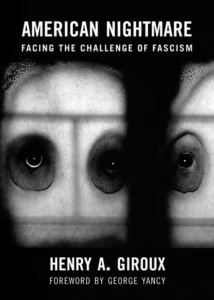
In “Staring into the Authoritarian Abyss,” the introduction to his book American Nightmare: Facing the Challenge of Fascism, Henry A. Giroux wrote the following:
Under the economic, religious, and political extremists Trump has been installing in positions of power, intolerance and militarization will intensify. Financial capital will be deregulated in order to be free to engage in behavior that puts the American public and the planet in danger. Institutions that embody the common good, such as public schools, will be defunded or privatized, and as a culture of greed and selfishness reaches new heights, there will be a further retreat from civil literacy and a growing abandonment by the state of any allegiance to the public interest. The free-market mentality that gained prominence under the presidency of Ronald Regan will advance under Trump and will continue to drive politics, destroy many social protections, further privilege the wealthy, and deregulate economic activity.[1]
Published in 2018, the analysis in American Nightmare could have been created yesterday. Giroux goes on to explain Trump’s tax reform bill of his first term which bears more than a passing resemblance to the Big Beautiful [Ugly] Bill recently passed by Congress. He explains that the bill:
largely favors the ultra-rich and and major corporations and would eventually leave 83 million middle-class and poor families paying more in taxes. Moreover, the increase in the deficit caused by these tax cuts enables the Republicans to wage and justify a major assault on the welfare state and its chief social provisions, such as social security, Medicare, and Medicaid. And what other rationale is there for Trump’s war on the environment, evident not only in his withdrawing from the Paris climate agreement but also in his opening up billions of acres of land on both the Pacific and Atlantic coasts for oil drilling? This is beyond shameful. It constitutes an act of war on the planet and the health of millions of adults and children.[2]
This pro-corporate fascism will make all human activities, practices, and institutions subject to market principles and commercialization. In other words, “there will be no place for morality and no place for compassion. Principles of equality, egalitarianism, and meritocracy however frail, are no longer espoused by the major political parties.”[3] The result is a morally bankrupt government of and by corporations that denigrates and ignores the people, the common ‘man’: the workers, the working class, whether they be black, brown, red or white, and whether they are recent arrivals or their ancestors were immigrants decades ago. Some were forced to come to these shores, especially as Black slaves, others have come of their own free will. We are, from the Mayflower on, a nation of immigrants. The native indigenous peoples were of course already in the Americas; in the U.S. they are most often called Native Americans.
What do we do to challenge this fascism that is overtaking our country?
Giroux says “One place to begin is with reason and truth, and how fundamental they are to creating critically engaged citizens and communities.”
Both reason and truth are under attack and it is essential to create “social formations within authoritarian societies to advance social justice, egalitarianism, political tolerance, cultural diversity, and vibrant democracy-centered communities.”[4]
Giroux calls these communities “democracies in exile.” These groups are resistant to Trumpian fascist politics and “are grounded in community building, economic justice, and a discourse of critique, hope, social justice, and self-reflection,” a concept he explains and illustrates throughout the book in the process of his detailed analysis.
Since 2018 when this book was published many such communities have flourished. At the national level the Poor People’s Campaign led by Liz Theoharis and William Barber is a re-establishing of Martin Luther King’s Poor People’s Campaign after his death.
Local communities have been building their own groups, often as social structures, to support action around a particular issue whether it be housing, food scarcity, immigration and deportation, blatant racism and DEI, widespread poverty, voting rights and defending Social Security, Medicare, Medicaid, and SNAP (food for low income families and many elders, who need this source to eat.)
Peace and justice groups are anti-militarism. Since this book was written they have taken on the issue of genocide in Gaza/Palestine and opposed Israel’s cruelty with the bombing and now starvation and genocide of Gazans. Support with constant demonstrations and actions critical of U.S. aid to Israel has spread worldwide where millions have marched against their governments’ support of Israel. Peace and justice groups that have for many years opposed Israeli apartheid in Israel/Palestine and supported equality in Israel/Palestine have activly opposed Israel’s Zionism, They have been accused, along with the many who have joined them, of antisemitism but are actually anti-Zionist not antisemitic, Zionism being an imperialistic political system created in the late 19th century and not to be confused with the ancient religion of Judaism.
Professor George Yancy, Professor of Philosophy at Emory Univeresity who wrote the Foreword to Giroux’s book about the American nightmare, fittingly ends his commentary with a quote from the poet James Baldwin:
People who shut their eyes to reality simply invite their own destruction, and anyone who insists on remaining in a state of innocence long after that innocence is dead turns himself [sic] into a monster.[5]
Some thoughts about this book from Sue Ann Martinson —
What I have always liked about Giroux’s thinking and writing is the way he makes the connections between often seemingly disparate facts and actions and this book is no exception. In the case of Trump, Giroux weaves what appear to be isolated attacks and outrageous statements into a tapestry that shows what often may be easily dismissed as simple nonsense but instead show greater purpose: He holds these lies, deceits, and vagaries as a system that melds together with greater intent and purpose and takes Trump out of the level of con man and baffoon into the realm of an authoritarian dictator who is power and greed crazy and into a totalitarian and fascistic state held together by the concept of White Supremacy.[6]
Giroux shows how before Trump the seeds of totalitarianism and fascism were already deep in the soil of 20th century America from earlier centuries and how Trump is both the messenger and tool of unearthing them. He is now bringing them to fruition in this his second term.
Fascistic programs that were foreshadowed in his first presidential term are now being carried out as Trump’s authoritarianism has rapidly deteriorated into cruelty.
This book is long, and I have read only part of it so far. It is also scholarly and dense. Full of fascinating and illuminating detail and references to other scholars, it is well-documented. I am going to fast forward to the last chapter and conclusion of the book. I will finish reading it because it contains so much information, discussion and many insights that are relevant to now and to our future. I encourage others to read it as well.
Foreshadowing the Present
Professor George Yancy entitled his Foreword “Facing the Challenges: the Urgency of Now.” It echos the urgency in the title of Martin Luther King’s book Why We Can’t Wait.
Giroux’s title for his last chapter is “Toward a Politics of Ungovernability.” He prefaces the chapter with a quote from James Baldwin: “In this country we are menaced−intolerably menaced−by a lack of vision. . . .” Giroux begins the chapter with a reference to MLK’s famous Riverside speech where King:
…spoke eloquently about what it meant to use nonviolent direct action as part of a broader struggle to connect racism, militarism, and war. His call to address a “society gone mad on war” and the need to “address the fierce urgency of now” was rooted in an intersectional politics. one that recognized a comprehensive view of oppression, struggle, and politics itself. Racism, poverty, and disposability could not be abstracted from the issue of militarism and how those modes of oppression informed each other.[7]
Restoring Historical Memory
Giroux also emphasizes the need for historical memory. How American history is taught is a major target of the Trump administration as they attempt to bury any history that does not support white supremacy. The point is to not include the attempted genocide of native peoples and the treatment of Blacks in American history and of others as well that we used to call ‘minorities.’ Their truths contradict the idealized America the Trumpites have invented that has the appearance of the clean slate that MAGA wishes to impose.[8]
This erasure of memory also includes the banning of books that is taking place in many states. Most of these books are about people of color and about LGBTQIA+ people. Many are classics and award-winning books.
DEI (Diversity, Equity, and Inclusion) is another program that is under attack. Trump has asked corporations to drop DEI guidelines in their workplaces and organizational guidelines. Many corporations have agreed, such as Target who dropped the program and is being boycotted, but others such as Costco have resisted and kept the DEI policies.
Shutting Down American Style Authoritarianism
“A successful resistance struggle must be comprehensive and at the same time embrace a vision that is unified, democratic, and equitable,” [9] says Giroux: A tall order. One that is “both political and pedagogical.” (Pedagogy refers to teaching, methods and strategies used in education.). Grioux calls for “democracy in exile” a concept that he defines in the book’s Conclusion but that infuses his commentary made throughout the book.
We need a new vision that refuses to equate capitalism and democracy, normalize greed and excessive competition and accept self-interest as the highest form of motivation. We need a language, vision, and understanding of power to enable the conditions in which education is linked to social change and the capacity to promote human agency through the registers of cooperation, compassion, care, love, equality, and respect for difference.” [10]
Resistance
Right now in L.A., a city under siege because of the high-handed arrest and deportation of especially immigrants of hispanic origin by ICE that has of course met the resistance of many people. Trump has called out California’s national guard although he is unauthorized to do so and has then sent troops to L.A. as the people of L.A. continue to resist with national support. “Democracy in Exile” organizing is taking place as documented by Amy Goodman’s Democracy Now! on August 11, 2025. On the one hand attorney generals nationwide met regarding L.A. to discuss their existing legal actions and their determination to plan more. These attorney generals may be considered a’”community’ in that they share the common thread of their work and in this case of shared vision.
On the other hand, on the ground in L.A. a group called Union del Bario from its smaller base organized many collaborative organizations. Recently they were able to film a young woman getting arrested by ICE. Eventually they got her released with a call-in that was local in L.A. but also went out nationally. Over 500 people responded.
This type of organizing, “a resurgent act of witnessing and moral outrage [that] will grow and provide the basis for a new kind of politics, a fierce wind of resistance, and a struggle too powerful to be defeated,” what Giroux calls “democracy in exile,” is able to take many forms by many seemingly unrelated groups of people.
The two examples juxtaposed on Democracy Now! are, although quite different, valid forms of resistance and are also collaborative within their scopes of influence. And now, in 2025, such collaborative community groups of many backgrounds are forming and growing in both local and national forms with an overall goal of restoring a functioning democracy. International groups are also challenging and influencing governments worldwide, especially in regard to the genocide in Gaza/Palestine.
Yet another recent example is the Miccosukee tribe in Florida. They have won a temporary lawsuit to halt construction of “Allegator Alcatraz,” a federal ‘concentration camp’ to hold deportees, on the grounds that no environmental impact statement (EIS), as required by federal law, has been conducted and that their tribal lands are threatened. Their tribal cultural center was recently burned to the ground:
The tribe is concerned about the facility’s potential impact on their ancestral lands, sacred sites, traditional hunting grounds, and other areas of cultural significance. They also fear environmental degradation, including potential pollution of water resources and impacts on endangered species like the Florida panther.
Radical Democracy
Those who believe in a radical democracy must find a way to make this nation ungovernable by the powers that currently claim governing authority. Small-scale defiance and local actions are important, but there is a more urgent need to mobilize through a comprehensive vision and politics that is capable of generating massive teach-ins all over the United States so as to enable a collective struggle aimed at producing powerful events such as a nationwide boycott, sit-ins, and a general strike in order to bring the country to a halt. The promise of such resistance must be rooted in the creation of a new political movement of democratic socialists, one whose power is grounded in the organization of novel political organizations, unions, educators, workers, young people, religious groups and others who constitute a progressive base.”[11]
Conclusion
Democracy in Exile
“The concept of democracy in exile is grounded in community building, economic justice, and a discourse of critique, hope, social justice and self-reflection.”[12]
Ever the educator, Giroux asks, “What role could a resuscitated critical education play in challenging the deadly neoliberal claim that all problems are individual when the roots of such problems lie in larger systemic forces?”
He also asks what role universities might play. Sadly, many universities have capitulated to restrictions of free speech around genocide in Gaza/Palestine as Trump blackmails them by threatening to withhold federal funding necessary for research and other programs and insists they punish students and faculty who decry the genocide.
Giroux calls upon leaders of the past for inspiration; often they sre Black because their resistance to white supremacy and oppression in the U.S. was/is bold and fearless. He quotes Frederick Douglas:
It is not light that is needed, but fire; it is not the gentle shower, but thunder. We need the storm, the whirlwind, the earthquake. The feeling of the nation must be quickened; the conscience of the nation must be roused; the propriety of the nation must be startled; the hypocracy of the nation must be exposed; and the crimes against God and man must be proclaimed and denounced.
Giroux continues: “The political oppression of our times requires that we work together to redefine politics and challenge the pro-corporate two-party system.”
As a warning, he has included the words of James Baldwin’s letter to Angela Davis:
Some of us, white [red, yellow] and black, know how great a price has already been paid to bring into existence a new consciousness, a new people, an unprecedented nation. If we know and do nothing, we are worse than the murderers hired in our name. If we know then we must fight for your life as though it were our own−which it is−and render impassable with our bodies the corridor to the gas chamber. For, if they take you in the morning, they will be coming for us in the night.
“In the end,” Giroux says, “there is no democracy without informed citizens, no justice without a language critical of injustice, and no change without a broad-based movement of collective resistance.”[13]
It is possible to see if you open your eyes that Trump and his cohorts and the Trump administration with their fascist authoritarianism are trying to destroy the paths to informed citizens, to the use of language for truth to expose hypocrisy and lies and replace them with justice, and to the formation of a broad-based collaborative movement of collective resistance. They continue their attacks on Social Security (now to be called a Federal Benefit program even though every bit of money received has been earned by recipients in their working years), Medicare, Medicaid and SNAP (money for food) as well as cultural organizations like the Smithsonian where they are demanding that any artwork that is negative about Trump and the Trump administration be removed.
Now nationwide. and also to some extent worldwide. we are in the throes of resistance and creation, refusing to accept authoritarian fascist government with the creation of broad-based collective resistance.ß
Henry A. Giroux is a renowned American and Canadian scholar, cultural critic, and public intellectual, widely recognized as a founding theorist of critical pedagogy in the United States. He is known for his work in public pedagogy, cultural studies, youth studies, higher education, and media studies. He currently holds the McMaster University Chair for Scholarship in the Public Interest and is the Paulo Freire Distinguished Scholar in Critical Pedagogy.
Sue Ann Martinson is the editor and publisher of Wings of Change.
Notes
[1] Henry A, Giroux, American Nightmare: Facing the Challenge of Fascism (San Francisco: City Lights Books, 2018) p,40
[2] Ibid. p. 41
[3] Ibid. p.35
[4] Ibid, p.33
[5] Ibid, p.22
[6] Ibid. p. 27
[7] Ibid. p. 287
[8] Ibid .pp. 291-92
[9] Ibid. pp. 297-99
[10] Ibid. pp. 303-04
[11] Ibid.
[12] Ibid. p. 310
[13] Ibid. pp. 321-23