It is past time to unmask the violent agents targeting people like Narciso, and halt Trump’s racist, xenophobic mass detentions and deportations.
Time to Unmask Trump’s Detention and Deportation Squads
By Amy Goodman & Denis Moynihan/ Democracy Now / Column / June 26, 2025
With each passing day, the violence wielded by ICE, U.S. Immigration and Customs Enforcement, grows more intense and widespread. One grotesquely emblematic example of this was the recent violent arrest of 48-year-old Narciso Barranco in Santa Ana, California. Narciso, a hardworking immigrant laborer who came from Mexico over thirty years ago, is the father of three US Marines. While landscaping outside an IHOP restaurant on June 21st, he was assaulted by at least seven armed, masked men, who tackled him and repeatedly punched him in the head. They handcuffed him and shoved him into an unmarked SUV. The plainclothes agents wore face masks, bullet-proof vests and military-grade helmets. Some of the vests read, “Police–US Border Patrol” on the back, but to anyone confronted by these gangs, no identifying marks, names, or badges were visible.
Image Credit: Instagram/@santaanaproblems
One of Narciso’s sons, Alejandro Barranco, a US Marine Corps veteran, was able to visit his father in jail. Narciso was still wearing the same work clothes that were bloodied in the assault.
“He looked beat up, he looked rough, he looked defeated, he was sad,” Alejandro said on the Democracy Now! news hour. “Anybody would be scared if they see these guys come up to them, masked, not in uniform, guns out.”
City of Santa Ana councilmember Jonathan Hernandez, also on Democracy Now!, added, “We are watching violence unfold, racial profiling increase in cities like Santa Ana, where 41% of our residents are migrants, 70% are of Latino descent…agents come into our community, and they’re refusing to identify themselves, they don’t have judicial warrants and these ICE raids are an example of the government’s overreach.”
In mid-June, President Trump briefly paused immigration raids on farms, hotels and restaurants, ostensibly to ensure these key industries that have supported him in the past continue to do so. “Our great Farmers and people in the Hotel and Leisure business have been stating that our very aggressive policy on immigration is taking very good, long time workers away from them, with those jobs being almost impossible to replace,” Trump wrote.
Soon after, he reversed himself. The short pause revealed a fundamental truth about undocumented immigrants: the US economy doesn’t function without them. Nevertheless, urged on by White House Deputy Chief of Staff Stephen Miller, ICE, Homeland Security and Border agents are snatching and deporting the very workers on whom our economy depends.
There are some sectors of the economy that are thriving amidst the mass deportations. GEO Group, the private prison corporation, has seen its stock rise by over 50% since Trump’s election. Palantir, the tech and AI firm co-founded by Trump backer, billionaire Peter Thiel, has seen its stock rise over 500% in the past year. It was recently reported that Palantir is building tools to allow near real-time tracking of immigrants in the US. The Program on Government Oversight, POGO, reported that Stephen Miller’s financial disclosure reveals he owns up to $250,000 in Palantir stock.
Meanwhile, the Republican majority on the US Supreme Court has handed Trump a deportation-related victory. Several immigrants sued the government to stop or reverse deportations to Guatemala, South Sudan and Libya. A federal judge in Massachusetts issued an injunction against these so-called “third party nation removals.” This week, the Supreme Court’s six conservative justices overturned that injunction, without comment. Justices Sonia Sotomayor, Elena Kagan and Ketanji Brown Jackson dissented, writing that the Trump administration’s “flagrantly unlawful conduct,” backed by the Supreme Court, is “exposing thousands to the risk of torture or death.”
Resistance is active, growing and making a difference. Grassroots pressure and legal battles have won the release of international students targeted for their solidarity with Palestinians, among them Rümeysa Öztürk, Mohsen Mahdawi, and the first such student arrested and threatened with deportation, Mahmoud Khalil.
Likewise, grassroots, legal and Congressional pressure forced the Trump administration to bring Kilmar Abrego Garcia back to the United States. The Maryland father received asylum during Trump’s first term, in 2019, based on credible threats from an El Salvador gang. Then, this past March 12th, he was snatched from a parking lot and sent, against a court order, to El Salvador.
Under enormous legal and grassroots pressure, the federal government finally returned Abrego Garcia to the US. Despite that victory, upon his return the federal government promptly rearrested him, charging him with human trafficking for allegedly driving undocumented immigrants several years ago. He remains in federal custody in Tennessee, and, if released, ICE will likely attempt to deport him.
Meanwhile, Narciso Barranco sits in ICE detention, with his two sons still on active duty in the US Marines not far away, at Fort Pendleton. It is past time to unmask the violent agents targeting people like Narciso, and halt Trump’s racist, xenophobic mass detentions and deportations.
The original content of this program is licensed under a Creative Commons Attribution-Noncommercial-No Derivative Works 3.0 United States License. Please attribute legal copies of this work to democracynow.org. Some of the work(s) that this program incorporates, however, may be separately licensed. For further information or additional permissions, contact us.
Related
Story Jul 02, 2025
“Arrest Now, Ask Questions Later”: Why Did L.A. ICE Agents Arrest and Jail U.S. Citizen Andrea Velez?
Our Daily Digest brings Democracy Now! to your inbox each morning.
You are all an inspiration to me. Please join me on Wings of Change. It’s only the beginning as we still have so much work to do as many activists and organizations make plans for the upcoming years.Wings of Change is pleased and excited to be a part of that work through education, information, and inspiration.
If Roosevelt had lived what was his vision for the country and for the world?
The Unraveling of the New Deal, FDR’s Vision, Part 4
By Sue Ann Martinson / Wings of Change / June 30, 2025
FDR: The Four Freedoms
FDR, besides the New Deal, left this legacy of a New Bill of Rights as well. He had been elected for a fourth term and these were his promises. What America would be like now if he had been able to carry them out we can only speculate. But certainly as a nation we would not have been in the autocratic state we in now and people would have been more secure economically and with the comfort of being who the are without outside definitions created by others that are derogatory.
Having corporate overmasters is unconstitutional and yet another way to deconstruct a democracy that is “of the people, for the people and by the people.” Idealistic? Yes. But FDR more than any other president attempted to make a people’s government.
National and International Intentions After the War
On January 6, 1941 ─ after the invasion of Poland in 1939 when England declared war on Germany ─ FDR was focusing on the state of the world. He gave a State of the Union address in which he named the Four Freedoms for the world. In this speech he addressed the need to achieve world peace and peace for America.
This speech is 80 years to the day when on January 6, 2021, the United States Capitol in Washington, D.C., was attacked by a mob of supporters of President Donald Trump in an attempted self-coup, two months after his defeat in the 2020 presidential election.
The Four Freedoms:
Equality of opportunity for youth and for others:
Jobs for those who can work.
Security for those who need it
The ending of special privilege for the few
The preservation of civil liberties for all.
Many subjects connected with our social economy call for immediate improvement. As examples:
We should bring more citizens under the coverage of old-age pensions and unemployment insurance.
We should widen the opportunities for adequate medical care.
We should plan a better system by which persons deserving or needing gainful employment may obtain it.
FDR also outlined U.S. foreign policy at that time:
Just as our national policy in internal affairs has been based upon a decent respect for the rights and the dignity of all our fellow men within our gates, so our national policy in foreign affairs has been based on a decent respect for the rights and dignity of all nations, large and small. And the justice of morality must and will win in the end.
Our national policy is this:
First, by an impressive expression of the public will and without regard to partisanship, we are committed to all-inclusive national defense.
Second, by an impressive expression of the public will and without regard to partisanship,we are committed to full support of all those resolute peoples, everywhere, who are resisting aggression and are thereby keeping war away from our Hemisphere. By this support, we express our determination that the democratic cause shall prevail; and we strengthen the defense and the security of our own nation.
Third, by an impressive expression of the public will and without regard to partisanship, we are committed to the proposition that principles of morality and considerations for our own security will never permit us to acquiesce in a peace dictated by aggressors and sponsored by appeasers. We know that enduring peace cannot be bought at the cost of other people’s freedom.
In the recent national election there was no substantial difference between the two great parties in respect to that national policy. No issue was fought out on this line before the American electorate. Today it is abundantly evident that American citizens everywhere are demanding and supporting speedy and complete action in recognition of obvious danger.
No realistic American can expect from a dictator’s peace international generosity, or return of true independence, or world disarmament, or freedom of expression, or freedom of religion ─ or even good business.
Such a peace would bring no security for us or for our neighbors. “Those, who would give up essential liberty to purchase a little temporary safety, deserve neither liberty nor safety.”
As a nation, we may take pride in the fact that we are softhearted; but we cannot afford to be soft-headed.
In a later State of the Union speech on January 11, 1944, FDR explained his vision of a New Bill of Rights:
FDR’s New Deal and his “Four Freedoms” speech outlined a broader “New Bill of Rights” that included economic security, a concept distinct from the traditional Bill of Rights which focused on individual liberties. The “New Bill of Rights” encompassed the right to a job, adequate living standards, healthcare, education, and protection from economic hardship, as outlined in FDR’s “Second Bill of Rights.”
The Four Freedoms are the foundation for the Universal Declaration of Human Rights that was adopted by the United Nations on December 10, 1948. After the death of FDR Eleanor carried the torch forward as chair of the UN Commission on Human Rights that created the document.
Although the war was not yet over, in his State of the Union address on January 11, 1944 FDR, planning ahead for the war-end, reiterated a commitment to a New Bill of Rights for the American people.
On June 11, 1944 FDR repeated the full text of the speech in one of his Fireside Chats for the nation to hear.
Perhaps FDR had been reading Thoreau’s essay on civil disobedience that calls for an even more perfect Union in the United States than existed in the Constitution. Thoreau said:
The authority of government, even such as I am willing to submit to — for I will cheerfully obey those who know and can do better than I, and in many things even those who neither know nor can do so well — is still an impure one: to be strictly just, it must have the sanction and consent of the governed. It can have no pure right over my person and property but what I concede to it.
The progress from an absolute to a limited monarchy, from a limited monarchy to a democracy, is a progress toward a true respect for the individual…. Is a democracy, such as we know it, the last improvement possible in government?
Thoreau goes on to say:
Is it not possible to take a step further towards recognizing and organizing the rights of man? There will never be a really free and enlightened State, until the State comes to recognize the individual as a higher and independent power, from which all its own power and authority are derived, and treats him accordingly.
I please myself with imagining a State at last which can afford to be just to all men, and to treat the individual with respect as a neighbor; which even would not think it inconsistent with its own repose, if a few were to live aloof from it, not meddling with it, nor embraced by it, who fulfilled all the duties of neighbors and fellow-men.
First Thoreau is taking about himself as a good neighbor. We tend to think of neighborhoods as small units. But what if it were another country? What if all countries considered themselves a good neighbor to the countries next to them? He goes from the microcosm to the macrocosm. That interpretation seems to fit with FDR’s idea of the Four Freedoms as he expresses it in relation to Russia and Great Britain, remembering that settler colonialism was still prevalent and Western European countries held empires, including the British Empire, which was dominant.
Here is how Thoreau concludes:
A State which bore this kind of fruit, and suffered it to drop off as fast as it ripened, would prepare the way for a still more perfect and glorious State, which also I have imagined, but not yet anywhere seen.
State of the Union, January 11, 1944
“Necessitous men are not free men.” People who are hungry and out of a job are the stuff of which dictatorships are made.
FDR, in the January 11, 1944, State of the Union Speech addressed his vision for a second Bill of Rights and explains that these rights are true security and that “The best interests of each Nation, large and small, demand that all freedom-loving Nations shall join together in a just and durable system of peace.”
It is our duty now to begin to lay the plans and determine the strategy for the winning of a lasting peace and the establishment of an American standard of living higher than ever before known. We cannot be content, no matter how high that general standard of living may be, if some fraction of our people—whether it be one-third or one-fifth or one-tenth- is ill-fed, ill-clothed, ill housed, and insecure..
This Republic had its beginning, and grew to its present strength, under the protection of certain inalienable political rights—among them the right of free speech, free press, free worship, trial by jury, freedom from unreasonable searches and seizures. They were our rights to life and liberty.
As our Nation has grown in size and stature, however—as our industrial economy expanded—these political rights proved inadequate to assure us equality in the pursuit of happiness.
We have come to a clear realization of the fact that true individual freedom cannot exist without economic security and independence. “Necessitous men are not free men.” People who are hungry and out of a job are the stuff of which dictatorships are made.
In our day these economic truths have become accepted as self-evident. We have accepted, so to speak, a second Bill of Rights under which a new basis of security and prosperity can be established for all regardless of station, race, or creed.
Among these are:
The right to a useful and remunerative job in the industries or shops or farms or mines of the Nation;
The right to earn enough to provide adequate food and clothing and recreation;
The right of every farmer to raise and sell his products at a return which will give him and his family a decent living;
The right of every businessman, large and small, to trade in an atmosphere of freedom from unfair competition and domination by monopolies at home or abroad;
The right of every family to a decent home;
The right to adequate medical care and the opportunity to achieve and enjoy good health;
The right to adequate protection from the economic fears of old age, sickness, accident, and unemployment;
The right to a good education.
All of these rights spell security. And after this war is won we must be prepared to move forward, in the implementation of these rights, to new goals of human happiness and well-being.
America’s own rightful place in the world depends in large part upon how fully these and similar rights have been carried into practice for our citizens. For unless there is security here at home there cannot be lasting peace in the world.
One of the great American industrialists of our day, a man who has rendered yeoman service to his country in this crisis-recently emphasized the grave dangers of “rightist reaction” in this Nation. All clear-thinking businessmen share his concern. Indeed, if such reaction should develop—if history were to repeat itself and we were to return to the so-called “normalcy” of the 1920’s—then it is certain that even though we shall have conquered our enemies on the battlefields abroad, we shall have yielded to the spirit of Fascism here at home.
I ask the Congress to explore the means for implementing this economic bill of rights ─ for it is definitely the responsibility of the Congress so to do.
Flash Forward
Los Angeles (LA) June 2025
From the Brennan Foundation: A panel discussion re the sending in the military to LA. Is it legal? What are the ramifications for the future?
The deployment of Marines and federalized National Guard members to police protests in Los Angeles poses a serious threat to American democracy. The president’s memorandum appears to preemptively allow the deployment of federal forces anywhere there are protests against immigration raids nationwide, regardless of whether or not they are peaceful. This broad authorization suggests that the troop deployments go beyond protecting federal property or law enforcement — they are about suppressing disagreement against the government.
— Elizabeth Goitein in a Just Security expert panel discussion.
Note FDR words above:
…the grave dangers of “rightist reaction” in this Nation.
…we shall have yielded to the spirit of Fascism here at home.
Yet now Congress has fallen under thrall to that “rightist reaction” under the influence of those forces of fascism daily are that being forced upon us that is the opposite of “a new basis of security and prosperity can be established for all regardless of station, race, or creed.” Instead social welfare programs that support that vision are being slashed with support for money for corporate needs growing and for the military while the rest of the citizenry is ignored, funds for social programs decimated. Thousands have lost their jobs, their retirement savings, even their homes while the New Bill of Rights is decimated. Education, a core of democracy, is being defunded.
Yet FDR is very clear: these are the rights worldwide that bring true security, not the building up of the military:
In the plain down-to-earth talks that I had with the Generalissimo Chiang Kai Chek and Marshal Stalin and Prime Minister Churchill, it was abundantly clear that they are all most deeply interested in the resumption of peaceful progress by their own peoples—progress toward a better life. All our allies want freedom to develop their lands and resources, to build up industry, to increase education and individual opportunity, and to raise standards of living.
All our allies have learned by bitter experience that real development will not be possible if they are to be diverted from their purpose by repeated wars—or even threats of war.
Those leaders of primary world powers are now dead and the lessons learned from WWI and WWII have faded from consciousness. Endless War prevails. The monies taken from the social programs is instead to be used to increase the military might of America with Trump’s proposed Golden Dome, similar to the Iron Dome in Israel only four times larger to somehow protect the whole of the United States. But did the Iron Dome protect Israel from attack by Hamas?
Instead we now have a government that has embraced the “rightest reaction” and taken much of the nation with it through propaganda and lies. Our so-called president (not my president) becomes more autocratic every day. He blatantly declares his racism by word and deed. He is as he has always been basically a misogynist. The women he has appointed to positions are women who just do what they are told, yes-women. He openly flaunts the Constitution and tries to silence anyone who attempts to defy him. He calls himself a king. He allows his “flock” of fundamentalists to worship him as if he were divine. The “divine right of kings.” That went out in the Middle Ages.
“The law stands high above the king.” Magna Carta, 1215
The lords of England issued a writ that they would no longer be subservient to the king. The “divine right of kings” absolute authority was challenged. It included the right to a speedy trial, now known as habeas corpus.
A wise person once observed that it takes the support of the middle class for a revolution to succeed. Although it was the nobility of England who rebelled, they were in the middle, as the king with his divine right was above them and the peasants below them..
The Magna Carta still forms an important symbol of liberty today, often cited by politicians and campaigners, and is held in great respect by the British and American legal communities, Lord Denning describing it in 1956 as “the greatest constitutional document of all times—the foundation of the freedom of the individual against the arbitrary authority of the despot.”
Back to the Law
U.S. judges, have often, if not consistently, challenged Trump’s edicts, that is, executive orders, as being unconstitutional or breaking established laws. Trump has attempted to go after them of course, but different judges keep cropping up to challenge his often anti-Constitutional and law-breaking declarations. So far the idea of law above the king is functioning, resembling some semblance of law and order, not with guns, but with THE LAW as judges nationwide intervene against many of Trump’s edicts as unconstitutional or otherwise illegal. Most recent as I write this is a judge ruling the release of Mahmoud Khalil, the student from Columbia arrested for his pro-Palestinian activities although he has a green card and is married to a U.S. citizen.
Flash Forward, June 27, 2025
To stop the lower courts from challenging his unconstitutional executive orders Trump and his pro-fascist cohorts has had their allies in the U.S. Supreme Court state that the lower courts can no longer challenge Trump’s executive orders that undermine the Constitution although it will not go into effect immediately. As reported in Reuters, “The ruling also did not address the legality of the policy, part of Trump’s hardline approach toward immigration.”
Relevant Diversion
The U.S. system of law, while it was heavily influenced by French philosophers of the Enlightenment, is still based on English common law. The most predominant French influencers were Locke, Montesquieu, and Rousseau. But in turn Locke and Montesquieu were heavily influenced by English law in their contributions to the structure of the Constitution and the shaping of the U.S. government as it still stands today.
Rousseau’s primary contribution was the idea of laws created directly by the vote of the people. He also introduced the idea of “neighborhoods,” an idea that Thoreau elaborated on in his essay on civil disobedience. The idea of neighborhoods still exists in many cities, including Minneapolis which is divided into neighborhoods that have governing bodies that create and manage programs that deal with neighborhood-specific issues.
Locke believed in what he called a social contract and influenced Thomas Jefferson’s writing of the Declaration of Independence. Locke favored a representative government. Montesquieu advocated for the separation of powers.
The Senate is debating the “Big Beautiful Bill” that further destroys the Pillars of Democracy and Violates FDR’s Four Freedoms.
If I remember my civics class correctly (that was ninth grade ─ do they teach it anymore?) the executive, legislative, and judicial sections of government were meant to balance each other. The legislative branch today is often impotent on many issues, controlled by Trump’s and the GOP’s yes-men and women. As noted, by one vote on May 22, 2025, the House passed the “Big Ugly Budget” that steals money from the people of the United States.
These cuts, if they are allowed, will cause significantly more struggling to survive for millions of Americans. In some cases they will cause preventable deaths because of the cuts to Medicare and Medicaid. In the case of Social Security, cuts that are a lifeline for many Americans could be seriously cut down.
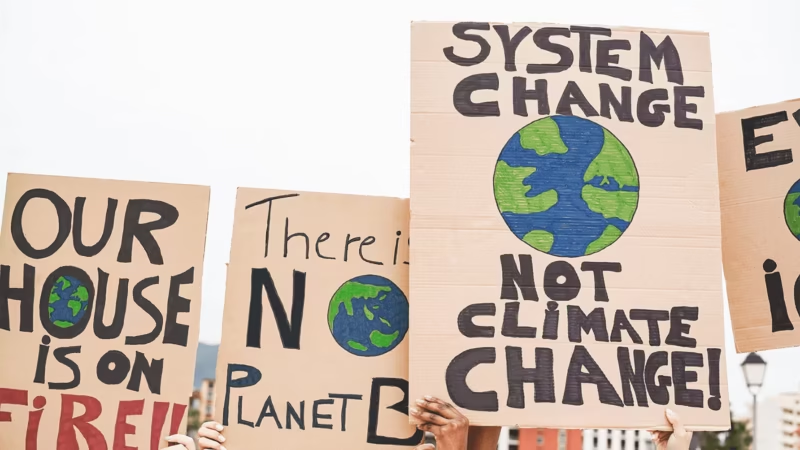
But not for corporate America: They are being pampered with money for investments and new laws are allowing them to develop fossil fuel that will further pollute the planet and hasten the global crisis. (There is no Planet B!)
Will the Senate show any backbone in accepting this Big Ugly Budget or not? That is not hopeful as they are controlled by the GOP. Sad, but true. That is the real fraud against the American people. We cannot go back (MAGA), even if we wanted to, and millions of us do not want to, as evidenced by the Hands Off and No Kings demonstrations. Many of us joined in the demonstrations not because we are Democrats (or Republicans either), but because we are antiwar and anti-genocide in Gaza because of its obvious inhumanity. We are also opposed to the illegal DOGE actions by Elon Musk and approved by Trump after creating DOGE as a government department by a presidential executive order not approved by Congress.
Elon Musk has left of DOGE and has actually criticized Trump’s platform and fascistic plans. In part this may be because the sales of his Tesla have greatly decreased, although it is only one way he makes money. He has been pilloried for the cuts he is responsible for, including USAid which affects millions worldwide.
Most members of Congress are supporters of Israel. Because so many of us support Palestine and are adamantly opposed the the genocide being perpetrated by Israel on Palestine, we are accused of being supporters of Hamas. We are what we say we are: antiwar and pro-Palestine. Having been involved in support of Palestine in educational programs and demonstrations, I can honestly say that we do not support Hamas per se. It has not come up in 20 years of pro-Palestine activities, not even since October 7, 2023. No chants I know of glorify or support Hamas.
Those who have worked on Middle East issues for 20 years or more such as Boycott, Divestment and Sanctions (BDS) and the WAMM Middle East Committee see Hamas as part of the very complicated geopolitics in the Middle East. What is not complicated is that genocide is a crime against humanity and no amount of Israel’s denial, even with the support of the U.S., can change the moral outrage at the wholesale death of a people. That was also true of the Holocaust, of course, but what Israel has become in its zealous Zionism backed by the U.S. is NOW, not then.
What About Now?
Shame hangs over the U.S. like a shroud.
As I write this the Senate is still deliberating about the Big ‘Beautiful’ Budget Bill and has not yet voted. Once they do settle on a version it has to go back to the House where members may wish to make changes. A final version of the bill may still take some time to be decided.
Trump, Congress, and the Supreme Court and 2025 supporters attack the Pillars of Democracy
Trump’s ravaging of the Constitution and American values in the Constitution and as they have developed in Constitutional additions over the years is a denial and attempt to crush democracy. These additions have become laws, such as the right of people of color to vote, of women to vote, laws against child labor, and union rights like collective bargaining. Many became law over the years of our existence since 1787 when the U.S. Constitution went into effect after being approved by the individual states. Some of these laws were created under the influence of socialism, such as the eight-hour work day, social security, the minimum wage, better working conditions, rights and healthcare for veterans, even Obama’s more recent healthcare law, and more. It’s how a democracy works.
These amendments to the Constitution and these laws have also improved our democracy over the years.
These additions and changes did not happen automatically but were fought for with much sacrifice by many Americans of all races, colors, and religions. Not the least are the laws against discrimination based on race, color, national origin, religion, age, gender, disabilities, etc., in the Civil Rights Act of 1964 and related legislation.
MAGA is an unachievable myth, at least the way Trump and project 2025 define it. The U.S. Empire is losing hold, as all empires in the history of the world do. We can dance out gracefully and still be who our best selves are.
We can choose to be what and who we would like to be in our most positive forms, created by the original Constitution and by the laws and Constitutional amendments added over the years of our country’s existence that were chosen by the people, not by corporate rule or some ruling elite that consider themselves superior; but they are not. Many Americans who came from poor circumstances have distinguished themselves in their areas of expertise while many of the “elite” have been lackluster or incompetent, as evidenced by many current public officials. On the other side are those who still have moral fiber and refuse to go along with the destruction of democracy that the Trump administration is engaged in. They include but are not limited to the current Supreme Court judges who wrote the dissenting opinions regarding Trump’s most recent efforts as he and his cohorts continue to attack democracy.
We can become an utter failure as a people and as a nation, or we can protest and actively fight for our rights against legislation like the Big Beautiful Budget that is really a Big Ugly Budget that does the opposite of what we strive for in equality, that is, it robs from the poor and gives to the rich. We can protest the obscene build-up of the military and the constant endless wars that support the oil industry and the war industry machine. We can continue to protest and fight the corporate entities that defile our planet with pollution and cause death in other parts of the world and in ours unusually severe weather patterns of storms, tornados, hurricanes. Our planet as a living organism strives to survive our mistreatment and desperately continues to need our help, which we can continue to offer in as many ways possible.
In spite of the shameful actions of our collective governments, that is, both Republicans and Democrats, we can especially protest in regard to what is clearly a genocide in Gaza/Palestine and a weaponization of anti-Semitism that is an insult to the ancient religion of Judaism and to those who died and those who survived the Holocaust. We can protest and actively defy the recent executive orders and autocracy of our current president and those he represents in cruel and anti-democratic actions that lean into fascism. Instead we can support those values that reflect our better selves in the Constitution. the amendments to the Constitution, and the laws created around equal rights and civil liberties that support those American democratic values.
In these most perilous times support independent media. Wings of Change gets no funding except from our readers.
Oh, sacred world
now wounded,
we pledge to make you free,
of hate, of war,
and selfish cruelty,
and here in our small corner
we plant a tiny seed,
and it will grow to beauty
to shame the face of greed.
What does Washington want to get out of its never-ending political and economic war on Iran?
War on Iran Is Part of US Plan for Global Domination: Economist Michael Hudson ExplainsBy Michael Hudson and Ben Norton / Geopolitical Economy Report / ScheerPost / June 28, 2025
War on Iran is part of the US empire’s larger attempt to re-impose its unipolar dominance on the global political and financial system, argues economist Michael Hudson.
Washington wants to preserve dollar hegemony and the petrodollar, while disrupting BRICS and Eurasian integration with China and Russia.
Hudson explained this in the following interview with Geopolitical Economy Report editor Ben Norton.
BEN NORTON: Why is the United States so concerned about Iran?
US President Donald Trump admitted that what Washington wants is regime change in Tehran, to overthrow the Iranian government.
Trump backed a war on Iran in June, in which both the US and Israel directly bombed Iranian territory.
Trump claimed that he brokered a ceasefire after what he calls the 12-Day War that the US and Israel waged against Iran. But it’s very difficult to believe that this ceasefire will hold.
Especially considering that Trump said the same in January. He claimed to broker a ceasefire in Gaza, but then in March, two months later, Israel started the war again, after Trump had given Israel the green light to violate the ceasefire that he helped to broker.
So it’s very difficult for Iranian officials to believe that the ceasefire will truly hold. And even if it does hold in the short term, the reality is that the US government has been waging a kind of political war and an economic war against Iran for many decades, going back to 1953, when the US carried out a coup that overthrew Iran’s democratically elected Prime Minister Mohammad Mosaddegh and installed a pro-US dictator, Shah Mohammad Reza Pahlavi.
So why is this? What does Washington want to get out of its never-ending political and economic war on Iran?
To try to answer this question, I interviewed the renowned economist Michael Hudson, who has written many books and is an expert on global political economy.
Michael Hudson published an article in which he outlines the economic and political reasons for this war on Iran, and he posits that this is part of the attempt by the US empire to impose a unipolar order on the world, like we saw in the 1990s, when the US was the only superpower and it could impose its political and economic will on almost all countries on Earth.
Iran was one of the very few countries that was actually resisting US unipolar hegemony. And today we see, as the world is more and more multipolar, Iran plays an important role as a BRICS member, and as a supporter of resistance groups.
Iran is pushing for a more multipolar world, in opposition to the US empire’s unipolarity, as the economist Michael Hudson describes in this essay.
Hudson wrote:
What is at stake is the US attempt to control the Middle East and its oil as a buttress of US economic power, and to prevent other countries from moving to create their own autonomy from the US-centered neoliberal order administered by the IMF, World Bank, and other institutions to reinforce US unipolar power.
In our discussion today, Michael connects all of the different factors involved in this conflict, including the oil and gas and other resources in West Asia (in the so-called Middle East); including the role of the US dollar and the petrodollar system; and how Iran, as a member of BRICS, and many other Global South countries, are de-dollarizing and seeking alternatives to the dollar.
We also talk about the geopolitics of the region, the trade routes and interconnectivity among China, Iran, and Russia, as part of a project of Eurasian integration; we talk about the geopolitical goals of the US and Israel; and much, much more.
Here is an excerpt of our conversation, and then we’ll go straight to the interview:
MICHAEL HUDSON: What we have seen in the last month — or I should say the last two years actually — is the culmination of the long strategy that America has had ever since World War II, to take complete control of the Near Eastern oil lands and make them proxies of the United States, under client rulers, such as Saudi Arabia and the king of Jordan.
Iran represents a military threat to Russia’s southern border, because if the United States could put a client regime in Iran, or break up Iran into ethnic groups who would be able to interfere with Russia’s corridor of trade southwards, into access to the Indian Ocean, well, then you have boxed in Russia, you have boxed in China, and you have managed to isolate them.
That is the current American foreign policy. If you can isolate countries that do not want to be part of the American international financial and trade system, then the belief is that they cannot exist by themselves; they are too small.
America is still living back in the epoch of the 1955 Bandung Conference of Non-Aligned nations in Indonesia. When other countries wanted to go alone, they were too economically small.
But today, for the first time in modern history, you have the option of Eurasia, of Russia, China, Iran, and all of the neighboring countries in between. For the first time, they are large enough that they do not need trade and investment with the United States.
In fact, while the United States and its NATO allies in Europe are shrinking — they are de-industrialized, neoliberal, post-industrial economies — most of the growth in world production, manufacturing, and trade has occurred in China, along with the control of the raw materials refining, such as rare earths, but also cobalt, even aluminum, and many other materials in China.
So America’s strategic attempt to isolate Russia, China, and any of their allies in BRICS or the Shanghai Cooperation Organization ends up isolating itself. It is forcing other countries to make a choice.
That is the only thing that America has to offer other countries in today’s world. It can’t offer them exports. It can’t offer them monetary stability.
Hence this free lunch, where other countries can earn dollars, but they have to re-lend them to the United States. And the United States, as their banker, has to hold it all, and the banker may just decide whom to pay and whom not to pay.
It’s a gangster. It has been called a gangster state, for just such reasons. And other countries are afraid of what the United States can do, not only under Donald Trump, but what it has been doing for the last 50 years. It is simply confiscating, and destabilizing, and overthrowing.
America has basically declared war against any attempt to create an international trade and investment system that the United States does not control, in its own self-interest, wanting all of the earnings from it, all of the revenue from it, not just part of it. It’s a greedy empire.
Interview
BEN NORTON: Michael, thanks for joining me. It’s always a real pleasure having you.
Let’s talk about this article you wrote, in which you argue that the war on Iran is part of an attempt by the United States to impose its unipolar hegemony on the world.
We see that we’re living in more and more of a multipolar world, and Iran has played an important part of the multipolar project as a member of BRICS, as a member of the Shanghai Cooperation Organization, as a partner of China and Russia. Iran has also been pushing for de-dollarization of the global financial system.
Talk about how you see the war on Iran — which didn’t start under Donald Trump, this goes back many years — and how you see it in particular as an economist.
MICHAEL HUDSON: Well, the war on Iran started in 1953, when the United States and MI6 overthrew the elected Prime Minister [Mohammad Mosaddegh], and the reason he was overthrown was because he wanted to nationalize the oil reserves of Iran. The United States has always viewed Iran as part of the Near Eastern oil Gulf.
American foreign policy, in terms of weaponizing its foreign trade, has always been based on two commodities: food grains — the ability to stop exporting food to countries that oppose US policy, as the United States stopped exporting grain to China under Mao — and oil.
For a century, the United States has focused on control of the oil as the basis of its international trade balance — it’s the largest contributor to the trade balance — and of its ability to sanction the rest of the world, by turning off the oil supply, and thereby turning off the electricity, turning off the gas, turning off the home heating, of countries that break away from US policy.
When I worked for the Hudson Institute in the early 1970s, Herman Kahn brought me to a meeting with some generals, and they were discussing what to do with Iran in case, under the shah, Iran should ever once again try to assert its autonomy and go its own way.
Iran has always been the strongest power in the entire Near East, and the capstone to controlling the Near East. You cannot fully control the Near Eastern oil — Syria, Iraq, the rest of the countries there — without controlling Iran too, because of the size of its population and the strength of its economy.
It was a very interesting meeting. Herman Kahn, the model for Dr. Strangelove, discussed how to break up Iran into its various ethnicities, five or six ethnicities, in the case that it should, take a policy independent from the United States.
The United States’ concern already in the 1970s, 50 years ago, was, “What do we do if other countries do not follow the kind of international world order that we are, organizing?”
Herman said that he thought the crisis point that was going to break up in international news was going to be Balochistan, at Iran’s border with Pakistan. The Balochis are a distinct population, just as the Azerbaijanis, Azeris, the Kurds.
Iran is a composite of many ethnic groups, including a very large Jewish group there. It is a multi-ethnic society, and the United States’ strategy, in case there was a war against Iran, was to play on these ethnicities — just as similar plans were drawn up for Russia, how to break it into separate ethnic parts; and China, how to break China into ethnic parts, at such point as America wants to take them on.
And the reason this ethnic division was developed was, as a democracy, especially in the 1970s, it became very apparent that the United States never again could field an army for invasion, as it was doing in Vietnam.
At the time I sat in on this meeting, late 1974 I think, or early ’75, there were demonstrations. It was obvious that there could never be a military draft again.
How was the United States to exert its international power without military power? It had military bases all over the world; it spent more on military than any other country.
The entire US balance of payments deficit was military spending abroad, and yet it couldn’t go to war. It had to use proxies.
This was the time when, in addition to the discussions that I sat in on how to use ethnicities in countries that we declared war on, as opponents; America decided to create the largest military base in the Near East, and that was Israel.
Henry Jackson, the pro-war, Military-Industrial Complex’s senator, met with Herman Kahn — I actually was in Herman’s office, listening to the phone call, when it came through — and the agreement was that the Military-Industrial Complex and Jackson would back Israel, if Israel agreed to act as America’s landed aircraft carrier in the Near East, as it was put at the time.
Herman very gladly made that arrangement, because the Hudson Institute at that time was a Zionist organization, and it was a training ground for Mossad.
One of my colleagues was Uzi Arad. We made a number of trips together to Asia. And Uzi became Netanyahu’s advisor and head of Mossad in subsequent years.
So I sort of sat in at the time when the American strategy was being outlined.
Israel was going to be America’s face, and indeed has been coordinating America’s backing of Al-Qaeda and the Wahhabi butchers who have taken over Syria, and are now busy killing the Christians, killing the Shiites, killing the Alawites.
And you will never see any criticism of Israel by Al-Qaeda, or the group [Hayat Tahrir al-Sham (HTS)] in Syria, whatever you want to call it there now. And vice versa, there has always been a working relationship.
So this gives some background as to how long the United States has anticipated the day when it would try to finally capstone its invasion of Iraq, its attack on Syria, its destruction of Libya, its backing of the destruction of Lebanon, and other countries, in North Africa, etc.
What we have seen in the last month — or I should say the last two years actually — is the culmination of the long strategy that America has had ever since World War II, to take complete control of the Near Eastern oil lands and make them proxies of the United States, under client rulers, such as Saudi Arabia and the king of Jordan.
Geopolitics and global trade
BEN NORTON: You raised so many interesting points, Michael. I want focus on two main issues here: one is the geopolitics of Iran’s integration with Eurasia, and the other is oil and the petrodollar system.
I will start with the geopolitics. Of course, when we talk about the petrodollar, we should keep in mind that Iran has been selling its oil and gas in other currencies, and pushing for de-dollarization.
But before we get to that, I want to talk about the role that Iran has played not only in supporting resistance groups in West Asia, but also in deepening its political and economic partnership with China and Russia, as part of a larger Eurasian partnership.
There are numerous physical projects integrating these regions.
Iran is at the heart of China’s New Silk Road. This was originally launched by Chinese President Xi Jinping in 2013, and then it expanded into the Belt and Road Initiative (BRI).
Iran is an important part in that, connecting East Asia, through Central Asia, through Iran, into West Asia. And the US has really tried to disrupt that.
Iran also plays an important role in a Russian-led economic corridor that connects from St. Petersburg, through Moscow, down through the Caspian Sea, through Iran, and to India.
This is known as the International North-South Transport Corridor, the INSTC.
So we have seen that Iran has played a very important role challenging the US dollar, challenging US hegemony, and also seeking economic and political integration with other countries in Eurasia.
Can you speak more about this and why these imperial planners in Washington see this as so much of a threat?
Now, the Belt and Road corridor means they’re avoiding going by sea.
American and British military policy has been based for a hundred years on control of the seas, and control of the oil trade was part of that strategy.
Because if Iran, Saudi Arabia, Kuwait, and the other oil-producing countries can’t load up tankers with oil, how are they going to be able to export? And how can importers such as China, or India, obtain oil from the Near East?
Well, with China’s Belt and Road Initiative, its intention was to go all the way through, via Iran, and then proceed on all the way to the Atlantic Ocean, to Europe.
This Belt and Road was to span the entire Eurasian continent, the entire eastern hemisphere.
And if the United States could conquer Iran and take it over, that would interfere with China’s long-distance railroad development, and it would block it — just as the United States is hoping to goad India and Pakistan into some kind of fight that would interrupt China’s Belt and Road Initiative that goes through through Pakistan [the China-Pakistan Economic Corridor (CPEC)].
So, on the one hand, Iran is the key to China’s overland trantransportation to Europe.
And as you just pointed out, with Russia: Iran represents a military threat to Russia’s southern border, because if the United States could put a client regime in Iran, or break up Iran into ethnic groups who would be able to interfere with Russia’s corridor of trade southwards, into access to the Indian Ocean, well, then you have boxed in Russia, you have boxed in China, and you have managed to isolate them.
That is the current American foreign policy. If you can isolate countries that do not want to be part of the American international financial and trade system, then the belief is that they cannot exist by themselves; they are too small.
America is still living back in the epoch of the 1955 Bandung Conference, of Non-Aligned nations, in Indonesia. When other countries wanted to go alone, they were too economically small.
But today, for the first time in modern history, you have the option of Eurasia, of Russia, China, Iran, and all of the neighboring countries in between. For the first time, they are large enough that they do not need trade and investment with the United States.
In fact, while the United States and its NATO allies in Europe are shrinking — they are de-industrialized, neoliberal, post-industrial economies — most of the growth in world production, manufacturing, and trade has occurred in China, along with the control of the raw materials refining, such as rare earths, but also cobalt, even aluminum, and many other materials in China.
So America’s strategic attempt to isolate Russia, China, and any of their allies in BRICS or the Shanghai Cooperation Organization ends up isolating itself. It is forcing other countries to make a choice.
This was made very clear immediately upon Trump taking the presidency and announcing his tariff policy, saying, “In three months, I’m going to impose such devastatingly high tariffs that you, the Global South countries, the Global Majority countries, your economies will be in chaos without having access to the American market”.
But, [Trump said], “We have three months to negotiate, and, if you give us a give-back, I will roll back these tariffs to 10%, so that it won’t devastate your economies. And one of the agreements that you have to make is you’ll agree to America’s sanctions not to trade with China, not to invest in China, not to use alternatives to the US dollar”.
China is trying to avoid using dollars, just as Russia no longer is able to use dollars, because the United States has simply confiscated $300 billion of Russia’s foreign exchange holdings in the West, that it held in Brussels, in order to manage its foreign exchange, to stabilize its exchange rate, which is what central banks do throughout the world.
Well, it’s very interesting. The Financial Times had a front page article [reporting] that now European countries, especially Germany and Italy, which have the second- and third-largest gold holdings, have asked, “Could you please [give us our gold back]? We have, since World War II, we have left all of our gold supplies at the Federal Reserve in New York”.
America’s gold is in Fort Knox, but other countries keep their gold reserves in the basement of the Federal Reserve Bank, right across from Chase Manhattan bank in the downtown area.
And other countries now realize that, under Trump, if he says, “Well, Europe has been really taking advantage of us; they have been exporting more to us than we’ve sold to them” — you know, Italy and Germany are worried that somehow America will say, “Well, we’re just gonna grab all of this gold that you’ve built up by taking advantage of us”.
So you’re having the rest of the world pull back from the dollar. This reflects the effect of everything that the United States is trying to do to isolate the other parts of the world from contact with the United States, if they try to have an alternative economic system to neoliberal finance capitalism, if they try to have industrial socialism — which is really industrial capitalism on the way to being industrial socialism, with active government investment in basic infrastructure, instead of privatizing the infrastructure Margaret Thatcher style.
The effect will be to leave the United States isolated, and all the rest of the world going its own way, unable to trade with the United States because of the high tariffs that Trump has imposed, and afraid to trade in dollars because of the predatory weaponization of the dollar standard, which had been America’s free lunch under the whole epoch of US Treasury bill standard, since America went off gold in 1971.
Oil and the petrodollar
BEN NORTON: Again, Michael, you raised so many good points there.
I want to stick with this issue of oil and the US dollar, and the petrodollar system.
Now, you have mentioned a few times that the US really relies on exports of oil and control of the oil trade, partially to try to reduce its enormous current account deficit — which, I mean, it still is not very successful. The US runs massive current account deficits — that is, trade deficits with the rest of the world.
But what is something that is different in the 2020s is that the US is now the world’s largest exporter of oil. It’s the largest producer of oil on Earth, and the largest producer of gas.
So that’s a significant difference. That’s largely a development in the past decade due to the explosion in fracking in the US, and also the shale oil revolution.
So, it’s not necessarily that the US needs to physically get access to all of the oil in the region.
Although, of course, US fossil fuel corporations would love to privatize all of the oil in West Asia, that is state-owned.
So for instance, we talked about Mohammad Mosaddegh, the prime minister of Iran who was overthrown in the 1953 CIA-backed coup, after he nationalized the oil in Iran and kicked out US and British oil companies.
Well, the current Iranian government, following the Iranian Revolution in 1979, also nationalized the oil, and the Iranian state does actually have a lot of influence in the economy, including through state-owned enterprises.
So, of course the US would love to privatize that. But this is not really necessarily about getting access to all that oil.
This is about maintaining the current financial order, which is really backed by oil, especially after Richard Nixon in 1971 took the dollar off of gold.
Then, in 1974, Nixon sent his treasury secretary, William Simon — Bill Simon, from Salomon Brothers — who was a bond expert. He ran the Treasuries desk, trading US government debt at Salomon Brothers, this major Wall Street investment bank.
This came one year after the OPEC oil embargo, in which the countries in the Global South showed that they could use their control of oil as a geopolitical tool to punish the US and the West for their support of Israel.
So I mean, all this history is still so relevant today.
Now, Iran is directly challenging that petrodollar system. Iran is selling its oil to China in Chinese yuan, the renminbi.
Iran is also trading with India, selling its oil, and it is using its currency, the rial. India is also using its currency, the rupee, and India is essentially trading its agricultural goods for Iranian oil.
So can you talk about this petrodollar system, and why Iran is seen as such a major challenge to this system? And really what that means is a direct challenge to the global dominance of the US dollar itself.
MICHAEL HUDSON: Well, I mentioned that the original drive of the United States was to control Near Eastern oil.
I was the balance of payments economist for Chase Manhattan Bank, and I did a whole study on behalf of the US oil industry to calculate the balance of payments returns, and the average dollar spent by the Seven Sisters, the big oil companies.
The average dollar invested in Saudi Arabia, Kuwait, other Arab countries, was recovered in only 18 months.
Oil was the most profitable investment in the entire US economy, and it was tax free.
Now, the original plan, as I mentioned, of the US in the Near East, it viewed as having oil. Then came the oil war — and it was more than an oil war — in 1974, after Israel waged the 1973 war, and after the United States quadrupled its grain prices.
Well, you mentioned [Nixon’s Treasury Secretary] Bill Simon. Herman Kahn and I went to meet with Bill Simon in 1974, to discuss what should America’s strategy be with the oil companies.
Simon said, “We’ve explained to them that, they can charge whatever they want for oil. They can quadruple the prices”.
In fact, that made Standard Oil of New Jersey, Socony [later Mobil], and the other American oil companies very happy, because, as you point out, America was itself a huge oil producer.
When the OPEC countries quadrupled the price of oil, that made the American oil companies immensely profitable on their and Canada’s oil production.
So, Bill Simon told me that he had explained to them that they could charge whatever they wanted for the oil; quadrupling was okay.
But the agreement was they had to keep all of their savings from what they made off this oil — I won’t call it profit, because it’s really natural resource rent — they had to keep their rents in the United States economy.
The deal was that Saudi Arabia and other countries would export their oil for dollars; they would not remove these dollars from the United States.
They would leave the dollars that they were paid by European countries, by other countries buying their oil; they would invest it primarily in US Treasury securities, and they could also buy US stocks and bonds.
But they could not do what America did with its foreign exchange of European currency, for instance. The OPEC countries could not buy control of any major American company.
They could buy stocks and bonds, but they had to spread the investment in the stock market over the market as a whole. So I think the king of Saudi Arabia bought a billion dollars of every stock in the Dow Jones Industrial Average, to spread it all out.
But most of their money was kept safely in US Treasury securities.
So, essentially, the OPEC revenue — I won’t say earnings because, again, it wasn’t really earned; it’s unearned income — OPEC revenue from the oil sales all ended up in the United States, most of it lent to the United States government.
Well, that inflow of dollars is what enabled the United States to do two things.
One, as a balance of payments inflow, it enabled the United States to continue spending its military overseas spending abroad, in order to have the military fist behind its economic empire.
But it also funded the domestic budget deficit. Foreign central banks were largely funding America’s own domestic budget deficit, by their holding of American Treasury bills.
So the OPEC countries essentially became captive parts of the American financial system that I had described in my book Super Imperialism.
So I met with the Treasury Treasury people, basically explaining what I had written about in Super Imperialism, about how ending other countries’ practice of holding their international monetary reserves in gold, but holding them in loans to the US Treasury in the form of buying Treasury bonds as the vehicle for their savings, essentially made the savings of the entire world, the monetary savings, all centralized in Washington and New York.
That control of what began as control of the oil trade, to weaponize the trade in oil, became control of the international financial system with the dollar’s surpluses being thrown off by the oil trade.
So you had that symbiosis between the trade system and the financial system as the basis for American military policy, and what I called super imperialism.
Super imperialism
BEN NORTON: Yeah, and what you described over 50 years ago, so brilliantly, as the system of super imperialism, what we’re seeing today is that Iran and other BRICS countries are challenging that system.
They are challenging the exorbitant privilege of the US dollar and trying to seek alternatives.
So maybe you can speak more about this global de-dollarization movement and how Iran plays a central role in this.
And that is one of the reasons, of course, why it’s a target of the US.
MICHAEL HUDSON: Well, Iran really wasn’t central to it, because the United States has been able to isolate Iran.
As soon as the shah was overthrown, the United States played a dirty trick on Iran — Chase Manhattan Bank did.
Iran had a foreign debt — like every country has, by issuing foreign bonds — and it sent the dollars to the Chase Manhattan Bank, to pay the bond holders their dividends.
The Treasury went to David Rockefeller and told him, “Don’t send this Iranian money along. Just hold it there”. And so Iran was considered to be in default, and the entire foreign debt came due, and America seized, confiscated, Iranian economic and financial resources in the United States.
They later negotiated to give it back, because all of this was illegal under international law, but that has never stopped the United States, as we’re seeing right now.
After the shah was overthrown, the United States said, “We’ve got to destabilize the the new Iranian government, and if we grab its foreign reserves, that will cripple it and cause chaos, and that’s how we run the world, by causing chaos”.
That is the only thing that America has to offer other countries in today’s world. It can’t offer them exports. It can’t offer them monetary stability.
Hence this free lunch, where other countries can earn dollars, but they have to re-lend them to the United States. And the United States, as their banker, has to hold it all, and the banker may just decide whom to pay and whom not to pay.
It’s a gangster. It has been called a gangster state, for just such reasons. And other countries are afraid of what the United States can do, not only under Donald Trump, but what it has been doing for the last 50 years. It is simply confiscating, and destabilizing, and overthrowing.
America has basically declared war against any attempt to create an international trade and investment system that the United States does not control, in its own self-interest, wanting all of the earnings from it, all of the revenue from it, not just part of it. It’s a greedy empire.
Sanctions and economic warfare
BEN NORTON: Yeah, and what you’re getting at, Michael, is such an important point, because essentially what this shows is that these tactics that the US has abused more and more frequently in the past few decades are not entirely new.
But of course, Iran was one of the first countries to be sanctioned, after its revolution in 1979.
And we know that in 2022, the US and the EU seized $300 billion dollars and euros worth of Russian assets, and that was a huge wake-up call to the world.
But, actually, Iran was the kind of first test case. It was the US that seized Iran’s assets first, and then they later seized Venezuela’s assets, and then Afghanistan’s assets, and now Russia.
So Iran was always the first country to be targeted by these aggressive tactics, and now they have become so commonplace that we have seen a kind of global rebellion against this system, even by longtime US allies.
Like for instance Saudi Arabia and the UAE, which historically have been US client states, but they see what has happened to Russia, Iran, and Venezuela, and they’re worried that they could be next.
MICHAEL HUDSON: Well, this is exactly what is shaping Saudi Arabian and Arab policy in the region.
Obviously, the Arabs don’t like what Israel is doing in Gaza.They don’t like the ethnic cleansing, and the ethnic cleansing of the West Bank, and the whole attack on the Palestinians and other Arab populations.
But they’re afraid of acting on behalf of Iran.They may be very sympathetic with it. The populations of these countries are very much against the violence that Israel is waging against the Arab states, but the leaders of these countries have a problem: All of the savings that Saudi Arabia has accumulated for the last 50 years are held as hostage in the US Treasury and in the US banks.
And the US banks, essentially, are arms of the Treasury. Most of all, Chase Manhattan was a designated bank that would act on behalf of the Treasury. Citibank was more independent, of that.
So you have not heard a peep out of Saudi Arabia and its neighboring oil-producing countries, because they’re afraid. They realize that they’re in a very delicate position.
All of this money that their sovereign wealth fund that they have built up to finance their own future development — if you can call what they’re doing, it’s a twisted development — but their plans for the future are held hostage, and they’ve been politically neutralized, because of this exposure to the US dollar.
Well, you can imagine that other countries realize what is happening, and Asian countries, the Global South countries, and even European countries like Germany and Italy, say, “We don’t want to be stuck in the same trap that the Arab countries are stuck in, where not only our savings, and Treasury securities, and US stocks and bonds, and our investments in the United States are held hostage; our gold supply is being held there!”
And the whole world is now moving toward gold.They’re afraid to hold dollars. Dollar holdings by foreign central banks have been at just stable, while the gold holdings have been going up.
And many foreign official gold holdings are held off the books. The government will hold stock in a company that holds gold. You can conceal what they’re doing, so they won’t very conspicuously being shown to be dumping the dollar.
There’s a kind of Kabuki dance going on in financial statistics, as well as in dropping bombs on countries.
The Military-Industrial Complex
BEN NORTON: Michael, I want to talk about the military-industrial complex, because another point that you made in this article which is very important and is often left out is how US military contractors profit from these wars — like we saw in what they’re now calling the 12-Day War, between the US/Israel and Iran.
You pointed out that Iran was mostly using its older missiles. It was emptying its stockpile of old missiles to hit Israel, and trying to overwhelm Israel’s air defense system.
Now, we know that US military contractors have boasted about the advanced military equipment the US has given to Israel, like the Iron Dome, the David’s Sling system, and the Arrow system.
US corporations have benefited from helping to design these systems, and from providing the missiles and interceptors.
So Israel has spent many millions of dollars trying to shoot down these old Iranian missiles that Iran wanted to get rid of anyway.
If the war had continued, it would obviously have bled more and more resources of Israel and the US.
But as you point out, this is actually something that the military-industrial complex in the US benefits from, because what the US calls the “aid” that it gives to many countries is actually not really aid; it’s actually contracts given to US private contractors, and then they give that military equipment to Israel, or to Egypt, or to Japan, South Korea, and other countries.
So can you talk more about the role of the military-industrial complex, and how it has profited from all of this?
MICHAEL HUDSON: Well, this is the key to the debate in Congress that is now occurring over the Republican tax law. The enormous amount of money that is spent on the military-industrial complex that basically, the weapons it makes do not work.
We’ve seen in Ukraine the inability of the NATO countries to defend against the Russian missiles.
We’ve seen in Israel that the Iron Dome is very easily penetrated by Iran.
And Iran, already several months ago, demonstrated this when it sent two sets of rockets. It warned Israel, “We don’t want to go to war. We don’t want to hurt anybody, but we just want to show you that we can bomb you whenever you want, and so we’re gonna drop a bomb on this particular location; get everybody out of there; we’re just gonna show you that it works. Try to shoot us down”. And they dropped it.
They did the same with the United States, in Iraq, saying:
“You know, we don’t want to really have to go to war with you in Iraq. We lost a million Iranians fighting the Iraqis, when you were setting Saddam Hussein against us before [in the Iran-Iraq War in the 1980s], but you should know that we can wipe out your American bases whenever we want. Let’s give you a demonstration. Here’s a base that’s not very populated. We’re going to bomb it, so get everybody out; we don’t want anyone to get hurt. We’re gonna bomb you on such and such a date. Do everything you can to shoot us down”.
Whoosh! They bombed it. America could not shoot them down.
Well, the Iron Dome obviously doesn’t work, nor does the American military defense work.
Well, President Trump has just come out and said, “We’re going to vastly increase the US budget deficit by creating an Iron Dome in the United States for $1 trillion”.
Well, imagine spending a trillion dollars replicating the system that Iran and Russia show that they can penetrate right away.
BEN NORTON: Michael, this is called the Golden Dome. And Elon Musk’s companies like SpaceX are poised to get massive US government contracts. It is estimated that hundreds of billions of dollars in total will be spent to make this Golden Dome that won’t even work.
MICHAEL HUDSON: Of course, for Trump, everything is gold, not iron — I should have noticed that — just like the doorknobs in his Trump Towers, of course.
So we’re seeing this fantasy.
What the military-industrial complex makes aren’t arms to actually be used in war. They’re arms to be traded or sold.
And, as as you pointed out, in addition to the enormous amount of direct Congressional spending on buying arms for the US Army, Navy, and Marines, on the military, the United States gives foreign aid to South Korea, Japan, and other countries, and this foreign aid is spent by their own purchases of US military arms.
This is not included in the American military budget, but in effect, it’s financing the military-industrial complex through the back door, by giving money to America’s allies to buy America’s arms, that also don’t work.
Well, you must wonder what these allies are thinking now, especially in Europe, it’s almost embarrassing to see NATO refusing to acknowledge the fact that the American arms that it wants to buy, and the European arms that it has made, simply are not able to defend themselves against Russian and Iranian arms.
American technology is backwards, because the military-industrial complex companies have taken all this enormous money that they’ve paid, their profits that they’ve made, by paying out dividends and buying their own stocks.
They haven’t spent it on research and development. 92% of every dollar they’ve got is recycled into supporting their stock prices, not in actually making arms.
So, by financializing its military system, along with the industrial economy as a whole, the United States has essentially de-industrialized itself, and you could almost say disarmed itself, against the rest of the world, that actually spends their military money on arms that work, arms that are intended to work, not simply to make profits, to increase the stock prices of military-industrial companies.
BEN NORTON: Yeah, I think that’s actually a great note to end on. We could go on for another hour, but we should save that for another time.
Michael, is there anything you would like to recommend for people who want to find more of your work?
MICHAEL HUDSON: Well, I have my website, Michael-Hudson.com, and all of my articles are on the website, including the one that Ben has just mentioned. So you can see my ongoing commentary on all of this.
And my book Super Imperialism explained the whole unfolding dynamic of all of this.
BEN NORTON: As always, Michael, it’s a real pleasure. Thanks for joining us today, and we’ll talk again soon.
MICHAEL HUDSON: Well, it was a timely discussion.Thanks for having me..
Michael Hudson is president of the Institute for the Study of Long-Term Economic Trends (ISLET), a Wall Street financial analyst, and distinguished research professor of economics at the University of Missouri, Kansas City. He is the author of many books, including “Super Imperialism,” “…And Forgive Them Their Debts,” and “Killing the Host.” You can follow his work at Michael-Hudson.com.
Editor’s Note:At a moment when the once vaunted model of responsible journalism is overwhelmingly the play thing of self-serving billionaires and their corporate scribes, alternatives of integrity are desperately needed, and ScheerPost is one of them. Please support our independent journalism by contributing to our online donation platform, Network for Good, or send a check to our new PO Box. We can’t thank you enough, and promise to keep bringing you this kind of vital news.
The protests highlighted the overwhelming popularity and the dire need for a massive, independent movement against Trumpism.
Demonstrators take part in the “No Kings” protest on June 14, 2025, in Portland, Ore. (AP Photo/Jenny Kane)
The ‘No Kings’ Protests Were Historic. We Can’t Stop There
The huge decentralized turnout for No Kings Day has shown that grassroots power can be a major force against the momentum of the Trump regime. The protests were auspicious, with 5 million people participating in 2,100 gatherings nationwide. Activists are doing what the national Democratic Party leadership has failed to do — organize effectively and inspire mass action.
What we don’t need now is for newly activated people to catch a ride on plodding Democratic donkeys. The party’s top leadership and a large majority of its elected officials are just too conformist and traditional to creatively confront the magnitude of the unprecedented Trumpist threat to what remains of democracy in the United States.
Two key realities are contradictions that fully coexist in the real world: The Democratic Party, led by the likes of Sen. Chuck Schumer and Rep. Hakeem Jeffries, is in well-earned disrepute, having scant credibility even with most people who detest President Donald Trump. And yet, Democratic Party candidates will be the only way possible to end Republican control of Congress via midterm elections next year.
Few congressional Democrats have been able to articulate and fight for a truly progressive populist agenda — to directly challenge the pseudo-populism of MAGA Republicans. Instead, what implicitly comes across is a chorus of calls for a return to the incremental politics of the Joe Biden era.
Activists are doing what the national Democratic Party leadership has failed to do.
Awash in corporate cash and milquetoast rhetoric, most Democratic incumbents sound inauthentic while posturing as champions of the working class. For activists to simply cheer them on is hardly the best way to end GOP rule.
With top-ranking Democrats in Washington exuding mediocrity if not hackery, more and more progressive organizers are taking matters into their own creative hands, mindful that vocal reframing of public discourse can go a long way toward transforming public consciousness and the electoral terrain. The Occupy movement did it early in the 2010s. The Bernie Sanders presidential campaigns did it later in the decade. The Black Lives Matter movement did it several years ago.
In contrast, playing follow-the-leader by deferring to the party hierarchy is a trip on a political train to further disaster. The kind of leadership now exemplified by Schumer and Jeffries amounts to the kind of often devious partisan maneuvering that dragged this country into its current abyss, after protracted mendacity claiming that Biden was fit to run for re-election.
Today, realism tells us that the future will get worse before it might get better — and it can only get better if we reject fatalism and get on with organizing. Republicans are sure to maintain control over the federal government’s executive branch for another 43 months and to retain full control over Congress for the next year and a half. While lawsuits and the like are vital tools, people who anticipate that the court system will rescue democracy are mistaken.
The current siege against democracy by Trump forces will be prolonged, and a united front against them will be essential to mitigate the damage as much as possible. The need is to engage in day-to-day pushback against those forces, while doing methodical groundwork to oust Trump’s party from the congressional majority in 2026 and then the White House in 2028.
But the need for a united front against Trump should not blind us to the political character of aspiring politicians. Widely touted as the Democratic Party’s next presidential nominee, Gov. Gavin Newsom is a cautionary case in point. Outside of California, few are aware that he has repeatedly vetoed state legislation that would have helped domestic workers, farm workers, undocumented immigrants and striking workers.
Last weekend, under the breathless headline “Newsom Becomes a Fighter, and Democrats Beyond California Are Cheering,” The Hill senior political correspondent Amie Parnes wrote that he “is meeting the moment, Democrats say” — “he’s punching back, and he’s going on offense.”
Newsom provided clarity when he said in a June 10 speech, “If some of us can be snatched off the streets without a warrant — based only on suspicion or skin color — then none of us are safe. Authoritarian regimes begin by targeting people who are least able to defend themselves, but they do not stop there.”
Yet touting Newsom as a working-class hero would be a tough sell. He signaled his elitist proclivities months ago when he sent prepaid phones to 100 heads of major corporations along with notes inviting them to use the speed-dial programming to reach him directly. “If you ever need anything, I’m a phone call away,” Newsom wrote to a tech firm CEO. No such solicitude has gone to advocates for the millions of Californians in desperate economic straits while he pushes to slash the state’s social safety net.
People can unite to lead so that leaders will follow and justice can prevail.
The Democratic Party will need a very different orientation to regain support from the millions of working-class voters whose non-voting or defection to Trump last fall put him back in the White House.
Progressive populist agendas — such as enhanced Medicare for all, increases in Social Security benefits, higher taxes on the wealthy, free public college tuition and measures against price-gouging — appeal to big majorities of working people and retirees. But the Democratic Party is mostly run by people who want to remain on the neoliberal pathway that led to Trump’s electoral triumphs. The same approach still dominates in mass-media debates over how the party might revive itself.
In effect, the Democratic establishment keeps insisting that the way to get out of the current terrible situation is the same way that we got into it in the first place — with the party catering to corporate America while fueling wars with an ever-bigger military budget and refusing to really fight for people being crushed by modern capitalism.
But people can unite to lead so that leaders will follow and justice can prevail. The imperative is to work together and make such possibilities come true. ♥
The Unraveling of the New Deal: the Legacies and MLK, Part 3
Civil Rights/Civil Liberties Call to Action
The streets and other public gathering areas rang with cries of freedom across the nation in the protest called by Indivisible they named Hands Off. In Minnesota about 20 separate demonstrations took place, not including the major one in St. Paul at the state capitol that thousands of Minnesotans.
Nationwide it was a reaction to Trump’s and Elon Musk’s riding roughshod over the American people in attempting to destroy the Constitution and reverse many of the programs for the people initially created by FDR’s New Deal as well as other important social programs.
This huge outpouring of people across the country taking to the streets in mass demonstrations like Hands Off are holding Trump accountable for attacks on civil rights and civil liberties. His racist statements are blatant; his deportation tactics are cruel and inhuman punishment. And saddest of all is the support he has in Congress from the GOP and by too many Democrats who have betrayed their party’s traditional base of the working people of America and supported book bans instituted by Republicans, union busting, denying voter rights, accepting white supremacy as the order of the day, and more.
Civil Rights and Liberties
The civil rights movement for Black people, and affecting other people of color as well, was led by Martin Luther King and so many others, too many to enumerate here. This legacy of voting rights and laws to stop so many racist practices were part of the New Deal in spirit and very much a part of the work of Eleanor Roosevelt, although many barriers were put in place to obstruct those rights, especially in southern states. After the Civil War and the Emancipation Proclamation most southern states created the Jim Crow laws that blocked people of color from voting. They found excuses to arrest especially Black men and put them on chain gangs for forced labor to get around the 13th Amendment that prohibited “involuntary servitude” except as punishment for a crime. Also, certain questions were posed that if they could not answer correctly they could not vote. Poll taxes were often used to prevent African Americans from voting as well.
In more recent years other methods were sought as documented in the book The New Jim Crow by Michelle Alexander. And as noted in Part 1, a federal law against lynching was not signed until March 29, 2022 by then President Biden
In 2020 in response to the murder of George Floyd, large demonstrations starting in Minneapolis spread first nationwide and then worldwide. Now millions of people worldwide have protested the genocide against Palestinians in Palestine/Gaza, which under Israel leads in the Middle East while Trump targets Muslim people inside the United States along with the deportation of people of Hispanic origins from Central and South America and others.
But my writing here is not reminiscence. It is a call to action, as so many of the good things about American values are being not just threatened but eviscerated by greedy men and women who have no problem, for example, sacrificing the people of Gaza/Palestine in genocide. They have now turned on the people of all colors in their own country.
The U.S.A. does not have a good record when it comes to treatment of people of color in America, as evidenced by the treatment of Black people and Native Americans and of Hispanic workers in the fields and even of the Chinese who built the railroads of the west over the mountains or the Japanese who built the northern route that joined east and west by rail.
During WWII camps were created for people of Japanese heritage who were forced to survive under difficult living conditions because it was feared that they would be spies; although not stated, revenge for the bombing of Pearl Harbor by the Japanese was most likely a factor. FDR approved these camps and initially so did Eleanor Roosevelt. But she visited the camps and saw that the only determining factor was race and therefore later opposed them. (Ken Burns: The Roosevelts, Episode 6, PBS.)
It needs to be noted that during WWII while people of German heritage were often disparaged or even shunned. they were not put into camps even though the source and execution of the war was from Germany. Their whiteness protected them.
The Targets Now
Bernie Sanders has named some targets of the Trump camp’s attacks as he has traveled the country giving talks, now joined by Alexandria Ocasio-Cortez (AOC). He says Trump, Musk and company want to privatize, and therefore make profitable for corporations: the USPS, the Veterans Administration, NASA, Medicare, Medicaid, and Social Security. SNAP is also under attack. Formerly called Food Stamps, SNAP provides food to many families, most especially children and elders.
In contrast, FDR ended his acceptance of the nomination for his second term with these words:
It is not alone a war against want and destitution and economic demoralization. It is more than that; it is a war for the survival of democracy. We are fighting to save a great and precious form of government for ourselves and for the world.
Franklin D. Roosevelt, Acceptance Speech for the Renomination for the Presidency, Philadelphia, Pa. Online by Gerhard Peters and John T. Woolley, The American Presidency Project
Today it is a fight to defend democracy, but it is even more. We are fighting the specters of nuclear war and of a climate crisis that could destroy our planet. These are both worldwide struggles against pernicious forces.
In many ways these struggles are encapsulated by what is happening on college campuses in the U.S. where young people are having face-offs about the genocide in Gaza. The sides are not Muslim vs. Jew. Students of many religions and backgrounds are involved, including young Jews who disagree with Israel’s genocide and with the aggressive empire-building imperialistic policies of Zionism.
These young protesters are the future, along with the many young people who are taking to the streets. The protesters on campuses who focus on the Palestine/Israel issues are also representing the future of education, and along with the faculty members who support them, the struggle for academic freedom. The administrations of these academic institutions, with some exceptions, are aggressively on the wrong side of these issues. In many cases they are firmly against free speech and academic freedom where the Palestine/Israel issues are involved.
Dozens of pro-Palestine protesters occupied a patch of grass in front of the John Harvard statue in Harvard Yard. Photo by Frank S. Zhou, The Harvard Crimson
Harvard, one of the most elite colleges in the country and endowed with billions of dollars, has challenged Trump’s actions against the students. The administrations of other colleges have for the most part folded, placing strict penalties on students for pro-Palestine demonstrations, and in some cases firing professors for their support of the students and insistence on academic freedom. Some colleges, a few, refused to go along with the punishment of the protesters. Carlton College in Northfield Minnesota is an exception, although they did not agree to divest.
Chris Hedges has pointed out that Trump’s true target is the destruction of liberalism, replacing it with an autocratic government. Most of these colleges and universities have traditionally been liberal institutions.
Autocracy and Fascism
The techniques Trump and his camp are using overall are lifted directly from Hitler’s fascist playbook: books are banned (not burned), demands that only a white elitist history of the U.S. is to be taught in all schools (firing of Jewish professors and jailing of clergy who opposed Hitler), punishing of students (the execution of the White Rose students), and ICE is operating with impunity in making arrests for deportation and incarcerating them under poor living conditions or deporting them to impossible living conditions in detention in other countries, and more. They are not sending them to camps to exterminate them like Hitler’s Germany did but they are sending them to jails (camps) under impossible living conditions in the U.S. and other countries.
That denial of the colleges was also true in some respects during the protests on campuses during the Vietnam War. Protests involved hundreds and sometimes thousands. Not only did they occupy administrative offices, they shut down campuses. At the University of Minnesota they shut down major streets such as Washington and University Avenues and blocked access to nearby freeways. They set up a People’s Park in a vacant lot adjoining a commercial area in what is called Dinkytown. The police tear-gassed students on the main plaza near the main administration building, Morrill Hall.
This time I have seen clips of police violence worldwide. Because as was true during the George Floyd demonstrations in 2020 in Minneapolis that drew thousands of protesters, shut down freeways and city streets, and more, the police were violent toward the protesters and the press. As is always true from labor strikes to antiwar and civil rights protests, the police represent the authorities; they attempt to contain and stop the protesters; in most cases they do not hesitate to use violence to do so.
In the more recent case of the George Floyd in the Minneapolis/St. Paul protests there was looting and extensive burning of buildings. In some cases there were outside agitators who clearly led the burnings and later were picked up by federal agents in other parts of the country.
George Floyd Protest The Minnesota Reformer The place where George Floyd was killed is hallowed ground By: Max Nesterak– June 1, 2020 2:39 pm
Yet the majority of protesters was nonviolent and in many cases attempted to rein in those were more violent. But the police did not hesitate to hurt people, especially going after journalists, as is happening currently in many protest situations around Gaza. While this violence may not be viewed on the mainstream corporate media, they are numerous examples on social media. They used and still use tactics that were meant for violent criminals on the protesters and the press.
Fortunately, although we have had and are still having large pro-Palestinian protests in Minneapolis and St. Paul, they have been nonviolent, with experienced organizers who have also conducted trainings for protesters in general and for civil disobedience. Following an extensive study with the federal Department of Justice and Communities United Against Police Brutality (CUAPB), new police guidelines have been put in place; these guidelines however have been threatened by the current Trump administration.
The same holds true in the Twin Cities for recent protests around immigration policies of the current U.S. Trump administration; while in large part pro-Palestine protests around the country and world have been nonviolent, the violence comes from the police or sometimes from counter protesters. That is not to say whether or not some pro-Palestinian protesters have crossed the line, but one never knows if these are genuine or a result of an oft-used tactic of planting violent protesters to make demonstrators look bad.
The LA Protests and Militarization
The most recent Hot Spot is Los Angeles. Trump has called out the National Guard, the Marines, and other law enforcement while the State of California suing Trump for doing so since he did not have the permission of the California governor to call out the National Guard or troops. Meanwhile the protests continue as I write this, and so do the lawsuits.
The first recent protests in Los Angeles in June 2025 took place on June 6, 2025, according to multiple sources. These protests were sparked by Immigration and Customs Enforcement (ICE) raids targeting individuals suspected of illegal immigration. The protests initially began peacefully but escalated into clashes with law enforcement, including the LAPD, near the Metropolitan Detention Center. (Ai, Google Search)
No Kings Day, June 14, 2025
When Trump decided to organize a military parade in the tradition of dictators to show his [supposed] strength on his birthday, Indivisible, the primary organizer of the Hands Off demonstrations, again called for nationwide resistance ─ and got it, with even more people than turned out for April 5, 2025. At the Minnesota state capitol grounds in St. Paul an estimated 80,000 people came with their good will, nonviolence and their signs and chants. A turnout of five million was estimated for the day, national and international.
This turnout in Minnesota was after a state politician and her husband were murdered by a lone gunman shortly before No Kings Day and another couple was seriously injured. Rather than cancel the events planned, which some had considered, a call went out to honor the people who were killed and attacked by taking part in the demonstrations at the capitol and elsewhere.
The Legacy of Martin Luther King, Jr.
I often speak of Trump’s Legacy of Hate, a legacy that is predominant now in the nation and worldwide: the racism, the taking away of rights guaranteed by the U.S. Constitution, the unraveling of so many programs started by Franklin Delano Roosevelt (FDR), and the weaponizing of anti-Semitism, not to mention Trump’s hate rants against Ilhan Omar, Fifth District representative in the House, or against just about anyone who crosses him.
But now I would like to speak of another important legacy, that of Martin Luther King (MLK) and the Civil Rights Movement along, with the invaluable lessons of that movement from MLK.
Originally published in 1963, MLK’s book Why We Can’t Wait, is well-described by the publishers as ”Martin Luther King’s classic exploration of the events and forces behind the Civil Rights Movement.”
With the rise of white supremacy that disgracefully comes from the White House and Congress, the words of MLK are again relevant for Black people and other people of color, including people of Hispanic heritage and the Native Peoples.
Taking Action
It is more than that now though, as the Hands Off and No Kings Day demonstrations brought home to all of us: We cannot wait and must take action. This plight, this fight, this struggle is not essentially Democrats vs. Republicans as the mainstream media (MSM) (more accurately called the mainstream corporate media) likes to frame it. While it is for Black people and other people of color most definitely, it is also for all of us to form a movement against this insanity being perpetrated on us all by people who are demented in their treatment of other human beings, in their greed and insatiable quest for power, and in their attempts to maintain an imperialistic empire of settler colonialism that benefits the few. For them, Hegemony is All: Worldwide Domination. And it definitely is not a government ”of the people, for the people, by the people.”
From Why We Can’t Wait, the last chapter, “The Days to Come”
The hard truth is that the unity of the movement is a remarkable feature of major importance. The fact that different organizations place varying degrees of emphasis on certain technical approaches is not indicative of disunity. Unity has never meant uniformity. If it had, it would not have been possible for such dedicated democrats as Thomas Jefferson and George Washington, a radical such as Thomas Paine and an autocrat such as Alexander Hamilton to lead a unified American Revolution. Jefferson, Washington, Paine and Hamilton could collaborate because the urge of the colonials to be free had matured into a powerful mandate. This is what has happened to the determination of the Negro to liberate himself. When the cry for justice has hardened into a palpable force, it becomes irresistible. This is a truth which wise leadership and sensible society ultimately come to realize.
Martin Luther King, Jr. was a man of vision. He and many others fought for the rights of Blacks and people of color, but his vision went beyond. He spoke against the Vietnam War. He knew. He understood. And once again now, in this rise up times, “We Can’t Wait.” Once again his words reverberate with what we need to do.
To reiterate from Part 1 of The Unraveling of the New Deal
Trump and Elon Musk created the so-called Department of Government Efficiency (DOGE), which was not created by Congress but illegally by an executive order of Trump’s. Although DOGE is supposedly managed by the bipartisan DOGE Caucus whose purpose is “pave the way for the House of Representatives to streamline government operations and to save taxpayer money” they are dismantling and cutting off and/or reducing funding for many programs that support ordinary citizens in need as well as some foreign programs like USAid.
Trump and Musk are conducting a hell-bent crusade against as many social programs as possible that benefit ordinary people. They may not directly be the repeal of the same laws that were passed by Congress under FDR’s presidency but with the many layoffs in agencies, it is as if Trump and his cronies are trying to match the 15 million people who were unemployed when FDR officially became president in 1933. In addition are the the millions Trump has deported or plans to deport, some of whom are American citizens or hold green cards.
Elon Musk has now resigned from DOGE and has criticized Trump’s 2025 program. Regardless, Trump has vowed to go forward with the program. He has created what he calls The Big Beautiful Budget Bill which cuts many social service programs including Social Security and Medicaid. This bill passed the House by one vote, 215 to 214, and now goes to the Senate. Online articles, podcasts, etc. are constant at this time speculating about the bill and its contents. Most of this discussion is framed around party loyalty as Democrats vs. Republicans, although it affects all Americans of both parties who, are for example. on Medicaid or collecting social security and crosses party lines.
Trump and others plan to privatize all social service agencies, all agencies that serve the ordinary people, including social security. This privatization, with corporations holding the reins, would have disastrous results for the American people. Corporations ultimately have one goal, to make money for upper management and for their stockholders. Their stockholders are private individuals, not the average American citizen, who would have no rights under such a system.
The right of the people to assemble is already under fire. The right of the people to petition the Government for a redress of grievances would not exist. They could perhaps try to petition the corporations but would be shut down. Union strikes? If they have a Union. Collective bargaining? Already under attack.
The right to peaceably assemble? We are already being attacked for peaceable protest gatherings, especially on college campuses. The students have been told for the most part in no uncertain terms they have no right to petition the campus presidents and boards to redress grievances and are instead being punished for what is an established right as set forth in the Bill of Rights although it does not apply to private groups, only the government. Of course, technically that right is the right to petition government, but their government on campus consists of these college officials. They are attempting to petition the government of their colleges and universities only to have the doors slammed in their faces as corporations are private entities and there are essentially no rights for the students.
A Note About Civil Disobedience
In an act of what we now call civil disobedience, colonial men climbed aboard a ship in Boston Harbor and threw the tea overboard in protest of the tax on tea by the British, now referred to as the Boston Tea Party. The colonial women women organized what we would now call a boycott of the tea as they were the ones who made such domestic purchases. What they were protesting of course was the oppression of the British government of their “colony.”
Protest is deep in American tradition. Whether you landed here by plane or boat, or walking across the Rio Grande, whether you arrived yesterday or your ancestors arrived those many years ago, we are all a part of that tradition. In his now famous lecture and essay on A Call of Duty for Civil Disobedience, where he coined the name, Henry David Thoreau names and discusses conscience and action by individuals and their relationship to government, using practical examples from his own neighborhood and state.
FDR: WWII Intervenes
I have chosen not to go into detail on FDR’s role during World War II. He was still president; he was in constant touch and met with Churchill several times before entering the war, which took place after the bombing of Pearl Harbor on June 6, 1943. The American public was opposed to entering another world war, but did not have full information about what was occurring in Germany and mainland Europe with the concentration camps and murders of much of the Jewish population. FDR had sources and did know, but not until Pearl Harbor did he act. The American people now understood how this war far from their borders affected them.
By mid-1944, the Willow Run assembly plant [Ford] was producing one B-24 per hour — accounting for half of all B-24s assembled that year. Photo: Assembly Magazine
When FDR acted he oversaw the industrialization of the United States into a full war economy. Instead of making cars, for example, Ford Motor Company, General Motors, and other major manufacturers converted their factories: some made turbine engines, some planes, some tanks, etc. While men went overseas as soldiers to several parts of the world where war was being waged, women worked in factories and stepped into many jobs previously held by men. Ken Burns: The Roosevelts, Episodes 6 and 7, PBS.
Rose Will Monroe worked on the Willow Run assembly line building B-29 and B24 “Liberator” military planes. While on duty, she caught the eye of Hollywood producers who were casting the part of a “riveter” for a promotional film encouraging Americans to buy war bonds. Her exposure in that film resulted in the popular “We Can Do It!” poster by J. Howard Miller. [The legend of “Rosie the Riveter” was born.] Photo: Ford Corporate
At the end of the war FDR met twice at Yalta with Churchill and Stalin. It was after the second of these meetings that he suffered a fatal stroke and died on on April 12, 1945. (Ken Burns: The Roosevelts, Episode 7, PBS.
UPDATE (OPINION)
As I post this the breaking news I cannot ignore is that Trump has bombed Iran, ostensibly to take out Iran’s nuclear facilities, in total collusion with Israel, Zionism, and imperialism, never really giving any negotiations a chance. Much has appeared online about it already and more will follow. Being antiwar I am of course totally opposed to this bombing. I think Trump has an itchy trigger finger and needed to prove himself as “strong,” (it takes more strength to be nonviolent than violent) to regain what was lost in his self-respect when the Kings Day March in Washington DC was essentially a washout. He still has very low opinion polls. He should not have put the nation at risk of a nuclear war or even of a new “hot war” in the Middle East as is being discussed by news outlets, journalists and others online now.
His alliance with Israel and their genocidal Zionist policies is of course morally and culturally just plain evil. His imperialism along with Israel cloaked in the weaponization of antisemitism is anti-American.
On June 14th 5 million Americans spoke out on the streets on No Kings Day. For everyone who was there, there are many who for one reason or another, could not take to the streets (like me). For everyone on the streets at least one more could not be: That means a mandate of at least 10 million Americans opposed to not just Trump but to the 2025 program he endorses. And to his new Big Beautiful Budget Bill that destroys or cuts services essential for so many Americans just to survive, be healthy and while not rich at least comfortable while the rich get richer and the poor get poorer.
Part 4, the last chapter of The Unraveling of the New Deal will be published soon.
Democrats should pound away with their own form of economic populism and avoid playing on Republican turf.
California Gov. Gavin Newsom, left, and MAGA influencer Charlie Kirk on Newsom’s podcast. (Via This is Gavin Newsom on YouTube)
Some leading Democrats are engaged in what’s being called the “Great Un-Awokening.”
Former ambassador to Japan Rahm Emanuel calls Democrats “weak and woke.”
Democratic Maryland Gov. Wes Moore, who is Black, vetoes a bill passed by his Democratic-dominated state legislature that took steps toward reparations.
Democratic California Gov. Gavin Newsom calls it “unfair” to allow transgender athletes to participate in female college and youth sports.
Michigan’s Democratic Sen. Elissa Slotkin says the party needs more “alpha energy.”
Former Transportation Secretary Pete Buttigieg removes his pronouns from his social media bio.
Hello?
None of this gives the Democrats a message for the future. None responds to the central issues Americans care about.
The largest force in American politics is antiestablishment fury at a rigged system. There is no longer a big-government left or a small-government right or a moderate “center” in between.
There’s only right-wing cultural populism — taking aim at immigrants, transgender people, the “deep state,” “DEI,” “woke-ism”, “socialism,” critical race theory and other Trump Republican bogeymen.
Democrats cannot win by giving in to Republican cultural populism.
Or economic populism — aiming at the real causes of the nation’s soaring inequality and the legalized bribery of politicians: large corporations that insist on regulatory rollbacks, their fat-cat CEOs (now earning 350 times their typical employees) who want bigger tax loopholes, and other hugely wealthy Americans who are demanding larger tax cuts.
Democrats cannot win by giving in to Republican cultural populism. They must hammer economic populism.
We are at a time in the nation’s history when inequality has soared to record highs, when big money from large corporations and the rich has engulfed our politics, when CEOs are raking in record compensation compared to average workers, when a president has surrounded himself with billionaires and pledged a huge tax cut that will mainly benefit the rich at the expense of programs on which the poor and working class depend, and when American democracy is in imminent danger of succumbing to a dictatorship.
Democrats must move the national conversation to the terrain they occupied the last time inequality and corruption exploded in America.
1. The era of the Democrats’ economic populism
In the early 20th century, Americans reclaimed the economy and democracy from the robber barons of the first Gilded Age.
The Progressive Era, as it was called, emerged because millions of Americans saw that wealth and power concentrated at the top was undermining democracy and stacking the economic deck.
Wisconsin’s “Fighting Bob” La Follette instituted the nation’s first minimum-wage law. Presidential candidate William Jennings Bryan attacked the big railroads, giant banks and insurance companies. Ohio’s Sen. John Sherman led the way to America’s first antitrust legislation.
American democracy is in imminent danger of succumbing to a dictatorship.
President Theodore Roosevelt used that legislation to bust up the giant trusts. Suffragists like Susan B. Anthony helped secure women the right to vote. Reformers like Jane Addams successfully pushed for laws protecting children and the public’s health. Organizers like Mary Harris “Mother” Jones spearheaded labor unions.
In 1910, Roosevelt warned that “a small class of enormously wealthy and economically powerful men, whose chief object is to hold and increase their power” could destroy American democracy. Roosevelt’s answer was to tax wealth. The estate tax was enacted in 1916 and the capital gains tax in 1922.
Teddy Roosevelt’s fifth cousin, Franklin D. Roosevelt, saw in the 1929 stock market crash an opportunity to renegotiate the relationship between capitalism and democracy. He attacked corporate and financial power by giving workers the right to unionize, the 40-hour workweek, unemployment insurance and Social Security.
FDR also instituted a high marginal income tax on the wealthy — those making more than $5 million a year were taxed up to 75 percent — and regulated finance.
Accepting nomination for reelection as president in 1936, FDR spoke of the need to redeem American democracy from the despotism of concentrated economic power. He reviewed what had led to the Great Crash:
Through new uses of corporations, banks and securities, [an] industrial dictatorship [now] reached out for control over Government itself. … The political equality we once had won was meaningless in the face of economic inequality. A small group had concentrated into their own hands an almost complete control over other people’s property, other people’s money, other people’s labor — other people’s lives. … Against economic tyranny such as this, the American citizen could appeal only to the organized power of Government. The collapse of 1929 showed up the despotism for what it was. The election of 1932 was the people’s mandate to end it.
Roosevelt warned the nation against the “economic royalists” who had pressed the whole of society into service. “The hours men and women worked, the wages they received, the conditions of their labor … these had passed beyond the control of the people and were imposed by this new industrial dictatorship,” he thundered. What was at stake, he said, was nothing less that the “survival of democracy.”
On the eve of his 1936 reelection, FDR told the American people that big business and finance were determined to unseat him. He said that during his first term of office:
We had to struggle with the old enemies of peace — business and financial monopoly, speculation, reckless banking, class antagonism, sectionalism, war profiteering.
They had begun to consider the Government of the United States as a mere appendage to their own affairs. We know now that Government by organized money is just as dangerous as Government by organized mob.
Never before in all our history have these forces been so united against one candidate as they stand today. They are unanimous in their hate for me — and I welcome their hatred.
2. Why the Democratic Party gave up economic populism
By the 1950s, the Democratic Party had given up economic populism. Gone from their presidential campaigns were tales of greedy businessmen and unscrupulous financiers.
Postwar prosperity had created the largest middle class in the history of the world and reduced the gap between rich and poor. By the mid-1950s, a third of all private-sector employees were unionized, and blue-collar workers regularly received generous wage and benefit increases.
Keynesianism had become a widely accepted antidote to economic downturns — substituting the management of aggregate demand for class antagonism. Even Richard Nixon purportedly claimed “we’re all Keynesians now.” Who needed economic populism when fiscal and monetary policy could even out the business cycle, and when the rewards of growth were so widely shared?
Postwar fears of Soviet communism also put a damper on the older Democratic class politics.
“Democrats have lost support with all working-class voters across the electorate.”
Then the civil rights and anti-Vietnam War movements spawned an antiestablishment, anti-authoritarian New Left that distrusted government as much as it distrusted Wall Street and big business, if not more. The split eventually gave rise to a struggle within the Democratic Party between Bernie Sanders’ populists and Hillary Clinton’s mainstream Democrats.
As Democratic pollster Stanley Greenberg concluded after the 2016 election, “Democrats don’t have a ‘white working-class’ problem. They have a ‘working-class problem’ which progressives have been reluctant to address honestly or boldly. The fact is that Democrats have lost support with all working-class voters across the electorate.”
Before Donald Trump’s election in 2016, Democrats had occupied the White House for 16 out of 24 years. During the first two years of the Clinton and Obama administrations, Democrats controlled both houses of Congress.
They scored some important victories for working families, including the Affordable Care Act, an expanded Earned Income Tax Credit, and the Family and Medical Leave Act.
I’m proud of having been part of a Democratic administration during that time.
But I was also terribly frustrated during those years by the New Democrat political operatives who focused on suburban swing voters and ignored the old Democratic working class, and the corporate Democrats in Congress who refused to do more for average workers and who failed to see that if the middle class continued to shrink, authoritarianism would only grow.
Bill Clinton used his political capital to pass free trade agreements without providing millions of blue-collar workers who consequently lost their jobs the means of getting new ones that paid at least as well. His North American Free Trade Agreement and acquiescence to China’s joining the World Trade Organization undermined the wages and economic security of manufacturing workers across the nation, hollowing out the Rust Belt.
Both Clinton and Obama stood by as corporations busted trade unions, the backbone of the working class. Neither Clinton nor Obama spent any political capital to reform labor laws by allowing workers to form unions with a simple up-or-down majority vote, or even to impose meaningful penalties on companies that fired workers for trying to form unions.
Both Clinton and Obama stood by as corporations busted trade unions.
During the 2008 campaign, Obama was instructed to not even use the words “labor union,” since most workers were not members and unions were thought to be unpopular.
Labor unions don’t just give workers more bargaining leverage to get higher wages and benefits. They also used to be a political counterweight to the power of large corporations and Wall Street.
Yet under Clinton and Obama, corporate power continued to rise and union membership to fall as a portion of the workforce. Antitrust enforcement continued to ossify.
Both Clinton and Obama depended on big money from corporations and the wealthy. Both turned their backs on campaign finance reform. In 2008, Obama was the first presidential nominee since Nixon to reject public financing in his primary and general election campaigns, yet he never followed up on his reelection promise to pursue a constitutional amendment to overturn the Citizens United v. FEC decision.
3. The Republican Party’s embrace of cultural populism
The Democrats’ failure to embrace economic populism as they did under FDR enabled Republican cultural populism to fill the void, offering Americans who have been losing ground an explanation for what’s gone wrong and a set of villains to blame for what has happened to them.
Nixon and his protégé Pat Buchanan saw in cultural populism a means of destroying the New Deal coalition and attracting the white working class to the Republican Party.
Ronald Reagan deployed cultural populism in claiming that Washington insiders and arrogant bureaucrats had stifled the economy and hobbled individual achievement. The rot at the top of America was a cultural elite out of touch with average working Americans and who coddled the poor — including “welfare queens,” Reagan’s racist dog-whistle.
In the 2004 presidential election, Republicans described Democrats as an effete group of “latte-drinking, sushi-eating, Volvo-driving, New York Times-reading, body-piercing [and] Hollywood-loving” jerks out of touch with the real America.
Meanwhile, big money poured into the American political system. By the 2016 election, the richest 100th of 1 percent of Americans — 24,949 extraordinarily wealthy people — accounted for a record-breaking 40 percent of all campaign contributions flowing to both parties. That year, corporations flooded the presidential, Senate and House elections with $3.4 billion in donations.
Labor unions no longer provided any countervailing power, contributing only $213 million.
By the 2020s, Republicans saw the culture wars as the central struggle of American public life.
Enter Trump.
4. The consequence
In the decades immediately after World War II, college graduates voted Republican. Republican legislators were significantly more likely than Democratic legislators to hail from Ivy League universities.
It’s the reverse today. Between the 1980s and 2020s, the Democratic Party went from being the party of American workers to the party of college-educated professionals.
Trump is the consequence rather than the source of these trends.
Yet Republican cultural populism is entirely bogus. The biggest change over the previous four decades — the change lurking behind the insecurities and resentments of the working class — has had nothing to do with identity politics, “woke”-ism, critical race theory, transgender kids, immigration, “cat ladies” or any other Republican cultural bogeymen.
Trump is the consequence rather than the source of these trends.
It has been a giant upward shift in the distribution of income and wealth; in the power that has accompanied that shift; and in the injuries to the pride, status and self-esteem of those who have been left behind.
The so-called “Great Un-Awokening” in the Democratic Party is a dangerous diversion from where the party should be — a deflection from what has really happened to a very large number of Americans.
If Democrats have learned anything from what has occurred in America, it should be that they must reverse the distribution of income and wealth. Counter the upward shift in power. Strive to heal the injuries borne by those who have been left behind.
In short, they must embrace economic populism. Otherwise, why have a Democratic Party?
If you must die
then I must live
to begin where you left off, although
you have never truly ceased.
Your poems journey across the world,
echo in my mind,
gather like a family’s embrace.
Your lessons visit me each night,
an alarm that stirs the soul,
reminding me to live,
always, and without fail.
I must live
to trace your steps,
stand where your footprints lie.
I must read in cafés and cars,
on bustling streets,
amidst the market stalls.
I must read at home and in the university —
just as you so often did.
I must meet you in the pages of your books —
Gaza Writes Back. Gaza Unsilenced.
No hesitation, I must live
to cling to the tail of a paper kite
soaring across the world,
boundless and free, no walls to hinder,
no soldier to halt my flight.
I fly with a pen in my hand as my weapon,
just as you did.
On my back I carry a bag
filled with your poems,
inked on paper, so true.
I must soar
to scatter the fragrance of your verses from the sky.
Your words descend, colorful blossoms upon the earth.
One drifts to a child with a paper kite in hand.
The child glimpses the brilliance you release
and is struck, as I was,
with a fever of love for poetry and art —
caught by it, just as I was.
I will live
to answer that little one’s questions,
to plant the seeds of your verses,
scatter the nectar of your steps,
and one day stand before you in the sky.
I will carry your trust on the wings of a plane,
deliver your message to all those children
who will be struck with love for poetry,
the children who tomorrow will rise,
successors to Refaat in poetry and letters.
I must live
to prosecute those who sentenced your art to death,
halted its rightful course
and sought to crush the scent of safety
your verses breathed into the hearts of your readers.
I must stand before your words,
draw hope there —
a hope I fear losing
as I lost you.
I must do my work
so you may rest in peace —
you’ve left your legacy in the right hands.
Your inheritance, divided justly, multiplies
and even strangers tremble at the weight of its value.
I will live
to mourn the tale of the great father,
to close the notebooks of barren grief,
to ignite a revolution of true poetry
and sound the warning of a searing fire,
to bring to the world the essence of your verses
and tear down the veil of Zionism,
as you once desired.
I can still imagine you there — in the university.
I must tell you how everyone yearned for your counsel,
how they hesitated to mourn you.
The students flocked to the Faculty of Arts
at the mere mention of your name in the news,
the weight of your death
pressed upon them,
even as they tried not to hear it.
I must craft endless poems
from the deepest part of my sea,
tuck them away in my travel bag
along with countless messages
from all who love you.
I will keep them safe for you
until we can meet.
The US is at war. It has always been at war. Whether a world war, a proxy conflict, an armed intervention, a psyop, or a regime change mission, the United States has not enjoyed a single moment of true, unadulterated peace.
And it’s not just at war with nations abroad. The US is also at war with itself.
Empires Eat Themselves: Trump’s Absurd War on Education
Positive peace is not just the absence of violence, but also the absence of oppression. In all the years of this country’s existence, oppression has flourished, leaching away the lies told about the land of the free. Many pretend not to see the institutional apartheid and chronic subjection of minorities, but it lurks in every city, town, and neighborhood, right under the nose of the social theater we all take part in.
Well, the US is in hospice, and it’s lashing out—a last gasping breath of the inhumane, psychopathic systems that perpetuate violence, at home and abroad.
As Ariel Durant wrote, “A great civilization is not conquered from without until it has destroyed itself from within.” No country needs to declare war on the United States—it’s caught in its own self-destructive web.
There are many casualties in war other than people. Truth was killed a long time ago, a necessary death for the proliferation of our military and the subjugation of countries and people that act against our interests. The next casualties will be the very values we tell ourselves we stand for, written boldly in our Constitution—though weren’t they also a lie? Overseas, human rights are meaningless. We’ve bombed and murdered scores of people, over and over and over again, and we’ve smiled with rotting teeth and declared it was all for the greater good.
Turns out the rot was coming from within.
If the US is at war with the world and itself, then every battlefield is a frontline—Ukraine, Gaza, China, the entire exploited global south, the self-declared allies with no true sovereignty… and here, university campuses are merely one more frontline.
Universities have a particular power in the US. They generally enjoy the ability to intellectually critique the US, its subjection of people, and the crimes it has inflicted on the global population. They are meant to have a level of separation from government interference and operate as beacons of education and places of global interaction and community. This doesn’t always happen, but sometimes it does.
Why are educational institutions a threat? Because they have the tools needed to see through the cognitive shroud of militarized capitalism and talk about it. Students are the real change-makers because they haven’t spent a lifetime beaten down by the system, exhausted by its impossibilities, and bent hopeless by the apparent futility of trying to make change. Change is slow, but students are young, energized, hopeful, open-minded, and visionary. They are also the future.
Students observe injustice, and they act on it. They’ve protested every war we’ve decided was wrong long after the fact—Vietnam, Korea, Iraq, Afghanistan, and now Palestine. And every time, the government has cracked down on students, demanding arrests and university compliance with its global agenda. The Trump administration is not doing anything new—they’ve just crossed a few more lines and been obvious about it.
University protests and encampments protesting the Gaza genocide were the major catalyst for the most recent crackdowns on academia, providing the government justification for launching probes to investigate “antisemitism” on campuses. The Trump administration has also been actively targeting what they perceive to be “anti-American” fields of study, like postcolonialism, critical race theory, gender studies, and social theory—the very fields that act as tools to outthink the militarized capitalism thinking bubble. They emphasize a need for “patriotic education,” which is the newest terminology for imperialist propaganda.
A wall of protest over police brutality. As many Americans and U.S. institutions have attempted a true reckoning with the role that race and racism play in American history and society, certain Republican legislators and conservative activists have capitalized on this backlash. (Image by Ted Eytan/Creative Commons)
These actions coincided with unprecedented persecution of students and professors who have actively criticized the Gaza genocide and the United States’ role in funding it. Visa and green card holders alike have been arrested and face ongoing deportations merely for having an opinion that acts in opposition to state interests… the very definition of fascism.
Harvard is an interesting case. Widely seen as a symbol of American elitism, it almost seems counterintuitive for an oligarchic government to oppose. But there are no rules here, and the internal power systems have gone rabid, turning on themselves in an effort to choke out their own active failings. Trump plays the populist card well, but he’s hiding behind a mirror of his own gross corruption. He calls to “drain the swamp,” while bringing his ragtag group of billionaire friends into the White House and giving them political power they should never have—a blatant contradiction many choose to ignore.
Initially, Harvard University refused to capitulate to Trump’s demands, arguing they directly violated the university’s independence and constitutional rights. In response, Trump ordered federal agencies to freeze over $100 million in funds and attempted to revoke Harvard’s ability to enroll international students.
Harvard president Alan Gerber remains steadfast in his refusal to surrender, saying that Harvard must “stand firm” and set an example for other universities that will continue to be targeted.
To counter Harvard’s steadfastness, the administration’s most recent move reached absurd new heights. Last week, a joint letter from three congressional committees accused Harvard of partaking in global supervillain-esque activities such as training genocidal paramilitary groups from China, partnering with the Chinese military using US defense funds, collaborating with Iranian government-backed scientists, and even potentially helping to develop next-gen spy robots and transplant technology with illegal organ-harvesters.
The letter was ridiculous, reading less like a serious national security inquiry and more like a bureaucratic fever dream fueled by a conspiracy-laced Wikipedia binge. The “training” of a Chinese paramilitary group was actually a public health course that was attended by members of a Chinese administrative body. The accusations of Iran funding was regarding medical research on the bacterial properties of particles done in conjunction between Imam Khomeini International University, Harvard Medical School, and Zhejiang University-University of Edinburgh Joint Institute—a great display of an international, collaborative scientific study that could help improve the lives of all people (There is clearly a profound misunderstanding on how scientific and medical research works. These fields are collaborative by design, and all nearly of these studies are public, peer-reviewed work).
And the most bizarre claim of all is that Harvard’s liver regeneration research is somehow aiding and abetting organ harvesting conspiracies. Do I even need to speak to that?
Ultimately, this letter has nothing to do with national security concerns and is merely another weapon for the current administration to throw at Harvard in its efforts to get it to capitulate to their demands. And if the anti-China warhawks can push their agenda a bit more by using their red-baiting, xenophobic grab-bag of buzzwords, then what’s stopping them? They will conflate academic exchange with espionage, collaboration with treason, and conference panels with covert operations as long as it helps obtain their end goal of wiping independent thinking off syllabuses and replacing it with strictly I-love-America propaganda. At the end of the day, they don’t want you to know how to think—they want to tell you what to think.
If the Trump administration thinks that defunding our top academic institutions will improve the already lagging education systems, and that censoring free speech and prohibiting collaborative research will be a boon for progress and productivity, they have another thing coming. These actions will only hurt the US and drag it further behind on its last-ditch efforts to maintain its slipping grasp on world domination.
Montesquieu wrote, “The corruption of each government almost always begins with that of its principles.” Well, the US has never represented the principles that it’s long claimed to stand for. Men have never been treated equally, speech has never been free, and liberty and liberation have always been things to strive for, never things that are. This is not a change that spontaneously occurred, but something that is inherent within the imperialist system. And now the decay is becoming visible, and the empire with its “immoderate greatness” is turning on itself—eating itself—and we are all vulnerable to its collapse.
Megan Russell is CODEPINK’s China is Not Our Enemy Campaign Coordinator. She graduated from the London School of Economics with a Master’s Degree in Conflict Studies. Prior to that, she attended NY, where she studied Conflict, Culture, and International Law. Megan spent one year studying in Shanghai and over eight years studying Mandarin Chinese. Her research focuses on the intersection between US-China affairs, peacebuilding, and international development.
The perpetuation of the fiction of widespread antisemitism, which of course exists but which is not fostered or condoned by these institutions, coupled with the refusal to say out loud what is being live streamed to the world, has shattered what little moral authority these institutions and liberals had left. It gives credibility to Trump’s effort to cripple and destroy all institutions that sustain a liberal democracy.
Trump’s Useful Idiots – by Mr. Fish
by Chris Hedges/ Original to ScheerPost/ May 27, 2025
The media, universities, the Democratic Party and liberals, by embracing the fiction of “rampant antisemitism,” laid the groundwork for their own demise. Columbia and Princeton, where I have taught, and Harvard, which I attended, are not incubators of hatred towards Jews. The New York Times, where I worked for fifteen years and which Trump calls “an enemy of the people,” is slavishly subservient to the Zionist narrative. What these institutions have in common is not antisemitism, but liberalism. And liberalism, with its creed of pluralism and inclusiveness, is slated by our authoritarian regime for obliteration.
The conflation of outrage over the genocide with antisemitism is a sleazy tactic to silence protest and placate Zionist donors, the billionaire class and advertisers. These liberal institutions, weaponizing antisemitism, aggressively silenced and expelled critics, banned student groups such as Jewish Voice for Peace and Students for Justice in Palestine, allowed police to make hundreds of arrests of peaceful protests on campuses, purged professors and groveled before Congress. Use the words ‘apartheid’ and ‘genocide’ and you are fired or excoriated.
Zionist Jews, in this fictional narrative, are the oppressed. Jews who protest the genocide are slandered as Hamas stooges and punished. Good Jews. Bad Jews. One group deserves protection. The other deserves to be thrown to the wolves. This odious bifurcation exposes the charade.
In April 2024, Columbia University President Minouche Shafik, along with two board members and a law professor, testified before the House of Representative education committee. They accepted the premise that antisemitism was a significant problem at Columbia and other higher education institutions.
When Co-Chair of the Board of Trustees of Columbia University David Greenwald and others told the committee that they believed “from the river to the sea” and “long live the intifada” were antisemitic statements, Shafik agreed. She threw students and faculty under the bus, including long-time professor Joseph Massad.
The day after the hearings, Shafik suspended all the students at the Columbia protests and called in the New York City Police Department (NYPD), who arrested at least 108 students.
“I have determined that the encampment and related disruptions pose a clear and present danger to the substantial functioning of the University,” Shafik wrote in her letter to the police.
NYPD Chief John Chell, however, told the press, “the students that were arrested were peaceful, offered no resistance whatsoever, and were saying what they wanted to say in a peaceful manner.”
“What disciplinary action has been taken against that professor?” Representative Elise Stefanik asked in the hearing about Columbia law Professor Katherine Franke.
Shafik volunteered that Franke, who is Jewish and whose position at the law school where she had taught for 25 years was terminated, and other professors, were being investigated. In an apparent reference to visiting Columbia Professor Mohamed Abdou, she claimed he was “terminated” and promised he “will never teach at Columbia again.” Professor Abdou is suing Columbia for defamation, discrimination, harassment and financial and professional loss.
The Center for Constitutional Rights wrote of the betrayal of Franke:
In an egregious attack on both academic freedom and Palestinian rights advocacy, Columbia University has entered into an “agreement” with Katherine Franke to leave her teaching position after an esteemed 25-year career. The move — “a termination dressed up in more palatable terms,” according to Franke’s statement — stems from her advocacy for students who speak out in support of Palestinian rights.
Her ostensible offense was a comment expressing concern about Columbia’s failure to address harassment of Palestinians and their allies by Israeli students who come to campus straight from military service — after Israeli students sprayed Palestinian rights protestors with a toxic chemical. For this, she was investigated for harassment and found to be in violation of Columbia’s policies. The actual cause of her forced departure is the crackdown on dissent at Columbia resulting from historic protests opposing Israel’s genocide of Palestinians in Gaza. Franke’s fate was sealed when former Columbia president Minouche Shafik threw her under the bus during her cowardly appearance before Congress.
You can see my [Hedges] interview with Franke here.
Despite her capitulation to the Zionist lobby, Shark resigned a little more than a year after assuming her position as head of the university.
The crackdown at Columbia continues, with an estimated 80 people arrested and over 65 students suspended following a protest in the library in the first week of May. Former television journalist and Columbia’s acting president Claire Shipman condemned the protest, stating, “Disruptions to our academic activities will not be tolerated and are violations of our rules and policies…Columbia strongly condemns violence on our campus, antisemitism and all forms of hate and discrimination, some of which we witnessed today.”
Of course, appeasement does not work. This witch hunt, whether under the Biden or Trump administration, was never grounded in good faith. It was about decapitating Israel’s critics and marginalizing the liberal class and the left. It is sustained by lies and slander, which these institutions continue to embrace.
Watching these liberal institutions, who are hostile to the left, be smeared by Trump for harboring “Marxist lunatics,” “radical leftists,” and “communists,” exposes another failing of the liberal class. It was the left that could have saved these institutions or at least given them the fortitude, not to mention analysis, to take a principled stand. The left at least calls apartheid apartheid and genocide genocide.
Media outlets regularly publish articles and OpEds uncritically accepting claims made by Zionist students and faculty. They fail to clarify the distinction between being Jewish and being Zionist. They demonize student protesters. They never bothered reporting with any depth or honesty from the student encampments where Jews, Muslims and Christians made common cause. They routinely mischaracterize anti-Zionist, anti-genocide and pro-Palestinian liberation slogans and policy demands as hate speech, antisemitic, or contributing to Jewish students feeling unsafe.
The New York Times, in a decision worthy of George Orwell, instructed its reporters to eschew words such “refugee camps,” “occupied territory,” “slaughter,” “massacre,” “carnage,” “genocide” and “ethnic cleansing,” when writing about Palestine, according to an internal memo obtained by The Intercept. It discourages the very use of the word “Palestine” in routine text and headlines.
In December 2023, Democratic Governor of New York Kathy Hochul sent a letter to university and college presidents who failed to condemn and address “antisemitism,” and calls for the “genocide of any group.” She warned that they would be subjected to “aggressive enforcement action” by New York State. The following year, in late August, Hochul repeated these warnings during a virtual meeting with 200 university and college leaders.
Hochul made clear in October 2024 that she considered pro-Palestine slogans to be explicit calls for genocide of Jews.
“There are laws on the books – human rights laws, state and federal laws – that I will enforce if you allow for the discrimination of our students on campus, even calling for the genocide of the Jewish people which is what is meant by ‘From the river to the sea,’ by the way,” she said at a memorial event at the Temple Israel Center in White Plains. “Those are not innocent sounding words. They’re filled with hate.”
The Governor successfully pressured City University of New York (CUNY) to remove a job posting for a Palestinian studies professorship at Hunter College which referenced “settler colonialism,” “genocide” and “apartheid.”
Senate Minority Leader Chuck Schumer in his new book “Antisemitism in America: A Warning,” leads efforts by the Democratic Party — which has a dismal 27 percent approval rating in a recent NBC News poll — to denounce those protesting the genocide as carrying out a “blood libel” against Jews.
“Whatever one’s view of how the war in Gaza was conducted, it is not and has never been the policy of the Israeli government to exterminate the Palestinian people,” he writes, ignoring hundreds of calls by Israeli officials to wipe Palestinians from the face of the earth during 19 months of saturation bombing and enforced starvation.
The grisly truth, openly acknowledged by Israeli officials, is far different.
“We are disassembling Gaza, and leaving it as piles of rubble, with total destruction [which has] no precedent globally. And the world isn’t stopping us,” gloats Israel’s Finance Minister Bezalel Smotrich.
“Last night, almost 100 Gazans were killed…it doesn’t interest anyone. Everyone has gotten used to [the fact] that [we can] kill 100 Gazans in one night during a war and nobody cares in the world,” Israeli Knesset member Zvi Sukkot, told Israel’s Channel 12 on May 16.
The perpetuation of the fiction of widespread antisemitism, which of course exists but which is not fostered or condoned by these institutions, coupled with the refusal to say out loud what is being live streamed to the world, has shattered what little moral authority these institutions and liberals had left. It gives credibility to Trump’s effort to cripple and destroy all institutions that sustain a liberal democracy.
Trump surrounds himself with neo-Nazi sympathizers such as Elon Musk, and Christian fascists who condemn Jews for crucifying Christ. But antisemitism by the right gets a free pass since these “good” antisemites cheer on Israel’s settler colonial project of extermination, one these neo-Nazis and Christian fascists would like to replicate on Brown and Black in the name of the great replacement theory. Trump trumpets the fiction of “white genocide” in South Africa. He signed an executive order in February that fast-tracked immigration to the U.S. for Afrikaners — white South Africans.
Harvard, which is attempting to save itself from the wrecking ball of the Trump administration, was as complicit in this witch hunt as everyone else, flagellating itself for not being more repressive towards campus critics of the genocide.
The university’s former president Claudine Gay condemned the pro-Palestine slogan “From the river to the sea, Palestine will be free,” which demands the right of an independent Palestinian state alongside Israel, as bearing “specific historical meanings that to a great many people imply the eradication of Jews from Israel.”
Harvard substantially tightened its regulations regarding student protests, in January 2024, and increased the police presence on its campus. It barred 13 students from graduating, citing alleged policy violations linked to their participation in a protest encampment, despite an earlier agreement to avoid punitive measures. It placed more than 20 students on “involuntary leave” and in some cases evicted students from their housing.
The capitulations and crackdowns on pro-Palestine activism, academic freedom, freedom of speech, suspensions, expulsions and firings, since Oct. 7, 2023, have not spared U.S. colleges and universities from further attacks.
Since Trump took office, at least $11 billion in federal research grants and contracts have been cut or frozen nationwide according to NPR. This includes Harvard ($3 billion), Columbia ($400 million), University of Pennsylvania ($175 million) and Brandeis ($6-7.5 million annually).
On May 22, the Trump administration intensified its attacks on Harvard by terminating its ability to enroll international students that make up around 27 percent of the student body.
“This administration is holding Harvard accountable for fostering violence, antisemitism, and coordinating with the Chinese Communist Party on its campus,” Kristi Noem, DHS Secretary wrote on X, when posting screenshots of the letter she sent to Harvard revoking foreign student enrollment. “Let this serve as a warning to all universities and academic institutions across the country.”
Harvard, like Columbia, the media, the Democratic Party and the liberal class, misread power. By refusing to acknowledge or name the genocide in Gaza, and persecuting those who do, they provided the bullets to their executioners.
They are paying the price for their stupidity and cowardice.
NOTE TO SCHEERPOST READERS FROM CHRIS HEDGES: There is now no way left for me to continue to write a weekly column for ScheerPost and produce my weekly television show without your help. The walls are closing in, with startling rapidity, on independent journalism, with the elites, including the Democratic Party elites, clamoring for more and more censorship. Bob Scheer, who runs ScheerPost on a shoestring budget, and I will not waver in our commitment to independent and honest journalism, and we will never put ScheerPost behind a paywall, charge a subscription for it, sell your data or accept advertising. Please, if you can, sign up at chrishedges.substack.com so I can continue to post my now weekly Monday column on ScheerPost and produce my weekly television show, The Chris Hedges Report.
.
Independent media is essential. Truth is not fake news, misinformation or disinformation. “Reasonable minds can disagree on solutions, but making progress as a society requires a willingness to learn facts, appreciate nuance, and engage in meaningful debate.” Barbara McQuade, Introduction, Attack from Within, How Disinformation is sabotaging America.
Please donate to Wings of Change and share this article to support meaningful debate in America
Feds Leverage Assistance from Minneapolis Police & Hennepin County Sheriff’s
Office Debut Action of New Task Force Shocks Lake Street Community
Anonymous Federal Police Identify as “The Others” on Nameplate
Minneapolis, MN — Dozens of federal agents in a newly minted federal task force raided a business on East Lake Street in South Minneapolis on Tuesday morning (June 3) and were quickly met with a raucous crowd amid toxic smoke conditions from Canadian wildfires. The crowd of up to 200 people grew through the day under the impression an immigration raid was underway, at times blocking federal vehicles from vacating alleys and streets. Federal agents responded violently by shooting pepper balls and unleashing pepper spray; personnel from the FBI and Immigration and Customs Enforcement (ICE) Special Response Teams (SRT) were filmed shoving people. Mobilized community members eventually pressured the federal agents out of the neighborhood, while Minneapolis police officers provided crowd control.
ICE Special Response Team badge. Courtesy Brandon Schorch.
Inside the new “Homeland Security Task Force” (HSTF) network, the lead agency is Homeland Security Investigations (HSI), one of two divisions inside ICE. The other division of ICE, Enforcement and Removal Operations (ERO) – which targets immigrants for deportation – was also involved, according to Jamie Holt, HSI’s acting special agent in charge in Minnesota. Holt said this was the debut action of the HSTF in the state. (More about the little-known new HSTF network below.) [Unicorn Riot leaked ICE HSI agent manuals in our #Icebreaker series.]
Pastor Ingrid Rasmussen (Holy Trinity Lutheran Church) confronts Minneapolis Police Chief Brian O’Hara. Courtesy Aaron Johnson.
The raid started before noon and federal agents walked out of the neighborhood in groups sometime after 1 p.m. but street activity continued for hours into the afternoon. Authorities said they had a warrant to search Las Cuatro Milpas restaurant on Bloomington Avenue and Lake Street, claiming to be seeking evidence of drug trafficking and money laundering. The restaurant’s suburban location was also raided along with six other locations.
Unidentified ATF agents; one is wearing a tag saying “The Others.” Several ATF agents are wearing shirts with yellow “Sheriff” labels. Courtesy Brandon Schorch.
Badge featuring a Vegsivir design – the agent had ICE markings on the opposite shoulder. Courtesy Brandon Schorch.
Many of the federal agents were masked and did not have visible names or identification numbers, which makes it difficult, if not impossible, to file lawsuits against individual agents in court.
Masked ATF agents walking on Lake Street. Garbage bins were placed in the street by community members to deter vehicles. Courtesy Aaron Johnson.
By the end of a full afternoon of confusion, at least five community members had been detained with a few being arrested. Unicorn Riot saw one forceful arrest shortly after 4 p.m. as Minneapolis police tried to practice crowd control.
Overall the incident showed that, similar to an ICE-led immigration raid in San Diego on Friday, May 30, people in local communities are becoming galvanized against the presence of masked and menacing federal law enforcement personnel targeting their neighborhoods.
Protesters gathered outside the site of the former Minneapolis Police Department Third Precinct, at Lake Street and Minnehaha Avenue. Courtesy Aaron Johnson.
Local politicians and officials have weighed in; several were on the site of the raid and during the community gathering after the feds pulled out in the afternoon:
State Senator Omar Fateh (DFL-62) described it as “blatant fascism.” Minnesota Attorney General Keith Ellison (DFL) said“it seemed like the point was to inflict terror and fear into the community.” Hennepin County Attorney Mary Moriarty posted“ICE is being used to terrorize people” and that local law enforcement should be “transparent about what assistance” they are giving to the Feds. Jazz Hampton posted that they saw someone they know personally knocked unconscious. (Hampton and Fateh are both running for mayor currently, as is incumbent Jacob Frey.)
…we cannot hope that a Federal Task Force led by this DHS or FBI will have any goal in mind other than to create maximum fear and anxiety while accelerating Trump’s agenda of family separation and deportations.
Hennepin County Sheriff Dawanna Witt tried to push a message that community actions were triggered by “irresponsible rumors” while Frey attacked Fateh’s statement about “blatant fascism,” claiming this was “stoking panic.” (Frey attempted to distance this raid from immigration enforcement, but targeting immigrants is actually foundational to the Trump’s HSTF task force structure itself. More on that below.) Frey also made the rounds [1, 2] trying to reassure Lake Street business owners that he’s not assisting the Trump administration crackdown.
Minneapolis Police and the Hennepin County Sheriffs Department claim they were unaware of the raid until it occurred. In a press conference on June 4, Minneapolis Police Chief Brian O’Hara said the raid was “tone-deaf.”
Groups in the Twin Cities including the Minnesota Immigrant Movement (MIM), Asamblea de los Derechos Civiles and Minnesota Immigrant Rights Action Committee (MIRAC) held a press conference outside Mayor Frey’s office on June 5, demanding “accountability from the mayor and MPD after local law enforcement helped federal authorities terrorize the immigrant community on Lake Street. […] [T]he mayor is unable to uphold this promise of safety for the city’s residents. […] This is what the Trump administration’s war on immigrants looks like.” Other groups including SEIU Local 26, Communities United Against Police Brutality (CUAPB), Indigenous Protector Movement (IPM), Twin Cities Coalition for Justice (TCC4J) and Wrongfully Incarcerated and Over-Sentenced Families Council-MN (WIAOCF-MN) are also supporting this press conference event.
‘Homeland Security Task Force’ Led by ICE-HSI Makes its Minnesota Debut
Mayor Frey claimed on Wednesday “our police officers will not work to enforce federal immigration law, we will not be involved in federal immigration actions.” However, Unicorn Riot obtained a memo showing all HSTF teams are built directly on “Border Enforcement Security Task Forces” — that entire document is transcribed below.
Very little is known about the new HSTF system. A new report from NBC News discusses HSTF alongside “Operation at Large.” A new estimate of 21,000 National Guard personnel are sought for this currently active White House-directed operation, along with 5,000 federal law enforcement personnel.
The text of this Homeland Security Investigations diagram is dated 2/21/2025. Agency badges include the departments of Treasury, Defense, Homeland Security, Justice, State, the Office of the Director of National Intelligence and the U.S. Postal Inspection Service. Here’s the full text of the document transcribed from the diagram image above:
ESTABLISHMENT OF HOMELAND SECURITY TASK FORCES (HSTF)
In accordance with the President’s Executive Order (EO) 14159 section 6: “Protecting the American People Against Invasion,” the National Security Council is directing the creation of a Homeland Security Task Force (HSTF) network. The Secretary of Homeland Security and the Attorney General are directed to take all appropriate action to jointly establish HSTFs in all states nationwide — to include the establishment of a national command center to coordinate law enforcement activities of the HSTFs, provide support as required, and direct national-level priorities aligned with the EO. This whole-of government approach will include representatives from federal law enforcement agencies, federal prosecutors and other U.S. Government agencies with the ability to provide logistics, intelligence and operational support to the HSTFs. The approach will include representation from relevant state, territorial and local law enforcement agencies in the fight against transnational organized crime (TOC).
HSTF STRUCTURE
The HSTF will leverage the existing structure and capabilities of the U.S. Department of Homeland Security (DHS) Immigration and Customs Enforcement (ICE) Homeland Security Investigations (HSI)-led Border Enforcement Security Task Forces (BESTs) and U.S. Customs and Border Protection (CBP) National Targeting Center (NTC), which together provide a strong foundation to meet the requirements for an HSTF network. There will be a minimum of one HSTF per U.S. state with interagency support staff provided by the executive steering committees.
HSTFs will be immediately deployed nationwide leveraging 112 BESTs operating in every state and U.S. territory. At the discretion of the HSI Special Agent in Charge, additional HSTFs can be established augmenting other existing law enforcement task forces with interagency personnel.
GOVERNANCE
The HSTF has a three-tiered governance structure with Interagency Support Staff (ISS):
1: Principals. Cabinet-level officials, chaired by the Secretary of Homeland Security and co-chaired by the Attorney General, with additional participation from the Director of National Intelligence, the Secretary of Defense, the Secretary of Treasury, and the Secretary of State.
2: Executive Steering Committee (ESC): Deputy Director-level official designated by the HSTF Principals to represent their respective Department and/or Agency Heads. The ESC will be chaired by HSI and co-chaired with the Federal Bureau of Investigation (FBI).
3. Executive Steering Sub-Committees (ESSC): Established in all 30 HSI SAC (special agent in charge) offices, the ESSCs will report directly to the ESC. Each ESSC will be chaired by an HSI Special Agent in Charge (SAC) and co-chaired by an FBI SAC.
The HSTF National Command Center (NCC), located at ICE Headquarters (HQs) is staffed with ISS representatives from federal law enforcement and intelligence agencies with the ability to provide funding resources, logistics, criminal network analysis and operational support to nationwide HSTFs in the fight against TOC [transnational organized crime].
NCC chart includes three groupings. Intelligence Operations: Strategic, Data Integration, Targeting & Analysis. Global Operations: Immigration Enforcement, Human Trafficking, Transnational Gangs, Weapons Trafficking, Narcotics & Contraband Smuggling, Illicit Proceeds & Financial Crimes, Human Smuggling. Mission Support: Staffing & Personnel Security Unit, Legal, Policy & Planning, Budget & Performance, Training & Development.
Editor’s Note: For the full report published in Unicorn Riot on May 29, 2025, go to The New ‘ICE ARMY” Also available on WingsofChange.me under the same title.
Interview with reporter Dan Feidt on KFAI Radio, June 4, 2024 [Vimeo / YouTube]:
Niko Georgiades and Dingane Xaba contributed to this report.Cover image composition by Dan Feidt. Images courtesy Aaron Johnson and Brandon Schorsch.