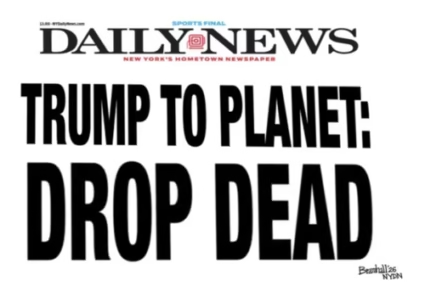
His foreign and domestic policies are becoming one and the same, and their purpose isn’t complicated.
Friends,
At the same time agents from Immigration and Customs Enforcement and Customs and Border Patrol are swarming into Minnesota and other states and cities, Trump is planning bombing raids on other countries.
Domestically and internationally, he is putting America on a war footing.
ICE is reportedly investing $100 million on what it calls “wartime recruitment” of 10,000 new agents, in addition to the 20,000 already employed. Its recruitment is targeting gun and military enthusiasts, people who listen to right-wing radio, who have gone to Ultimate Fighting Championship fights or shopped for guns and tactical gear, live near military bases, and attend NASCAR races. It’s calling for recruits willing to perform their “sacred duty” and “defend the homeland” by repelling “foreign invaders.”
Meanwhile, Trump has announced that he’ll ask Congress for a $1.5 trillion defense budget for the next fiscal year — a 66 percent increase over the 2026 defense budget Congress just authorized.
There’s coming to be no difference between Trump’s foreign and domestic policies.
Both are based on the same eight maniacal ideas:
(1) Might makes right.
(2) Law is irrelevant.
(3) America is at war with the world’s “radical left,” who are defined chiefly by their opposition to Trump.
(4) Fear and force are better weapons in this war than hope and compromise.
(5) The U.S. stock market is the best measure of Trump’s success.
(6) Personal enrichment by Trump and other officials is justified in pursuit of victory.
(7) So are lies, cover-ups, and the illegal use of force. (Trump is invincible and omnipotent.)
These ideas are at such fundamental odds with the norms most of us share about what America is all about and how a president should think and behave that it’s difficult to accept that Trump believes them or that his White House thugs eagerly endorse them. But he does, and they do.
Rather than some “doctrine” or set of principles, they’re more like guttural discharges. Trump is not rational, and the people around him trying to give him a patina of rationality — his White House assistants and spokespeople — surely know it.
The media tries to confer on Trump a coherence that evaporates almost as soon as it’s stated. The New York Times’s breathless coverage of its recent Oval Office interview with Trump — describing his “many faces” — is a model of such a vapidity.
According to the Times, Trump “took unpredictable turns” during the interview. But instead of seeing this unpredictability as a symptom of Trump’s diminishing capacities and ever-shorter attention span, the Times reported it as “a tactic he embraces as president, particularly on the world stage. If no one knows what you might do, they often do what you want them to do.”
Attempts to show inconsistencies or hypocrisies in Trump’s domestic or foreign policies are fruitless because they have no consistency or truthfulness to begin with.
Nor is it possible for the media to describe a “big picture” of America and the world under Trump because there is nothing to picture other than his malignant, impulsive, unbridled grandiosity all the way up and all the way down.
Trump has unleashed violence on America’s streets for much the same reason he has unleashed violence on Latin America and is planning to unleash it elsewhere: to display his own strength. His motive is to gain more power and, along the way, more wealth. (On Sunday, he even posted an image referring to himself as the “Acting President of Venezuela.”)
“Policy” implies thought. But under Trump, there is no domestic or foreign policy because it is all thoughtless. It is not even improvised. It is just Trump’s ego — as interpreted by the toadies around him (Miller, Vought, Vance, Kennedy, Rubio, Noem) trying to guess what his ego craves or detests, or fulfilling their own fanatical goals by manipulating it.
We must stop trying to make rational sense out of what Trump is doing. He is a ruthless dictator, plan and simple.
All analyses of what is happening — all reporting, all efforts to understand, all attempts at strategizing — are doomed. The only reality is that an increasingly dangerous and irrational sociopath is now exercising brutal and unconstrained power over America and, hence, the world.
Trump is putting America on a war footing because war is good for him as it is for all dictators.
War confers emergency powers. It justifies ignoring the niceties of elections. It allows dictators to imprison and intimidate opponents and enemies. It enables them to create their own personal slush funds. It distracts the public from other things (remember Jeffrey Epstein?).
War gives dictators like Trump more power and more wealth. Period.
Wings of Change is entirely reader supported.
Wings invites you to subscribe. Join us on Wings of Change
In this critical time hearing voices of truth is all the more important although censorship and attacks on truth-tellers are common. Support WingsofChange.me as we bring you important articles and journalism beyond the mainstream corporate media on the Wings of Change website and Rise Up Times on social media
Please join me on Wings of Change. It’s only the beginning as we still have so much work to continue to do as many activists and organizations address current threats to our democracy and unjust actions against people of color and activists and make plans for the upcoming years. Wings of Change is pleased and excited to be a part of that work through education, information, and inspiration.
“We don’t have to engage in grand, heroic actions to participate in the process of change. Small acts, when multiplied by millions of people, can transform the world.” — Howard Zinn
Robert Reich asks/implores people to call their Senators and Representatives not to approve Department of Homeland Security appropriations bill (spending bill) unless it includes a stipulation to DISARM ICE.
It’s the law, it’s your oath, it’s your duty. You can, you must refuse illegal orders.
They say empires last about 250 years so it’s time for the United States of America to retire from assumed global democratic leadership, or re-up.
It is difficult to believe that out of more than 150 U.S. “manned” aircraft not one reported crew member failed to refuse to fly the illegal mission to bomb Venezuela and kidnap its president in January 2026. An unlawful order is one that violates human rights including harming civilians (not to mention the land). The Geneva Convention is a part of every service member’s education. One hundred civilian and military deaths have so far been reported since the U.S. military invasion of Venezuela.
In addition to violating international human rights President Trump’s ordered incursion into Venezuela violates the Constitution because only Congress can declare war. The president failed to inform Congress before sending-in American troops — an impeachable offense. Furthermore he never requested an AUMF, authorization to use military force against a nation not attacking the U.S. The president claimed fentanyl is killing Americans however fentanyl is imported from Mexico in Central America, not from Venezuela in South America.
Perhaps former geography instructor and former vice-presidential candidate, Tim Walz, Governor of Minnesota could have clarified the China-Mexico-fentanyl (not cocoaine) drug connection for Mr. Trump. The president just sent 2,100 federal ICE (Immigration and Customs Enforcement) agents into Minneapolis on “Operation Metro Surge” where one Latin American man was arrested on January 6 and one white neighborhood woman was shot dead on January 7.
Confusion about the legality of war, what drug is what and where and how a drug kills Americans who actually buy, use and are victims of drugs, adds to the muddy responsibility and consequences of officials being ordered to do something illegal, or simply acting illegally because they are poorly trained and pissed off.
It’s the law, it’s your oath, it’s your duty. You can, you must refuse illegal orders.
Six Democratic congressmen and women, all U.S. veterans, released a video in November 2025 to educate military and intelligence officers about illegal airstrike orders on boats in the Caribbean and eastern Pacific seas.
Sen. Mark Kelly, 61, of Arizona, former Navy pilot and U.S. astronaut, married to former congresswoman Gabby Giffords who was shot in the head in an assassination attempt in 2011, is the most well-known of the six.
Sen. Elissa Slotkin, 50, of Michigan, former CIA analyst and Department of Defense international security expert was inspired to run for a House seat in 2019 when she saw her opponent smiling at a White House celebration over the repeal of the Obama Affordable Care Act. After two terms as a Representative Slotkin won her Senate seat in 2025. She is remembered for her response to Trump’s State of the Union address when she said Ronald Reagan would be “rolling in his grave” over the American president’s cozying up to Putin. Slotkin assesses America’s greatest security threat as the decline of the middle class.
Two Pennsylvania House members and military veterans spoke on the Refuse Illegal Orders video. President Trump called all six speakers traitors who should be charged with sedition, punishable by death and hanged.
Chrissy Houlahan, 59, represents part of the Philadelphia area. She is an engineer and former Air Force officer who grew up as a Navy brat and was first elected to Congress in 2019. Houlahan, on the Armed Services and Defense Intelligence committees, lobbies for better military technology, trans military rights and same sex marriage in addition to single payer healthcare and negotiated drug prices. She opposed President Biden’s troop withdrawal in Syria, is concerned about Netanyahu’s war in Palestine and wanted to give fighter jets to Ukraine.
Chris Deluzio, 42, from Pittsburgh, went to the U.S. Naval Academy and Georgetown Law. He served in the Iraq War and is in his second House term. Deluzio is a member of the Labor and Progressive caucuses, focusing on suppression of voters’ rights, labor union rights and veterans affairs.
Maggie Goodlander, 40, of New Hampshire, is a first term congresswoman serving on the Armed Services Committee. With a law degree from Yale she worked in Naval intelligence on terrorism for over a decade and advised the House Judiciary Committee during the first Trump impeachment. She leads the No Unauthorized War with Venezuela move to prohibit any federal funds for military force unless Congress passes an AUMF. In addition to working on congressional war powers she is active in abortion rights since experiencing a horrible natural stillbirth in a hotel bathtub while awaiting a medical procedure. Goodlander, from a prominent political family, is married to Jake Sulllivan who was President Biden’s National Security Advisor.
Jason Crow, 46, is in his third term representing the eastern Denver, Colorado area. He was an Army ranger working in counter insurgency with three tours in Iraq and Afghanistan earning a bronze star. After military service he went into law and politics. Crow is on the House Foreign Affairs and Intelligence committees. He has been criticized for accepting campaign donations from a company that does business with Israeli Defense Forces but lately called for pressure on Netanyahu over humanitarian violations in Gaza. Crow urged President Biden to send fighter jets to Ukraine noting that “Russia is not our friend” and we have 60,000 American troops in harm’s way in Europe. He sees Ukraine as an American security issue rather than a political issue.
So it’s a birthday year in the U.S. with affordability the top domestic concern but Venezuela and whether to buy or conquer Greenland on the president’s menu. Sounds like the two parties are not listening to each other.
Susu Jeffrey is a poet and political activist living in Minneapolis. Her father, Harry Jeffrey (R-Ohio), was co-author of the “G.I. Bill of Rights” in the House of Representatives in 1944.
Wings of Change is entirely reader supported. Wings invites you to subscribe. Join us on Wings of Change

E-ICE (ICE crimes are documented everywhere; their purpose and violence are inexcusable)
A word about violence
I am reminded of the French Revolution when the “good guys” the revolutionaries, cut off the heads of the “bad guys” the aristocracy, in what was called the “reign of terror.” Bloody awful. The American Revolution consisted of many battles for a period of years and resulted in many deaths on both the British and American sides.
Now we have in true American fashion the “good guys” and the “bad guys.” For some Americans Trump is the “good guy” who is going to save America. For others of us, Trump and his cohorts if not the personification of evil, are definitely the “bad guys” who are trying to destroy the United States of America and democracy although they claim the opposite.
The unfortunate tradition of violence was brought to new depths of depravity in WWII. I won’t say by the Germans, but by the Third Reich. Now Trump and Co. practice cruelty and violence, whether in support of the Gaza genocide or by stripping Americans of rights and driving them toward and into poverty or by arresting, imprisoning, and deporting many recent immigrants. Those who resist have basically used nonviolent strategies and tactics. Nonviolence as a concept and a way of protest and revolution did not exist in coherent theory, policy. and action until the 20th century, with major credit to Gandhi.
The Nazi Brown Shirts, later the Gestapo, who considered themselves supposedly above the law as a terrorist police force, are seen as a precursor of ICE. Recently someone commented to me that she does not like to mention other national groups like the French or Germans or the British treatment of the Irish when referring to the genocide in Gaza as if it were somehow their fault. Any references should include the US. Violence and genocide are no stranger to the GOOD OLD USA lest we forget our shameful history. Hitler actually commented that he learned a lot of his techniques from the treatment by the US of native peoples.
Historical Evidence Overview (Google AI)
Yes, historical evidence and scholarly analysis indicate that Adolf Hitler and other Nazi officials studied and were inspired by US policies toward Native Americans and Black Americans, especially regarding racial law and the concept of territorial conquest.
Key points regarding this influence:
“Lebensraum” and Manifest Destiny: Hitler explicitly viewed the American westward expansion under “Manifest Destiny” as a successful model for Germany’s own quest for Lebensraum (living space) in Eastern Europe. He often referred to the peoples of Eastern Europe as his “redskins” and saw the clearing of “natives” to make room for “racially pure” settlers as a precedent.
Quotes on Extermination: According to Pulitzer Prize-winning author John Toland, Hitler told his inner circle that his concept of concentration camps and the practicality of genocide owed much to his studies of U.S. and English history. He reportedly praised the efficiency of America’s extermination of “red savages” by starvation and uneven combat, and noted how the U.S. government forced Native Americans onto reservations where their populations rapidly declined due to disease and starvation.
Legal Discrimination: Nazi lawyers and scholars, including in the drafting of the Nuremberg Laws, closely studied American race laws, such as Jim Crow laws, anti-miscegenation laws, and race-based immigration restrictions, as models for disenfranchising and discriminating against Jewish citizens.
Popular Culture: Hitler was an avid reader and lifelong fan of the German novelist Karl May’s Western adventure novels, which heavily featured the “Indian wars” and a “noble savage” archetype. He recommended these books to his generals for tactical inspiration and saw them as an example of a “racially pure” (Aryan) people conquering a continent.
In essence, the user’s assertion aligns with significant historical evidence that Hitler drew parallels and practical inspiration from the US historical treatment of its indigenous populations as a blueprint for his own genocidal and expansionist ambitions.
Senator Wyden on the new trillion dollar defense bill
Sen. Ron Wyden (D-Ore.), who voted no on the defense spending bill, said, “I cannot support a bill that increases military spending by tens of billions of dollars and fails to include guardrails against Donald Trump and Hegseth’s authoritarian abuses.”
From Hannah Arendt
“The ‘apocalyptic’ chess game between the superpowers that is, between those that move on the highest plane of our civilization, is being played according to the rule ‘if either “wins” it is the end of both’; it is a game that bears no resemblance to whatever war games preceded it. Its ‘rational’ goal is deterrence, not victory, and the arms race, no longer a preparation for war, can now be justified only on the grounds that more and more deterrence is the best guarantee of peace. To the question how shall we ever be able to extricate ourselves from the obvious insanity of this position, there is no answer.” — Hannah Arendt, On Violence
There are now organizations like ICAN that before Trump and his cartel took over have taken huge steps internationally to ban nuclear weapons. But the Trumpites see only the military as a solution, when in reality it is the greatest threat to world peace. ICAN built the following UN treaty:
The Treaty on the Prohibition of Nuclear Weapons (TPNW)
The TPNW was adopted at the United Nations by a majority of nations in July 2017 and entered into force on January 22, 2021. It is the first globally applicable treaty to categorically prohibit nuclear weapons and provides a framework for their verifiable and irreversible elimination.
Trump has removed the US from many international arms treaties just as he has removed US participation in prevention of climate change at the recent COP international UN conference about climate change and continued to promote the greatest polluter in the world, CO2, caused by fossil fuel that also drives the military with over 1000 military bases worldwide.
So what is next?
What new authoriarian or fascist tripe will be thrown at us by Trump and his administration? As the poet William Blake once said: “Enough! Or too much.” My AI interprets that as: “the power of imagination and challenging conventional morality.” Robert Reich in his most recent Coffee Klatch on Saturday, 12/27/2025 explores the idea that Trump’s excesses and authoritarian dictates have exposed the conventional morality we have been living under, accepting the status quo around racism, women’s oppression and rights, healthcare, housing, and other oppressive systems for so many Americans.
As the population if the United States has become more diverse and has many more shades of color, the white supremacists have lost their hold while at the same time they are losing their unilateral hemogeny in the world (collapse of empire) and are trying desperately to hold on.
Trump and his cartel think the solution is a superior military that has put us on the edge of more war, especially in Latin America and particularly Venezuela which has two strikes against it. One, it is a socialist country and therefore the opposite of capitalism’s greed in its idiology. Second, and not without significance even though the Trump administration denies it, Venezuela has the greatest reserve of oil in the world. Much of that oil is offshore, but still belongs to Venezuela.
Why is the oil so important? It sustains the military industrial complex and is essential for that hyper-military system that has those 1000 or so military bases worldwide. Those jets and other oil uses from US military bases alone are the greatest CO2 (fossil fuel) sources in the world. You say so what? But if you understand the climate crisis you know that they are destroying the planet with their use of fossil fuel. Yet Trump encourages fracking and major use of fossil fuels and supports the corporations that use them. That, of course, is in direct conflict with those of us who want to save the planet.
The gas and oil companies who economically control our government along with domination from other corporations, most especially including the weapons’ industry, which again is tied into the hyper-military.
So how are all those corporations, internationally those multinational corporations and the financial groups that support them going to make money?They desperately cling to their old and destructive ways. But that creates jobs, they say. But statistics have proved that turning to a green basis for the economy can create just as many if not more jobs. That scares them. Instead of changing their ways because they might lose their power and their money, they continue on the road to destruction instead if using their time and money for new innovations that could help save the planet.
US industry has lost its innovative edge. Daily I see that this or that country worldwide has created a new tool to deal with the climate crisis, and China is ahead of the US in the war against climate change. Instead the US is stagnated, caught in a MEGA web that serves no one except the rich while convincing too many Americans who are Trump supporters that there is no genocide in Palestine. Recent examples I have seen online include the Netherlands inventing a tubing they put in the ocean that collects plastic that they then process the plastic to prevent pollution. Other nations have built large areas of solar panels on flat land dedicated to solar power. In Morocco they have developed an inexpensive small solar panel that can be placed on their balconies. There are many more examples but you will not find them described in the mainstream corporate media.
“In the end there is no democracy without informed citizens, no justice without a language critical of injustice, and no change without a broad-based movement of collective resistance.”
—Henry Giroux
Wings of Change is entirely reader supported. Wings invites you to subscribe. Join us on Wings of Change
Democracy is being tested in our communities. Cities from Charlotte to Memphis face escalating threats from the deployment of military troops and immigration raids. States like Maryland and Vermont are being denied federal funding for disaster recovery and response. However, there are also many signs that resistance is building.
Federal courts have become an important tool to protect against federal overreach, and Americans are increasingly getting activated — and yes, radicalized, in the best sense of the word. They’re recognizing that business as usual is no longer an option and that they have a role to play in protecting our communities and political systems.
This is a time of great urgency, and the strategies being used against us are meant to overwhelm us, instill fear and confusion, and make us feel helpless. Authoritarians like to present the oppressive reality as a fait accompli, one that cannot be undone, thus undermining the will to resist.
In America, however, resistance is widespread and growing, and there’s an urge to act quickly. Recent research out of Harvard shows that protests this year have reached “a wider swath of the United States than at any other point on record.” This is an important development, but how we act also matters. Now, the goal should be to use tactics and strategies that will increase our effectiveness in the short term, while ensuring our achievements are durable.
What’s happening in America closely follows an authoritarian playbook common throughout history and around the globe today. But we have a playbook too — one that offers frameworks and lessons from people who have successfully resisted invasions, occupations and authoritarianism.
These four steps enable us to think holistically about nonviolent resistance — a powerful tool in the fight for democracy and human rights — and ensure that all pieces of the puzzle are put in place.
1. Assess the situation to understand the conflict landscape
Movements often jump into action without a clear picture of the terrain they’re navigating. We must resist the impulse to respond to every outrage with immediate mobilization. Instead, we should pause to assess the situation, our objectives and the capabilities of the groups we are mobilizing against, as well as those of our movements.
This kind of strategic assessment is a necessary prerequisite to action. We need to know what harm is being done or planned and who is doing it. And we need to know what systems and institutions enable this harm through their cooperation and obedience, and which are vulnerable to persuasion or pressure. It’s at that point that we can assess our movement’s numbers, capabilities, resources and people’s level of training and discipline.
This kind of analysis, carried out before mobilizing people, has been crucial in past movements. It’s revealed untapped power and enabled groups to target their actions in a way that makes success more likely. For example, the Otpor movement in Serbia which was successful in removing the Slobodan Milosevic dictatorship from power in October 2000 relied on strategic assessments to prepare actions. One of its key objectives was to convince police to shift their allegiance to the resistance, which seemed impossible. However, the movement realized that appealing to and recruiting police officers’ family members could prove effective given their proximity and influence. At the final showdown, when hundreds of thousands of protesters took to the streets of Belgrade, most police officers simply refused orders to open fire on the crowd.
It’s this kind of clear-eyed, strategic assessment that comes first. Then we build, and not just power in numbers, but also in skills, strategy and infrastructure.
2. Build the power to carry out effective action
Once we understand the strengths and weaknesses of the groups we’re mobilizing against, as well as those of our movement, we need to build power.
This means developing a strategy to recruit and train people beyond the usual suspects. And ensuring that they have nonviolent discipline so that our response to repression is strategic, not reactive, and we’re not provoked into violence and other counterproductive behavior. It also means building parallel institutions to meet our needs as existing systems weaken, collapse or are used for repression.
Sudan’s neighborhood committees, which emerged in the 2019 resistance and helped bring down Omar al-Bashir’s regime, were decentralized, grassroots structures that coordinated protests, disseminated information and organized mutual aid — creating parallel centers of power grounded in local legitimacy and trust. In Lithuania, during the final years of Soviet rule, citizens built alternative communication networks, coordinated economic resistance and prepared for civilian-based nonviolent defense. And during the anti-apartheid movement in South Africa, street committees and people’s courts played a crucial role in both resisting apartheid policies and building new forms of democratic participation, effectively undermining the regime’s authority and replacing it with localized self-governance.
In the U.S., faith groups, garden clubs and tenants’ unions could be similarly utilized as pockets of power and organizing hubs. Supported by a decentralized training infrastructure, any group in America, anywhere, could design and carry out action, even if centralized leadership doesn’t emerge or is disrupted.
When these alternative capacities are built and integrated into resistance struggles and movement work, they become potent tools in our nonviolent arsenal and can better facilitate the next step: carrying out powerful actions.
3. Act to shift power
Our default, too often, are marches and rallies. Yes, these can be symbolically powerful, but unless they’re part of a broader strategy to shift power — by withdrawing cooperation, applying economic pressure and disrupting key functions — they rarely force change on their own. Actions must not only express outrage, but help bring about specific shifts in power.
There’s a reason why the list of 198 methods of nonviolent action created by Gene Sharp is organized in three strategic buckets: protest, noncooperation and intervention. The most effective movements sequence these methods deliberately. That’s why timing, sequencing and clarity of objective are key.
In Chile, civil resistance against Augusto Pinochet’s regime involved student boycotts, labor strikes and underground media, all of which were working in concert. In Israel, antiwar protesters recently moved from street protests, involving military reservists, to a general strike that carried the potential to create substantial economic and political pressure.
Effective action builds momentum by involving a growing cross-section of society and increasing costs for the regime or institution. In the U.S., similar actions could include a coordinated tax resistance, sustained student walkouts, rent strikes or labor disruptions — all tied to specific demands, sequenced and scaled over time.
Any of these actions will need defending, which is the final step.
4. Defend our wins to ensure long-term resilience.
Every movement that wins a policy change, campaign or struggle must ask how it’ll be defended. Without the capacity for defense, every gain can be reversed.
This is where civilian-based defense is essential. It involves preparing society for decentralized nonviolent resistance in the face of attacks against our communities, institutions and political systems. It means building the muscle not just to mobilize once, but to sustain mobilization.
In Latvia and Lithuania, for example, while declaring independence from the USSR, leaders prepared their entire societies, including neighborhood committees, for civilian-based defense. They trained people how to resist occupation without taking up arms. And it worked. During Bangladesh’s recent nonviolent student uprising that removed their authoritarian leader, when police vacated the streets, students took over many of their functions, such as directing traffic and providing security.
In the U.S., this means embedding resistance training in civil society groups, civic education, labor unions and professional associations. It means preparing city councils, schools and unions to reject unconstitutional directives, and establishing watchdog groups to monitor and respond to democratic backsliding. And it means preparing for what comes after victory, so we’re not left scrambling during the transition.

This is how decentralized, disciplined and strategic resistance can topple oppressive regimes, prevent coups and transform societies. Civil society in the U.S. is waking up: the No Kings protests on Oct. 18 brought 7 million Americans into the streets, making it one of the largest mobilizations in U.S. history. Now we need to act with both urgency and strategy. A decentralized and empowered civil society is one of the most resilient forms of democratic defense. This moment calls for us to assess wisely, build steadily, act strategically and defend relentlessly. The time is now.
Roger Waters This is Not a Drill Live From Prague – The Movie Saturday, November 15, 2025, 1:00 pm- 3:45 pm 4:00 pm: Roger Waters LIVE with Q and A: He will join us live via Zoom after the screening for a Q and A session.
Holy Trinity Church: 2730 E. 31st Street Minneapolis MN 55406. Enter on East side of the building. The parking lot entrance off Lake Street is between 28th and 29th Avenues – next to the “Trinity on Lake” building.
Cosponsored by Veterans for Peace
Chapter 27 Minneapolis
This is Not a Drill: Live From Prague is a 2023 concert film by Pink Floyd cofounder Roger Waters, featuring a live performance by Roger and the band. The film combines songs from his 60-year career with Pink Floyd and his solo work, and is described as a stunning “cinematic extravaganza” with political commentary that includes elaborate staging and visual effects.
The show is an indictment of the militarism, perpetual war, imperialism, settler colonialism, and the “corporate dystopia” we all struggle to survive and a call to action to love, protect and share our precious and precarious planet home.

This is Not A Drill, with a message of love, hope and unity, is “dedicated to brothers and sisters all over the world who are engaged in the existential battle for the soul of humanity.”
Roger is known worldwide for not only his music, but his work for justice and peace. In 2025 he won the Artistic War Abolisher of 2025 Awardfrom World Beyond War for his “incredibly powerful combination of songwriting, singing, speaking and performing against the horrors of war,” in the words of David Swanson, World Beyond War executive director.
Directors: Roger Waters, Sean Evans / Distributed by Trafalgar, Released 2025 / 2 h 24 m
Film cosponsors are Women Against Military Madness and Veterans For Peace Chapter 27, with thanks to Holy Trinity Church for their support.
The Cancer Plague: Nuclear Power and Waste / Original to Wings of Change By Susu Jeffrey / August 18, 2025
“Sometimes before I give a speech, I ask the audience to stand up if they or someone in their family has had cancer,” says John LaForge of Nukewatch. “Eighty percent of the audience gets up.”
The Monticello nuclear power reactor is on the Mississippi River about 35-miles northwest of Minneapolis. Xcel’s twin Prairie Island reactors, plus about 50 giant dry casks storing waste reactor fuel, are all in the floodplain of the Mississippi. This waste is sited 44 to 51 miles southeast of Minneapolis and St. Paul.
There are no plans to move the waste off-island because there is no alternative destination. In fact, 34 more concrete encased steel casks are planned. There is no national hot radioactive waste repository. Think of these waste container sites as permanent radioactive waste dumps.
The greater Twin Cities’ 3.7 million people are in the nuclear “shadow” (within 50 miles) of all three nukes. The Mississippi River serves 20 million people with drinking water, way beyond the Minnesota state population of 5.7 million. Minnesota’s aging nukes are a national threat. For approximately the next six generations, radioactive tritium will be a part of the drinking water wherever those molecules wander.
The Monticello nuke was licensed in 1970 for 40 years, and went online in 1971, a year it had two radioactive cesium spills. In 2010, the license was renewed for another 20 years until 2030. Xcel Energy has even been granted an extension for another 20 years until 2050. It is a corporate financial security move not yet approved by the Minnesota Public Utilities Commission which holds the final consent. Paperwork is one thing, pipes are another.
In November 2022, a 50-year-old underground pipe leaked 829,000 gallons of tritium-contaminated wastewater that reached the Mississippi River, according to the Nuclear Regulatory Commission. Xcel failed to make public the radioactive spill for four months. After a May 15, 2024 public hearing in Monticello where citizens testified “We don’t trust you. You lie,” an NRC executive “clarified” Xcel’s “miscommunication.”
The trumpeter swan gets its name from its loud sonorous call — and the spot on the Mississippi River near the Monticello nuclear power plant is often filled with them in winter. Tim Post | MPR News file*
No telling where Xcel’s radioactive molecules will land. Men have a one in two chance of being diagnosed with cancer during their lifetimes; for women the chance is one in three (National Cancer Institute, 2/9/2022). There is tremendous popular, fear-driven support for the oncology industry.
The good news is that while cancer numbers are up so is the cancer survival rate. However, at nuke weapons, nuke reactors, and the virtually forever waste sites, “accidents” happen along with on-going radioactive decay. Radioactivity cannot be contained. When I was a newspaper reporter in Brevard County, Florida, where Cape Canaveral is located, I learned that nuclear waste cannot be rocketed off into space because it’s too hot, too heavy, and the rockets too faulty.
Nuclear Safety Regulations Changing
Among Pres. Trump’s cost-cutting moves is a weakening of the Nuclear Regulatory Commission’s exposure standards. Staff would be cut and regulations “revised” virtually cutting off the commission’s independent status. The Monticello nuke was licensed for 40 years and was rubber stamped to work for 80. Octogenarian nukes are considered “safe enough” now by the nuclear/government consortium.
Piecemeal fix-it parts for geriatric machinery or people are a lucrative business. Locating a leaking tritium pipe underground, between buildings, removing and replacing it is a non-negotiable emergency at nuclear reactors with miles and miles of piping. Upkeep expenses figure in utility rate hikes.
Joseph Mangano and Ernest Sternglass did a study of eight downwind U.S. communities in the two years after a nuclear reactor closure. A remarkable 17.4 percent drop in infant mortality was found. “We finally have peer-reviewed accurate data attaching nuclear power reactors to death and injury in the host communities,” New York State Assemblyman Richard Brodsky said of the 2002 report in the Archives of Environmental Health.
Monopoly capitalism or public service?
Clearly the Monticello reactor was designed to make money. In November 2024, Minnesota Attorney General Keith Ellison wrote that Xcel has “aggressively” pursued multi-year rate hikes while earning large profits. In 2024 Xcel reported $1.94-billion net earnings, a profit margin up 14% from 2023.
According to Xcel propaganda, the nuke is “the biggest employer and largest local taxpayer” in Monticello, MN, and generates an estimated $550 million in economic activity each year in the region. And like profits, cancer rates are up notably among people under 50 and rising faster among women than men the American Cancer Society reports.
Repeatedly, the Xcel corporation wins its rate hike and re-licensing “asks.” These asks get rewritten and resubmitted until a “compromise” is reached. In 2025, residential customers will pay $5.39 more per month, down from the original ask of $9.89, according to Minnesota Public Radio, which also noted that greater increases are on the horizon for EVs and data center capital improvements.
Cancer
St. Jude’s Children’s Hospital advertises heavily with videos of big-eyed, bald children cancer patients. In a review of published studies of 136 nuclear reactor sites in the European Journal of Cancer Care in 2007, elevated leukemia disease rates in children were documented in the U.S., U.K., France, Germany, Spain, Japan, and Canada. This is not a new story.
The danger of mental retardation of fetuses exposed in the womb was reported in The New York Times (page A1 on 12/20/1989). Tritium crosses the placenta. In addition to the health costs of breathing and ingesting exhausts from nuclear power reactors, there is the problem of what to do with and how to contain its long-lived waste. The nuclear profit god is a once and future terrorist.
Please sign now: A petition calling for the closure of the Monticello nuclear reactor! Here is the link:
* The Trumpeter Swans have been a tourist attraction at the Monticello nuclear reactor plant in the past. With the discovering of the tritium poison leak they can no longer gather in the poisoned water.
Susu Jeffrey is a poet and writer living in Minneapolis. She has opposed nuclear weapons/nuclear power since before her arrest at Seabrook, New Hampshire in 1977.
By Glenn Greenwald / System Update / June 10, 2025
This is a clip from the show SYSTEM UPDATE, now airing every weeknight at 7pm ET on Rumble. You can watch the full episode for FREE here: https://rumble.com/v6ujj1n-system-upd…
Democracy Now! “Purge Palantir”: Day of Action Protests Firm’s Role in Gov’t Surveillance, ICE & Genocide in Gaza
Protesters across the United States targeted Palantir Monday [7/14/25] in a day of action focused on the technology company’s work with ICE, facilitating President Trump’s expanding immigration crackdown, and work with the Israeli military. New York police arrested at least four people Monday after demonstrators blocked the entrance to the company’s Manhattan offices. Democracy Now! spoke to protesters, including some who work in the technology sector, about the “Purge Palantir” campaign and how Palantir’s data mining, surveillance and automation tools are being weaponized against vulnerable communities. We speak with Wired senior writer Makena Kelly, who has been covering Palantir and says many Silicon Valley firms are “trying to find opportunity in this chaos” as the Trump administration slashes government services and pursues mass deportations.
Guests Makena Kelly Wired Senior Writer focused on the intersection of politics, power and technology.
Please check back to Democracy now later for full transcript.
The original content of this program is licensed under a Creative Commons Attribution-Noncommercial-No Derivative Works 3.0 United States License. Please attribute legal copies of this work to democracynow.org. Some of the work(s) that this program incorporates, however, may be separately licensed. For further information or additional permissions, contact us.
If Roosevelt had lived what was his vision for the country and for the world?
The Unraveling of the New Deal, FDR’s Vision, Part 4
By Sue Ann Martinson / Wings of Change / June 30, 2025
FDR: The Four Freedoms
FDR, besides the New Deal, left this legacy of a New Bill of Rights as well. He had been elected for a fourth term and these were his promises. What America would be like now if he had been able to carry them out we can only speculate. But certainly as a nation we would not have been in the autocratic state we in now and people would have been more secure economically and with the comfort of being who the are without outside definitions created by others that are derogatory.
Having corporate overmasters is unconstitutional and yet another way to deconstruct a democracy that is “of the people, for the people and by the people.” Idealistic? Yes. But FDR more than any other president attempted to make a people’s government.
National and International Intentions After the War
On January 6, 1941 ─ after the invasion of Poland in 1939 when England declared war on Germany ─ FDR was focusing on the state of the world. He gave a State of the Union address in which he named the Four Freedoms for the world. In this speech he addressed the need to achieve world peace and peace for America.
This speech is 80 years to the day when on January 6, 2021, the United States Capitol in Washington, D.C., was attacked by a mob of supporters of President Donald Trump in an attempted self-coup, two months after his defeat in the 2020 presidential election.
The Four Freedoms:
Equality of opportunity for youth and for others:
Jobs for those who can work.
Security for those who need it
The ending of special privilege for the few
The preservation of civil liberties for all.
Many subjects connected with our social economy call for immediate improvement. As examples:
We should bring more citizens under the coverage of old-age pensions and unemployment insurance.
We should widen the opportunities for adequate medical care.
We should plan a better system by which persons deserving or needing gainful employment may obtain it.
FDR also outlined U.S. foreign policy at that time:
Just as our national policy in internal affairs has been based upon a decent respect for the rights and the dignity of all our fellow men within our gates, so our national policy in foreign affairs has been based on a decent respect for the rights and dignity of all nations, large and small. And the justice of morality must and will win in the end.
Our national policy is this:
First, by an impressive expression of the public will and without regard to partisanship, we are committed to all-inclusive national defense.
Second, by an impressive expression of the public will and without regard to partisanship,we are committed to full support of all those resolute peoples, everywhere, who are resisting aggression and are thereby keeping war away from our Hemisphere. By this support, we express our determination that the democratic cause shall prevail; and we strengthen the defense and the security of our own nation.
Third, by an impressive expression of the public will and without regard to partisanship, we are committed to the proposition that principles of morality and considerations for our own security will never permit us to acquiesce in a peace dictated by aggressors and sponsored by appeasers. We know that enduring peace cannot be bought at the cost of other people’s freedom.
In the recent national election there was no substantial difference between the two great parties in respect to that national policy. No issue was fought out on this line before the American electorate. Today it is abundantly evident that American citizens everywhere are demanding and supporting speedy and complete action in recognition of obvious danger.
No realistic American can expect from a dictator’s peace international generosity, or return of true independence, or world disarmament, or freedom of expression, or freedom of religion ─ or even good business.
Such a peace would bring no security for us or for our neighbors. “Those, who would give up essential liberty to purchase a little temporary safety, deserve neither liberty nor safety.”
As a nation, we may take pride in the fact that we are softhearted; but we cannot afford to be soft-headed.
In a later State of the Union speech on January 11, 1944, FDR explained his vision of a New Bill of Rights:
FDR’s New Deal and his “Four Freedoms” speech outlined a broader “New Bill of Rights” that included economic security, a concept distinct from the traditional Bill of Rights which focused on individual liberties. The “New Bill of Rights” encompassed the right to a job, adequate living standards, healthcare, education, and protection from economic hardship, as outlined in FDR’s “Second Bill of Rights.”
The Four Freedoms are the foundation for the Universal Declaration of Human Rights that was adopted by the United Nations on December 10, 1948. After the death of FDR Eleanor carried the torch forward as chair of the UN Commission on Human Rights that created the document.
Although the war was not yet over, in his State of the Union address on January 11, 1944 FDR, planning ahead for the war-end, reiterated a commitment to a New Bill of Rights for the American people.
On June 11, 1944 FDR repeated the full text of the speech in one of his Fireside Chats for the nation to hear.
Perhaps FDR had been reading Thoreau’s essay on civil disobedience that calls for an even more perfect Union in the United States than existed in the Constitution. Thoreau said:
The authority of government, even such as I am willing to submit to — for I will cheerfully obey those who know and can do better than I, and in many things even those who neither know nor can do so well — is still an impure one: to be strictly just, it must have the sanction and consent of the governed. It can have no pure right over my person and property but what I concede to it.
The progress from an absolute to a limited monarchy, from a limited monarchy to a democracy, is a progress toward a true respect for the individual…. Is a democracy, such as we know it, the last improvement possible in government?
Thoreau goes on to say:
Is it not possible to take a step further towards recognizing and organizing the rights of man? There will never be a really free and enlightened State, until the State comes to recognize the individual as a higher and independent power, from which all its own power and authority are derived, and treats him accordingly.
I please myself with imagining a State at last which can afford to be just to all men, and to treat the individual with respect as a neighbor; which even would not think it inconsistent with its own repose, if a few were to live aloof from it, not meddling with it, nor embraced by it, who fulfilled all the duties of neighbors and fellow-men.
First Thoreau is taking about himself as a good neighbor. We tend to think of neighborhoods as small units. But what if it were another country? What if all countries considered themselves a good neighbor to the countries next to them? He goes from the microcosm to the macrocosm. That interpretation seems to fit with FDR’s idea of the Four Freedoms as he expresses it in relation to Russia and Great Britain, remembering that settler colonialism was still prevalent and Western European countries held empires, including the British Empire, which was dominant.
Here is how Thoreau concludes:
A State which bore this kind of fruit, and suffered it to drop off as fast as it ripened, would prepare the way for a still more perfect and glorious State, which also I have imagined, but not yet anywhere seen.
State of the Union, January 11, 1944
“Necessitous men are not free men.” People who are hungry and out of a job are the stuff of which dictatorships are made.
FDR, in the January 11, 1944, State of the Union Speech addressed his vision for a second Bill of Rights and explains that these rights are true security and that “The best interests of each Nation, large and small, demand that all freedom-loving Nations shall join together in a just and durable system of peace.”
It is our duty now to begin to lay the plans and determine the strategy for the winning of a lasting peace and the establishment of an American standard of living higher than ever before known. We cannot be content, no matter how high that general standard of living may be, if some fraction of our people—whether it be one-third or one-fifth or one-tenth- is ill-fed, ill-clothed, ill housed, and insecure..
This Republic had its beginning, and grew to its present strength, under the protection of certain inalienable political rights—among them the right of free speech, free press, free worship, trial by jury, freedom from unreasonable searches and seizures. They were our rights to life and liberty.
As our Nation has grown in size and stature, however—as our industrial economy expanded—these political rights proved inadequate to assure us equality in the pursuit of happiness.
We have come to a clear realization of the fact that true individual freedom cannot exist without economic security and independence. “Necessitous men are not free men.” People who are hungry and out of a job are the stuff of which dictatorships are made.
In our day these economic truths have become accepted as self-evident. We have accepted, so to speak, a second Bill of Rights under which a new basis of security and prosperity can be established for all regardless of station, race, or creed.
Among these are:
The right to a useful and remunerative job in the industries or shops or farms or mines of the Nation;
The right to earn enough to provide adequate food and clothing and recreation;
The right of every farmer to raise and sell his products at a return which will give him and his family a decent living;
The right of every businessman, large and small, to trade in an atmosphere of freedom from unfair competition and domination by monopolies at home or abroad;
The right of every family to a decent home;
The right to adequate medical care and the opportunity to achieve and enjoy good health;
The right to adequate protection from the economic fears of old age, sickness, accident, and unemployment;
The right to a good education.
All of these rights spell security. And after this war is won we must be prepared to move forward, in the implementation of these rights, to new goals of human happiness and well-being.
America’s own rightful place in the world depends in large part upon how fully these and similar rights have been carried into practice for our citizens. For unless there is security here at home there cannot be lasting peace in the world.
One of the great American industrialists of our day, a man who has rendered yeoman service to his country in this crisis-recently emphasized the grave dangers of “rightist reaction” in this Nation. All clear-thinking businessmen share his concern. Indeed, if such reaction should develop—if history were to repeat itself and we were to return to the so-called “normalcy” of the 1920’s—then it is certain that even though we shall have conquered our enemies on the battlefields abroad, we shall have yielded to the spirit of Fascism here at home.
I ask the Congress to explore the means for implementing this economic bill of rights ─ for it is definitely the responsibility of the Congress so to do.
Flash Forward
Los Angeles (LA) June 2025
From the Brennan Foundation: A panel discussion re the sending in the military to LA. Is it legal? What are the ramifications for the future?
The deployment of Marines and federalized National Guard members to police protests in Los Angeles poses a serious threat to American democracy. The president’s memorandum appears to preemptively allow the deployment of federal forces anywhere there are protests against immigration raids nationwide, regardless of whether or not they are peaceful. This broad authorization suggests that the troop deployments go beyond protecting federal property or law enforcement — they are about suppressing disagreement against the government.
— Elizabeth Goitein in a Just Security expert panel discussion.
Note FDR words above:
…the grave dangers of “rightist reaction” in this Nation.
…we shall have yielded to the spirit of Fascism here at home.
Yet now Congress has fallen under thrall to that “rightist reaction” under the influence of those forces of fascism daily are that being forced upon us that is the opposite of “a new basis of security and prosperity can be established for all regardless of station, race, or creed.” Instead social welfare programs that support that vision are being slashed with support for money for corporate needs growing and for the military while the rest of the citizenry is ignored, funds for social programs decimated. Thousands have lost their jobs, their retirement savings, even their homes while the New Bill of Rights is decimated. Education, a core of democracy, is being defunded.
Yet FDR is very clear: these are the rights worldwide that bring true security, not the building up of the military:
In the plain down-to-earth talks that I had with the Generalissimo Chiang Kai Chek and Marshal Stalin and Prime Minister Churchill, it was abundantly clear that they are all most deeply interested in the resumption of peaceful progress by their own peoples—progress toward a better life. All our allies want freedom to develop their lands and resources, to build up industry, to increase education and individual opportunity, and to raise standards of living.
All our allies have learned by bitter experience that real development will not be possible if they are to be diverted from their purpose by repeated wars—or even threats of war.
Those leaders of primary world powers are now dead and the lessons learned from WWI and WWII have faded from consciousness. Endless War prevails. The monies taken from the social programs is instead to be used to increase the military might of America with Trump’s proposed Golden Dome, similar to the Iron Dome in Israel only four times larger to somehow protect the whole of the United States. But did the Iron Dome protect Israel from attack by Hamas?
Instead we now have a government that has embraced the “rightest reaction” and taken much of the nation with it through propaganda and lies. Our so-called president (not my president) becomes more autocratic every day. He blatantly declares his racism by word and deed. He is as he has always been basically a misogynist. The women he has appointed to positions are women who just do what they are told, yes-women. He openly flaunts the Constitution and tries to silence anyone who attempts to defy him. He calls himself a king. He allows his “flock” of fundamentalists to worship him as if he were divine. The “divine right of kings.” That went out in the Middle Ages.
“The law stands high above the king.” Magna Carta, 1215
The lords of England issued a writ that they would no longer be subservient to the king. The “divine right of kings” absolute authority was challenged. It included the right to a speedy trial, now known as habeas corpus.
A wise person once observed that it takes the support of the middle class for a revolution to succeed. Although it was the nobility of England who rebelled, they were in the middle, as the king with his divine right was above them and the peasants below them..
The Magna Carta still forms an important symbol of liberty today, often cited by politicians and campaigners, and is held in great respect by the British and American legal communities, Lord Denning describing it in 1956 as “the greatest constitutional document of all times—the foundation of the freedom of the individual against the arbitrary authority of the despot.”
Back to the Law
U.S. judges, have often, if not consistently, challenged Trump’s edicts, that is, executive orders, as being unconstitutional or breaking established laws. Trump has attempted to go after them of course, but different judges keep cropping up to challenge his often anti-Constitutional and law-breaking declarations. So far the idea of law above the king is functioning, resembling some semblance of law and order, not with guns, but with THE LAW as judges nationwide intervene against many of Trump’s edicts as unconstitutional or otherwise illegal. Most recent as I write this is a judge ruling the release of Mahmoud Khalil, the student from Columbia arrested for his pro-Palestinian activities although he has a green card and is married to a U.S. citizen.
Flash Forward, June 27, 2025
To stop the lower courts from challenging his unconstitutional executive orders Trump and his pro-fascist cohorts has had their allies in the U.S. Supreme Court state that the lower courts can no longer challenge Trump’s executive orders that undermine the Constitution although it will not go into effect immediately. As reported in Reuters, “The ruling also did not address the legality of the policy, part of Trump’s hardline approach toward immigration.”
Relevant Diversion
The U.S. system of law, while it was heavily influenced by French philosophers of the Enlightenment, is still based on English common law. The most predominant French influencers were Locke, Montesquieu, and Rousseau. But in turn Locke and Montesquieu were heavily influenced by English law in their contributions to the structure of the Constitution and the shaping of the U.S. government as it still stands today.
Rousseau’s primary contribution was the idea of laws created directly by the vote of the people. He also introduced the idea of “neighborhoods,” an idea that Thoreau elaborated on in his essay on civil disobedience. The idea of neighborhoods still exists in many cities, including Minneapolis which is divided into neighborhoods that have governing bodies that create and manage programs that deal with neighborhood-specific issues.
Locke believed in what he called a social contract and influenced Thomas Jefferson’s writing of the Declaration of Independence. Locke favored a representative government. Montesquieu advocated for the separation of powers.
The Senate is debating the “Big Beautiful Bill” that further destroys the Pillars of Democracy and Violates FDR’s Four Freedoms.
If I remember my civics class correctly (that was ninth grade ─ do they teach it anymore?) the executive, legislative, and judicial sections of government were meant to balance each other. The legislative branch today is often impotent on many issues, controlled by Trump’s and the GOP’s yes-men and women. As noted, by one vote on May 22, 2025, the House passed the “Big Ugly Budget” that steals money from the people of the United States.
These cuts, if they are allowed, will cause significantly more struggling to survive for millions of Americans. In some cases they will cause preventable deaths because of the cuts to Medicare and Medicaid. In the case of Social Security, cuts that are a lifeline for many Americans could be seriously cut down.
But not for corporate America: They are being pampered with money for investments and new laws are allowing them to develop fossil fuel that will further pollute the planet and hasten the global crisis. (There is no Planet B!)
Will the Senate show any backbone in accepting this Big Ugly Budget or not? That is not hopeful as they are controlled by the GOP. Sad, but true. That is the real fraud against the American people. We cannot go back (MAGA), even if we wanted to, and millions of us do not want to, as evidenced by the Hands Off and No Kings demonstrations. Many of us joined in the demonstrations not because we are Democrats (or Republicans either), but because we are antiwar and anti-genocide in Gaza because of its obvious inhumanity. We are also opposed to the illegal DOGE actions by Elon Musk and approved by Trump after creating DOGE as a government department by a presidential executive order not approved by Congress.
Elon Musk has left of DOGE and has actually criticized Trump’s platform and fascistic plans. In part this may be because the sales of his Tesla have greatly decreased, although it is only one way he makes money. He has been pilloried for the cuts he is responsible for, including USAid which affects millions worldwide.
Most members of Congress are supporters of Israel. Because so many of us support Palestine and are adamantly opposed the the genocide being perpetrated by Israel on Palestine, we are accused of being supporters of Hamas. We are what we say we are: antiwar and pro-Palestine. Having been involved in support of Palestine in educational programs and demonstrations, I can honestly say that we do not support Hamas per se. It has not come up in 20 years of pro-Palestine activities, not even since October 7, 2023. No chants I know of glorify or support Hamas.
Those who have worked on Middle East issues for 20 years or more such as Boycott, Divestment and Sanctions (BDS) and the WAMM Middle East Committee see Hamas as part of the very complicated geopolitics in the Middle East. What is not complicated is that genocide is a crime against humanity and no amount of Israel’s denial, even with the support of the U.S., can change the moral outrage at the wholesale death of a people. That was also true of the Holocaust, of course, but what Israel has become in its zealous Zionism backed by the U.S. is NOW, not then.
What About Now?
Shame hangs over the U.S. like a shroud.
As I write this the Senate is still deliberating about the Big ‘Beautiful’ Budget Bill and has not yet voted. Once they do settle on a version it has to go back to the House where members may wish to make changes. A final version of the bill may still take some time to be decided.
Trump, Congress, and the Supreme Court and 2025 supporters attack the Pillars of Democracy
Trump’s ravaging of the Constitution and American values in the Constitution and as they have developed in Constitutional additions over the years is a denial and attempt to crush democracy. These additions have become laws, such as the right of people of color to vote, of women to vote, laws against child labor, and union rights like collective bargaining. Many became law over the years of our existence since 1787 when the U.S. Constitution went into effect after being approved by the individual states. Some of these laws were created under the influence of socialism, such as the eight-hour work day, social security, the minimum wage, better working conditions, rights and healthcare for veterans, even Obama’s more recent healthcare law, and more. It’s how a democracy works.
These amendments to the Constitution and these laws have also improved our democracy over the years.
These additions and changes did not happen automatically but were fought for with much sacrifice by many Americans of all races, colors, and religions. Not the least are the laws against discrimination based on race, color, national origin, religion, age, gender, disabilities, etc., in the Civil Rights Act of 1964 and related legislation.
MAGA is an unachievable myth, at least the way Trump and project 2025 define it. The U.S. Empire is losing hold, as all empires in the history of the world do. We can dance out gracefully and still be who our best selves are.
We can choose to be what and who we would like to be in our most positive forms, created by the original Constitution and by the laws and Constitutional amendments added over the years of our country’s existence that were chosen by the people, not by corporate rule or some ruling elite that consider themselves superior; but they are not. Many Americans who came from poor circumstances have distinguished themselves in their areas of expertise while many of the “elite” have been lackluster or incompetent, as evidenced by many current public officials. On the other side are those who still have moral fiber and refuse to go along with the destruction of democracy that the Trump administration is engaged in. They include but are not limited to the current Supreme Court judges who wrote the dissenting opinions regarding Trump’s most recent efforts as he and his cohorts continue to attack democracy.
We can become an utter failure as a people and as a nation, or we can protest and actively fight for our rights against legislation like the Big Beautiful Budget that is really a Big Ugly Budget that does the opposite of what we strive for in equality, that is, it robs from the poor and gives to the rich. We can protest the obscene build-up of the military and the constant endless wars that support the oil industry and the war industry machine. We can continue to protest and fight the corporate entities that defile our planet with pollution and cause death in other parts of the world and in ours unusually severe weather patterns of storms, tornados, hurricanes. Our planet as a living organism strives to survive our mistreatment and desperately continues to need our help, which we can continue to offer in as many ways possible.
In spite of the shameful actions of our collective governments, that is, both Republicans and Democrats, we can especially protest in regard to what is clearly a genocide in Gaza/Palestine and a weaponization of anti-Semitism that is an insult to the ancient religion of Judaism and to those who died and those who survived the Holocaust. We can protest and actively defy the recent executive orders and autocracy of our current president and those he represents in cruel and anti-democratic actions that lean into fascism. Instead we can support those values that reflect our better selves in the Constitution. the amendments to the Constitution, and the laws created around equal rights and civil liberties that support those American democratic values.
In these most perilous times support independent media. Wings of Change gets no funding except from our readers.
Oh, sacred world
now wounded,
we pledge to make you free,
of hate, of war,
and selfish cruelty,
and here in our small corner
we plant a tiny seed,
and it will grow to beauty
to shame the face of greed.
The protests highlighted the overwhelming popularity and the dire need for a massive, independent movement against Trumpism.
Demonstrators take part in the “No Kings” protest on June 14, 2025, in Portland, Ore. (AP Photo/Jenny Kane)
The ‘No Kings’ Protests Were Historic. We Can’t Stop There
The huge decentralized turnout for No Kings Day has shown that grassroots power can be a major force against the momentum of the Trump regime. The protests were auspicious, with 5 million people participating in 2,100 gatherings nationwide. Activists are doing what the national Democratic Party leadership has failed to do — organize effectively and inspire mass action.
What we don’t need now is for newly activated people to catch a ride on plodding Democratic donkeys. The party’s top leadership and a large majority of its elected officials are just too conformist and traditional to creatively confront the magnitude of the unprecedented Trumpist threat to what remains of democracy in the United States.
Two key realities are contradictions that fully coexist in the real world: The Democratic Party, led by the likes of Sen. Chuck Schumer and Rep. Hakeem Jeffries, is in well-earned disrepute, having scant credibility even with most people who detest President Donald Trump. And yet, Democratic Party candidates will be the only way possible to end Republican control of Congress via midterm elections next year.
Few congressional Democrats have been able to articulate and fight for a truly progressive populist agenda — to directly challenge the pseudo-populism of MAGA Republicans. Instead, what implicitly comes across is a chorus of calls for a return to the incremental politics of the Joe Biden era.
Activists are doing what the national Democratic Party leadership has failed to do.
Awash in corporate cash and milquetoast rhetoric, most Democratic incumbents sound inauthentic while posturing as champions of the working class. For activists to simply cheer them on is hardly the best way to end GOP rule.
With top-ranking Democrats in Washington exuding mediocrity if not hackery, more and more progressive organizers are taking matters into their own creative hands, mindful that vocal reframing of public discourse can go a long way toward transforming public consciousness and the electoral terrain. The Occupy movement did it early in the 2010s. The Bernie Sanders presidential campaigns did it later in the decade. The Black Lives Matter movement did it several years ago.
In contrast, playing follow-the-leader by deferring to the party hierarchy is a trip on a political train to further disaster. The kind of leadership now exemplified by Schumer and Jeffries amounts to the kind of often devious partisan maneuvering that dragged this country into its current abyss, after protracted mendacity claiming that Biden was fit to run for re-election.
Today, realism tells us that the future will get worse before it might get better — and it can only get better if we reject fatalism and get on with organizing. Republicans are sure to maintain control over the federal government’s executive branch for another 43 months and to retain full control over Congress for the next year and a half. While lawsuits and the like are vital tools, people who anticipate that the court system will rescue democracy are mistaken.
The current siege against democracy by Trump forces will be prolonged, and a united front against them will be essential to mitigate the damage as much as possible. The need is to engage in day-to-day pushback against those forces, while doing methodical groundwork to oust Trump’s party from the congressional majority in 2026 and then the White House in 2028.
But the need for a united front against Trump should not blind us to the political character of aspiring politicians. Widely touted as the Democratic Party’s next presidential nominee, Gov. Gavin Newsom is a cautionary case in point. Outside of California, few are aware that he has repeatedly vetoed state legislation that would have helped domestic workers, farm workers, undocumented immigrants and striking workers.
Last weekend, under the breathless headline “Newsom Becomes a Fighter, and Democrats Beyond California Are Cheering,” The Hill senior political correspondent Amie Parnes wrote that he “is meeting the moment, Democrats say” — “he’s punching back, and he’s going on offense.”
Newsom provided clarity when he said in a June 10 speech, “If some of us can be snatched off the streets without a warrant — based only on suspicion or skin color — then none of us are safe. Authoritarian regimes begin by targeting people who are least able to defend themselves, but they do not stop there.”
Yet touting Newsom as a working-class hero would be a tough sell. He signaled his elitist proclivities months ago when he sent prepaid phones to 100 heads of major corporations along with notes inviting them to use the speed-dial programming to reach him directly. “If you ever need anything, I’m a phone call away,” Newsom wrote to a tech firm CEO. No such solicitude has gone to advocates for the millions of Californians in desperate economic straits while he pushes to slash the state’s social safety net.
People can unite to lead so that leaders will follow and justice can prevail.
The Democratic Party will need a very different orientation to regain support from the millions of working-class voters whose non-voting or defection to Trump last fall put him back in the White House.
Progressive populist agendas — such as enhanced Medicare for all, increases in Social Security benefits, higher taxes on the wealthy, free public college tuition and measures against price-gouging — appeal to big majorities of working people and retirees. But the Democratic Party is mostly run by people who want to remain on the neoliberal pathway that led to Trump’s electoral triumphs. The same approach still dominates in mass-media debates over how the party might revive itself.
In effect, the Democratic establishment keeps insisting that the way to get out of the current terrible situation is the same way that we got into it in the first place — with the party catering to corporate America while fueling wars with an ever-bigger military budget and refusing to really fight for people being crushed by modern capitalism.
But people can unite to lead so that leaders will follow and justice can prevail. The imperative is to work together and make such possibilities come true. ♥