Interviews by Amy Goodman on Earth Day include information about and why resistance is necessary by Indigenous people in the Southwest, Black people in Memphis, and state legislative action in Maine.
Note: Click title to view videos. Transcripts follow after the three video interviews.
“Data Colonialism”: Native Communities Fight AI Data Centers on Indigenous Land
“Colossus Failure”: Elon Musk’s Data Centers Face Lawsuit for Polluting Black Neighborhoods in Memphis
AI Data Center Resistance: Maine Passes Nation’s First Statewide Moratorium — Will Gov. Mills Sign It?
TRANSCRIPTS
“Data Colonialism”: Native Communities Fight AI Data Centers on Indigenous Land
Transcript
AMY GOODMAN: This is Democracy Now!, democracynow.org. I’m Amy Goodman.
On this Earth Day, we go now…to Montana, where we’re joined by Krystal Two Bulls, a longtime Oglala Lakota and Northern Cheyenne activist. She’s the executive director of the group Honor the Earth, which has launched the No Data Center Coalition. Honor the Earth has been closely monitoring the construction of data centers in or near Indigenous lands. She’s joining us from the Northern Cheyenne Reservation in southeastern Montana.
Krystal Two Bulls, welcome to Democracy Now! Can you give us an overview? You’ve made a crowdsource map of data centers and their relation to Indigenous lands across the United States. Talk about how you see this issue of data centers.
KRYSTAL TWO BULLS: Yeah. Good morning, Amy. Thank you for having me.
I think, you know, similar to what we just heard, we’re seeing the targeting of Native lands. But for us, when we talk about hyperscale data centers, we typically talk about the entire AI infrastructure, because that’s the driving demand for the hyperscale data centers themselves. And so we’re looking at the physical impacts of the data centers. We’re also looking at the critical minerals in the mining that’s going to be needed to power and create things like GPUs and servers and the chips, even the air conditioners for these hyperscale data centers, which often, and especially with this push for that mining to happen domestically now, we’re going to be looking at that mining happening on Indigenous lands.
We’re also looking at the uranium just now being added to the list of critical minerals. And so, that’s also going to be happening to power nuclear for fuel. And so, we have to also look at these hyperscale data centers that are creating — using massive amounts of electricity, and where is that energy going to come from. Now they’re shifting towards nuclear. They’re looking at revitalizing coal, the coal industry, and expanding fracked gas, until they can get nuclear online. And so, we try to connect all of those dots across the board, knowing that all of those industries right there are going to target Indigenous lands, as they have in the past and as we’ve already experienced.
The other thing that we’re seeing is that they’re targeting Indigenous lands because we have large — many of our large land-based tribes, we have access to that. We have access to water. There’s tax incentives that come along with it. We have a lack of legal infrastructure oftentimes to hold these accountable, these companies accountable. Also, the promised economic development that these corporations come with, when you are dealing with communities that often live in extreme poverty, the promise of these jobs is something that appeals to them, right? And then we also have the jurisdictional issues that happen on Indigenous land. So, all of those create an environment that is very conducive to these hyperscale data centers being built on Native lands.
AMY GOODMAN: Talk about the issue of secrecy surrounding the locations and owners of these data center projects, why your map, this crowdsource map, is actually — has been so hard to compile.
KRYSTAL TWO BULLS: Yeah. So, oftentimes these corporations, the hyperscale corporations, such as Microsoft, Google, Apple, Meta and Amazon, they’re oftentimes using their subsidiaries and then using also Native-owned energy companies to approach our communities. But they’re also coming with NDAs in hand. So, what we’re hearing from different Native nations is that corporations will come, they’ll start by talking about solar panels and installing that on their lands, and then it quickly shifts to a hyperscale data center. But often, before they even get to that conversation, they’re asking them to sign an NDA. And so that makes our tribal leadership accountable to them and not to the people who actually — they’re actually supposed to represent.
And so, oftentimes we don’t know that these projects are coming to our lands until we hear in a press release or on the news or we hear rumors of what’s happening. And so, we’ve had to actually use our networks as organizers and activists to really build those relationships and to figure out where they’re proposing these hyperscale data centers. So, right now we’re looking at about 103 to 160 proposed hyperscale data centers on Native lands.
AMY GOODMAN: Krystal Two Bulls, the Tulsa City Council just passed a nine-month moratorium on data centers. The Seminole Nation unanimously passed its own moratorium. Can you talk about how, out of all the states in the country, an anti-data center movement is gaining momentum in Oklahoma? Why Oklahoma?
KRYSTAL TWO BULLS: I mean, right now we have a really strong team from Honor the Earth that’s located in Oklahoma, and they’ve been on the ground in these communities, hosting town halls, having meetings, reaching out to the tribes, attending tribal council meetings, door knocking, petitions, just everything across the board. But Oklahoma is oftentimes considered a sacrifice zone. And so, for us at Honor the Earth, we really made it an intention to invest in those communities, and especially because we have activists and organizers on the ground there.
And so, what we’re seeing now is that they’ve been able to build multiracial coalitions with folks in agriculture, ranchers, land owners, etc., and they’ve built these coalitions, and they are working with local communities and local municipalities and local tribes to push back and put in some kind of buffer in protections for our communities. We also have — you know, the Muskogee were able to block a resolution that would have moved forward a hyperscale data center, and so, you know, it’s really a testament to the powerful organizing that’s been happening there and people pushing back.
The other thing is, like, if we can get these victories in Oklahoma, which is basically the crossroads of every extractive industry in the United States, then every other state needs to follow suit, and there’s not an excuse for us to be able to push back in our own communities.
AMY GOODMAN: Krystal Two Bulls, you’ve called data centers “continued colonialism … in the name of imperialism.” Can you explain what you’re saying? You were also very active in the standoff at Standing Rock, where Indigenous people from Latin America, the United States, Canada and their non-Native allies, thousands, gathered to fight the Dakota Access Pipeline. What connections do you see between these?
KRYSTAL TWO BULLS: Yeah, I think Indian Country is always a target for extractive industry. And what history has taught us is that anytime outside industry comes into Indian Country and has all these big, you know, promises of jobs and economic development and language revitalization and all of these things, that it tends to not work out for us. We are never the ones that actually truly benefit from that, and we’re always the one that ends up having to sacrifice our relationship to land, air, water, our communities and our nonhuman relatives, as well.
And so, what we can see from that and learn from that is, like, that is a continuation of settler colonialism in the land grabs that we had seen back in the 1800s. Now we’re just seeing a modern-day iteration of that, where these corporations are coming in, because we have large land bases, grabbing up the land, building — saying that they’re going to build with the tribes, offer these things, go back on their promises, and then, yet again, we are left with the damages and the results and the negative impacts of that. And so, I think history tells us that this is just another — this is the same thing with a new face, a new name. And so, for us, it was really important that we called it what it is, which is, you know, data colonialism — right? — and really push back on the physical and the material impacts on our lands.
AMY GOODMAN: A recent Bloomberg analysis found electricity costs go up nearly 267% near data centers. Yet a lot of these data centers target poorer tribal nations. If you can talk about the environmental costs, the amount of energy that’s required, and also the economic costs?
KRYSTAL TWO BULLS: Yeah, I mean, we’re looking at, from what we know — like, a lot of times these data centers come with NDAs, so it’s really difficult to know exactly how much water usage that they’re going to have or how much impact they’re going to have on the grid. But what we do know from existing hyperscale data centers that have already been built is that we’re looking at anywhere between 300,000 to like up to 2.7 million — I’ve heard even 5 million — gallons per year of water that’s being used. Right? And, like, these corporations, they come in, and they present this closed-loop water system that they’re going to be using, and they tell our nations that there will be zero impact to the water. They also tell us that, in fact, they’re going to use water positivity, and they’re actually going to increase the usage in the quality of the water so we can actually use it more, which both have been dispelled since then, but it’s a very strong narrative. So, we know that there’s going to be negative impacts on the water based on existing hyperscale data centers.
We also know about the noise pollution that comes with these, right? Many times they have diesel generators, but also the noise alone from a hyperscale data center is around 97 decibels. For those of us that know what an LRAD is, a long-range acoustic device, it’s a sound cannon that can rupture your eardrums. That’s at about 140 decibels, right? So, 97 to 140 is not a big jump. And so, you’re looking at hearing loss for long-term exposure to the sound that’s coming from them.
Also, a recent study came out and said that hyperscale data centers can increase the heat and create heat islands up to 16 degrees on the land around them. So, if you think about the impacts on ecosystems and the temperature increase of the water that’s going to happen, we’re looking at ecological collapse around these hyperscale data centers in our communities.
And then, that’s not to mention the rare cancers that have been tied to hyperscale data centers, as we heard before, is the respiratory issues that come from breathing in all the toxins that they emit, as well, and then the electricity itself. They need massive amounts of electricity to be powered. And what we’re seeing is that they’re putting a massive strain on the grid. And so, for Native communities, oftentimes our homes and our communities do not have an updated electricity grid, right? The country, in general, does not have one, and tribes more so. So what we’re looking at is rolling power outages that are going to be coming, also the threat of fires. When you don’t have up-to-code electricity in your — or, electricians in your home updating the wiring and whatnot, you’re looking at the risk of fires if you’re going to flood that much electricity into the grid, right?
And what we’re seeing already is that these hyper — these data centers, these corporations, are already working with groups like our public service commission, our county commissioners, and they’re approving upfront costs, where the rate payers and taxpayers pay for these hyperscale data centers up front, before they’re even built. So we’ve already been seeing increases, almost double, in our electricity bills here in Montana. One winter, I think last winter, we’ve seen a young woman with a trailer house have an electricity bill of $900, as a single person in a trailer house in Montana. And we did not have an extreme winter that winter. And so, we’re already feeling the impacts of the electricity in the costs.
You’re also looking at the jobs. So, they come with promises about jobs and economic development, which, in the construction phase, yes, there may be up to 1,500 jobs that are available. Oftentimes those jobs will not go to local community members. They will go to construction companies who already specialize in building hyperscale data centers. And then, once construction phase is over, which can last up to two years, those jobs drop all the way down, sometimes to three full-time jobs. And so, we know that for sure in Rapid City, South Dakota. They’ve made that public, where they go from 1,500 to three full-time jobs. And so they actually are not following through on any of the promises that they’re making to our communities.
AMY GOODMAN: Krystal Two Bulls, I want to thank you for being with us in this Earth Day special. Krystal is Oglala Lakota, Northern Cheyenne, and executive director of Honor the Earth, speaking to us from the Northern Cheyenne Reservation in Montana.
Coming up on this Earth Day, we go to the Arctic Sunrise, a Greenpeace ship sailing with the Global Sumud Flotilla, which is en route to Gaza. Stay with us.
[break]
AMY GOODMAN: “Greed” by Sweet Honey in the Rock decades ago in our firehouse studio.
“Colossus Failure”: Elon Musk’s Data Centers Face Lawsuit for Polluting Black Neighborhoods in Memphis
Transcript
AMY GOODMAN: This is Democracy Now!, democracynow.org, The War and Peace Report. I’m Amy Goodman.
On this Earth Day, we’re continuing our look at community resistance to the construction of AI data centers. We go now from the state of Maine, which just passed a statewide moratorium on the construction of new data centers, to the city of Memphis, Tennessee. Last week, the NAACP sued Elon Musk’s xAI, accusing the artificial intelligence company of polluting Black neighborhoods with toxic emissions from its makeshift power plant fueling its data centers in Memphis. The lawsuit alleges xAI is violating the Clean Air Act by operating over two dozen methane gas-burning turbines without legal permits. The massive xAI data centers are known as Colossus and Colossus II.
We go now to Memphis, where we’re joined by KeShaun Pearson, executive director of Memphis Community Against Pollution.
KeShaun, thanks so much for joining us again. We talked to you almost exactly a year ago. Can you talk about what is Colossus and Colossus II? Talk about the power these data centers require and what kind of regulation there is.
KESHAUN PEARSON: Thank you, Amy, for having me back. It’s good to be back.
And we are, unfortunately, in an even worse position than we were a year ago. At this point, we now have two facilities, Colossus I and Colossus II, that are being powered by illegal and unlawful methane gas turbines. These turbines generate enough power to power over half a million homes. This is unprecedented, the amount of pollution that we’re being exposed to, nitrogen dioxide, formaldehyde, chemicals that we know cause cancer. And so, in this moment, we have to do something similar to what Maine is doing, and we are demanding a moratorium of some sort come to fruition. But here in Memphis, we are, unfortunately, a cautionary tale about what will and possibly can happen if you don’t have the right rules and guardrails in place.
AMY GOODMAN: Last year, Elon Musk explained why he decided to build Colossus in Memphis.
ELON MUSK: Well, we needed a building. We can’t build a building, so we must use an existing building. So we looked for — basically, for factories that had been — that had been abandoned, but the factory was in good shape, like a company had gone bankrupt or something. So, we found an Electrolux factory in Memphis. That’s why it’s in Memphis, home of Elvis and also one of the oldest — I think it was the capital of ancient Egypt.
AMY GOODMAN: So, that’s Elon Musk. KeShaun Pearson, you’re the director of Memphis Community Against Pollution. That’s MCAP. It’s the NAACP that’s suing xAI, accusing the company of polluting Black neighborhoods. The facility, next to historically Black neighborhoods, runs on two dozen methane gas-powered turbine generators, which you have said emit significant amounts of nitrogen oxide and other toxic chemicals. Talk about what Elon Musk has said and why you think that this is particularly hurting Black communities.
KESHAUN PEARSON: What Elon Musk said is basically smoke and mirrors, because what we know is that southwest Memphis continues to be targeted. Memphis Community Against Pollution has stood up against multiple corporations and billion-dollar organizations who have sought to see our community as the path of least resistance, where they could push forward these environmentally unjust and these environmentally racist projects. These projects specifically focus on a neighborhood, on a community and on a region where you see an increased poverty level and you also see an increased amount of Black families. Just like all over the South, you see a concentration of AI data centers in communities that are largely Black or marginalized. This is nothing new.
This is Elon Musk presenting an option for Memphis which we know is untrue. Elon Musk was invited to Memphis. Unfortunately, our city mayor joined with Ted Townsend of our Greater Memphis Chamber, and these folks wooed the terrible decision that we continue to see operate like a cancer in our region.
xAI has not promoted or really led to the jobs that they said they would. They have not been in communication with the community in any significant way. But what they have done is continue to pollute our air, to do it unlawfully and illegally, and not include even our government officials.
We are in a place now where we are literally worse off than we have ever been. xAI continues to pollute at a level even higher than our Memphis International Airport. This has been terrible for our region, and it’s terrible for our future, because our community is going to continue to suffer. Our children have the highest rate of ER visits for respiratory illnesses and issues in the state of Tennessee. And it’s only going to continue to get worse.
AMY GOODMAN: Elon Musk claims he chose the former Electrolux building in Memphis because he wanted to expedite his AI applications using an abandoned building instead of a new one. What was Electrolux previously? And how did Musk’s company, xAI, go about purchasing the building?
KESHAUN PEARSON: Yeah, so, Electrolux was a company who came into Memphis doing something very similar to what we’re seeing xAI do. They offer hyperbolic promises and ended up a colossus failure. And Electrolux was a company, machine company, and they got breaks from our Shelby County Health Department, from our Shelby County government and our city of Memphis government. They actually received the building at a discount and got payments in lieu of taxes or a pilot program to help them finance it. And then they left. They got the money, and then they left, leaving this facility open. And xAI purchased the facility and started their environmentally unjust project. And so we are seeing this cyclical activity. And it’s in the same area. We cannot bifurcate the fact that southwest Memphis has continued to be the site and target of a lot of these extractive corporations in an extractive ecosystem.
One last thing I do want to add is that in 1968, Dr. Martin Luther King came, and he marched with sanitation workers in the city of Memphis. That was fighting for environmental justice, and that is the fight that we are continuing. It is no mistake that environmentally unjust projects continue to put pressure on the city of Memphis and continue to extrapolate what we know is our right to health, healthy environment and clean air. And so, with this project, we will continue to fight back, and we will continue to work alongside the NAACP, the Southern Environmental Law Center and Earthjustice, as well as our partners in coalition in South Haven, the Safe and Sound Coalition. Our families are suffering. Our region is suffering. We can’t continue to fall for smoke and mirrors. We have to do something that protects us, and we have to do it now.
AMY GOODMAN: KeShaun Pearson, I want to thank you for being with us, the executive director of Memphis Community Against Pollution.
AI Data Center Resistance: Maine Passes Nation’s First Statewide Moratorium — Will Gov. Mills Sign It?
Transcript
AMY GOODMAN: Today is Earth Day. Events are being held around the world centered on the theme “Our Power, Our Planet,” with a focus on renewable energy. The first Earth Day was held 56 years ago, on April 22nd, 1970. That date is often considered the start of the modern environmental movement.
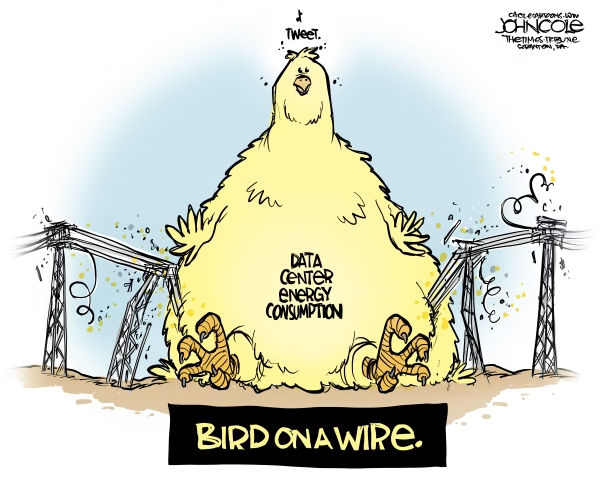
Well, today, we begin by looking at a pressing environmental issue facing communities across the United States: the vast expansion of AI data centers being built to fuel artificial intelligence. Critics warn the AI data centers are a threat to local land, energy and water resources. According to the group Food & Water Watch, a single large data center can consume as much energy as 2 million U.S. households.
Last month, Vermont’s independent Senator Bernie Sanders and Democratic Congressmember Alexandria Ocasio-Cortez introduced legislation to impose a national moratorium on new AI data center construction. The bill would halt all new construction until Congress passes federal laws to protect workers and consumers and ensure the technologies don’t harm the environment. This is Congressmember Ocasio-Cortez.
REP. ALEXANDRIA OCASIO–CORTEZ: More than 100 local communities across 12 states have already enacted local moratoriums on data centers, and Congress itself has a moral obligation to stand with them and stop Big Tech from ruining their communities. Our legislation in the House and the Senate would hit the brakes on construction of new data centers until we address several of the key areas of harm AI poses.
AMY GOODMAN: In the state of Maine, lawmakers recently approved the nation’s first statewide moratorium on large data centers, but the governor of Maine, Democrat Janet Mills, has yet to say if she’ll sign the legislation. This comes as Mills is in a tough primary race for a U.S. Senate seat against fellow Democrat, Graham Platner.
We go now to Freeport, Maine, where we’re joined by Melanie Sachs, a Democratic Maine state representative who sponsored the statewide moratorium on new data centers.
Welcome to Democracy Now! It’s great to have you with us. Can you explain what this legislation does and the significance of the Maine Legislature being the first in the country to pass a statewide moratorium? We’ll see what happens with whether the governor signs the legislation, but if she doesn’t, and doesn’t veto it, it still will go into effect.
REP. MELANIE SACHS: Correct. And good morning. Thank you so much for having me, Amy.
I put forward the bill because this same governor, our wonderful governor, Janet Mills, actually put together an AI Task Force, full of her own state agency members, as well as business members and a bipartisan set of legislators. In that report, which came out in fall of 2025, it said two things, that Maine residents are concerned about the impacts of data centers on both their electric rates and other utility rates, as well as on our wonderful environment we have here in Maine. When you think of Maine, you think of our wonderful natural resources. So, the second recommendation, not only that called out the fears of Maine residents, but also that we needed a playbook. The recommendation was we need to meet the moment and put together regulations that perhaps look at the opportunities, but certainly the impacts that these have.
And so, that’s why I brought this bill, which is going to put together a collaborative council, full of, again, state agencies, rate payer protectors, environment, tribes, municipalities, all together to say what is the regulatory framework that Maine needs to meet the moment — to meet the moment, and at the same time to putting a temporary, limited, targeted pause on the development of these data centers so that we can make sure that regulatory framework is correct.
AMY GOODMAN: Can you talk about — well, it is a Democrat-controlled Legislature, the governor is a Democrat, she’s running for Senate — whether you’ve gotten any signal about whether she will sign the bill? And what is the deadline here?
REP. MELANIE SACHS: So, she has until April 25th to either sign the legislation, veto it or let it go into law without her signature. I know she’s carefully considering it. We just finished our session here in Maine, so she had several hundred bills go to her desk. I know that this is a bill that she has said she is generally in favor of.
However, there is one project that has surfaced, as several have during the course of this legislation, that we had been told, of course, no data centers are coming to Maine. Both the AI Task Force and my committee — I chair the Energy Committee here in Maine — we’ve been told that, really, there were no data centers here in Maine, but, lo and behold, when I put the bill in, several of them surfaced, which was so interesting, that had been working in secret. One such project actually is closer to fruition than others, and that is the one that she’s concerned about.
AMY GOODMAN: So, let’s talk about the data center project in Jay, which saw the closure of several paper mills over the last years. Governor Mills and others argue the data centers boost jobs. What is your response? And though we’re talking to you in Freeport, you grew up in Jay. Your father actually worked in one of those paper mills.
REP. MELANIE SACHS: Right. I grew up in New Sharon, Maine, which is a community very close to Jay, and, yes, my dad did work at that very same mill that is slated for development with the data center. So I know the area. I know what economic development means.
One of the reasons I put in this bill, however, is because we have the evidence from all across the country of the harm that these data center projects can potentially do, limited economic opportunity with very few local jobs done. This developer has promised anywhere — it’s gone from 100 to 125 to 150 permanent jobs. Also, they’ve talked about, well, it’s going to be a lesser footprint than that of the former mill. But we actually don’t know that, because the Sentinel Data company, which is sort of a turn-and-burn colocation — they bring somebody in. We don’t know what that design looks like. And we also don’t have the permitting, the emissions, the regulatory framework around the electric load that might need to accommodate a particular project.
The last thing I will say is, it is more — these projects are more than just the locality where they are located. These projects impact the grid, electricity rates, utility rates, water usage for the entire community and sometimes statewide. So we really need to look at something like this. It’s been — it’s been offered as almost a baby data center, soothingly saying, “Look, this won’t have the same impact.” However, the projected load that we’ve been able to get out of the developer actually can be 10% of Maine’s entire load for this one data center. So we really do need to make sure that we meet the moment.
AMY GOODMAN: State Representative Sachs, how has the AI industry responded to your bill? Why are we seeing also this rapid expansion of data centers in states like yours, in Maine?
REP. MELANIE SACHS: Right. I would say that Maine, while we do have a little bit higher electricity rates than maybe other communities, we’re one of the lower in New England. We have an amazing workforce, and we have abundant natural resources with a cool climate. I understand why they might think that we are ripe for opportunity.
My concern is that this project, along like many of the other projects that surfaced during the bill, were done in complete secrecy, without community engagement. AI hasn’t actually come to talk to me, but the problem is they’re also not talking to the communities. We now have had several communities, like your lead-in piece, that have had to put their own local moratorium on data centers because they’re just concerned about the impact of these projects without notable gain for the communities. And that’s really one of the reasons that I’m so excited about this bill, is to make sure that communities have the opportunity to engage and that the framework is correct.
AMY GOODMAN: We’re talking about what? Almost half a dozen other states are looking at the kind of regulation you proposed and the Legislature passed. And can you talk about who specifically — can you name names? — are the AI lobby, and how they strategized to, how they tried to defeat this bill in Maine?
REP. MELANIE SACHS: Right. So, we did — we do have several lobby firms that have tried to actually write amendments to the bill or have tried to offer other reports on the bill when it came out of committee. I’m not paid by a lobbyist. I don’t read their speeches on the floor, and I don’t think that that’s in the best interest of Maine to just cede our policy to lobbyists. I think that we need to make sure that we are writing the policy that is good for Maine, and not include them on, say, this council or to have that sort of orientation towards our communities and our natural resources. I write my own bills.
I worked very closely, actually, with the administration to write the initial bill, because I think this is important for Maine to be able to take charge and say this is how we protect rate payers, this is how we protect our natural environment, and this is how we look out for our communities. And that is really the important part about this bill. It is not a permanent pause or ban. It is a temporary ban to make sure that we have the work of the council and then the time to put those regulations in place to protect Maine.
AMY GOODMAN: Melanie Sachs, Democratic Maine state representative from Freeport, sponsored the statewide moratorium on new data centers, the first in the nation to be passed by a legislature. Now the governor has until April 25th to sign it, veto it or just let it become law.
Coming up, we go to Memphis, Tennessee, where the NAACP is suing Elon Musk and xAI for pollution from its data center power plants. We’ll speak to Memphis organizer KeShaun Pearson.
[break]
AMY GOODMAN: “The Taker Story” by Chicano Batman.
The original content of this program is licensed under a Creative Commons Attribution-Noncommercial-No Derivative Works 3.0 United States License. Please attribute legal copies of this work to democracynow.org. Some of the work(s) that this program incorporates, however, may be separately licensed. For further information or additional permissions, contact us.